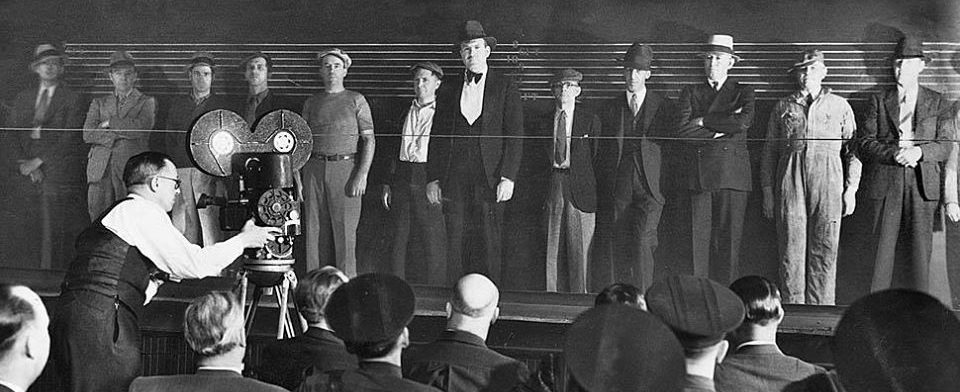

The United Service Organizations (USO), a non-governmental nonprofit, was founded on February 4, 1941 by Mary Ingraham, acting on President Franklin Roosevelt’s request to boost defense morale. Although the US had not yet entered World War II, war clouds were gathering, and a peacetime draft had been enacted in September 1940.

Pomona Progress-Bulletin 3/3/1941.
Succeeding the United National Welfare Committee, the USO represented the YMCA, YWCA, the National Catholic Community Service, the Jewish Welfare Board and the Salvation Army.
On January 11, 1942, the USO had an open house for its new Los Angeles club at 514 S. Grand Avenue. That day, Dr. A. H. Giannini, Chair of the Los Angeles Area board of the USO, announced that a Hollywood branch of the USO would open soon at Hollywood Boulevard and Cahuenga Avenue, on the second floor of a retail and office building (today known as the Julian Medical Building). The space was donated by the building’s owner, C.B. Bunson. A few days later, Giannini revealed that film producer/songwriter Buddy De Sylva had donated $2500 to the USO, a portion of which would go toward renovating the new Hollywood home.

The Hollywood USO originally opened in this building. USC digital photo.
The Hollywood USO held a gala to dedicate the new club on February 2, 1942, with klieg lights sweeping the sky and the street roped off so the Jeeps and Army trucks bringing servicemen to the event would have places to park (always a consideration in Hollywood). Mayor Bowron was in attendance, along with Hollywood actors Edward G. Robinson (the guest of honor), Jinx Falkenberg, Larraine Day, Donna Reed, Virginia O’Brien, Barbara Britton, and Marie McDonald. Newlyweds Ann Sheridan and George Brent also dropped by.
LA Times 2/3/1942.
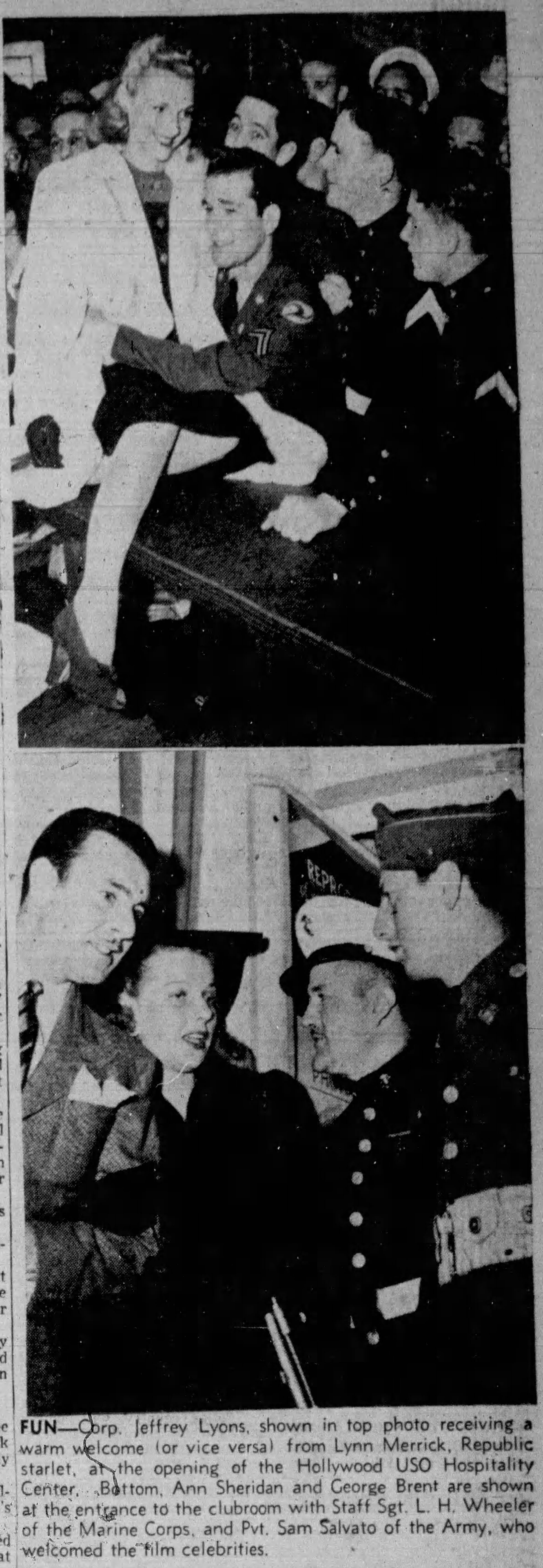
Dedication party for the Hollywood USO. Hollywood Citizen News 2/3/1942.
The Hollywood USO opened for regular service the following day, February 3, 1942. Accessed from the Cahuenga side of the building, its address was 1654 N. Cahuenga. The club featured a writing room, ping pong tables, a library, and a canteen that served free coffee, sandwiches, donuts, punch, candy and cigarettes. Volunteer hostesses provided companionship and entertainment. On Saturday nights, there was a broadcast, over CBS radio, MC’d by Art Linkletter, during which one lucky serviceman would be chosen to call his mother. Local businesses donated tickets to sporting matches, radio broadcasts, theaters, ice skating, bowling, Hollywood Bowl concerts, etc. Although it had no dormitory, the Hollywood USO could help find overnight accommodations at local hotels or other facilities.

Hero bomber Captain Hewitt T. Wheeler being served donuts and coffee by USO hostess, actress Ann Nagel in May 1942. LAPL photo.
On February 15, 1942, the Beverly Hills USO opened a few miles away. Headquartered at the famous pink hotel on Sunset Boulevard, guests of the USO could use the pool, tennis and badminton courts. Motor transport service was provided to pick up guests of the Hollywood and other area USO clubs and take them to use the recreation facilities.
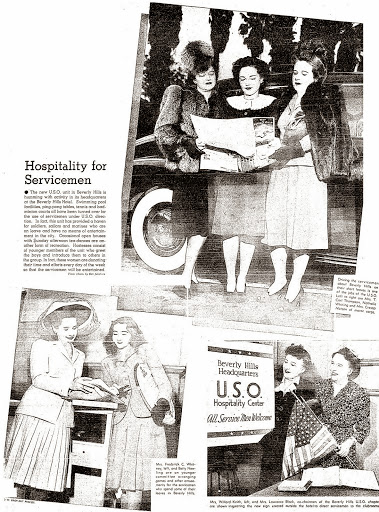
Beverly Hills USO. LA Times 3/1/1942.

The Beverly Hills Hotel pool c. 1935. Huntington Library photo.
In June 1943, the Hollywood USO moved to new, larger quarters a few doors south of its original home. Located in a former car dealership at 1531 N. Cahuenga, the new Hollywood USO had three times the space, with a stage, large dance floor, a recording booth (for broadcasts and where service personnel could record messages on records, to be mailed home to loved ones), a library, dressing and shower rooms, offices, and of course a canteen.

Hollywood Citizen News 6/5/1943.

The Hollywood USO at 1531. N. Cahuenga. California State Library photo.
The brick walls of the new quarters were decorated with murals, depicting Hollywood life, painted by Art Institute student Tessie Smith in July 1943.

Although some syndicated Hollywood gossip columnists attributed the USO murals to artist Richard Whorf, they were actually the work of an art student, Tessie Smith. Hollywood Citizen News 7/15/1943.

Tessie Smith putting the finishing touches on her murals for the Hollywood USO’s new home. Hollywood Citizen News 7/16/1943.
On November 26, 1944, the Hollywood USO debuted what was termed the first ever “Pin Up Exhibition” featuring images of Jane Russel, Toni Seven and (Liltin’) Martha Tilton. The three appeared in person, signing autographed photos for servicemen, on the closing day of the event, December 2, 1944.

LA Times 11/27/1944.

Jane Russell, Toni Seven and Martha Tilton signing autographs during the “pinup exhibition” at the Hollywood USO’s canteen on December 2, 1944. This photo is sometimes mistakenly labeled as taking place at the Hollywood Canteen, which was a separate venue, located nearby at 1451 N. Cahuenga. LAPL photo.
On July 1, 1944, a group of Hollywood artists began a cartoon-mural map of Hollywood for the Hollywood USO. Valued at over $5000, the work was unveiled at a ceremony on January 27, 1945, hosted by Bing Crosby, Frances Langford and Joe E. Brown. The occasion also marked the United Service Organizations’ national fourth anniversary.

Long Beach Independent 1/24/1945.
Unlike the earlier murals by Tessie Smith, this mural was removable; after the war, it was anticipated that it would be moved to a military hospital.

Karen Johnson, one of the artists who worked on the new Hollywood cartoon-map mural for the Hollywood USO. LA Times 1/22/1945.

The cartoon Hollywood map-mural inside the Hollywood USO at 1531 N. Cahuenga seen in Life Magazine, 2/12/1945.
On May 8, 1945, Germany unconditionally surrendered, ending the hostilities in Europe. President Truman announced Japan’s unconditional surrender on August 14, 1945, marking the end of the war. With the many military bases in the area and Los Angeles a port of disembarkation for troops returning from the Pacific Theater, however, demand for the Hollywood USO’s services remained high.
The nearby Hollywood Canteen closed its doors on November 22, 1945 (Thanksgiving Day). The following day, the Hollywood USO held a dedication celebration for its new wing, which included a 400-bed dorm, a new stage and enlarged dance floor, administrative offices, a ladies powder room, a writing room, and a canteen capable of serving 1000 patrons an hour.
The Hollywood USO at 1531 N. Cahuenga finally closed its doors on June 30. 1947.

7/1/1947 LA Times.
With the Korean War underway, a new Hollywood USO opened on February 17, 1951 at 1710 N. Ivar. Mayor Bowron again attended the dedication, which featured appearances by Bob Hope and Marilyn Maxwell.
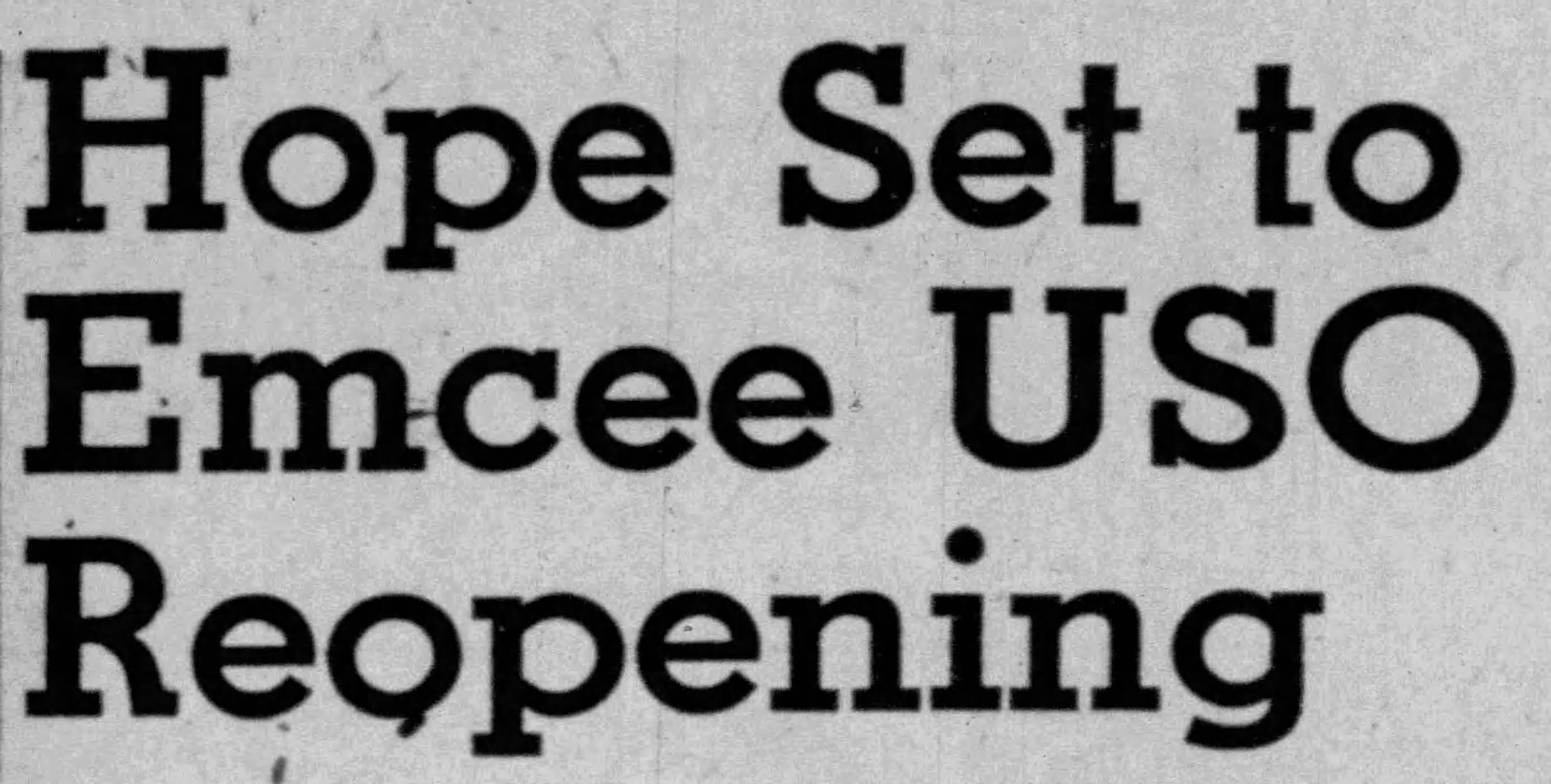
Hollywood Citizen News 2/16/1951.
This was a small facility; dances had to be held in other venues, including the former Florentine Gardens nightclub, which had been purchased by the Hollywood Canteen Foundation. It closed in June 1952. A new, larger Hollywood USO opened at 6225 Hollywood Boulevard and Argyle (the Pantages Theater building) with a 3-day gala (Mayor Bowron was there) November 7, 8, and 9 1952. It later provided YWCA amenities for service women as well.
In increasingly high demand, the Hollywood USO club remained at this location, until September 1964. On September 11, 1964, it opened in “temporary” quarters at 6160 Hollywood Boulevard, formerly the restaurant space in the former Regent Hotel (at this time known as the Hotel Hastings).

Hollywood Citizen News 9/10/1964
In November 1965, Bob Hope offered to donate his royalties from “Bob Hope on the Road to Viet Nam,” a recording made of his Christmas tour to Southeast Asia, to the Los Angeles and Hollywood USO clubs. The Chamber of Commerce, spurred into action, voted to back the effort to provide adequate space for the club. Though the various civic groups raised funds and discussed plans to build a new home for the Hollywood USO, the club remained in the “temporary” home until May 1973 when it purchased the former California Gas Co. building at 1641 N. Ivar Street. (6160 Hollywood became Greektown restaurant). Dedicated on June 14, 1973, the new facility was called the Bob Hope USO Club aka the Bob Hope Hollywood USO Club.

Bob Hope offered to donate the royalties from this album, released in 1965, to the Los Angeles and Hollywood USO clubs.

Plans for a newly-built modern Hollywood USO never materialized. Hollywood Citizen News 12/16/1965.
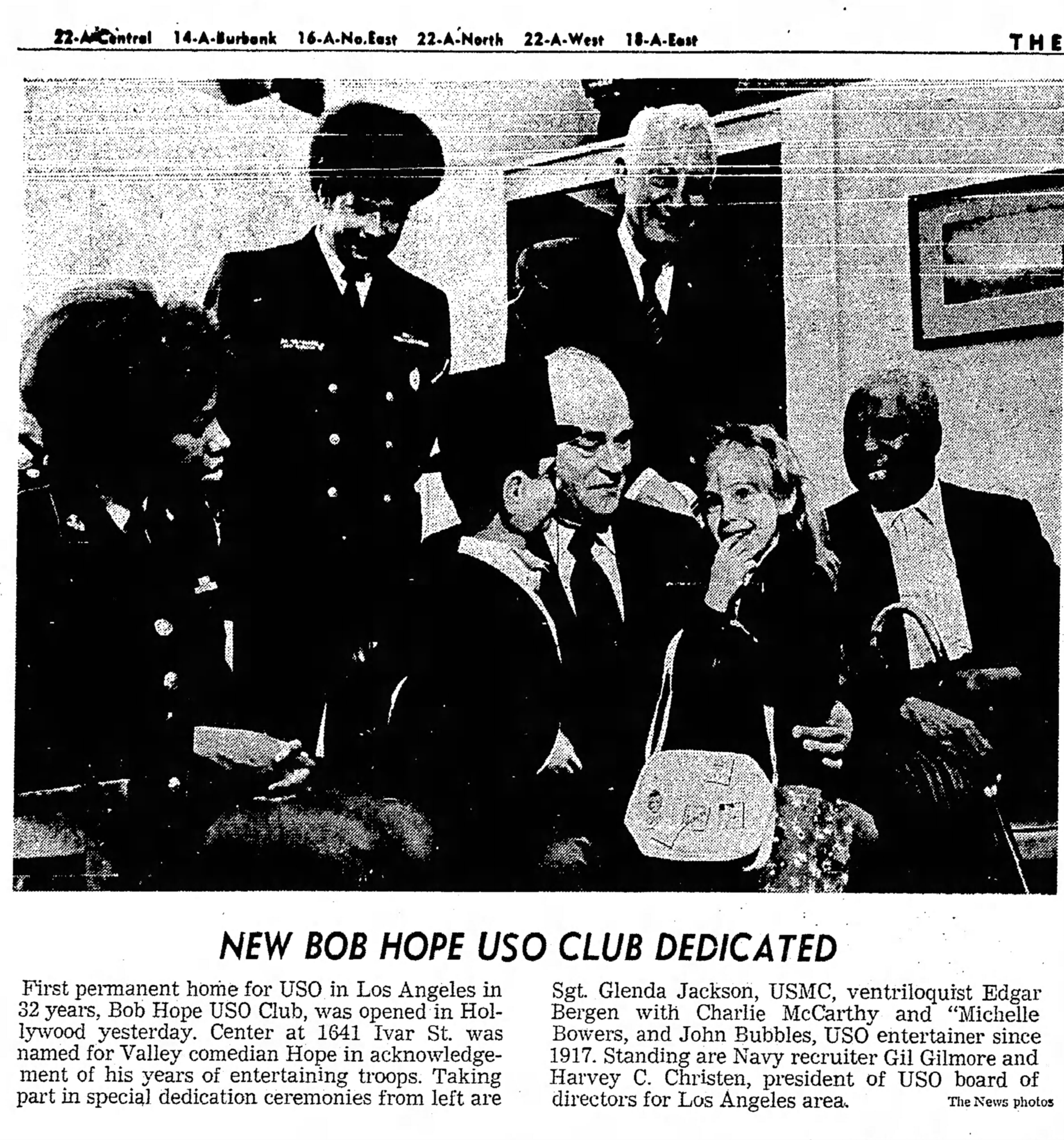
The new Hollywood USO was known as the Bob Hope USO Club. Van Nuys News 6/15/1973.
In September 1988, the Bob Hope Hollywood USO announced that it would move to Long Beach in December; it remained on Ivar, however, into 1990. The Long Beach Bob Hope USO Club opened at 230 Pine Street (Masonic Temple Building) on October 22, 1990. The Ivar location continued to be used for a time by the Hollywood USO Mobile Shows program.
In 2018, the Bob Hope USO Club opened new, larger facilities in the historic LAX Theme Building. The amenities include a “Hollywood Canteen” snack bar.
 J. H. Graham
One thought on “The Hollywood USO”
Comments are closed.