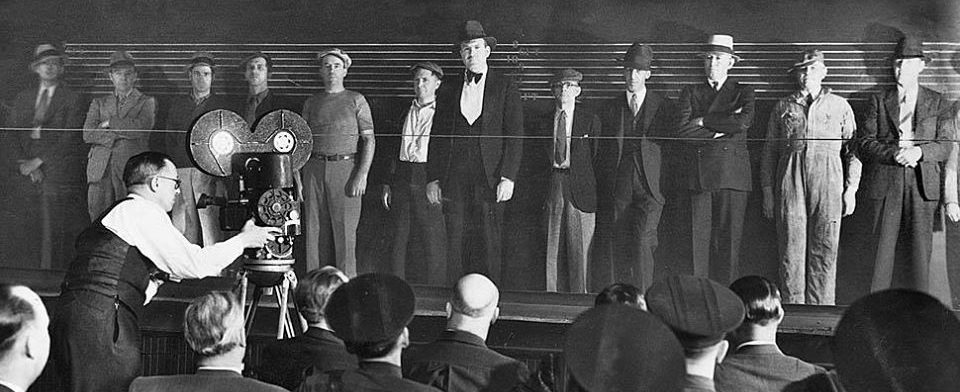
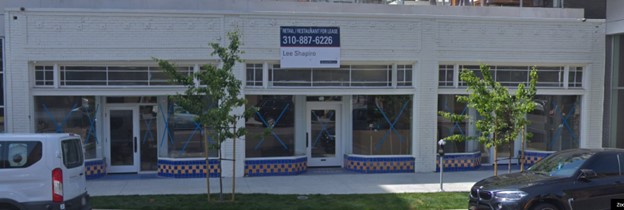
This modest, 1-story retail structure, originally 5524-5526 and 5528 Hollywood Boulevard was designed in 1920 by society architect Frank F. Rasche for Bertram Y. Taft, who, with his brothers Alfred Z. Taft, Jr., Harold O. and Chester, operated the Taft Realty Company. Typical of the low-rise development along Hollywood Boulevard at this time, before the brothers built the famous Taft Building (6280 Hollywood) on the corner of Hollywood and Vine in 1923, this building was sometimes referred to as the “Taft Building.”
The three retail spaces were originally leased by a phonograph company (5524), a cafe (5526) and a furniture store (5528). It is most well-known today, and the reason it was not demolished, for its association with the Falcon Studio school of fencing and dance from 1943 until the death of its co-founder Ralph B. Faulkner, in 1987.

Although his design was not selected, Rasche also made plans for the Hollywood YMCA in 1920. LA Times 1/25/1920

C.W. Worth’s Worth’s Cafe was the original tenant of 5526 Hollywood Boulevard. Hollywood Citizen 6/4/1920

Sturgis Fonograph Shop was the first tenant of 5524 Hollywood Citizen 6/4/1920.

Hollywood Citizen 5/7/1920
Sturgis Fonographs opened at 5524 on May 22, 1920. Worth’s Cafe opened at 5526 on June 5, 1920. Klett & Noble’s furniture store opened in May 1920. None of them stayed very long, which was also typical of retail development in Hollywood at the time. (Klett & Nobel became Klett Brothers and moved a few doors to the west to another new building at 5540 a few months later). The building was damaged by fire in September 1923, thought to have originated in the cafe that succeed Worth’s at 5526.
Crime at this section of town did not begin in the 1960s. The Worth Cafe was held up by a gang of armed robbers, believed responsible for a number of other local hold-ups, in April 1921.

LA Evening Express 4/2/1921
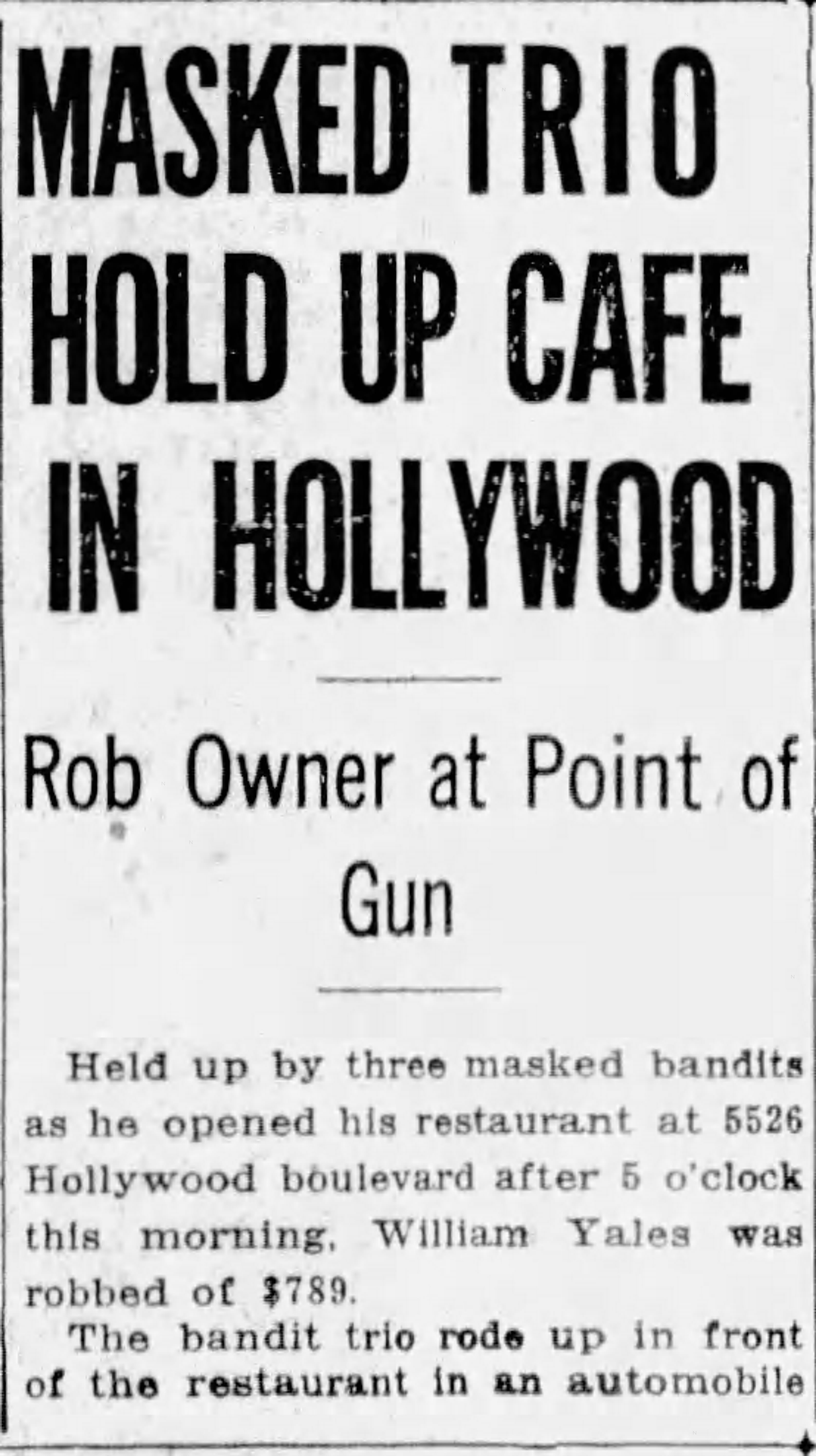
The cafe that succeeded Worth’s, run by William Yalen (not Yales) was also held up – this time by mobile bandits. LA Evening Express 8/11/1923

The Taft Buildng in this case refers to B Y Taft, not the height-limit building being constructed by his brother, A Z Taft. Hollywood Daily Citizen 9/21/1923
5526 housed Kempler & Son’s from circa 1930 to 1940- they sold radios and later appliances.
In May 1943, Falcon Studios announced that it was moving to 5526 from its present home, 5610 Hollywood Boulevard, so that 5510 could be used for defense plant purposes. They made the move by June, although the remodeling of 5526 was not yet completed.
Falcon Studios originated as the Edith Jane School of Dance, founded by Edith Jane Plate in March 1929. The school’s first home was 1759 N. Highland Avenue.

Edith Jane Plate. Hollywood Daily Citizen 3/2/1929
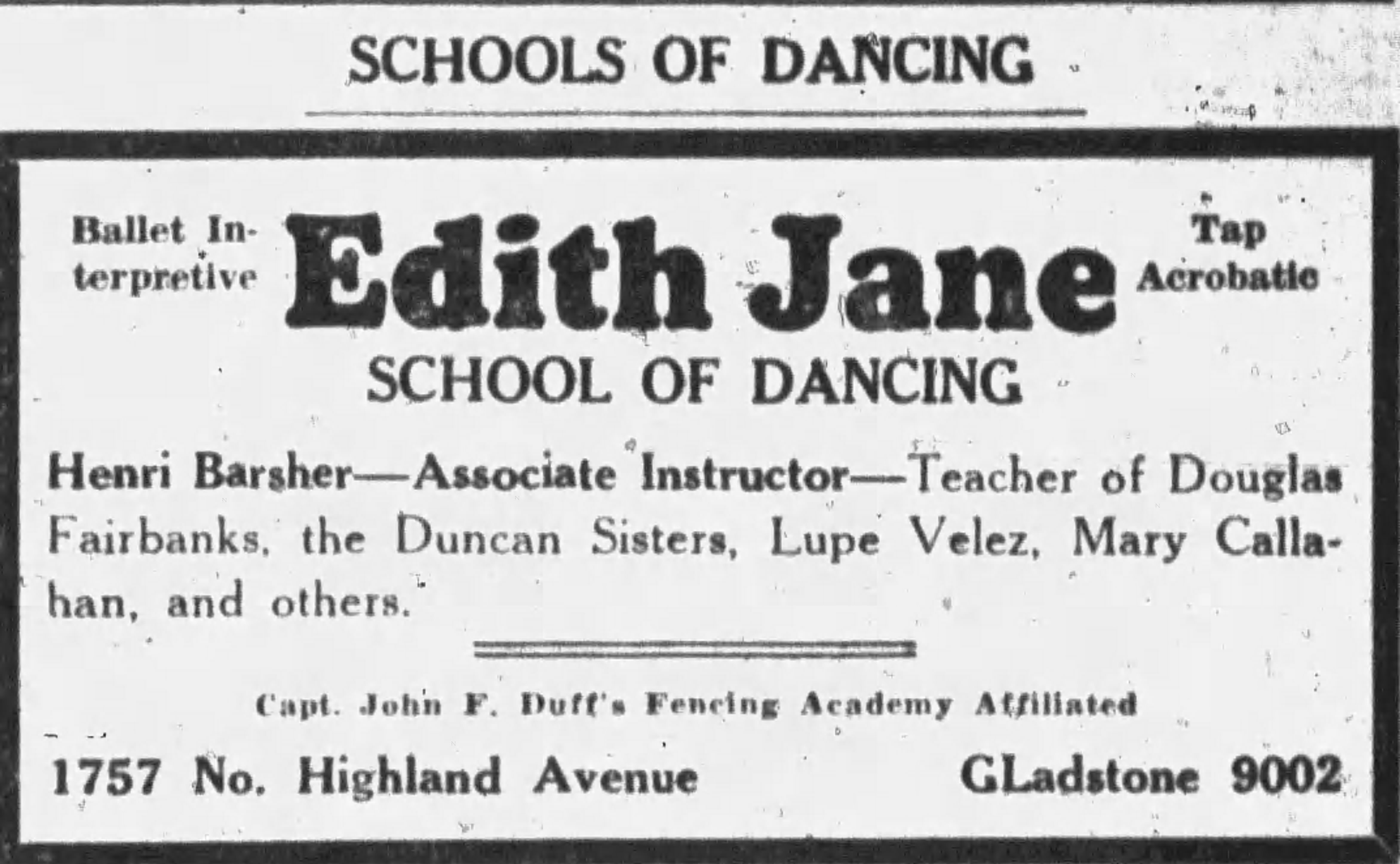
Hollywood Daily Citizen 3/2/1920
Edith Jane Plate came to Hollywood from New York, where she had graduated from the National Academy of Design, the Vestoff-Serova Russian Ballet School, and Ned Wayburn’s School of Modern Stage Dancing. She had also coached with Ruth St. Denis. Plate had appeared on Broadway in several George M. Cohen productions, including “The Royal Vagabond.” Since coming to Hollywood, about 1924, she had been an instructor and producer with the Walter Wills School, at 7617 Hollywood Boulevard.
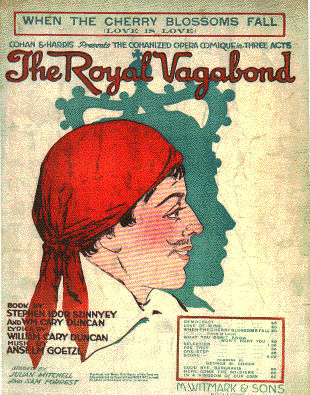
Sheet music from George M. Cohen’s “The Royal Vagabond.”

Hollywood Daily Citizen 3/2/1929
The Edith Jane School’s regular instructor was Henri Barshow, instructor of swashbuckler Douglas Fairbanks, Sr. For fencing instruction, the school was affiliated with Captain John F. Duff’s Fencing Academy. In April 1929, the school invited Japanese dancer Michio Ito as a guest instructor. Ralph B. Faulkner, then the reining West Coast sabre champion and a participant in the 1928 Summer Olympics, met Ito at the studio and the two ultimately put on a recital at the Figueroa Playhouse, sponsored by Edith Jane School, to demonstrate “occidental and oriental” styles of fencing. In June 1922, Faulkner appeared with Edith Jane at the school’s Spring recital, held at the Windsor Square Theater.
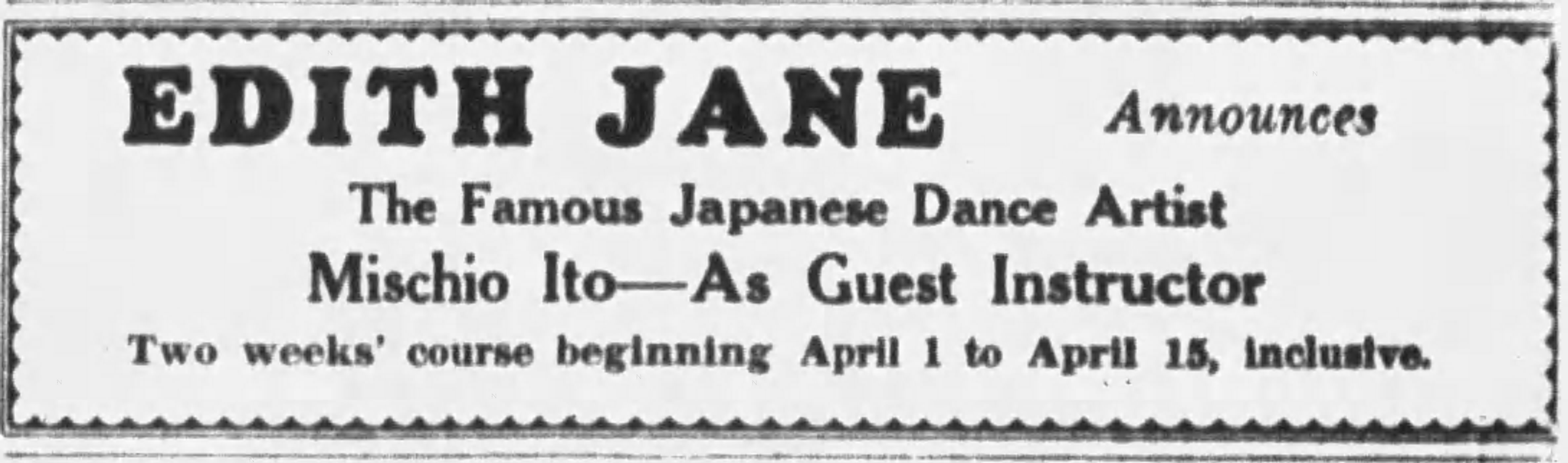
Hollywood Daily Citizen 3/23/1929
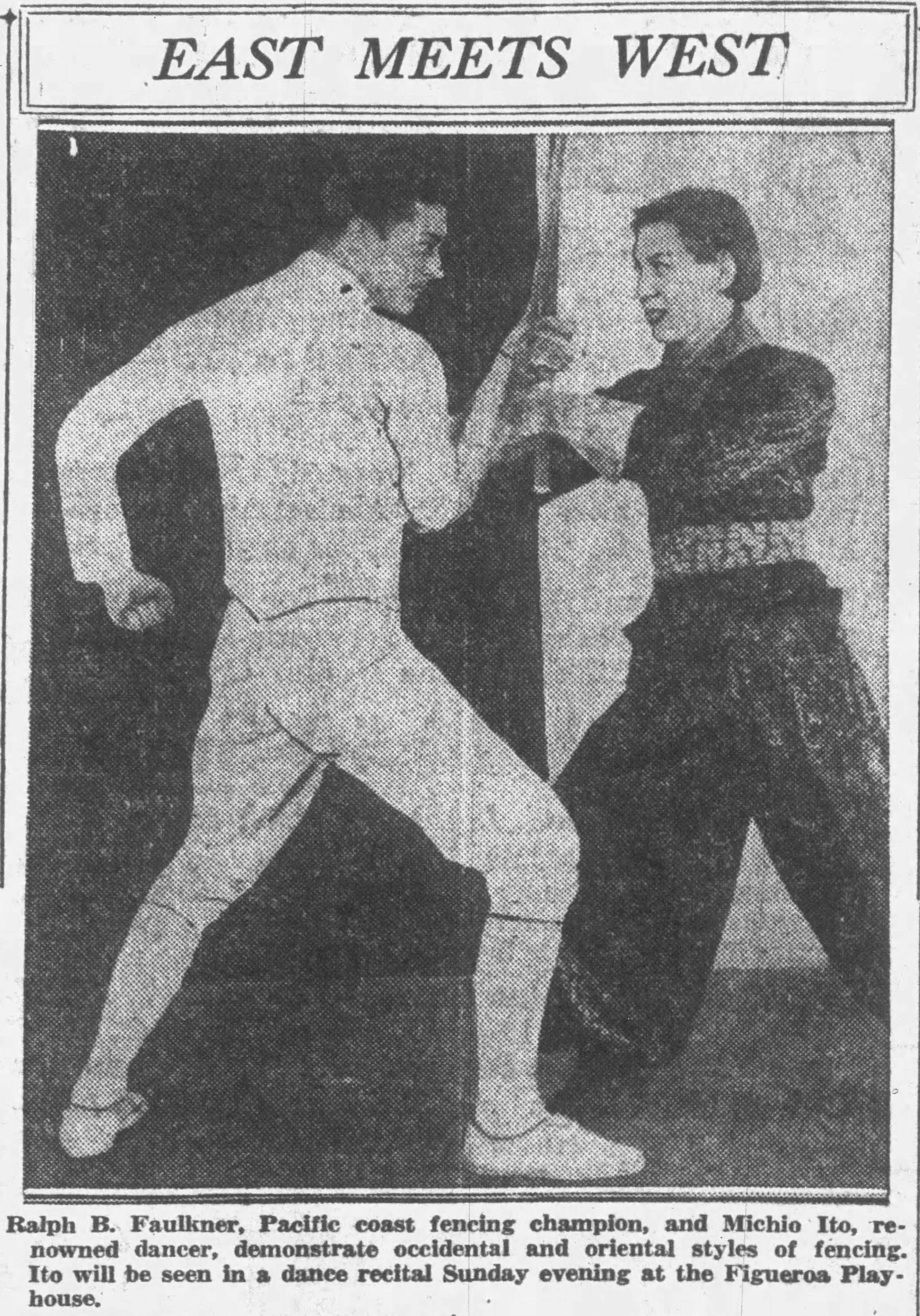
Ralph B. Faulkner and Michio Ito. The LA Record 4/26/1929

Hollywood Daily Citizen 6/22/1929
In April 1932, both Faulkner and Plate qualified to be on the US sabre team in the 1932 Summer Olympics, to be held in Los Angeles. Plate won the women’s foil championship in the Pacific Coast Fencing Tournament.
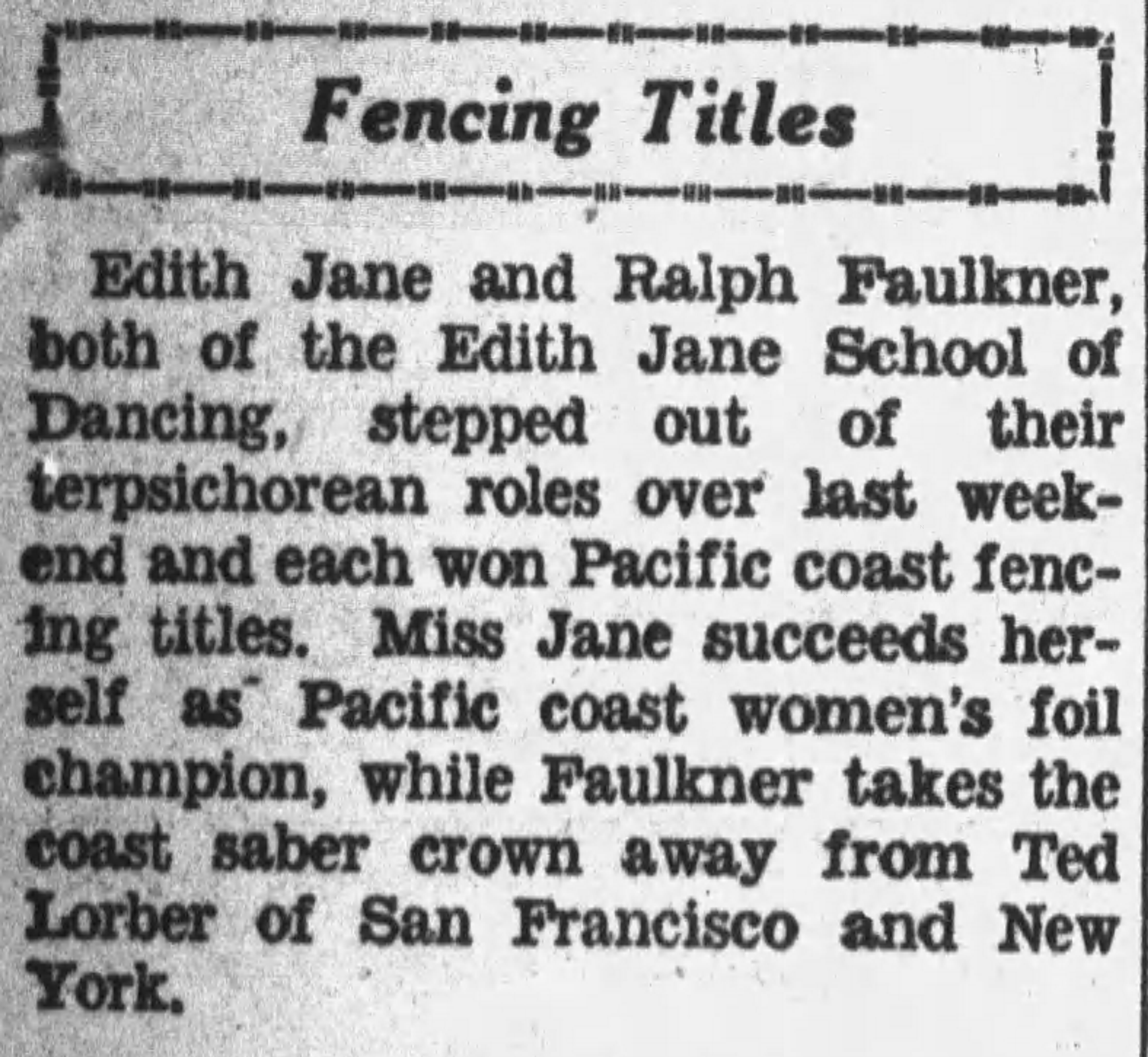
LA Illustrated Daily news 4/23/1932
Faulkner and Plate were married in late 1936. By November 1936, Faulkner had organized his own school of fencing, the Faulkner Fencing Academy, aka the Faulkner School of Fencing. By January 1937, it was officially affiliated with the Edith Jane School. In April of that year, the Edith Jane School, which was still at 1759 N. Highland Avenue, announced that it had leased an entire building at 5610 Hollywood Boulevard. That building will have its own post.

Ralph Faulkner as an instructor at Edith Jane School. Hollywood Citizen News 8/22/1936
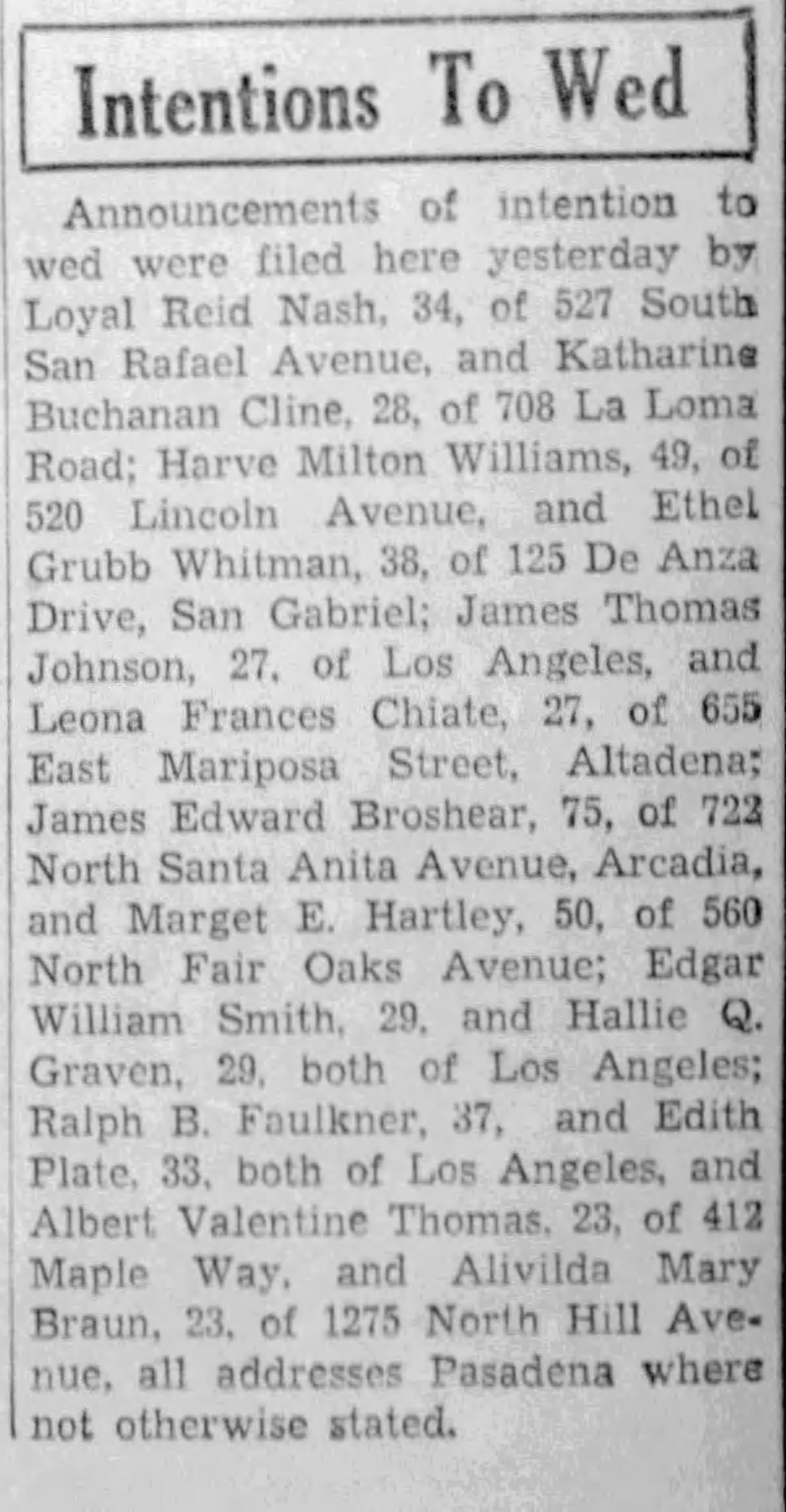
Pasadena Post 9/30/1936
Faulkner, who had appeared in minor roles in silent films, was hired by David Selznick to instruct Ronald Colman on swordplay for his production of “The Prisoner of Zelda” (1937). He also appeared onscreen in the film (uncredited).
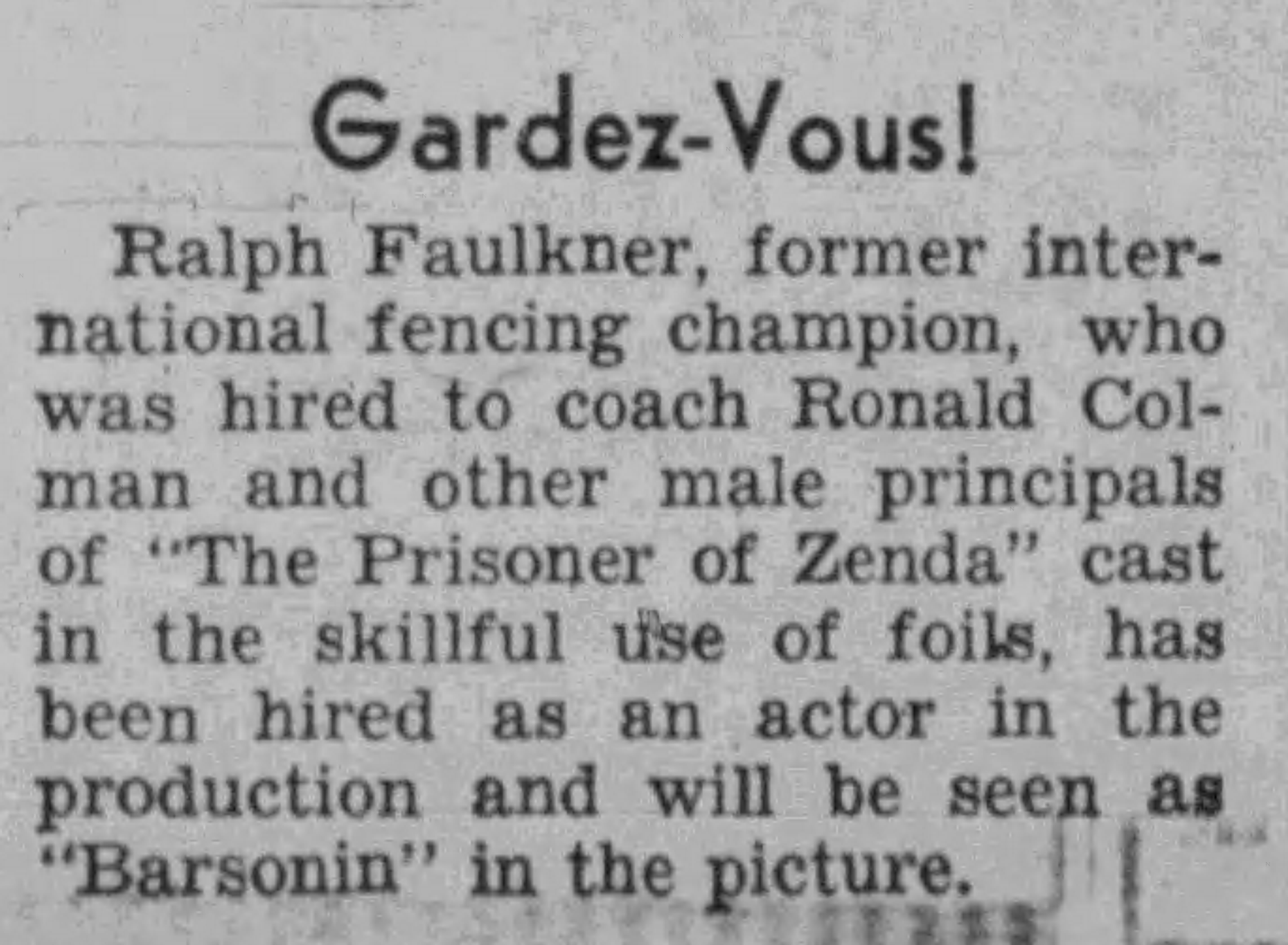
LA Daily News 5/29/1937

Hollywood Citizen News 2/6/1937

Hollywood Citizen News 4/17/1937

The Edith Jane School moved to 5610 Hollywood Boulevard in April 1937. Hollywood Citizen News 4/10/1937.
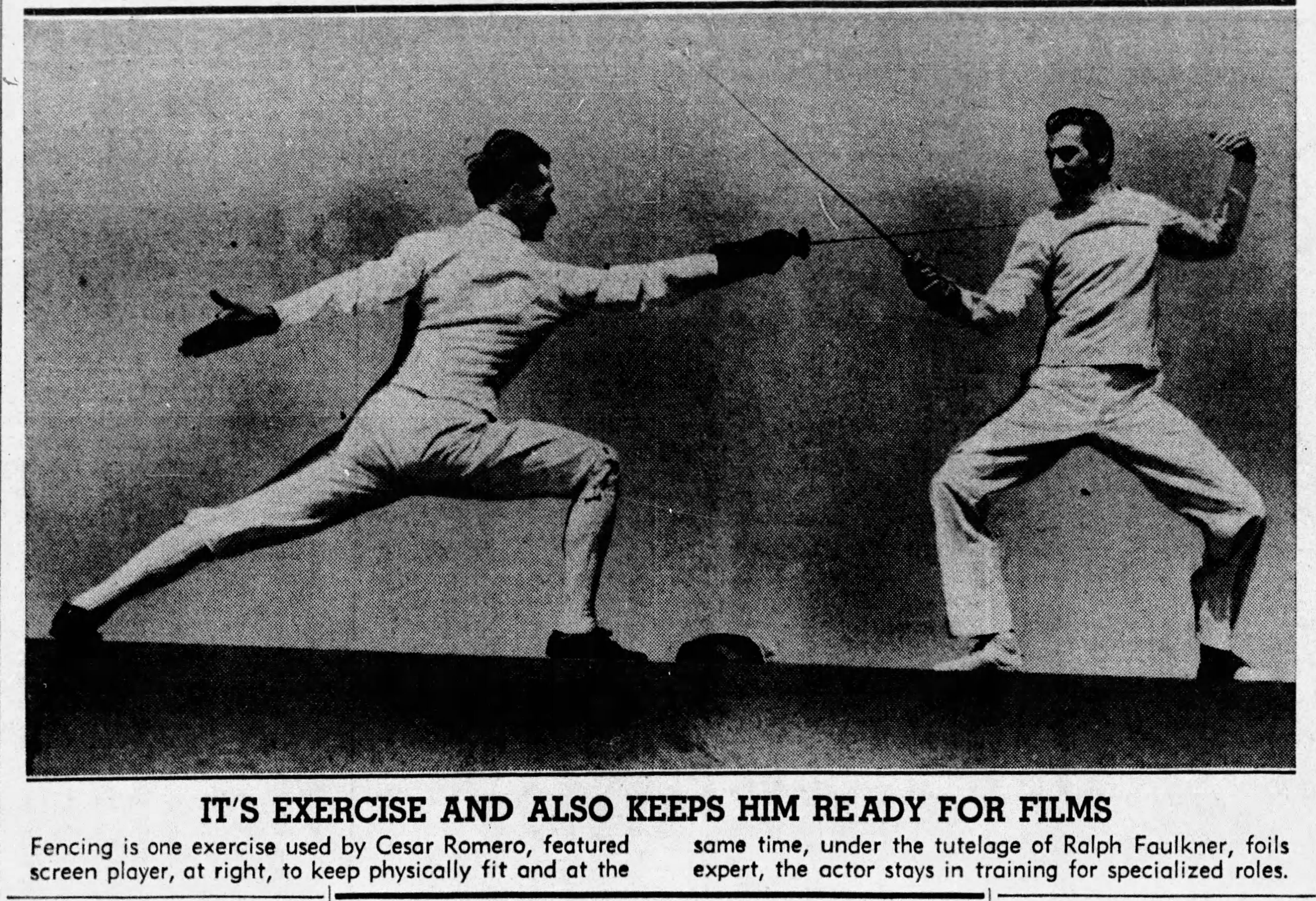
Increasingly known as fencing instructor to the stars since “Prisoner of Zelda,” Faulkner os seen here with Casar Romero. LA Times 7/11/1937.
In August 1937, the Edith Jane School and the Faulkner School of Fencing announced that it would now be known as “the Falcon School.”

Faulkner with a student. Hollywood Citizen News 8/28/1937

LA Times 8/29/1937.

In January 1938, the Falcon School added radio classes to its curriculum. Student made regular broadcasts over local radio. Hollywood Citizen News 1/22/1938
By December 1942, the school was known as the Falcon Studios.

Hollywood Citizen News 12/26/1942
In June 1943, the Falcon Studios made the move to 5526 Hollywood Boulevard, The new quarters featured a large outdoor stage and theater, covered by a canopy, as well as a garden, a “Victory Garden” or World War II.. Famous students would press their handprints and autographs, into the cement of the walkways, a’ ‘la Grauman’s Chinese Theater.

Hollywood Citizen News 5/8/1943
Falcon School carried on at 5526 Hollywood Boulevard through the war years, into the 1950s, the 1960s, and the 1970s. Edith Jane Plate Faulkner died in July 1975. Ralph Faulkner carried on with fencing instruction until shortly before he passed away in January 1987.
Polly August, a former student who had helped run the business, inherited the building and studio from Faulkner. She sold it in July 1987. The new owners, Paul and Tep Tan, proposed demolishing the building, which was designated a city landmark in July 1988. Through the efforts of Hollywood television writer Jonathan Polansky and celebrity former students such as Alexis Smith and MacDonald Carey, the structure was saved.
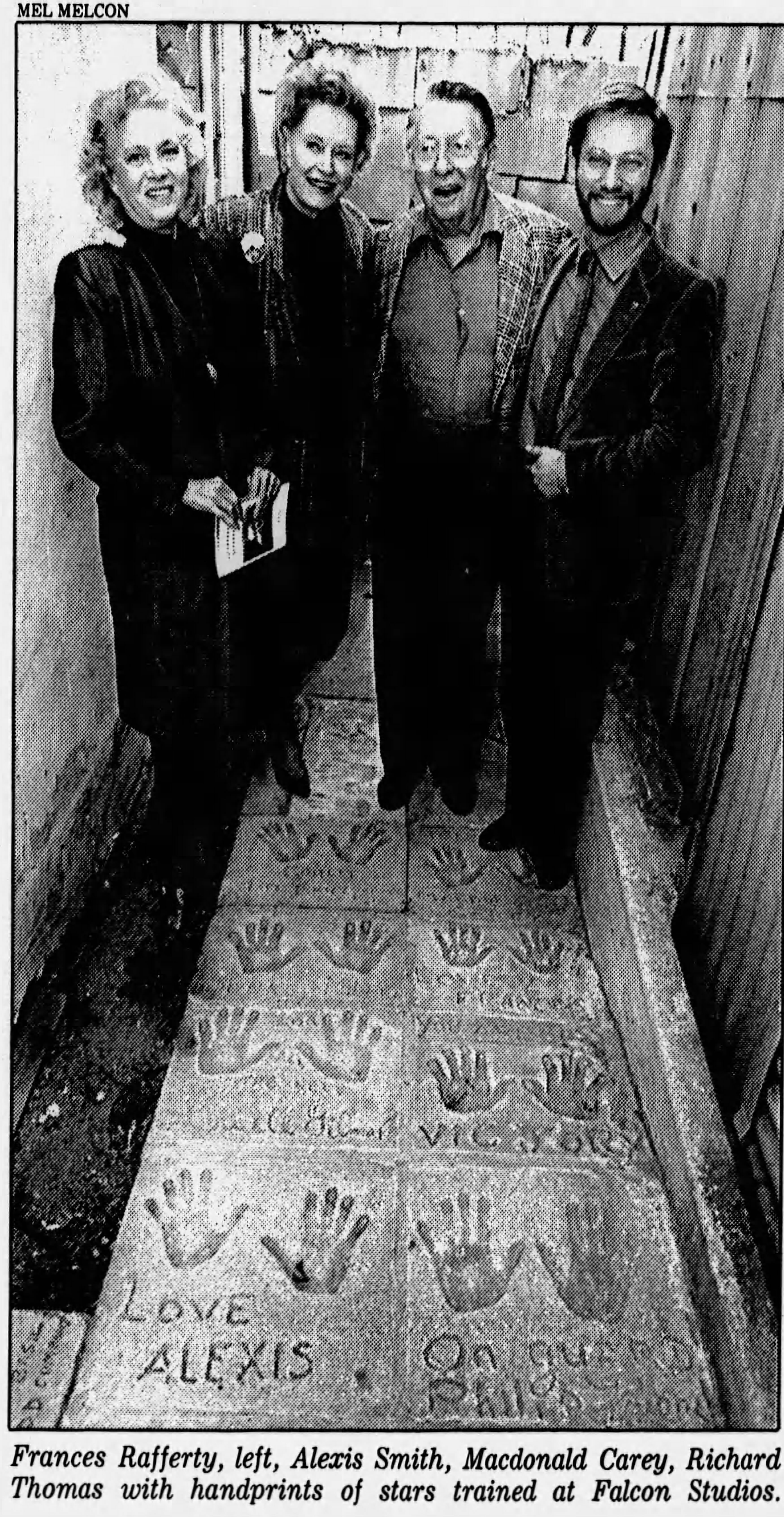
LA Times 3/9/1988
Today, thanks to them, the building is extant, although dwarfed by the apartment towers built around it in 2016.
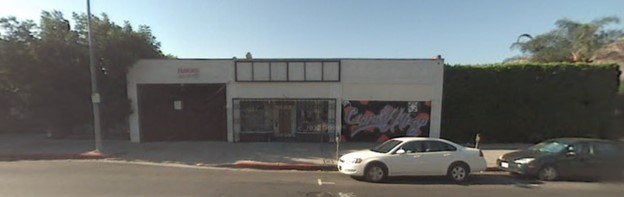
5526 in 2007. Google map image.

5526 now. Google map image.
 J. H. Graham
4 thoughts on “5526 Hollywood Boulevard: Falcon Studios”
Comments are closed.