
Located on the south side of Hollywood Boulevard facing Gramercy Place, 5620 Hollywood Boulevard could almost be a mini-Los Angeles City Hall. John Parkinson, who designed the building along with Donald Parkinson, had been one of the architects for the City Hall, which had opened less than two years earlier. In addition to the eye-catching 80-foot tower, the 2-story building had 3550 square feet for the bank’s needs and 4 retail shop spaces.
California Bank announced that it was constructing a new Hollywood branch in January 1930, having purchased the land from real estate investors Rodolfo and Consuelo Montes. 1930 was not a great year to be a bank. The Stock Market Crash in October 1929 had resulted in a run on banks and many had failed. Before federally-insures deposits, when a depositor’s money was gone, it was gone. In 1930, banks had to look solid, like they would still be around the next year and the year after that, to convince customers to trust them with their money rather than hiding it under their mattresses.

LA Evening Express 1/11/1930
California Bank had started in 1904 as the Co-operative Savings Bank. It changed its name the following year to California Savings Bank. In 1915 it was renamed California Savings & Commercial Bank.
In February 1918, California Savings & Commercial Bank opened its first Hollywood Branch, on the southeast corner of Hollywood Boulevard at Western Avenue.

Hollywood Citizen 3/1/1918
California Savings & Commercial Bank was acquired by Hibernian Savings Bank in 1919 and Hibernian took over all of its branches. The same year, Hibernian merged with Home Savings Bank. In November 1920, it became “California Bank.”
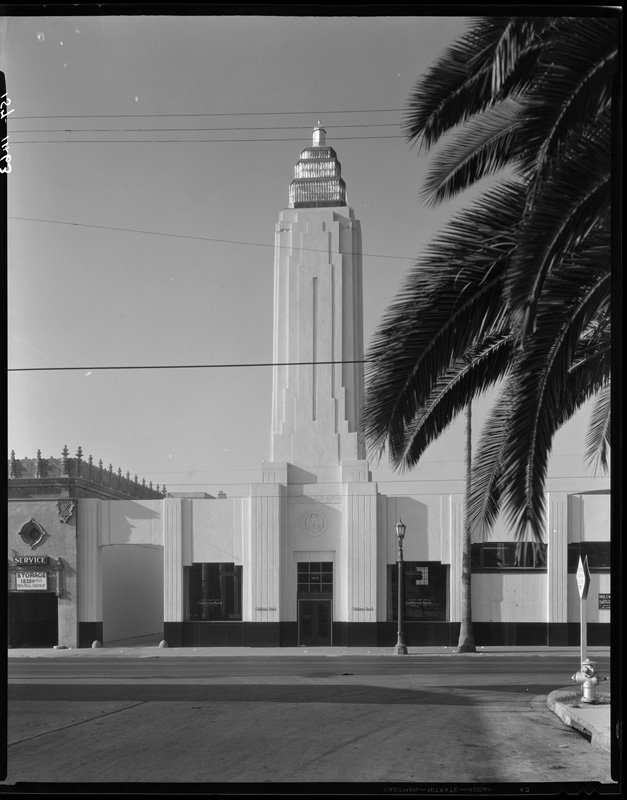
1930. California State Library photo.
California Bank’s new Hollywood-Gramercy Branch opened to the public on June 30, 1930. It replaced the Hollywood and Western branch.

Entrance detail, 1930. California State Library photo.

Hollywood Daily Citizen 6/27/1930
Just a little over a year later, in August 1931, the bank would open its main Hollywood branch in the new Equitable Building at Hollywood and Vine. There would also be a West Hollywood branch at 7550 Sunset Boulevard.
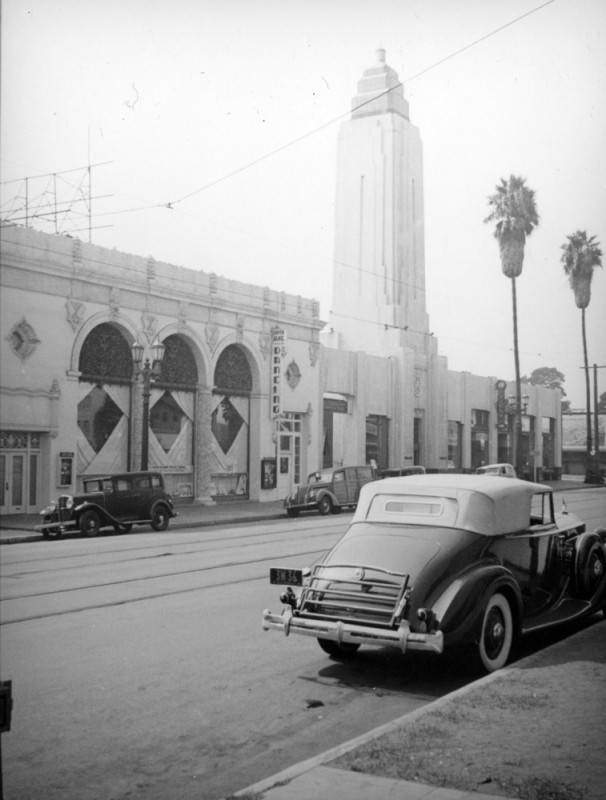
The California Bank Building in 1937. Next door at 5610 Hollywood Blvd. is the Edith Jane School of Dancing. Herman J. Schultheis photo, LAPL.
In June 1945, due to consolidation, the Hollywood Gramercy branch became surplus and the bank put the building up for sale.

Hollywood Citizen News 6/8/1945
It housed a radio training school for the remainder of the 1940s. In 1950 it became the Coast Visual Training Company, which lasted into 1968. It went on to have other uses.
The building was damaged in the January 1994 Northridge Earthquake but was repaired and is extant today.
 J. H. Graham