
The Brokaw home at 5947 Hollywood Boulevard. LAPL photo.
The 2-story ranch home of John B. and Ida H. Brokaw, set amid lemon orchards, was located on 10 acres on the north side of Hollywood Boulevard (then Prospect Avenue) between Bronson and Gower extending north almost to Franklin. The residence was originally 539 E. Prospect Avenue; as of 1913 it was 5947 Hollywood Boulevard.
Brokaw, a buggy maker from Ohio, came to California on a visit in the 1880s and bought up 30 acres in the heart of Hollywood. He returned in 1892 and bout a 2-1/2 acre tract that he had planted with lemons; in 1894 he purchased the 10-acre tract that became the ranch home. Near the home, the Brokaws planted cypress and cedars and more exotic specimen trees and shrubs. The couple didn’t reside in Hollywood permanently, however, until after 1900; the 1900 US Census shows them still living in Ohio.
By 1901 Brokaw had decided to sell off his orchard property, other than the home ranch, in 1- to 3-acre tracts, through agent Alex Culver. The next year he would also sell tracts in Brokaw Tract #2, across the street from the family ranch on the south side of Hollywood Boulevard.

Ad for the first Brokaw Tract, along Hollywood Boulevard between Bronson and Gower, not including the family ranch parcel. LAT 11/17/1901.
The Brokaws did NOT move from the family ranch, however. In the 1910 US Census, they are at 539 E. Prospect, where John lists his profession as “rancher.”
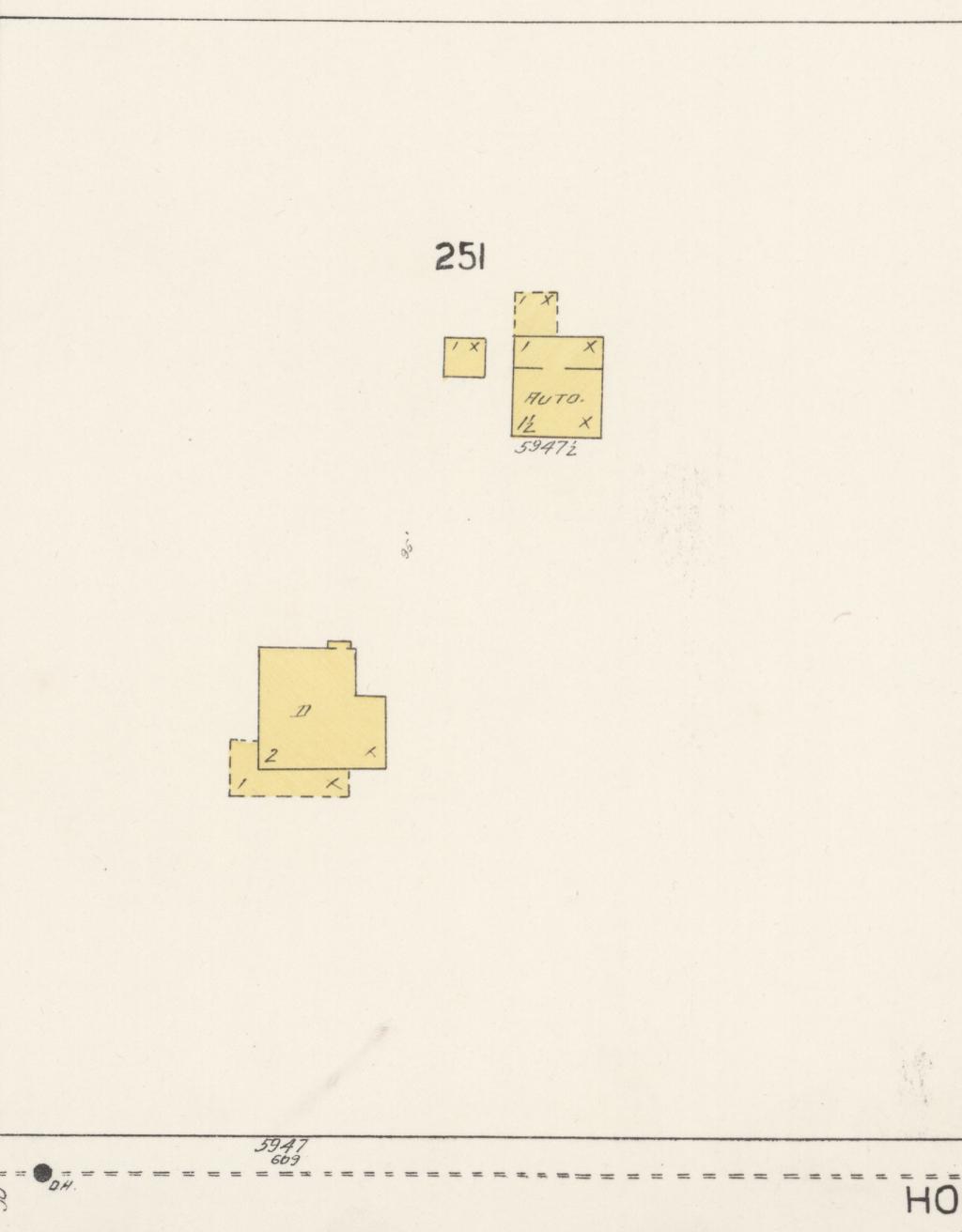
Detail of the 1913 Sanborn Fire Insurance Company map showing the Brokaw home at 5947 Hollywood Boulevard.
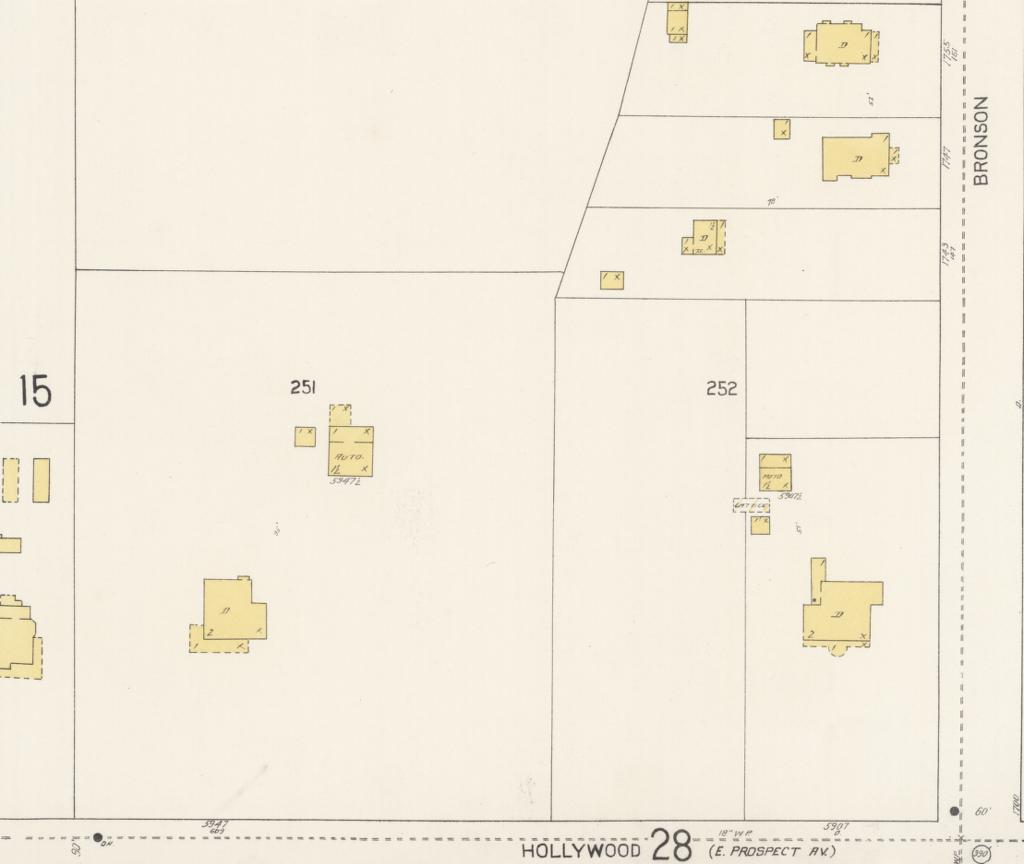
Portion of a 1913 Sanborn Fire Insurance Company map showing the Brokaw ranch property at 5947 Hollywood Boulevard and some of the buildings built in the vicinity since the tracts were sold in 1-3 acre parcels starting in 1901. Library of Congress.
They were still living at the ranch, since re-addressed as 5947 Hollywood Boulevard, in the US census of 1920.

Excerpt of the 1920 US Census. National Archives.
In February 1921, Ida leased a 3-story brick building at 1320 S. Main Street in downtown Los Angeles to the Los Angeles Auto Engineering Company. In November 1921, John, the former buggy maker, announced the opening of his new auto body shop here.

LA Times 11/6/1921
On September 1, 1922 local papers blared the news of a gigantic 717-room. $6,000,000 hotel to be built in Hollywood on the Brokaw ranch property that would be known as the Hollywood-California Apartment Hotel. To be built by the Davenport Corporation, Noel Davenport told reporters he had secured a 99-year lease for the Brokaw ranch where the hotel would be built. Sketches of the mammoth project, by architect H. H Whiteley, were splashed across the front pages of the major local papers. It even made the mountains look small.
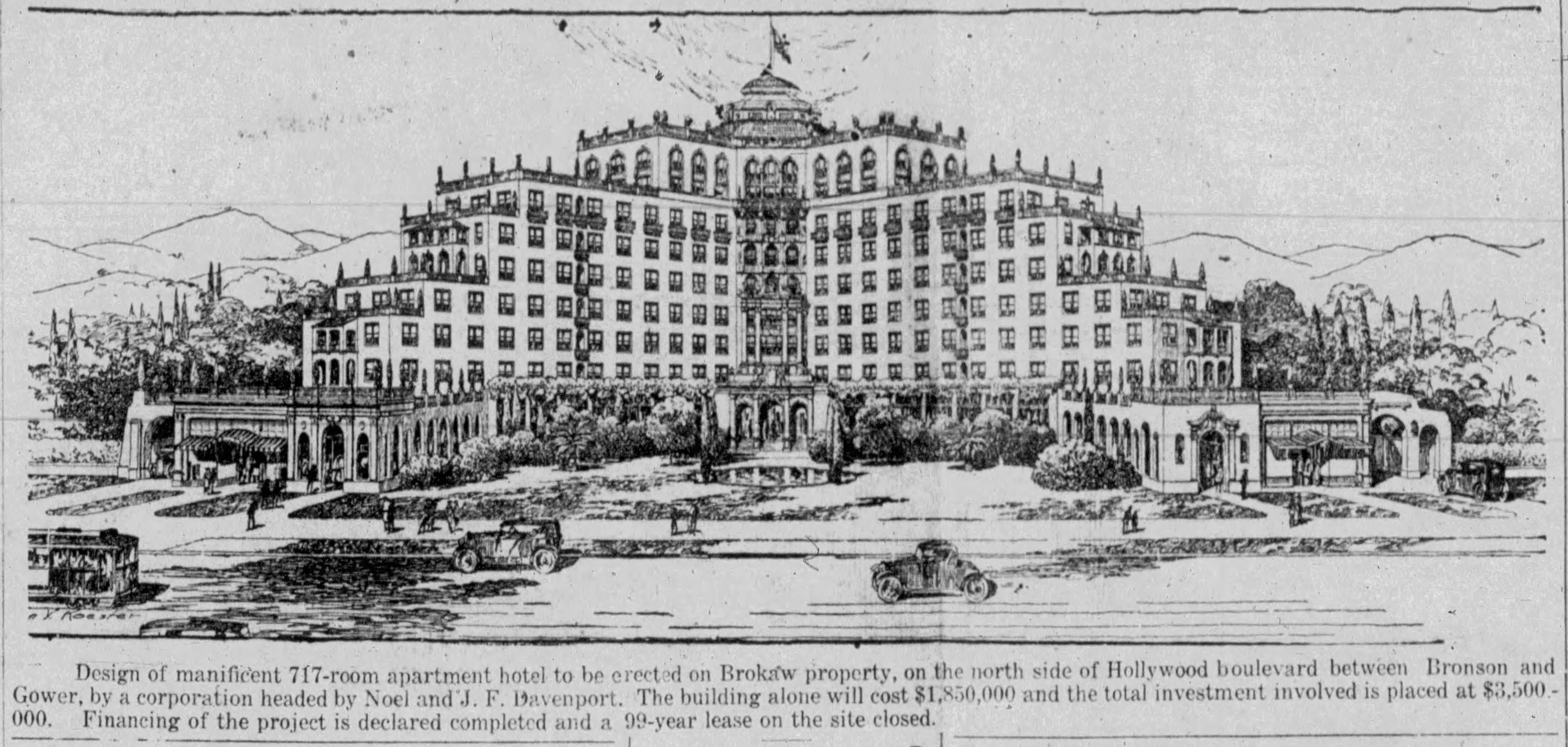
Hollywood Daily Citizen 9/1/1922.
On January 17, 1923, Davenport breathlessly announced that rather than leasing the property from Brokaw, the company had just completed paperwork to buy it outright. This was not true. The work of removing the old Brokaw residence would begin within 2-weeks, he said; the company would then build itself a 1-story admin structure and a month after that, excavation of the hotel would commence. None of this would happen, either. The Brokaw residence was not going anywhere anytime soon.
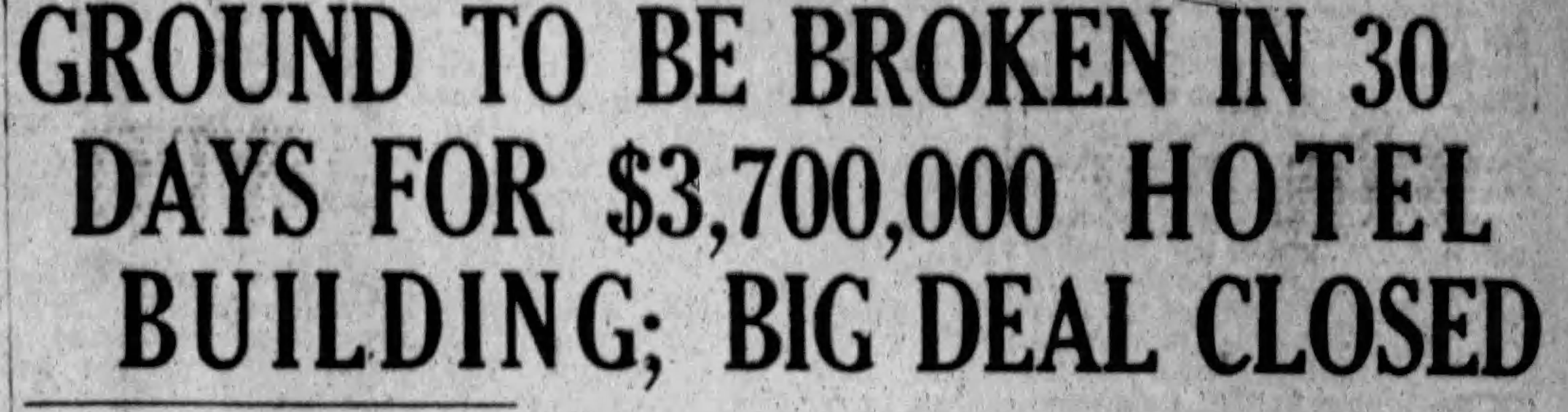

Hollywood Daily Citizen 1/17/1923
Ten months passed, then on November 13, 1923, the LA Times reported that the Davenports, “well-known Southern California hotel men” were building at 1002-room hotel on the Brokaw ranch house property. They wrote this as if it was the first time anyone was hearing about this project. Almost all details provided are verbatim from previous announcements. Work, they said, was to begin within 60 days and would be complete by the end of 1924.

LA Times 11/13/1923

LA Times 4/24/1924
Sixty days came and went. Nearly five months into 2024, Davenport announced that work on the $6,000,000 Hollywood-California Hotel would start within a few weeks (At least this time the paper acknowledged its previous reporting). Ads selling stock in the project, featuring a drawing of an entirely different building, sketched by architects Curlett & Beelman, appeared in local papers on May 5, 1924. Ida H. Brokaw was among the asserted board of directors.

LAT 5/5/1924
On May 22, the promoters held a presentation at the Jonathan Club. Curlett & Beelman showed of the plans. Finance director David A. Coleman said they’d sold a bond of $2,500,000 and almost half the preferred and common stock was subscribed. June 15, 1924, yet another drawing of the $6,000,000 hotel appeared (again) in major local papers. Davenport said preliminary construction work was to begin the project the first of next week and dismantling of the Brokaw homestead was to start immediately. That did not happen.

LAT 6/15/1924
It’s the last we hear of the hotel on the Brokaw ranch property. In 1925, Brokaw was the victim of a swindle, also coincidentally involving a $6,000,000 project- in this case a fake railroad merger that burned many LA businessmen, bankers and politicians. The bunco artists behind the swindle. Thomas Hennessey and Harry D. Hibbs were exposed by Brokaw in May 1925. They were found guilty in September 1925. Brokaw’s investment was variously reported as $10,000, $30,000 and $100,000.

LA Times 5/8/1925

LA Time 5/8/1925
John Brokaw died, age 74, on August 9, 1926 at his ranch home at 5947 Hollywood Boulevard.

Hollywood Daily Citizen 8/10/1926.
The ranch house property became the subject of a lawsuit brought by Ida Brokaw against Guarantee Trust & Title Company, the executors of her late husband’s estate. The title company asserted that she had signed away her rights to the property in 1924 in a document conveying her share to her husband. Ida argued that she had not understood the document she signed. The court agreed on August 27, 1929,that Ida was the victim of fraud, and her signature on the document was the result of duress and undue influence.

LA Times 8/28/1929
Ida continued to live on the ranch property, with her brother Will C. Higgins, in 1930, when a 1-acre section of the grounds were made into a miniature golf course.
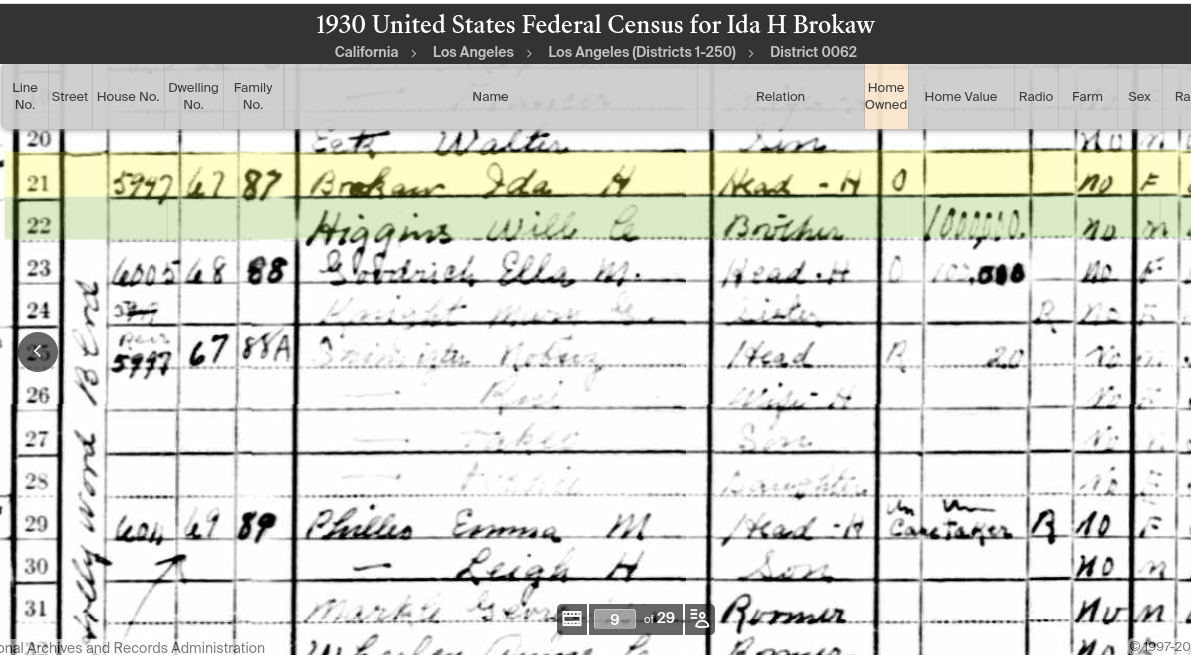
1930 US Census showing Ida Brokaw living at 5947 Hollywood Boulevard.
The miniature golf craze was at its height in the summer of 1930. Another old ranch property down the street at 5261-5263 Hollywod Boulevard had a course put in around the same time. Ralph B. Smith’s “Shady Greens” opened with the address 5937 Hollywood Boulevard on June 28, 1930. It did open the next season, 1931, but that was it.

“Golf in a Garden.” Shady Greens ad, 6/27/1930. Hollywood Daily Citizen.
In May 1932, the site opened as the Hollywood Garden Bridge Club, using a part of the gardens for outdoor bridge club gatherings. The club was founded by Mrs. Elaine Warren McIntire, who added an orchestra stage and toilets. Concrete pads installed for shuffleboard during Shady Greens’ run were used as a patio with a canvas canopy overhead.

LA Times 5/22/1932
Ida still lived at 5947 Hollywood Boulevard in 1931 and into 1932. Sometime between 1932 and early 1933, the property was acquired by the owner of the Los Angeles Times, the Times-Mirror Corp. and Ida moved out.
In 1933, the property served as an outdoor venue for the Los Angeles Kennel Club’s national dog show, addressed as 5945 Hollywood Boulevard- the only time this address was used. When the Los Angeles club hosted the event again in 1936, the address used was 5937.

Hollywood Citizen News 5/19/1933.

LA Times 5/4/1933
In December 1936 owner Times Mirror obtained a permit for a cafe building, to be built at 5931 Hollywood Boulevard. Designed by architect Gordon B. Kaufmann, it occupied part of the ranch property next to the concrete decks where the golf course/bridge club had served outdoor meals. The unfinished building was leased to William Klute for a cafe, to be known as the Palms Grill. (It has its own post here).
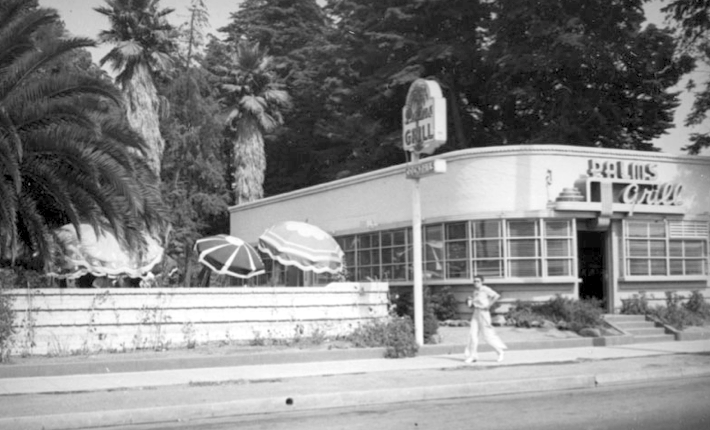
The Palms Grill c. 1937. Schultheis Collection, LAPL photo.
In February 1937, Times Mirror commissioned a building designed by architect A. B. Sedley, to be construction on the west end of the property, at 5959 Hollywood Boulevard. As with the Palms Grill, it was leased before construction began to a grocery store and would open as the Hollywood Food Mart (it will have its own post).

5959 Hollywod Boulevard as the Hollywood Food Mart, c. 1937. LAPL photo.
In November 1937, another project for the parcel was announced: the Florentine Gardens cabaret restaurant, to be constructed at 5955 Hollywood Boulevard. Also designed by Gordon B. Kaufman, it would open in December 1938 (it has its own post here).

Florentine Gardens at 5955 Hollywood Boulevard. LAPL photo.
the Brokaw ranch house was being used as a boarding house in its last years. A permit to demolish the residence was obtained on June 9, 1938.

Ad for the Brokaw ranch house. Hollywood Citizen-News 8/19/1936.
Finally, in November 1939, Times Mirror announced a theater was to be built on the last vacant part of the parcel, to be known as the Hawaii Theater. (It has its own post here).s 5939 Hollywood Boulevard, it reportedly occupied the site of the Brokaw ranch house itself.

Sketch of the proposed Hawaii Theater, 5939 Hollywood Boulevard. LA Times 11/19/1939
Notes:
Ida H. Brokaw was buying property in Los Angeles as of 1888. Even after moving from the ranch, she remained in the vicinity of her longtime home. In 1934-1936 she lived at 6060 Franklin Boulevard. By 1938 she was at 1781 Gower. In financial difficulties later, she spent her last years in an apartment with her brother at 1765 N. Vine. Her brother died in February 1948. Ida passed away in July 1948 at age 90.
 J. H. Graham
6 thoughts on “5947 Hollywood Boulevard: The Brokaw Property”
Comments are closed.