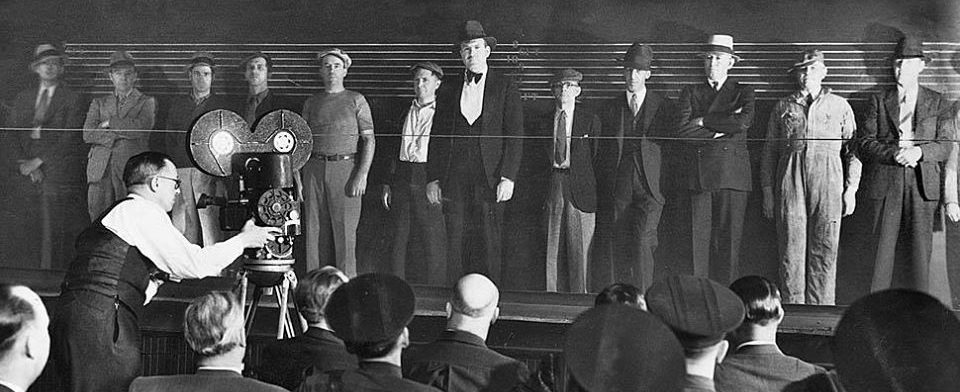

The Hawaii Theater in May 1940. Umbrellas on the patio dining area of the Palms Grill can be seen in the center right. California State Library photo.
The Hawaii Theater opened on May 6, 1940. The last of 4 buildings constructed on the former Brokaw ranch property (the others were the Palms Grill at 5931-5937, the Hollywood Food Mart at 5959 and the Florentine Gardens cabaret restaurant at 5955), the theater, addressed initially as 5939 Hollywood Boulevard, was said to occupy the site of the ranch house itself.

Sketch of the proposed Hawaii Theater in the Los Angeles Times on November 19, 1939. The Times’ parent company owned the property that it would be built on.
On November 19, 1939, the property owner, the Times-Mirror Company, announced the project. Carl G. Moeller designed the streamline moderne-style 2-story building, which also housed two retail stores and office space, with supervising architect Clarence J. Smalle. The unfinished building was leased to Albert A. Galston and Jay M. Sutton of Galston & Sutton Theaters, who operated the Marcal Theater just up the block at 6025 Hollywood Boulevard. To be called the Hawaii Theater (it was peak Hawaiian craze, after all), it reflects a new era of theater building- not a movie palace but a neighborhood picture house. With seating for 1100 people, it featured a mezzanine in the “modern colonial” style with a children’s nursery (the Merry Melody room), complete with staffed attendant; a women’s reception room and powder room; a men’s lounge with a private smoking lounge next to the Projection Room; and the offices of Galston & Sutton, all of which would open onto a furnished 50-foot oval lobby.
At the “ground pouring” ceremony in December 1939, Harold Lloyd placed his signatire trademark round glasses in a block of wet cement, like at Graumann’s Chinese Theater up the block.
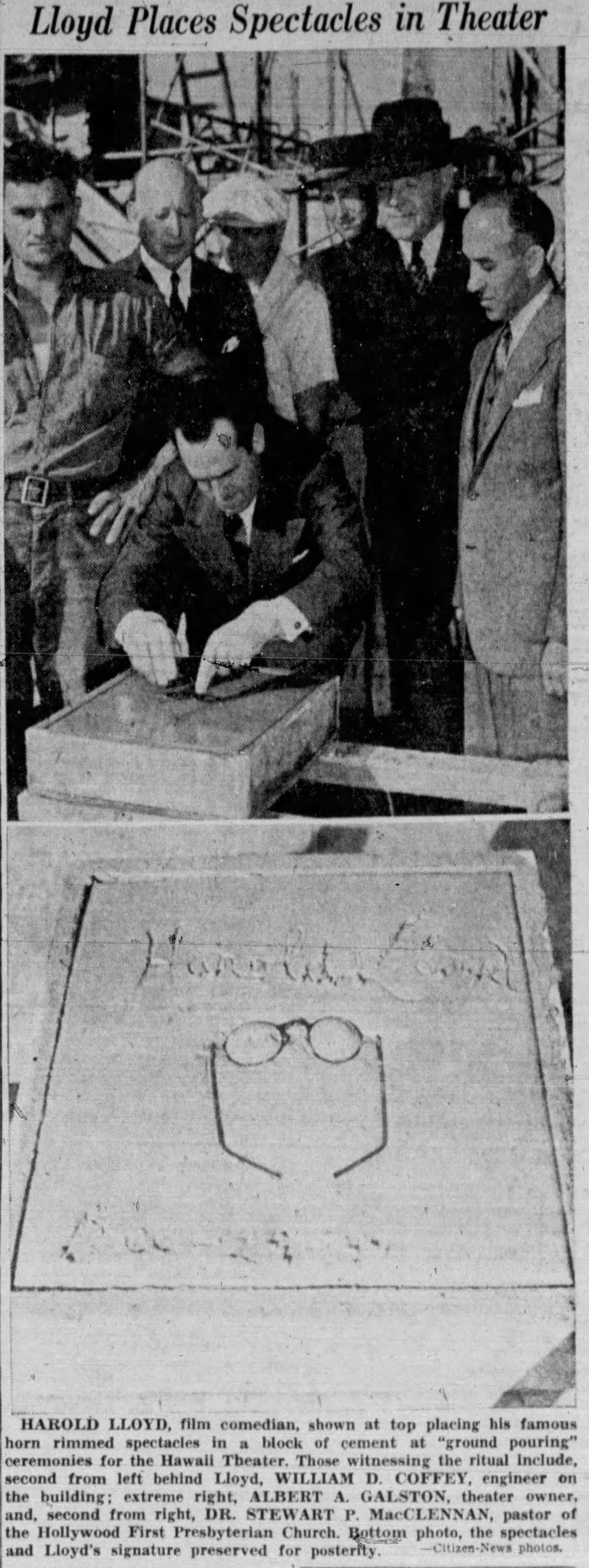
Hollywood Citizen News 12/30/1939
The Hawaii theater’s decor was, not surprisingly, Hawaiian. The auditorium was notable at the time for the use of blacklight illumination with fluorescent murals by Ruth Seeley.
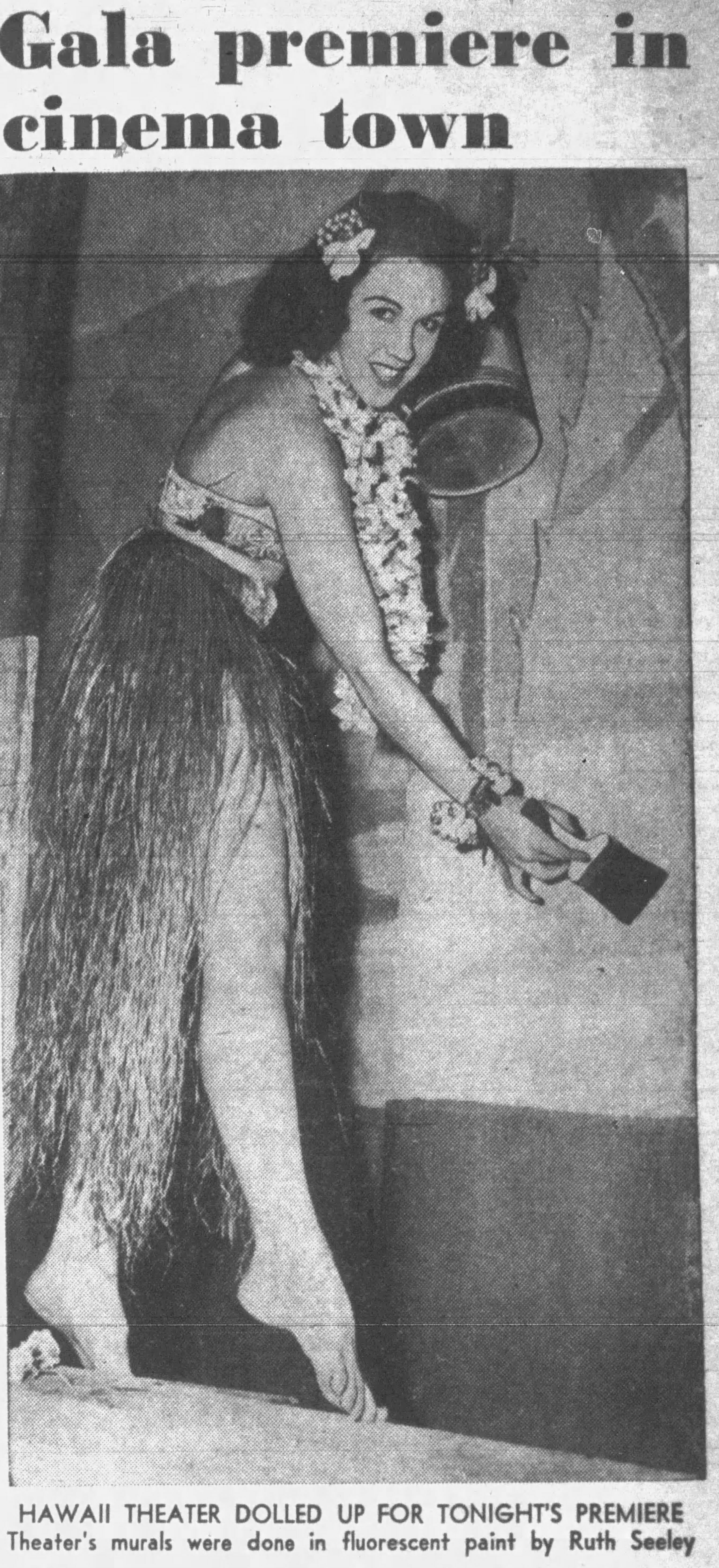
LA News 5/6/1940
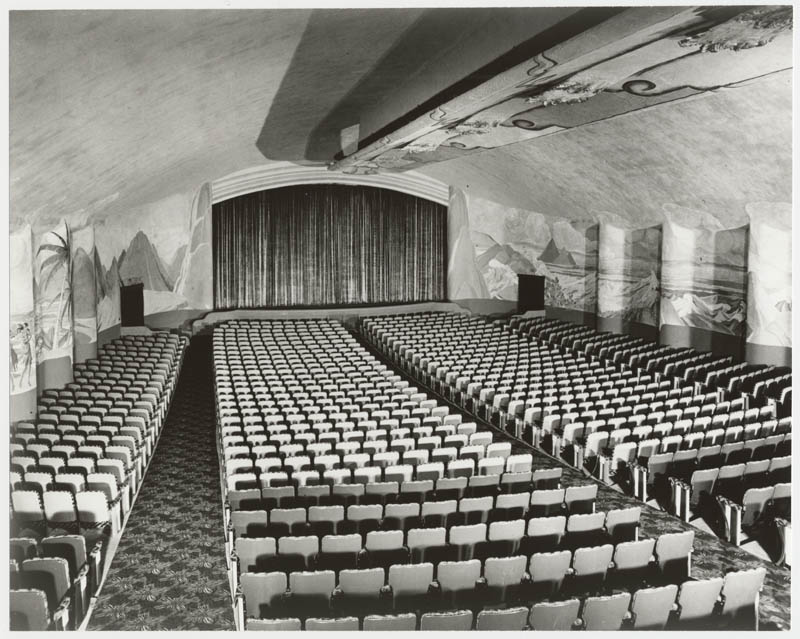
Auditorium of the Hawaii Theater in 1940. California State Library photo.
Citizens lined the Boulevard for the gala opening on May 6, 1940, which featured Hawaiian music, lights, stars, and, more importantly- free parking! Usherettes wore leis and “Hawiian-looking” outfits.
Most of the big-name stars were up the block at the Warner Theater for a preview of “Torrid Zone” with Ann Sheridan, James Cagney and Pat O’Brien. The Hawaii’s debut film was a reissue of “Abe Lincoln In Illinois,” which had premiered in Los Angeles in January 1940. The second feature was a first run film, The Courageous Dr. Christian,” with Jean Hersholt as the doctor, reprising his role in the popular Dr. Christian radio series (1937-1954).
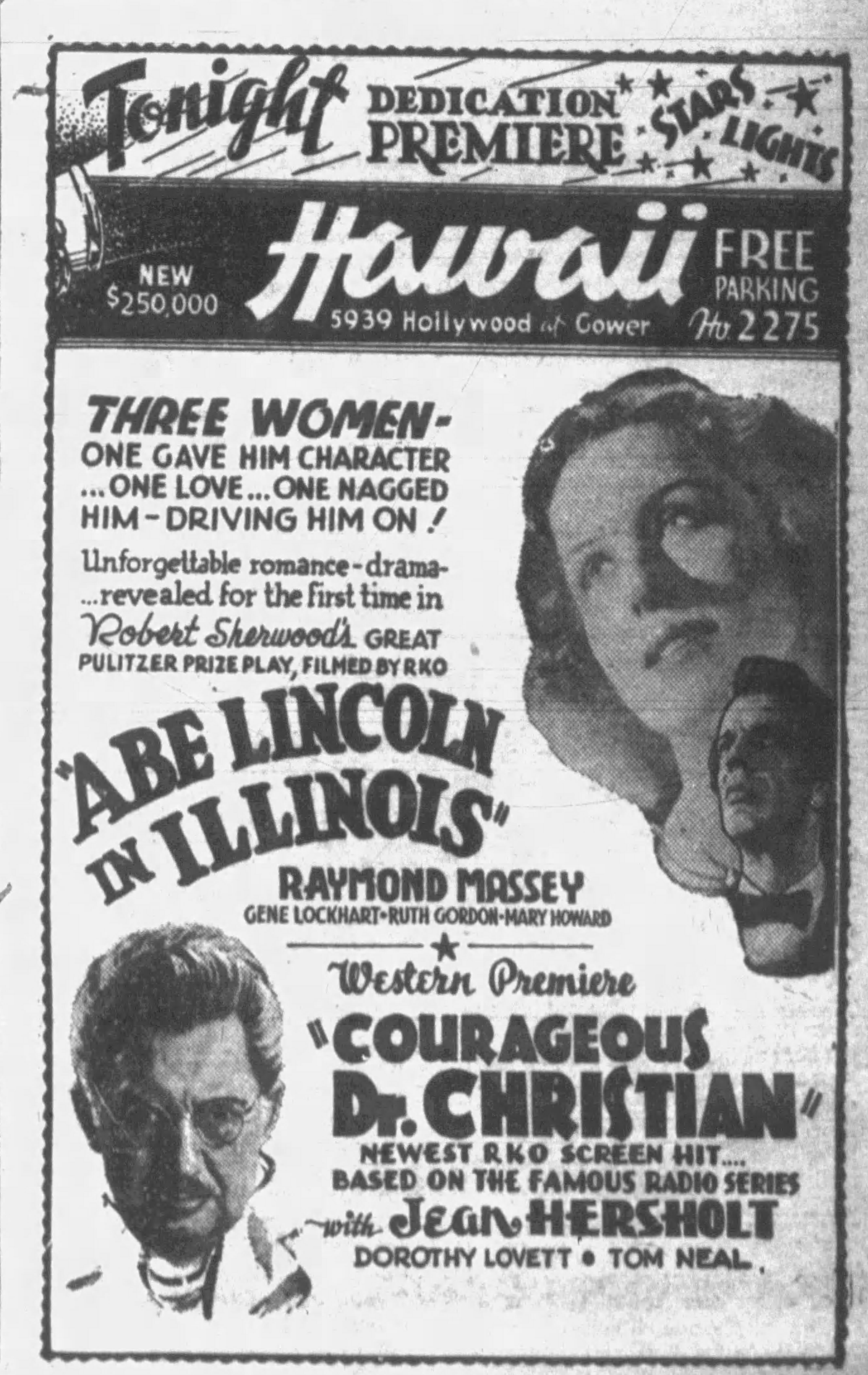
Los Angeles News 5/6/1940
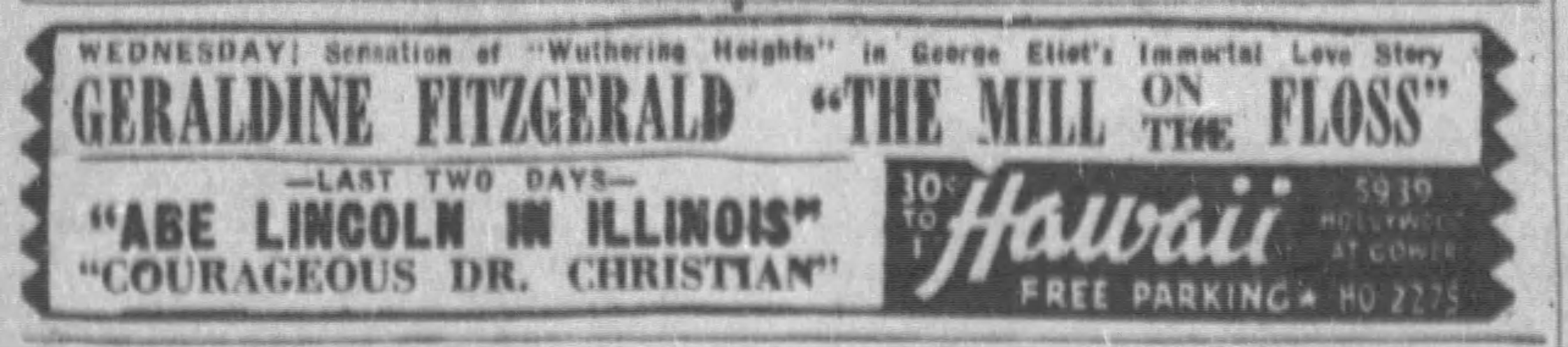
The Mill on the Floss and Isle of Destiny followed Abe Lincoln and Dr. Christian at the Hawaiian. LA Times 5/20/1940.
An independent theater at a time when many theaters were affiliated with, if not owned by, the major movie studios, the Hawaii was the first Los Angeles theater to land Gone With the Wind after the picture finally left the Carthay Circle Theater.
Gone With the Wind had been produced by an independent studio, Selznick International. MGM studio had netted distribution rights to the film as part of the king’s ransom David O. Selznick had to pay MGM (headed by his father-in-law, Louis B. Meyer), for the use of Clark Gable, who was under contract to MGM. The film had its world premiere in Atlanta December 14-16, 1939. It had its Los Angeles premiere at the Carthay Circle on December 28, 1939 and began its public run the following day at Carthay Circle and the United Artis Theater downtown. It remained at UA for 16 weeks and at the Carthay Circle for 24 weeks before closing its initial run on June 12, 1940. The film opened at the Carthay and US for a return engagement August 5-11, 1940 coinciding with the Hawaii Theater opening. The Hawaii Theater had to install benches on the street corners to accommodate all the Gone With the Wind fans arriving or leaving by streetcar or bus.

LA News 8/1/1940
The Hawaii Theater was primarily a second-run house, mostly showing films like Gone With the Wind, that had previously enjoyed an initial run at a major theater, or revivals of pictures that had not been on the screen in several years. Showmen Galston and Sutton often got creative with stunts and performance art “prologues” to fill the Hawaii’s 1100 seats. During the run of “Phantom Speaks,” which opened on Friday, April 13, 1945, for example, actor Loren Palmer would be “electrocuted” on the stage 5 times a day, then would subsequently run through the auditorium as the “electric ghost.”

Hollywood Citizen News 4/11/1945
In June 1945, it was reported that the San Francisco Music Hall theater chain had acquired 4 Los Angeles theater: The Hollywood at 6523 Hollywood Boulevard, the Los Angeles at 8th & Broadway, the Beverly Hills on Wilshire, and the Hawaii Theater. United Artist were partners in the organization, as were Sutton and Galston. Music Hall theaters would show mostly first-run films, starting with Ernie Pyle’s “The Story of G.I. Joe” on August 8, 1945
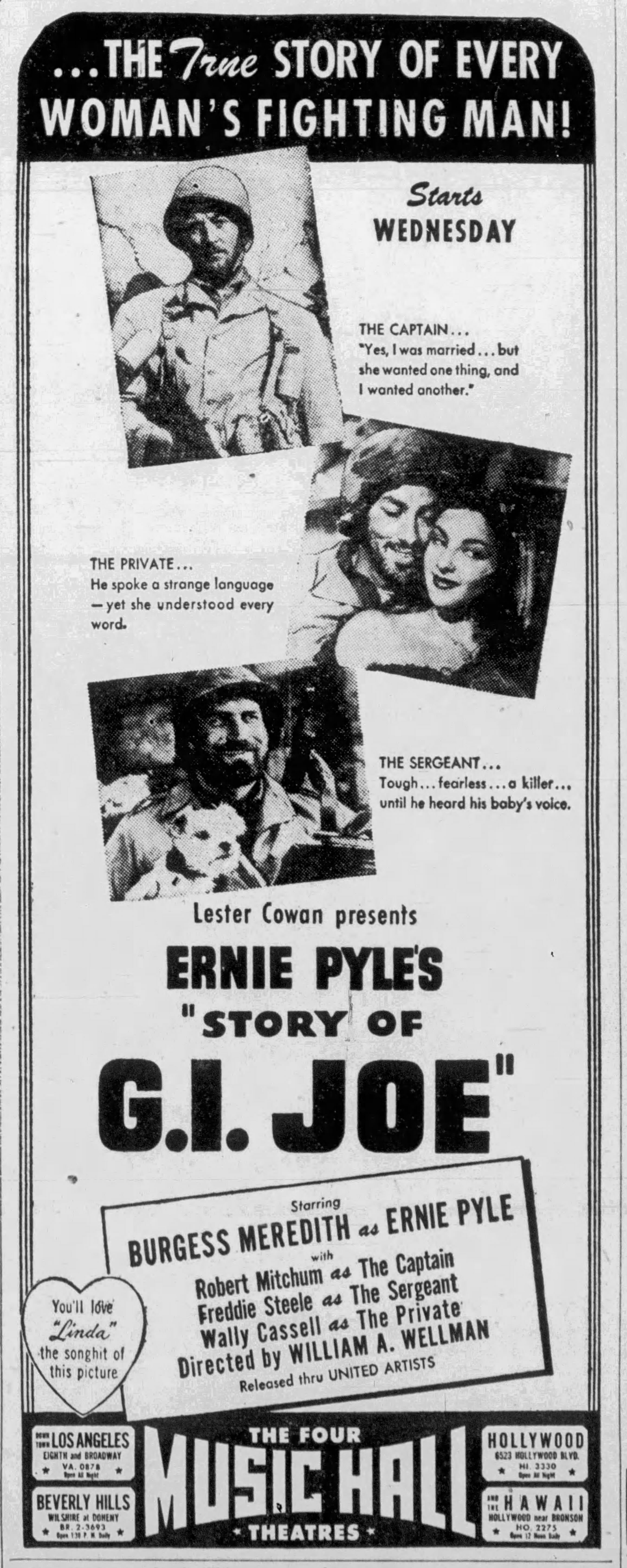
LA Daily News 8/6/1945
Howard Hughes’ long-delayed film “The Outlaw” finally went into general release in April 1946 and the Hawaii, as one of the Music Hall theaters, was one of the 4 places to see it in Los Angles. Was it a real stinkeroo? Yes. Did audiences flock to see it anyway? Also yes.

Hollywood Citizen News 3/30/1946

Hollywood Citizen News 4/4/1946

The Hawaii Theater in early February 1947 during the run of “The Chase” starring Robert Cummings. LAPL photo.

The Chase in its 2nd week at the Hawaii. LA Times 2/1/1947
With a general shortage of new films being produced in 1948, the Music Hall theaters, including the Hawaii, revived “Lost Horizon,” which had first been seen in 1937. The revival proved to be a huge hit.
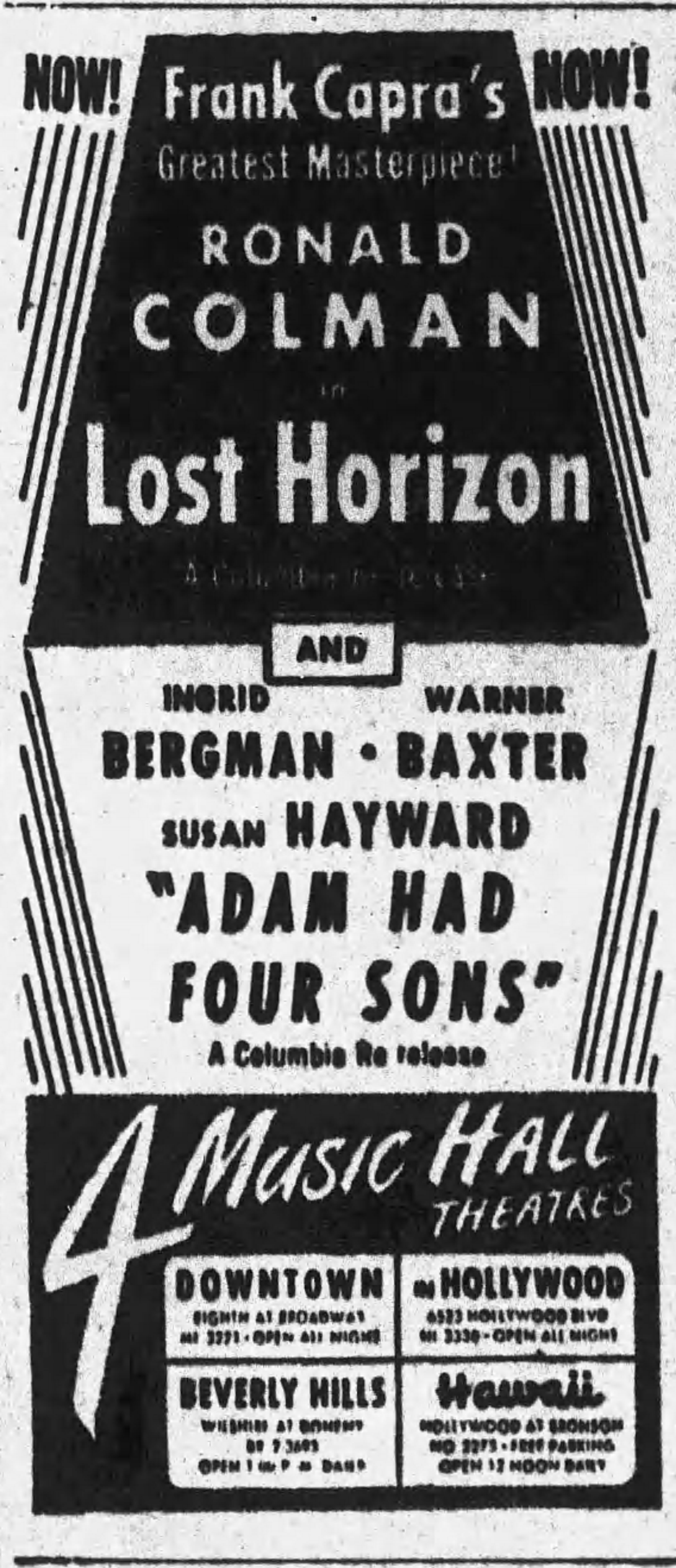
Hollywood Citizen News 4/13/1948
In May 1948, the US Supreme Court ruled in favor of the federal government in an anti-trust lawsuit against the major film corporations, filed by the Department of Justice almost 10 full years earlier.
In July 1938, the DOJ sued Paramount Pictures, Inc., Loew’s Inc., the Irving Trust Co. (trustee for RKO Corp., then in bankruptcy), Warner Brothers Pictures, Inc., 20th Century Fox Film Corp., Columbia Pictures Corp., Universal Corp., and United Artists Corp., accusing the industry of violating the 1890 Sherman Anti-Trust Act. The suit was an outgrowth of complaints by small, independent theater operators, who felt that studio policies for motion picture distribution and exhibition were designed to drive them out of business or compel them to sell to studio-owned theaters. A similar suit had been filed in 1928 and the studios lost; however, as with attempts to regulate film content, the studios basically functioned as usual and in 1933 got the federal government to nullify the judgment under FDR’s new National industrial Recovery Act (itself declared unconstitutional in 1935). No doubt there were many late-night meetings about it over at the Meyer Building down the street.

LA Daily News 7/21/1938
A settlement in the 1938 suit was reached in June 1940, shortly after the indy Hawaii Theater opened. The studios were meant to comply with new distribution and exhibition rules by November 1943. The compliance did not happen and the DOJ went back to court. The case went to trial in October 1945 and the District court ruled in favor of the studios. The DOJ appealed to the US Supreme Court, which decided in favor of the government in May 1948. Each of the defendants entered into a consent decree with the DOJ- known as the “Paramount Decrees” – between 1949 and 1952. Among other things, the ruling meant studios could no longer both distribute films and own theaters without prior approval of the Court and outlawed the long -hated (by theater operators) practice of “block-booking” whereby a theater had to take all of a studio’s film offerings, stinkeroos included, not just the pipperoos it wanted.
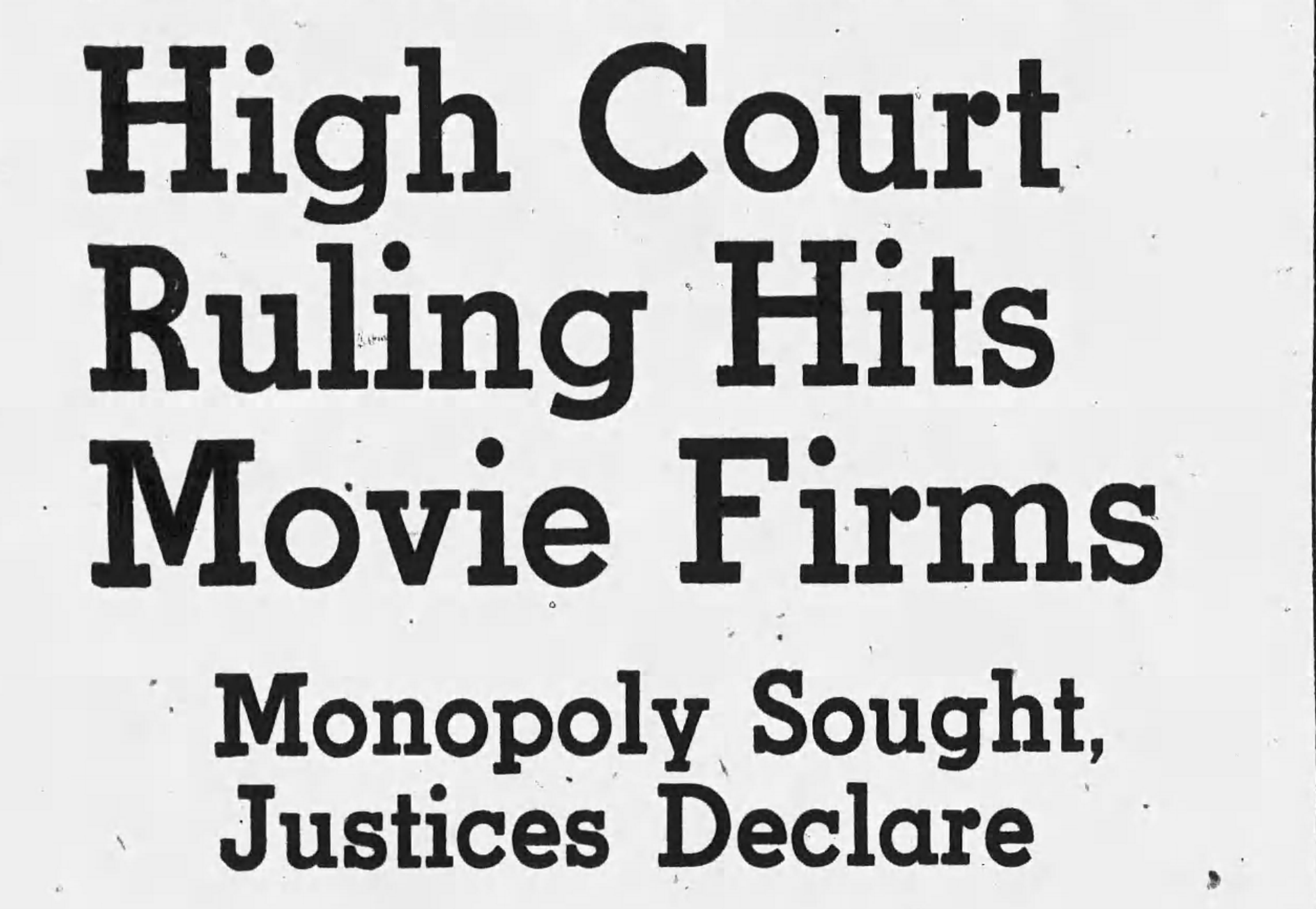
Hollywood Citizen News 5/3/1948
The ruling is often cited as the cause of the breakup of the studio system. However, movie theaters, like nightclubs, were already struggling as audiences drifted to other past times. Tax figures, for example, showed movie theater and nightclub admissions were down 20% in 1948 compared to 1947. The huge dinner theater nightclub next door to the Hawaii, The Florentine Gardens, went bankrupt in 1948.

Hollywood Citizen News 3/30/1948
“The Golden Gloves Story,” released in May 1950, was one of the last first-run films to show at the Hawaii as part of the Music Hall theater chain.
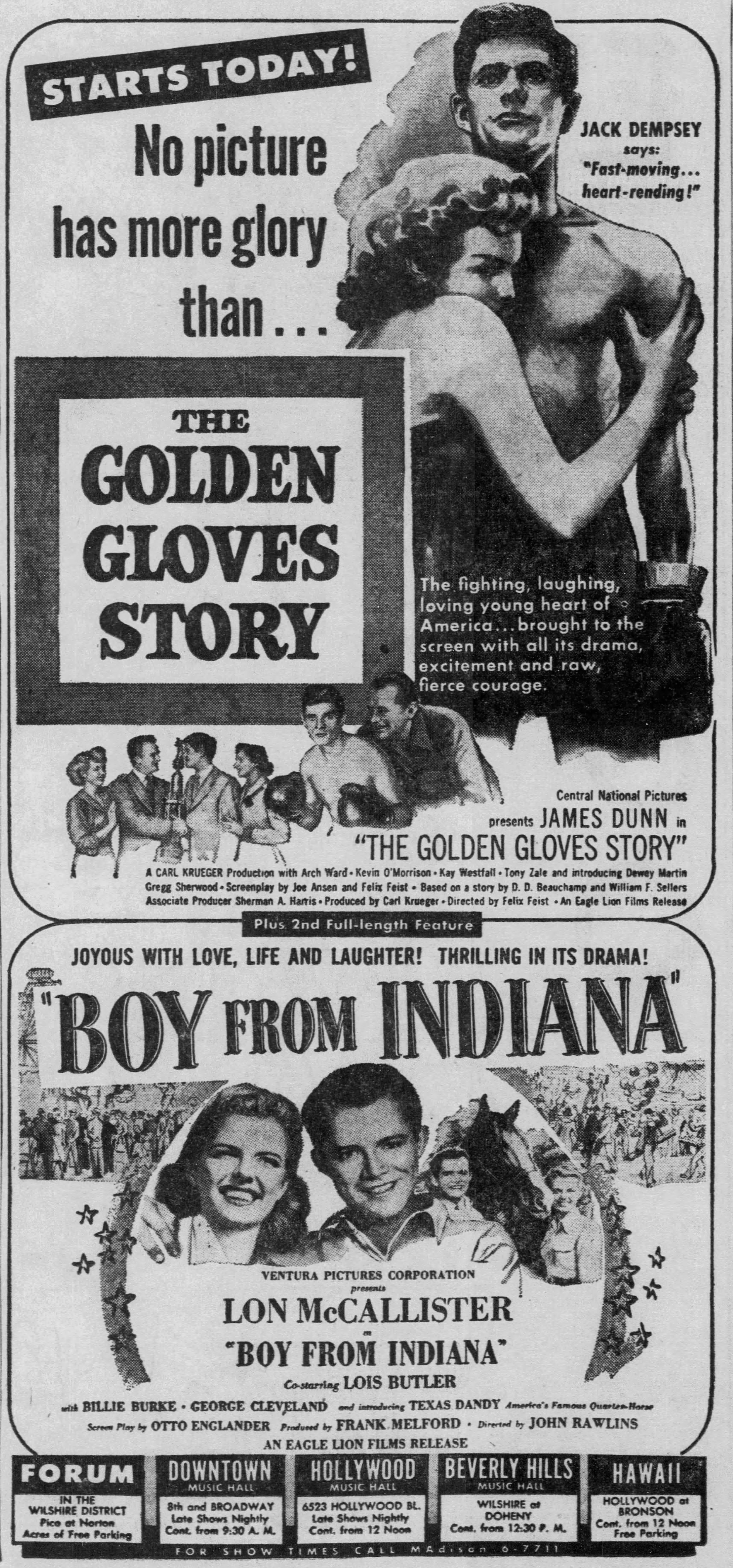
A fifth Music Hall theater had been added to the chain- the Forum. LA Times 5/17/1950
The stars of “His Kind of Woman,” Robert Mitchum and Jane Russell, signed autographs in the lobby of the Hawaii Theater on August 31, 1951, the day the film opened at the Hawaii, the Orpheum and the El Rey. The Hawaii was no longer part of the Music Hall chain.
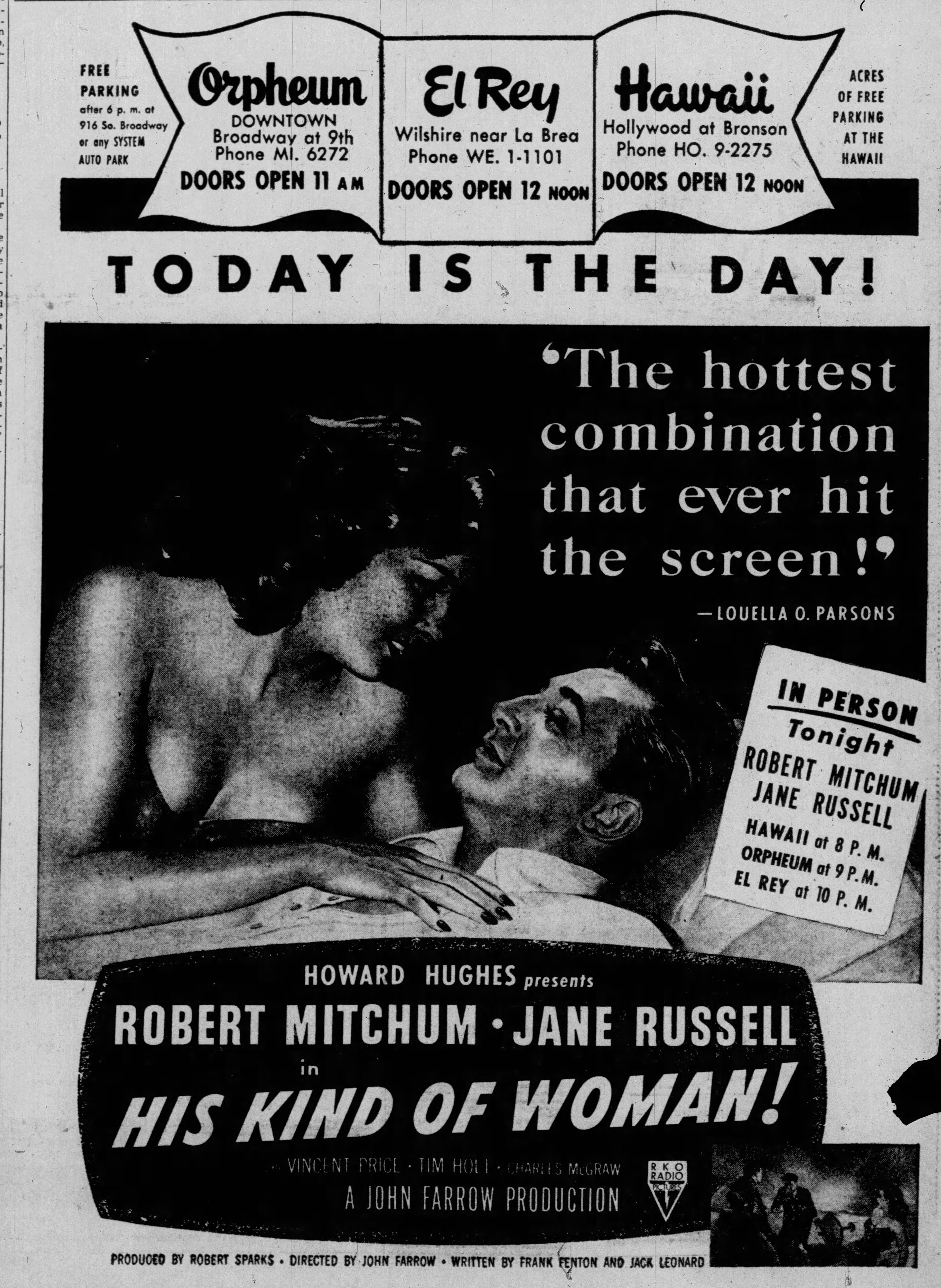
Hollywood Citizen News 8/31/1951
In September 1951, operators of the Hawaii Theater, the Marcal and the Beverly Hills Music Hall, filed an anti-trust lawsuit against 20th Century Fox Corp., National Theaters Corp., Loew’s Inc., Warner Brothers Pictures, Inc., Warner Brothers Pictures Distributing Company, Universal Film Exchanges, Inc., Paramount Pictures Corp., Columbia Pictures Corp., United Artists Corp., Fox West Coast Theater Corp., and the Fox West Coast Agency Corp., charging them with unfair distribution and exhibition practices. With the federal lawsuit also finalizing its terms, the lawsuit was successful. Films often began to open at the Hawaii concurrently with their runs at the major downtown theaters.
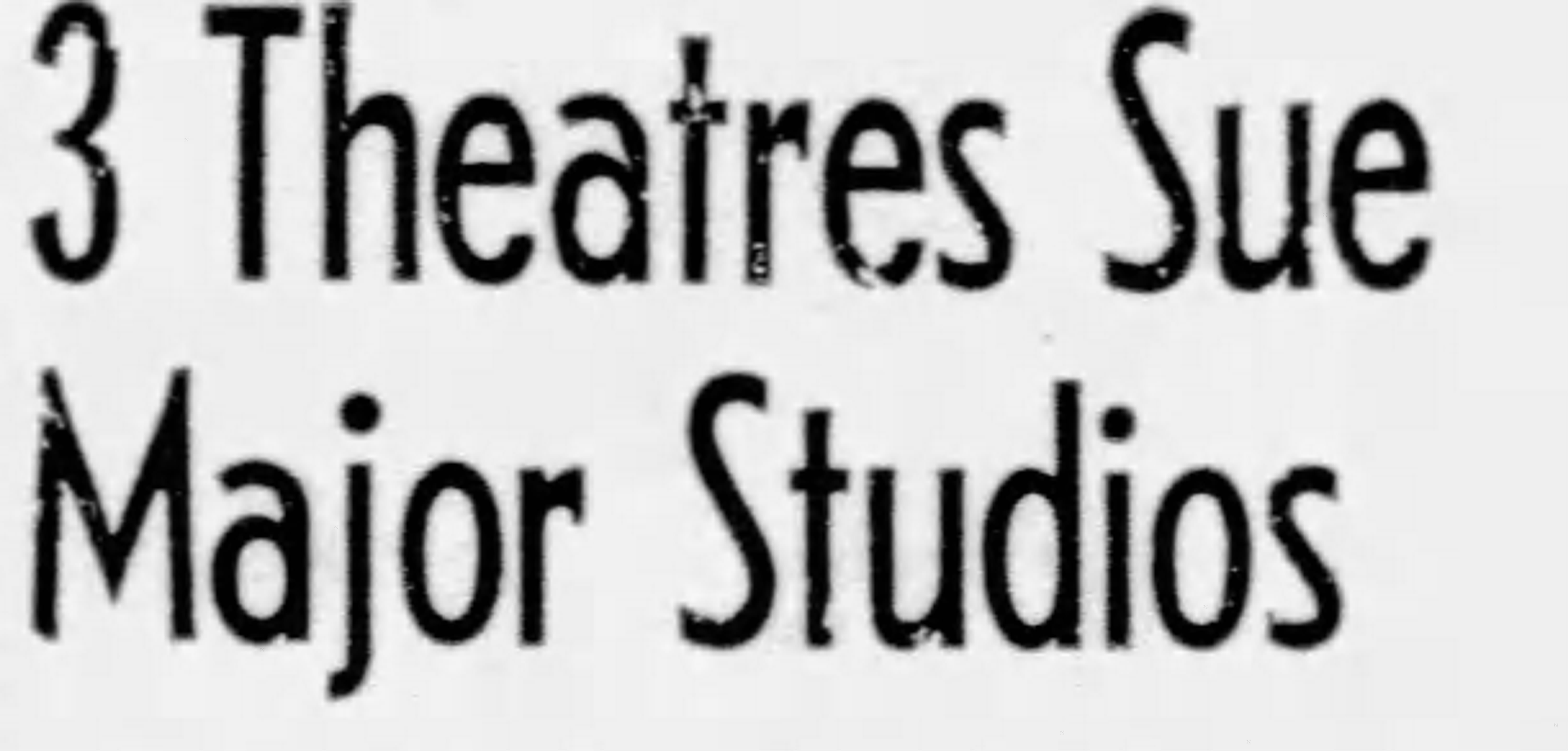
San Pedro News Pilot 9/25/1951
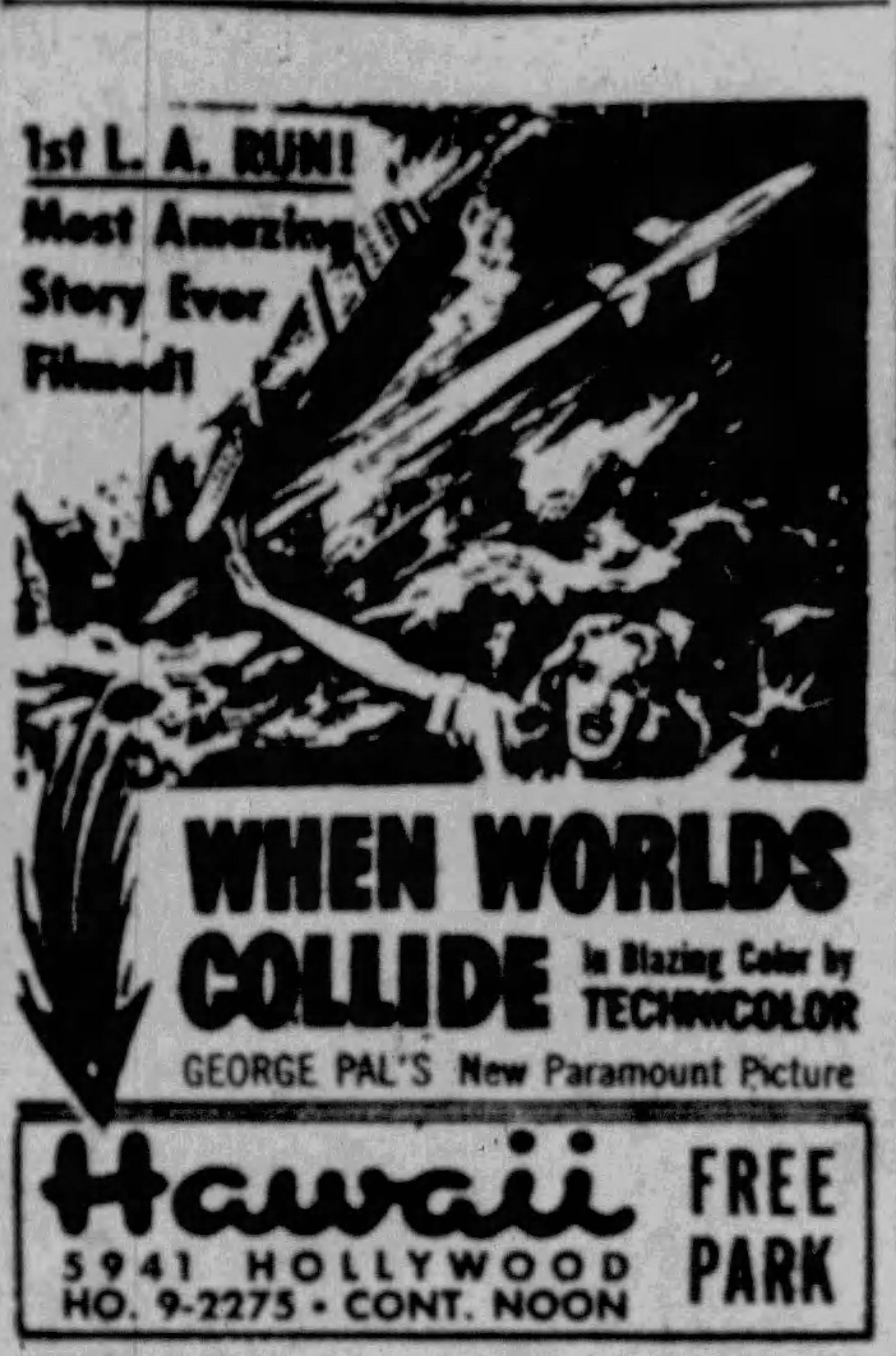
Paramount’s first-run When Worlds Collide debuted at the Hawaii Theater at the same time as it was showing downtown. Hollywood Citizen News 11/22/1951.
Theaters in general and independent theaters in particular, struggling in the early 50s to compete with television turned to new technology like CinemaScope, Filmorama, cycloramaic screens and 3D pictures to draw customers.
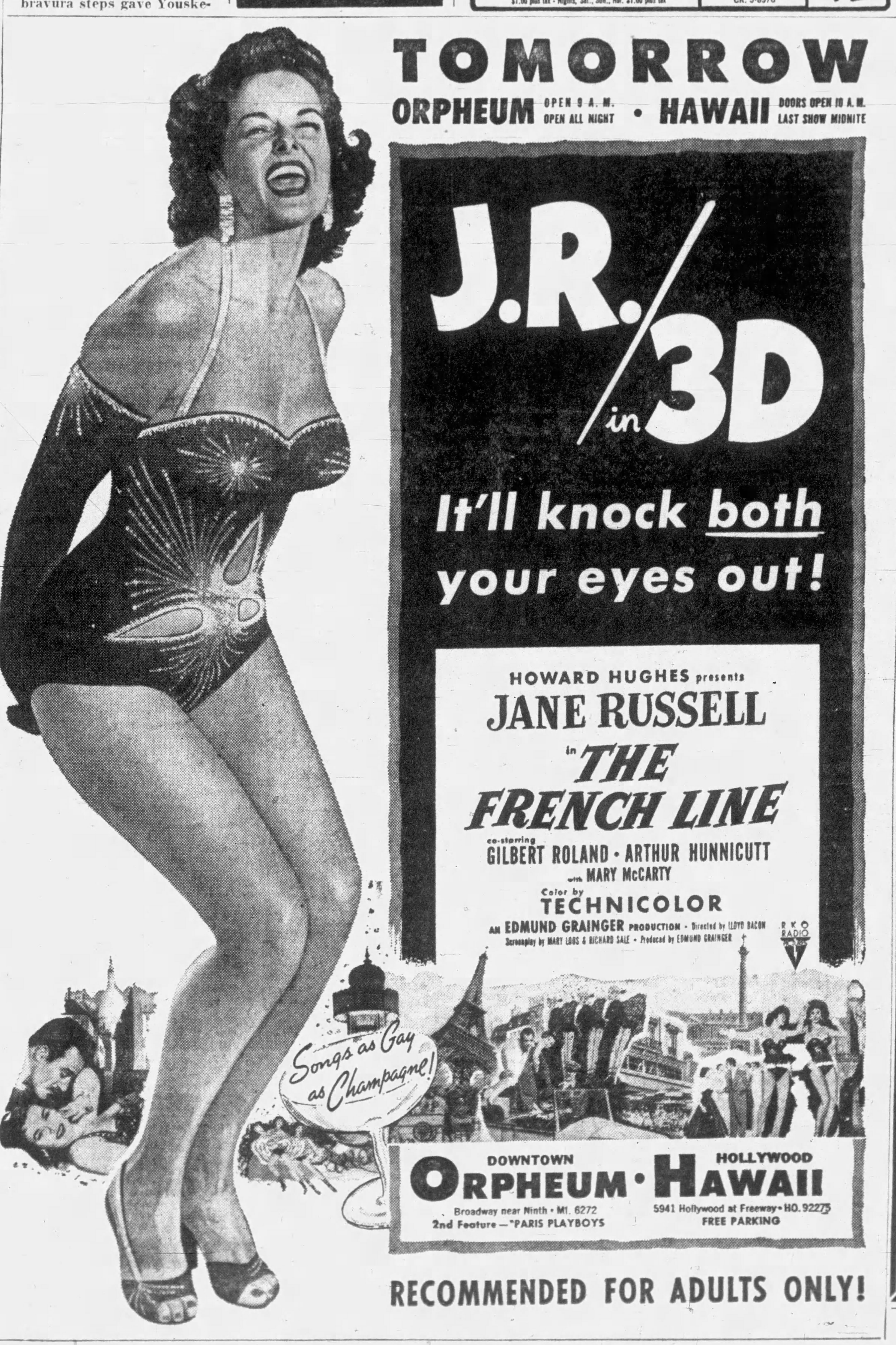
Jane Russel’s 3-D technicolor film The French Line came to the Hawaii on February 24, 1954. LA Mirror 2/23/1954.
Nothing could stop the changes happening to Hollywood Boulevard, however. Over the next decade, The Palms Grill next door closed. The Florentine Gardens and the Hollywood Food Mart became office buildings. The Mountain View Inn across the street was torn down.
The last film to screen at the Hawaii Theater was “Bye Bye Birdie.” The film opened at the Hawaii (and other theaters) on June 19, 1963 in wide release after finishing its held-over 11-week initial run at the Hollywood Paramount Theater.
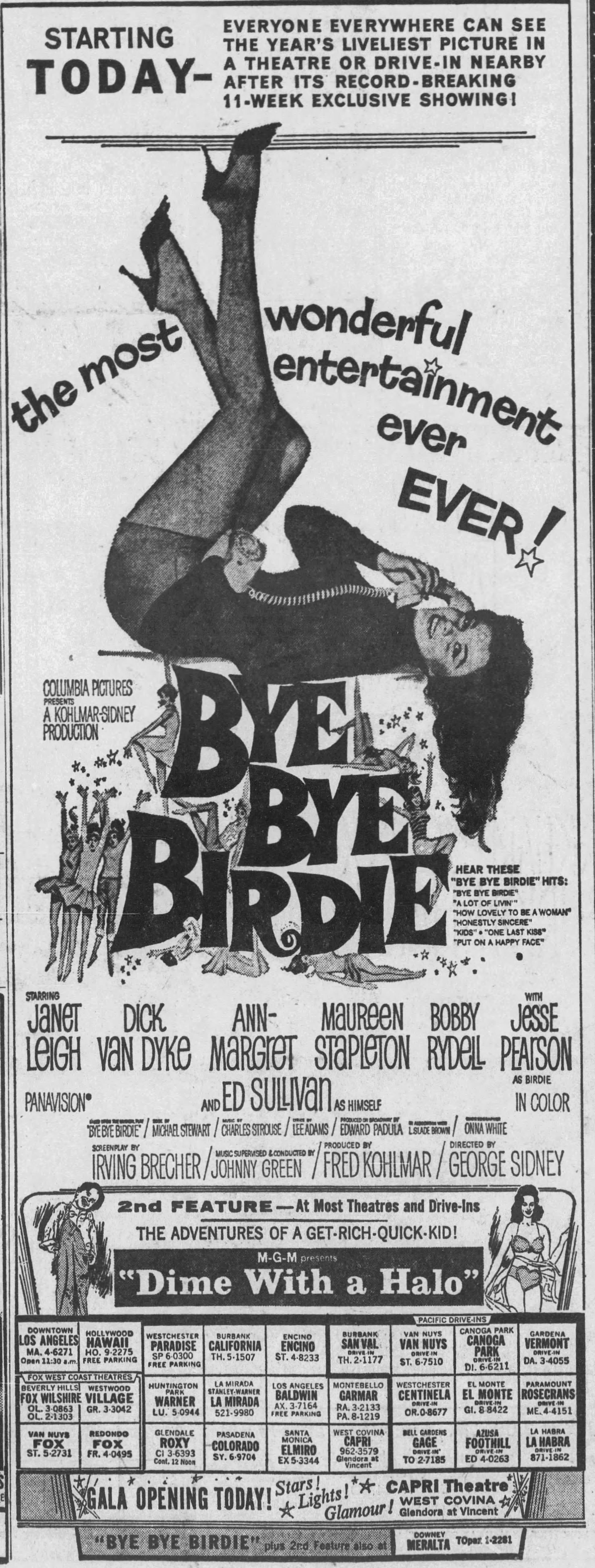
LA Times 6/19/1963. “Bye Bye Birdie” played in wide release with “Dime With a Halo,” a comedy produced at the Hal Roach Studio.
The final showing of “Bye Bye Birdie” at the Hawaii Theater was June 23, 1963. Its doors closed after that.

LA Times 7/29/1963

“The invasion of Hollywood….” Hollywood Citizen News 10/14/1964
In July 1963 the Salvation Army took over the Hawaii Theater building as its new Hollywood headquarters. (The organization would also take over the vacant Palms Grill next door). The building’s interior was gutted and the exterior was substantially altered. The new headquarters held a grand opening October 16-18, 1964. The building is still extant, but unrecognizable.
Notes:
Sutton & Galston began operating the Marcal, taking a lease from owner Mark M. Hansen, in late December 1934. They continued to run it through 1941. In April 1940 Hansen sued to have their 10-year lease forfeited. The Marcal will have its own post.
 J. H. Graham
I’ve seen one photo of the Hawaii theatre at night and it had a superb neon sign. A man on facebook said it was a beautiful theatre.
LikeLike