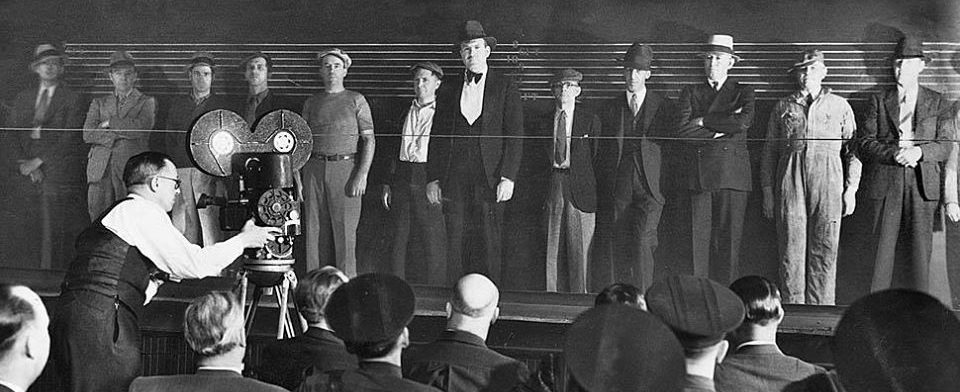

Paul G. Hoffman in 1951.
Born in Illinois in 1891, Paul G. Hoffman came to Los Angeles and began selling Studebakers when he was still a teenager. In 1919 he partnered with Robert D. Maxwell as Maxwell and Hoffman, and on March 9, 1919 Maxwell and Hoffman were named Studebaker distributors for Los Angeles, headquartered at 1047 S. Grand Avenue (they later moved to 1015 S. Grand).
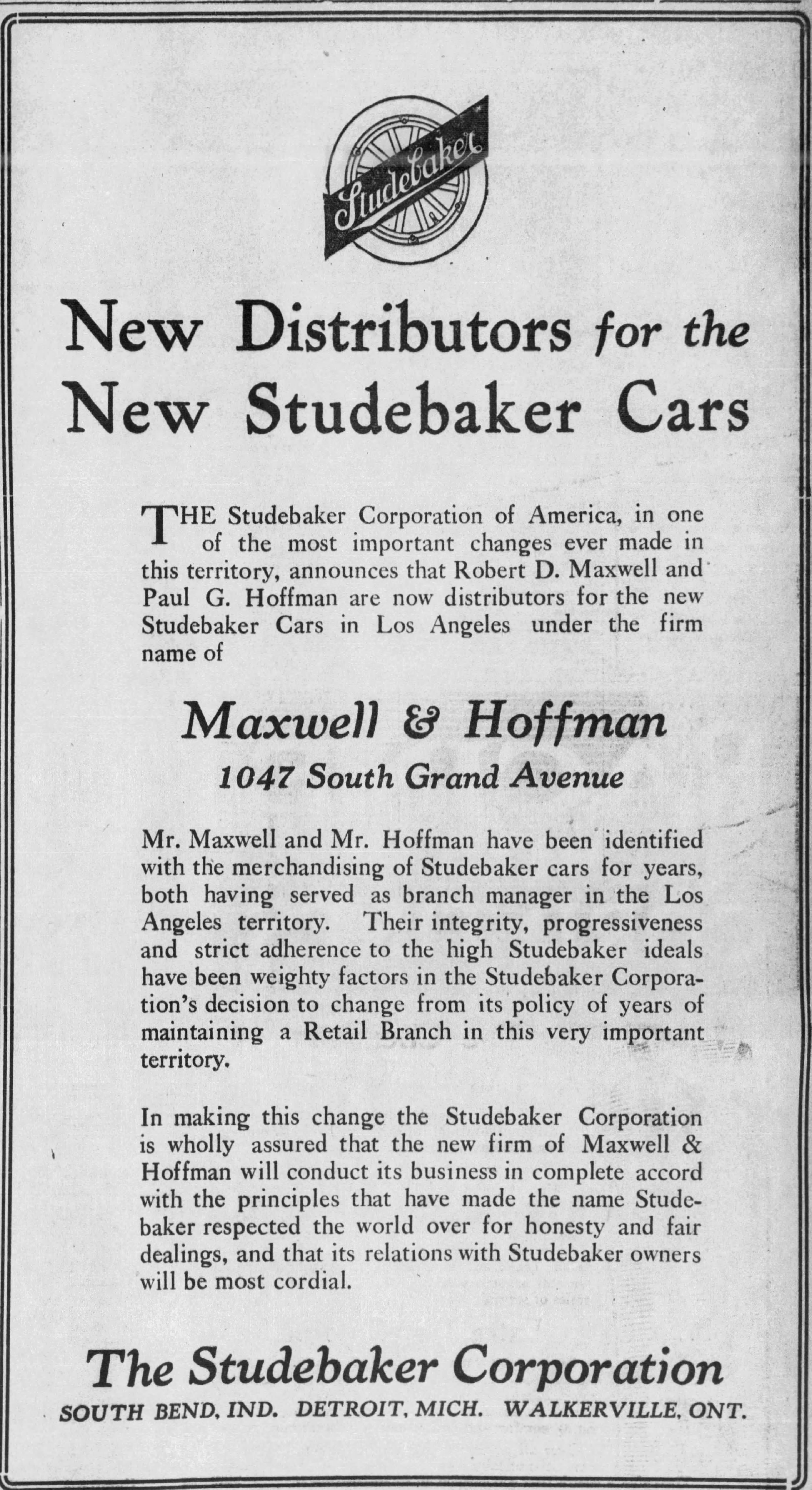
LA Times 3/9/1919
At that time, the Wright Motor Co., run by Frank E. Wright, was the Studebaker dealer for Hollywood, having succeeded James Nixon of the Nixon Motor Company in 1918. Nixon/Wright were located at 6658 Hollywood Boulevard then at 6150 Hollywood Boulevard.

LA Times 4/4/1920
Just a little more than a year after being named Studebaker distributors for Los Angeles, on April 4, 1920, the Paul G. Hoffman Company took over succeeded Maxwell and Hoffman as Studebaker dealer for Los Angeles as well as expanding his territory to include Hollywood. He opened his Hollywood branch at 6325 Hollywood Boulevard. (In June 1920 Hoffman would open his new downtown headquarters at 1250 S. Figueroa.
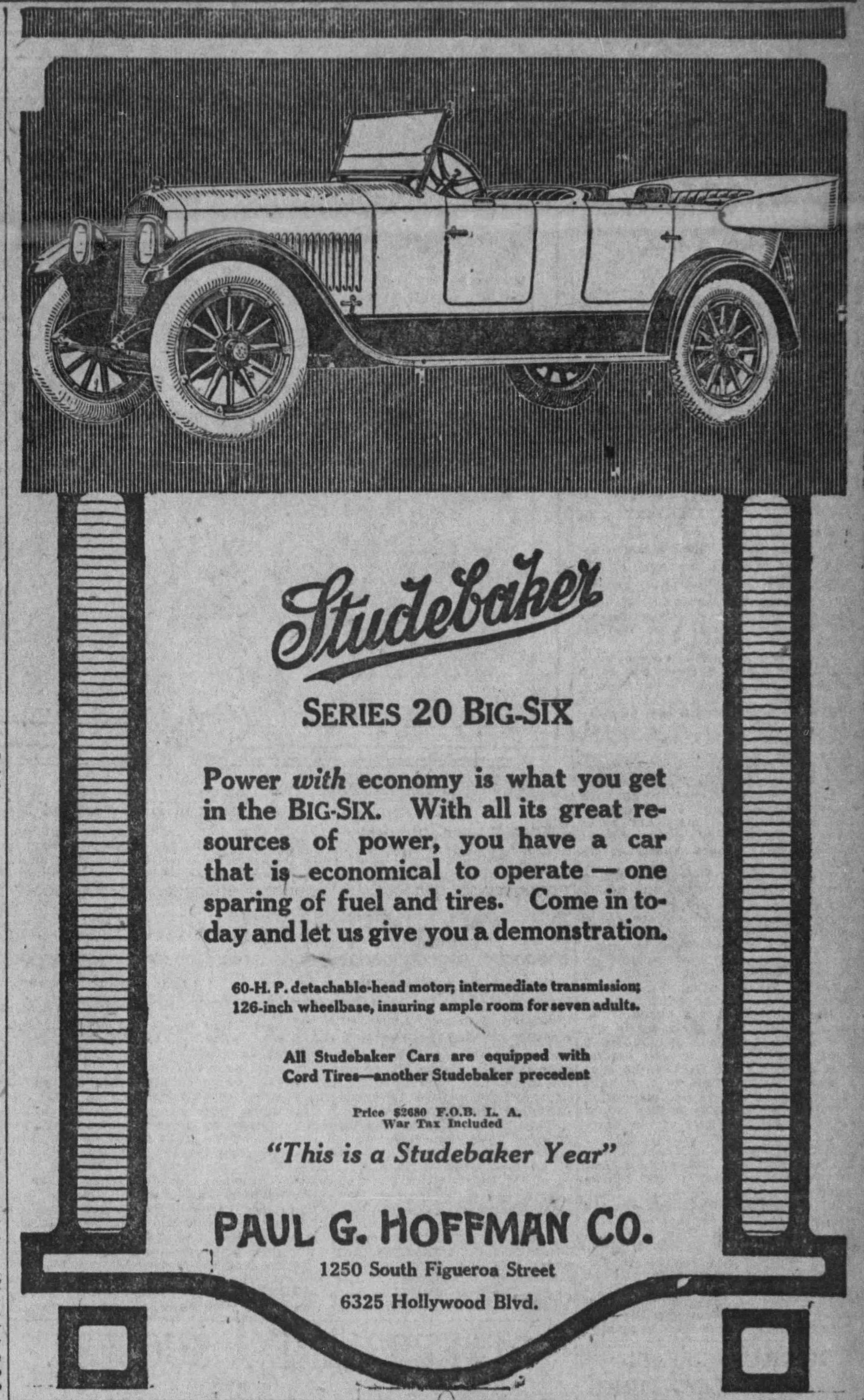
LA Times 6/13/1920.
In July 1922, the Hoffman company negotiated with the estate of Daeida (Ida) Wilcox Beveridge for lease of a property and to construct a new 1-story showroom building, to be located at 6116 Hollywood Boulevard on the south side of the boulevard near Gower. Meyer and Holler were the builders.

Hollywood Daily Citizen 7/27/1922.
This property had been part of a large rural parcel that Daeida (Ida) Beveridge had owned with her first husband, Harvey Henderson Wilcox. The couple came to the area from Topeka, Kansas and subdivided Hollywood in 1887. Wilcox passed away in 1891; in 1892, Ida married Philo Beveridge. Now Ida Beveridge, she controlled the Wilcox land holdings and, when Hollywood incorporated in 1903, donated land for many of its civic buildings. She passed away in 1914 and her estate manager, C.B. Brunson (who was married to the Beveridge’s daughter Phyllis), developed the property as Hollywood turned increasingly commercial.
Paul G. Hoffman Co. moved into the new building between November 25 and December 2, 1922.

LA Times 12/8/1922.
In October 1924, Hollywood’s first radio station, KNX, owned by the Los Angeles Evening Express newspaper, located its broadcasting studio in the Hoffman building. The massive transmitting towers and giant red KNX letters were a beacon for blocks around, as much of the vicinity was still undeveloped or contained buildings no taller than 1 or 2 stories tall. The first broadcast took place on October 10, 1924. KNX moved the station to the Paramount Pictures lot in 1928, but continued to use the Hoffman studio as well. In 1933 they operated out of 5939 Sunset Boulevard, which had been built in 1924 as a showroom for the Peerless Motor Car.

The Paul G. Hoffman Studebaker dealership with the KNX signage and transmitting towers on the roof. Los Angeles Evening Express 10/9/1924.
Based in South Bend, Indiana, Studebaker began as a wagon-making company in 1852. It had been producing automobiles, both gas and electric, in partnership with other companies, since the early 1900s. The first wholly Studebaker-produced motor cars were made in 1912.
By the mid 1920s, Paul G. Hoffman, the person, left Los Angeles For South Bend to serve as VP of the Studebaker Corporation of America under its president Albert R. Erskine, though he would remain president of his namesake company here. The company acquired luxury automobile maker Pierce-Arrow in 1928. However, the 1929 Stock Market crash impacted the company’s finances.
In 1932, it began marketing a lower-priced vehicle called the Rockne, named for Notre Dame coach Knute Rockne, made in Detroit. (The Hoffman Rockne division was at the downtown location).
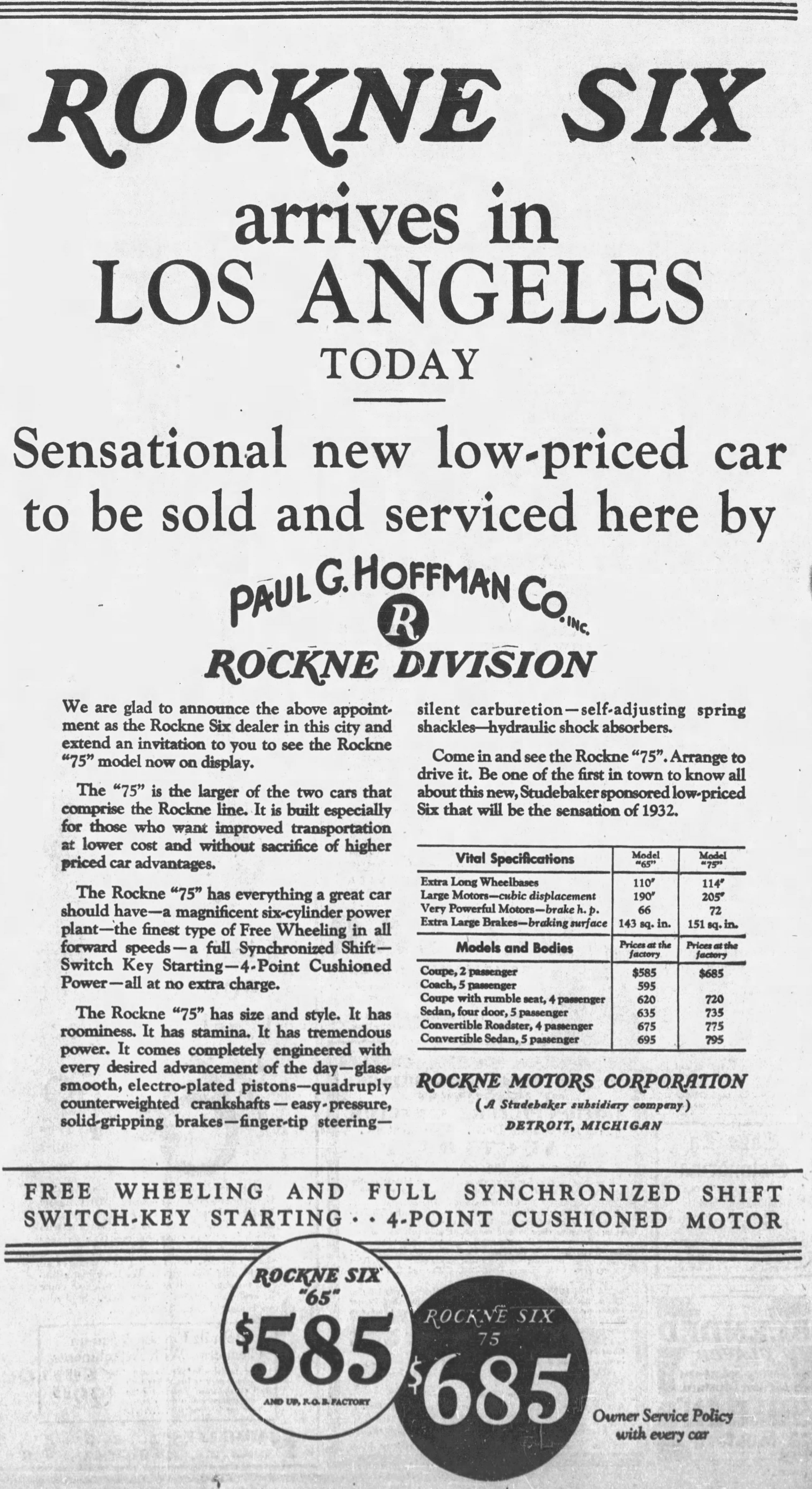
LA Times 1/5/1932
But on March 18, 1933, the Studebaker Corporation entered into receivership. Paul G. Hoffman, the person, was one of the receivers. Corporate president Erskine was fired; he killed himself on July 1, 1933. That month, the company dropped the Rockne. It also sold Pierce-Arrow.

Hollywood Citizen News 12/15/1933.
Amid news of Studebaker’s reorganization negotiations, the Hollywood branch of Paul G. Hoffman offered a distraction in the form of “Captain” J. J. Lynch’s driverless car demonstration that involved a “Phantom Studebaker” making a U-turn on Hollywood Boulevard. Even a car with a driver in it making a U-turn on the crowded Boulevard would have been newsworthy, but Lynch, a self-styled captain often referred to as a radio engineer, took it to a new level.
The Phantom car, a 1934 Studebaker roadster, was to leave the showroom at 6116 and head south on Gower to Sunset, then proceed west on Sunset to La Brea; it would go north on La Brea back to Hollywood Boulevard and head east to Cahuenga, where it would complete a U-turn in the middle of the street before returning to 6116. Luckily. there were no reports of any injuries.
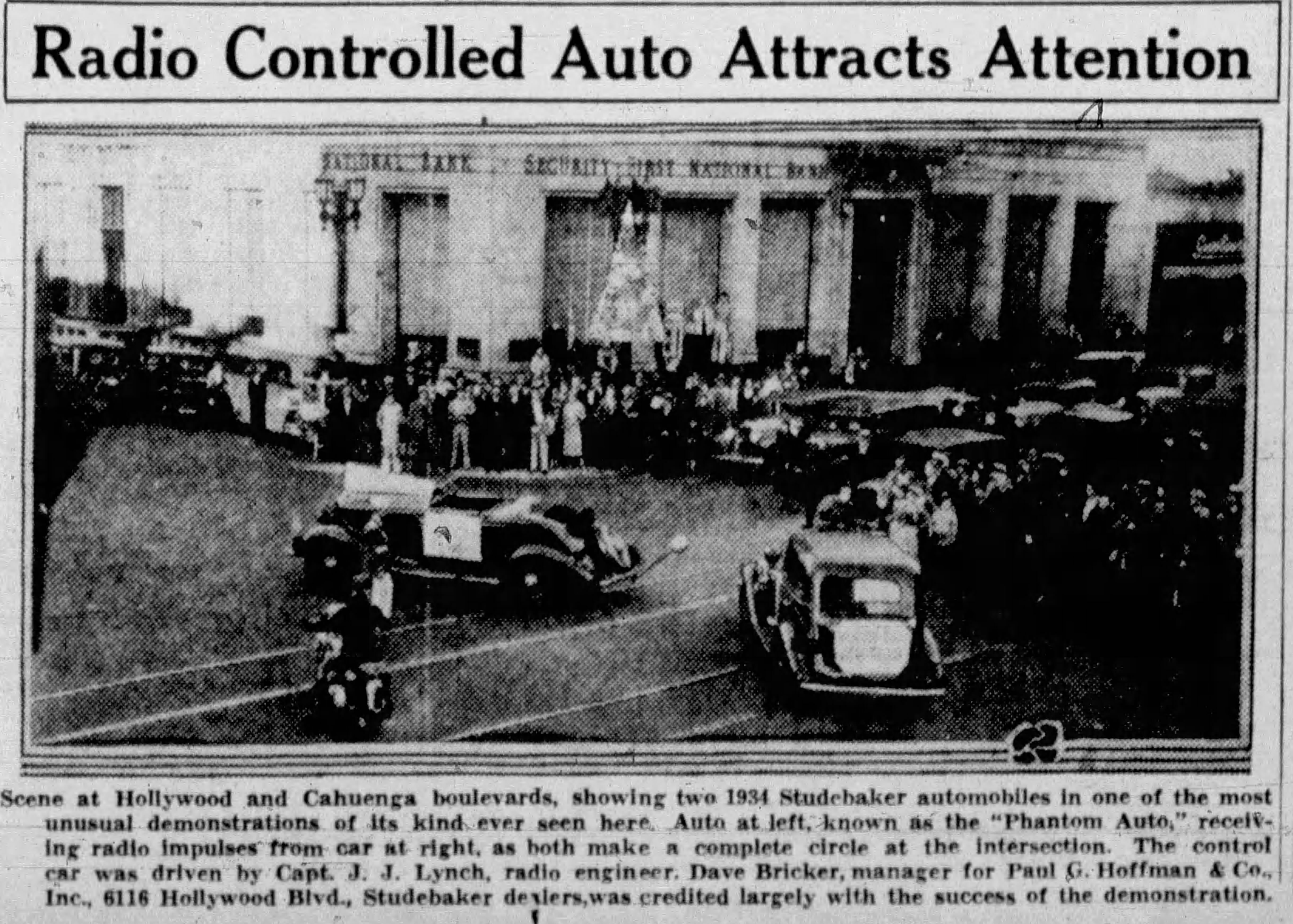
The Phantom Car at Hollywood and Cahuenga. Hollywood Citizen News 12/20/1933.

Pomona Progress Bulletin 2/5/1935.
In January 1935, Studebaker emerged from receivership, reorganized and refinanced, with Paul G. Hoffman as president.
Paul G. Hoffman, the Hollywood Studebaker company, retired the dealership in Hollywood and closed the showroom at 6116 Hollywood Boulevard as of Oct 1, 1937 when its former salesman of the last 6 years, David J. Bricker took over as Studebaker distributor for Hollywood.
In late January 1939, 6116 became Ernie Smith Inc., a Lincoln, Mercury and Lincoln Zephyr dealership. To celebrate it displayed the “X-Ray car,” a Lincoln Zephyr bound for the Golden Gate Exposition at Treasure Island in San Francisco.
Lincoln and Mercury were part of the Ford Motor Company. Ford had acquired the Lincoln Motor Company in February 1922 and it operated as Ford’s luxury division. The streamlined Lincoln Zephyr was introduced in 1936. Mercury was a new division of Ford, introduced by Henry Ford’s son Edsel Ford in November 1938.

On October 6, 1939, a new firm called Hollywood Motors., Inc. succeeded Ernie Smith at 6116 as Hollywood’s Mercury, Lincoln and Lincoln Zephyr dealership. It was originally managed by Leo S. Domergue; later it was Paul Boulton.
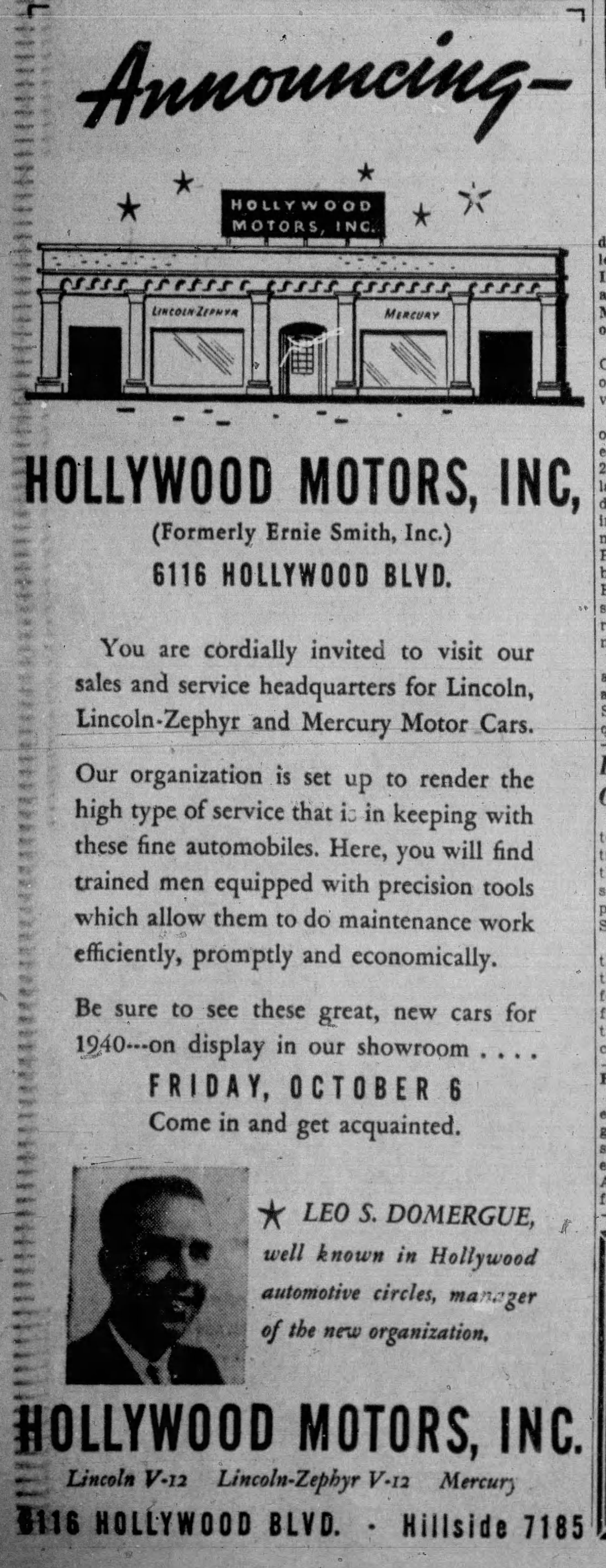
Hollywood Citizen News 10/4/1939.

Hollywood Citizen News 3/13/1940.
In November 1941, Hollywood Motors, Inc.’s Lincoln, Lincoln Zephyr and Mercury dealership moved to 5600 Sunset Boulevard. The following month, longtime LA auto dealer Ralph Hamlin acquired 6116 for used car sales. Hamlin remained through January 1942. Later that month it became Hollywood Hudson. Just weeks later, all domestic vehicle production in the US shut down as auto manufacturers concentrated on the war effort. Dealers, like Hollywood Hudson, focused on their service departments- as maintaining your existing car became critical.

Hollywood Citizen News 3/18/1942.
The elegant building built for Paul G. Hoffman ended its days as an automotive showroom as the used car dealership of J. L. Herd Automobile Company. In December 1945, the Office of Price Administration (OPA), which among other things regulated prices during the war emergency, suspended Herd’s license for 30 days for selling a 1942 Buick for $840 over the OPA’s price ceiling.
In July 1946, 6116 Hollywood Boulevard became a Collins Appliance Co retail store, which was here for two years.
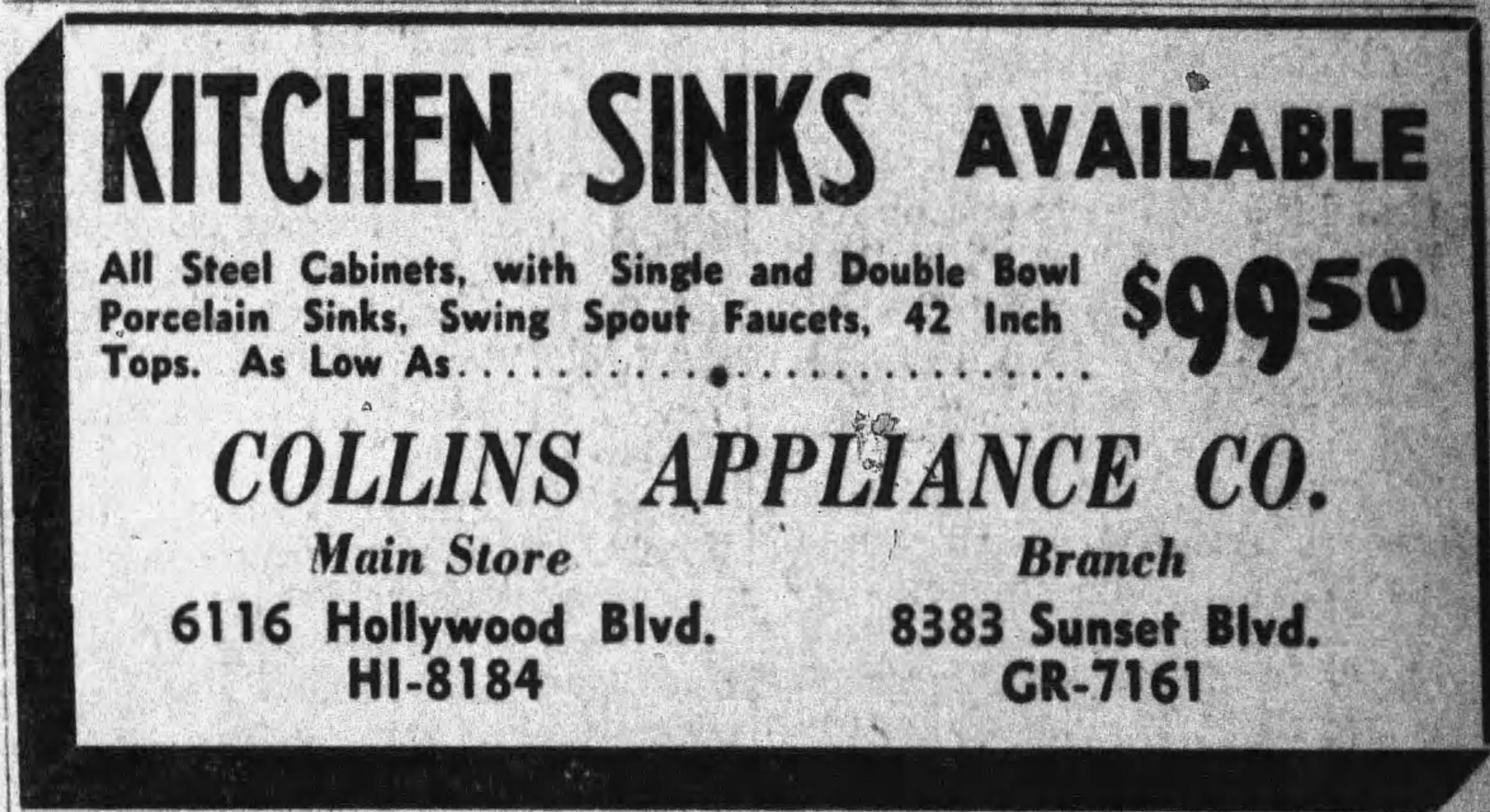
Hollywood Citizen News 7/19/1946.
The building became a film studio for Harris Productions, which made commercial films and test strips. It was damaged by (the inevitable) fire in June 1949.
As of May 1950, the building became the new home of the Hollywood Gun Shop, which moved here from another automotive building at 6032 Hollywood Boulevard. The gun shop was ultimately the longest tenant the building had had to date- remaining here into 1969.

The Valley Times 6/25/1969.
The building was demolished in 1971. Today it is a parking lot for the adjacent Fonda Theater at 6126 Hollywood Boulevard.
 J. H. Graham
The gun shop used to display a kind of amphibious army duck visible through the front windows, so you might say it continued to be an automotive showplace up to the last days. Oddly, Hollywood Motors Inc. is also a name readable on the building signage of the Ford dealership that went to Hartunian. Could there have been a direct connection to the Lincoln/Mercury guys that moved to Sunset?
LikeLike
Wonder what happened to the duck vehicle. About the Hollywood Motors building signage…Pappy Laurence, who bought the Ford dealership from Al Stuebing in Nov 1954, officially named his company Hollywood Motors, Inc. (aka Hollywood Ford).
LikeLike
There was a Hollywood Motors, Inc. as far back as 1923 but they were handling the Packards over on N. Western by this snippet at the column top: https://books.google.com/books?id=FtI6tAkpdxEC&pg=RA2-PA68&lpg=RA2-PA68&dq=hollywood+motors+inc.+ford+mercury+lincoln&source=bl&ots=Dfx3rjPUjK&sig=ACfU3U2SgqS0tvYwSCNH6-MGxdeyCxFjDw&hl=en&sa=X&ved=2ahUKEwi9vfCOsfOAAxUWJjQIHbWFC0c4FBDoAXoECAMQAw#v=onepage&q=hollywood%20motors%20inc.%20ford%20mercury%20lincoln&f=false
LikeLike
That’s right- Hollywood Motors Inc. Packard dealers existed Oct 1923 to late April 1926. If I ever make it to the 7000 block of this Hollywood Boulevard series I will cover them as they moved there from N. Western (and continued under a different name)
LikeLike
Popping this one in kind of late, but the link leads down to a 1946 film which has shots of the Hawaiian Theater when Captain Kidd was playing. At 2:05 into the clock, the ticket booth followed by a crowd lined up to the west end on the sidewalk: https://www.pacificelectric.org/pacific-electric/western-district/pacific-electric-tracks-in-the-hollywood-freeway-a-missed-opportunity/
LikeLike