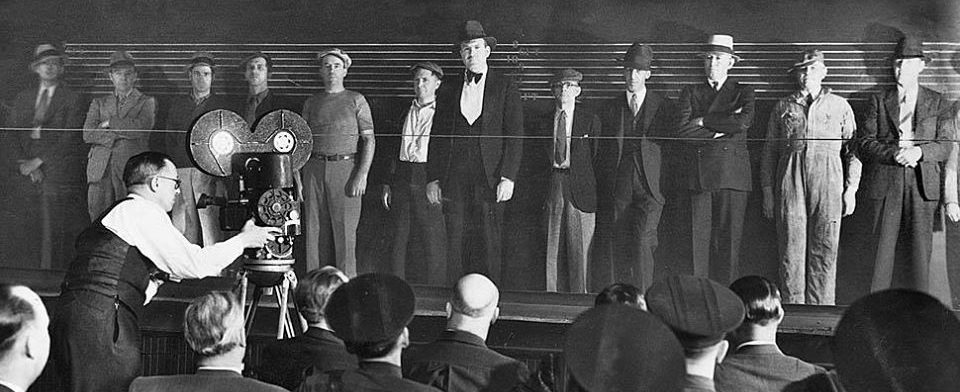

Eskimo Village, 1930. California State Library photo.
Located in the Mount View Tract and separated from the Mountain View Inn to the east by an alley called Brokaw Place (connecting Hollywood Boulevard to Carlton Way), Eskimo Village Miniature Golf opened at 6004 Hollywood Boulevard in August 1930 at the height of the nation’s short-lived miniature golf obsession. It wasn’t the only miniature golf links to open on Hollywood Boulevard that summer. It wasn’t even the only mini golf links on this block- there was Shady Greens across the street on the Brokaw ranch property, and Loma Linda links down the street. But it was certainly one of the most unique courses.
Organized by Sid Algier, a film director, it was meant to be the first in a chain of Eskimo Villages. The course was designed and built by H.C. Lydecker, a former art director and miniatures expert with the Tiffany-Stahl studio. It had an Alaskan theme with Hollywood studio snow, wrecked ships, totem poles, icebergs and igloos. It opened on the evening of August 7, 1930. Actress Alice White and her future husband, screenwriter Sidney “Sy” Bartlett, officiated.
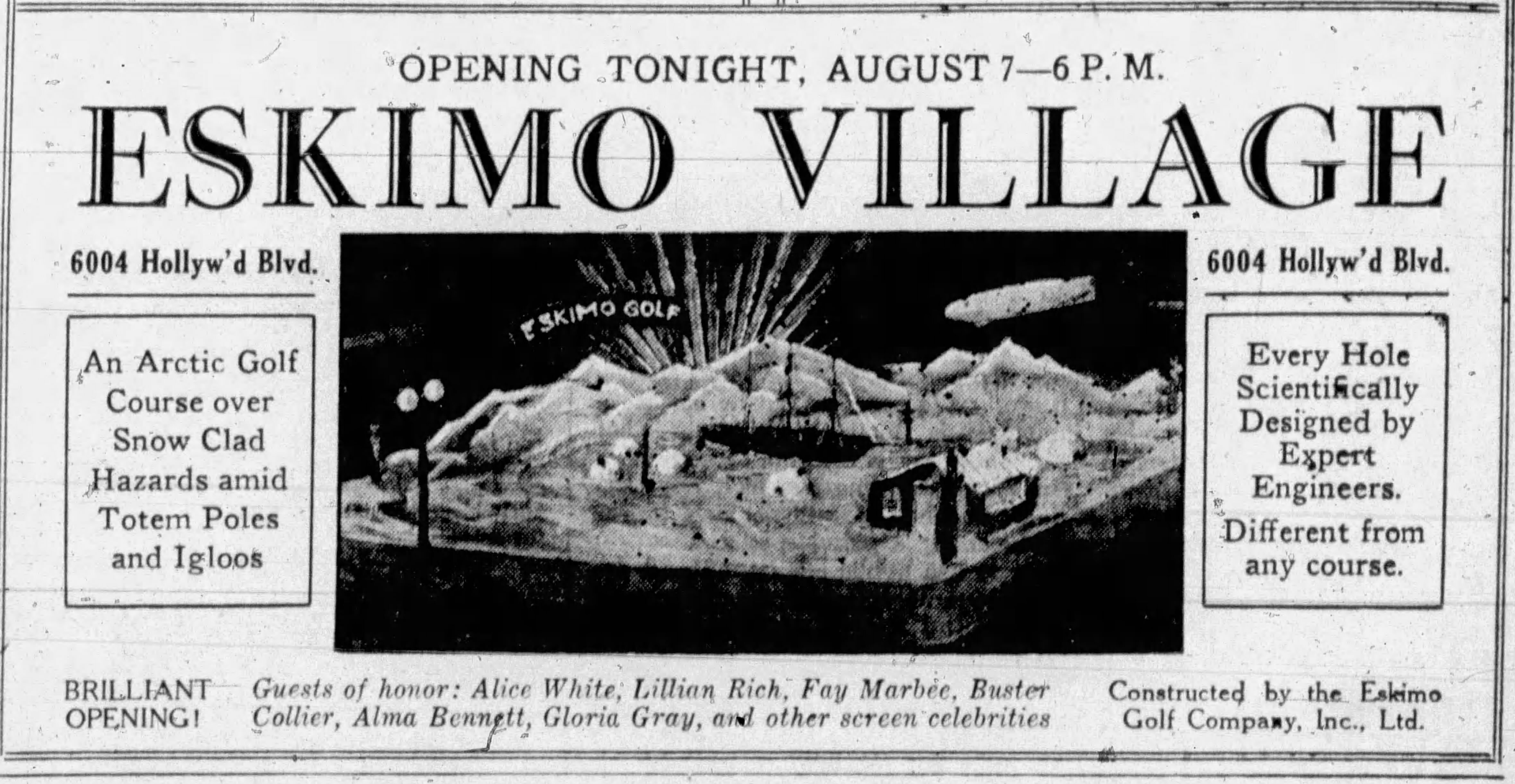
Hollywood Daily Citizen 8/7/1930.
6004 Hollywood Boulevard, originally addressed as 556 Prospect Avenue, had been the home of William Thornton Glassell and his wife Fannie.
W.T. Glassell was born in California in 1863. He was named after his uncle, who had been a captain in the Confederate Navy during the Civil War. His father had come West from Virginia during the Gold Rush. Widowed in 1898, in 1901 he married Fannie E. Moore, lately arrived from England and 20 years his junior.
By 1905 the couple had settled in Hollywood with their two young children and William’s grown son from his first marriage. The ranch house was set amid a lemon grove.

LA Express 4/22/1905
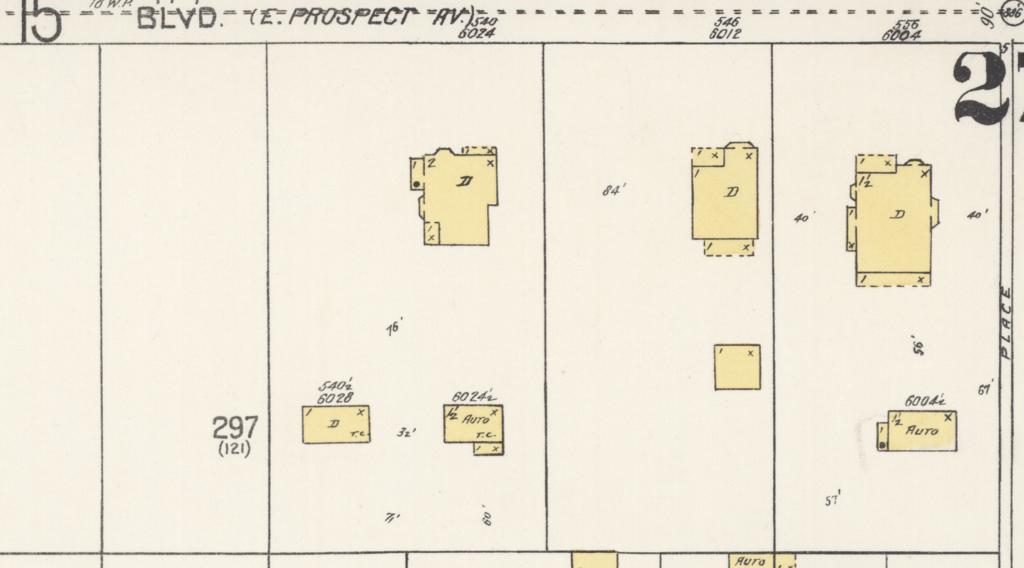
The Glassell residence, 6004 Hollywood Boulevard. Detail of a 1913 Sanborn Fire Insurance map. Library of Congress.
William Glassell died in January 1918. Fannie relocated with the children and rented 6004 Hollywood Boulevard, initially as a residence then for retail use as the Boulevard became increasingly commercial. She remarried in 1920 and became Fannie M. Shippee.
In March 1922, a film actress turned real estate agent named Mary Vittitoe obtained a permit, with Shippee’s permission, to build an office on the Glassell parcel. A. F. Leicht was the architect listed. The unique structure, shaped like a lighthouse, became an instant landmark when Mary opened for business, as 6002 Hollywood Boulevard, in July 1922.

Originally it was going to be 6004 Hollywood Boulevard but Mary opened her lighthouse-shaped office as 6002. Hollywood Daily Citizen 3/10/1922.

Postcard view of Mary’s lighthouse-shaped office.
Mary billed herself as the “youngest real estate salesgirl in the world.” How young was she? Well…. In the 1920 US Census Mary’s age is listed as 18. She appears in the census of 1900, however, as a year-old baby; her birth date is given as May 1899. In the 1930 US Census, Mary shaved even more years off her age, stating that she was 25. For 1940 and 1950, though, she reverted back to her actual age. The May 1899 date is correct; therefore she would have been 23 when her lighthouse office opened. Did that still make her the youngest real estate salesgirl in the world? Who was to say.
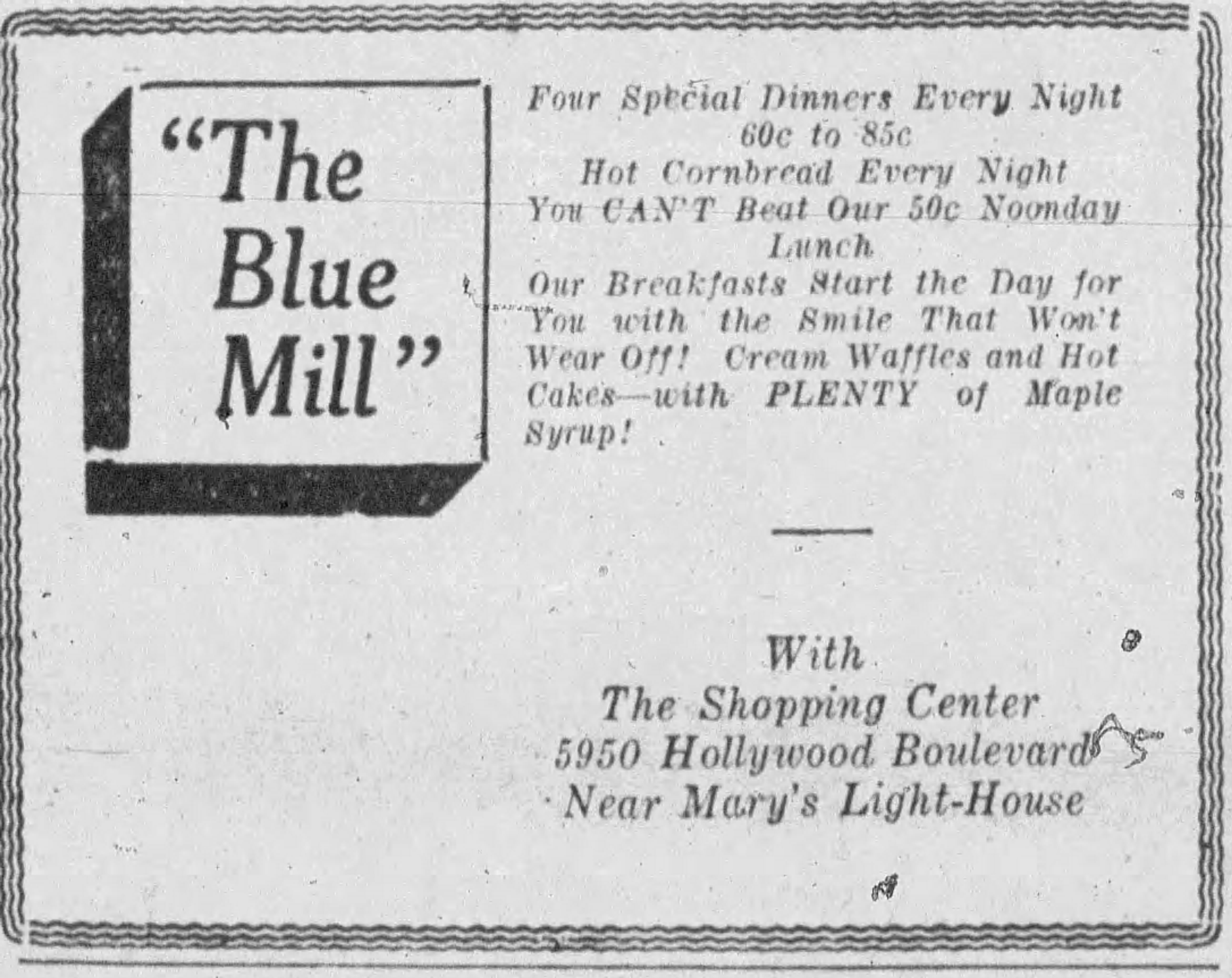
Mary’s Lighhouse referenced in an ad for the Blue Mill cafe, located in the new “The Shopping Center” at 5950 Hollywood Boulevard (later Gordon Warren Chevrolet). Hollywood Citizen News 6/6/1922.
Mary advertised at this location until early April 1925; later that month she moved to 5908 Hollywood Boulevard.
Mary’s lighthouse was repurposed as Lova’s Treasure Chest gift shop in 1925; in 1926 it was the Hollywood branch of the Pacific Coast Mortgage Company, specializing in automobile loans.

Hollywood Daily Citizen 11/24/1925.

LA Times 11/25/1926.
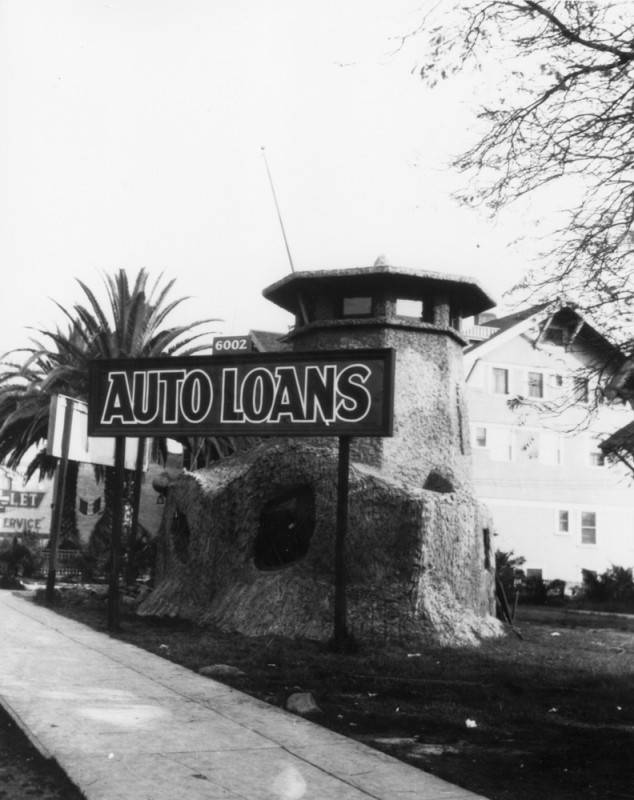
Mary’s lighthouse at 6002 Hollywood Boulevard, repurposed as an auto loan office. The Mountain View Inn can be seen behind it. LAPL photo.
In December 1923, local papers reported that C.B. Christie of the Christie Hotel had taken a 99-year lease on the property from Fannie Shippee. He planned to build a 12-story hotel there, he said- encouraged by the mammoth hotel recently proposed for the Brokaw property across the street. Like that project, this hotel would never come to be and whether the lease story was true or pie in the sky, Shippee retained control of this property. No structure taller than 1 story would ever be built on it.
In July 1925, Walter Jay Israel, a former Hollywood costume director for Frank Lloyd Productions, Joseph M. Schenck and Jackie Coogan, opened the Hollywood Costume Company, a costume and theatrical supply store, here. In January 1926, L.L. Burns of the Western Costume Company, then located at 937 S. Broadway, purchased Israel’s business and stock. Israel was appointed manager of Western Costume’s costume department.

LA Times 7/5/1925.
In June 1928 Shippee had the residence demolished.
Mary’s lighthouse continued to be used by other business- as of February 1928 it was operating as the Hollywood Brokerage Company. In August 1929 the vacant real estate office was demolished. The lot was now clear. In July 1930 Shippee approved the construction of the miniature golf course and a related lunch stand. Unique as it was, the Eskimo Village links only lasted the one season.
For most of the 1930s into 1941, this parcel, addressed as 6000 Hollywood Boulevard, served as the used car lot of Chevrolet dealer Gordon Warren of 5950 Hollywood Boulevard. After 1941, it was the used car lot for the auto dealership at 6028 Hollywood Boulevard, home to Plymouth, De Soto and most recently Lincoln-Mercury. On May 13, 1957 it became the new home of Hollywood Ford, which moved here from 1748 N. Cahuenga.
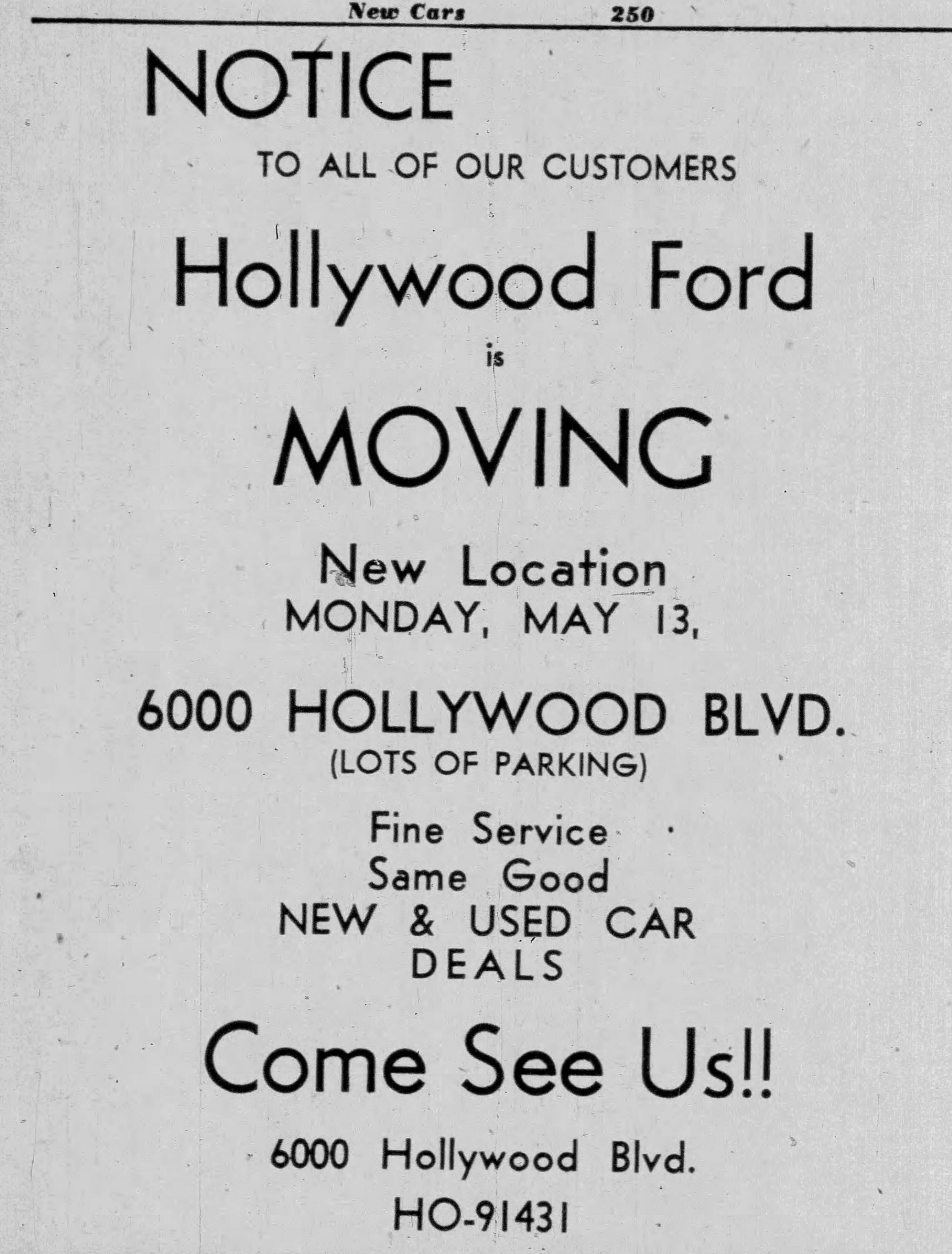
LA Times 5/10/1957.
This was the Hollywood Ford. There was another Ford dealership at 4531 Hollywood Boulevard, run by John G. Caddell from 1930-1941, which became Boyle-Fox Ford, the Cort Fox Ford. This was considered East Hollywood. (It will have its own post).
Hollywood Ford could be traced back to A. C. Gray, who became Hollywood’s authorized Ford agent in May 1912. He operated from his Reliable Garage, just off Hollywood Boulevard.

Hollywood Citizen 3/8/1912.

Hollywood Ford Agent A C Gray now operated out of 1627 Cahuenga as of June 1912. Hollywood Citizen 6/21/1912.
In November 1912, Gray partnered with E. A. Walden, former Ford dealer in Peabody, Kansas, who had recently moved to Hollywood. Now known as Walden and Gray, the firm constructed a new garage on North Cahuenga just north of Hollywood Boulevard at 1716 N. Cahuenga. It would open by April 1913.
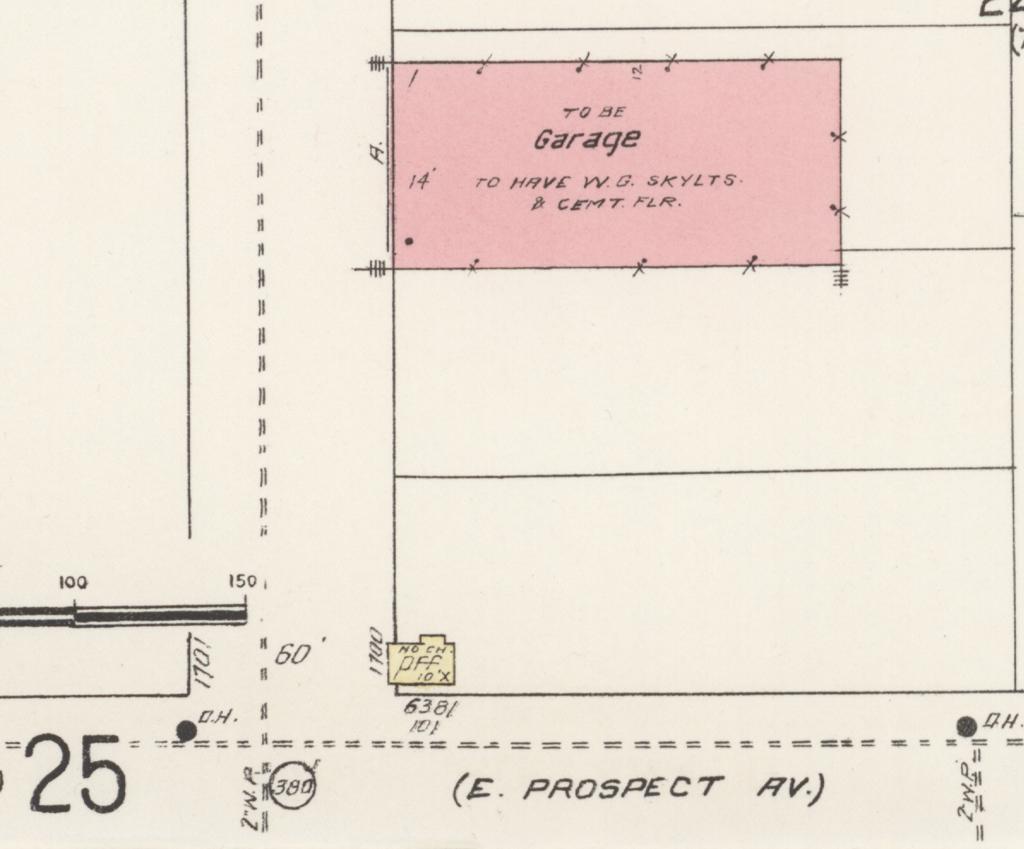
Detail of a January 1913 Sanborn Fire Insurance Co. map for Hollywood showing the Walden & Gray Ford garage under construction at what would become 1716 N. Cahuenga. Library of Congress.

Hollywood Citizen 4/25/1913.
Walden and Gray operated the Ford dealership out of 1716 N. Cahuenga, Hollywood together through April 1918, when Walden turned his share of the business back over to Gray. Gray continued at 1716 as the Gray Motor Car C., Hollywood branch of the Ford agency.
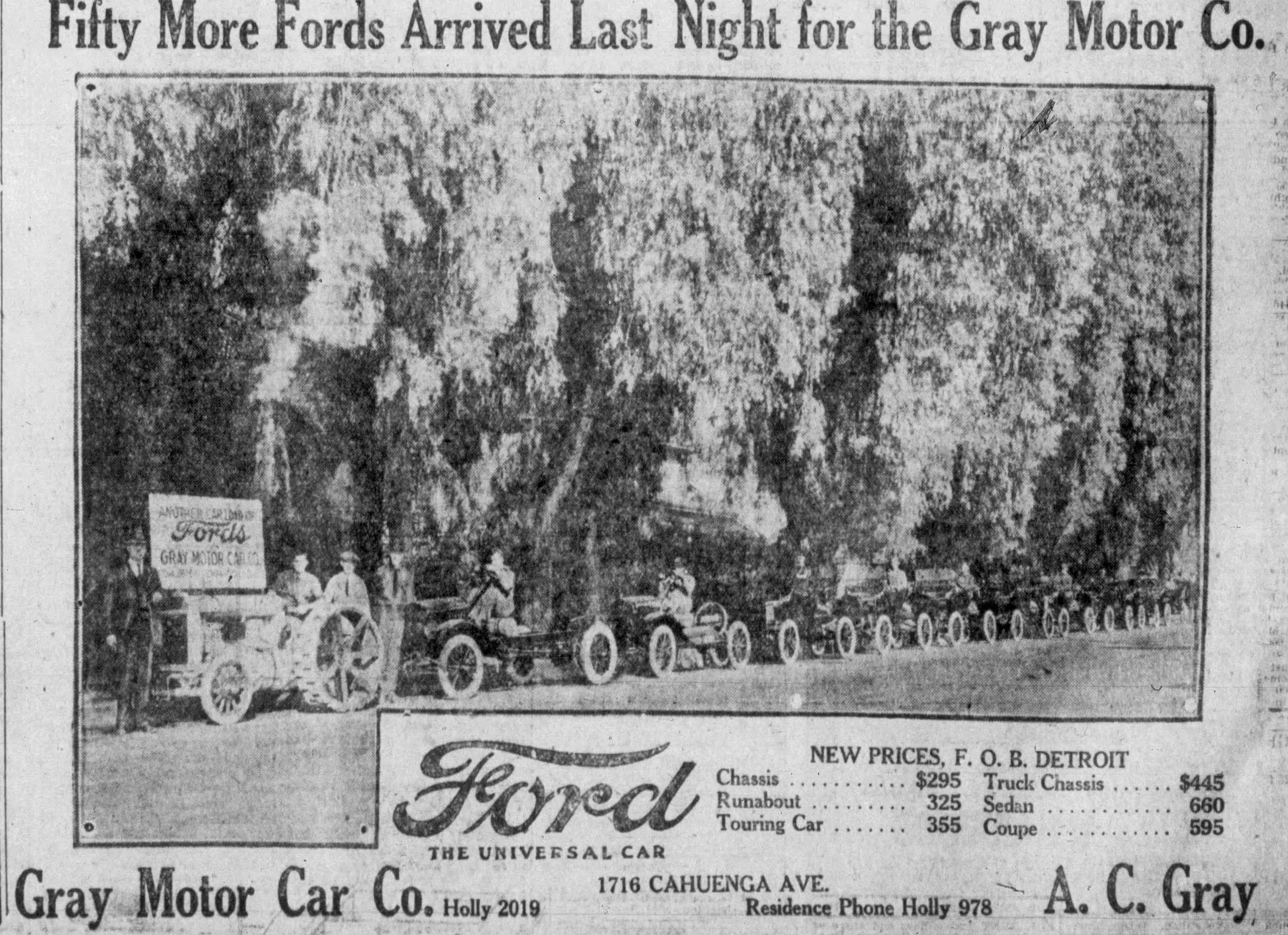
Hollywood Citizen 12/7/1921
In January 1922 A C Gray’s son C. A. Gray, Hollywood Dodge dealer of 1734 N. Cahuenga, moved into 1716. Dad A. C. Gray’s Gray Motor Co. Ford dealership moved into 1734 and also occupied a new garage just north of that at 1742 N. Cahuenga. Gray senior would be back to using 1716-1920 in 1930 then back to 1742-1748 N. Cahuenga in 1932.
1716 N. Cahuenga later became the popular Tick Tock Tearoom.

Built for Walden and Gray Hollywood Ford dealer, 1716 N. Cahuenga became the Tick Tock Tearoom in 1934.

Hollywood Citizen News 11/28/1934.

Hollywood Daily Citizen 6/10/1922

Hollywood Daily Citizen 9/19/1930.

Hollywood Citizen News 8/17/1932.
Gray Motor Car Co. Ford occupied 1734-1948 through 1935.
In January 1936, Douglas Applewhite took over the Ford dealership. Applewhite had been working for A. C. Gray since 1917, most recently as a salesman. He renamed the dealership Douglas Applewhite Inc. He also had a used car lot at 6350 Santa Monica Boulevard.

Douglas Applewhite became the new Hollywood ford dealer in January 1936, taking over the Gray Motor Car Co. Hollywood Citizen News 1/29/1936.
In May 1939, Al Stuebing, former Ford dealer of Long Beach, took over Douglas Applewhite Inc. and continued to operate the Ford dealership here at what was now addressed as 1748 N. Cahuenga. Stuebing also marketed Ford products at 5457 Crenshaw Boulevard and would later have a used car lot at 1335 N. Vine. His dealership was known as “Stuebing Hollywood Ford.”

As Al Stuebing Hollywood Ford. Hollywood Citizen News 5/17/1939.
Hollywood Citizen News 5/18/1949.
Hollywood Citizen News 6/27/1953.
Effective November 19, 1954, DeForest “Pappy” Laurence, formerly general manager of a Ford dealership in Studio City, took over Al Stuebing Hollywood Ford, still at 1748 N. Cahuenga, and renamed the business Hollywood Motors, Inc., but more commonly known as Hollywood Ford.

Hollywood Citizen News 11/2/1955

Hollywood Citizen News 12/31/1954.
In May 1957, Pappy Laurence announced that his Hollywood Ford Motors had moved its headquarters from 1748 N. Cahuenga to enlarged new quarters at 6000 Hollywood Boulevard, adjacent to Pearson Lincoln-Mercury.
In May 1970, Fannie Shippee died. In June 1970, the Ford Motor Company, having over time acquired the adjacent parcels to the west to the corner of Gower, had these lots cleared of extant structures. The address 6000 Hollywood Boulevard now included 6028 and 6032 Hollywood Boulevard.
In January 1983, Hollywood Toyota moved to 6000 Hollywood Boulevard, sharing the space for a time with Hollywood Lincoln-Mercury. Today 6000 Hollywood Boulevard is still the Hollywood Toyota dealership.

LA Times 1/24/1983.

LA Times 6/24/1983.
Notes:
The permit listing A.F. Leicht as architect is also stamped “cancelled” so it’s not clear if it was carried out. Ultimately, Mary’s building was constructed. If A.F. Leicht designed Mary’s lighthouse, it’s interesting that he was later commissioned to design a series of lighthouses for Amiee Semple McPherson’s “Navy of the Lord” tabernacles. The architect sued McPherson in December 1929 for nonpayment of his services, stating that he had carried out the commission for McPherson between June 1925 and January 1928.


 J. H. Graham