Franklin Delano Roosevelt was elected president in November 1932, defeating the 1-term incumbent Herbert Hoover, who four years earlier had won in a landslide partly on a platform of retaining the Volstead Act. Since then his failed economic policies had sent the stock market into a tailspin and plunged the country into an economic depression. Millions of Americans were out of work and couldn’t even legally drown their sorrows. After his inauguration March 3, 1933, Roosevelt wasted no time in making good on his campaign promise to repeal national prohibition. Continue reading
Gangsters
Spike Takes in the Olympics
Los Angeles papers had been reporting the antics of Edward “Spike” O’Donnell for years. Noted for his many brushes with death at the hands of his rivals, the nattily-dressed O’Donnell was always good for a pithy quote or two.
Bugsy Siegel in Los Angeles Part 1
The year that Bugsy Siegel arrived in Los Angeles to be the New York mob’s man on the West Coast varies from source to source. Siegel himself claimed in a legal document that he had been a resident since 1935. It’s known a that he visited at least twice before that, starting in 1932.
Charles H. Crawford
Much of what is written about Charles Crawford and his Los Angeles crime syndicate today comes from a series of articles written in 1939 for Liberty magazine’s, based on information from cafeteria owner Clifford Clinton’s citizen-led vice investigations. Clinton’s work was sincere, but by that time Crawford was long dead and he was relying on secondary sources for information about him. The following is based on my original research.
Clinton’s efforts led to the voters of Los Angeles ousting Mayor Frank Shaw in 1938, often cited as the first mayor of a major U.S. city to be recalled. However, Seattle’s Mayor Hiram C. Gill beat him to it. Gill was booted out in 1911 after less than a year in office, when the public learned that he and his Chief of Police Charles “Wappy” Wapperstein were collecting a large percentage of the receipts from the Northern Club, a saloon-gambling hall-brothel run by a syndicate that included Charles Crawford.
Bugs Moran’s Boys in Los Angeles
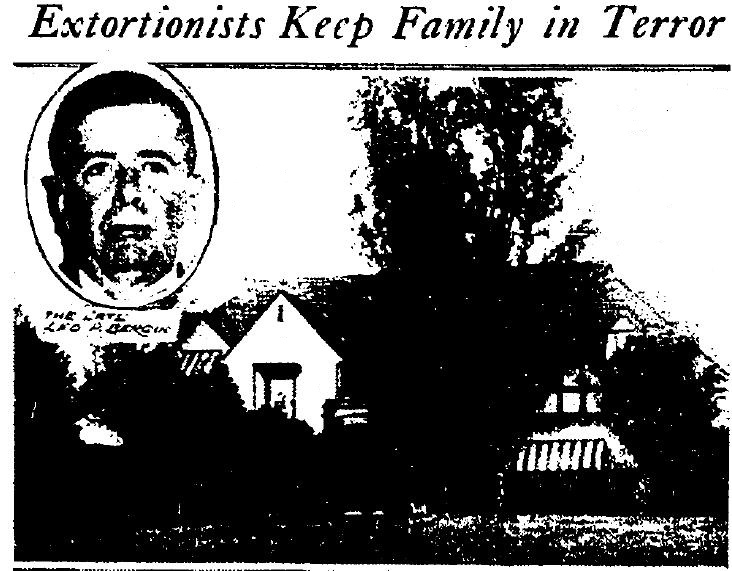
Leo Parnell Bergin was not a gangster or a bootlegger, nor a professional gambler, but a chance encounter with all of the above led to his untimely death in 1931 and exposed the fact that the city had become, in the words of the city’s leading newspaper, a “mecca for gangsters and gamblers from the East.” Continue reading
Paul Crank
The LAPD’s survey, Gangland Killings 1900-1951, documents five local gang-related murders for the year 1931. Chicago would call that a slow Tuesday. For Los Angeles it was a “bootlegger’s war.” Twenty year-old Paul Crank was its third victim. Continue reading
Zeke Caress
E. L. “Zeke” Caress is perhaps best remembered today as the victim of a bungled kidnapping in 1930 but he was also a master odds-maker with close ties to the Spring Street Gang. Continue reading
August Palumbo
The LAPD’s survey, Gangland Killings 1900-1951, list just three gang-related murders for 1928, although newspapers at the time of August Palumbo’s shooting death of July 18 refer to him as the seventh such victim in a “bootlegger’s war” that had been going on for six weeks prior. The 1951 survey also notes that there was “no prosecution to date” in the Palumbo case. In fact, there were plenty of prosecutions, just no convictions. Continue reading
The Jacobson Case
It wasn’t the first time a public figure who opposed Los Angeles’ underworld suddenly found himself involved in a compromising position, intended to either discredit or bring them to heel. But the plot to silence vice-crusading city councilman Carl I. Jacobson didn’t run quite to plan.
A Shooting at the Bella Napoli
Two crimes, ten years apart. The robbery of a Sun Drug employee in May 1923 and a shooting at the Bella Napoli Cafe in Hollywood in August 1933. The connection between these crimes was a long and twisted road paved with gangland vengeance.