5711-5717 Hollywood Boulevard: Ralphs Market

Founded in 1873 by brothers George A. and Walter B. Ralphs, Ralphs was one of the oldest grocers in Los Angeles. The chain had opened its first Hollywood store at 7257 Sunset Boulevard in May 1925.

In January 1929, the chain purchased a site for a second Hollywood store from Security Trust and Savings Bank (soon to be renamed Security-First National Bank), located on a portion of what had been Alfred Taft Sr.’s lemon orchard. At the northeast corner of Hollywood Boulevard and Taft Avenue, the address would be 5711-5717 Hollywood Boulevard.

LAT 1/20/1929

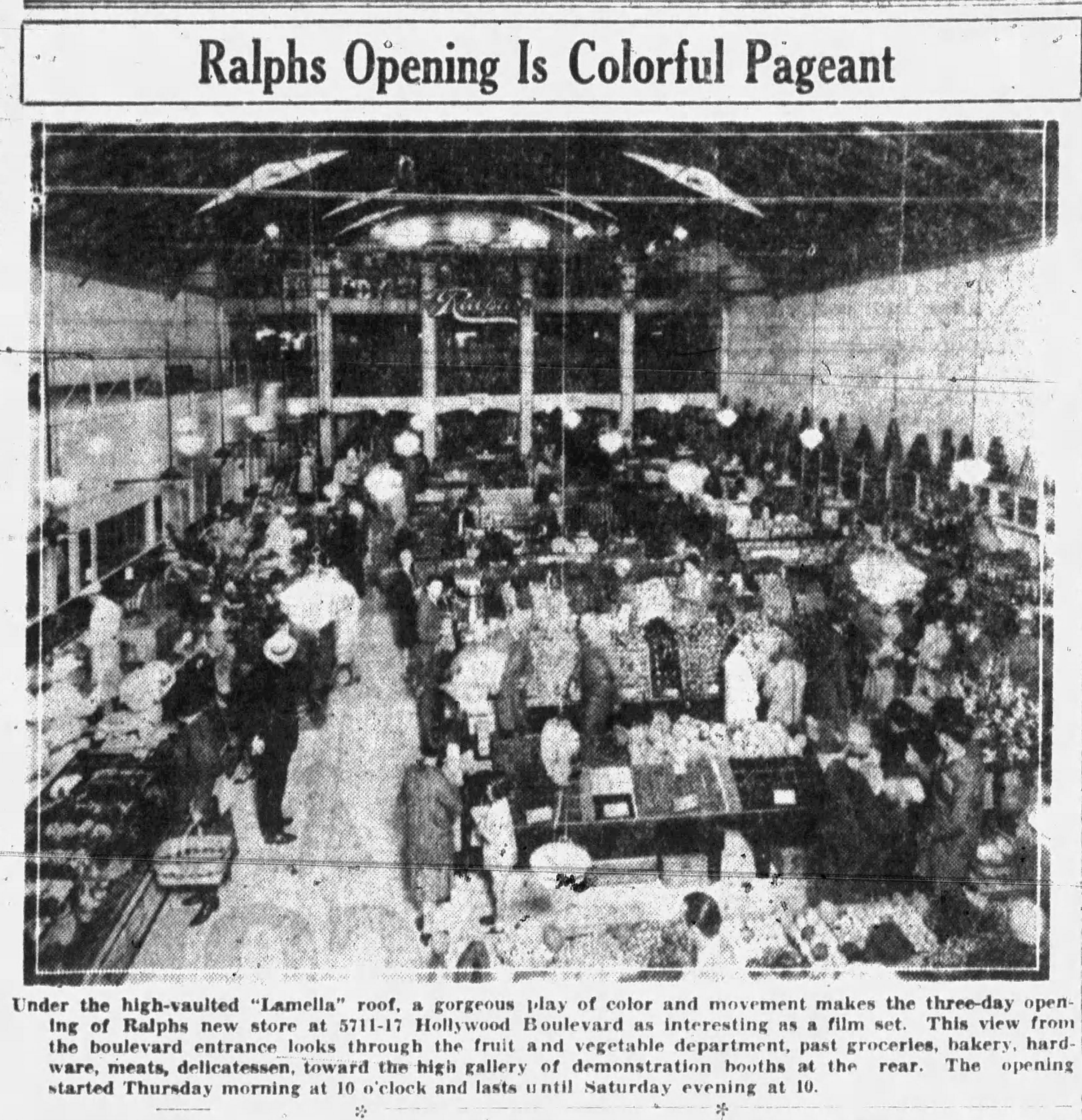
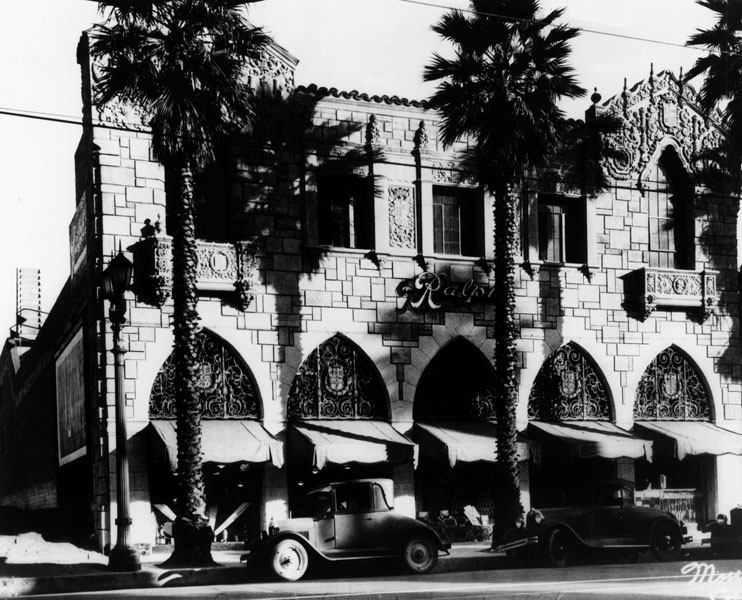
Architect Sidney Newton designed an unusual period-revival building, which the Hollywood Daily Citizen called a “modern interpretation of Spanish architecture.” The outer walls were of simulated antique stone blocks; interior walls were plastered with a simulated stone effect as well. The vaulted lamella roof, with its web of supporting timber beams, allowed the shopping area to be free of posts and pillars.

At the rear of the property was a 3-story garage and warehouse.

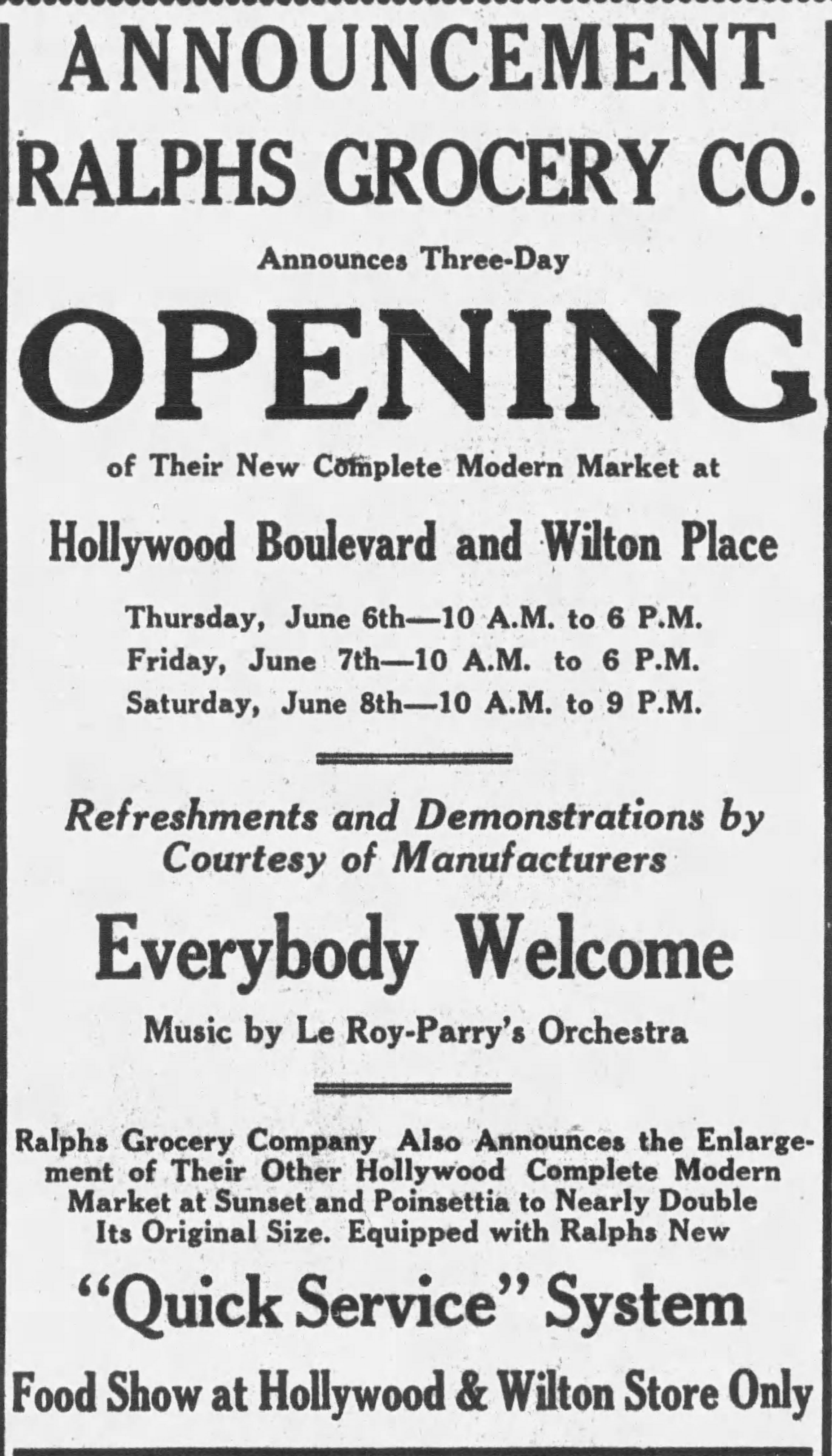
The new store held a 3-day gala grand opening on June 6, 7, and 8 1929.

The new market would introduce Ralphs’ “quick service” system, where customers could shop multiple departments- meat, dairy, bakery, etc, but pay for it all in one place.

La Times 6/6/1929

Hollywood Daily Citizen 6/7/1929

Hollywood Daily Citizen 6/5/1929.

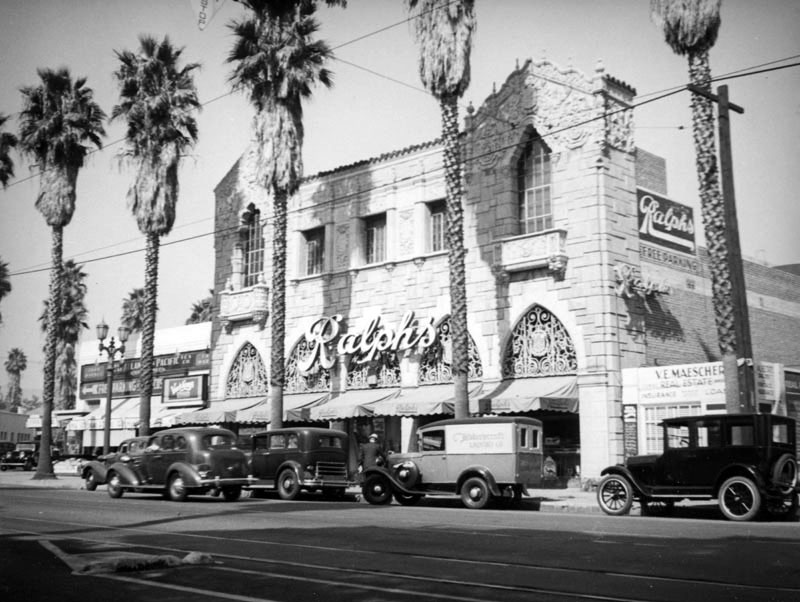
the Hollywood Ralphs c. 1937. LAPL photo.

The store remained in business as Ralphs into 1968. The building became a Pier 1 Imports store. It was demolished in April 1986 for a new Pier 1 building.

5701 Hollywood Boulevard: Security-First National Bank of Los Angeles

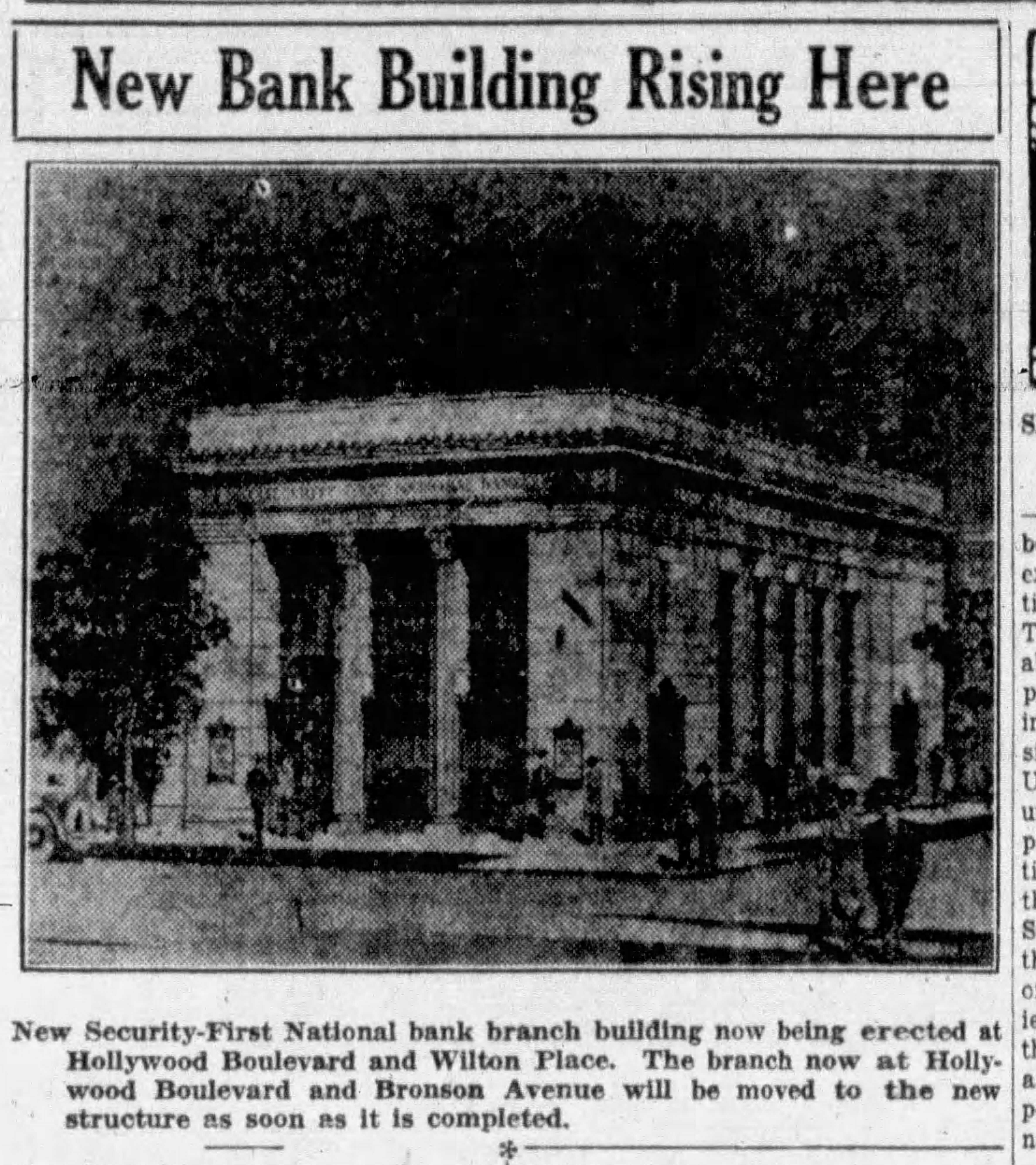
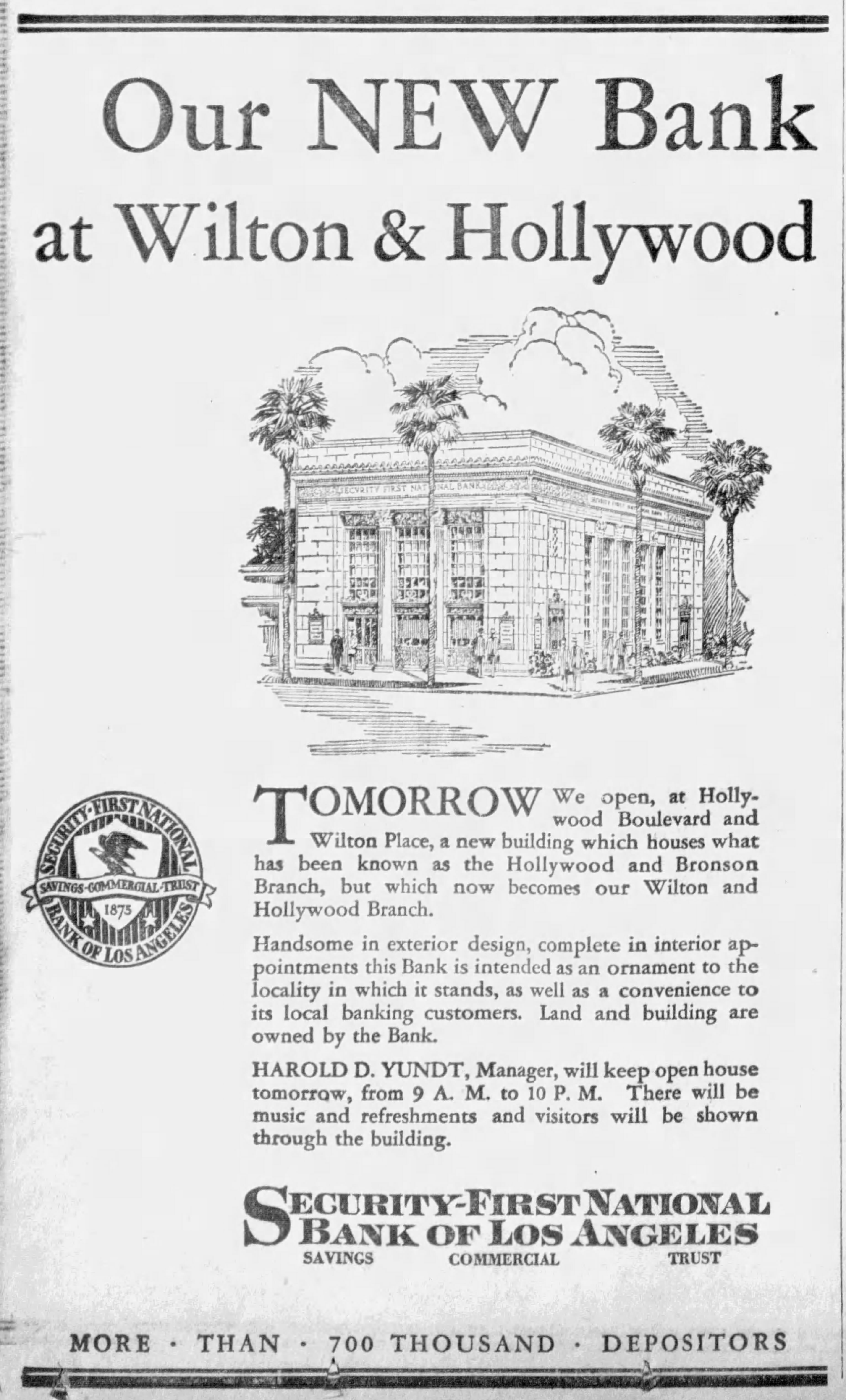
This classical building on the northwest corner of Hollywood Boulevard and Wilton Place was designed by architects Morgan, Walls and Clements for Security-First National Bank of Los Angles in 1929.

A permit for the structure was obtained in November 1929, less than 3 weeks after the Stock Market Crash had caused a major Panic and a run on banks, many of which collapsed. When plans for the bank’s new Hollywood branch were made public in December 1929, depositors must have felt doubly assured that their money was in safe hands and there was no need to withdraw it and hide it under the mattress.

Hollywood Daily Citizen 12/9/1929

Security-First National Bank had come to be in January 1929, the result of a merger between Security Trust and Savings Bank and Los Angeles-First National Bank.

Security Trust and Savings Bank itself had been created in December 1911 when investor Joseph Saroni’s Security Savings Bank consolidated with the Southwest Trust Company and Equitable Savings. Los Angeles-First National Trust and Savings Bank had merged with Pacific Southwest Trust and Savins Bank in February 1924.

LA Evening Express 3/7/1930


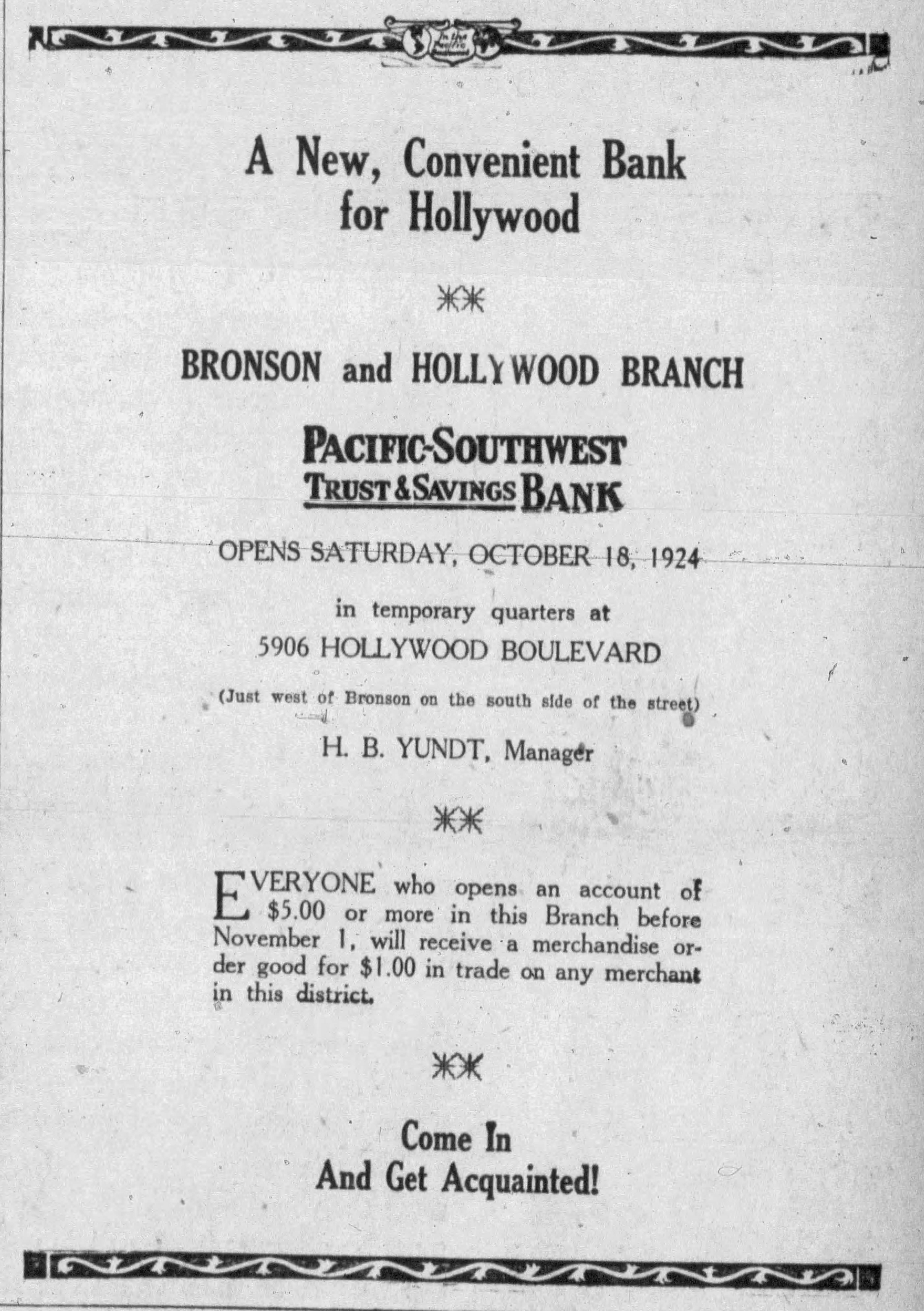
The new Hollywood branch opened at 5701 Hollywood Boulevard on March 8, 1930. It replaced its previous Hollywood branch at 5906 Hollywood Boulevard at Bronson, which had opened only a few years earlier, in 1924, as the Pacific-Southwest Trust and Savings Bank.

Hollywood Daily Citizen 10/17/1924

With such rapid changes, it’s a wonder customers could remember where their bank branch was located, let alone the name of the bank.

Practically every LA child was, or wanted to be, a card-carrying member of Security-First National Bank’s Hopalong Cassidy Savings Club, launched in March 1951, which could net you a letter from Hoppy, a Hoppy bank and other swag, plus coded messages that only members could decipher. On opening day, tellers wore Hoppy costumes but neither Hoppy nor Topper could appear. LA Daily News 3/14/1951.

In 1968, Security-First National Bank merged with Pacific National Bank of San Francisco and became known as Security Pacific National Bank.

The bank’s branch at 5701 Hollywood Boulevard became “Escrow Center” in 1973. The building is a lone survivor, its neighbor, the adjacent Ralphs Market (which also opened in 1930 having purchased the site from the bank) being long gone.

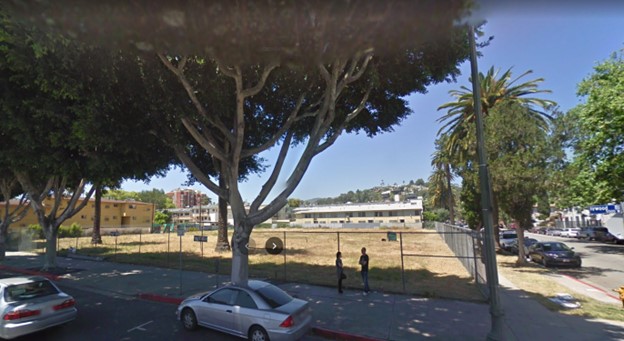
5701 Hollywood Boulevard at Wiltern in 2018. Google map image.

Notes:

In August 1991, after a series of bad overseas investments, Security Pacific National Bank merged with Bank of America and continued in business as Bank of America thereafter.

5555 Hollywood Boulevard: The New Hollywood Apartments

This 3-story wood-frame, stuccoed apartment building was located on the northwest corner of Hollywood Boulevard and Garfield Place. Designed in 1913 by architect Rudolph F. Schering for Coast Utility Investment Company, it was u-shaped with a courtyard in the center, a sun parlor on the roof and billiard parlor in the basement. Known as the New Hollywood Apartments, it was originally addressed as 5553 Hollywood Boulevard.

A permit for the construction was obtained in August 1913- nearly 100 years ago today. The plans were made public September 1913 and the building was ready for occupation by April 1914.

LA Times 9/21/1913

LA Express 4/4/1914

In November 1916, the apartment building was sold to investor Lucalvin M. Hoff for a reported #100,000.

LA Times 12/15/1916

George W. Tackabury took over lease of the property, managing it until February 1922, when he sold the lease to two women, Mattie H. Moore (Miss), who would run the place, and investor Mrs. Beth Lytal. By now the building’s address was 5555 Hollywood Boulevard. It was said to be “noted as the home of many motion picture celebrities.”

It surely well was, but it was also well known to the police blotter.

In 1968, David Chu built a 1-story restaurant on the property, known as Chu Chu’s. It later served a bakery.

Hollywood Citizen News 10/17/1969

The not-so new-anymore New Hollywood Apartments suffered substantial damage in the January 1994 Northridge earthquake and the building was demolished in 1997. The newer restaurant building remained but it too was demolished in 2005. The site sat vacant until late 2011, when the present senior housing complex, known as the Metro at Hollywood, was constructed.

Plan for the demolition of the New Hollywood Apartments, July 1997. LA Dept. of Building and Safety.

Plan for the demolition of the 1-story structure, 2005. LA Dept. of Building and Safety.

Site of the New Hollywood Apartments in 2009. Google map image.

5655-5661 Hollywood Boulevard: Retail Building

This 1-story building on the northeast corner of Hollywood Boulevard and Wilton Place was built in 1929 with four retail spaces addressed as 5655, 5657, 5650 and 5661 Hollywood Boulevard. The architect was Vincent Palmer.

Like its neighbor to the east at 5649-5653 Hollywood Boulevard built only a few months earlier, the architecture was modernistic- a style made popular by the Exposition internationale des arts décoratifs et industriels modernes held in Paris in 1925. Today it would be called Art Deco, a term coined in 1968. Unlike period revival or more traditional architectural styles that took inspiration from the past, Art Deco reflected the fast-paced world of the present and future.

The Hollywood Daily Citizen’s reporter, struggling to describe this new addition to the Boulevard, wrote that it was “built along perpendicular lines that stress the upward movement of the structure. Iron grill work is coated with silver leaf, giving the white-metal effect that is preferred these days.” It was painted a silvery-grey.

This particular form of modernism was popular for a short time only; after 1934, its sharp lines would give way to the aerodynamic curves of streamline moderne style. Both would be very popular on Hollywood Boulevard.

A permit for the building was obtained in November 1929 and ground-breaking took place on December 21, 1929.

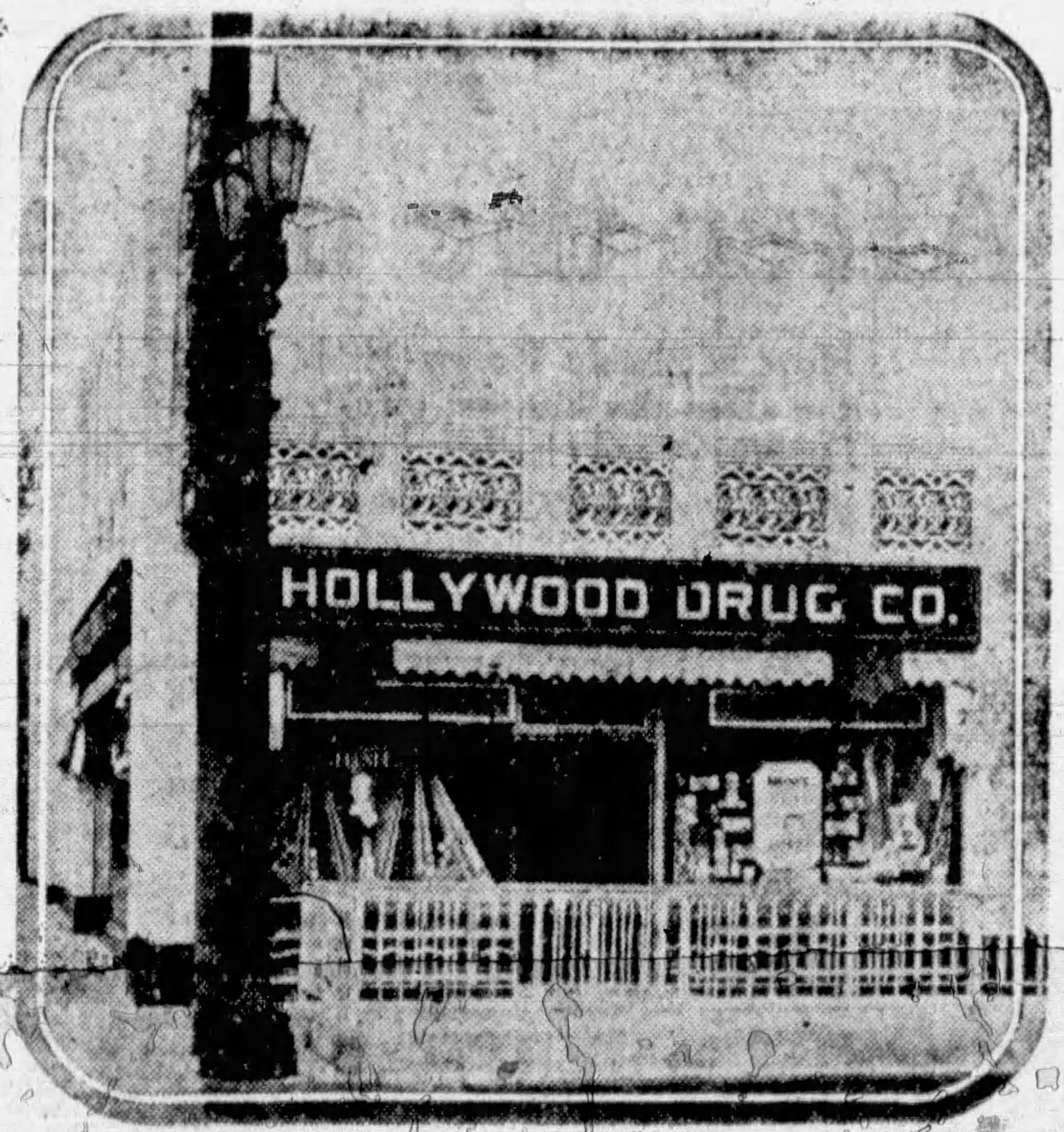
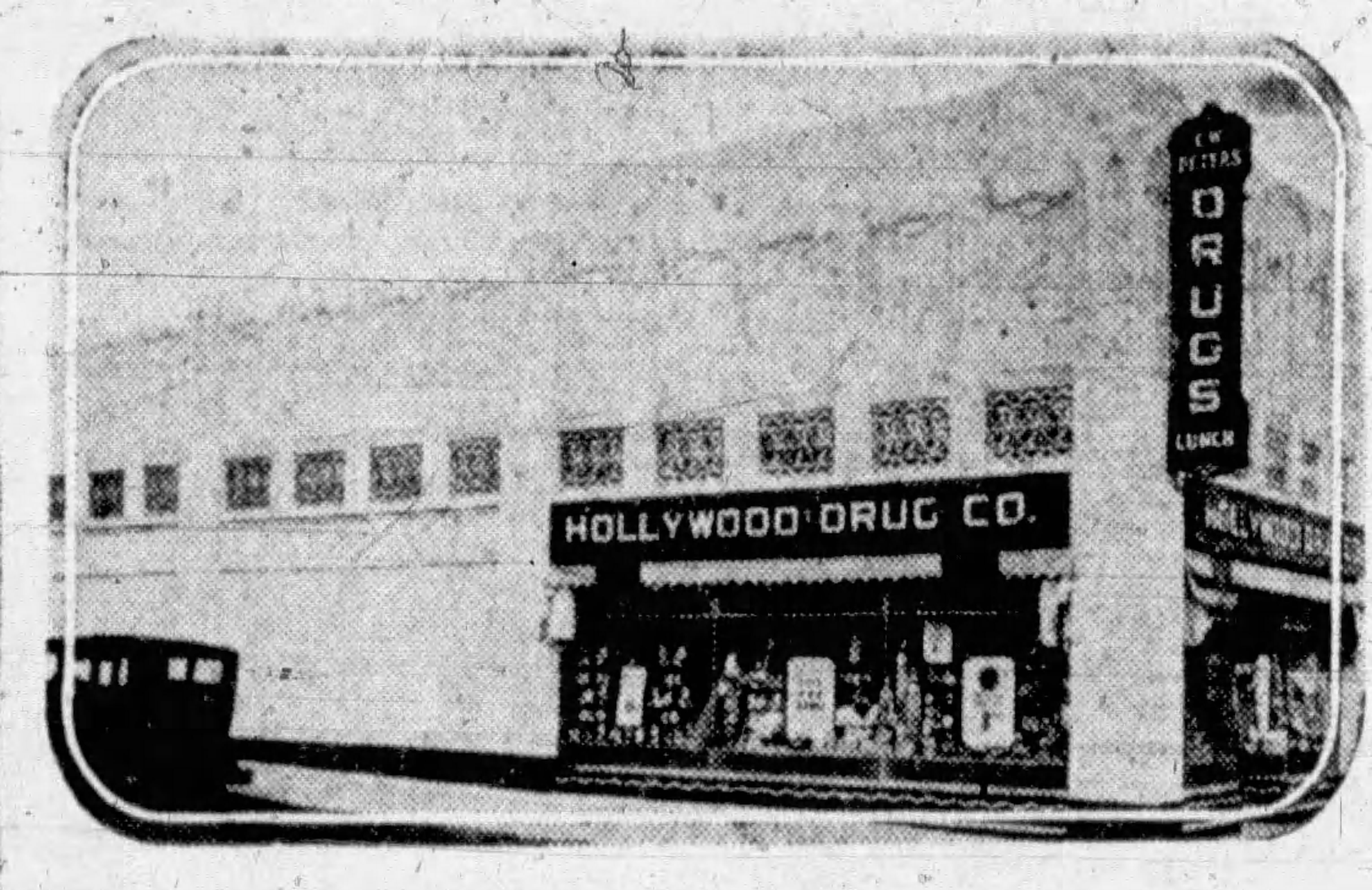
Druggist Charles W. Peters of the Hollywood Drug Company leased the key corner space, addressed as 5661 Hollywood Boulevard, while the building was still under construction.

Peters had been in Hollywood for 7 years and moved his Hollywood Drug Co. here from its previous location at 5600 Hollywood Boulevard with a gala grand opening on April 5, 1930.

Hollywood Daily Citizen 4/4/1930.

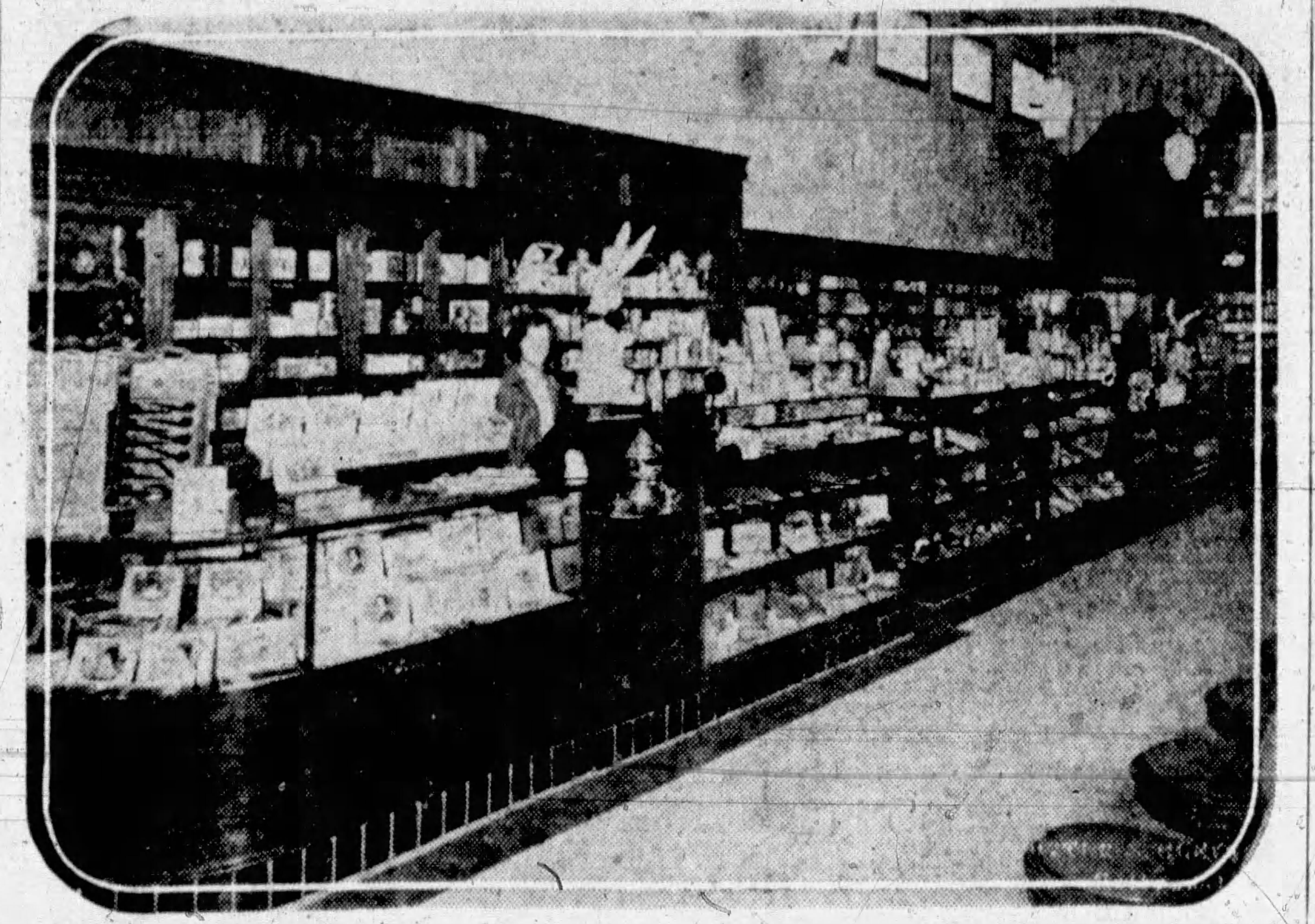
The interior of the store had a “velvety rose colored ceiling,” cream walls, walnut fixtures, and a Terrazzo floor. Like most drug stores at the time, it featured a large soda fountain.

Candy and stationary. Note the high windows, covered on the exterior by iron grillwork. Hollywood Daily Citizen 4/4/1930.

The soda fountain. Hollywood Daily Citizen 4/4/1930

Exterior of the corner store, 5661 Hollywood Blvd., as it looked in 1930. Hollywood Daily Citizen 4/4/1930.

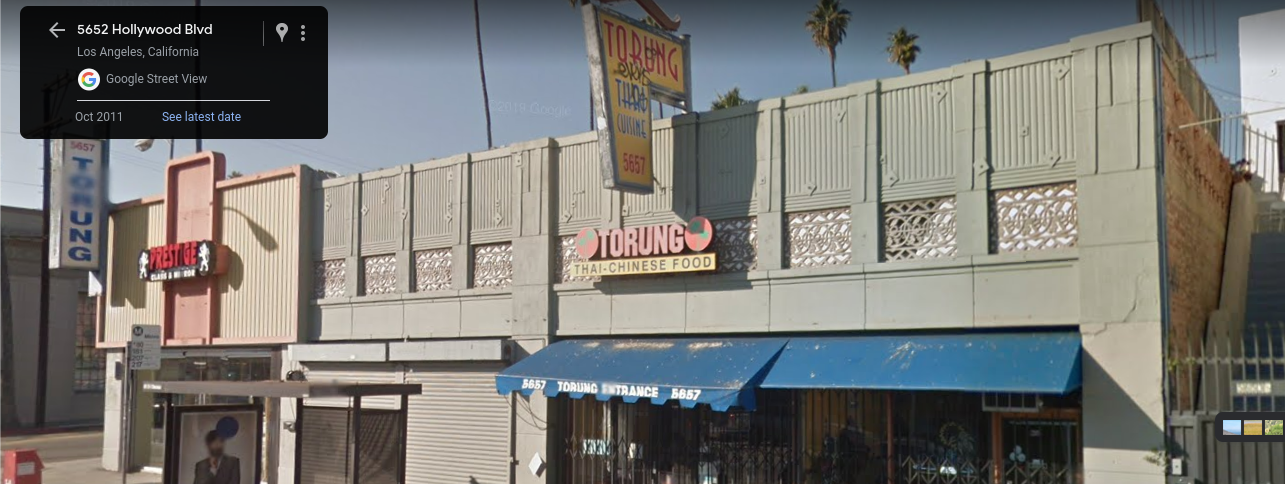
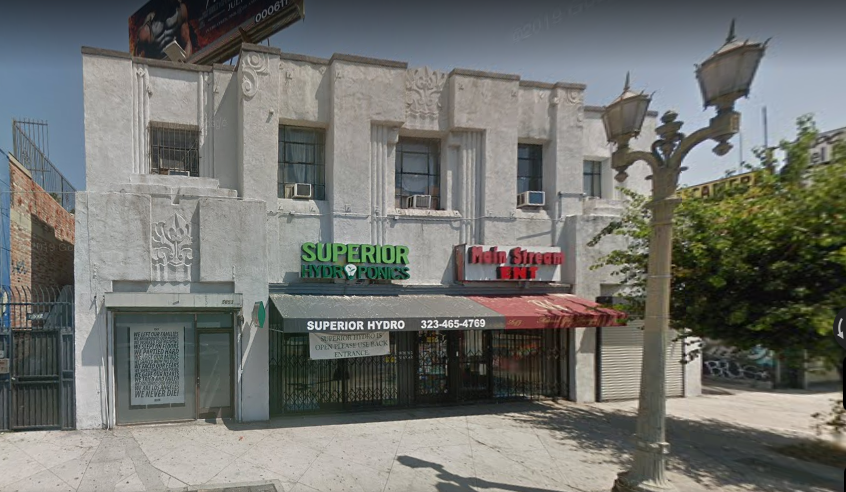
5661 remained an independent drugstore into the late 1970s. The building remains extant. The corner space has been significantly altered c. 1960s, in such a different style that it almost appears to be a separate building from 5555-5559. The original silver leaf grillwork is probably still present under the current modification.

The original grillwork is present on part of the building’s Hollywood Boulevard facade. Google map image.


5657-5661 today. Google map image.

5649-5653 Hollywood Boulevard: Retail/Offices

This 2-story retail and office building at 5649-5651-5653 Hollywood Boulevard (upstairs was 5653-1/2) was constructed in 1929 in the fashionable modernistic style that would now be called Art Deco, a term coined in 1968.

The key tenant, at 5649, was a grocery store chain with the not very catchy name of  “Clarence Saunders, Sole Owner of My Name.”

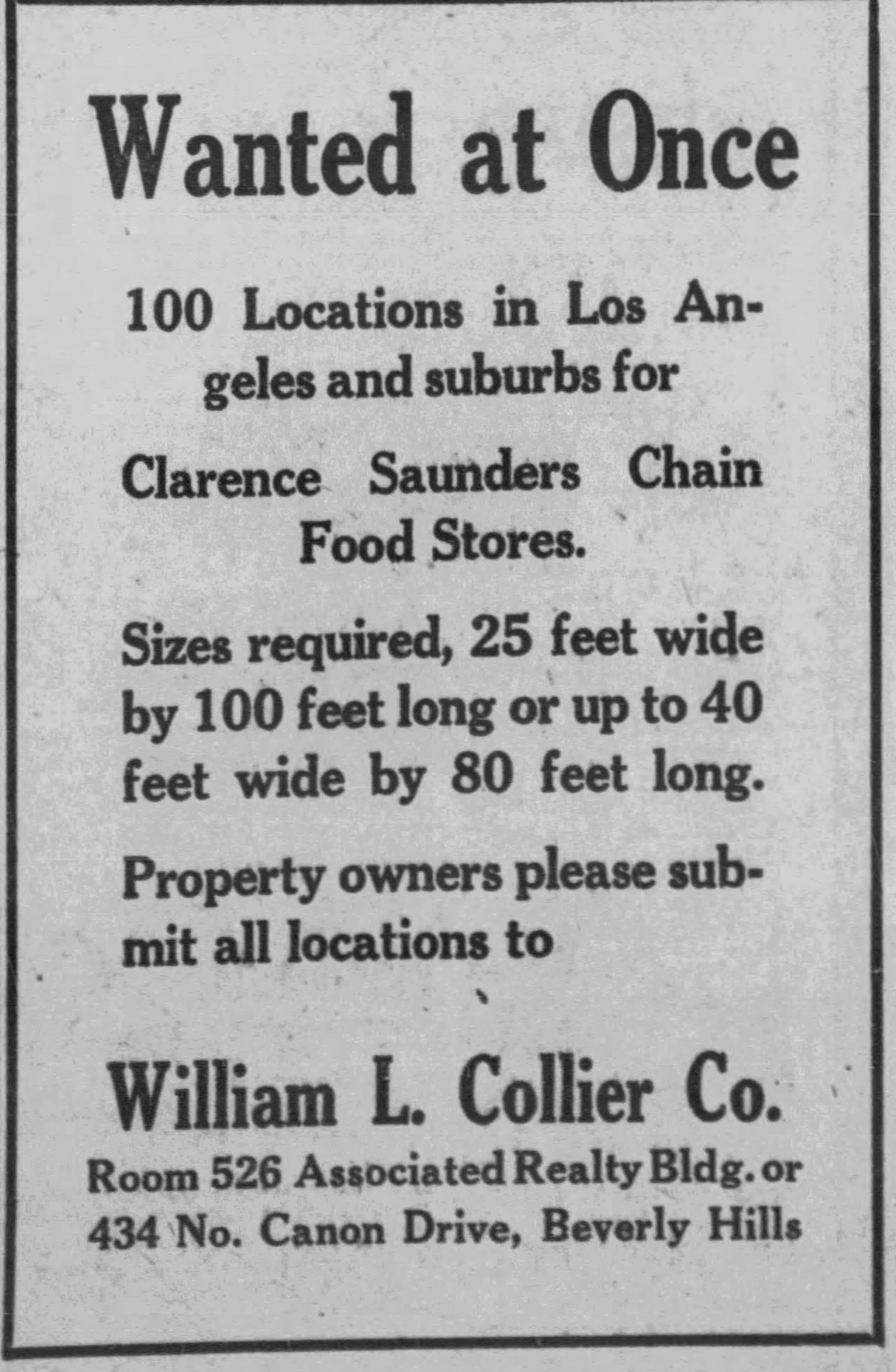
The Saunders chain had announced in February 1929 that it would be opening stores on the West Coast soon. In March 1929, the chain advertised in Los Angeles papers that it was seeking locations for 100 stores.

LA Times 3/14/1929

Los Angelinos may have been familiar with the name Clarence Saunders. He has revolutionized grocery shopping in the pre-supermarket era with his self service markets, Piggly Wiggly, which he founded in Tennessee in 1916. Customers could pick up a shopping basket as the entered the store through a turnstile,and pick out their own items from the shelves rather than presenting a list to the shopkeeper and waiting for their groceries to be retrieved. Due to Wall Street shenanigans, in 1923 he had been forced to give up his interest in Piggly Wiggly, which continued on without him.

In 1928 he founded the “Sole Owner of My Name” chain which likewise operated on a self-service basis.

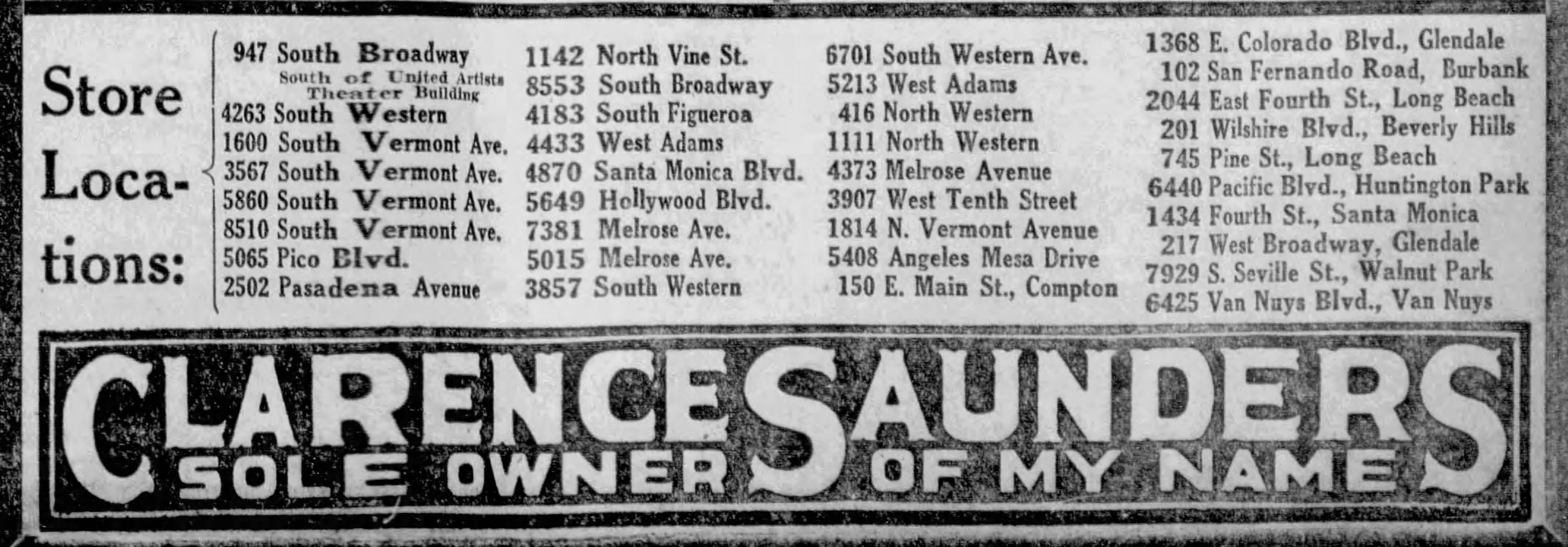
The first Los Angeles area Clarence Saunders Sole Owner of My Name stores- 19 of them- opened on September 7, 1929.

By the time the Hollywood Boulevard store opened here, on December 21, 1929, it was one of 36 local stores.

This ad is kind of a downer, Clarence Sunders, Sole Owner of My Name. LA Evening Express 12/19/1929.

LA Evening Express 12/19/1929.

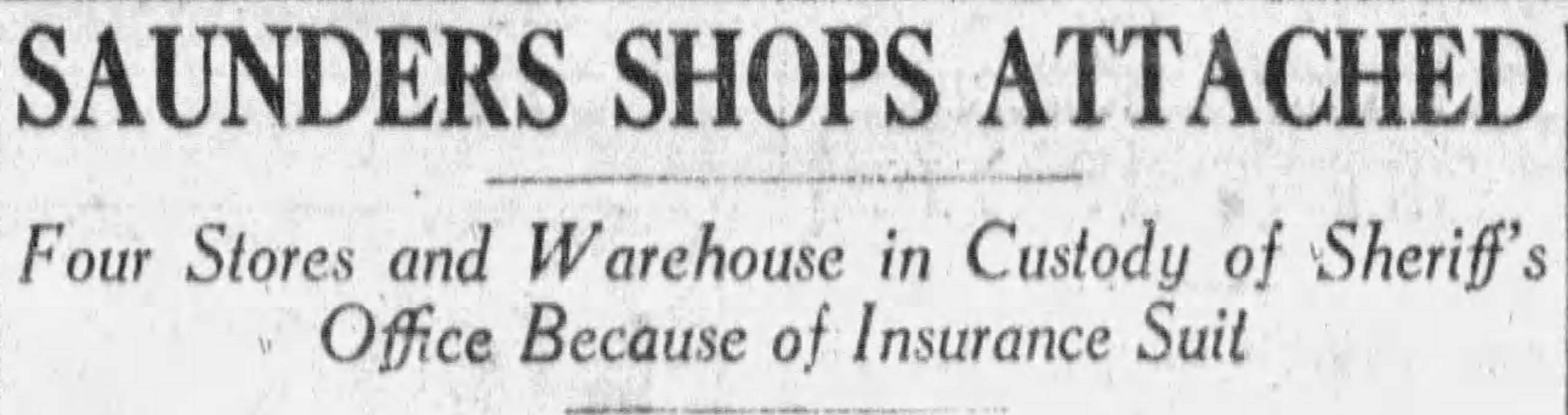
LA Times 4/11/1931

The opening came right after the Stock Market crash of October 1929 and the onset of the Great Depression. The store at 5649 Hollywood Boulevard closed at the end of March 1931, padlocked by the Sheriff’s office due to an insurance lawsuit. In April 1931 the company announced it was selling all of its stores in Los Angeles and San Francisco. In June 1931, Saunders filed for bankruptcy in federal court. He would begin again in a few years’ time.

It was a story that played out again and again during the Depression as chain stores expanded nationally. Unlike mom and pop stores who went into the breadline if they got into debt, corporations could file for bankruptcy, reorganize, and start fresh.

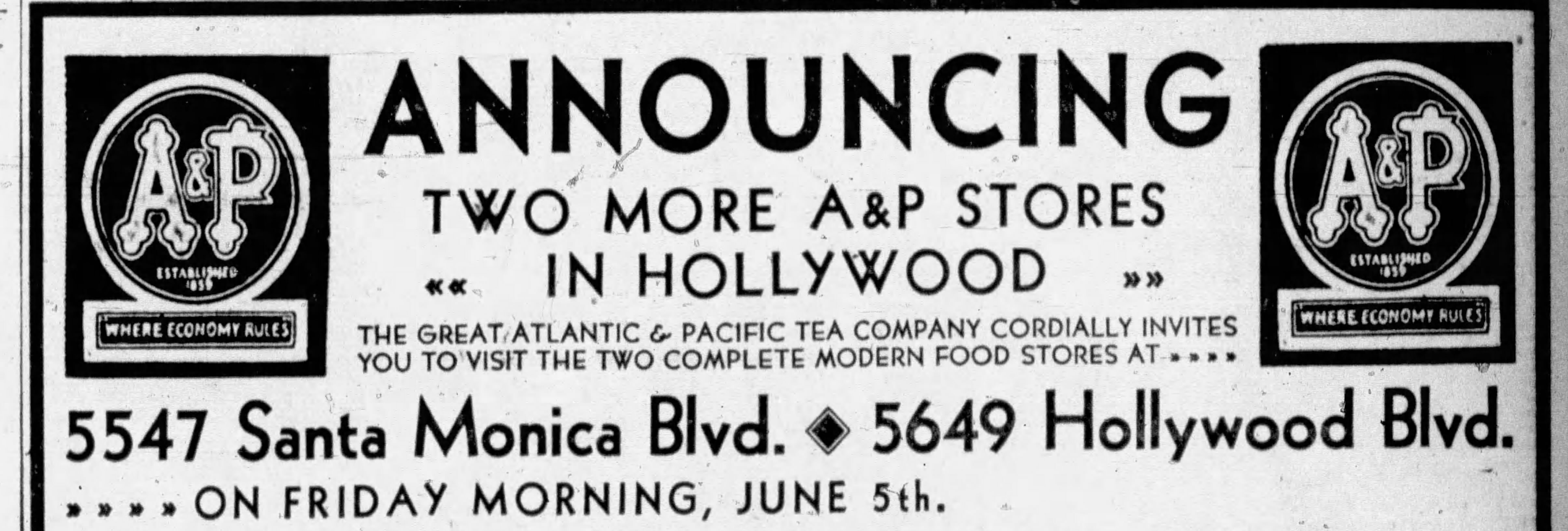
On June 5, 1931, 5649 Hollywood Boulevard opened as another chain grocery store, the Atlantic & Pacific Tea Company, better known as A&P. A&P was only here briefly.

(A&P opened at 5719 Hollywood Boulevard in November 1933, and in June 1940 it moved next door to its 1931 home, at 5635 Hollywood Boulevard.

Hollywood Daily Citizen 6/4/1931

5651 was briefly a Safeway in 1931.

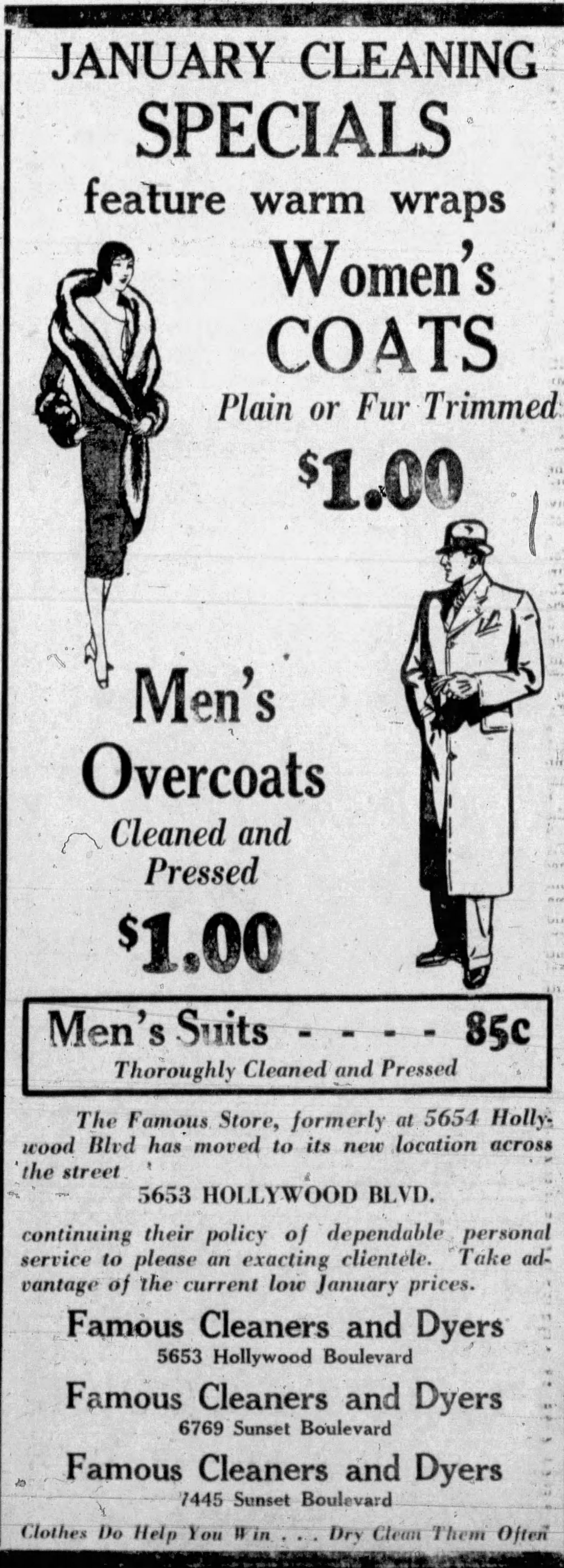
5653 opened in January 1930 as an outlet of Famous Cleaners, who moved here from across the street at 5654 Hollywood Boulevard. Was this the sunny side of the street?

Hollywood Daily Citizen 1/4/1930

The studio on the second floor, 5653-1/2 Hollywood Boulevard was initially to be a physical cultural studio started by Hayden Phythian, physical director of the Hollywood Athletic Club; announced in October 1929, its not clear that it ever opened. The space briefly became the Hollywood School of the Dance, run by I.C. Overdorff; the school moved to 5760 Sunset Boulevard in June 1930. Japanese dance/fencing instructor Micho Ito took it over in October 1930. Ito had previously been a guest instructor with the Edith Jane School (later known as Falcon Studios) and appeared in recitals with Ralph B. Faulkner. (See my posts on the Edith Jane School/Falcon Studios here and here). It became Mrs. R. R. Crow’s Fine Arts School in 1933.

LA Times 6/14/1931

The building is still standing, a good example of a modest late 1920s moderne style that looked to the future for inspiration rather than the past.

5635 Hollywood Boulevard: A&P Market

5635 Hollywood Boulevard was designed in December 1939 by architect Frank L Stiff on spec for the property owner, real estate investor Earl Callan. The first tenant was the Atlantic and Pacific Tea Company (A&P) grocery store. A&P moved here from 5719 Hollywood Boulevard, where they had been since November 1933, having previously been located next door at 5649 beginning in June 1931. The new store here opened in April 1940.

Like most Hollywood grocery stores before World War II, it was originally an open-air market, so that the dazzling displays of colorful local fruit and veg would extend out on the sidewalk, under an awning, to catch the eye of passing motorists. It was later enclosed with glass.

LA Times 4/19/1940

Located in the Morgan’s Hollywood Tract, 5635 Hollywood Boulevard had been the address of J.J. Morgan’s residence. (My post on Jackson is here).

Detail of a 1913 Sanborn Fire Insurance map showing 5635 Hollywood Boulevard when it was still a residence. Library of Congress map.

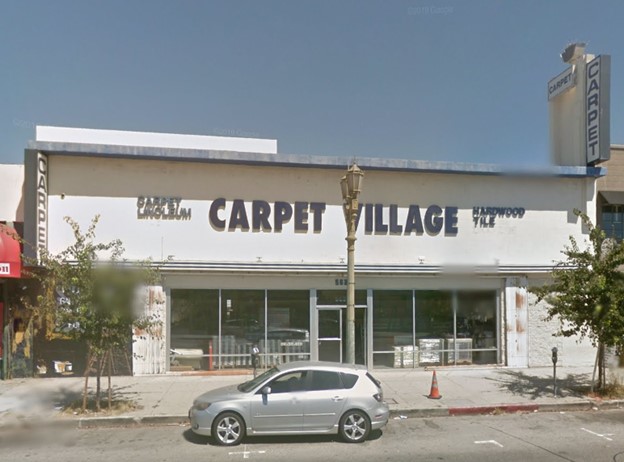
The store remained an A&P into the late 1960s. Today it is a “Carpet Village” flooring shop.


5652 Hollywood Boulevard: The W. O. Jackson Residence/Stores

LA Times 1-8-1922

5652 was the modern address given to the 14-room frame residence of William O. Jackson and his wife Harriet M. Hovey Jackson. The Jacksons came to Hollywood from Chicago with their young sons in 1893 and bought a 10-acre lemon ranch between what is now Hollywood Boulevard and Carlton Way and Wilton Place and St. Andrews Place, which they called Lemona.

In 1918, society architect Frank F. Rasche designed a 9-room home for the Jackson’s oldest son Augustus along the property’s south boundary, addressed as 5653 Carlton Way.

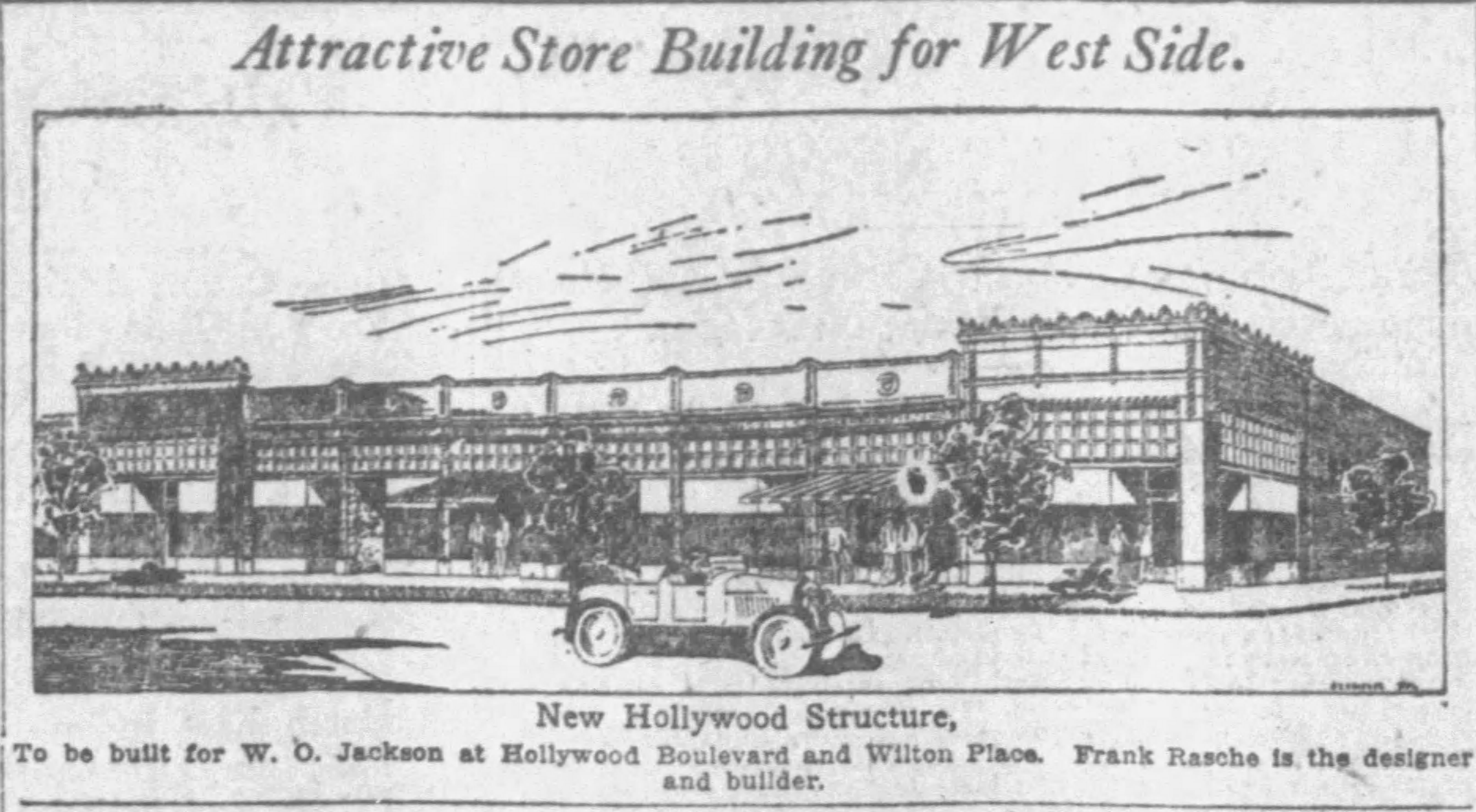
The Jacksons witnessed the phenomenal growth of Hollywood within a fairly short period of time and the increasing commercialization of this section of Hollywood Boulevard. In March 1921, William Jackson obtained a permit to build a row of 1-story stores along the property’s Hollywood Boulevard frontage, addressed as 5648-5664 Hollywood Boulevard, also to be designed by Frank Rasche, who the previous year had built a similar retail complex for B.Y Taft at 5524-5528 Hollywood Boulevard (see my post about this property here). The plans were made public in January 1922.

Hollywood Daily Citizen 1/2/1922

Unlike other Hollywood pioneers who may have subdivided their land and moved, the Jacksons remained in their ranch home, which was no longer visible from the street after the stores constructed in front of it. The ranch house was re-addressed as 1680 N. Wilton Place. The retail space now bearing the address 5526 Hollywood Boulevard became Rasche’s office through most of 1928.

Hollywood Daily Citizen 1/14/1925


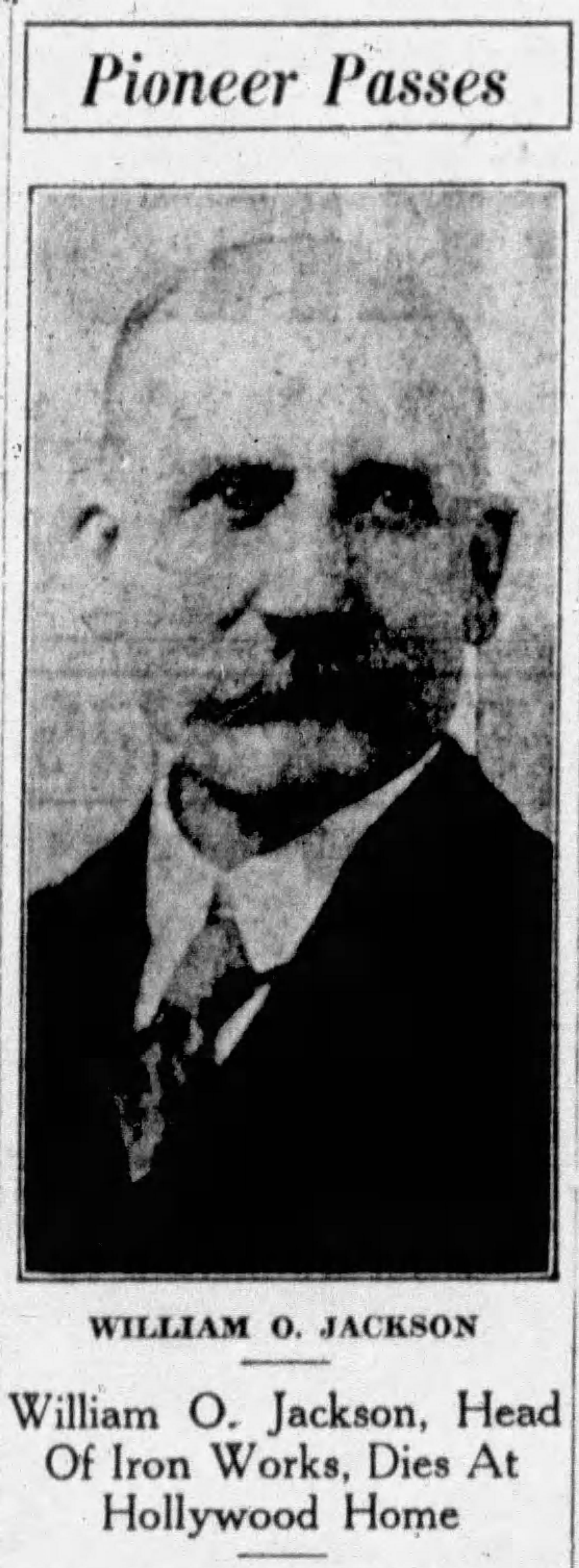
Hollywood Daily Citizen 3/26/1930.

William O. Jackson passed away at home in March 1930. Harriet Jackson continued to reside in the old ranch house until her own death in February 1940. Son A.W. Jackson also remained at the 1918 home on Carlton way, where he died in 1948.

An apartment building was constructed at 1680 N. Wilton Place in 1953.

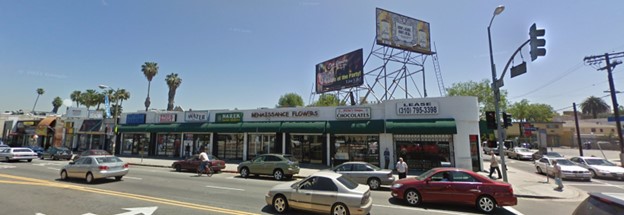
The Frank Rasche retail complex has been altered many times since 1922 but is extant- for the time being- an increasingly rare example of the low-rise development that characterized Hollywood Boulevard in the early 1920s.


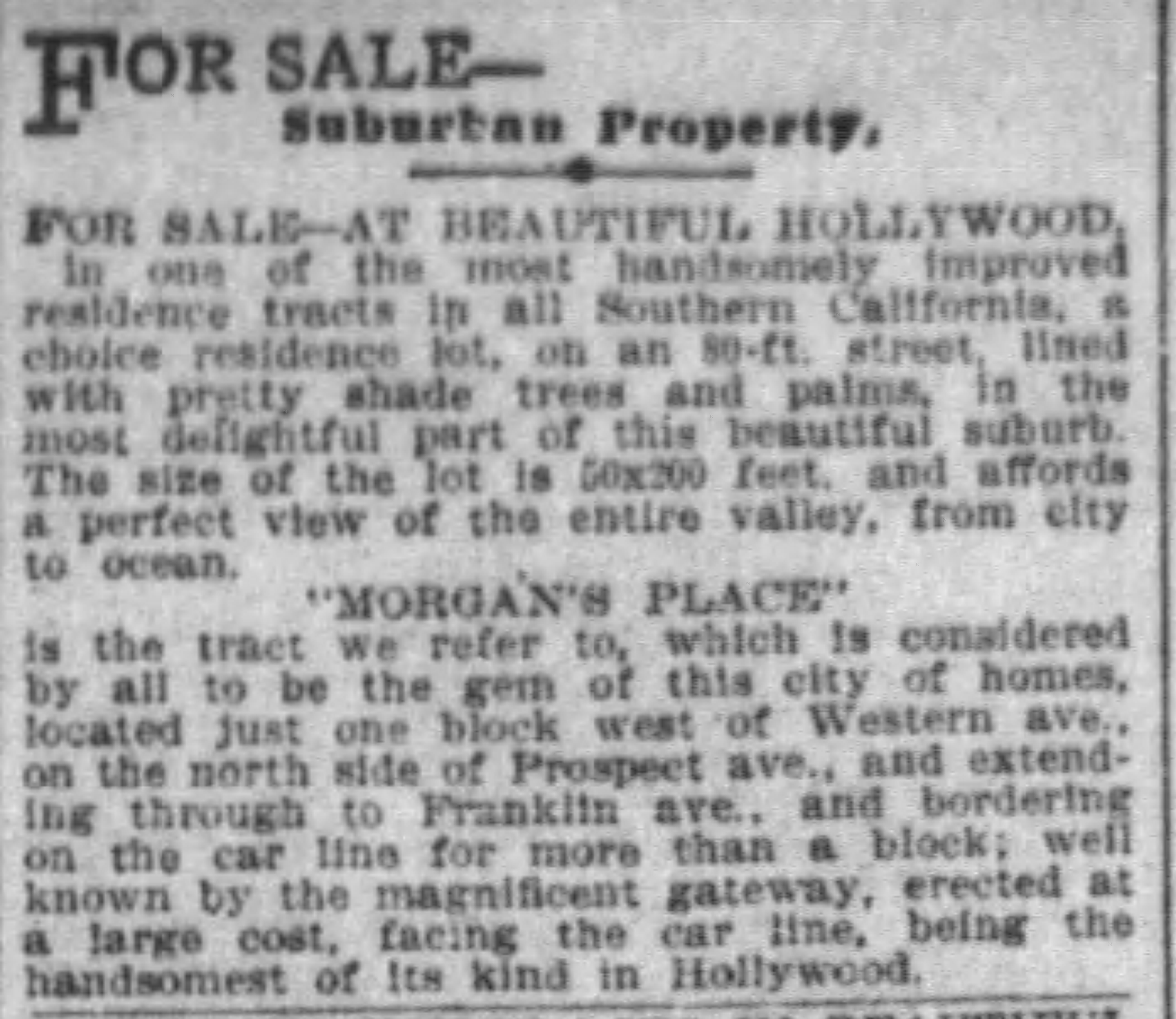
5627 Hollywood Boulevard: Morgan’s Hollywood Tract and Morgan Place


Morgan’s Hollywood Tract was a Hollywood subdivision started in 1905 by Jeremiah J. Morgan. It consisted of 10 acres of ranch and orchard land on the north side of Hollywood Boulevard (then Prospect Avenue) between Wilton Place and Garfield Place and Hollywood Boulevard and Franklin Avenue.

Front and center of the development was Morgan Place, a new street between Garfield and Wilton Place, running from the North side of Hollywood Boulevard to the South side of Franklin Avenue. Subdivided into 97 lots, Morgan Place was improved with cement sidewalks and shade trees. Ornamental gates market the north and south entrances to Morgan Place from Hollywood and Franklin.

LA Times 11/26/1905

LA Times 5/28/1905

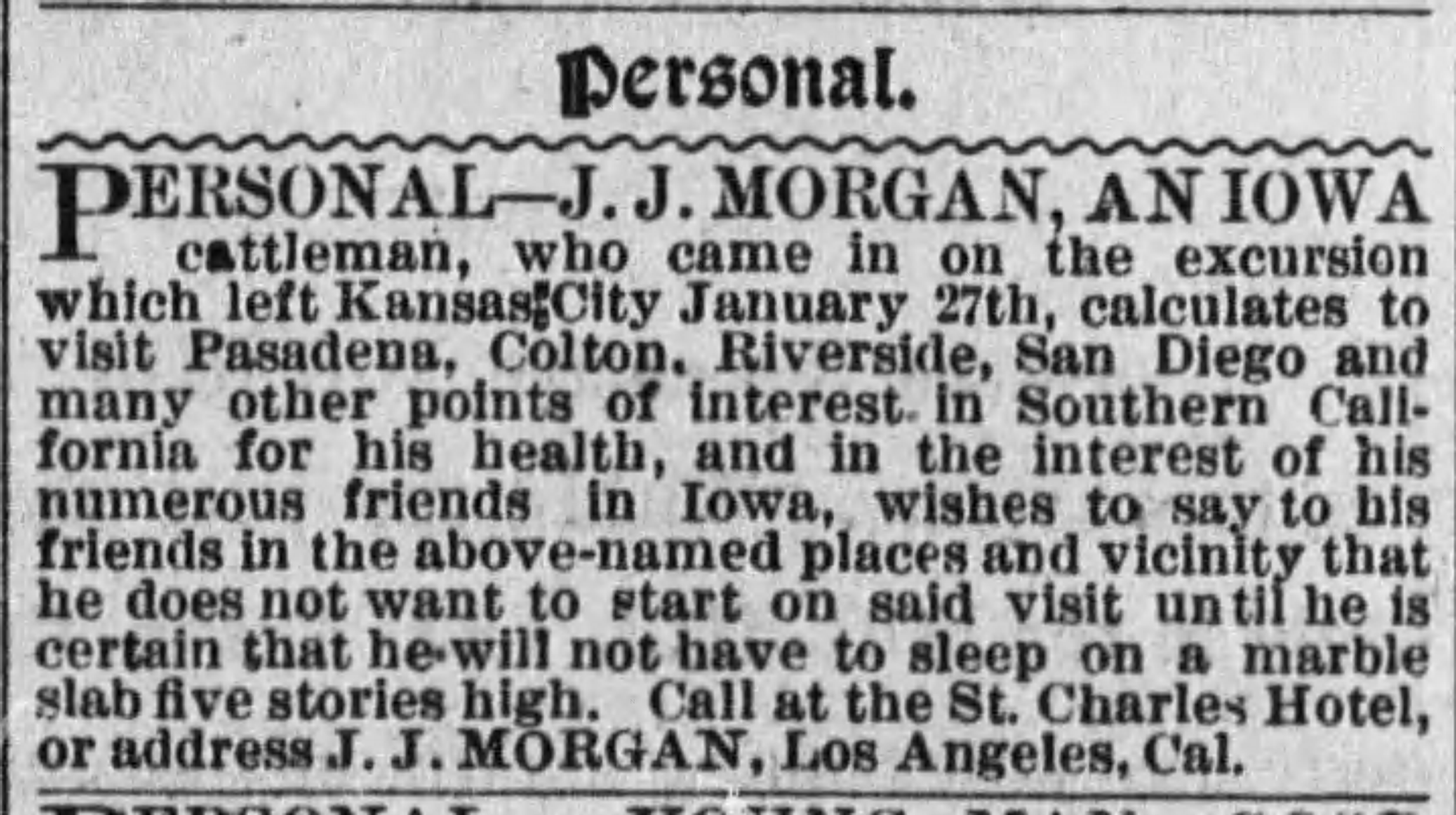
J. J. “Jerry” Morgan was born in Illinois in 1841. After serving in the Civil War, he settled in Iowa, where he raised cattle and later got into real estate and finance. He visited Los Angeles during the boom of 1886 and in 1887 began buying property there.

LA Times 2/3/1887

Morgan describes himself in this ad, disguised as a news item. LA Times 2/17/1887

In February 1902, Morgan settled permanently in Los Angeles and dealt in real estate, setting up offices at 244 1/2 S. Broadway.

The office for Morgan’s Hollywood tract was at the northwest corner of Hollywood and Morgan Place, later addressed as 5627 Hollywood Boulevard. It sat on a large parcel that also contained a residence., originally 955 E. Prospect Avenue, later 5535 Hollywood Boulevard. Morgan lived in the residence for a few years. He later moved to 1836 Taft Avenue.
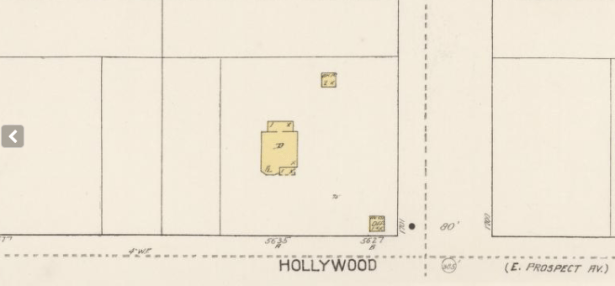
Detail of a 1913 Sanborn Fire Insurance map showing 5627 Hollywood Boulevard. Library of Congress.
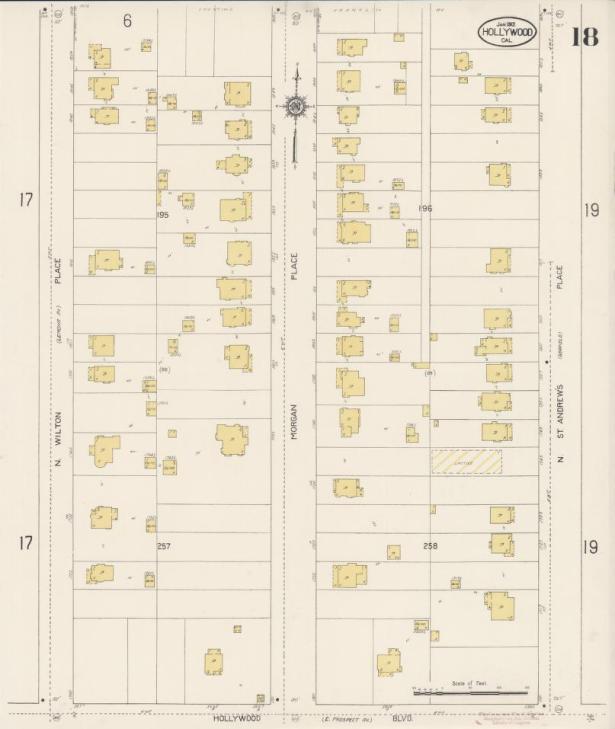
 

1913 Sanborn Fire Insurance Co. map showing the Morgan Place subdivision. Library of Congress.

Morgan acquired additional holdings in Hollywood and with son Alfonso F. Morgan, and as the Morgan Investment Company, created another 10-acre subdivision in the Hollywood foothills north of Franklin between Morgan Hill Dr./Taft Avenue and Wilson Place.

LA Times 4/16/1911.

In addition, J.J. Morgan bought property on the southwest corner of Hollywood Boulevard and Western Avenue. He later constructed a hotel on the Western Avenue side of the parcel and stores on the Hollywood frontage, except for the prime corner, where he planned to build a height limit building.

J.J. Morgan divorced his longtime wife, Alice Jane Lewis Morgan, c. 1908. She died in Los Angeles in 1911.

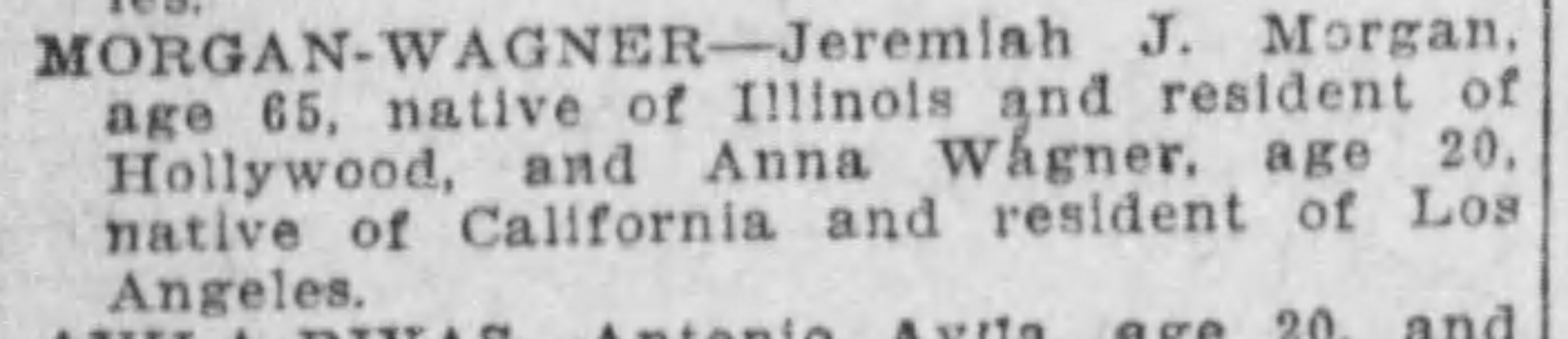
On July 10, 1909, Morgan, 65,  married a local girl, Joeanna F. (Annie/Anna) Wagner, age 20. Like Estelle Doheney- wife of the oil multimillionaire Edward Doheney- Anna had been a telephone operator. (The Doheney age difference was only 20 years, fairly average by Hollywood standards- not 45 years) The couple registered to wed in Los Angeles but ultimately tied the knot in Colorado Springs. After a 3-month honeymoon, they returned to Hollywood and lived in the house on Hollywood Boulevard.

LA Herald 7/8/1909

LA Times 9/10/1909

Morgan was canny enough to make his bride sign an Edwardian version of the prenup, barring her from any claim on his estate in exchange for $5000 cash.  The couple had a son, James George Morgan, born in Los Angeles March 31, 1912. But the May-December union was not a happy one. While on a business trip in Council Bluffs, Iowa, Morgan filed for divorce, which was granted on September 21, 1914. In March 1915, Anna sued, asserting that she’d never been served the divorce papers and that the action was not legal in any case because Jerry had not been a resident of Iowa at the time. Morgan prevailed and generously agreed to pay $5 a week for the support of his most recent son.

Morgan was making plans to develop his corner parcel at Hollywood and Western when he died in Los Angeles on May 31, 1925 at age 84.

Hollywood Daily Citizen 6/5/1925

J J Morgan in 1922; passport photo. National Archives.

He left an estate valued at a reported $1,250,000. There were numerous bequests to relatives, with the condition that they had to “become Christians.”

In May 1926, the City Planning Commission proposed changing the name of the street Morgan Place to Gramercy Place. A group calling itself the “Hollywood Boulevard, Western to Cahuenga, Improvement Association” protested, arguing that the name ought to stay out of memory to old Hollywood pioneer “Jeremiah P. Morgan” [sic] [LOL]. It’s Gramercy Place today, so we know how that went for them.

Hollywood Daily Citizen” 5/15/1926

In January 1927, the Morgan estate sold the Hollywood and Western parcel to Louis B. Mayer of MGM, who built the Hollywood-Western Building on it the following year.

As late as 1936, the corner of Gramercy Place and Hollywood Boulevard remained undeveloped. In January, a William A. Smith bought the property from the Morgan estate. He planned to demolish the old residence and lease the corner to a drive-in market organization. Whether that happened or not, in June 1940 a new A&P market opened at 5633 Hollywood Boulevard where the residence had stood. The Morgan’s Hollywood Tract real estate office at 5627 was moved to 4826 Van Nuys that year and the prime corner space may have been used for parking. In December 1950, a permit was obtained by I. Feldman and P. Rosenberg to build a 2-story retail complex, addressed as 55625-5627-5629-5631 and 5633 Hollywood Boulevard and 1707-1909-1711 and 1713 Gramcery Place. That structure is extant today.

Notes

Anna Wagner remarried in 1917. She died in 1965. Morgan and Anna’s son died in 1988.

In November 1927, a woman named Eleanor McIntyre, residing with Morgan in the 1920 US Census and listed as his niece along with her daughter Viola, then 13, sued the Morgan estate, asserting that she had looked after him for years and was engaged to be married to him shortly before his death. Her sister, Eva Helander, also sued, claiming that Morgan owed her money for a train ticket to Arizona, that she’d purchased the tickets and took “a young girl” named Jean to Arizona with her where the girl, Jean, waited to marry the 82-year old. When he didn’t show up, they returned to Los Angeles.

Detail of the 1920 US Census, which shows Morgan residing with McIntyre, 30, his niece, and McIntyre’s daughter Viola, 13.
5620 Hollywood Boulevard: California Bank Building, Hollywood-Gramercy Branch

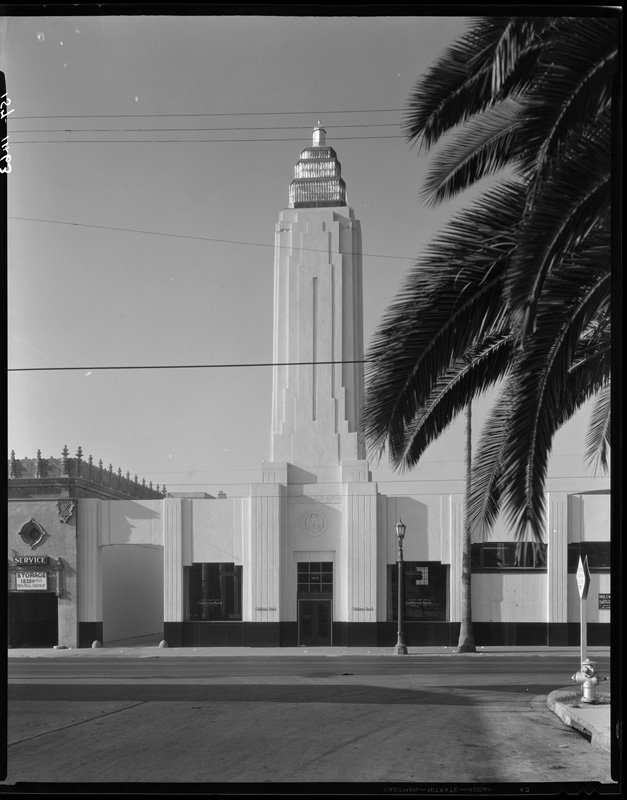
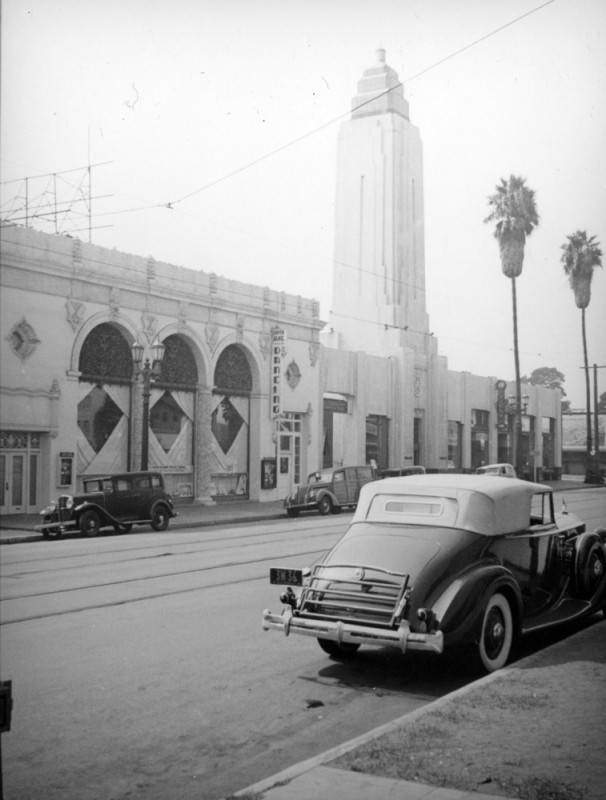
Located on the south side of Hollywood Boulevard facing Gramercy Place, 5620 Hollywood Boulevard could almost be a mini-Los Angeles City Hall. John Parkinson, who designed the building along with Donald Parkinson, had been one of the architects for the City Hall, which had opened less than two years earlier. In addition to the eye-catching 80-foot tower, the 2-story building had 3550 square feet for the bank’s needs and 4 retail shop spaces.

California Bank announced that it was constructing a new Hollywood branch in January 1930, having purchased the land from real estate investors Rodolfo and Consuelo Montes. 1930 was not a great year to be a bank. The Stock Market Crash in October 1929 had resulted in a run on banks and many had failed. Before federally-insures deposits, when a depositor’s money was gone, it was gone. In 1930, banks had to look solid, like they would still be around the next year and the year after that, to convince customers to trust them with their money rather than hiding it under their mattresses.

LA Evening Express 1/11/1930

California Bank had started in 1904 as the Co-operative Savings Bank. It changed its name the following year to California Savings Bank. In 1915 it was renamed California Savings & Commercial Bank.

In February 1918, California Savings & Commercial Bank opened its first Hollywood Branch, on the southeast corner of Hollywood Boulevard at Western Avenue.

Hollywood Citizen 3/1/1918

California Savings & Commercial Bank was acquired by Hibernian Savings Bank in 1919 and Hibernian took over all of its branches. The same year, Hibernian merged with Home Savings Bank. In November 1920, it became “California Bank.”

1930. California State Library photo.

California Bank’s new Hollywood-Gramercy Branch opened to the public on June 30, 1930. It replaced the Hollywood and Western branch.

Entrance detail, 1930. California State Library photo.

Hollywood Daily Citizen 6/27/1930

Just a little over a year later, in August 1931, the bank would open its main Hollywood branch in the new Equitable Building at Hollywood and Vine. There would also be a West Hollywood branch at 7550 Sunset Boulevard.

The California Bank Building in 1937. Next door at 5610 Hollywood Blvd. is the Edith Jane School of Dancing. Herman J. Schultheis photo, LAPL.

In June 1945, due to consolidation, the Hollywood Gramercy branch became surplus and the bank put the building up for sale.

Hollywood Citizen News 6/8/1945

It housed a radio training school for the remainder of the 1940s. In 1950 it became the Coast Visual Training Company, which lasted into 1968. It went on to have other uses.

The building was damaged in the January 1994 Northridge Earthquake but was repaired and is extant today.

5611-5623 Hollywood Boulevard: Retail/Office Building


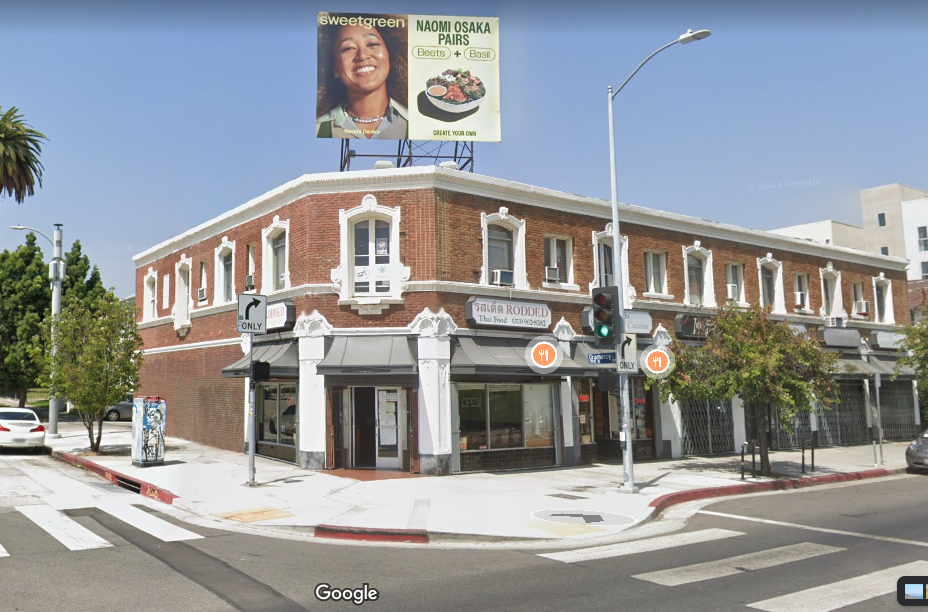
This 2-story brick retail and office building at 5611-5613-5615-5617-5619-5621-5623 Hollywood Boulevard on the northeast corner of Hollywood and Gramercy Place (originally Morgan Place) was  designed in 1922 by architect H. C. Deckbar on spec for owner Samuel Goodman.

LA Evening Express 7/22/1922

Located at what had been the gateway to Morgan’s Hollywood subdivision, Goodman first had Kress House Moving Company move an existing apartment building, built less than 10 years earlier at 5611-5617 Hollywood Boulevard, from this parcel north to 1706-1712 Morgan Place (now Gramercy Place).

Originally located at 5611-5617 Hollywood Boulevard (the NE corner of Hollywood Boulevard and Gramercy Place – then Morgan Place), this apartment building was constructed by the Milwaukee Building Company for owner J.E. Upson. It was moved to 1706-1912 Gramercy Place in 1922. LA Times 5/4/1913

The former 5611-5617 Hollywood Boulevard (now 1706-1712 Gramercy Place) is still extant. Seen here in an older Google map image.

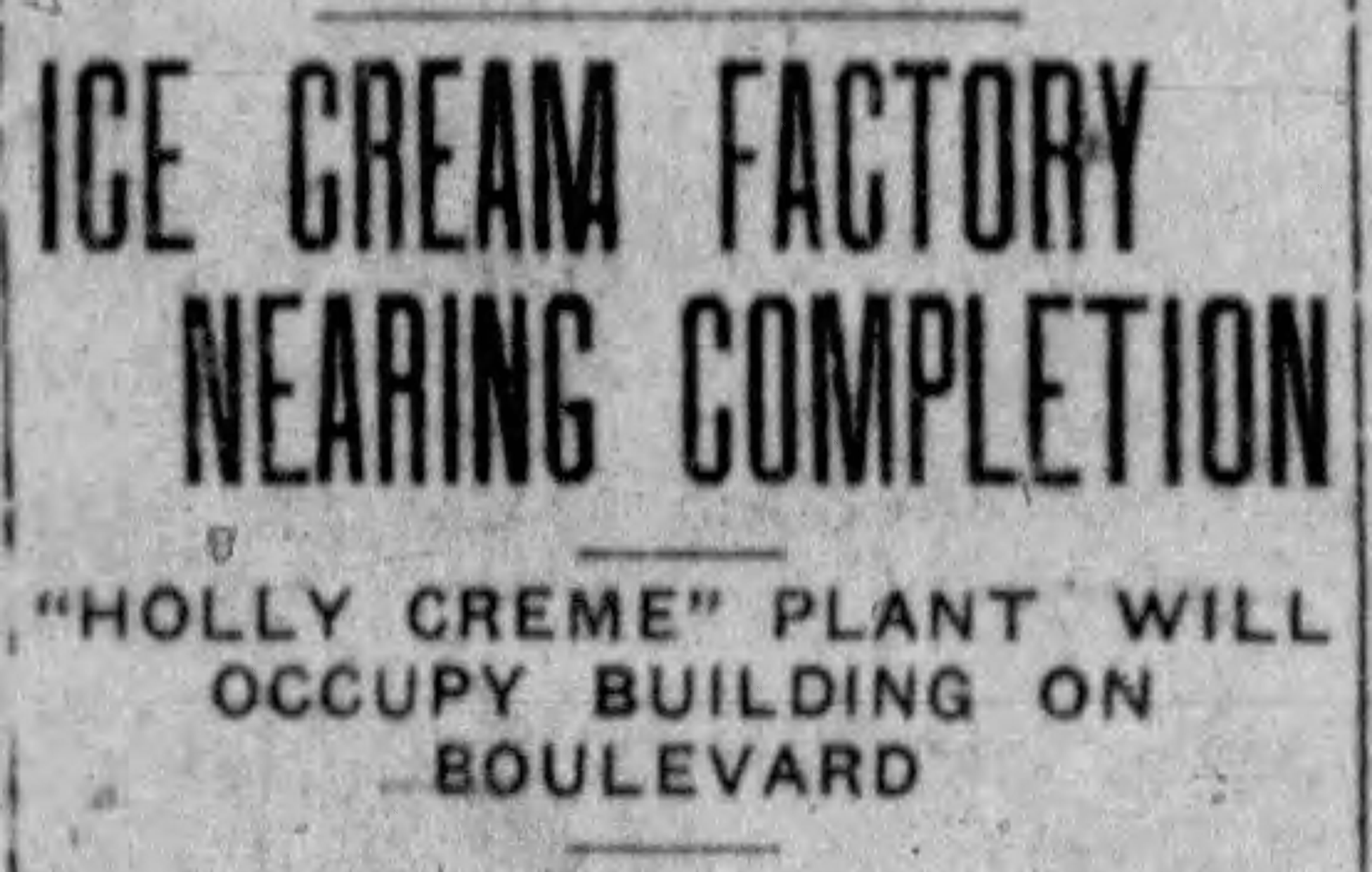
The first major tenant of the attractive little retail and office building was the Holly Creame Ice Cream Company, operated by W.J. Tarrant and R.J. Murphy announced in January 1923 that they were moving in to 5623 Hollywood Boulevard. The shop had its grand opening on February 10. 1923.
Hollywood Daily Citizen  1/10/1923

Hollywood Daily Citizen 2/9/1923

Holly Creme remained at 5623 through the Summer of 1925. In July 1926, the space became the Marion Drug Company. It remained a drug store for years. Today, it’s a restaurant.

Hollywood Daily Citizen 7/30/1926

The building is an unusually attractive example of the low-rise development typical of Hollywood Boulevard in the early 1920s, and a rare survivor.