6145 Hollywood Boulevard: Automobile dealership

LA Evening Express 6/12/1920.

This 1-story auto showroom on the north side of Hollywood Boulevard was built on the Del Mar tract for Elliot M. House and R. A. Meyer, Cole distributors for Southern California and Arizona.

Based in Indianapolis, the Cole Motor Car Company was founded by Joseph J. Cole in 1909. Its 8-cylinder engine, the Cole Eight was introduced in 1915. House and Meyer, as Davidson, House and Meyer, had become Cole distributors in August 1919 and had a new dealership at 1225 S. Grand Avenue. F. E. Wight of the Wright Service Company, became Hollywood’s Cole-Eight dealer in October 1919, located across the street at 6150. House & Meyer, sans Davidson, expanded the Cole franchise to Hollywood in May 1920 and their Hollywood branch showroom opened at 6145 Hollywood Boulevard in June 1920. The new building was along the same lines as the one on Grand Avenue.

House and Meyer’s first Cole showroom at 1225 S. Grand Avenue, Los Angeles.

Hollywood Citizen 7/9/1920.

House and Meyer’s time in Hollywood was short, however. In August, J. R. Allread took over the Cole franchise at 6145.

Hollywood Citizen 8/20/1920

In May 1921 it became the Chandler dealership of W. P. Herbert Company, distributor for So Cal. Chandler was based in Cleveland.

LA Times 5/4/1921.

In August 1923, the Hollywood branch was turned over to associate dealer H. F. Haldeman. Chester Bennett Motors took it over in November 1924.


Starting in 1923, Chandler has supposedly tested its engines on Pike’s Peak in Colorado. Winding up to a 14,000-foot elevation, it was the highest motor road in the world. Hollywood Daily Citizen 11/5/1924.

6145 as Chester Bennett Motor’s Chandler-Cleveland dealership c. 1924. This photo is from the Homestead Museum collection.

In December 1926, H. F. Haldeman returned to 6145, now a Nash dealer. Nash, based in Kenosha Wisconsin at this time, had been founded in 1916 by ex-General Motors president Charles W. Nash.

Hollywood Daily Citizen 12/15/1926.

Haldeman remained here through March 1927. In May 1927, it became the Hollywood branch of the White Auto Company. Headed by O.R. Fuller, the White Auto Company had been So Cal’s distributor of the Auburn automobile since 1924.

The Auburn Automobile Company of Auburn, Indiana was organized in September 1903 by brothers Charles, Frank and Morris Eckhart. The Eckhart family sold the company to Chicago investors in 1919. The company’s prestige and market share grew under the leadership of Errett Lobban (“E. L.”) Cord, who was elected vice-president and general manager of the Auburn Automobile Company in October 1924, and became president in February 1926. Born in Missouri in 1894, E. L. Cord grew up in Los Angeles and in 1933 would build an expansive estate in Beverly Hills he called “Cordhaven.” In October 1926, Cord purchased the Duesenberg Company, known for its racing cars, and employed its founders, brothers August and Frederick Duesenberg, to design passenger autos. In 1929 he created the Cord Corporation, a holding company, and that summer introduced the front wheel drive Cord L-29 automobile.
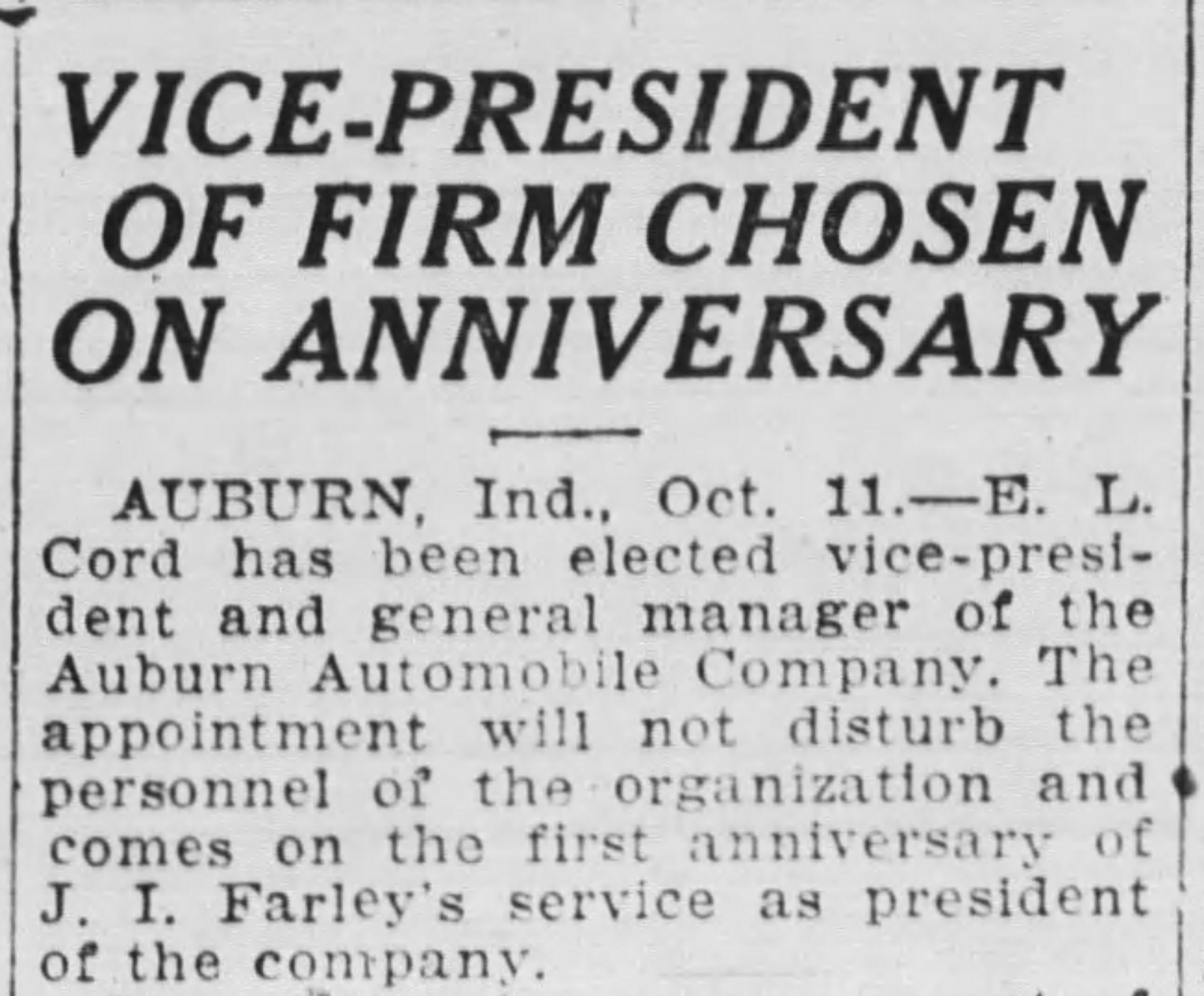
Oakland Tribune 10/12/1924.
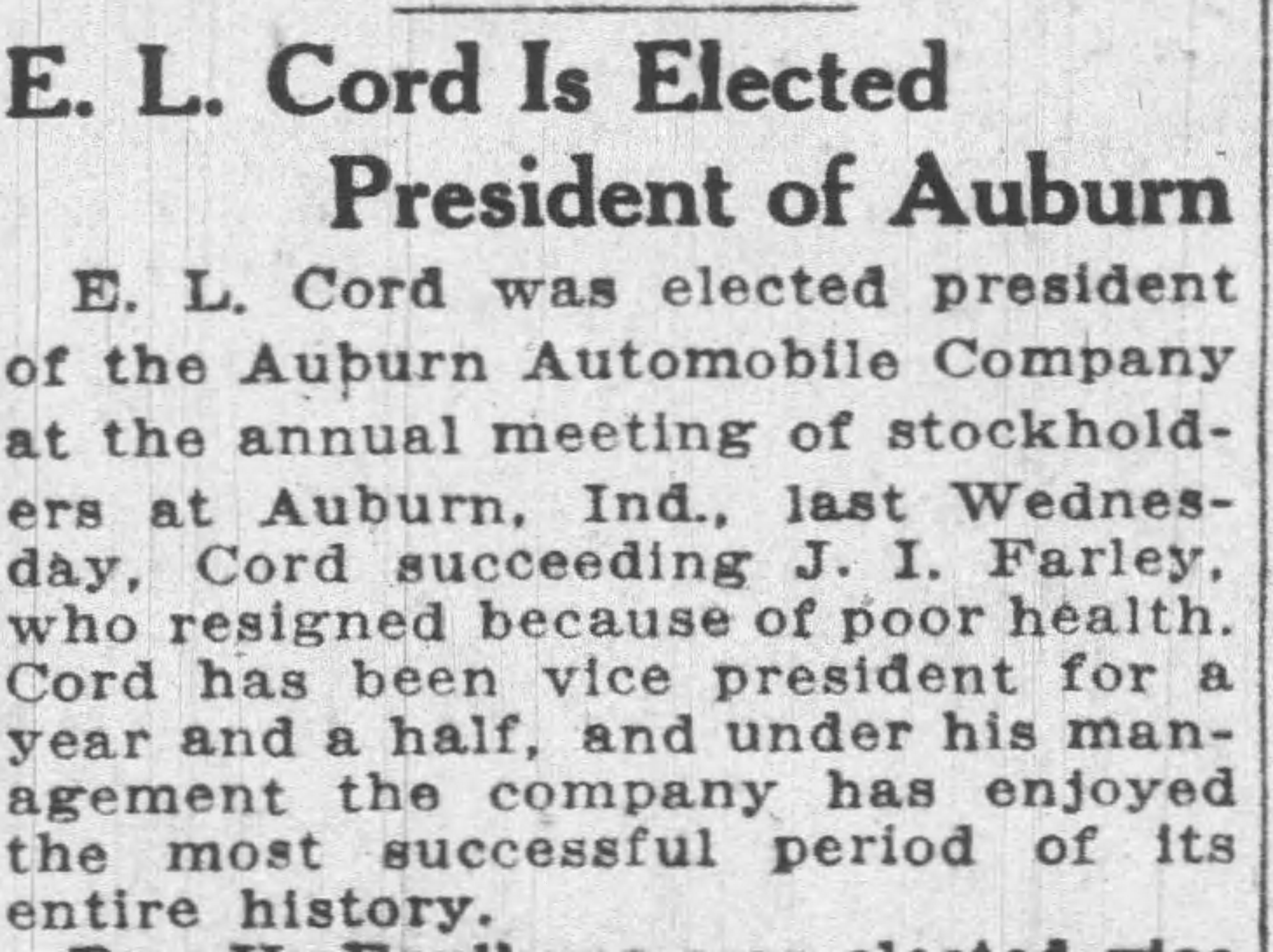
St. Louis Globe Democrat 2/7/1926.

The Indianapolis Time 10/6/1926.

The White Auto Co. was renamed the Auburn-Fuller Company in October 1928 to more fully associate itself with the product.

LA Times 5/8/1927.

Higgins and Trout ran the Hollywood branch of Auburn-Fuller initially. Higgins dropped out and it was operated by George C. Trout. Hollywood Daily Citizen 3/14/1928.

LA Times 1/24/1931.
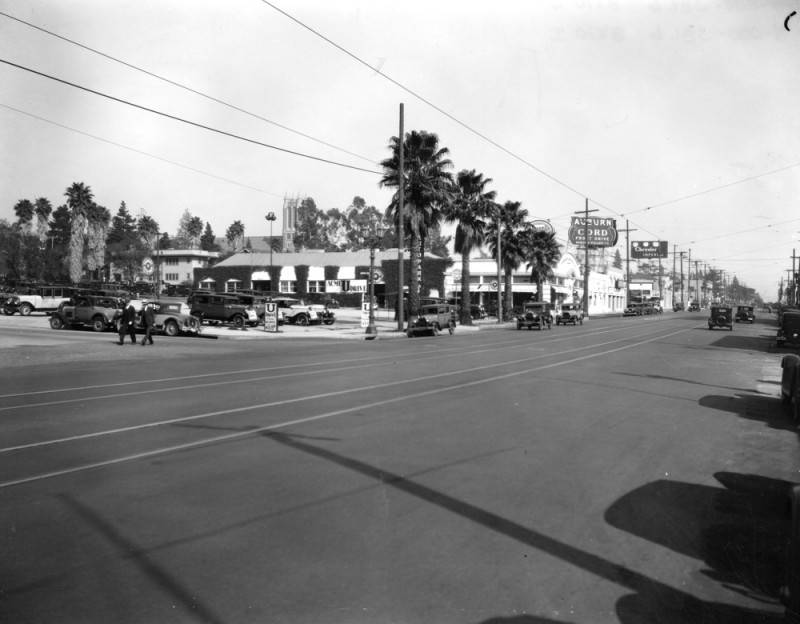
A glimpse of 6145 from the corner of Argyle c. 1930-31 while it was still an Auburn Cord dealership. The roof sign would be move across the street to Auburn-Fuller’s new home at 6250 in January 1932. LAPL photo.

In January 1932 Auburn-Fuller’s Hollywood Auburn Cord dealership and Richard F. Carlson Motor Company’s Hudson Essex dealership swapped spaces. Auburn moved to 6250 Hollywood Boulevard at the southeast corner of Argyle- previously home of Carlson Hudson, while Carlson moved into Auburn’s vacated space at 6145.
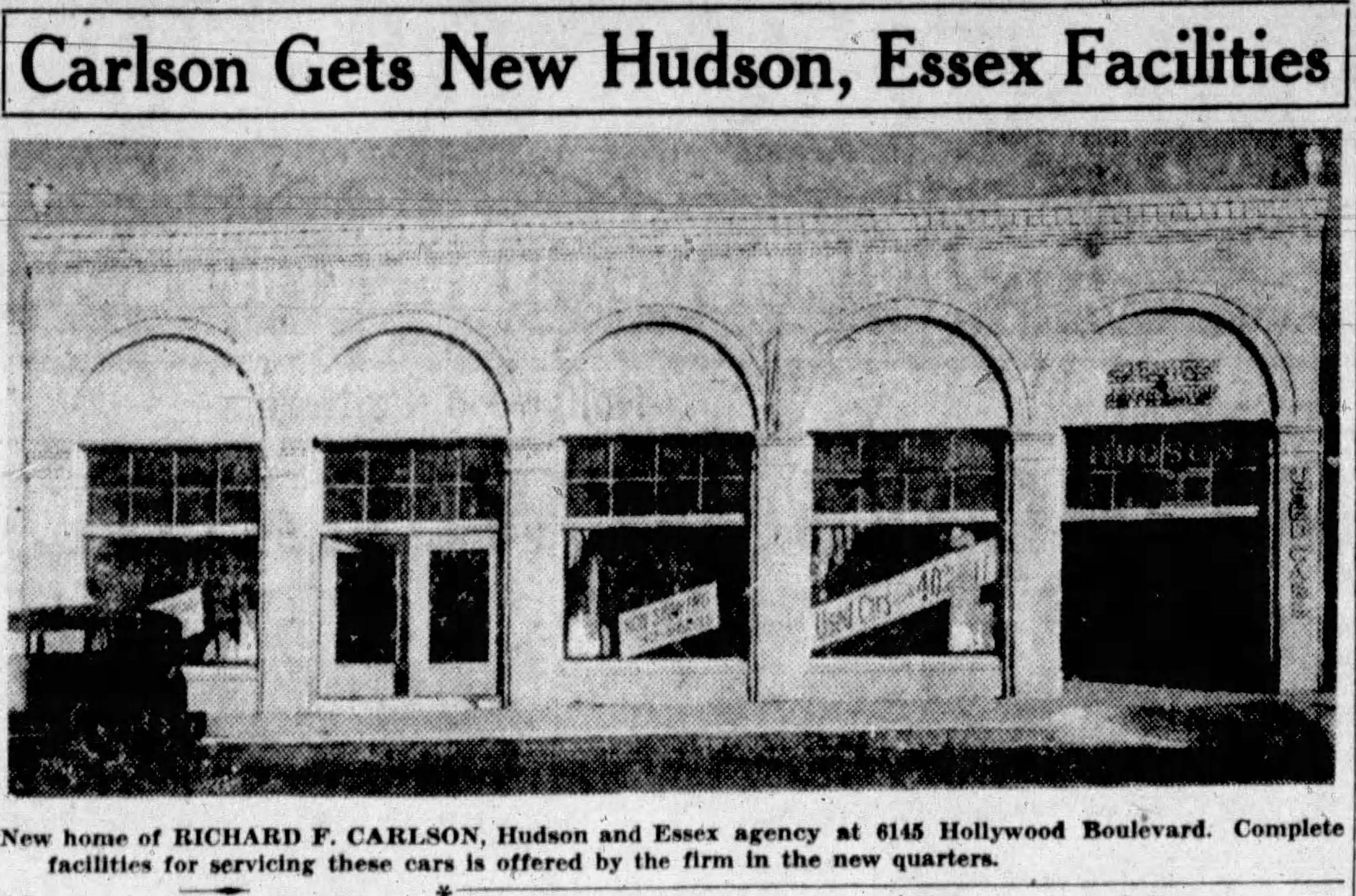
6145 as Carlson’s Hudson Essex dealership. Hollywood Citizen News 1/6/1932.

Hollywood Citizen News 1/27/1932.

Next it was Oldsmobile’s turn at 6145, handled by Harry Carver Inc., in February 1934. In May 1934, C. E. Kemper, Inc. took over the Oldsmobile franchise for Hollywood.

Hollywood Citizen News 2/28/1934.


Oldsmobiles were also being displayed at Hillcrest Motor Co. the Cadillac dealership, at 7001 Hollywood Boulevard. Hollywood Citizen News 5/23/1934.

Kemper continued selling new Oldsmobiles here through June 1941. Thereafter, Kemper offered used cars at this location, as well as maintaining his service department, through early August 1943. That month, it became Butler Motor Co. used cars and repairs. By now, the US had entered WWII and with domestic auto production suspended for the duration, used cars were all that was left. Maintaining your existing vehicle was critical.

Hollywood Citizen News 8/5/1943.

After the war, Butler Motor Co. became a Kaiser / Frazer dealership. Between June 28-30, industrialist Henry Kaiser and partner Joe Frazier exhibited the 1947 Kaiser Special and the 1947 Frazer at the downtown dealership of Kaiser / Frazer distributor, “Mad Man” Muntz Car Co., located at 11th and Figueroa. Kaiser, who was engaged in shipbuilding during the war, was also building affordable housing in the Los Angeles area with Fritz Burns as Kaiser-Burns Homes.

LA Times 6/13/1947.

C.R. Peterson replaces Butler as Hollywood’s Kaiser / Frazer dealer in July 1947. In February 1948, Peterson sold his franchise to Ray  L. Peterson (no relation) and Tom Maggard. who as Peterson & Maggard, continued selling Kaiser / Frazer automobiles through August 1949. In September 1949, their equipment and supplies were sold at auction.

Hollywood Citizen News 5/21/1948.

6145 Hollywood Boulevard became Joe Newell, the self-proclaimed “King of the Near Nu Cadillacs.”
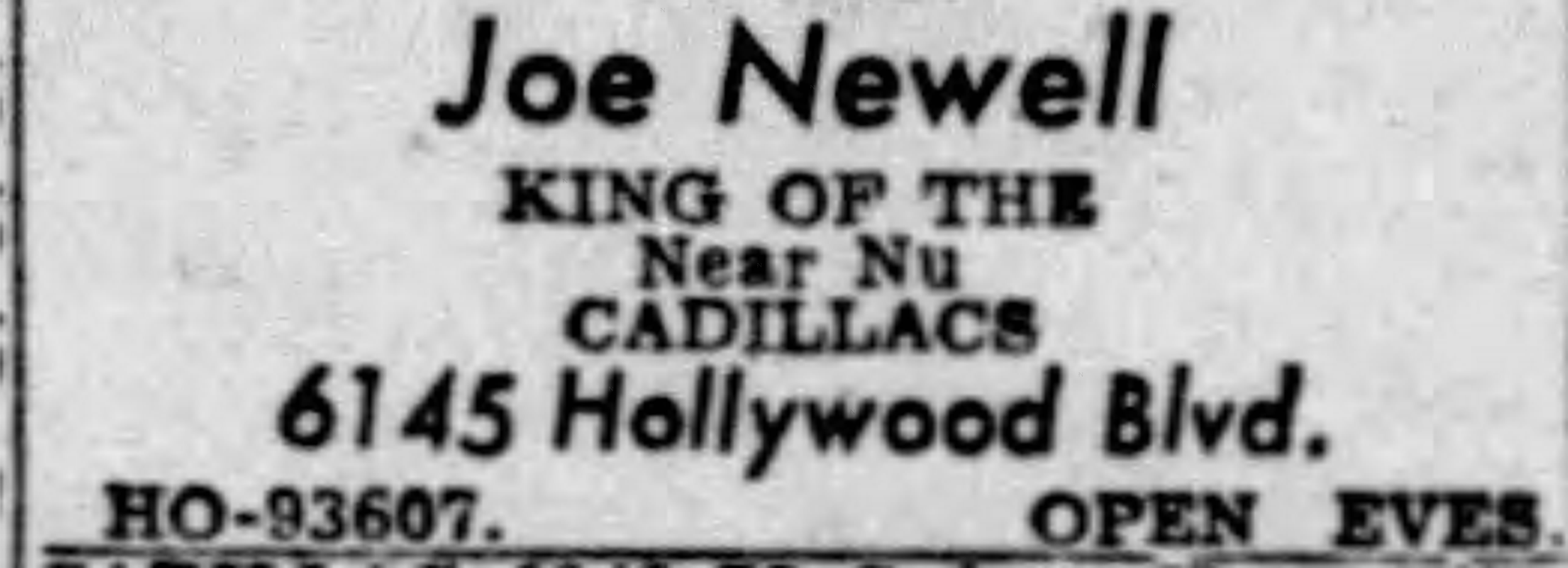
LA Times 12/30/1951

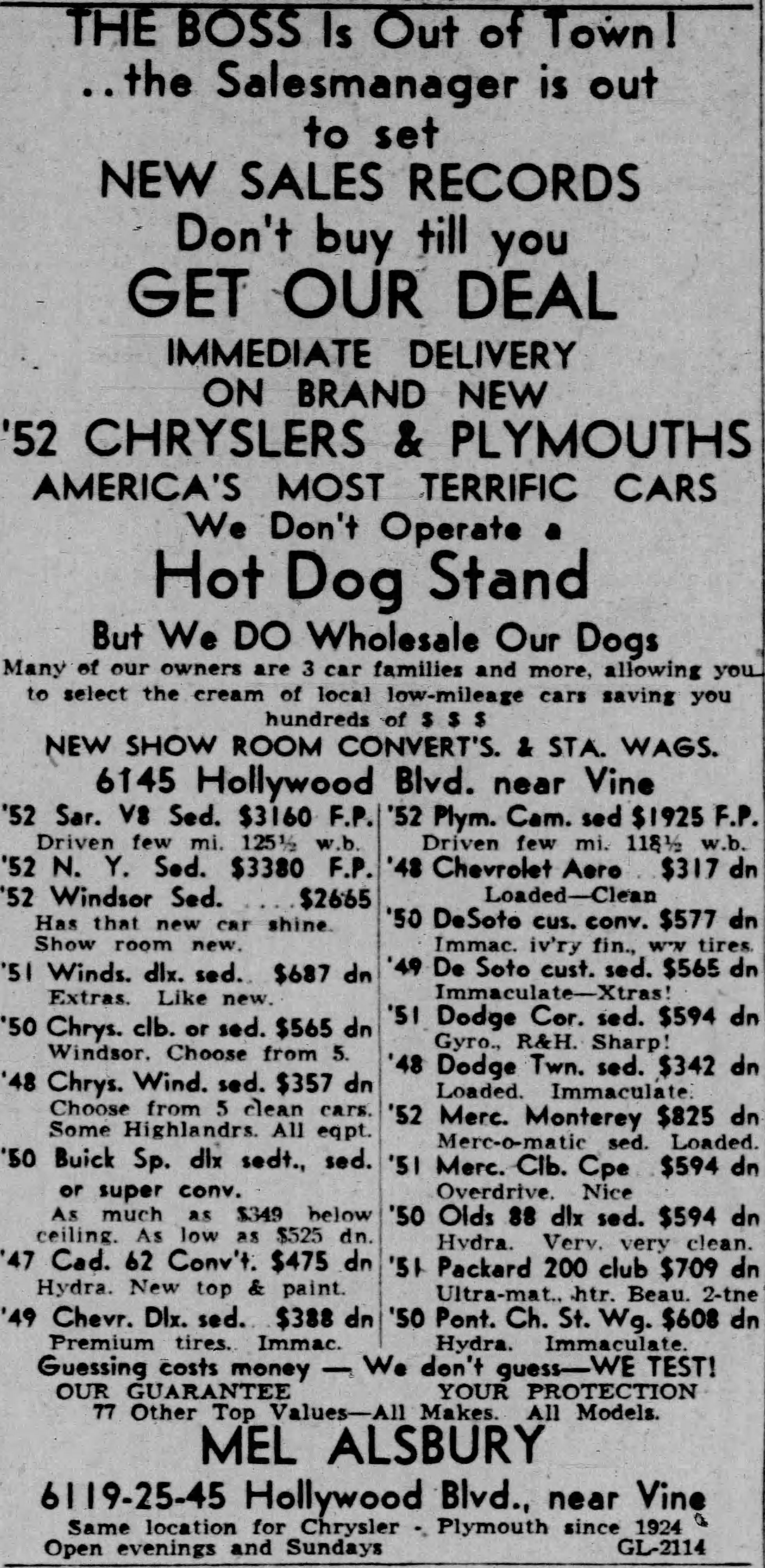
Joe remained here into early April 1952. In late April 1952, Mel Alsbury, the Chrysler – Plymouth dealer at 6119 Hollywood Boulevard, took over this location as well as its neighbor to the east at 6125, a 1-story auto garage of the same approximate vintage. This spot generally housed his used car department.
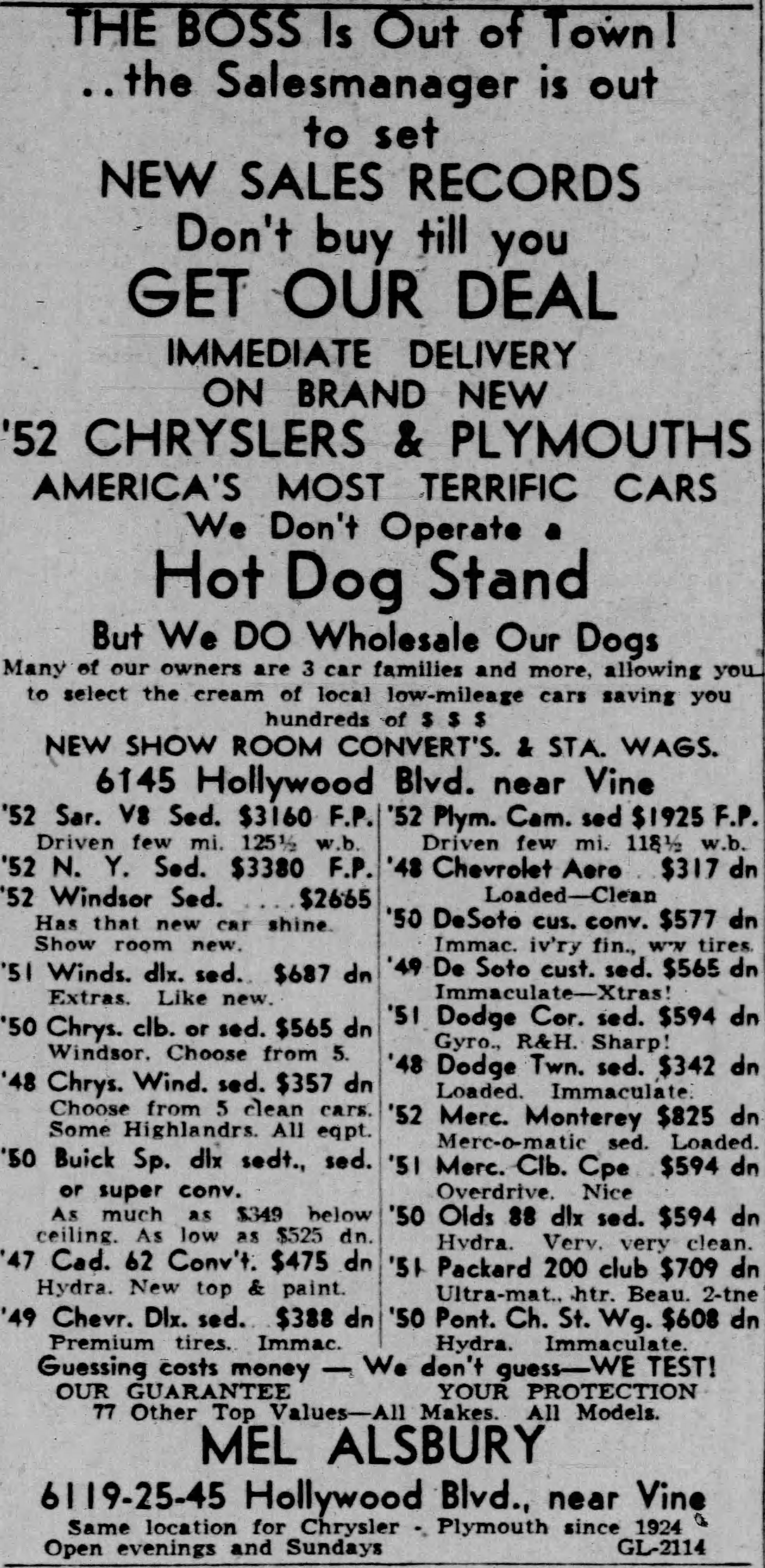
Hollywood Citizen News 5/28/1952.

The building was demolished in 1972.

6140 Hollywood Boulevard: Automobile building

Red arrow points to 6140 Hollywood Boulevard. LAPL photo.

This 1-story brick building at the southeast corner of Hollywood Boulevard and El Centro was built to house automotive supply retailers by the estate of Ida W. Beveridge circa 1916, one of the earliest structures to be built on the large rural parcel.

Daeida (Ida) Beveridge, often called the “Mother of Hollywood,” had owned the large ranch property with her husband, Harvey Henderson Wilcox. The couple came to the area from Topeka, Kansas and subdivided Hollywood in 1887. Wilcox passed away in 1891; in 1892, Ida married Philo Beveridge. Ida Beveridge controlled the Wilcox land holdings and, when Hollywood incorporated in 1903, donated land for many of its civic buildings. She passed away in 1914 and her estate manager, C.B. Brunson (who was married to the Beveridge’s daughter Phyllis), developed the property as Hollywood turned increasingly commercial.

It appears the address may have originally been 6130 Hollywood Boulevard. This number was first used in 1916 by Hollywood Motor Supply, who moved into the Beveridge building in March 1916. An addition went onto the building in 1920.


By 1934 it was addressed as 6140. Powell’s Dayton Tire Store move in in February 1934.

Hollywood Citizen News 2/14/1934.

The building had a side service entrance, accessed through a surface parking lot used by the adjacent Music Box Theater, seen here c. 1931. LAPL photo.

In June 1934, C. B. Brunson had 6140 Hollywood Boulevard remodeled as an auto showroom for Moyer Motors Inc., run by brothers George and Dale Moyer, dealers of the Willys 77. The economical, fuel-efficient car was made by the Toledo-based Willys-Overland which, like Studebaker, went into receivership in 1934.

Hollywood Citizen News 6/27/1934.

In September 1934, Moyer Motors became an Auburn dealership. Previously, the luxury automobile’s showroom was across the street at 6145. Whether Auburn would have the resources to offer the 1935 model had been in question- Auburn, too, was in financial dire straits. The company did quit making the Auburn motor car in 1937.

Hollywood Citizen News 11/21/1934.

On September 24, 1936, it became a retail shop again, a Goodrich Stilvertown battery and tire etc. shop.

Hollywood Citizen News 9/23/1936.

Hollywood Citizen News 9/29/1937.


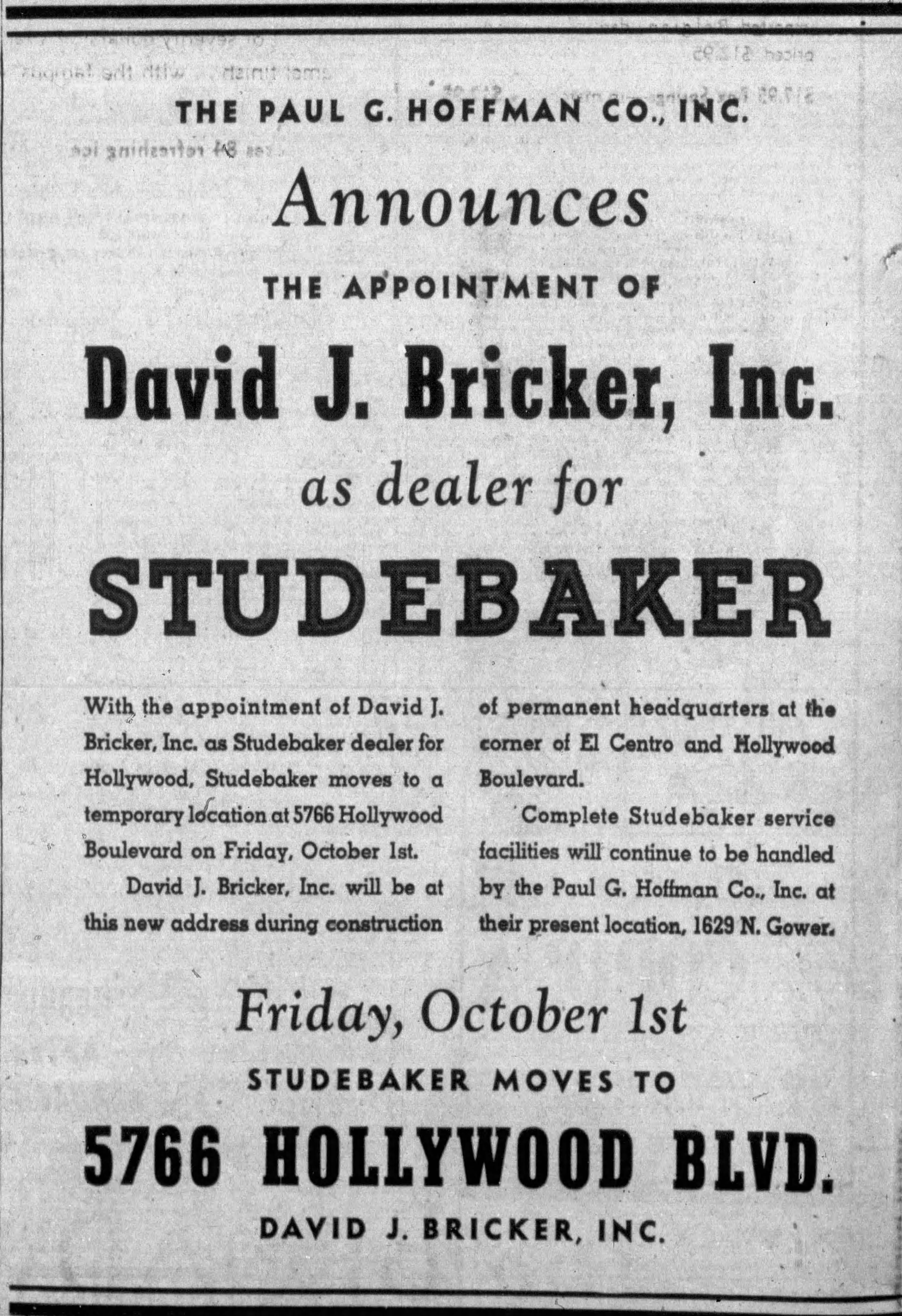
On October 1, 1937, David J. Bricker, longtime Studebaker salesman for Paul G. Hoffman Studebaker at 6116 Hollywood Boulevard, became the Studebaker dealer for Hollywood. Paul G. Hoffman Co. remained the Studebaker distributor for the Los Angeles area (Paul G. Hoffmann was then also president of the Studebaker corporation). Initially located at 5766 Hollywood Boulevard, David J. Bricker, Inc. moved to 6140 Hollywood Boulevard in March 1938.


Hollywood Citizen 3/23/1938.

In October 1939. Bricker remodeled the front facade of the building, giving it a streamlined, modern appearance, with a large expanse of angled plate;glass windows on the Hollywood and El Centro elevations. He also extended signage across the entrance to the surface parking lot between 6140 and the Music Box Theater to the east.

Hollywood Citizen News 10/18/1939.

Domestic automobile production shut down in the USA in February 1942 as auto makers focused on defense contracts. New 1942 models on car lots were generally commissioned for military use. Dealers like Bricker Studebaker emphasized their service departments, as maintaining one’s current vehicle was critical. Used cars were available but there were price caps imposed by the Office of Price Administration (OPA).

Hollywood Citizen News 3/10/1943.

Studebaker was purchased by the Packard Motor Car Company in 1954 to become the  Studebaker-Packard Corporation. David J. Bricker Inc. rolled with the changes into 1957.

Hollywood Citizen News 2/6/1957.

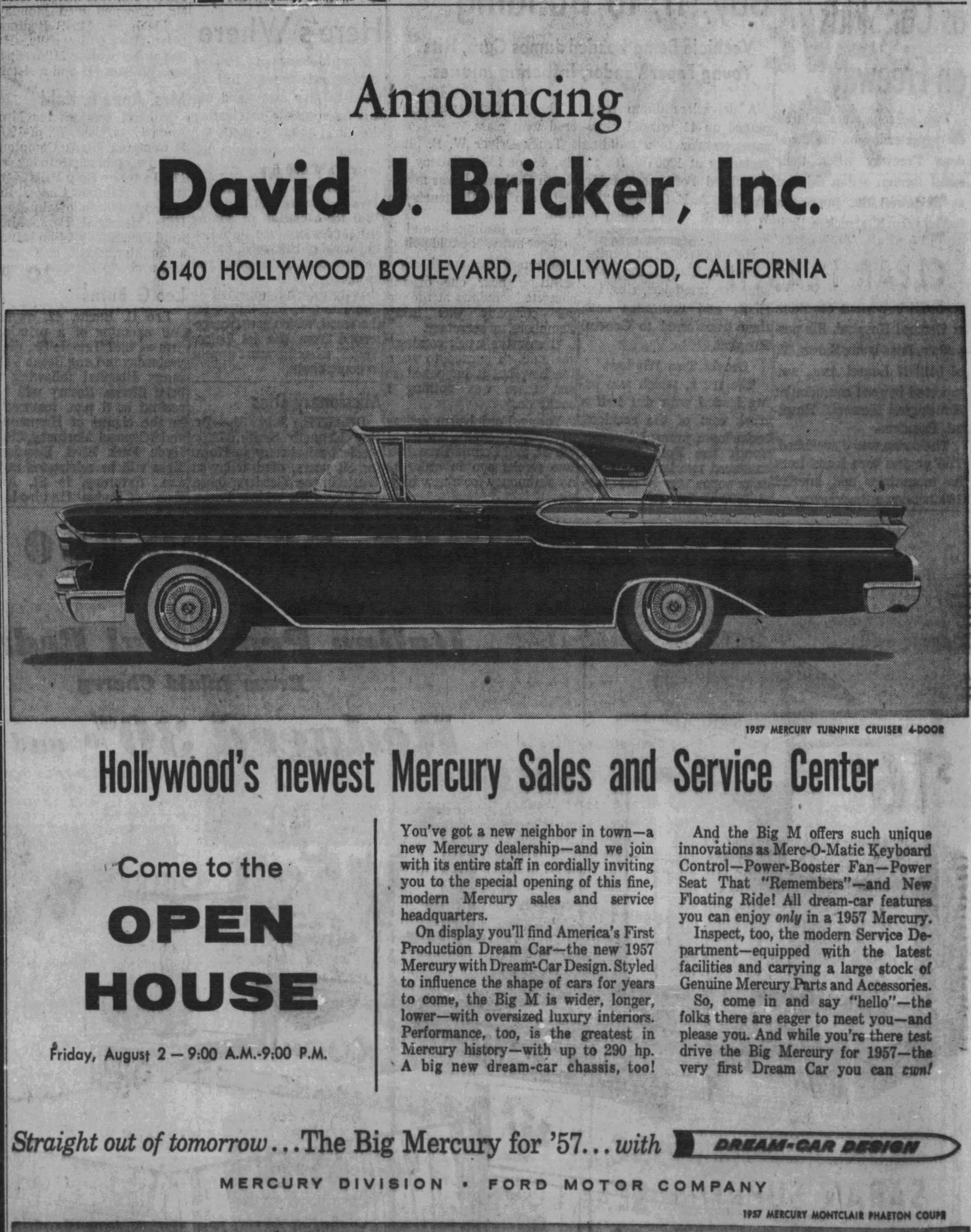
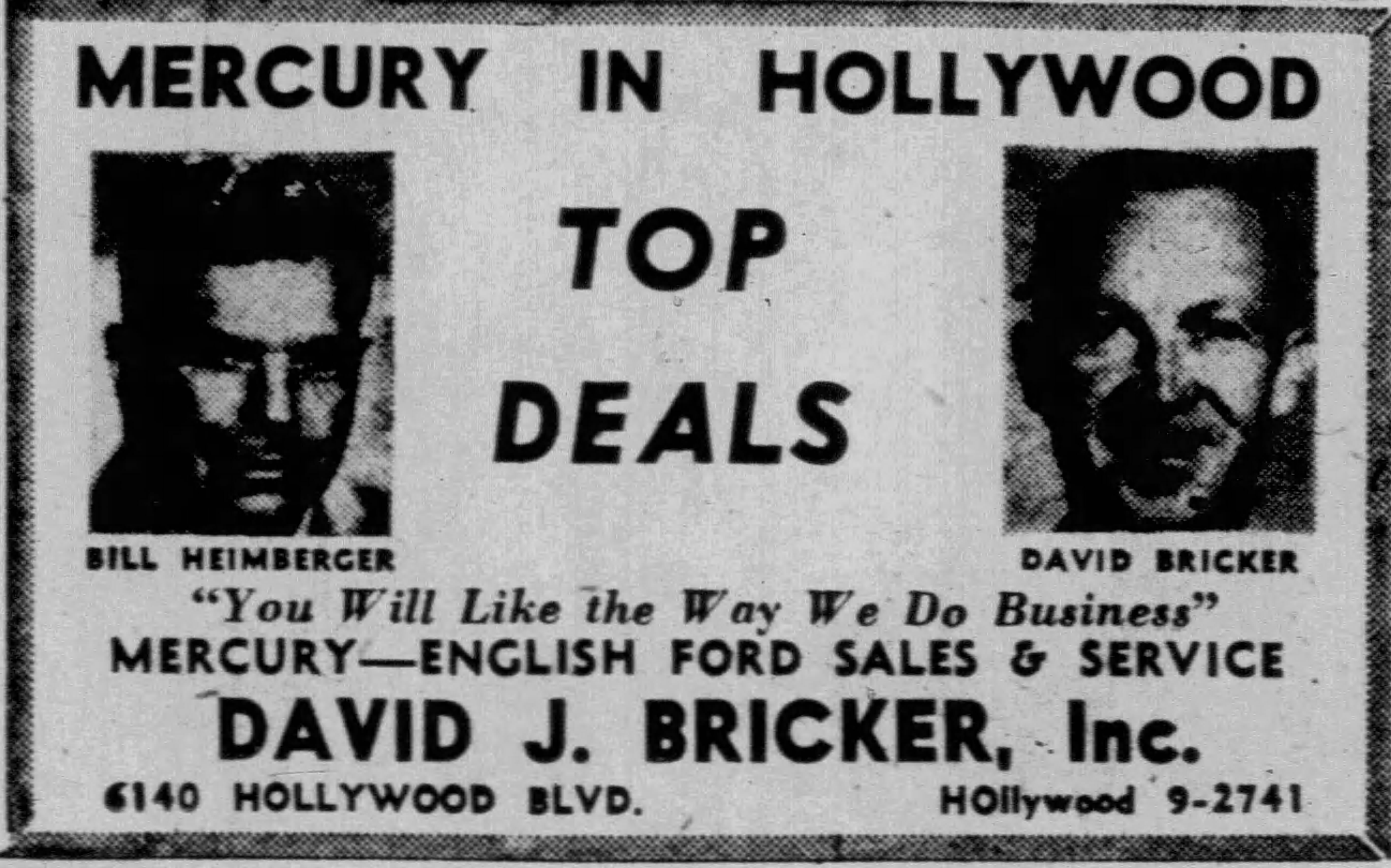
In July 1957, Bricker announced that it had taken on the Mercury franchise for Hollywood, leaving behind Studebaker-Packard for the Ford Motor Company. The dealership also handled English Ford imports.

LA Times 8/1/1957.


Hollywood Citizen News 8/19/1957.

In August 1958, Edsels and Lincolns were added to the mix of Ford-produced automobiles offered. Ford had acquired the Lincoln Motor Company in 1922. The Edsel, named for company founder Henry Ford’s son Edsel Ford, was marketed from 1958 to 1960.
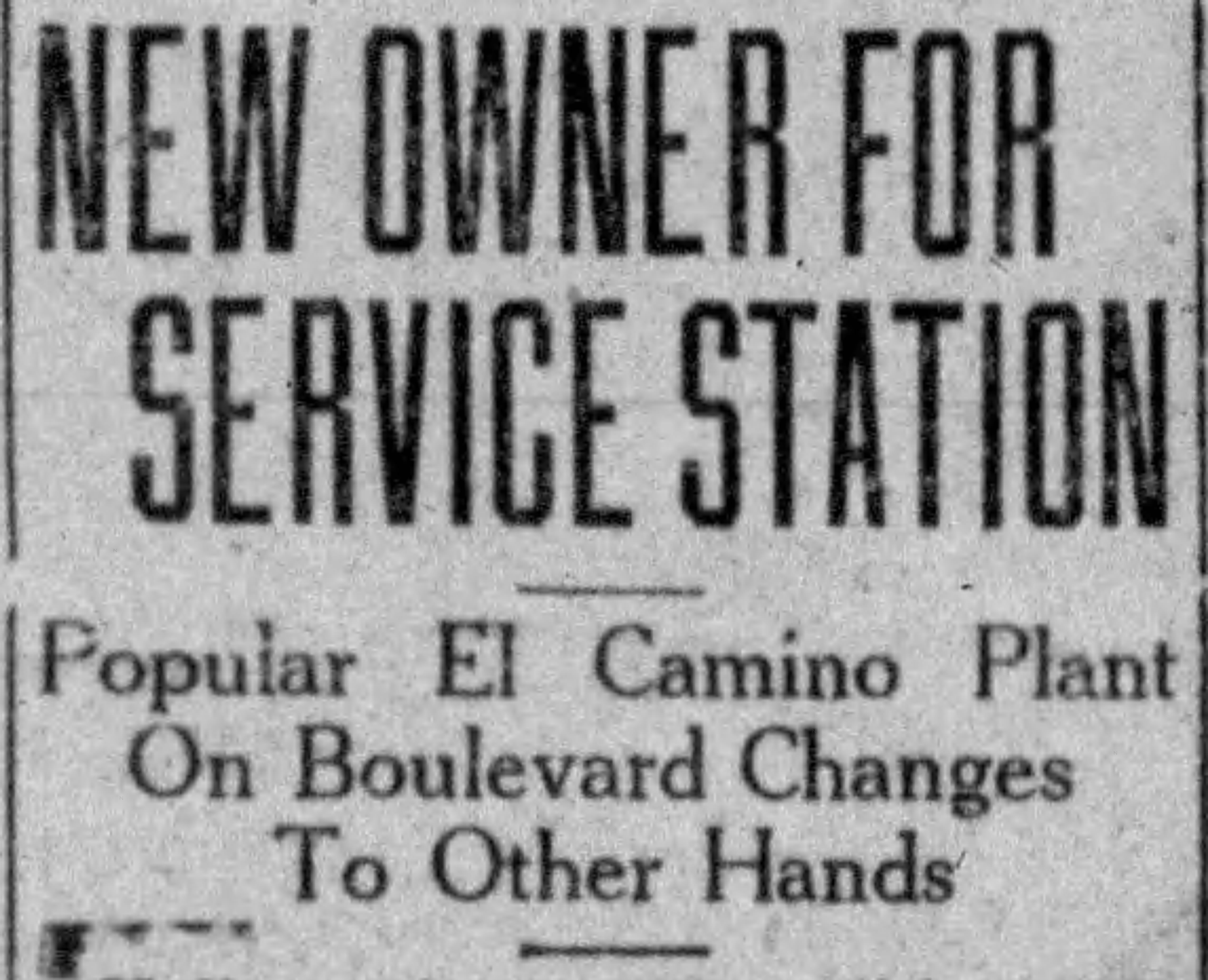
Hollywood Citizen News 8/15/1958.


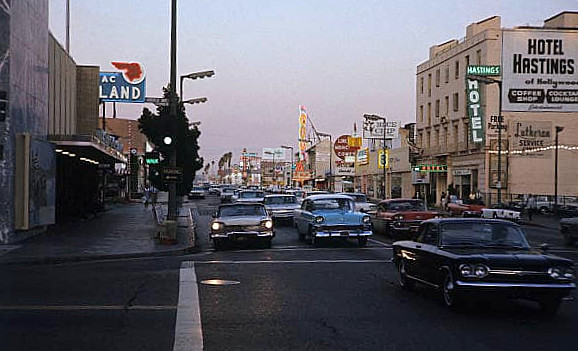
View of Hollywood Boulevard looking east from Argyle in 1965. Bricker’s round, red Lincoln Mercury roof sign can be seen midway up the block on the right. Photo by Mario De Biasi from the Mondadori Portfolio on the Getty Images website and posted by Ken McIntyre on the Photos of Los Angeles Facebook site.

David J. Bricker Lincoln Mercury would also use 6000 Hollywood Boulevard for its used car lot. It remained headquartered at 6140 through 1970.

In June 1971, 6140 Hollywood Boulevard became Hollywood Auto Imports Fiat dealership.

LA Times 6/24/1971.


6140 in 1975 as Hollywood Auto Imports Fiat dealership. This photo was posted by Moviejs1944 on the Cinema Treasures website for the Pix Theater (formerly the Hollywood Music Box) at 6126 Hollywood Boulevard.

The building, remodeled again back to its more closed-up appearance, is extant today.

Notes:

The address 6130 Hollywood Boulevard reappears in 1954 as an Army-Air Force recruitment center through 1968; this was not the same building, as 6140 was David J. Bricker during that time.

6116 Hollywood Boulevard: Paul G. Hoffman Studebaker

Paul G. Hoffman in 1951.

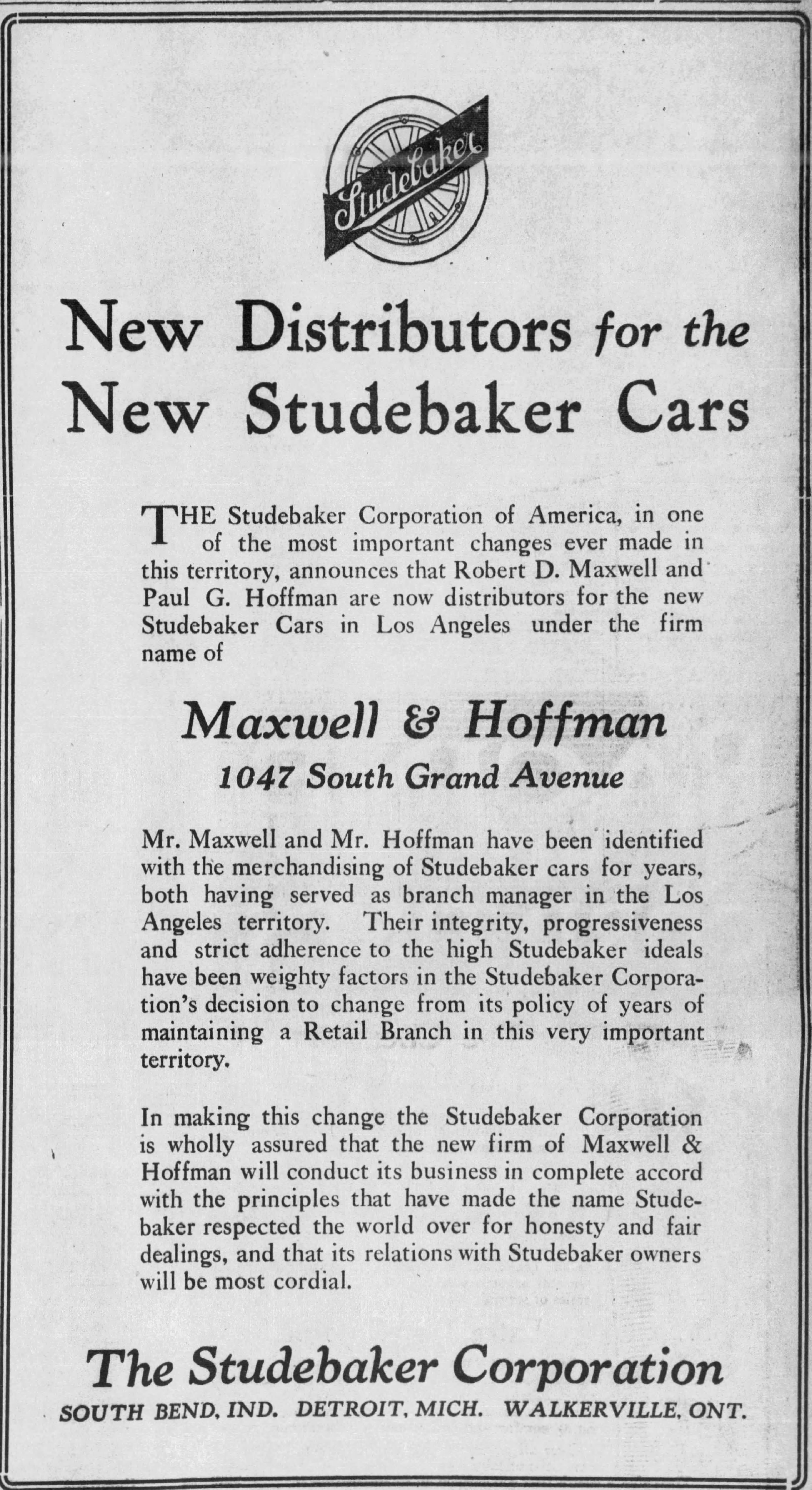
Born in Illinois in 1891, Paul G. Hoffman came to Los Angeles and began selling Studebakers when he was still a teenager.  In 1919 he partnered with Robert D. Maxwell as Maxwell and Hoffman, and on March 9, 1919 Maxwell and Hoffman were named Studebaker distributors for Los Angeles, headquartered at 1047 S. Grand Avenue (they later moved to 1015 S. Grand).

LA Times 3/9/1919

At that time, the Wright Motor Co., run by Frank E. Wright, was the Studebaker dealer for Hollywood, having succeeded James Nixon of the Nixon Motor Company in 1918. Nixon/Wright were located at 6658 Hollywood Boulevard then at 6150 Hollywood Boulevard.

LA Times 4/4/1920

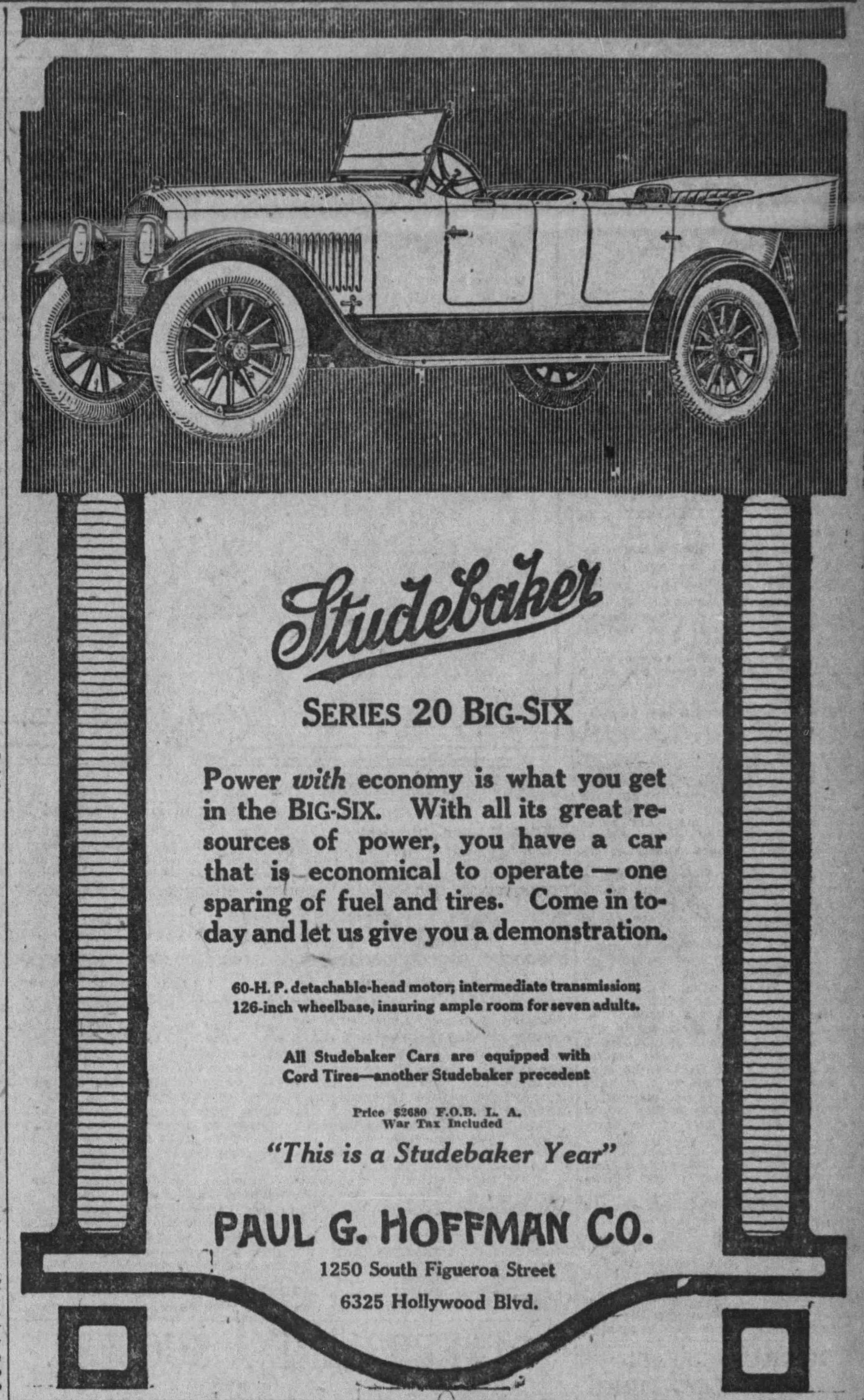
Just a little more than a year after being named Studebaker distributors for Los Angeles, on April 4, 1920, the Paul G. Hoffman Company took over succeeded Maxwell and Hoffman as Studebaker dealer for Los Angeles as well as expanding his territory to include Hollywood. He opened his Hollywood branch at 6325 Hollywood Boulevard. (In June 1920 Hoffman would open his new downtown headquarters at 1250 S. Figueroa.

LA Times 6/13/1920.

In July 1922, the Hoffman company negotiated with the estate of Daeida (Ida) Wilcox Beveridge for lease of a property and to construct a new 1-story showroom building, to be located at 6116 Hollywood Boulevard on the south side of the boulevard near Gower. Meyer and Holler were the builders.

Hollywood Daily Citizen 7/27/1922.
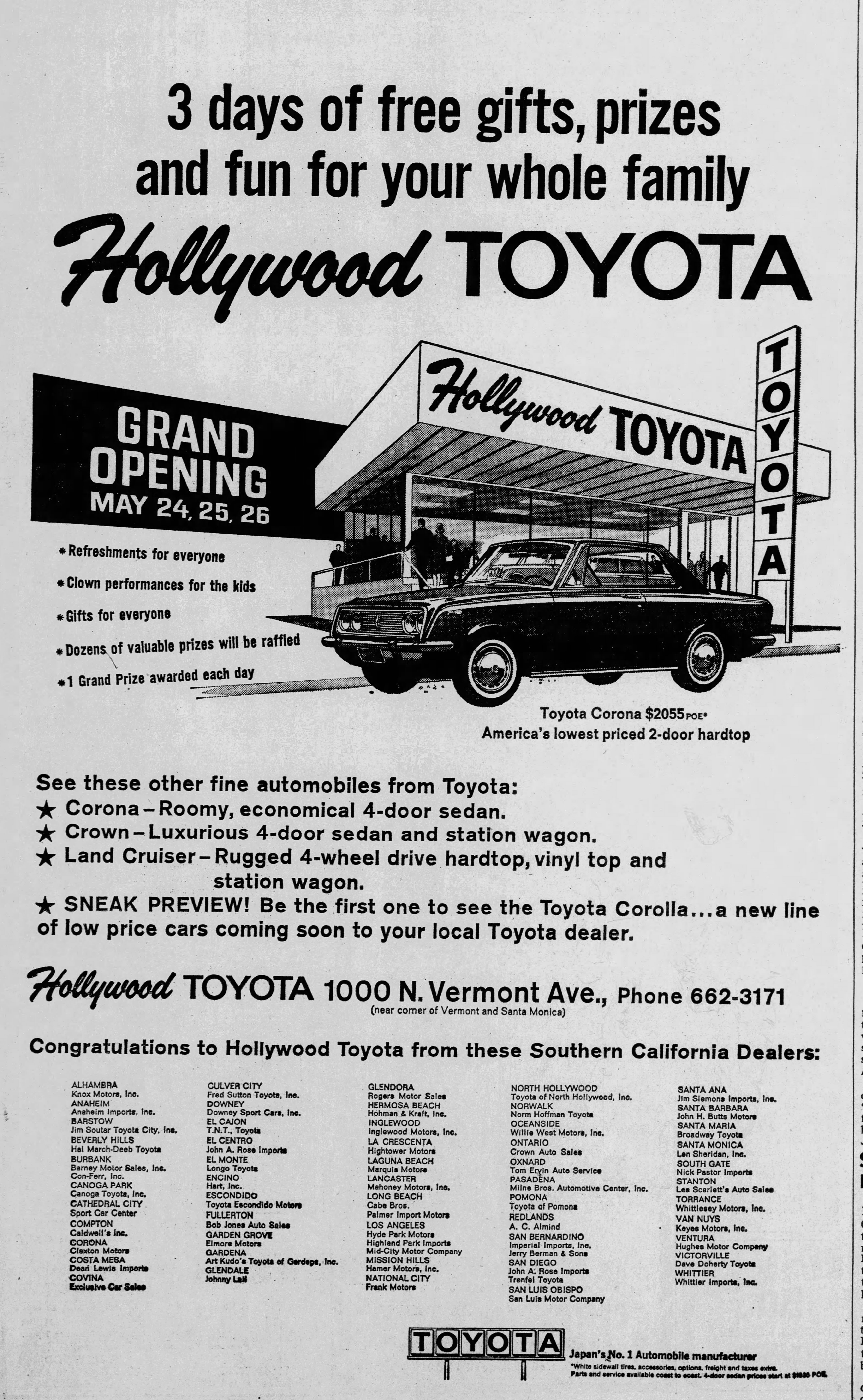
This property had been part of a large rural parcel that Daeida (Ida) Beveridge had owned with her first husband, Harvey Henderson Wilcox. The couple came to the area from Topeka, Kansas and subdivided Hollywood in 1887. Wilcox passed away in 1891; in 1892, Ida married Philo Beveridge. Now Ida Beveridge, she controlled the Wilcox land holdings and, when Hollywood incorporated in 1903, donated land for many of its civic buildings. She passed away in 1914 and her estate manager, C.B. Brunson (who was married to the Beveridge’s daughter Phyllis), developed the property as Hollywood turned increasingly commercial.
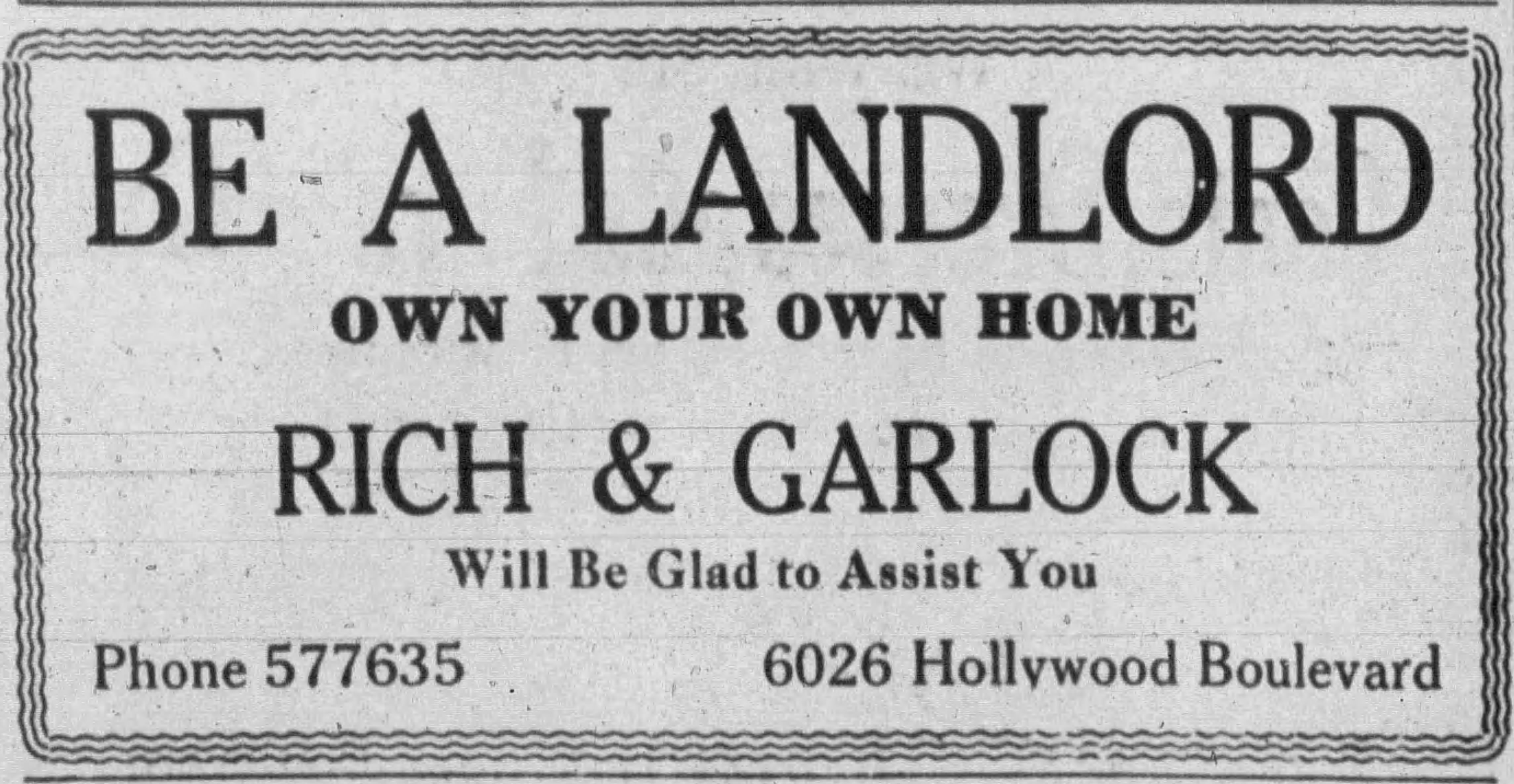
Paul G. Hoffman Co. moved into the new building between November 25 and December 2, 1922.

LA Times 12/8/1922.

In October 1924, Hollywood’s first radio station, KNX, owned by the Los Angeles Evening Express newspaper, located its broadcasting studio in the Hoffman building. The massive transmitting towers and giant red KNX letters were a beacon for blocks around, as much of the vicinity was still undeveloped or contained buildings no taller than 1 or 2 stories tall. The first broadcast took place on October 10, 1924. KNX moved the station to the Paramount Pictures lot in 1928, but continued to use the Hoffman studio as well. In 1933 they operated out of 5939 Sunset Boulevard, which had been built in 1924 as a showroom for the Peerless Motor Car.

The Paul G. Hoffman Studebaker dealership with the KNX signage and transmitting towers on the roof. Los Angeles Evening Express 10/9/1924.

Based in South Bend, Indiana, Studebaker began as a wagon-making company in 1852.  It had been producing automobiles, both gas and electric, in partnership with other companies, since the early 1900s. The first wholly Studebaker-produced motor cars were made in 1912.

By the mid 1920s, Paul G. Hoffman, the person, left Los Angeles For South Bend to serve as VP of the Studebaker Corporation of America under its president Albert R. Erskine, though he would remain president of his namesake company here. The company acquired luxury automobile maker Pierce-Arrow in 1928. However, the 1929 Stock Market crash impacted the company’s finances.

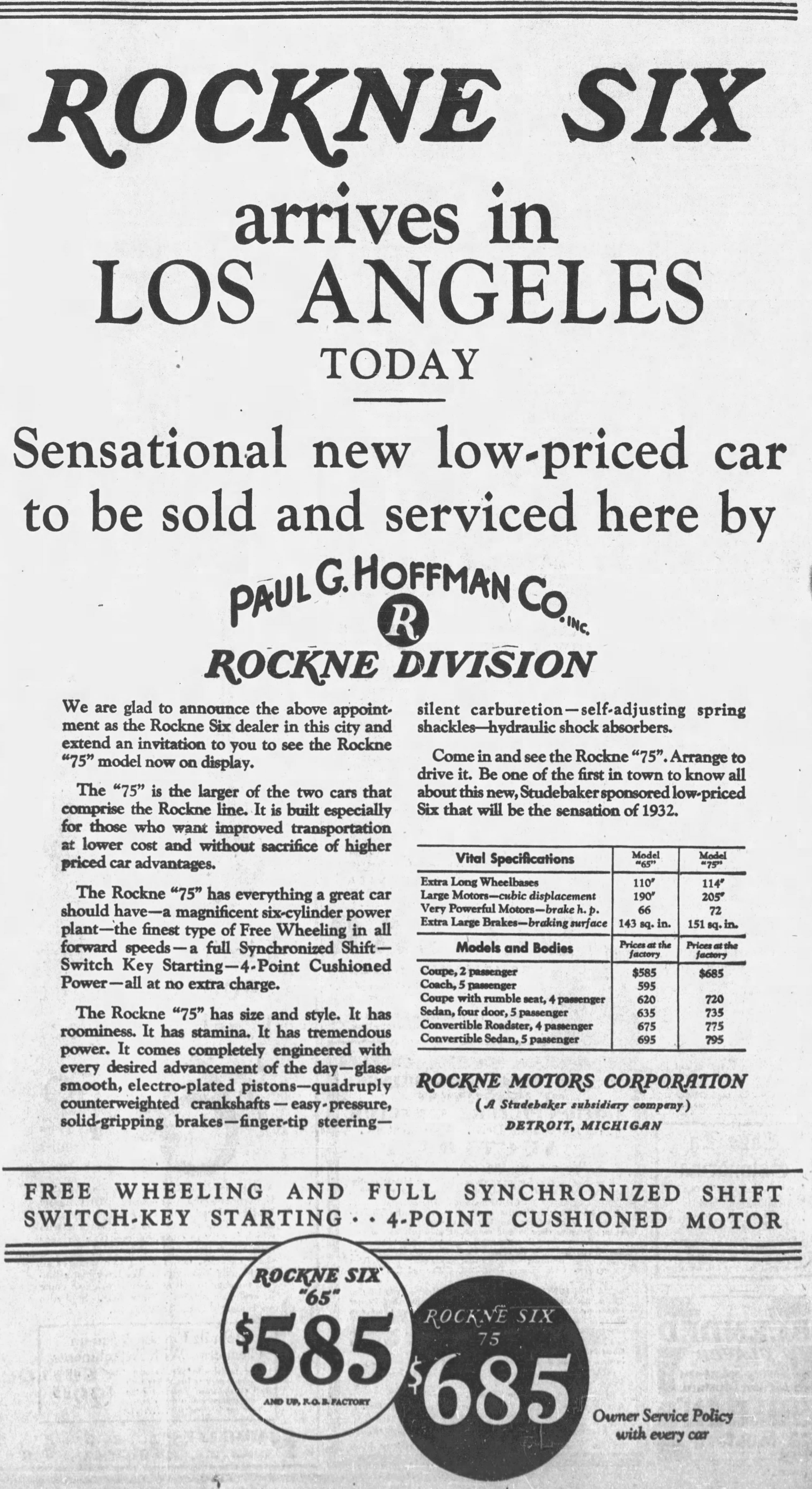
In 1932, it began marketing a lower-priced vehicle called the Rockne, named for Notre Dame coach Knute Rockne, made in Detroit. (The Hoffman Rockne division was at the downtown location).

LA Times 1/5/1932

But on March 18, 1933, the Studebaker Corporation entered into receivership. Paul G. Hoffman, the person, was one of the receivers. Corporate president Erskine was fired; he killed himself on July 1, 1933. That month, the company dropped the Rockne. It also sold Pierce-Arrow.

Hollywood Citizen News 12/15/1933.

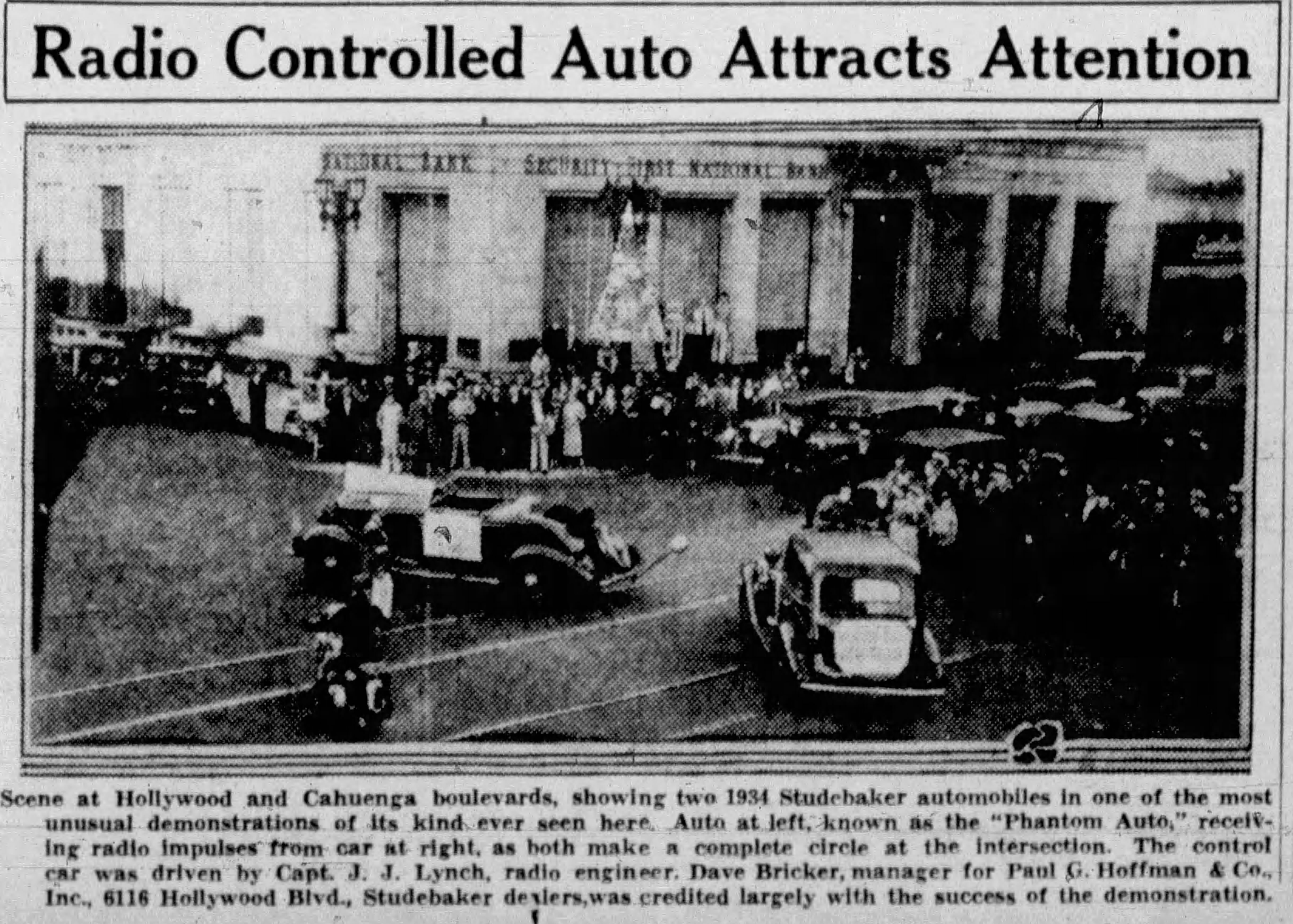
Amid news of Studebaker’s reorganization negotiations, the Hollywood branch of Paul G. Hoffman offered a distraction in the form of “Captain” J. J. Lynch’s driverless car demonstration that involved a “Phantom Studebaker” making a U-turn on Hollywood Boulevard. Even a car with a driver in it making a U-turn on the crowded Boulevard would have been newsworthy, but Lynch, a self-styled captain often referred to as a radio engineer,  took it to a new level.

The Phantom car, a 1934 Studebaker roadster, was to leave the showroom at 6116 and head south on Gower to Sunset, then proceed west on Sunset to La Brea; it would go north on La Brea back to Hollywood Boulevard and head east to Cahuenga, where it would complete a U-turn in the middle of the street before returning to 6116. Luckily. there were no reports of any injuries.

The Phantom Car at Hollywood and Cahuenga. Hollywood Citizen News 12/20/1933.


Pomona Progress Bulletin 2/5/1935.

In January 1935, Studebaker emerged from receivership, reorganized and refinanced, with Paul G. Hoffman as president.

Paul G. Hoffman, the Hollywood Studebaker company, retired the dealership in Hollywood and closed the showroom at 6116 Hollywood Boulevard as of Oct 1, 1937 when its former salesman of the last 6 years, David J. Bricker took over as Studebaker distributor for Hollywood.

In late January 1939, 6116 became Ernie Smith Inc., a Lincoln, Mercury and Lincoln Zephyr dealership. To celebrate it displayed the “X-Ray car,” a Lincoln Zephyr bound for the Golden Gate Exposition at Treasure Island in San Francisco.

Lincoln and Mercury were  part of the Ford Motor Company. Ford had acquired the Lincoln Motor Company in February 1922 and it operated as Ford’s luxury division. The streamlined Lincoln Zephyr was introduced in 1936. Mercury was a new division of Ford, introduced by Henry Ford’s son Edsel Ford in November 1938.

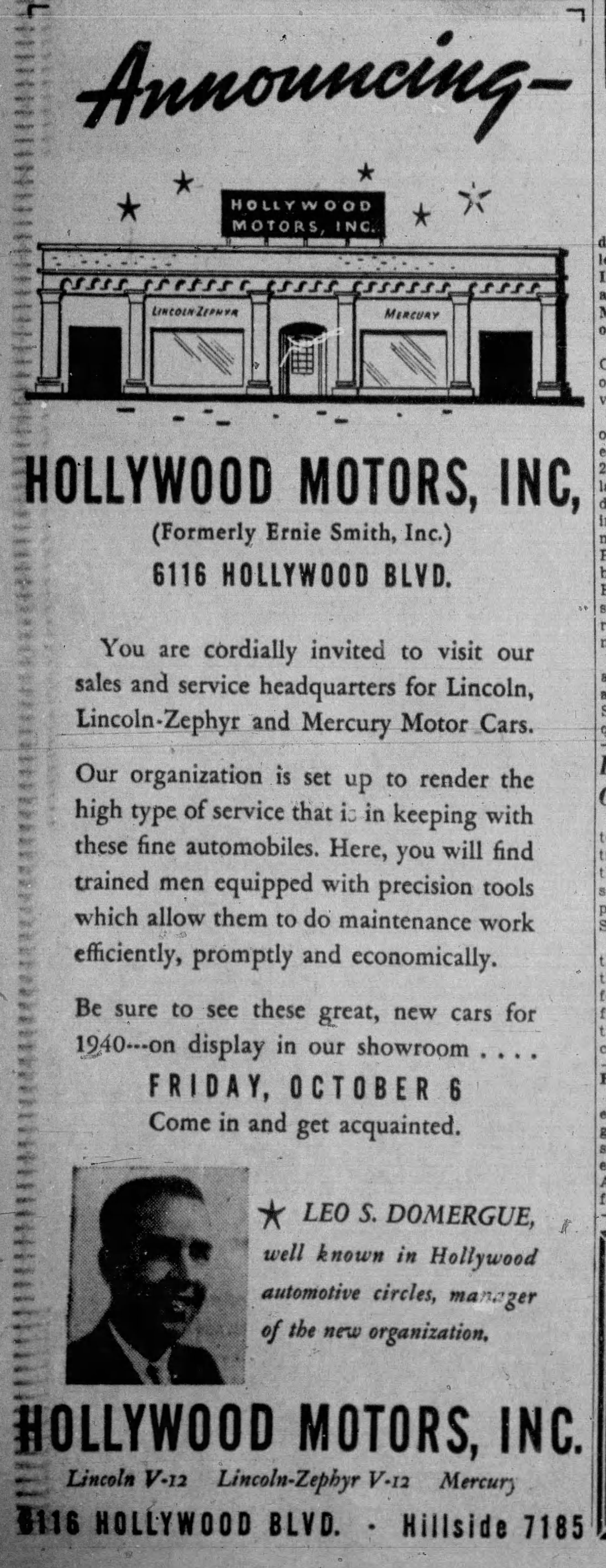
On October 6, 1939, a new firm called Hollywood Motors., Inc. succeeded Ernie Smith at 6116 as Hollywood’s Mercury, Lincoln and Lincoln Zephyr dealership. It was originally managed by Leo S. Domergue; later it was Paul Boulton.

Hollywood Citizen News 10/4/1939.

Hollywood Citizen News 3/13/1940.

In November 1941, Hollywood Motors, Inc.’s Lincoln, Lincoln Zephyr and Mercury dealership moved to 5600 Sunset Boulevard. The following month, longtime LA auto dealer Ralph Hamlin acquired 6116 for used car sales. Hamlin remained through January 1942. Later that month it became Hollywood Hudson. Just weeks later, all domestic vehicle production in the US shut down as auto manufacturers concentrated on the war effort. Dealers, like Hollywood Hudson, focused on their service departments- as maintaining your existing car became critical.

Hollywood Citizen News 3/18/1942.

The elegant building built for Paul G. Hoffman ended its days as an automotive showroom as the used car dealership of J. L. Herd Automobile Company. In December 1945, the Office of Price Administration (OPA), which among other things regulated prices during the war emergency, suspended Herd’s license for 30 days for selling a 1942 Buick for $840 over the OPA’s price ceiling.

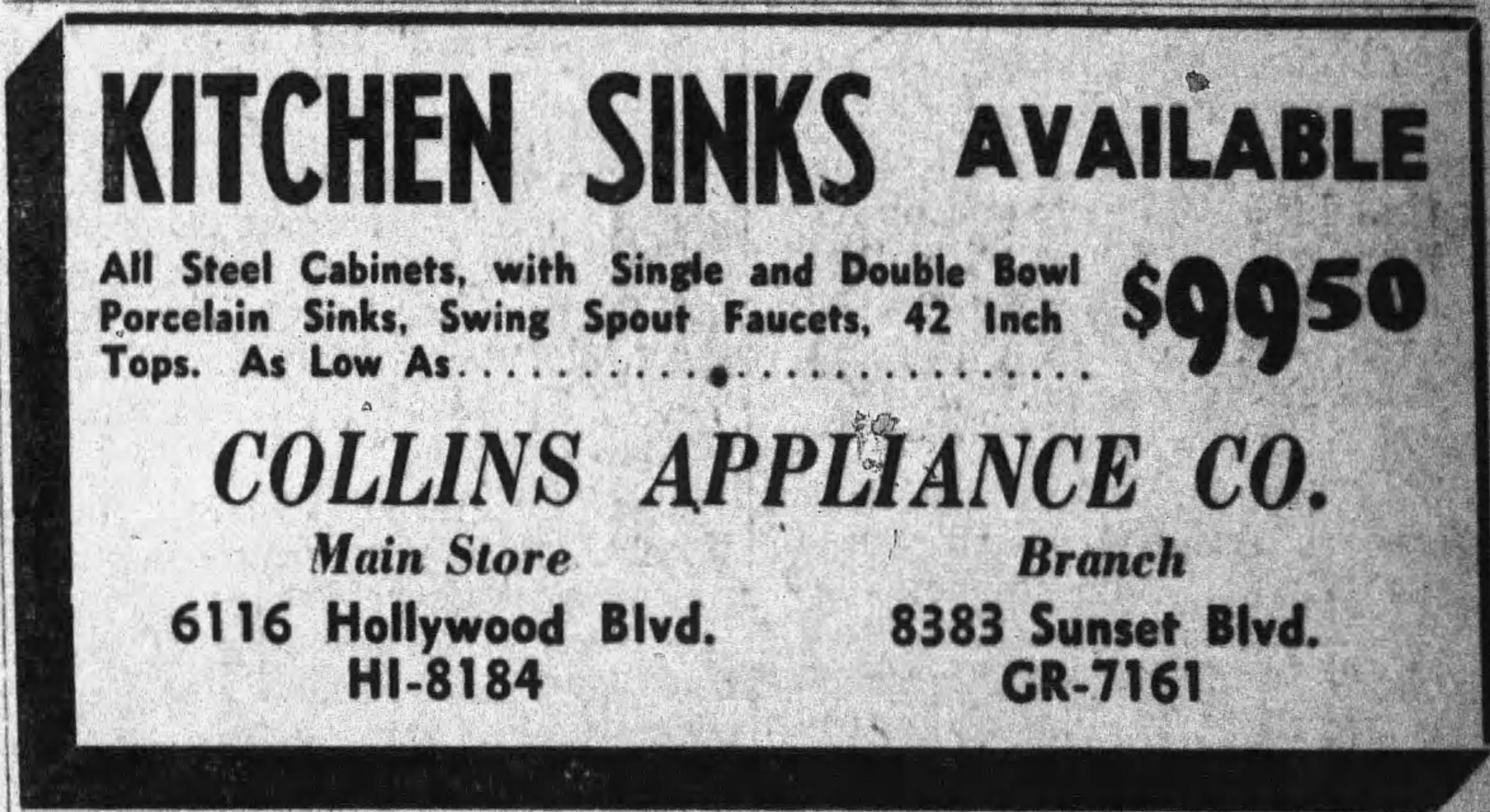
In July 1946, 6116 Hollywood Boulevard became a Collins Appliance Co retail store, which was here for two years.

Hollywood Citizen News 7/19/1946.

The building became a film studio for Harris Productions, which made commercial films and test strips. It was damaged by (the inevitable) fire in June 1949.

As of May 1950, the building became the new home of the Hollywood Gun Shop, which moved here from another automotive building at 6032 Hollywood Boulevard. The gun shop was ultimately the longest tenant the building had had to date- remaining here into 1969.

The Valley Times 6/25/1969.

The building was demolished in 1971. Today it is a parking lot for the adjacent Fonda Theater at 6126 Hollywood Boulevard.

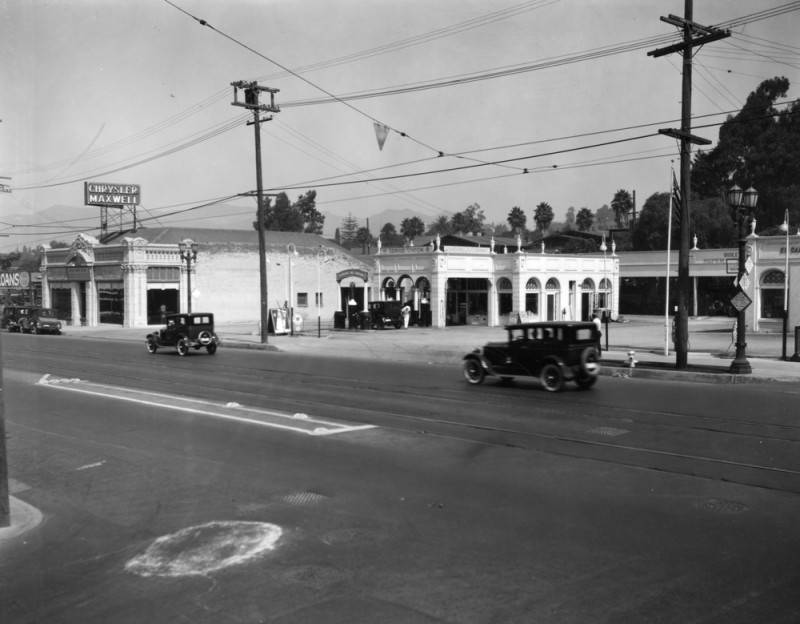
6111-6119 Hollywood Boulevard: Super Service Gas Station / Hollywood Chrysler

6111-6119 Hollywood Boulevard. LAPL photo.

An elegant little gas station, the El Camino Motor Service Station, opened at 6111 Hollywood Boulevard on the northwest corner of Gower in June 1921, the first of 3 such stations planned for Hollywood. It was owned by the Pacific Rubber Company.

Hollywood Citizen 7/1/1921.

Hollywood Citizen 6/10/1921.

In December 1922, it changed hands and became Triangle Super Service.

Hollywood Daily Citizen 12/2/1922.

Hollywood Daily Citizen 12/1/1922.

By June 1924 it was known as the Hollywood Super Service station. On February 10, 1925, the station welcomed a neighbor on the adjacent parcel to the west- Willard Barrows’ Barrows Motor Car Company Maxwell-Chrysler dealership.

Hollywood Daily Citizen 2/10/1925


The beautiful little building was designed by architect John M. Cooper. Hollywood Daily Citizen 2/10/1925.

The Chrysler Corporation Maxwells had been made since the early 1900s as Maxwell-Briscoe Co.. The Maxwell Motor Car Company was formed in 1913. Walter P. Chrysler, head of the Willys-Overland Motor Company, bought Maxwell in May 1921. In 1925 he formed the Chrysler Corporation and phased out the Maxwell that year.

Maxwell got top billing in the opening ad for Barrows Motor Car Company’s Maxwell-Chrysler dealership. Hollywood Daily Citizen 2/10/1925.

The gala grand opening on February 11, 1925 featured the now-usual searchlights by Otto K. Olesen, an orchestra and film stars dropping by. The festivities were broadcast over KNX radio- which was based across the street in the Paul G. Hoffman Studebaker building.

Hollywood Daily Citizen 3/18/1927.

In March 1927, Hollywood Super Service became a California Petroleum Corporation (Calpet) service station. It was still known as Hollywood Super Service. The building would change, but this location remained a gas station until it was demolished in 1981.


Hollywood Daily Citizen 6/30/1926.

Hollywood Daily Citizen 6/30/1926.

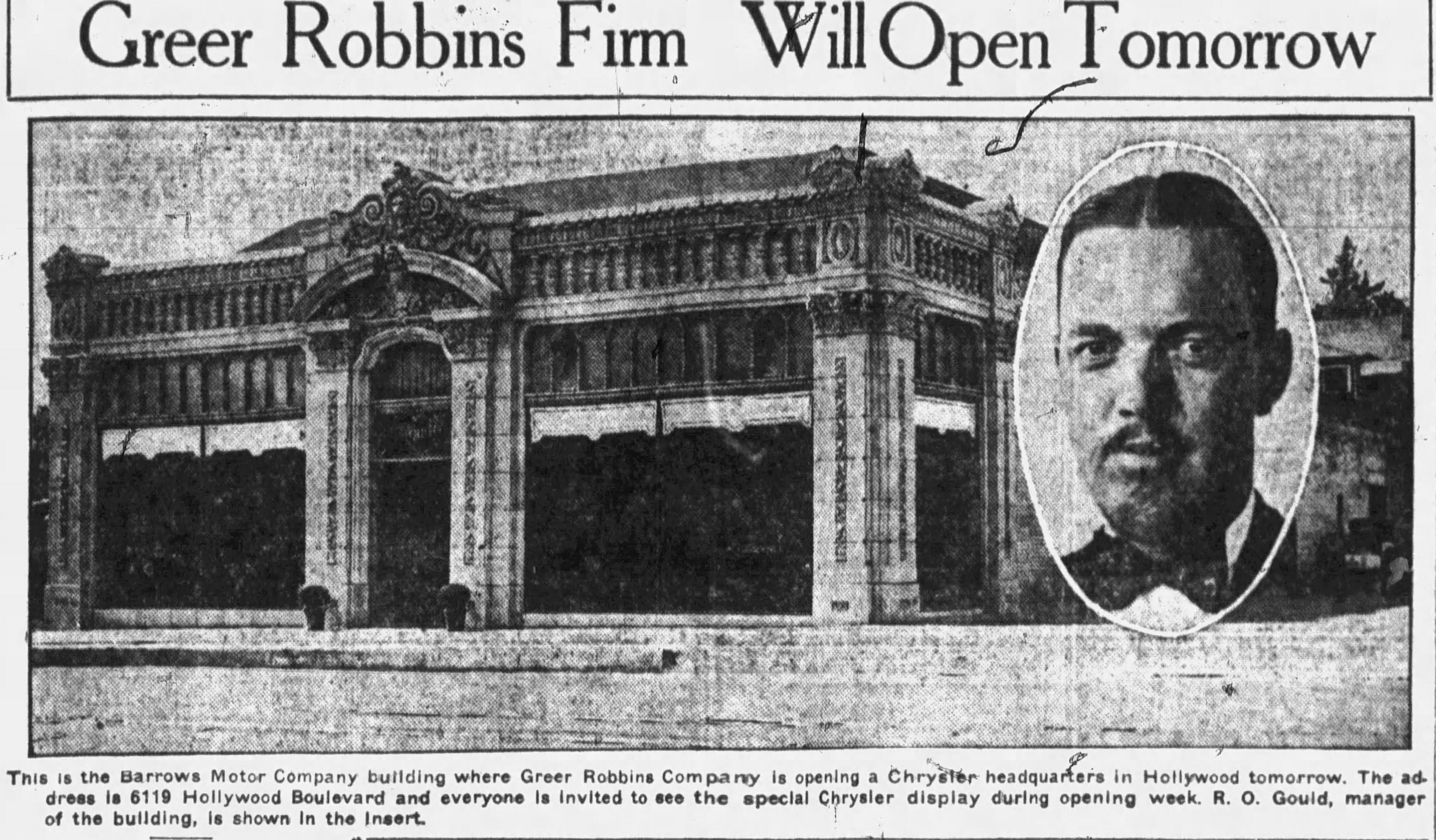
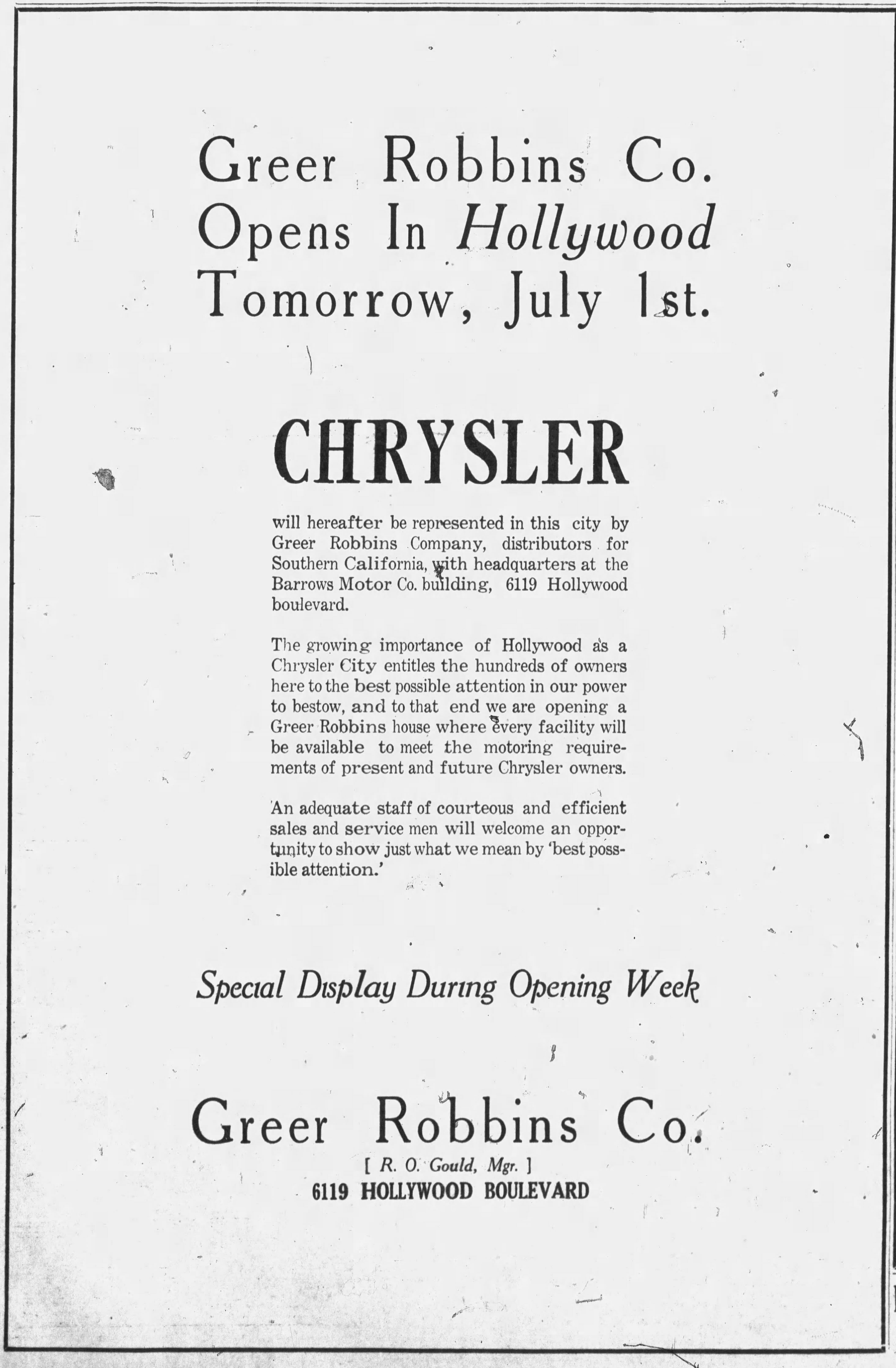
On July 1, 1926, the Greer Robbins Company became the Los Angeles distributor for Chrysler and took over the Hollywood dealership.

Chrysler introduced the lower-priced Plymouth brand in 1928.

LA Times 7/12/1928.

In February 1936 the Paul Bobst Co. was officially appointed the Chrysler (and Plymouth) direct dealer for Hollywood at 6119. Greer Robbins Co. still operated the downtown Los Angeles flagship. Samuel Paul Bobst was previously a state distributor of Chrysler in Oklahoma. Race car driver Barney Oldfield was his brother-in-law.


Hollywood Citizen News 2/12/1936.

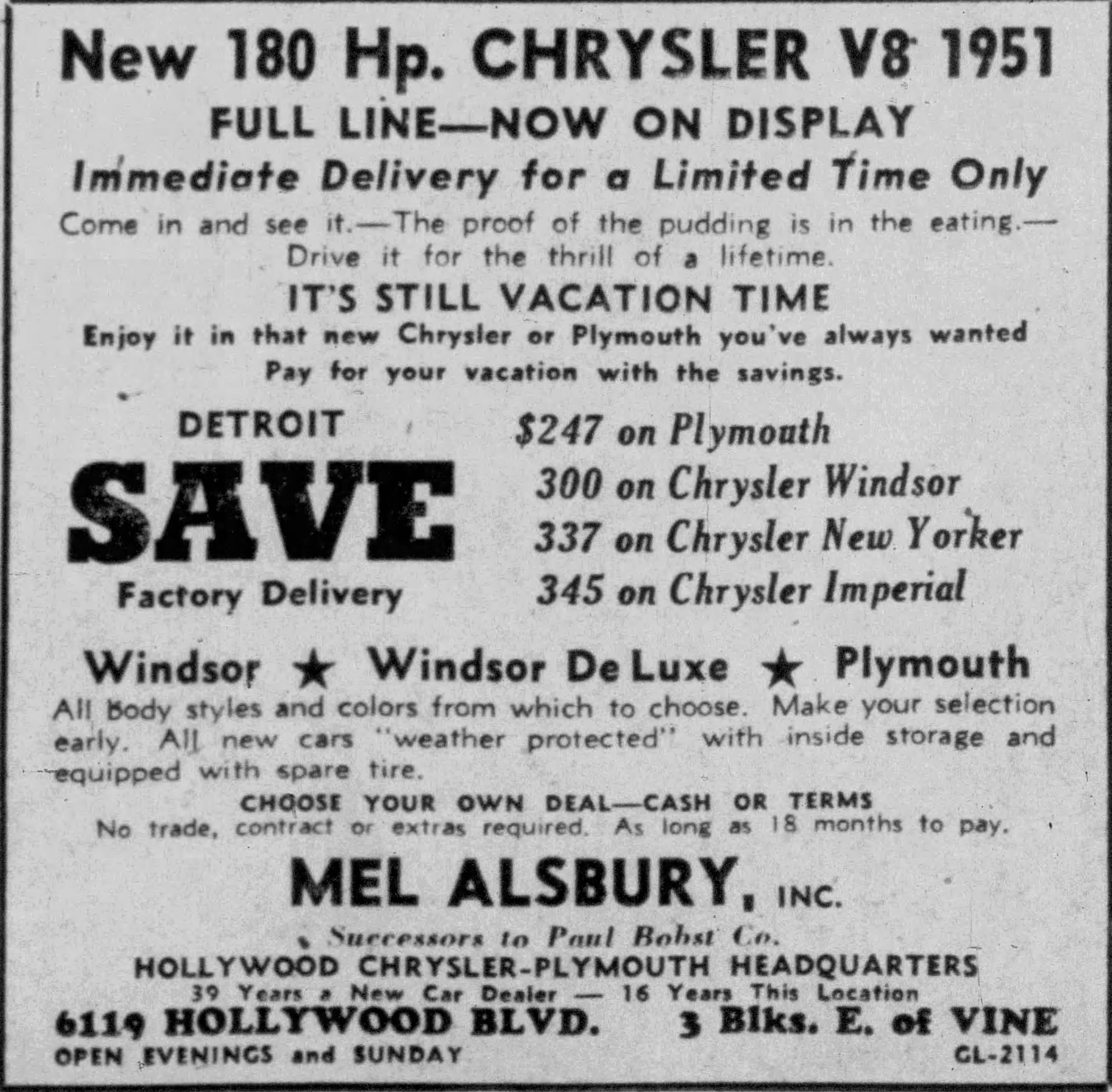
In August 1951 Mel Alsbury took over the Bobst dealership. Mel Alsbury Sr. had been a Chrysler-Plymouth dealer in Salinas, Kansas before coming to Hollywood in 1937 where he was a salesman for, and later VP and general manager of, Paul Bobst Co. In May 1952 Alsbury expanded into two adjacent buildings to the West, at 6125 and 6145 Hollywood Boulevard. Both were early 1920s auto garage/auto showroom structures.

Hollywood Citizen News 8/4/1951.

Hollywood Citizen News 5/28/1952.

Chrysler began making the Chrysler Imperial in 1926, as a luxury auto. In 1954 the Imperial became a stand-alone brand. Mel was now Mel Alsbury Imperial – Chrysler – Plymouth. Hollywood Citizen News 5/1/1957.


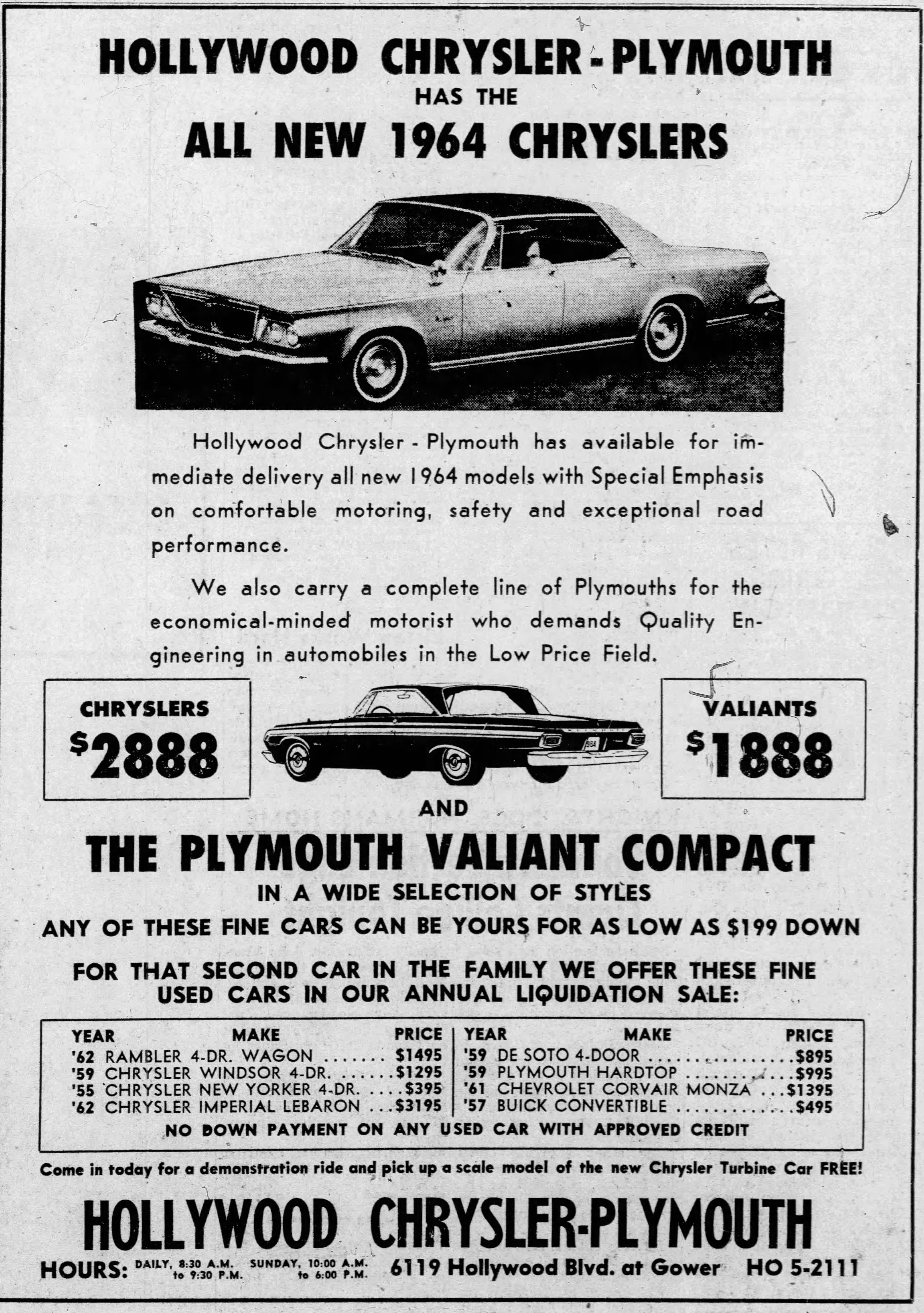
Mel Alsbury remained here through December 1963. In January 1964, the dealership at 6119 became known as Hollywood Chrysler-Plymouth and operated into the late 1960s.

Hollywood Citizen News 1/17/1964.

The building was demolished in 1971.


6100 Hollywood Boulevard: The Bungalow Church

LA Times 5/21/1910

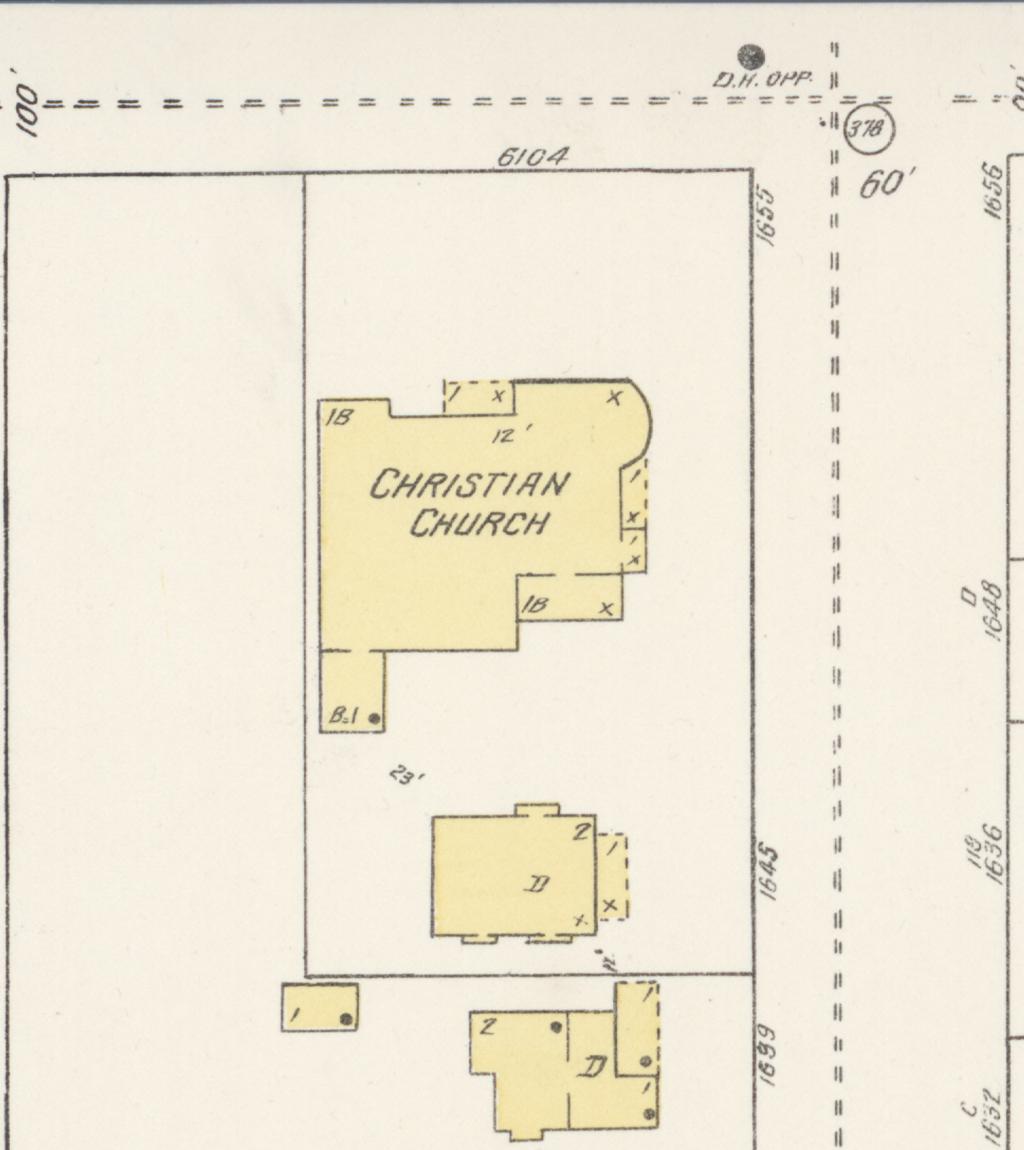
Located on the southwest corner of Hollywood Boulevard and Gower, the Hollywood Christian Church dedicated its new home here on May 21, 1910. The building was a former residential home, a vine-covered bungalow set amid sloping lawns, pepper trees and palms, and the church was fondly known as the “bungalow church.”

Los Angeles would have other bungalow churches. The trend was considered a particularly Southern California phenomenon, like open-air grocery markets.

LA Times 1/1/1914.

Detail of a 1913 Sanborn Fire Insurance Company map for Hollywood. Library of Congress.

The Hollywood Christian Church was founded in 1888 by merchant B. F. Coulter of the department store and the Rev .M. L. Yager who organized the Disciples of Christ Church. It originally met at a school in Coldwater Canyon, later site of the Beverly Hills Hotel, sharing the space on alternating Sundays with the Southern Methodists. In 1890, the church built a small building in Cahuenga near Sunset on land donated by Helen M. Judson Beveridge, wife of the ex-Illinois governor John Lourie Beveridge.

Having outgrown that space, in 1910 they began looking for a new home and found it in a literal home at what was then Prospect Avenue and Gower.

1908 classified ad for the residence at 6100 Hollywood Boulevard that became the Hollywood Christian Church, LA Times 8/4/1908.

LA Times 5/21/1910.

The area was still largely rural and there were several other churches along the Boulevard. The church removed some walls to make room for the congregation but left the fireplace and window seats to create a home-like atmosphere. A deep side porch was enclosed with glass for the Sunday school room.

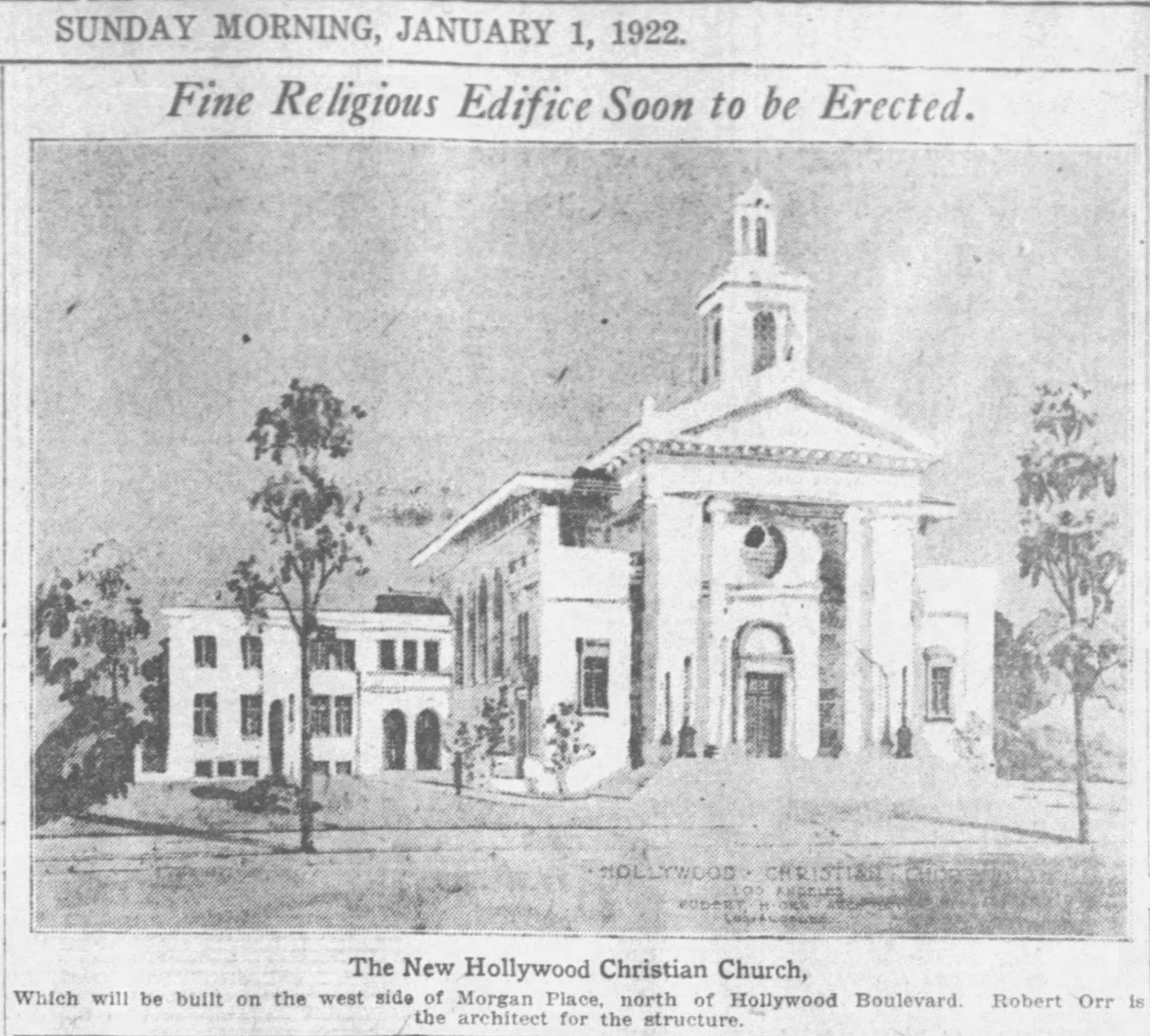
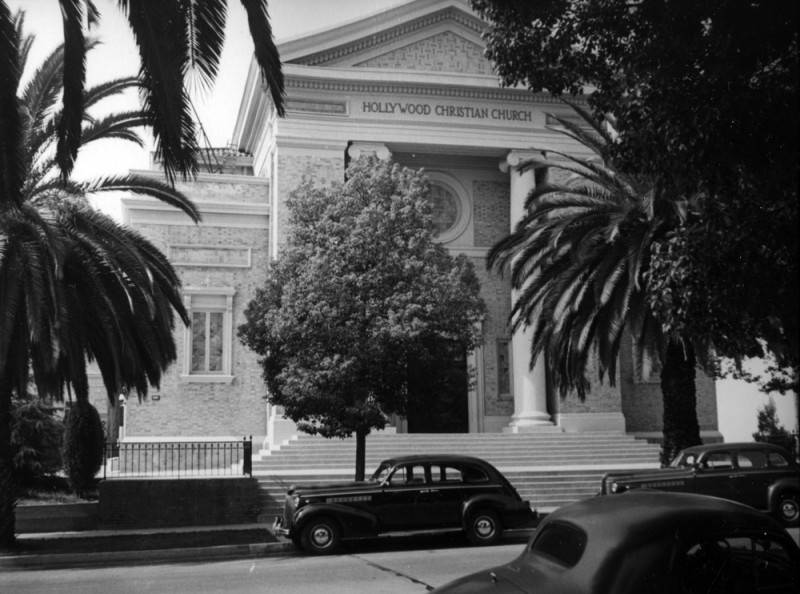
In 1920 the church acquired land at 1717 Morgan Place (later renamed Gramercy Place) just north of the Boulevard and in December 1921 revealed plans for a large new church to be built on it, designed by Robert H. Orr. Greek Revival in style, the new building would be quite different from the humble bungalow church.

LA Times 1/1/1922.

Hollywood Christian Church at what was now 1717 Gramercy Place c. 1937. Herman J. Schultheis photo, LAPL.

The church sold its bungalow home in December 1921 but continued to occupy it as a tenant, renting from the new owner while the new building was under construction. On April 5, 1923, the congregation moved out of the bungalow and began holding services in the Sunday school building of the Morgan Place property.

In May 1923, the former “bungalow church” building opened as a cafe with music and dancing called “Gypsyland.”

Gypsyland, Hollywood night”Where Joy Reigns Supreme.” Killjoys soon put an end to it. Hollywood Daily Citizen 5/30/1923.

Boulevard Karens went ballistic, aiming their criticism at the church for having allowed a rowdy cabaret to move into its former space. Pastor W.F. Richardson had to explain that they were no longer the owners and had no say over what the new owner (Christie Realty Co.) did with the property. Gypsyland was gone in a blink, anyway.

Hollywood Daily Citizen 7/26/1924.

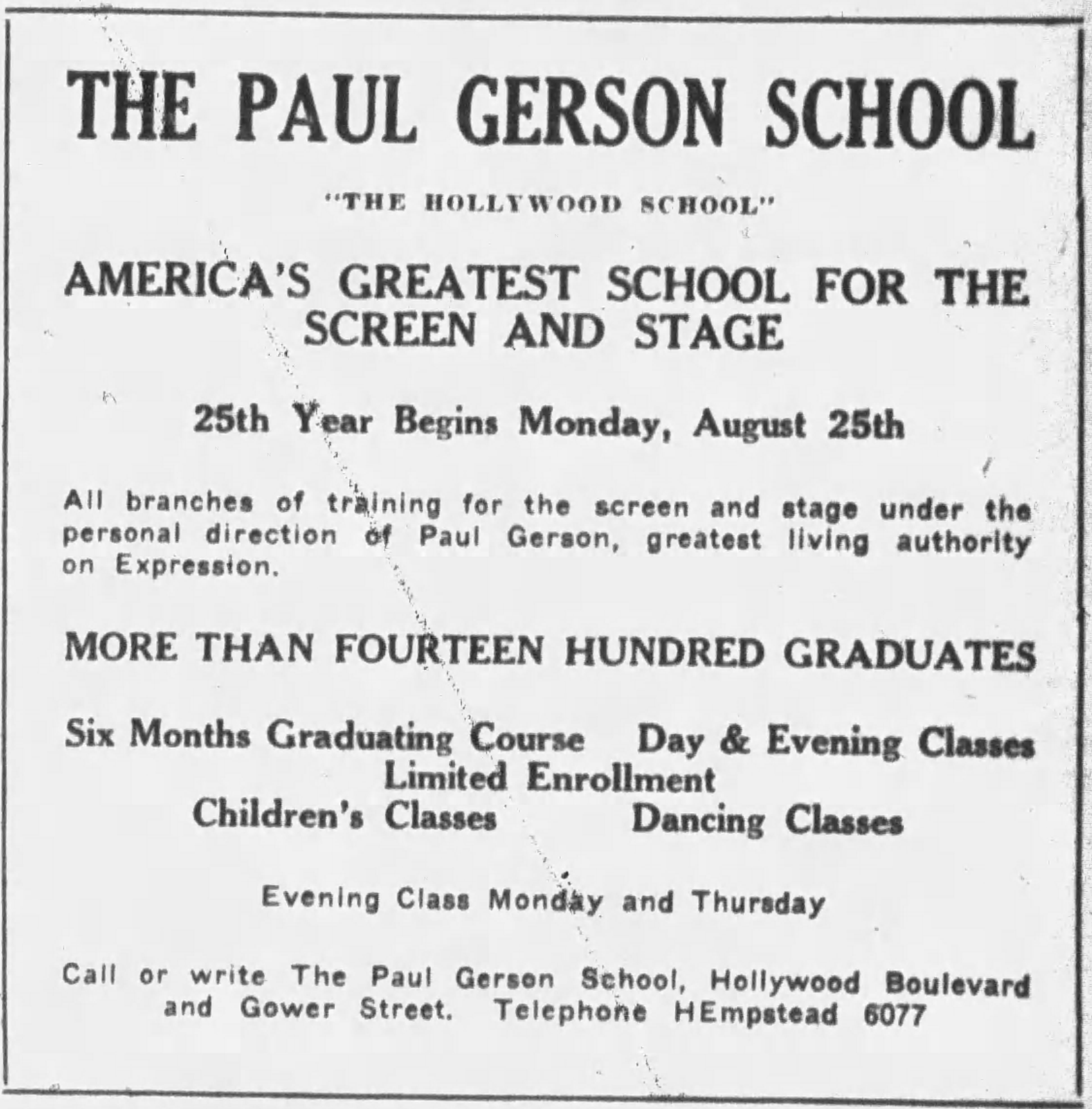
The bungalow was next occupied by the Paul Gerson dramatics school. Born in England in 1871, Paul Gerson was a stage actor who founded an acting school in San Francisco about 1904. His Hollywood branch opened at 6100 on August 25, 1924. It remained through January 1929.

LA Times 1/27/1929.

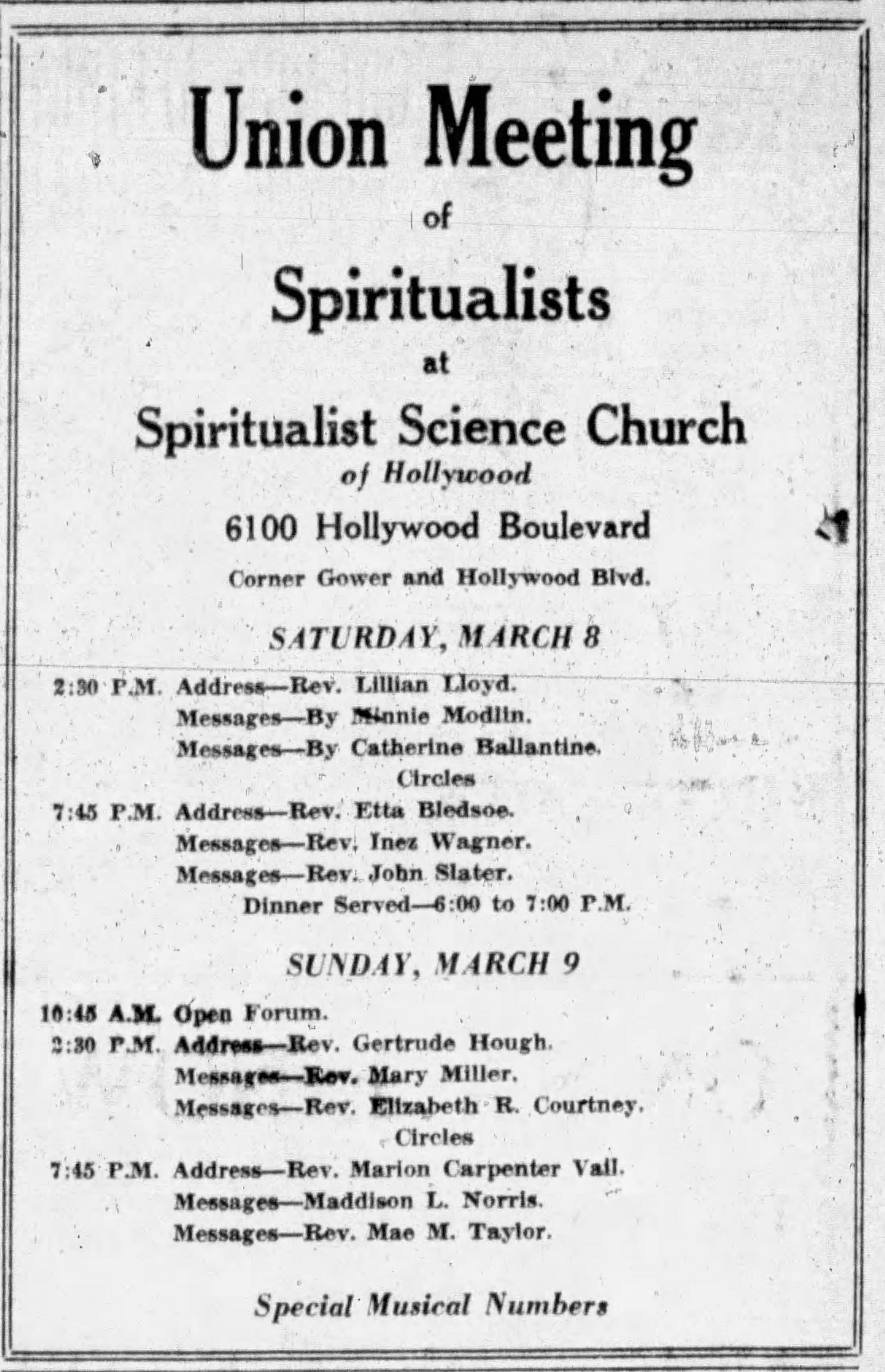
As of March 1930, the property resumed a religious use as the home of the Spiritualist Science Church of Hollywood run by Dr. Mae M. Taylor.

Hollywood Daily Citizen 3/7/1930.

In February 1934 Packard dealer W. H. Collins leased the property’s Hollywood Boulevard frontage for one of his used car lots, while the Spiritualist Church continued to occupy the building itself.

LA Times 2/10/1934.

In November 1935, a permit was obtained to construct a Standard Oil service station and W. H. Collins began to clear his lot. The Spiritualist Church stayed until the end as well but in December 1935, the bungalow was demolished.

LA Times 11/17/1935.

The corner was a gas station for decades. Today it is a parking lot.


Notes:

In October 1934, the Hollywood Christian Church merged with the Beverly Christian Church to become the Hollywood-Beverly Christian Church. The building on Gramercy Place, having suffered earthquake damage, was demolished in 1988.

The Spiritualist Science Church moved to the Castle Center at Franklin and Argyle in December 1935.


6032 Hollywood Boulevard: Automobile dealerships / Hollywood Toyota

Detail of a 1913 Sanborn Fire Insurance Co. map for Hollywood. The parcel that became 6030-6038 was still vacant. The Rich family also owned both parcels directly to the east (6024-6028) and west (6048). Library of Congress map.

Like its neighbor 6028 to the east, 6032 Hollywood Boulevard has home to a smorgasbord of automobile dealerships, including the first Toyota dealership in the USA.

The parcel was vacant until 1920 when siblings Frank Rich and Bessie Rich Garlock had a 1-story retail building constructed here. With space for 5 retail stores, it was addressed as 6030-6032-6034-6036-6038 Hollywood Boulevard. Rich & Garlock were the adult children of Edwin Rich, who owned the adjacent parcel (see 6028 Hollywood Boulevard). Their uncle was Sanford Rich, of 6048 Hollywood Boulevard, who had been mayor of Hollywood from 1904 to 1905 before it was annexed by the City of Los Angeles in 1910.

The building housed various small, mostly short-lived businesses- an automotive supply, a plumber, an architect, a hat shop, a luggage maker.

On June 2, 1928, local papers announced that the property had been leased to Leo G. Coryell, Hollywood Oakland-Pontiac dealer.

Though the papers stated that the existing 1-story building would be demolished and a new auto showroom built in its place at a cost of $20,000, that was either a mistake or a deliberate fib- the same day of the announcement, the siblings obtained a permit to modify the existing building at a cost of $20,000. From now on it would be 6032 Hollywood Boulevard.

Coryell had been a salesman for the Albertson Motor Company Dodge distributors. For several years in the early 1920s, the firm supplied a fleet of Dodges for the LAPD.

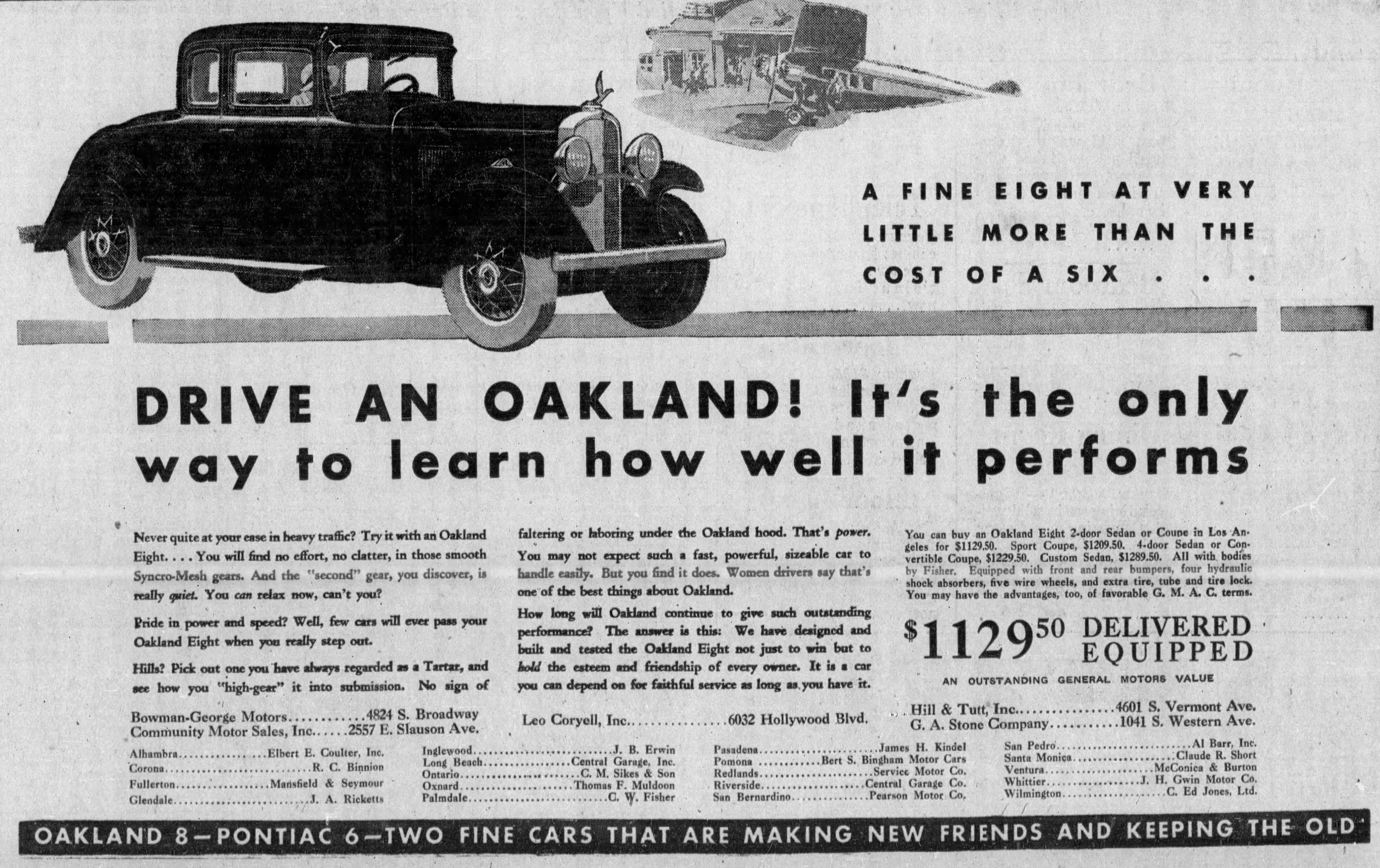
By 1927, Coryell was a dealer for Oakland and Pontiac automobiles. The Oakland Motor Car Company was founded in 1907 and purchased by General Motors (GM) in 1909. Pontiac was a also a GM brand, created in 1926.

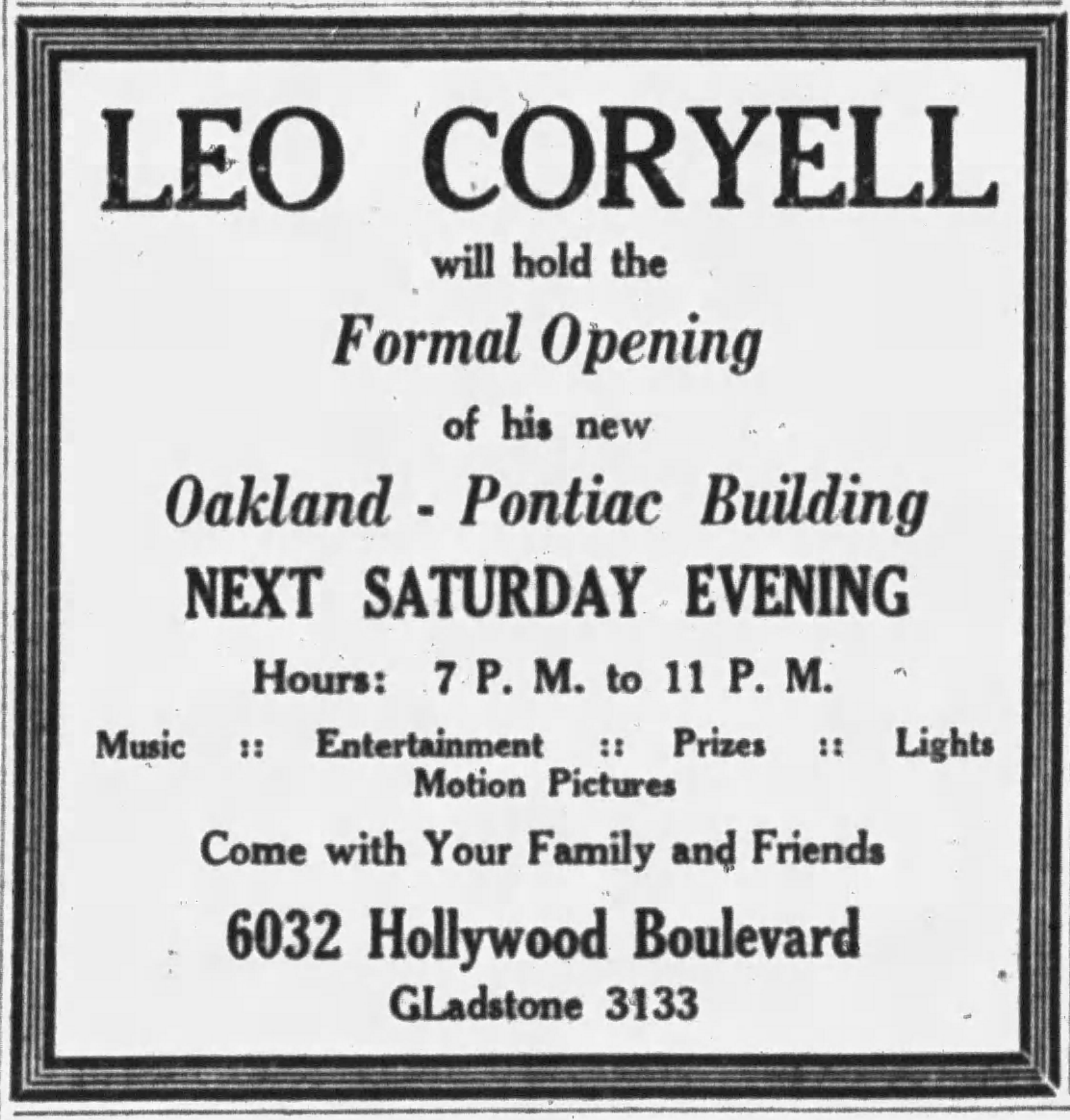
Coryell had his formal opening for 6032, with motion pictures, lights, prizes and a general good time, on August 25, 1928.

Hollywood Daily Citizen 1/15/1930.

Hollywood Daily Citizen 8/15/1928


Hollywood Daily Citizen 8/15/1928

Hollywood Daily Citizen 8/15/1928.

Hollywood Daily Citizen 8/23/1928.

LA Times 9/10/1931

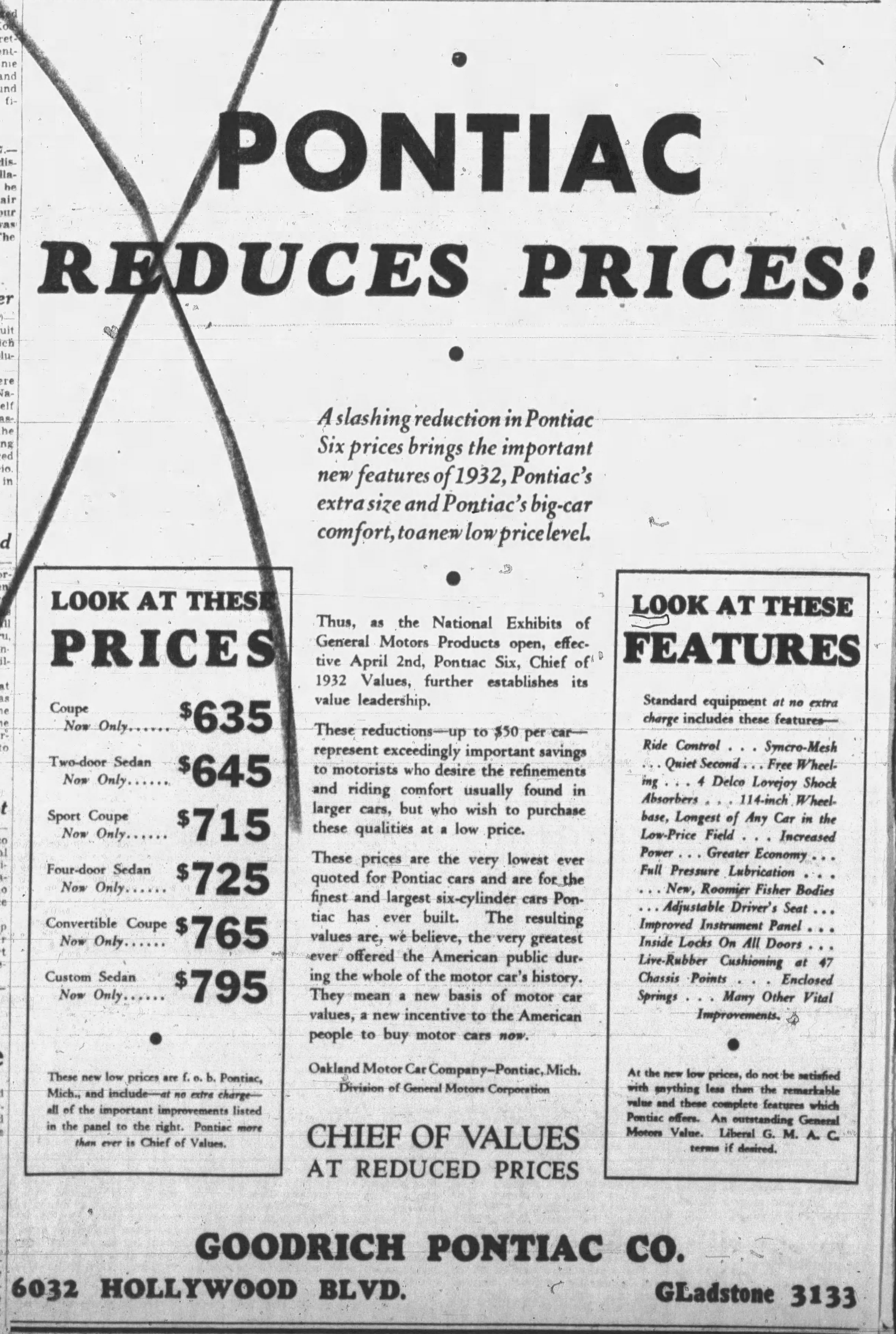
H. H. Goodrich, president of Leo Coryell, Inc., took over the dealership in April 1932, now selling the Pontiac only as GM phased out the Oakland in 1931. He was only in business briefly and closed out the shop in November 1932.

As Goodrich Pontiac. Hollywood Citizen News 5/7/1932.


LA Times 11/26/1932.


On March 1, 1933, it was announced that Hudson Essex dealer Glenn B. Austin had opened a branch at 6032 for his used car department, The cars sold here were largely demonstrator models with only a few miles on them.

Named for department store owner Joseph L. Hudson, the Hudson Motor Car Company was founded in Detroit in 1909. The company introduced the Essex in 1919. It began phasing out the brand in 1932, replacing it with the Terraplane.

“Why put up with mere transportation?” By all means, shame the Depression-era car buyer into taking on more debt, Glenn! Hollywood Citizen News 3/1/1933.

Austin was only here briefly, through May 1933. Hudson would return to this vicinity in 1941- when Sunset Motors moved next door at 6028. By then the Terraplane was no longer made- Hudson discontinued it in 1938.

From August 1933 to September 1935, 6032 Hollywood Boulevard served as an auction house.

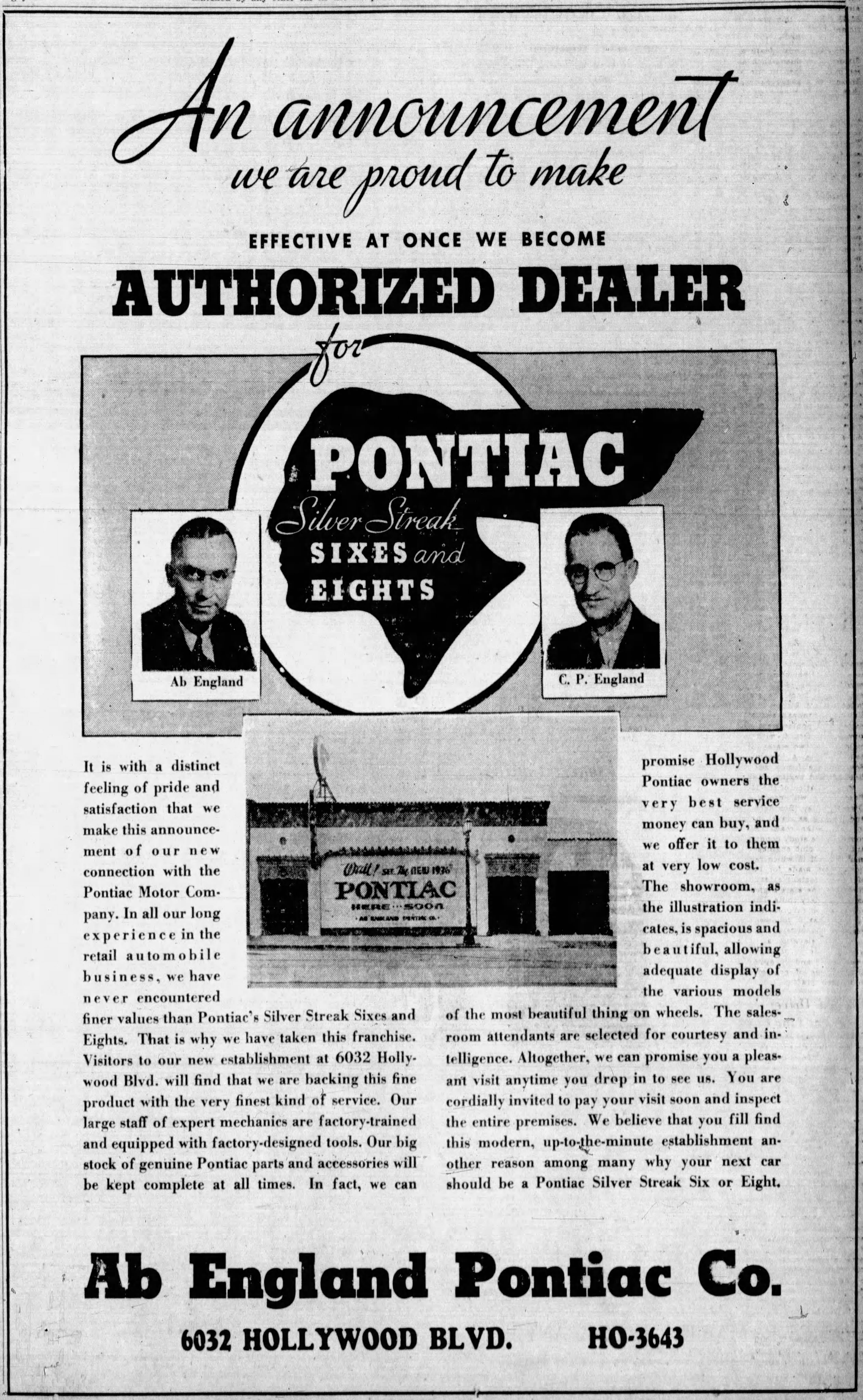
In October 1935, 6032 again became a Pontiac dealership when Pontiac dealer A. E. (Ab) England announced that he was moving into what he called “one of the finest and best equipped automotive establishments in the movie capital.”  England and his brother C.P. England came to Hollywood from Phoenix, where they’d been in the auto business with their uncle O.T. England.

As Ab. England Pontiac. Hollywood Citizen News 10/16/1935.

This section of the Boulevard was still fairly undeveloped at this point. The south side of the block was largely devoted to auto dealerships interspersed by the shaded lawns of the Mountain View Inn. Across the street, there was the Marcal Theater and some small retail buildings but the rural Brokaw property was still undeveloped, but for a defunct miniature golf course. That would change between the years 1936 and 1940 when the Palms Grill, Hawaii Theater, Florentine Gardens and Hollywood Food Mart were built.

Hollywood Citizen News 11/19/1941

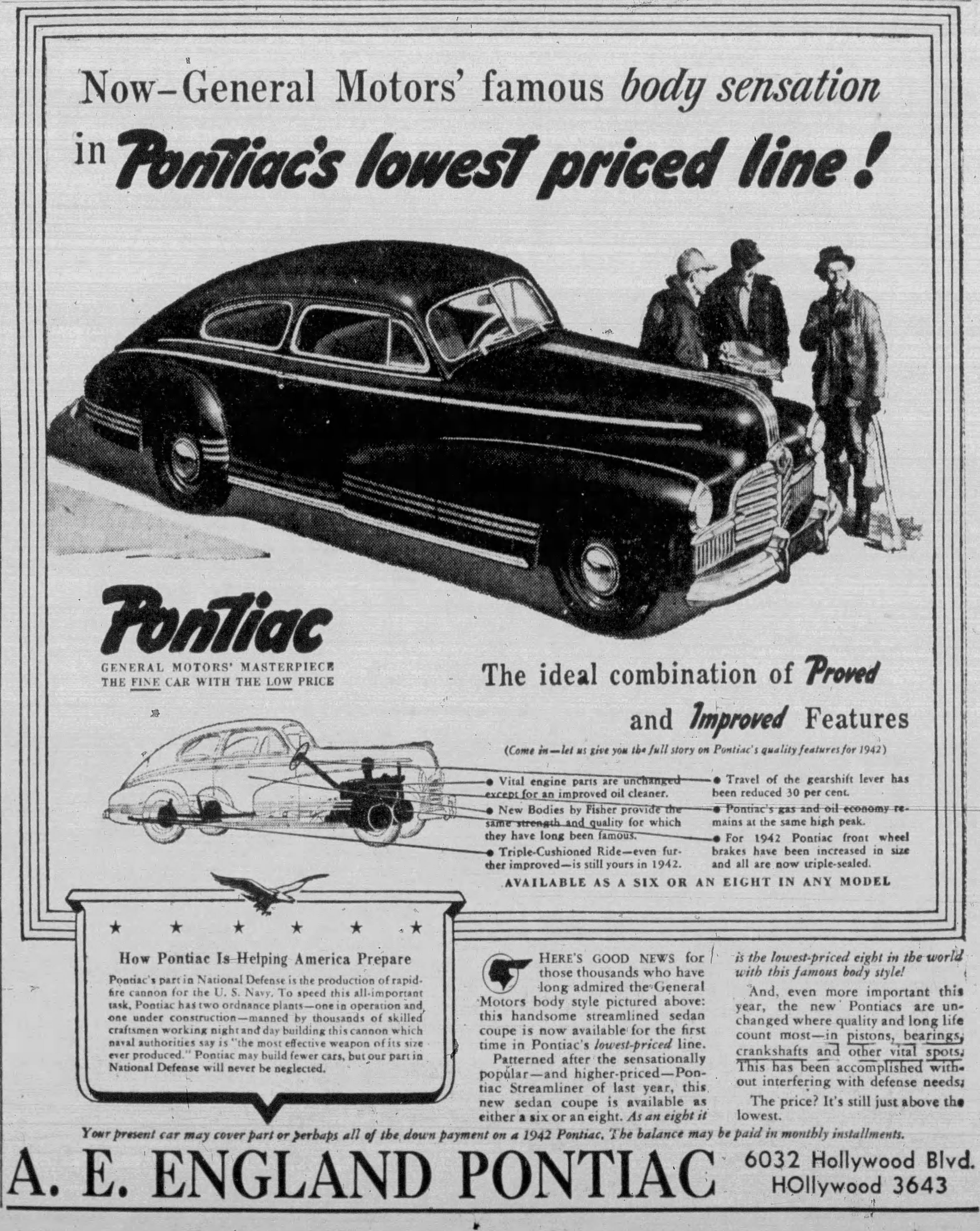
Many auto manufacturers like Pontiac were already working on military contracts prior to the US entry into World War II. Domestic auto production shut down in February 1942 as the auto industry turned 100% to the war effort. Dealers like A.E. England focused on maintaining and repairing existing cars in the service departments and buying and selling used models.

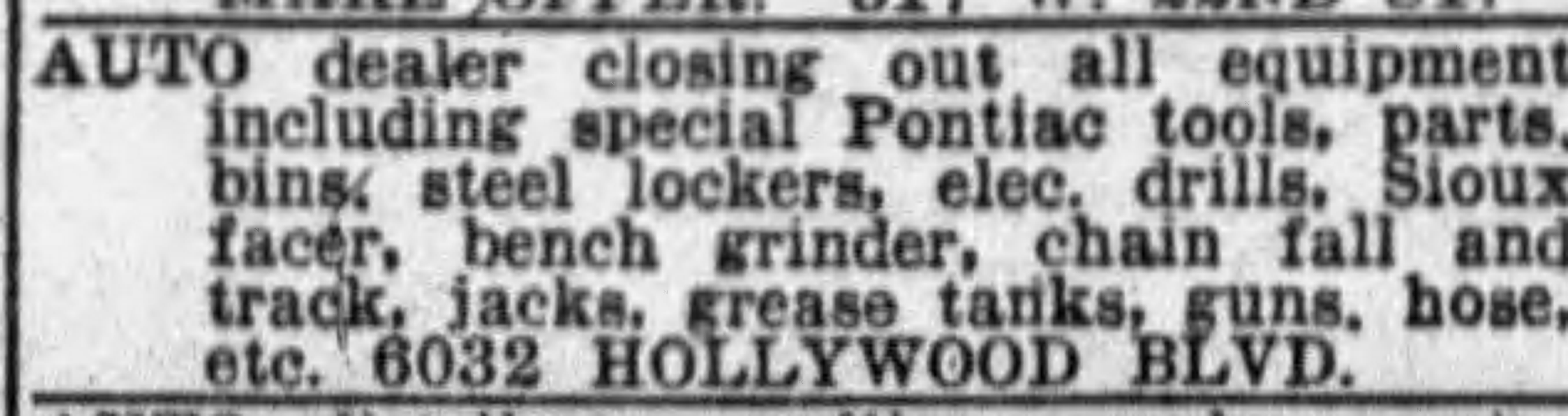
A. E. England Pontiac moved out of 6032 after September 1944, relocating up the block at 6161 Hollywood Boulevard.

6032 again languished as an automotive building. It became the new home of the Hollywood Gun Shop from March 1945 through December 1949. The shop also sold items such as bicycles, fishing rods and reels and other sporting goods equipment. It moved to the former Paul G. Hoffman Studebaker building at 6116 Hollywood Boulevard.

LA Times 3/18/1945.

LA Times 7/16/949

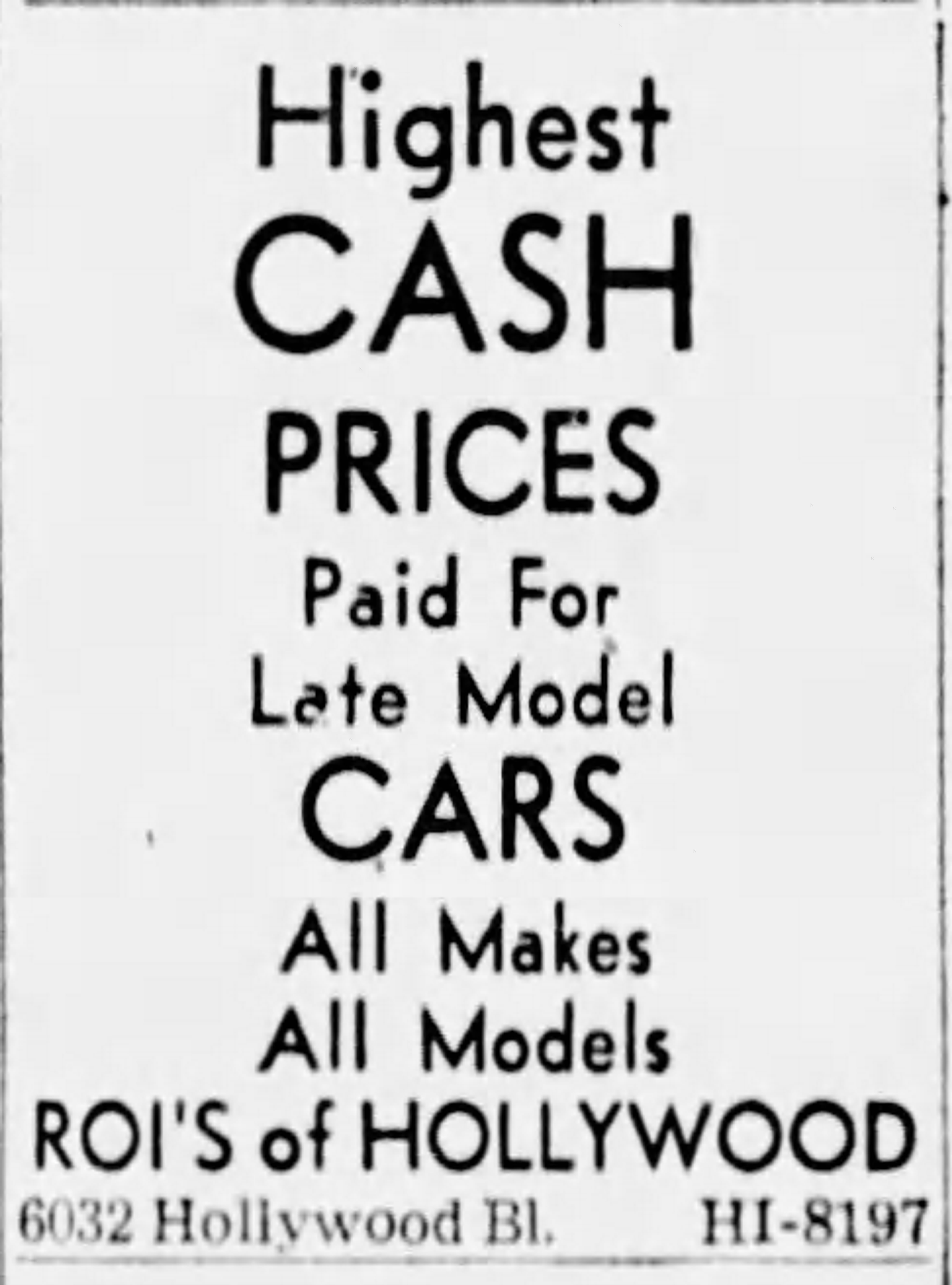
In March 1950, the building returned to automotive use as the showroom of “Roi’s of Hollywood” used cars. Roi’s remained here through early June 1950.

Valley Times 3/20/1950.

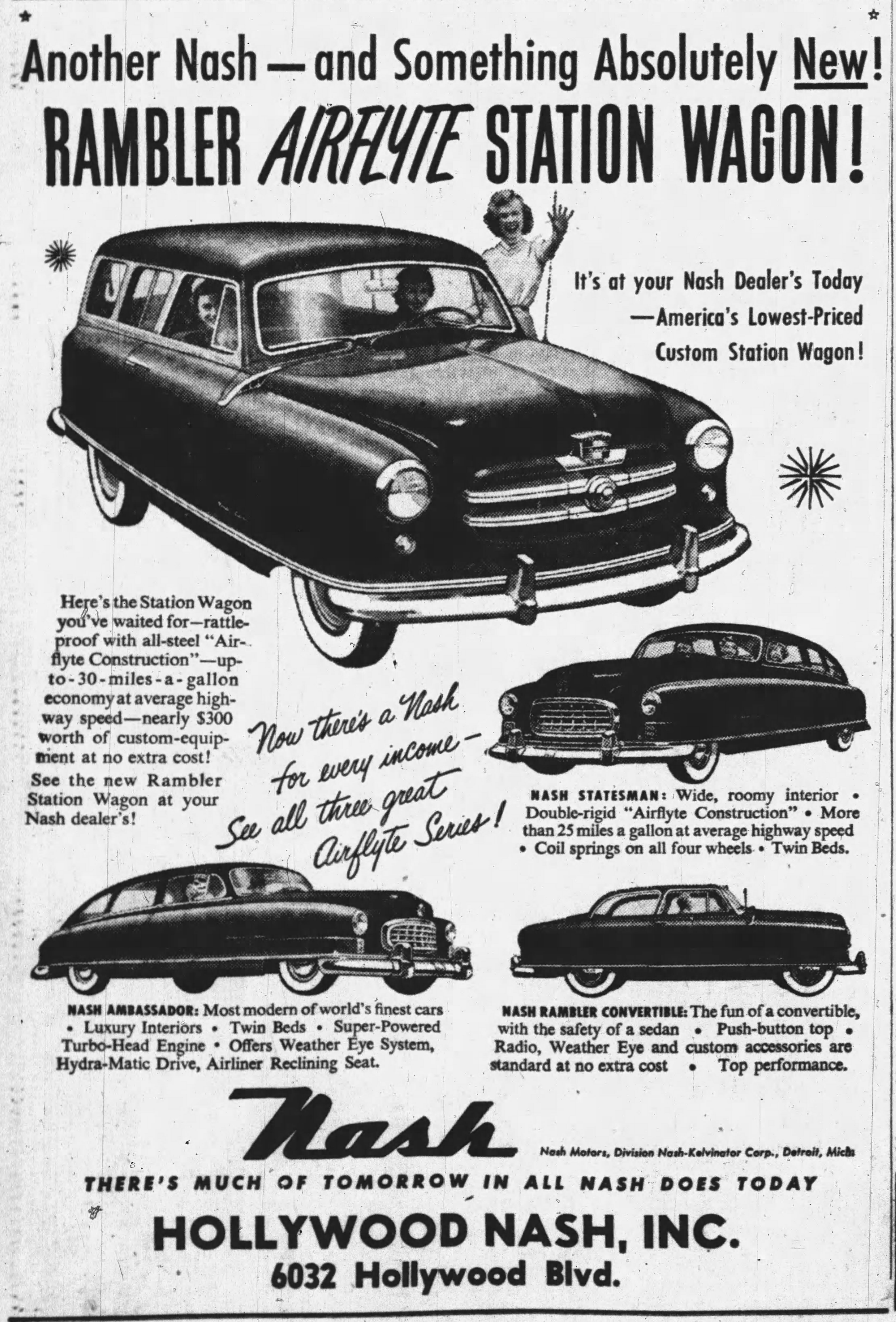
On June 22, 1950 it became Hollywood Nash. Nash had previously operated next door at 6028 in 1936 to 1937 when 6032 was a Pontiac dealership. Nash Motors Co. had become Nash-Kelvinator Corporation in January 1937, and operated as the automotive division of Kelvinator, manufacturer of refrigerators and other appliances.

Nash Motors Company, based in Kenosha, Wisconsin, was founded by former GM president Charles W. Nash in 1916 when he acquired the Thomas B. Jeffrey Co., which had manufactured a horseless carriage called the Rambler from 1902 to 1914. Nash introduced its Rambler for the 1950 model year along with the Nash Statesman and the Nash Ambassador. The Rambler was considered a compact car for the time. Nash began using the distinctive “Airflyte” aerodynamic body styling in 1949.

In November 1950, manager Ted Faull announced that a modernization and reorganization of the space was nearing completion. Customers would now be able to enter the service department from Hollywood Boulevard but would exit onto Carlton Way, thereby avoiding traffic on the Boulevard. This indicates the dealership must have been routing customers along the south (rear) part of the property, and to the east past 6028 and 6000 Hollywood Boulevard to the alley called Brokaw Place that connected Hollywood Boulevard to Carlton Way between 6000 and the Mountain View Inn at 5956 Hollywood Boulevard.

Twin beds? Yes, the Nash Ambassador and Nash Statesman features fold-down front seats that made into a bed. The “Weather Eye” was the heating and air-conditioning system. Hollywood Citizen News 6/23/1950.

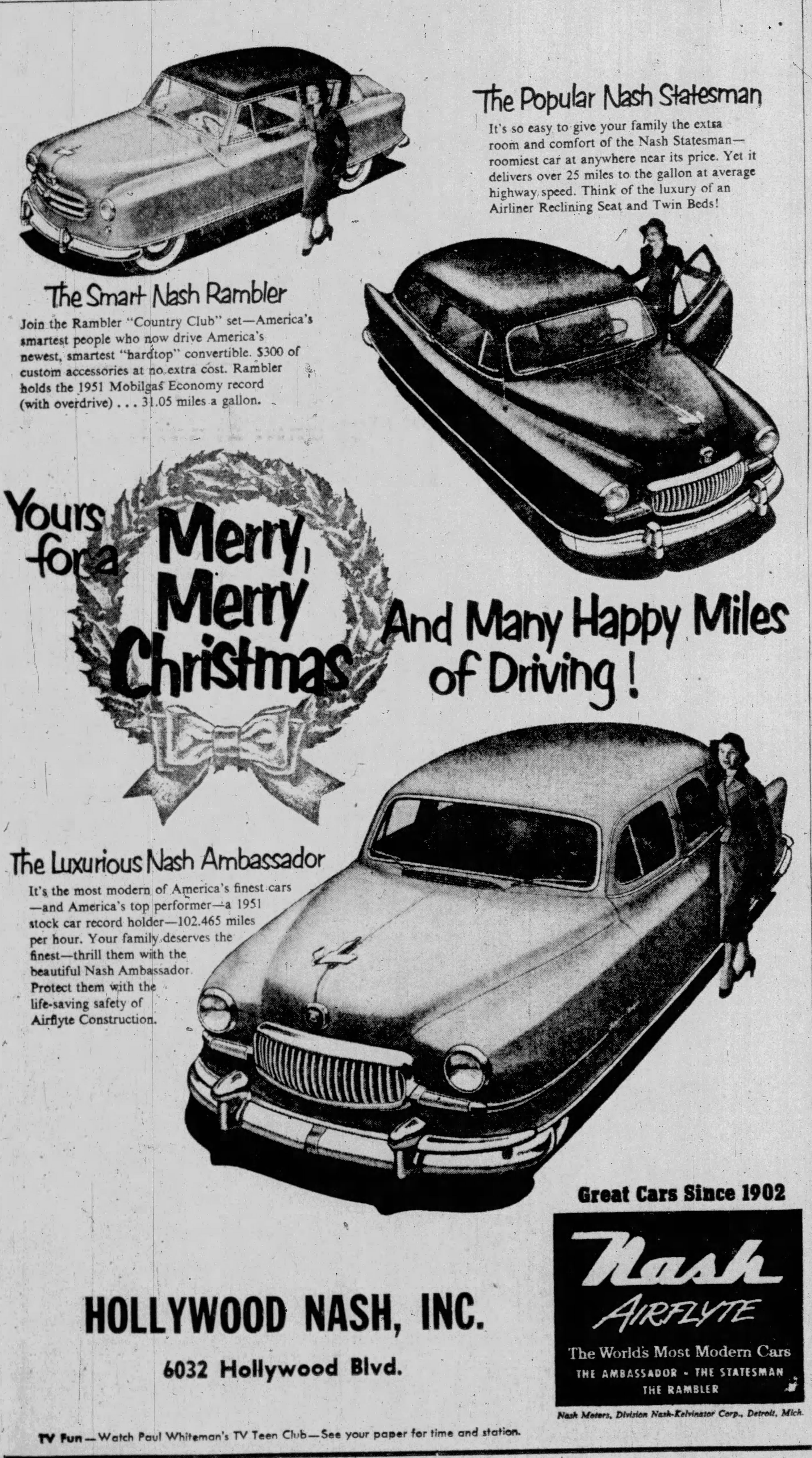
Hollywood Citizen News 12/13/1951

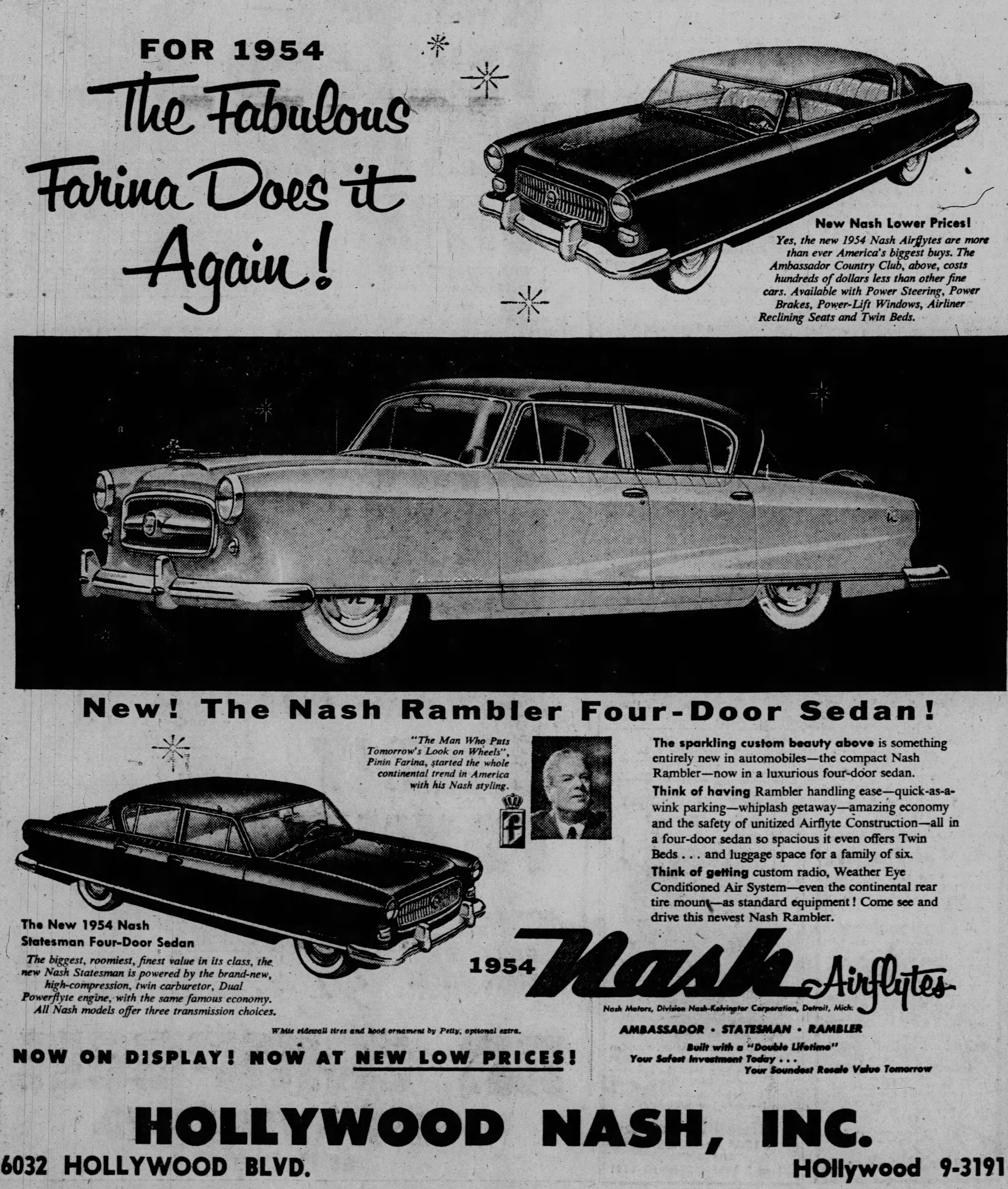
“The Fabulous Farina” is a reference to Italian auto designer Battista “Pinin” Farina who worked as a consultant for Nash on the 1952-1954 models. Citizen News 12/1/1953.

Hollywood Nash remained here through December 1953. It moved to 5239 Sunset Boulevard. In 1954, Nash-Kelvinator merged with Hudson to form the American Motors Corporation (AMC).

From January 1954 to May 1957, 6032 was used by J. F. O’Connor and Son  Lincoln-Mercury, who had moved to 6028 in 1949, and then by O’Connor’s successor, Pearson Lincoln-Mercury. By this time both parcels were owned by Mark M. Hansen of the Marcal Theater and his wife Ida. Hansen had acquired 6032 by 1940 and 6028 as of 1952 for sure. Pearson left in May 1957 when Hollywood Ford took over 6028 Hollywood Boulevard. Likely Ford was using this property as well.

Hollywood Citizen News 1/15/1954.

LA Times 5/13/1957.


In July 1957, Reuters and other news correspondents reported that the Toyota Motor Company of Nagoya, Japan was to begin exporting its Toyopet passenger cars in the USA, an attempt to capture the growing market her for smaller, more fuel efficient cars. Toyota officials scouted locations and decided that Hollywood was the ideal place to open its first dealership.

Reuters reports on Toyota’s plan to enter the US market. LA Times 7/14/1957.


Los Angeles Toyota fans with a paid admission to the Imported Motor Cars Show, held at the Shrine Auditorium January 9-19, 1958, got to see the new Toyopet Crown- the first showing in the USA.

LA Mirror News 1/11/1958.

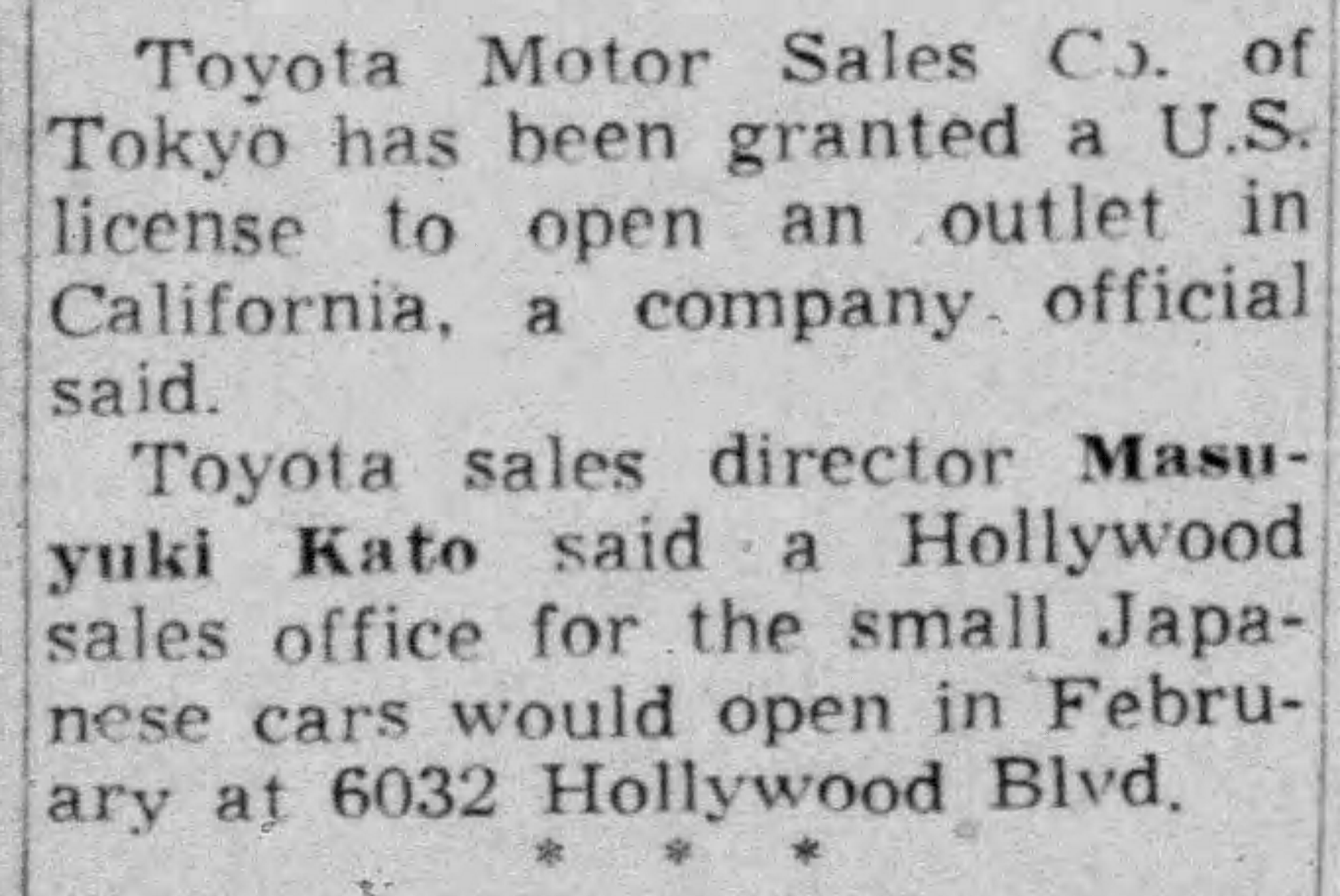
While the show was still underway, on January 18, 1958, the Hollywood Citizen-News reported that Toyota had been granted a license to sell their vehicles in California. Toyota sales director Masuyuki Kato announced that their first dealership would open at 6032 Hollywood Boulevard in February 1958. On March 1, the paper reported that Toyopet parts had arrived at Los Angeles Harbor, bound for the brand’s showroom at 6032 Hollywood Boulevard. The cars themselves were expected in late March. The article indicates there was a Toyota Land Cruiser, 2 station wagons and 4 passenger cars on hand here. These were likely demonstrator models and not for sale.

Hollywood Citizen News 1/18/1958.


Hollywood Citizen News 3/1/1958.


Late March came and went. The first shipment of Toyopets for retail sale arrived at LA Harbor on June 20, 1958 and would be available for public viewing on July 18. That date got pushed back to July 31, 1958. And when the Toyopets were finally put on the market, it does not appear that they were sold at 6032 Hollywood Boulevard, after all.  Holt Motor Company Dodge-Plymouth dealer in the Valley at 5230 Van Nuys Boulevard claimed the first public showing. A local Toyopet ad published July 31, 1958 lists all the So Cal Toyopet dealerships. 6032 Hollywood Boulevard is not mentioned. If Toyopet vehicles were being sold or displayed here at this time, it wasn’t hyped.

Pasadena Independent 6/26/1958.


Valley News 7/29/1958.

LA Mirror News 7/30/1958.

Closer look at the local Toyopet dealers listed in the ad above. LA Mirror News 7/30/1958.

In September 1959, Stan Brucks Oldsmobile had an import division called Brucks Imports at 6032 Hollywood Boulevard, and was an authorized dealer of the Toyopet along with other import makes- including Triumph and Singer motor cars from Britain and the Volvo.

LA Times 9/18/1959.

LA Times 9/18/1959.


LA Times 11/20/1959.

Brucks continued to advertise here through November 1959.

July 21, 1961 was the first advertisement for Hollywood Toyota Motor, Inc. at 6032 Hollywood Boulevard.

LA Times 7/27/1961.

If that wasn’t an incentive to buy a new Toyota from Hollywood Toyota! Free passes to see the new James Bond film then playing exclusively down at the Chinese Theater, “You Only Live Twice,” co-starring the Toyota 2000 G. T. Hollywood Citizen News 7/12/1967.

Hollywood Toyota moved to a new building at 1000 N. Vermont Avenue May 24-26, 1968, and later moved again to 6161 Hollywood Boulevard- the onetime home of A. E. England Pontiac.

Hollywood Citizen News 5/24/1968.

The address 6032 Hollywood Boulevard does not appear to have been used after Toyota moved out. In June 1970, Hollywood Ford at 6000 Hollywood Boulevard had all extant structures on 6032 and 6028 demolished and the entire property from 6000 to the corner of Gower was addressed as 6000 Hollywood Boulevard.  Hollywood Toyota moved back to this location (as 6000 Hollywood Boulevard) in 1983. Today it remains Hollywood Toyota.

6028 Hollywood Boulevard: Automobile dealerships


Detail of a 1913 Sanborn Fire Insurance map for Hollywood. Library of Congress.

6028 Hollywood Boulevard, on the south side of the street between Bronson and Gower was home to a variety of automobile showrooms.

Like most of the block, the parcel was rural/residential before World War I. The property owner was Edwin Rich, brother of Sanford Rich. The brothers had come to Hollywood in the early 1900s and developed numerous tracts in the heart of Hollywood. Sanford was a pioneer realtor and the first mayor of Hollywood when it was incorporated in 1903 (Hollywood was annexed by the City of Los Angeles in 1910), whose home was at 6048 Hollywood Boulevard until his death in June 1930 at age 89. Two of Edwin’s grown children, son Frank and daughter Bessie, were also in real estate, as Rich & Garlock, based briefly at 6026 Hollywood Boulevard, and developed the adjacent parcel at 6032. Edwin Rich passed away at age 90 in September 1932.

Hollywood Citizen 1/2/1920

F.R. “Jack” Germond was the first known auto dealer to operate at 6028 as The Germond Motor Company. A salesman for Earl V. Armstrong, LA’s distributor for the Chandler Motor Car Co., in October 1919 Germod was appointed Hollywood’s dealer for Cleveland Automobile Company, a new subsidiary of Chandler.  Apparently operating out of an existing building on this property, by November 1920 he had moved to temporary quarters at 6151 Hollywood Boulevard and 6028 became an auto repair shop. In 1922 a tire shop opened here as well. Edwin Rich modified the building with a partition to accommodate the two businesses.

Hollywood Citizen 7/23/1920

LA Evening Express 9/9/1922

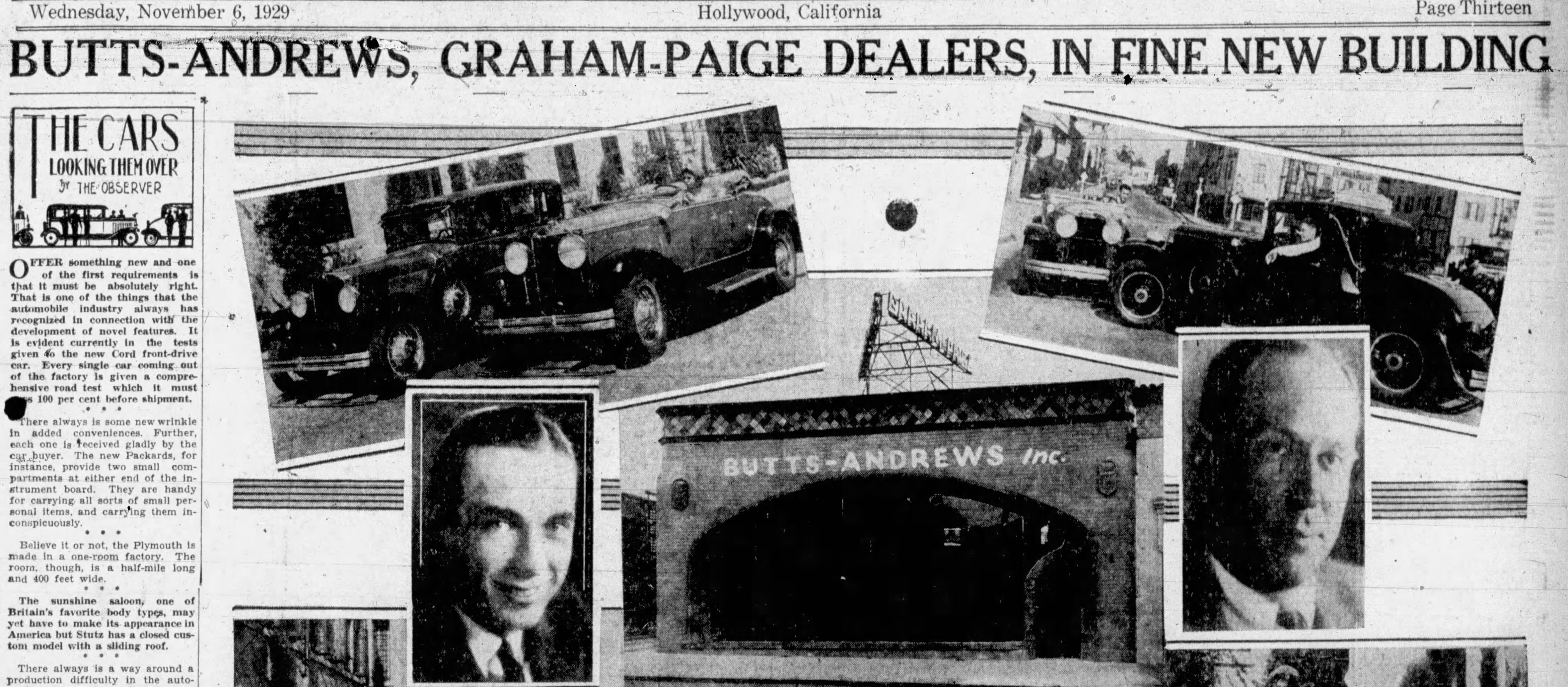
In November 1929, 6028 became the home of Butts-Andrews Graham-Paige, situated in a new building built for them by engineer William J. Moran. The unusual structure had a slightly Art Nouveau appearance, with a 50-foot-wide arched central window, intended to look like the proscenium arch of a theater. The interior was designed to “represent the tap room of an early Spanish inn,” with un-plastered, polychrome walls that had a “crude stone block” effect and ceilings of rough lumber that featured a “pyro” (burned) finish.

Hollywood Daily Citizen 11/6/1929

F.W. Butts and J. J Andrews had been Pierce-Arrow dealers at 5760 Sunset Boulevard in 1927. In October 1929, at the same location, they became dealers for Graham-Paige. Headquartered in Evansville, Indiana, Graham-Paige was established in 1927 when the Graham brothers purchased the Detroit Motor Car Company, makers of Paige and Jewett automobiles.

As Butts-Andrews Graham-Paige. Hollywood Daily Citizen 11/6/1929

Butts-Andrews were only in their new building a brief time, through June 1930.

The next tenant to move in was Herbert Woodward, Inc. Reo dealership, on October 15, 1930. Based in Lansing, Michigan, Reo was founded by Ransom E. Olds (of Oldsmobile) in 1905.

As Herbert Woodward Reo. Hollywood Daily Citizen 10/15/1930.

Herbert Woodward Reo was only here a brief time, also- through June 1931.

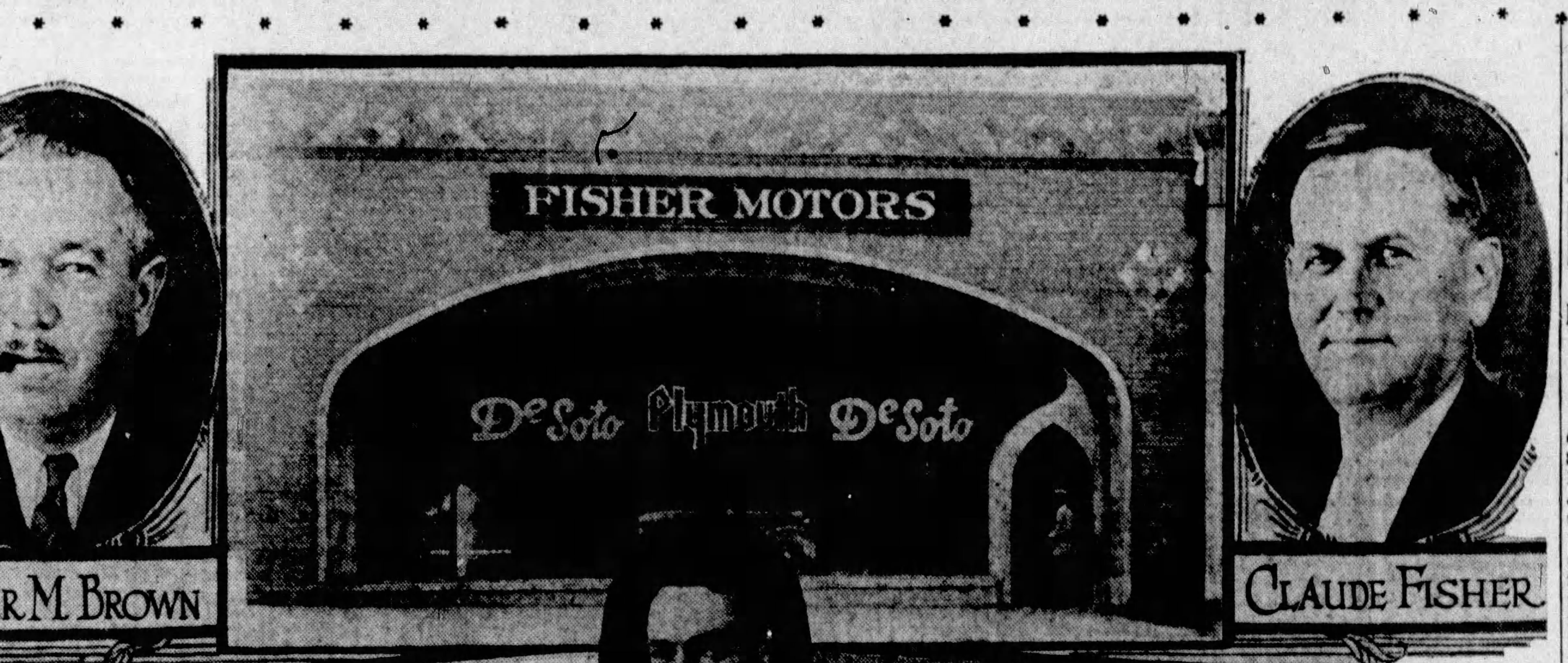
On September 30, 1931, 6028 Hollywood Boulevard became Fisher Motors De Soto-Plymouth, operated by Claude Fisher and Walton M. Brown. The formal opening was held October 3, 1931 with searchlights, music, and a talking picture of Plymouth’s record run through Death Valley. Plymouth and De Soto were divisions of the Chrysler Corporation introduced in July and August, respectively, 1928.

As Fisher Motors De Soto-Plymouth. Hollywood Daily Citizen 9/30/1931


Hollywood Daily Citizen 9/30/1931

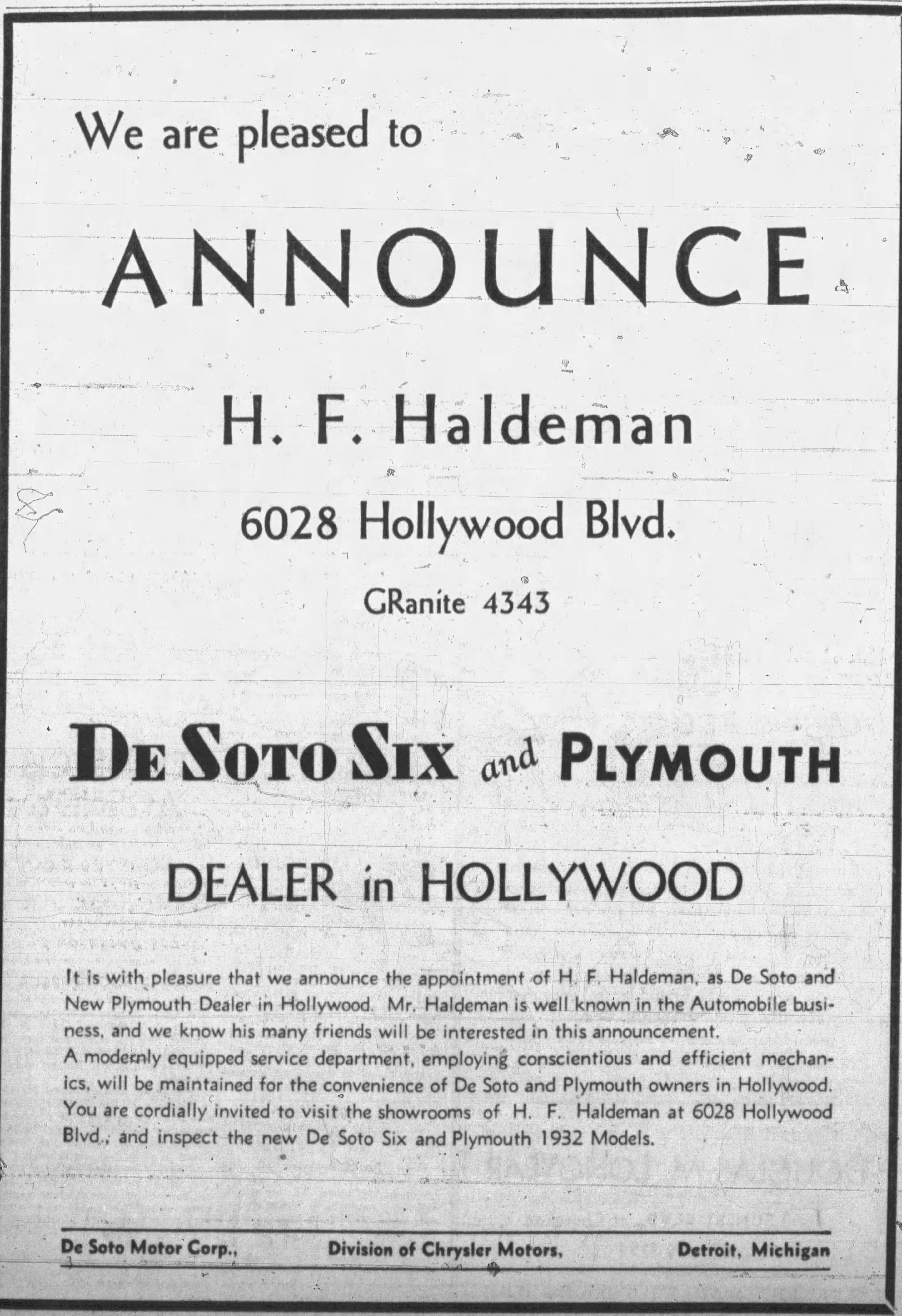
Fisher Motors exited in March 1932 but the building remained a De Soto and Plymouth Dealership under H. F. Haldeman, who opened here April 6, 1932.

As H. F. Haldeman DeSoto Plymouth. Hollywood Citizen News 4/6/1932

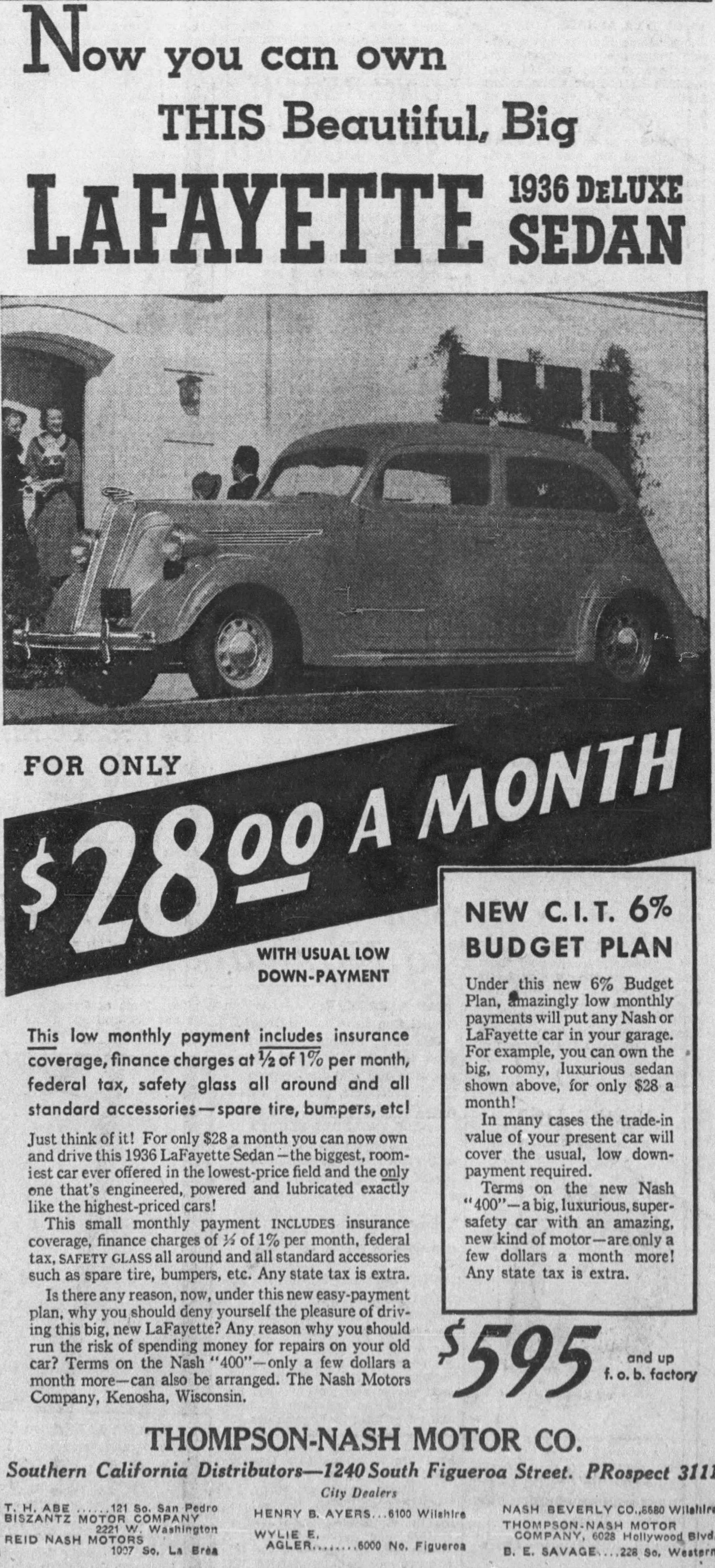
Haldeman remained here until November 1935. The Thompson-Nash Motor Company moved in in February 1936. Nash Motors Company, based in Kenosha, Wisconsin, was founded by former GM president Charles W. Nash in 1916 when he acquired the Thomas B. Jeffrey Co. Nash took over the LaFayette Motors Co. in 1921. The LaFayette name was retired for a time but revived by Nash in 1934.

LA Times 2/4/1936

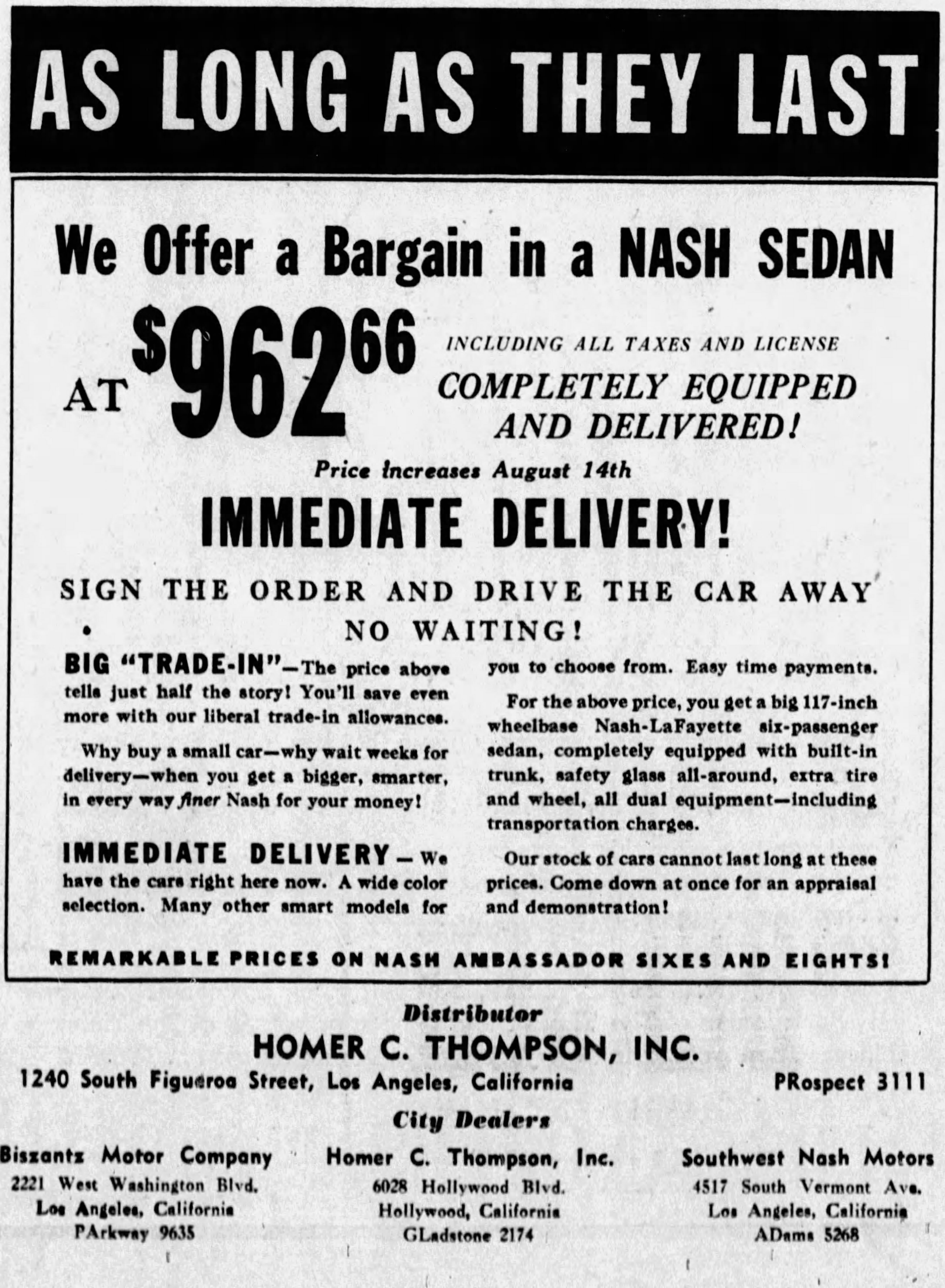
In August 1937, Thompson-Nash Motor Co. became Homer C. Thompson Inc. Homer C. Thompson was the general manager of Thompson Nash and continued selling Nash cars at 6028 after the change in name and ownership. Nash Motors Co. had become Nash-Kelvinator Corporation in January 1937, the automotive division of Kelvinator, manufacturer of refrigerators and other appliances.

LA Times 8/12/1937

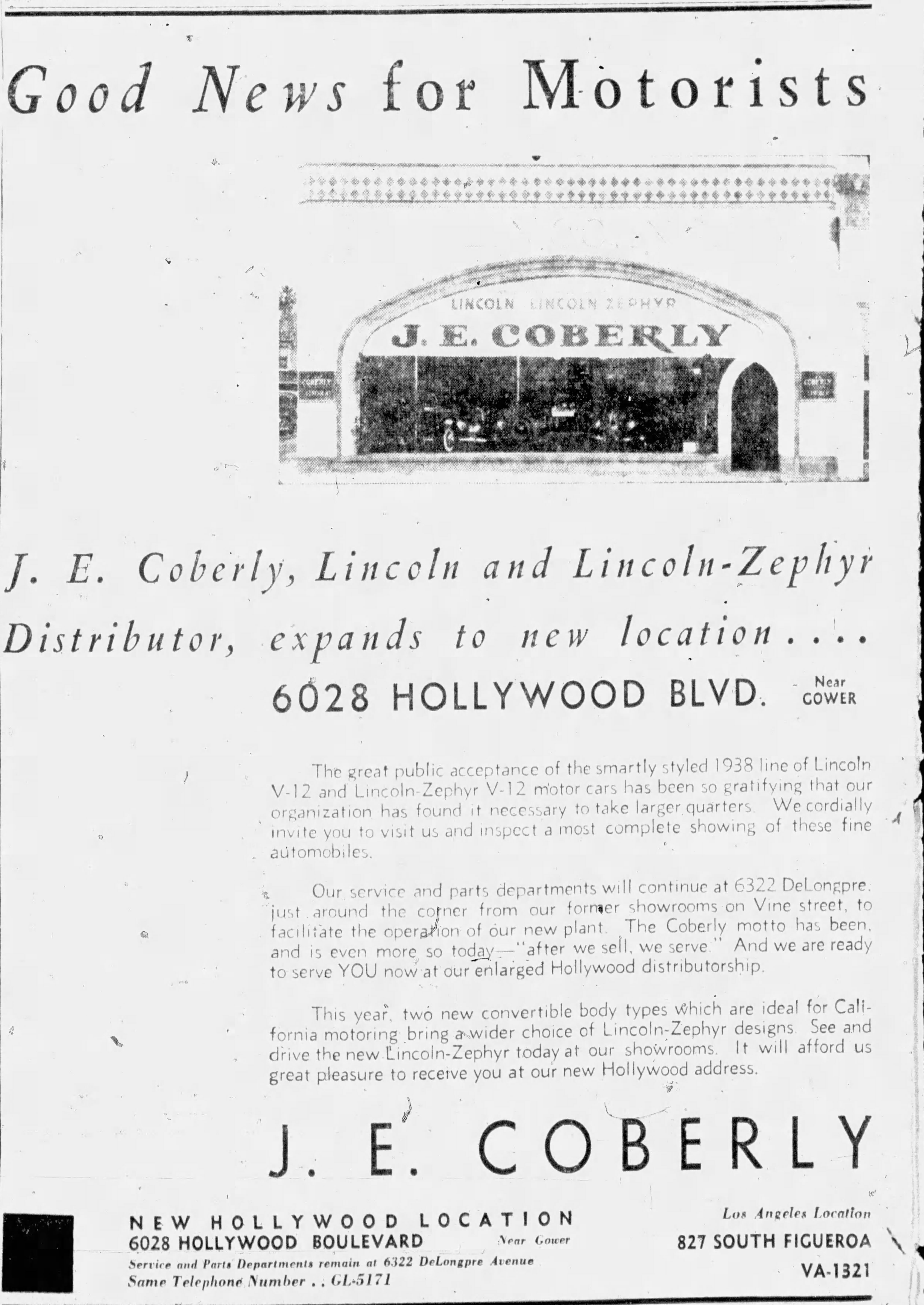
Homer C. was here only briefly (Nash, however, would later return to the vicinity, next door at 6032). In February 1938, this dealership became J. E. Coberly Lincoln, selling Lincolns and the Lincoln-Zephyr. Lincoln was the luxury division of the Ford Motor Company. Founded in 1917, it was acquired by Ford in 1922. Zephyrs were made from 1936 to 1942.

As Coberly Lincoln. Hollywood Citizen News 2/9/1938

J. E. Coberly was here through January 1939.

The property appears to have languished for a time. In November 1939 it was used as the temporary home of the Hollywood branch public library while the library’s old building at Hollywood and Ivar was being dismantled and salvaged for use at its new location north of the Boulevard on Ivar. In May 1940, 6028 was the temporary quarters of an auction house.

In January 1941, it became the new showroom of Sunset Motors, the Hudson dealership of Frank B. Hughes. Hudson Motor Co. of Detroit was founded in 1909. In 1954 it merged with Nash-Kelvinator to form the American Motors Corporation (AMC).

Hollywood Citizen News 2/19/1941.

Hollywood Citizen News 11/12/1941

Sunset Motors remained here until November 1941, when Hughes retired to serve with the Red Cross disaster emergency transportation organization. The following year, in November 1942, he became head of the auto division of the War Production Board.

With the US at war, the federal Office of Production put a freeze on all sales of passenger cars and the following month, February 1942, production of non-military vehicles came to a halt. 6028 turned into a defense plant for rivets and bolts then was again an auto repair shop- a service in high demand. With no new autos being made, maintenance of your existing car became critical.

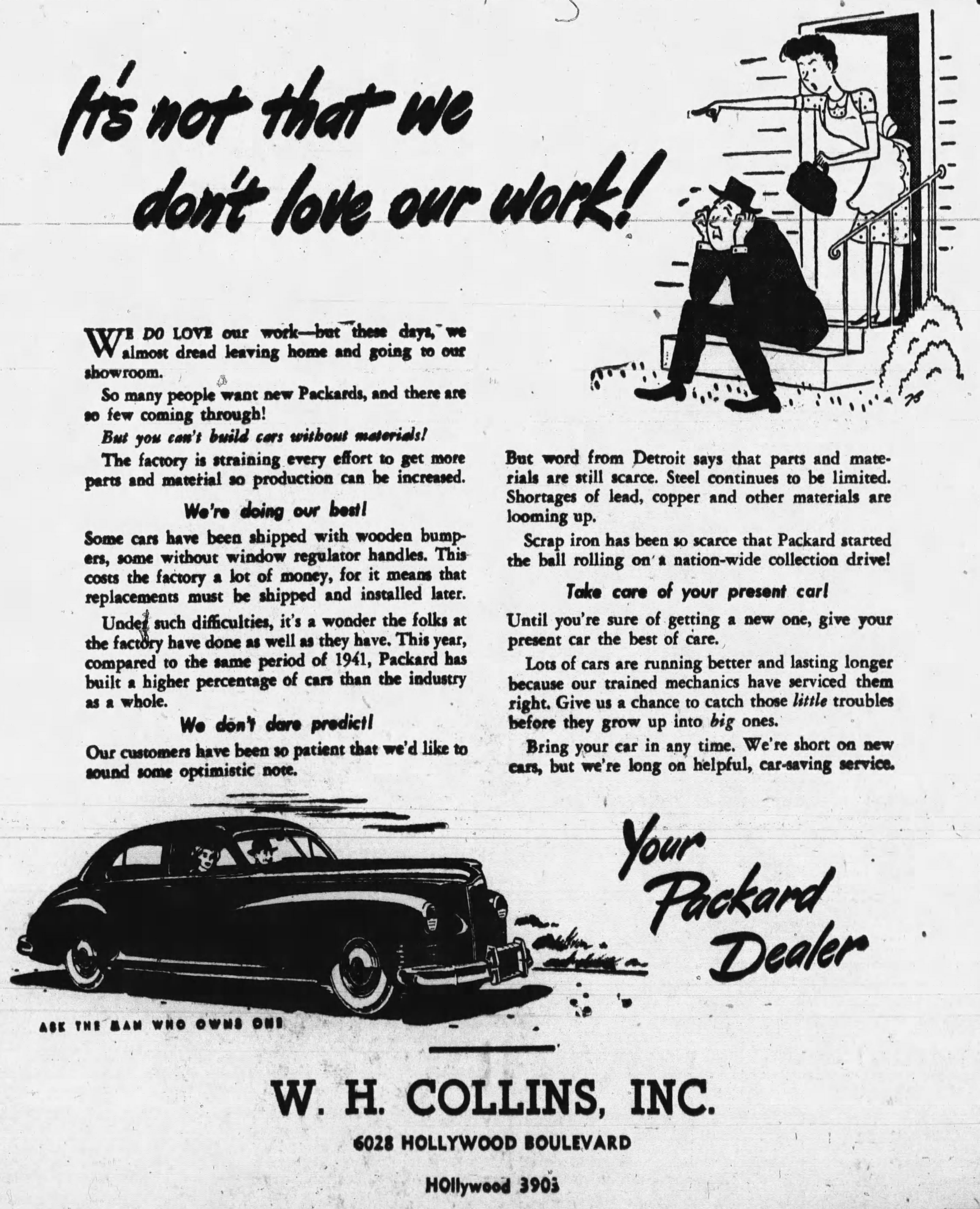
In March 1945, Packard dealer W. H. Collins Inc. moved in to 6028. Packard was a luxury automobile, founded in 1899, whose famous slogan was “Ask the man who owns one.”

With the war over, auto makers were given the green light to return to full commercial production on August 25, 1945. Still, it was impossible to meet the demand for new cars and for most customers it was a long wait until their orders could be filled. See my previous post on 1946 cars, here.

Hollywood Citizen News 10/29/1946

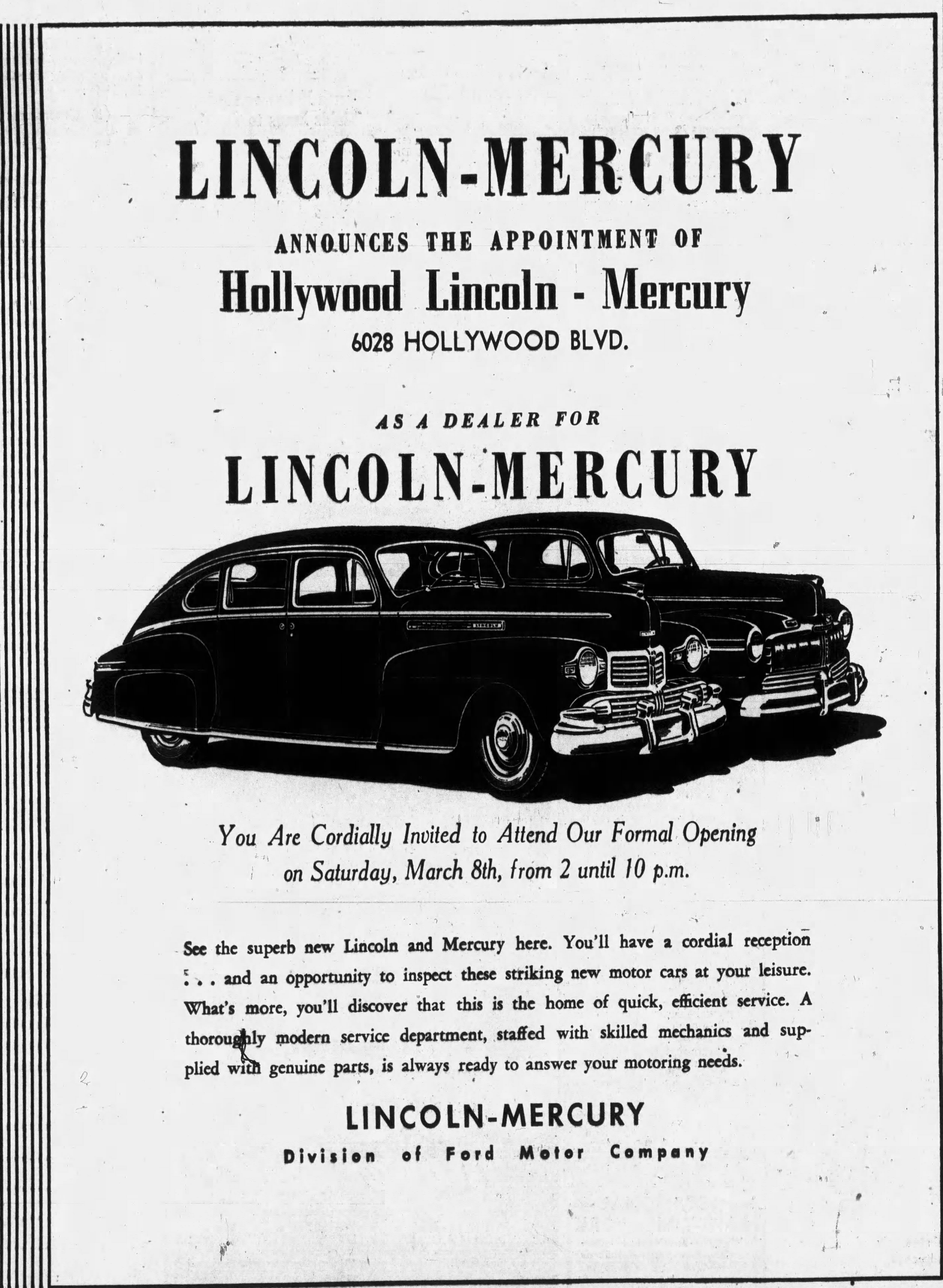
W. H. Collins Packard was here until February 13, 1947, when the dealership became L. W. “Eph” Andrews Lincoln-Mercury. Ford had introduced the Mercury in 1938. The Lincoln-Mercury division was formed in October 1945- part of Henry Ford II’s reorganization of the company. Eph Andrews had previously been the president and general manager of W. H. Collins Packard. The official opening was March 8, 1947 under the new name Hollywood Lincoln-Mercury.

As Hollywood Lincoln-Mercury. Hollywood Citizen News 3/7/1947

In August 1949, the dealership was taken over by J. F. O’Connor & Son, whose former location at 5800 Hollywood Boulevard was taken over for the Hollywood Freeway. Previously Nash dealers, O’Connor and Son was now a Lincoln-Mercury dealership.

O’Connor & Sons were previously at 5800 Hollywood Boulevard. Hollywood Citizen News 8/12/1949

LA Times 9/30/1949

O’Connor and Son would use both 6028 and 6032 Hollywood Boulevard at times; both parcels were acquired by Mark M. Hansen of the Marcal Theater and his wife Ida. Hansen also owned O’Connor’s previous location and had a building constructed for him on the lot in 1945. O’Connor also sometimes used 6000 Hollywood Boulevard.

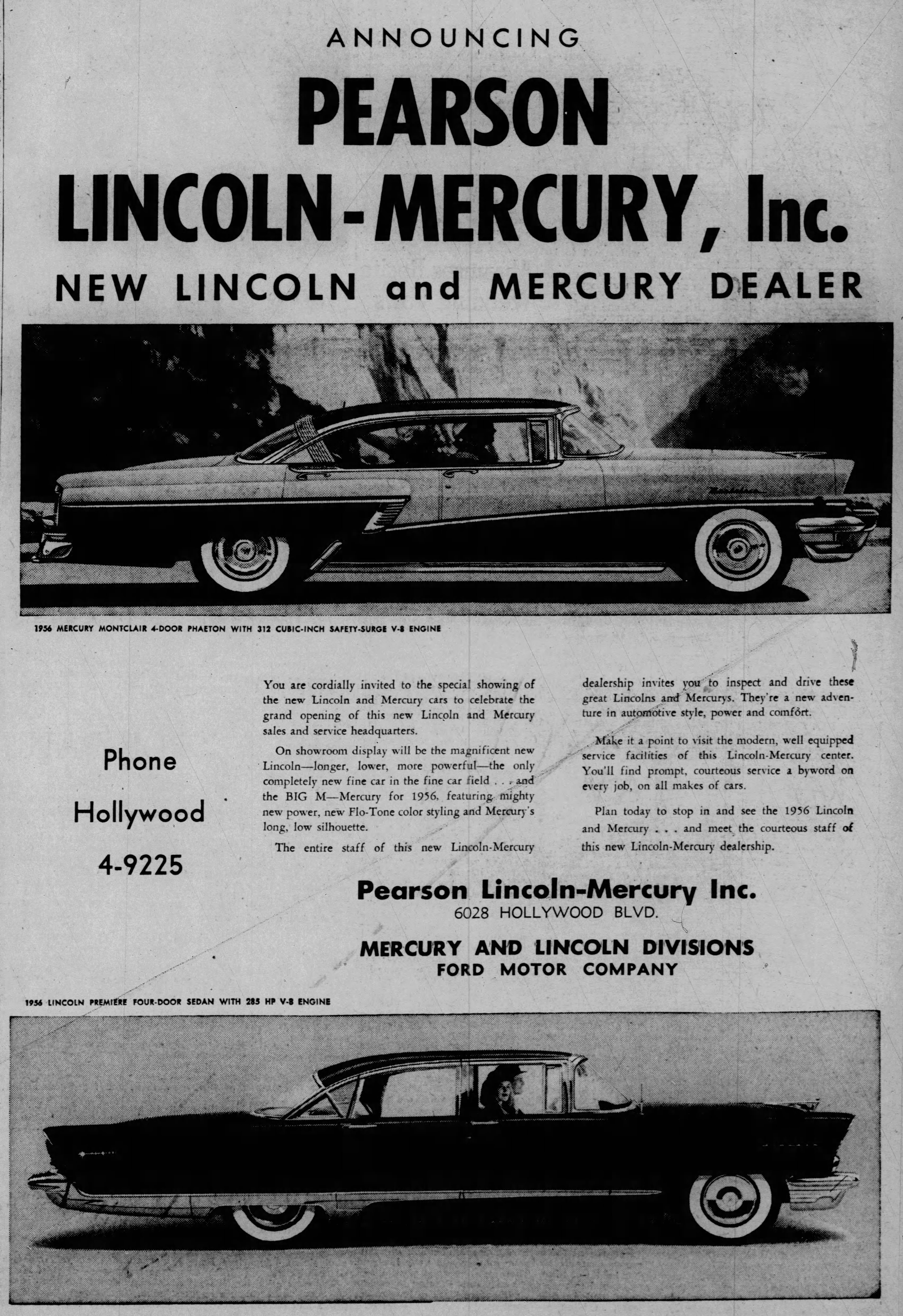
Glenn Pearson Lincoln-Mercury dealership took over from the O’Connors in July 1956. He held his grand opening in a much-remolded 6028 Hollywood Boulevard on November 10, 1956.

Glenn Pearson getting ready to take over 6028. Hollywood Citizen News 7/26/1956.


Hollywood Citizen News 8/3/1956.


As Pearson Lincoln-Mercury. Bye-bye proscenium arch window! LA Times 10/10/1956.

On May 13, 1957, Hollywood Ford moved to 6000 Hollywood Boulevard. Pearson remained at 6028 through May 1957 but thereafter, the address, if it was used at all, was Hollywood Ford. Ford demolished all structures on 6028 and 6032 in 1970. Today this parcel is part of the Hollywood Toyota dealership, addressed as 6000 Hollywood Boulevard.

California Eagle 8/16/1962


6000-6004 Hollywood Boulevard: Eskimo Village Mini Golf / Mary’s Lighthouse / Hollywood Ford

Eskimo Village, 1930. California State Library photo.

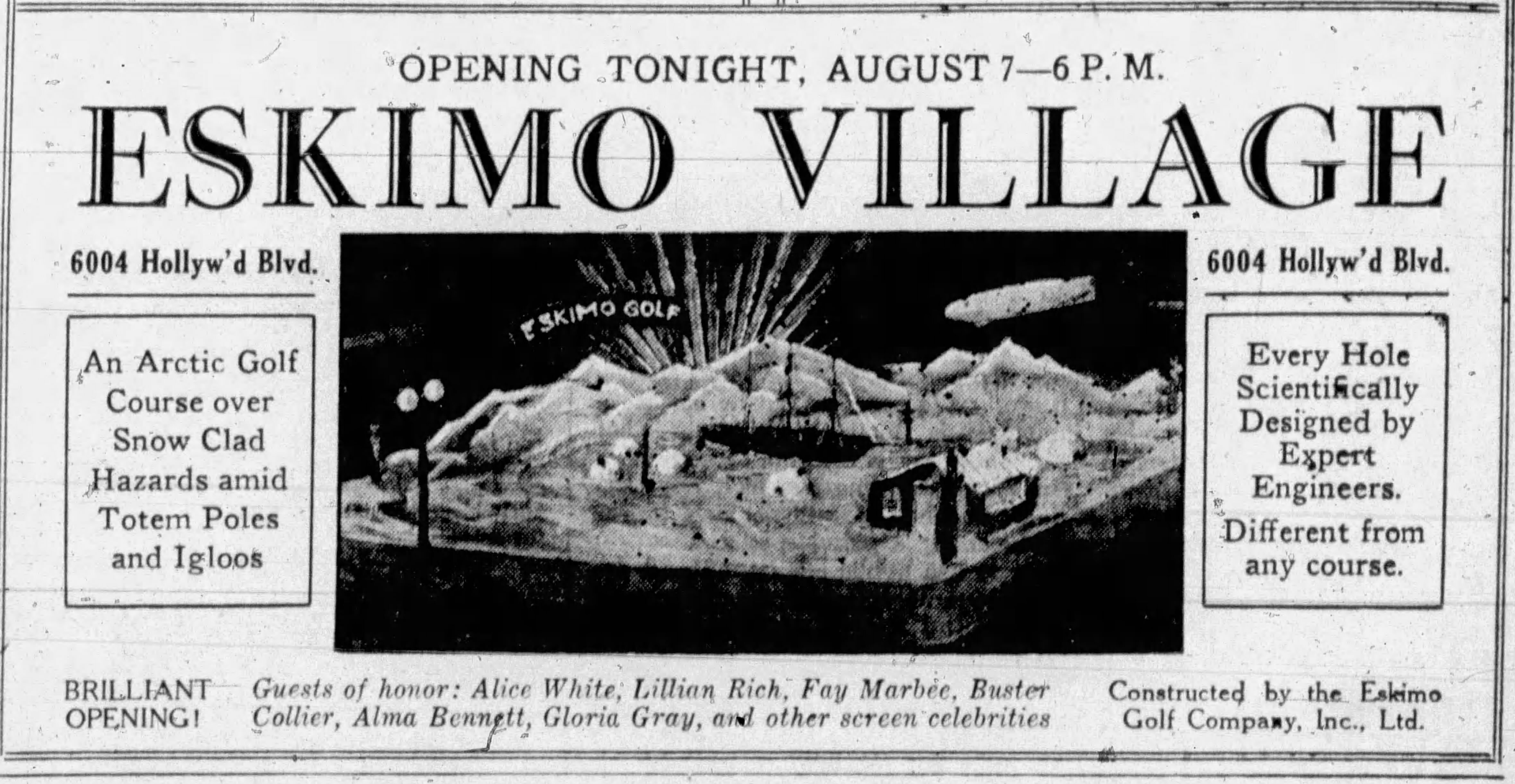
Located in the Mount View Tract and separated from the Mountain View Inn to the east by an alley called Brokaw Place (connecting Hollywood Boulevard to Carlton Way), Eskimo Village Miniature Golf opened at 6004 Hollywood Boulevard in August 1930 at the height of the nation’s short-lived miniature golf obsession. It wasn’t the only miniature golf links to open on Hollywood Boulevard that summer. It wasn’t even the only mini golf links on this block- there was Shady Greens across the street on the Brokaw ranch property, and Loma Linda links down the street. But it was certainly one of the most unique courses.

Organized by Sid Algier, a film director, it was meant to be the first in a chain of Eskimo Villages. The course was designed and built by H.C. Lydecker, a former art director and miniatures expert with the Tiffany-Stahl studio. It had an Alaskan theme with Hollywood studio snow, wrecked ships, totem poles, icebergs and igloos. It opened on the evening of August 7, 1930. Actress Alice White and her future husband, screenwriter Sidney “Sy” Bartlett, officiated.

Hollywood Daily Citizen 8/7/1930.

6004 Hollywood Boulevard, originally addressed as 556 Prospect Avenue, had been the home of William Thornton Glassell and his wife Fannie.

W.T. Glassell was born in California in 1863. He was named after his uncle, who had been a captain in the Confederate Navy during the Civil War. His father had come West from Virginia during  the Gold Rush. Widowed in 1898, in 1901 he married Fannie E. Moore, lately arrived from England and 20 years his junior.

By 1905 the couple had settled in Hollywood with their two young children and William’s grown son from his first marriage. The ranch house was set amid a lemon grove.

LA Express 4/22/1905


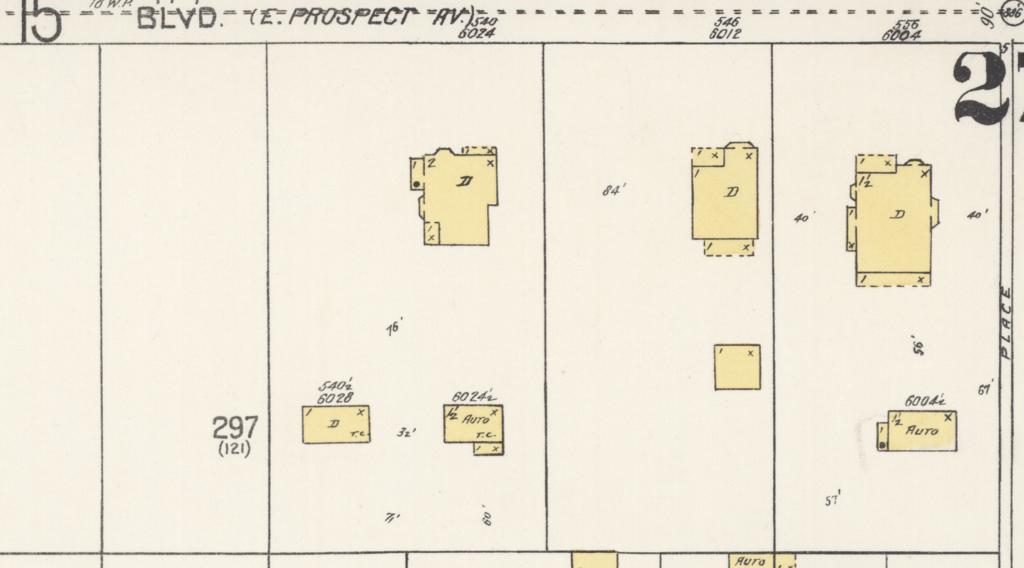
The Glassell residence, 6004 Hollywood Boulevard. Detail of a 1913 Sanborn Fire Insurance map. Library of Congress.

William Glassell died in January 1918. Fannie relocated with the children and rented 6004 Hollywood Boulevard, initially as a residence then for retail use as the Boulevard became increasingly commercial. She remarried in 1920 and became Fannie M. Shippee.

In March 1922, a film actress turned real estate agent named Mary Vittitoe obtained a permit, with Shippee’s permission, to build an office on the Glassell parcel. A. F. Leicht was the architect listed. The unique structure, shaped like a lighthouse, became an instant landmark when Mary opened for business, as 6002 Hollywood Boulevard, in July 1922.

Originally it was going to be 6004 Hollywood Boulevard but Mary opened her lighthouse-shaped office as 6002. Hollywood Daily Citizen 3/10/1922.

Postcard view of Mary’s lighthouse-shaped office.

Mary billed herself as the “youngest real estate salesgirl in the world.” How young was she? Well…. In the 1920 US Census Mary’s age is listed as 18. She appears in the census of 1900, however, as a year-old baby; her birth date is given as May 1899. In the 1930 US Census, Mary shaved even more years off her age, stating that she was 25. For 1940 and 1950, though, she reverted back to her actual age. The May 1899 date is correct; therefore she would have been 23 when her lighthouse office opened. Did that still make her the youngest real estate salesgirl in the world? Who was to say.

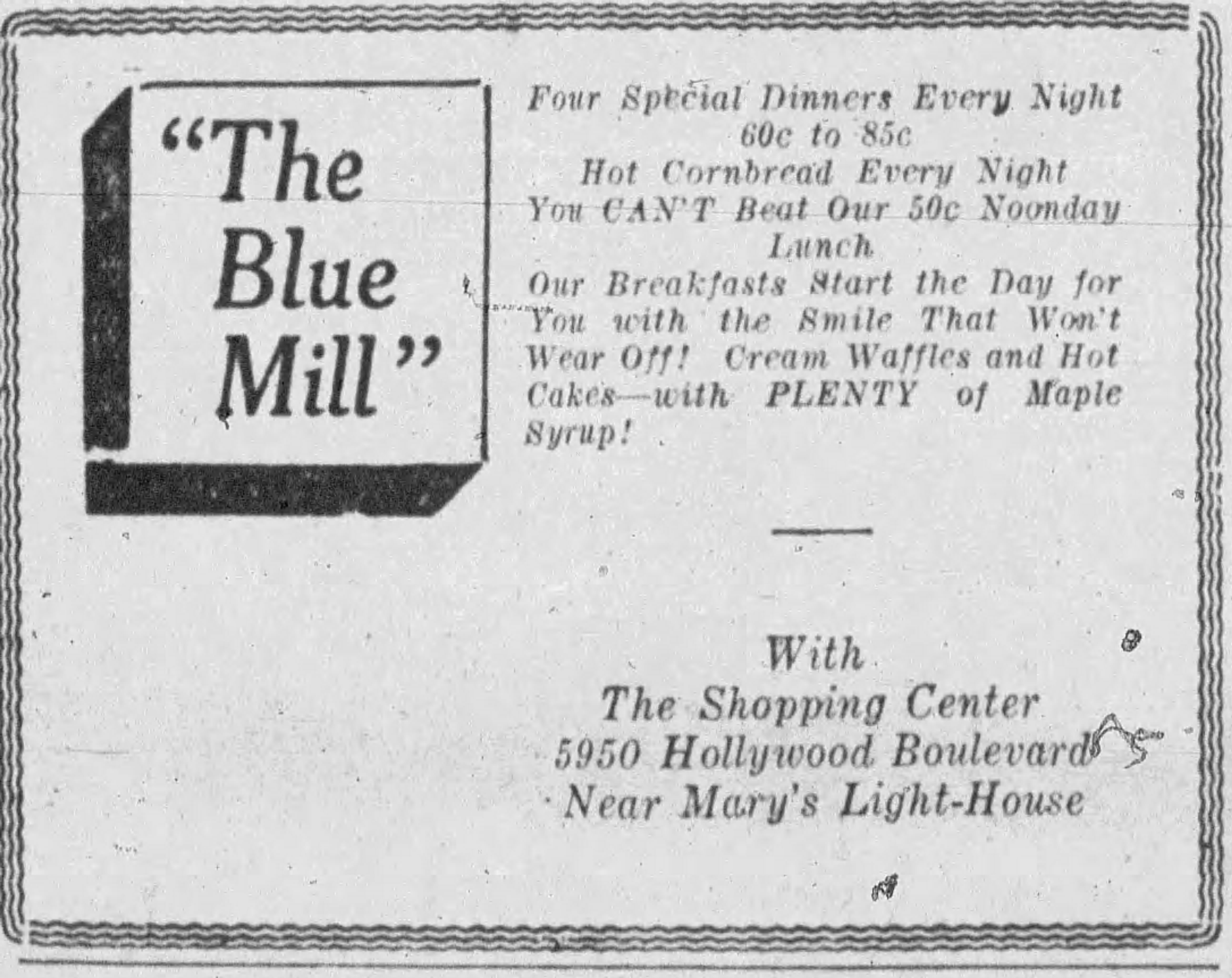
Mary’s Lighhouse referenced in an ad for the Blue Mill cafe, located in the new “The Shopping Center” at 5950 Hollywood Boulevard (later Gordon Warren Chevrolet). Hollywood Citizen News 6/6/1922.

Mary advertised at this location until early April 1925; later that month she moved to 5908 Hollywood Boulevard.

Mary’s lighthouse was repurposed as Lova’s Treasure Chest gift shop in 1925; in 1926 it was the Hollywood branch of the Pacific Coast Mortgage Company, specializing in automobile loans.

Hollywood Daily Citizen 11/24/1925.

LA Times 11/25/1926.

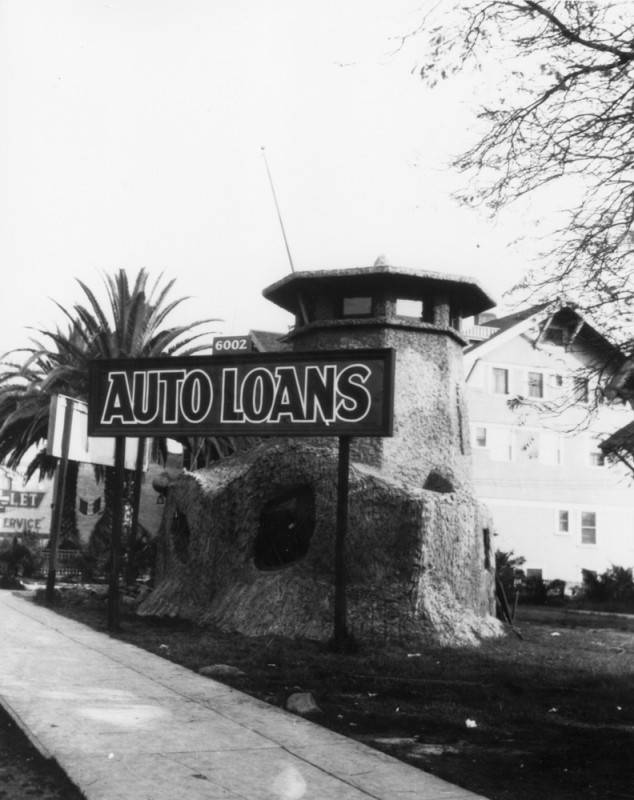
Mary’s lighthouse at 6002 Hollywood Boulevard, repurposed as an auto loan office. The Mountain View Inn can be seen behind it.  LAPL photo.

In December 1923, local papers reported that C.B. Christie of the Christie Hotel had taken a 99-year lease on the property from Fannie Shippee. He planned to build a 12-story hotel there, he said- encouraged by the mammoth hotel recently proposed for the Brokaw property across the street. Like that project, this hotel would never come to be and whether the lease story was true or pie in the sky, Shippee retained control of this property. No structure taller than 1 story would ever be built on it.


In July 1925, Walter Jay Israel, a former Hollywood costume director for Frank Lloyd Productions, Joseph M. Schenck and Jackie Coogan, opened the Hollywood Costume Company, a costume and theatrical supply store, here. In January 1926, L.L. Burns of the Western Costume Company, then located at 937 S. Broadway, purchased Israel’s business and stock. Israel was appointed manager of Western Costume’s costume department.

LA Times 7/5/1925.

In June 1928 Shippee had the residence demolished.

Mary’s lighthouse continued to be used by other business- as of February 1928 it was operating as the Hollywood Brokerage Company. In August 1929 the vacant real estate office was demolished. The lot was now clear. In July 1930 Shippee approved the construction of the miniature golf course and a related lunch stand. Unique as it was, the Eskimo Village links only lasted the one season.

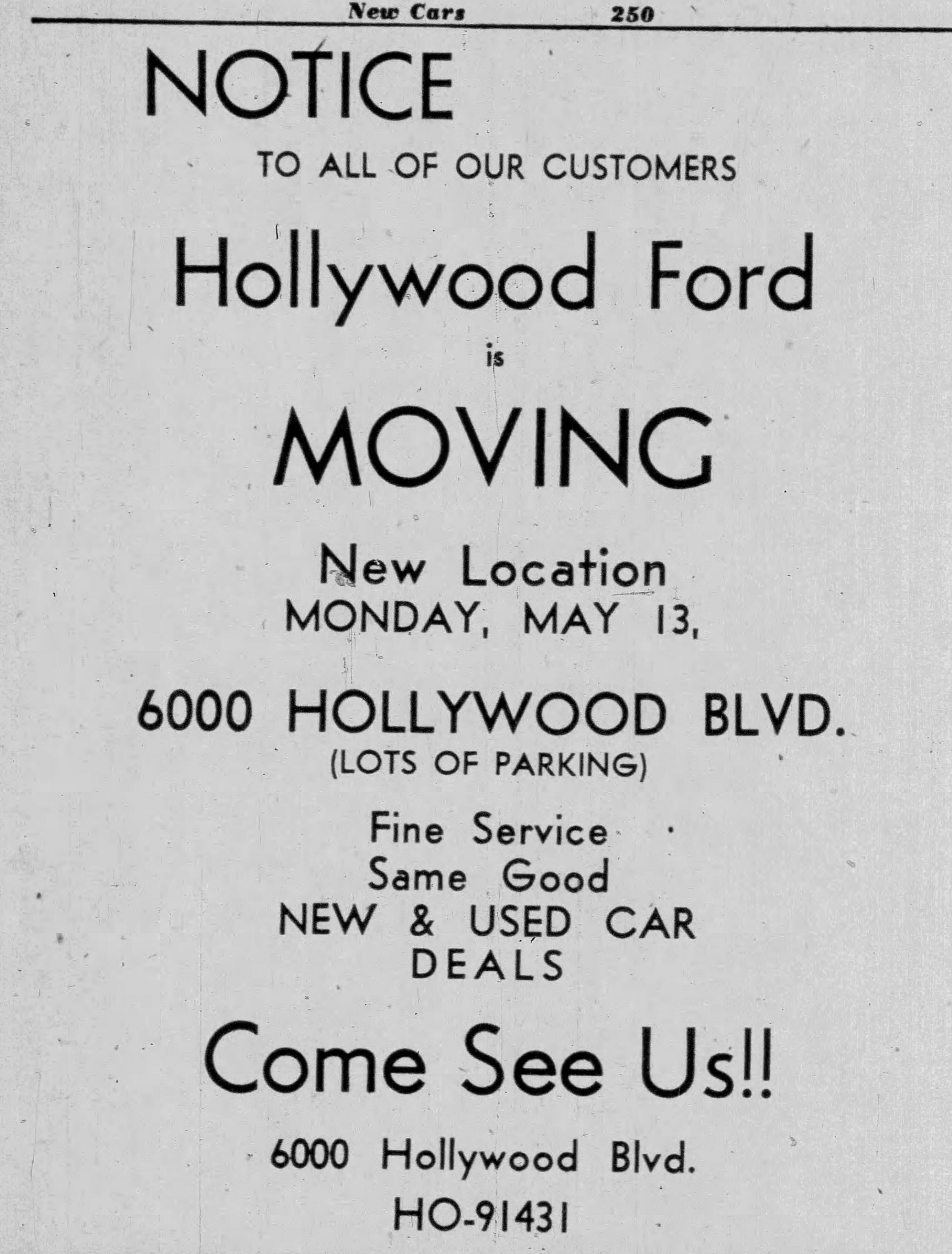
For most of the 1930s into 1941, this parcel, addressed as 6000 Hollywood Boulevard, served as the used car lot of Chevrolet dealer Gordon Warren of 5950 Hollywood Boulevard. After 1941, it was the used car lot for the auto dealership at 6028 Hollywood Boulevard, home to Plymouth, De Soto and most recently Lincoln-Mercury. On May 13, 1957 it became the new home of Hollywood Ford, which moved here from 1748 N. Cahuenga.

LA Times 5/10/1957.

This was the Hollywood Ford. There was another Ford dealership at 4531 Hollywood Boulevard, run by John G. Caddell from 1930-1941, which became Boyle-Fox Ford, the Cort Fox Ford. This was considered East Hollywood. (It will have its own post).

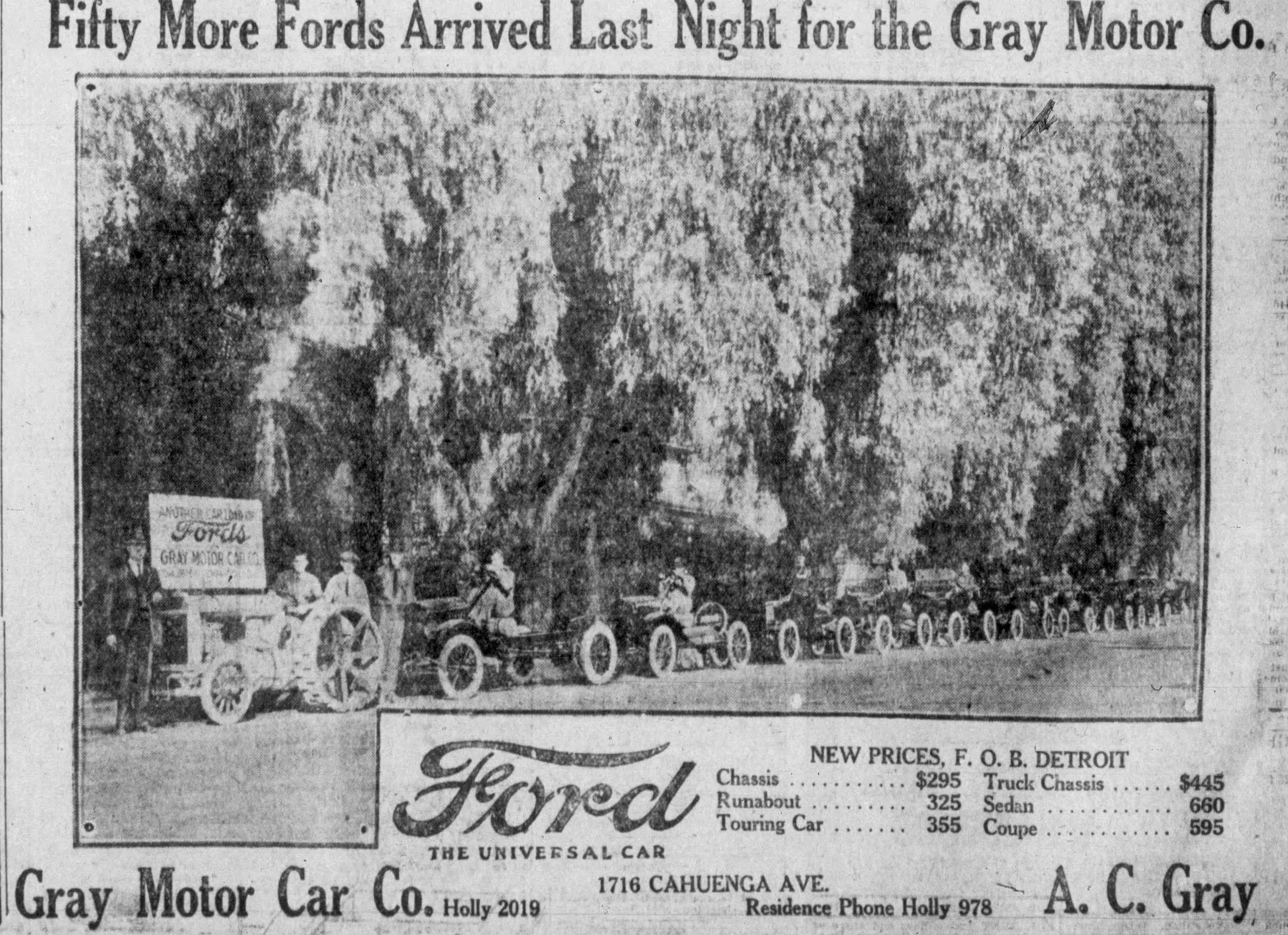
Hollywood Ford could be traced back to A. C. Gray, who became Hollywood’s authorized Ford agent in May 1912. He operated from his Reliable Garage, just off Hollywood Boulevard.

Hollywood Citizen 3/8/1912.

Hollywood Ford Agent A C Gray now operated out of 1627 Cahuenga as of June 1912. Hollywood Citizen 6/21/1912.

In November 1912, Gray partnered with E. A. Walden, former Ford dealer in Peabody, Kansas, who had recently moved to Hollywood. Now known as Walden and Gray, the firm constructed a new garage on North Cahuenga just north of Hollywood Boulevard at 1716 N. Cahuenga. It would open by April 1913.

Detail of a January 1913 Sanborn Fire Insurance Co. map for Hollywood showing the Walden & Gray Ford garage under construction at what would become 1716 N. Cahuenga. Library of Congress.

Hollywood Citizen 4/25/1913.

Walden and Gray operated the Ford dealership out of 1716 N. Cahuenga, Hollywood together through April 1918, when Walden turned his share of the business back over to Gray. Gray continued at 1716 as the Gray Motor Car C., Hollywood branch of the Ford agency.

Hollywood Citizen 12/7/1921

In January 1922 A C Gray’s son C. A. Gray, Hollywood Dodge dealer of 1734 N. Cahuenga, moved into 1716.  Dad A. C. Gray’s Gray Motor Co. Ford dealership moved into 1734 and also occupied a new garage just north of that at 1742 N. Cahuenga. Gray senior would be back to using 1716-1920 in 1930 then back to 1742-1748 N. Cahuenga in 1932.

1716 N. Cahuenga later became the popular Tick Tock Tearoom.

Built for Walden and Gray Hollywood Ford dealer, 1716 N. Cahuenga became the Tick Tock Tearoom in 1934.

Hollywood Citizen News 11/28/1934.

Hollywood Daily Citizen 6/10/1922

Hollywood Daily Citizen 9/19/1930.

Hollywood Citizen News 8/17/1932.

Gray Motor Car Co. Ford occupied 1734-1948 through 1935.

In January 1936, Douglas Applewhite took over the Ford dealership. Applewhite had been working for A. C. Gray since 1917, most recently as a salesman. He renamed the dealership Douglas Applewhite Inc. He also had a used car lot at 6350 Santa Monica Boulevard.

Douglas Applewhite became the new Hollywood ford dealer in January 1936, taking over the Gray Motor Car Co. Hollywood Citizen News 1/29/1936.

In May 1939, Al Stuebing, former Ford dealer of Long Beach, took over Douglas Applewhite Inc. and continued to operate the Ford dealership here at what was now addressed as 1748 N. Cahuenga. Stuebing also marketed Ford products at 5457 Crenshaw Boulevard and would later have a used car lot at 1335 N. Vine. His dealership was known as “Stuebing Hollywood Ford.”

As Al Stuebing Hollywood Ford. Hollywood Citizen News 5/17/1939.

Hollywood Citizen News 5/18/1949.

Hollywood Citizen News 6/27/1953.

Effective November 19, 1954, DeForest “Pappy” Laurence, formerly general manager of a Ford dealership in Studio City, took over Al Stuebing Hollywood Ford, still at 1748 N. Cahuenga, and renamed the business Hollywood Motors, Inc., but more commonly known as Hollywood Ford.

Hollywood Citizen News 11/2/1955


Hollywood Citizen News 12/31/1954.

In May 1957, Pappy Laurence announced that his Hollywood Ford Motors had moved its headquarters from 1748 N. Cahuenga to enlarged new quarters at 6000 Hollywood Boulevard, adjacent to Pearson Lincoln-Mercury.

In May 1970, Fannie Shippee died. In June 1970, the Ford Motor Company, having over time acquired the adjacent parcels to the west to the corner of Gower, had these lots cleared of extant structures. The address 6000 Hollywood Boulevard now included 6028 and 6032 Hollywood Boulevard.

In January 1983, Hollywood Toyota moved to 6000 Hollywood Boulevard, sharing the space for a time with Hollywood Lincoln-Mercury. Today 6000 Hollywood Boulevard is still the Hollywood Toyota dealership.

LA Times 1/24/1983.

LA Times 6/24/1983.

Notes:

The permit listing A.F. Leicht as architect is also stamped “cancelled” so it’s not clear if it was carried out. Ultimately, Mary’s building was constructed. If A.F. Leicht designed Mary’s lighthouse, it’s interesting that he was later commissioned to design a series of lighthouses for Amiee Semple McPherson’s “Navy of the Lord” tabernacles. The architect sued McPherson in December 1929 for nonpayment of his services, stating that he had carried out the commission for McPherson between June 1925 and January 1928.

5800 Block of Hollywood Boulevard: Hollywood Freeway

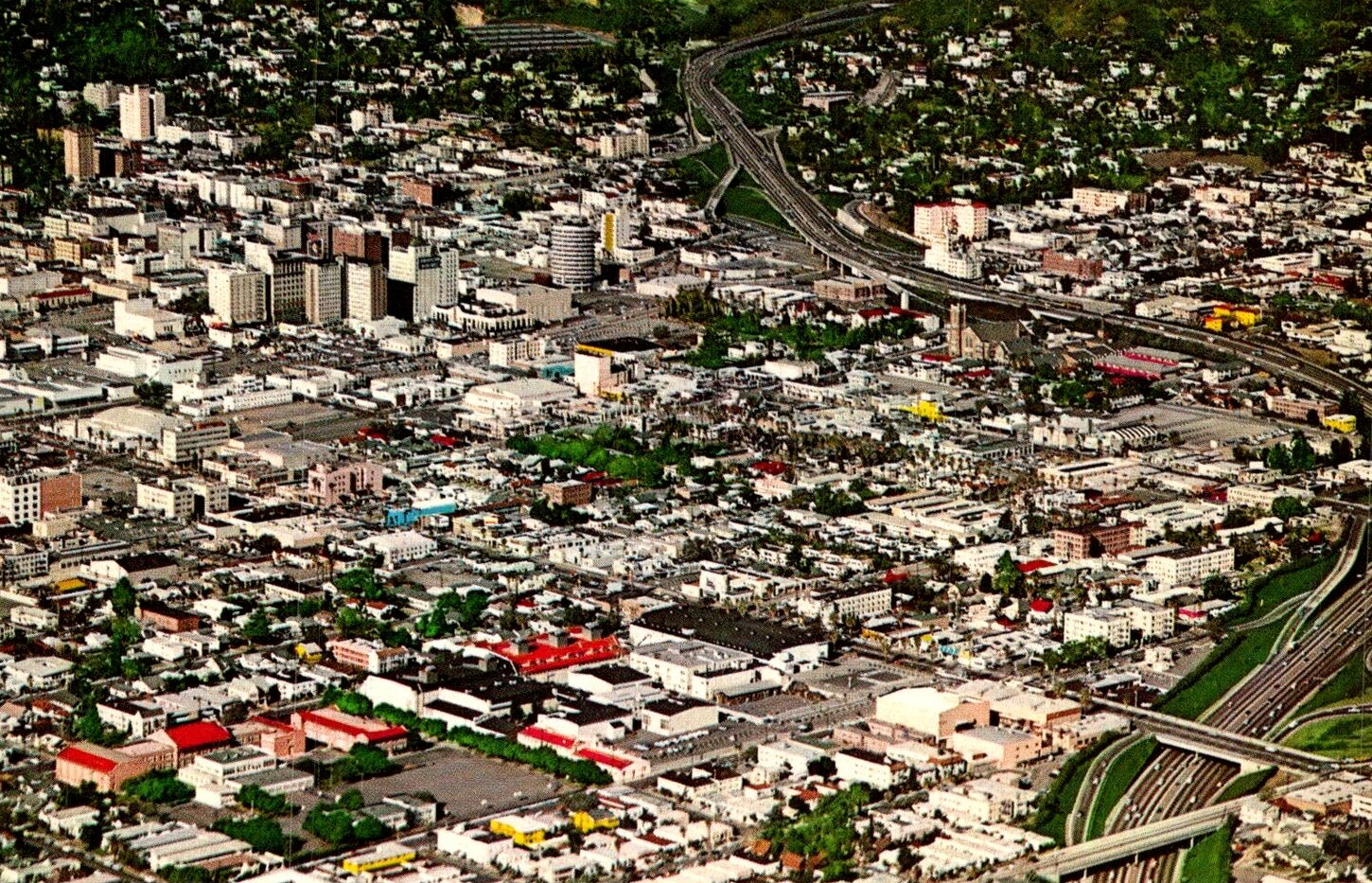
The Hollywood Freeway (US Route 101) was constructed to connect downtown Los Angeles with the San Fernando Valley.

Originally to be known as the Hollywood Parkway when a plan was presented to Mayor Bowron in 1939, the first unit, constructed by the City of Los Angeles with city and state funds, opened in July 1940 through the Cahuenga Pass from Highland Avenue to Barnham Boulevard.

Funding and World War II put a halt to further progress on the freeway for the duration, After the war, restarting of the project was again pushed back as civic leaders and residents protested that removal of existing dwellings would make the already severe housing shortage situation worse (see my posts on the postwar housing crisis here and here), but in 1946 excavation got underway in the Civic Center section and Fort Moore Hill became a lot less hill. The project was full steam ahead when the Collier-Burns Act of 1947 assured state highway funding for freeway construction.

Hollywood business and religious leaders expressed concerns about the route through Hollywood, arguing that it would impact the acoustics of the Hollywood Bowl and cause the destruction of  KTTV’s new studio (later Metromedia Square), which opened at 5746 Sunset Boulevard on January 1, 1947 and the 1923 First Presbyterian Church of Hollywood at 1760 N. Gower. The State Highway Commission did indeed modify the route to avoid the studio and the church, and added what would today be called mitigation measures around the Hollywood Bowl in the form of landscaping to diminish effects to the acoustics (which as it turned out were fine).

By 1949 right of way acquisition for the Western Avenue to Hollywood Boulevard link began. Because the Hollywood Freeway is a depressed freeway, construction on the Boulevard meant excavating underneath it and constructing a bridge over the freeway as well as on and off ramps. The 5800 block of Hollywood Boulevard was affected, between Van Ness Avenue to the east and Bronson Avenue to the west. Canyon Drive, which had gone through to the north side of Hollywood Boulevard, would be rerouted onto Van Ness north of the Boulevard.


Overall, Hollywood Boulevard itself was minimally impacted by the project. There wasn’t a lot of development here; there were 1 and 2-story retail buildings, remnants of large, formerly rural residential estates, used car lots (this was the tail end of Hollywood Boulevard’s Auto Row), and gas stations.

5821 Hollywood Boulevard between Van Ness and Canyon Drive had been the home of Mary Taft, matriarch of the Taft family, from 1904 until her passing in 1938 at age 96; her daughter Dr. Gertrude Taft continued to live here until her death in September 1941. Detail of a 1913 Sanborn Fire Insurance map, LOC.


5873 Hollywood Boulevard, between Bronson and Canyon Drive, was a residence in 1913; the site had been a Union Oil gas station since 1921. It survived the Hollywood Freeway construction and was demolished in 1969. The current Original Tommy’s fast food restaurant was built in 1995. Detail of a 1913 Sanborn Fire Insurance map, LOC.


Nash dealers J. F. O’Conner & Son relocated from 5800 Hollywood Boulevard, where they had been since 1945, to 6028 Hollywood Boulevard due to freeway construction. Mark M. Hansen, owner of the Marcal Theater and part owner of the Florentine Gardens, owned both this property and the new location. Hollywood Citizen News 8/12/1949.

With right of way acquisition completed, excavation work at Hollywood Boulevard got underway in March 1951. The first task was to build a detour for the Pacific Electric tracks between Bronson and Van Ness.

Hollywood Citizen News 2/24/1951


Work on the PE detour. Hollywood Citizen News 3/8/1951

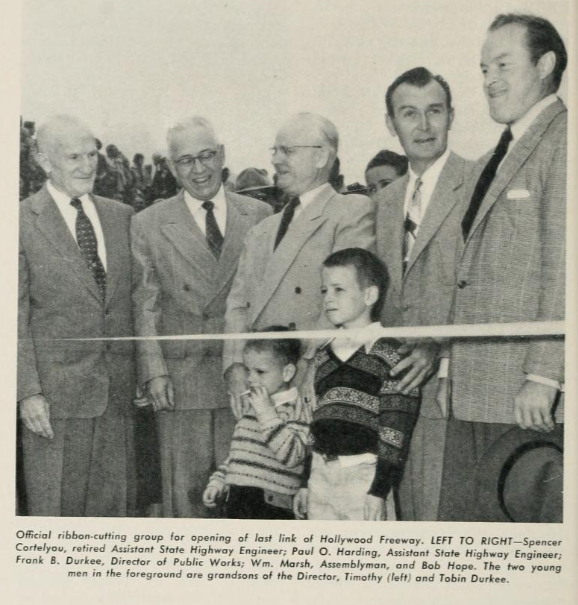
The final link, from Hollywood Boulevard to Mullholland Bridge was opened with a ribbon cutting ceremony on April 15, 1954.

The Hollywood Freeway bridge carrying eastbound Hollywood Boulevard traffic, May 1952. LAPL photo.


The opening if the Western Avenue to Hollywood Boulevard link. Hollywood Citizen News 3/3/1953

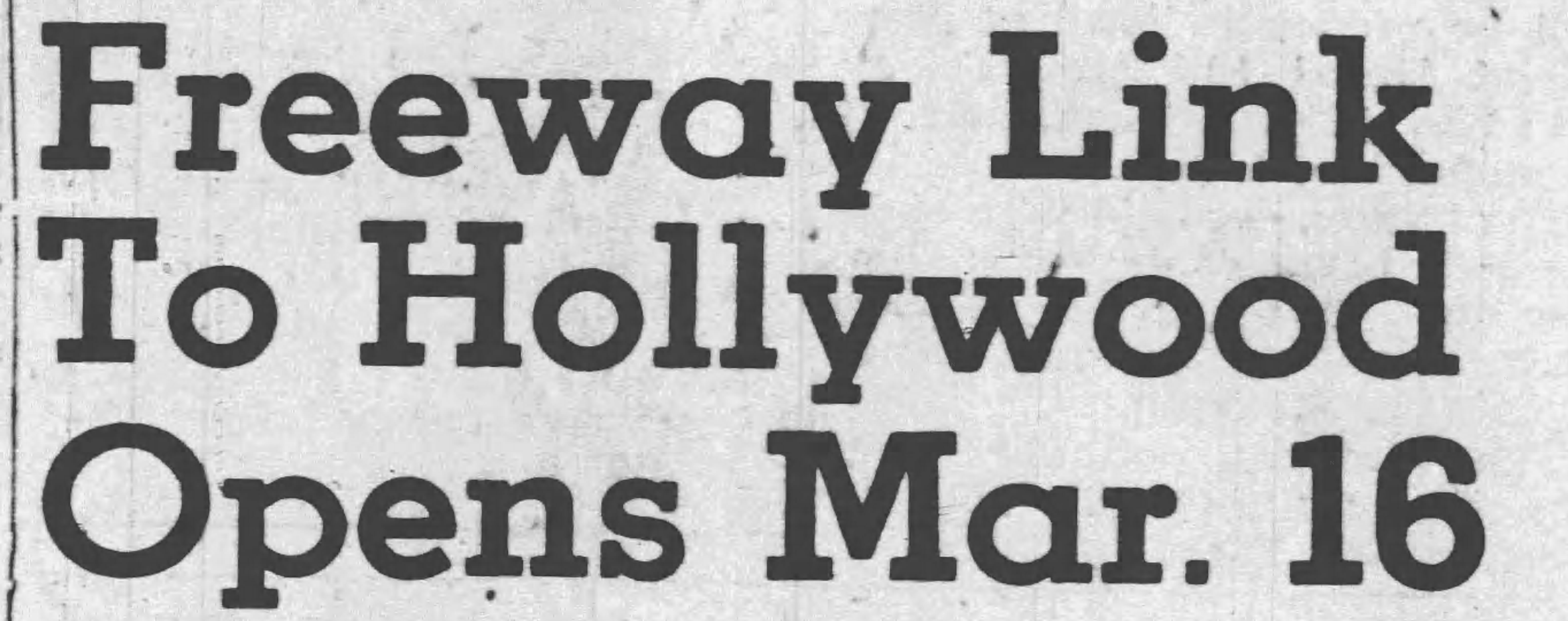
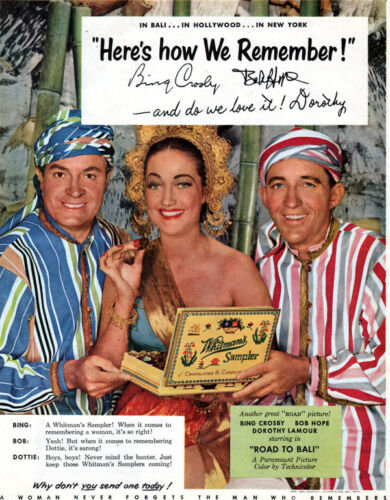
The Western Avenue to Hollywood Boulevard link of the freeway was to have opened in January 1953 but heavy rains delayed construction. It opened on March 16, 1953. Dorothy Lamour appeared at the ribbon-cutting ceremony- a nod to her “Road to…” series of films with Bing Crosby and Bob Hope. The first accident on this stretch of highway occurred about 5 minutes later.

Dorothy Lamour, Bob Hope and Bing Crosby were known for their “Road” films. In 1953 it was “The Road to Bali.”

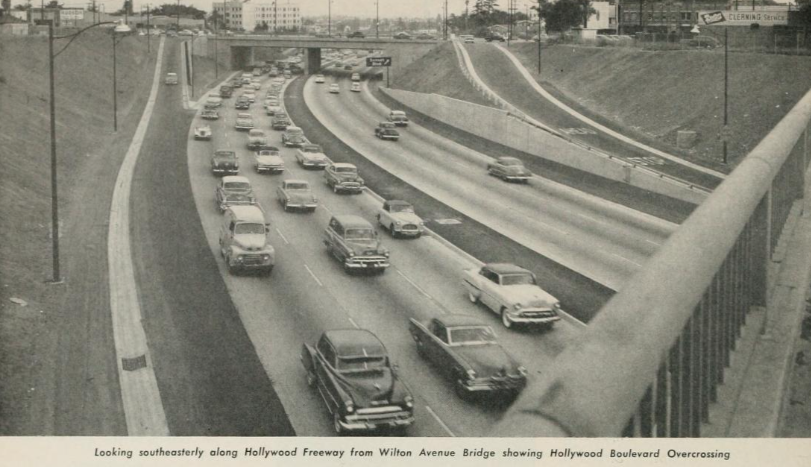
Looking toward the Hollywood Boulevard overcrossing from the Wilton Avenue Bridge. From California Highways and Public Works magazine September/October 1954.

Hollywood Boulevard would be the end of the freeway until the final link opened in April 1954. This time, Bob Hope officiated at the ribbon cutting.

Bob Hope opening the final link of the Hollywood Freeway, April 1954. From California Highways and Public Works magazine May/June 1954.


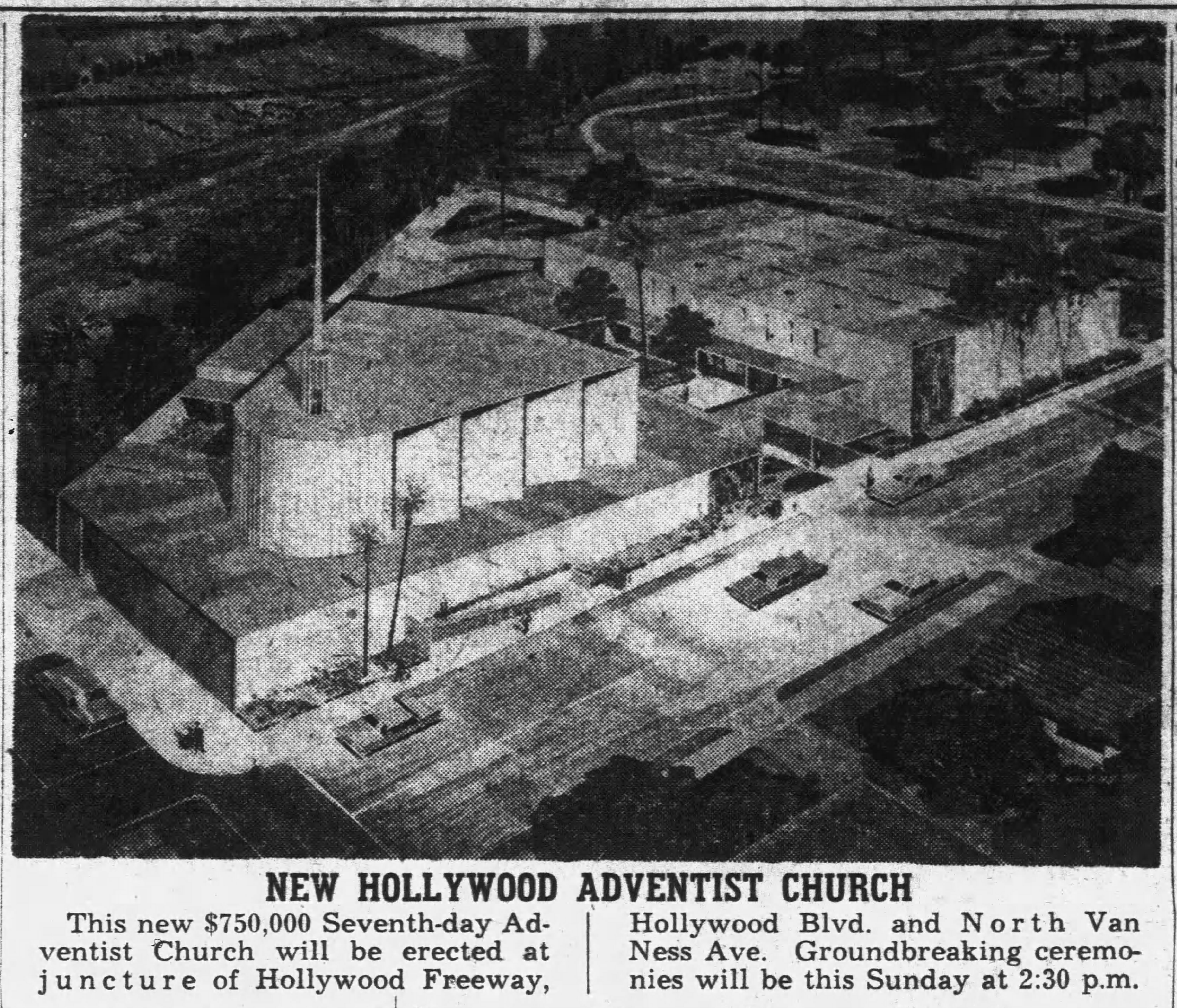
Although it looks like it was marooned by the Hollywood Freeway construction, the Seventh-Day Adventist Church between the ramps was built in 1961, almost 10 years after the freeway was completed. Its address is actually on Van Ness Avenue. Hollywood Citizen News 5/27/1961.