5447 Hollywood Boulevard: Hotel Rector

Located on the northeast corner of Hollywood and Western, the Hotel Rector held its gala grand opening on the night of October 4, 1924, at the same time as the Hollywood Guaranty Building down the street at 6331. An electrical display, “the Aurora Borealis,” supplied by Otto K. Olsen for both buildings lit the Hollywood sky to mark the occasion.

Hollywood Citizen News 10/6/1924

The new Hotel Rector. Hollywood Citizen News 10/3/1924

The 4-story brick structure was designed by architects Walker & Eisen for the leaseholder: the realty development department of the United Cigar Stores corporation. The ground it stood on was owned by a wealth widow, Delia Nadeau of Butte, Montana (who died in 1927). When people got hold of land in Los Angeles, they almost never sold it. Rather, they would issue long term leases on the property. If the leaseholder ever defaulted, any improvements made to the property reverted to the owner of the underlying ground. When the term “sold” was used in relation to real estate transactions, it usually really meant that the building itself, with its attendant lease, changed hands, not the underlying land. Heirs whose relatives didn’t sell off their land to pay for their gambling habits (thanks a lot, Grandpa Bob) lived off the profits of these long-ago leases for decades.

Like most large hotels of the era, it had retail shops on the ground floor. Some of the original tenants were the Rector Pharmacy, the Rector Bootery shoe store at 5461 and the Rector Master Tailor at 5459. The hotel itself was usually addressed as 5447; it was sometimes known as 5455.


Announcing new management of the Hotel Rector five months after it opened. Hollywood Citizen News 3/7/1925.


The 5400 block of Hollywood Boulevard looking west. The LA Public Library dates this photo to c. 1935.

The Hotel Rector saw Hollywood’s rise and its subsequent decline beginning in the late 1960s. Never a luxury accommodation but was a decent mid-level tourist hotel for most of that time, the Rector became a single-room occupancy (SRO) residence. It closed in the late 1980s, supposedly due to damage from the Whittier Earthquake (1987). With vacant or boarded-up structures, the corner of Hollywood and Western was increasingly known for rampant crime- mostly drugs and prostitution.

LA Times 9/6/1990

In September 1990, the Los Angeles Community Redevelopment Agency (CRA) gave developer Ira Smedra $5.1 million in loans and other funding to redevelop the 3-plus acre Hotel Rector property as mixed-use retail and low-income senior housing complex to be known as the Hollywest Promenade and the Hollyview Apartments. Smedra was supposed to secure the remaining funds needed by 1992 or begin paying 10% interest. Most of the money went toward acquiring the property. In September 1992, with the funding to build the project still unsecured, the CRA, which had extended Smedra’s funding deadline (without charging interest), approved Smedra’s request to demolish the Hotel Rector, on the basis that he would have a better chance of getting bank loans if the parcel was vacant. Some CRA board members questioned whether the senior housing was even a good idea- would seniors even want to live in such a crime-ridden area? They seem to have forgotten that the redevelopment was supposed to rid the area of said crime, but whatever.

The Hotel Rector was demolished in July 1993.

LA Times 5/8/2001

In March 1996, the CRA granted Smedra a sixth extension on the terms of his loan (no interest paid). The corner of Hollywood and Western continued to decline, with more boarded-up structures as a result of the Northridge Earthquake. As of February 1998 the parcel remained vacant. Construction on the retail portion of the project finally got underway around late 1999. In May 2001, still only partly completed, Smedra requested another $37 million for the senior housing portion of the complex, which was used as a scapegoat for the lack of progress. The senior housing opened in October 2003. The CRA purchased the project upon its eventual completion and turned the housing wing over to a nonprofit Retirement Housing Foundation.

The Hollywood Boulevard facade of the Hotel Rector property today. Google map image.


5440 Hollywood Boulevard: Leroy Bagley Mortuary

Located at 5440 Hollywood Boulevard, the Bagley Mortuary was one of two funeral homes within the same few blocks (the other being Strothers’ at 6240).

5440 was a 2-story, brick structure with a basement, designed by architect Henry G Grimwood of May & Grimwood for Harry M. Haldeman in June 1916. It had retail space on the ground floor and offices above.

The Eastern half of the Halderman building was leased by Jesse T. Smith, an embalmer with many years experience, and his brother-in-law Warren Leslie for the Smith & Leslie mortuary, which opened on September 11, 1916. It had a private family room, restrooms, an office, morgue and chapel on the main floor. The basement served as a showroom. “Throughout their entire establishment Messrs. Smith and Leslie have gone to a great deal of trouble and expense to make it as home-like as possible,” the Hollywood Citizen-News wrote on September 6, 1916. The “lady attendant” was Mrs. F. K. Paul.

Ad for Smith & Leslie, Hollywood Citizen News 9/15/1916

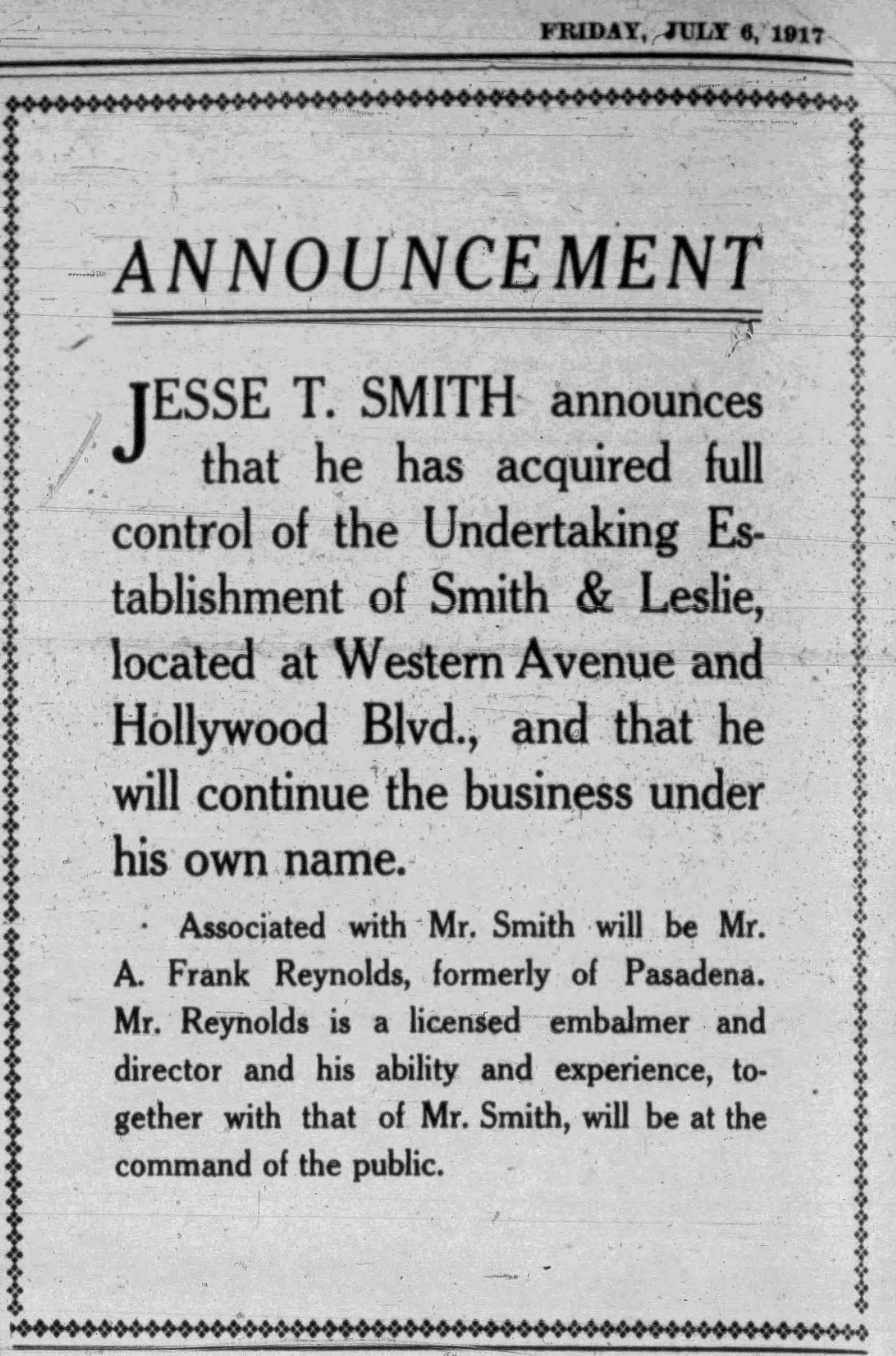
If you were dead in Hollywood, Smith & Leslie was the place to be seen. But the partnership did not last long. In July 1917, Smith took out an ad in the local paper to announce that he was now the sole owner of the establishment and would continue under his own name.

Hollywood Citizen News 7/6/1917

By August 1919, the firm was known as Smith & Dayton. A year later, Leroy Bagley (also spelled Leroy) had become the partner.

Bagley had come to Los Angeles with his wife from Nebraska. He was here by 1909, when he he listed his occupation as casket finisher.

Bagley in the 1910 Los Angeles City Directory.

The Smith-Bagley partnership lasted through 1921. In 1922, possibly due to financial troubles on Smith’s part, Bagley became the sole owner. Bagley, too, would take on a family member as an employee- his younger brother Clarence.

Hollywood Citizen News 10/24/1925

That might be the Bagley Mortuary on the left center of this view of the 5400 block of Hollywood Boulevard, which the Los Angeles Public Library dates to c. 1935. The Hotel Rector (5447 Hollywood Boulevard), opened 1924, is on the right. The Hollywood Western Building (1928) can be seen on the southwest corner of Hollywood & Western, and the St. Francis Hotel (1927) at 5533 Hollywood Boulevard in the distance.

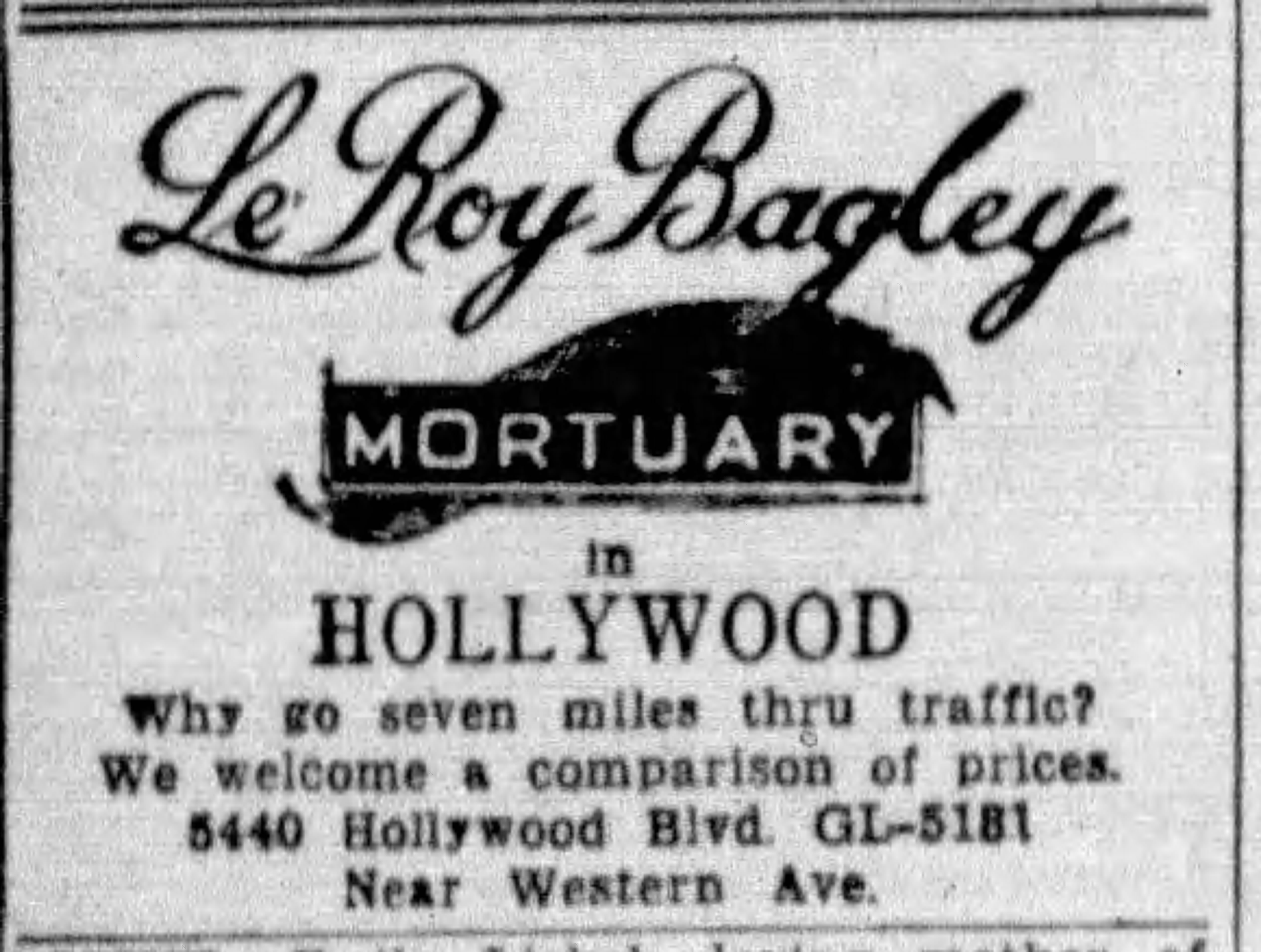
I don’t understand the reference to 7 miles, specifically but ok. Hollywood Citizen News 11/23/1935

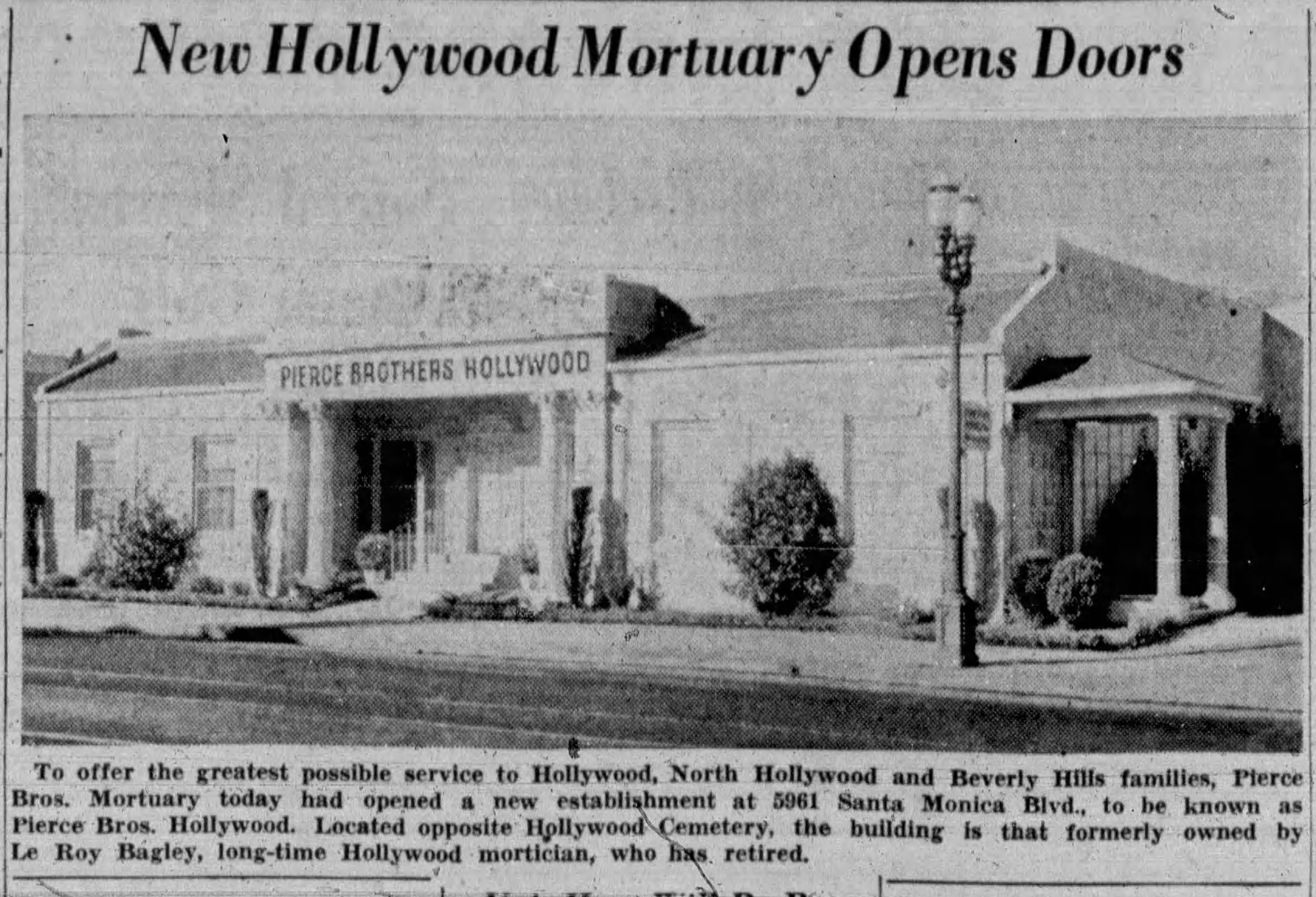
Bagley’s mortuary was at 5440 Hollywood Boulevard into August 1937. In October 1937, he reopened at 5961 Santa Monica Boulevard, conveniently located across the street from the Hollywood Cemetery. He continued at this new location for two more years before retiring.

New location of Leroy Bagley Mortuary. LA Times 10/7/1937

In December 1939, Bagley’s contemporary competition, Pierce Brothers, took over 5961 Santa Monica Boulevard.

Hollywood Citizen News 12/15/1939.

Hollywood Citizen News 12/16/1939

5440 Hollywood Boulevard had a variety of uses after Bagley departed. It has been demolished.

5410 Hollywood Boulevard: The Coronet Motel

The Coronet Motel was constructed at 5410 Hollywood Boulevard between May and December 1958. The 2-story, U-shaped structure held 61 units, 62 parking spaces, a large swimming pool close to the Hollywood Boulevard frontage, and a coffee shop (addressed as 5020 Hollywood Boulevard).

In September 1969, the motels furnishings and decor were sold off and the property underwent a remodeling and updating to become part of the Vagabond Motor Hotel chain.

5410 Hollywood Boulevard as a Vagabond Motor Hotel c. 1970.

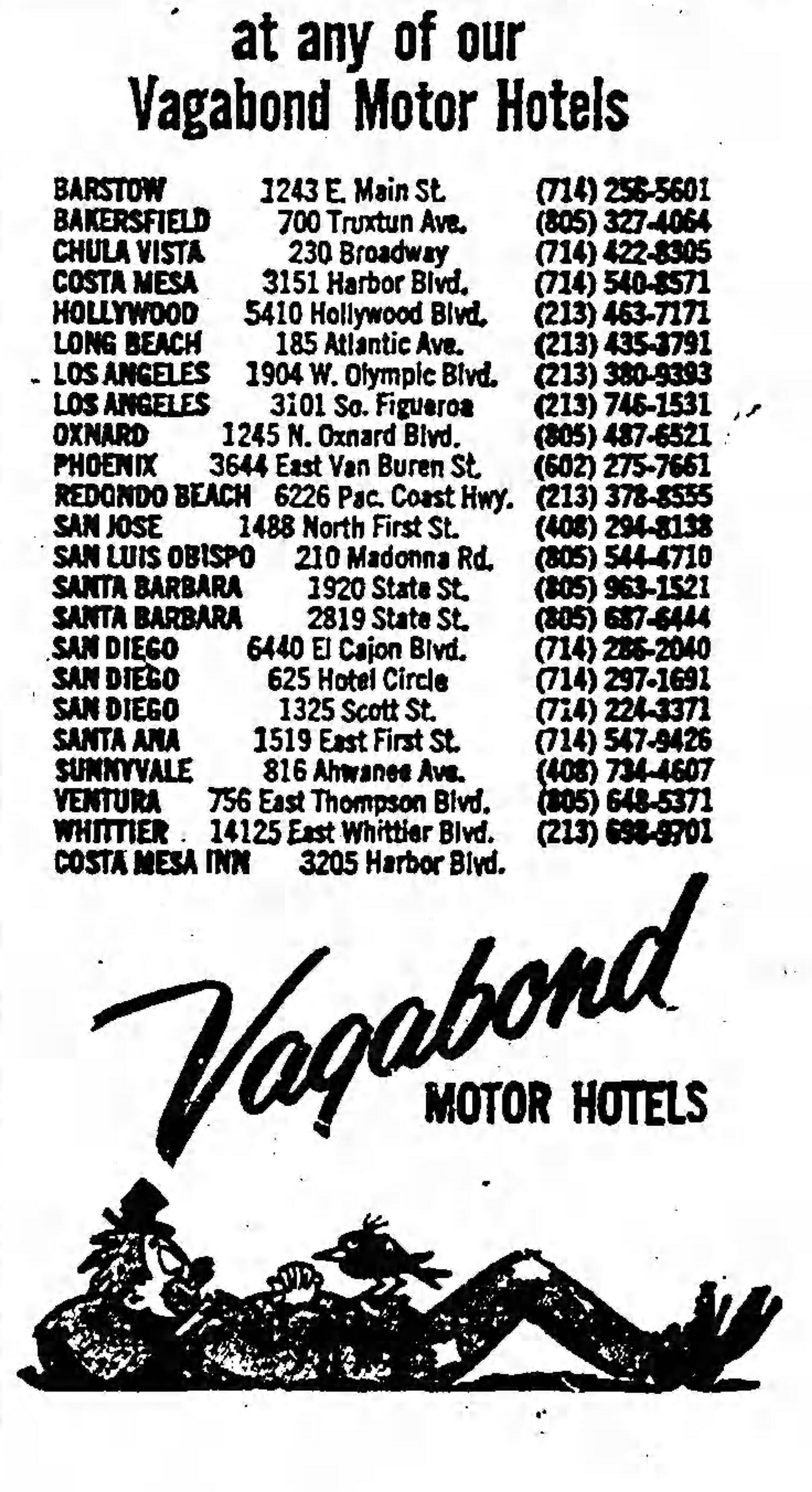
5410 was one of many Vagabond Motor Hotels in the Los Angeles area. LA Times 4/12/1970.


In 1989, the motel became a Quality Inn, then a Days Inn. Today is operates as a boutique hotel, the Dixie Hollywood.


Dixie Hollywood photo.

5261-5263 Hollywood Boulevard: Miniature Golf Course

The Hollywood Golf Course, 5261 Hollywood Boulevard. Hollywood Citizen News 3/1/1946

The Hollywood Golf Course miniature golf opened in early 1946 at 5261 Hollywood Boulevard operated by the three brothers- Charles H, Joseph E. and William L Palmer.

This property and adjacent parcels along Hollywood Boulevard near Harvard were part of the Lander Sunnyside Tract. Born in 1849, Anna Elizabeth Watson Lander (also spelled Annah) came to Los Angeles with her children in 1893 after the death of her husband Warren James Lander in November 1892 and was subdividing parcels by the end of the decade. Her sisters, Caroline Watson Lamb and Harriet J. (Hattie) Watson were also successful real estate developers who lived nearby at 1726 N. Harvard Boulevard along with their sister-in-law Mary Clough Watson. The Lander home was at 5253 Hollywood Boulevard. By the teens Lander had converted it to flats. Over time other office/studio structures were erected in the large property.

The Loma Linda Links miniature golf course, 5253 Hollywood Boulevard. Hollywood Citizen News 8/1/1930

On July 31, 1930, two of Anna Lander’s sons, Hirschel S. and W.J. Lander (probably Willard, but there was also Warren J. Lander), and their brother-in-law Ernest Hartwell Martin (he was married to Lucille Lander, Hirschel’s twin sister) opened a miniature golf course on the grounds of the old family property at 5253 Hollywood Boulevard and called it the Loma Linda Links.

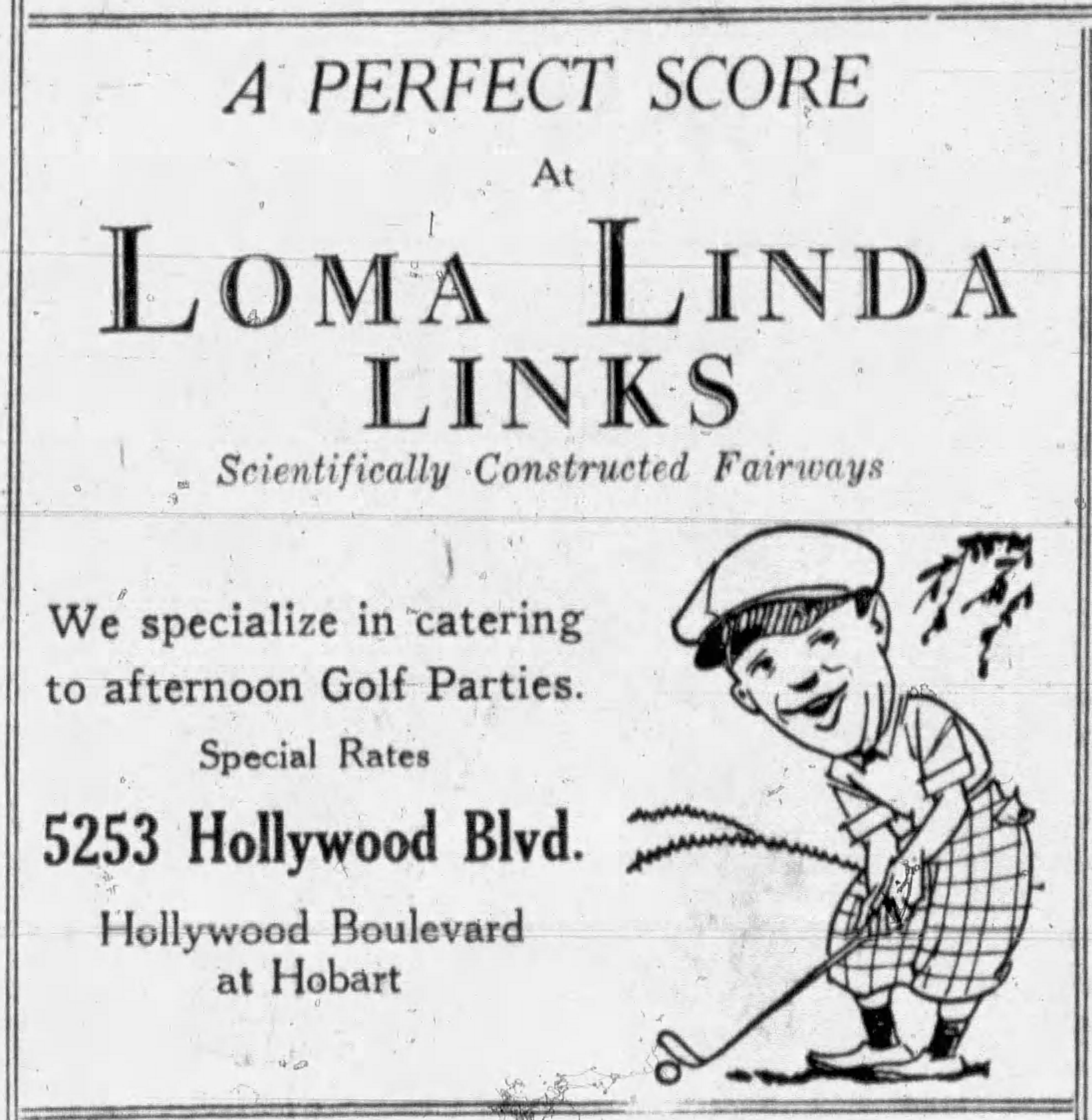
The Loma Linda Links offered scientifically constructed fairways and afternoon golf parties. Hollywood Citizen News 8/14/1930.

The nation was in the midst of a huge miniature golf fad. Links were springing up all around Los Angeles, including several on Hollywood Boulevard. Even the movie studios were worried about the competition. The craze soon died down but miniature golf remained a popular pastime. The postwar era saw another resurgence.

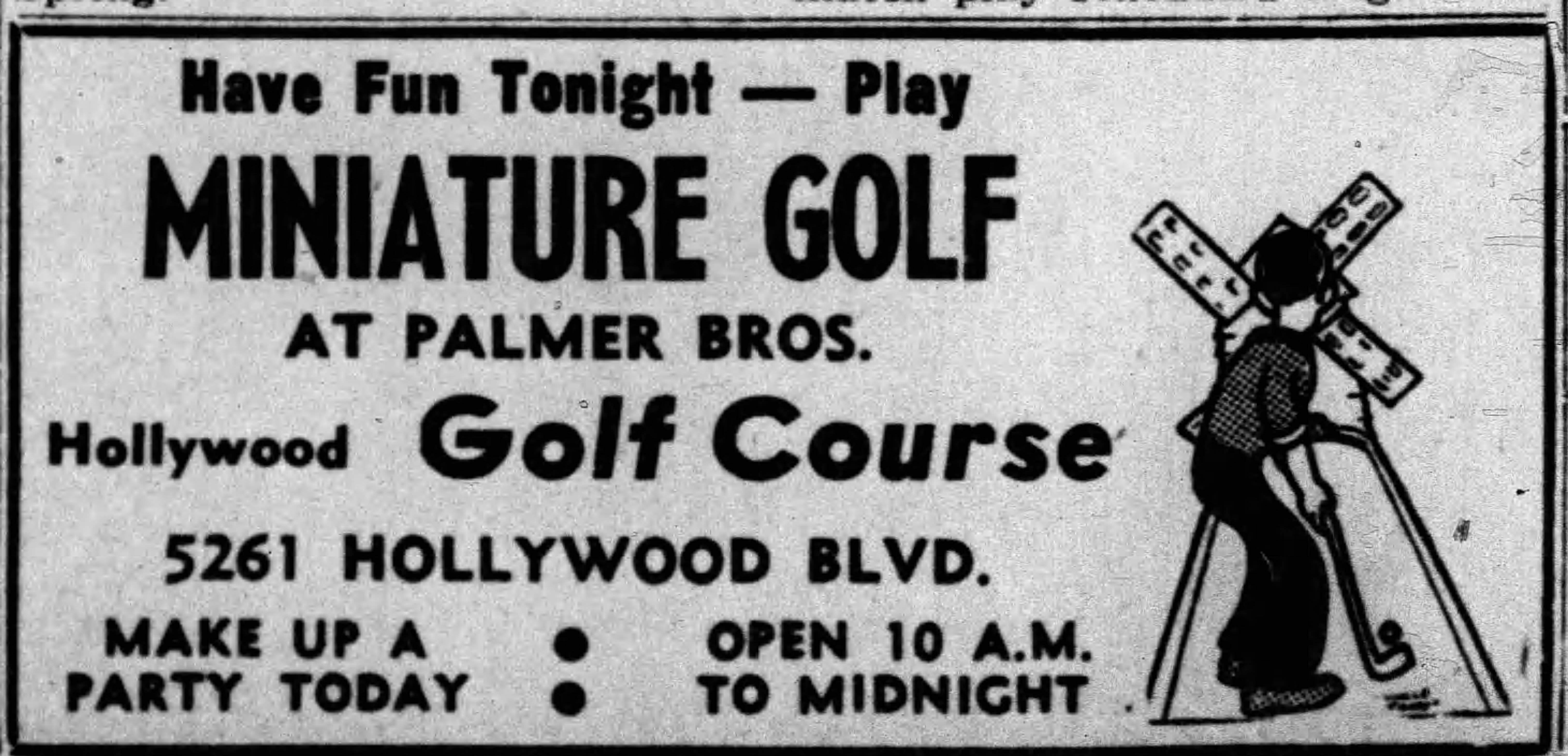
The Hollywood Golf Course offered night time play. Hollywood Citizen News 8/4/1949

In January 1949, the Palmer Brothers took over the Eagle Rock Miniature Golf Course at 1751 Colorado Boulevard. They continued to operate the Hollywood Golf Course through the summer of 1949 for sure.

By 1951, the course had been acquired by another set of brothers: George and Harry Gittelson, using the address 5263 Hollywood Boulevard.

Hollywood Citizen News 3/27/1951

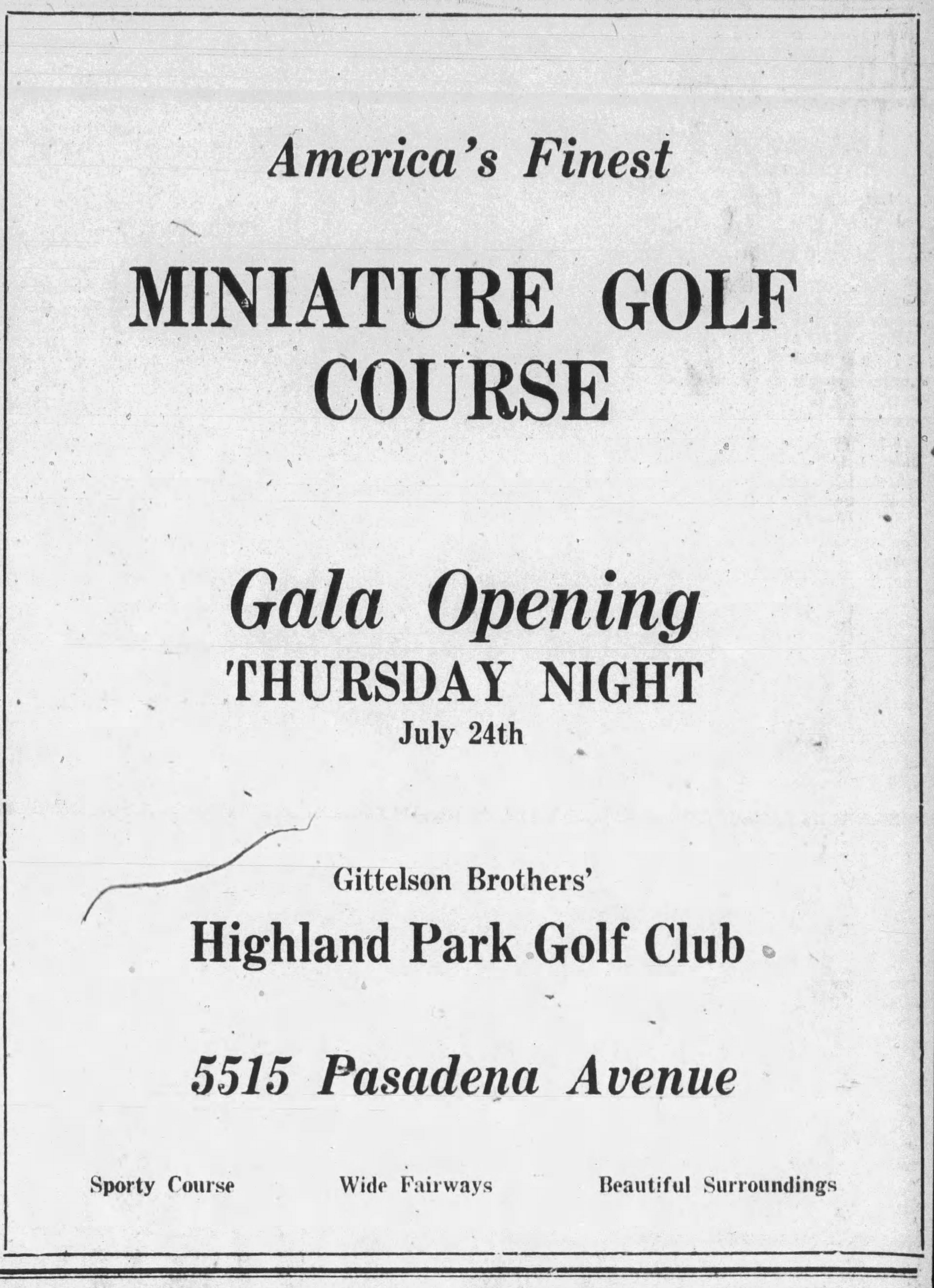
The Gittelson brothers had made a killing founding the first ticket broker agency in Los Angeles. They were also among the first to open a miniature golf course back in 1930, Their Highland Park Miniature Golf Course had opened at 5531 Pasadena Avenue on July 24, 1930, a few days before the Lander’s course opened. They had continued to operate miniature golf courses since that time.

Opening of the Gittelson Brother’s Highland Park Miniature Golf Course. Highland Park News Herald 7/23/1930

The Gittelson Brothers in 1930 at the time of their first miniature golf course opening. LA Evening Express 7/28/1930.

The Hollywood Boulevard links featured windmills, waterfalls and wishing wells. The grounds, extending around the old homestead buildings, were lush and green. The brothers added open-air ping pong table courts.

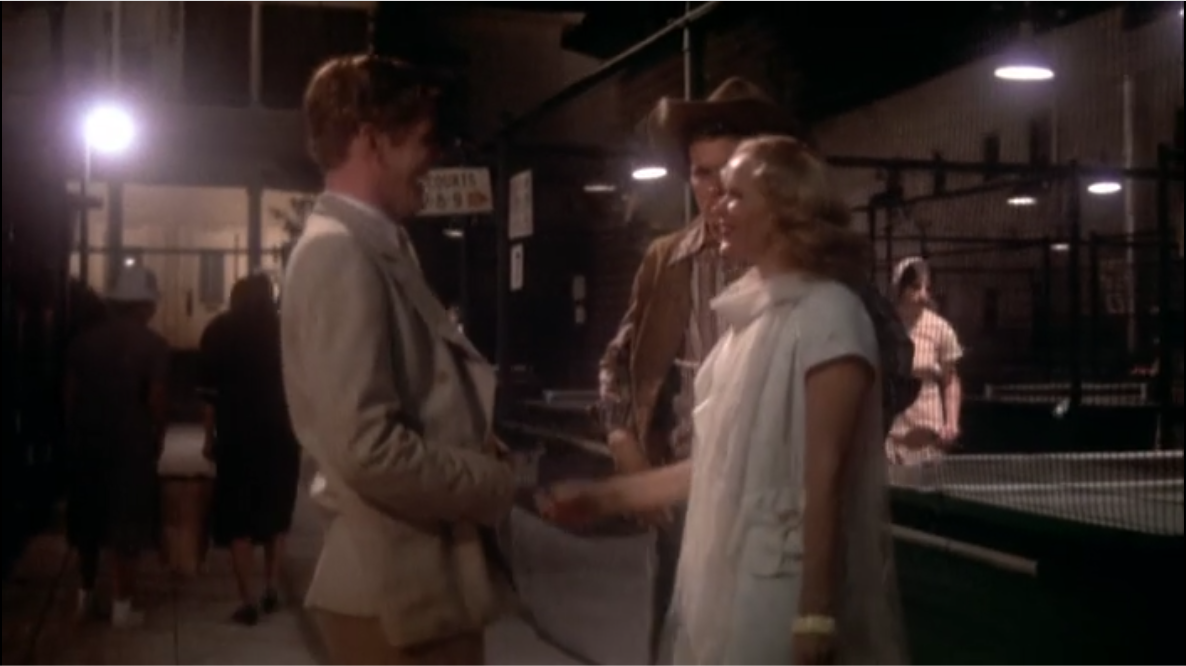
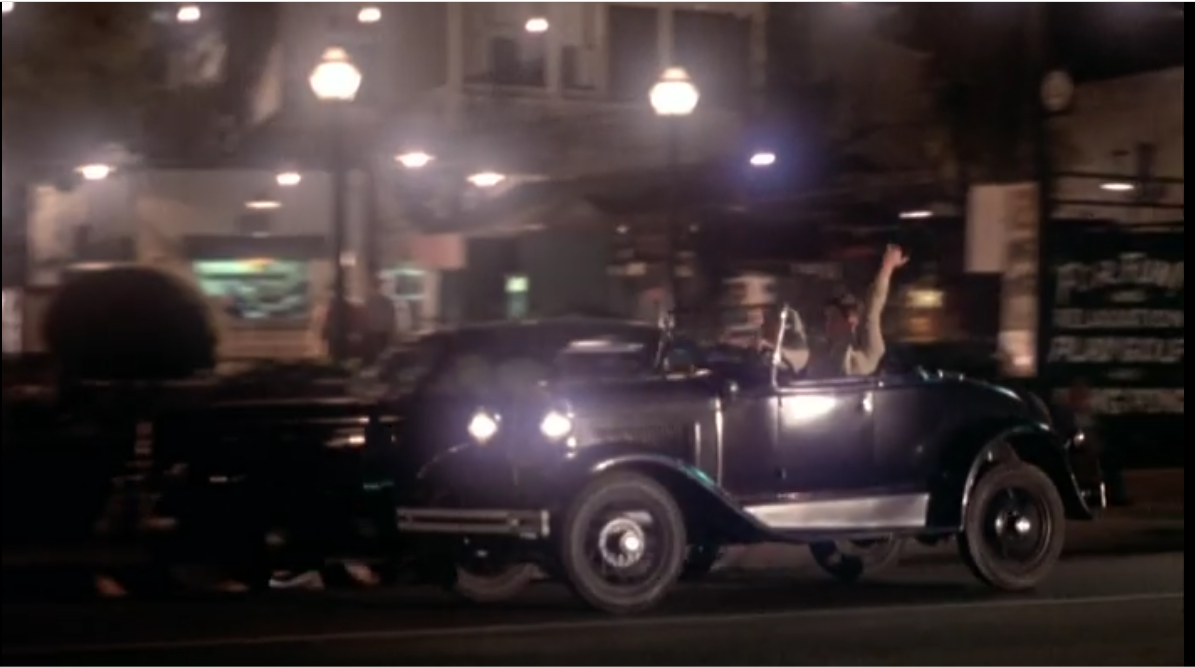
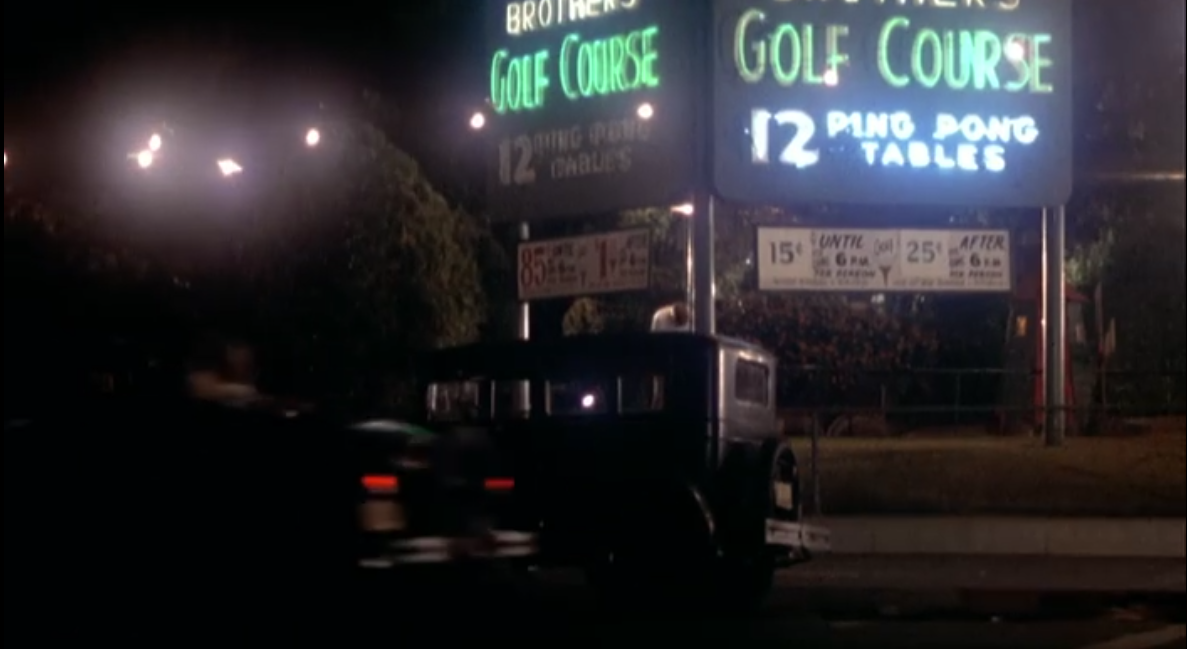
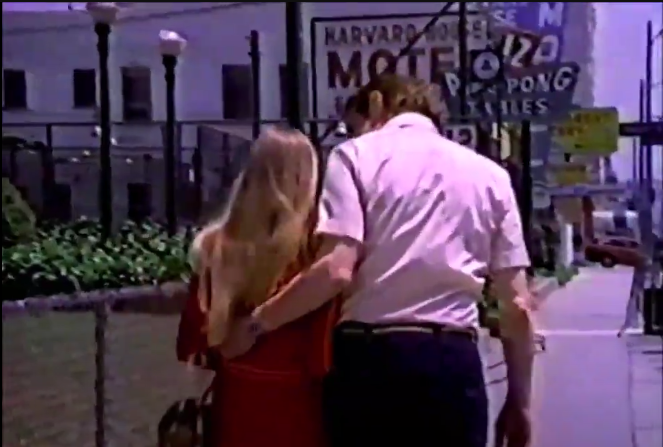
Harry Gittelson died in 1965, George in 1969. The miniature golf course continued into the 1970s. It can be seen at night in the 1975 film “The Day of the Locust” (set in the 1930s), and during the day in the 1976 television film “Dawn: Portrait of a Teenage Runaway.”

Screengrab from :The Day of the Locust” showing the ping pong tables.

Screengrab from :The Day of the Locust.”

Screengrab from :The Day of the Locust.”


Screengrab from :The Day of the Locust.”

Screengrab from “Dawn: Portrait of a Teenage Runaway.” filmed on location at the Gittelson Miniature Golf Course.

Screengrab from “Dawn: Portrait of a Teenage Runaway.” Dawn is heading toward the Harvard House Motel, the mini golf course and ping pong tables is on the left.

The entire property, incorporating addresses 5253 to 5373,

5253-5273 Hollywood Boulevard today. Google map image.

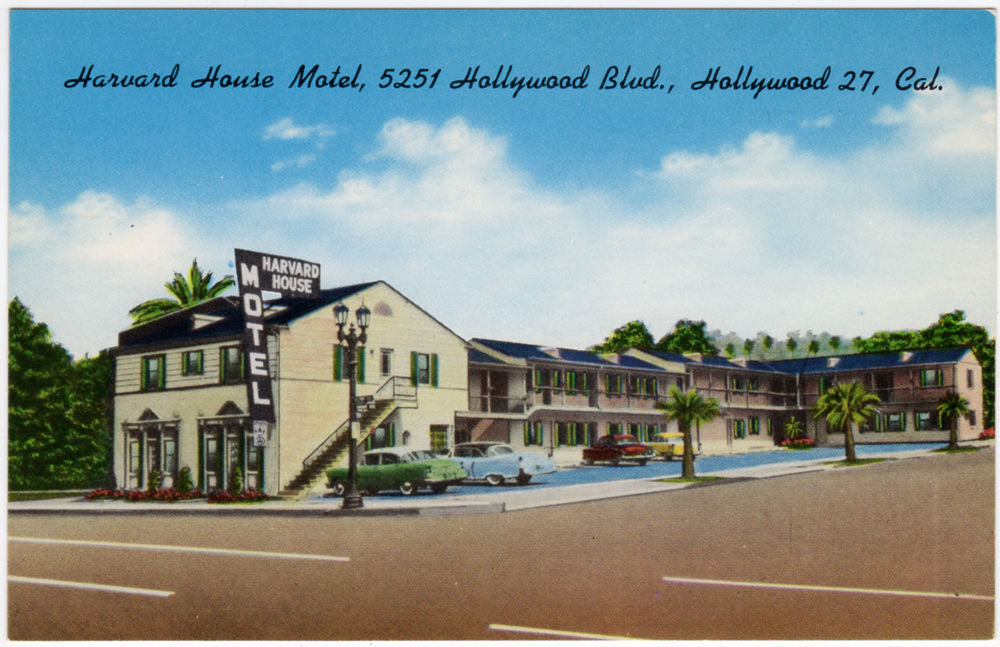
5251 Hollywood Boulevard – Harvard House Motel

Located at 5251 Hollywood Boulevard at the northwest corner of Hollywood and Harvard Boulevard, the Harvard House motel opened in 1947. The property was part of the Lander Sunnyside Tract (See my post here for more information on that).

The L-shaped, two story, stucco-clad structure initially contained 28 rooms and offices. It was designed by architect Arthur W. Hawes for owner Dushan S. Nicholich (sometimes spelled Nickolich), who operated a real estate business at this location. Nicholich applied for the permit in August, 1947. By 1951, Nicholich had departed Hollywood for Washoe County, Nevada, where he had the “Old Williams Ranch,” renaming it the 102 Ranch.

The Harvard House Motel is still extant.

Postcard view of the Harvard House Motel in the 1950s.

The Harvard House Motel today. Photo via Zillow.

Notes

The Harvard House, looking very much the same as it does today, can be seen in the dismal tv movie “Dawn: Portrait of a Teenage Runaway” (1976).

5217 Hollywood Boulevard- The Guardian Arms Apartments

Located at 5217 Hollywood Boulevard, the Guardian Arms held a public open house on June 29, 1928 and officially opened on June 30, 1928, the same day as its neighbor, the El Adobe Market.

Plans for the 7-story structure were revealed in February 1927. An artists’ drawing of the proposed Spanish-style building, designed by architect W. Douglas Lee, appeared in the Los Angeles Times on March 13, 1927. The owner, the Guardian Holding Corporation, applied for permits to construct the foundation in May 1927, and the building itself in June 1927.

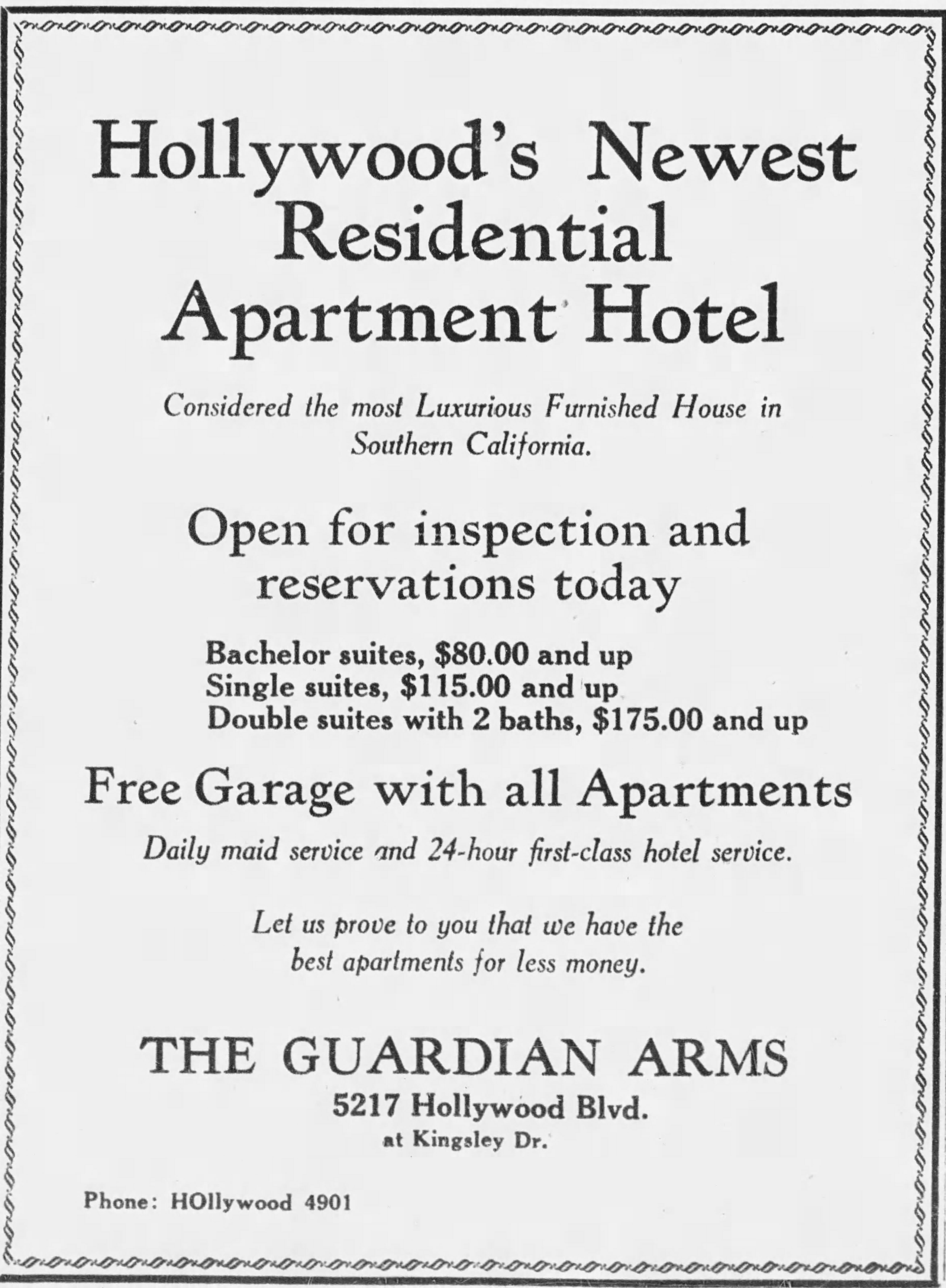
Hollywood Citizen News 2/18/1927.

LA Times 3/13/1927.

The project took more than a year to complete. The luxury residence contained 90 uniquely furnished units, with a penthouse bungalow and roof garden. Amenities included daily maid and valet service and a 55-car garage in the rear. There was a large lounge area with a dance floor and an auditorium/stage in the basement. Retail shops occupied the ground floor. 

Los Angeles Times May 11, 1928.

Hollywood Citizen-News 6/29/1928.

The Guardian Arms when new. LAPL photo.

Detail of the entrance. California State Library photo.

In 1932, an investor, Anna McKinnie, brought a lawsuit against Guardian Holding Corp, charging fraudulent stock transactions, and in January 1933 was awarded a judgement of almost $250,000. The following month, creditors of Guardian Holding Corp petitioned for bankruptcy in federal court. In April 1933, four officers of Guardian Holding Corp were indicted following a grand jury investigation into the firm’s dealings: E. J. Kampschroer, Charles H. Johnson, E. E. Pratt, and Theodore Kemp. The four were charged with conspiracy and violation of the state Corporate Securities Act. The trial, which began in September 1933, ended with a hung jury. A second trial began March 7, 1934. On April 11, 1934, after over 50 hours of deliberation, the jury found Pratt and Johnson guilty. Kemp was acquitted. The jury was unable to agree on the culpability of Kampschroer, and the DA ultimately moved to dismiss his case. Pratt and Johnson were sentenced to a term at San Quentin later that month. They remained free pending appeal and in October 1934, had their sentences overturned on a habeas corpus ruling.

Los Angeles Post-Record 4/20/1934.

The Guardian Arms sailed right along as a primo, luxury residence.

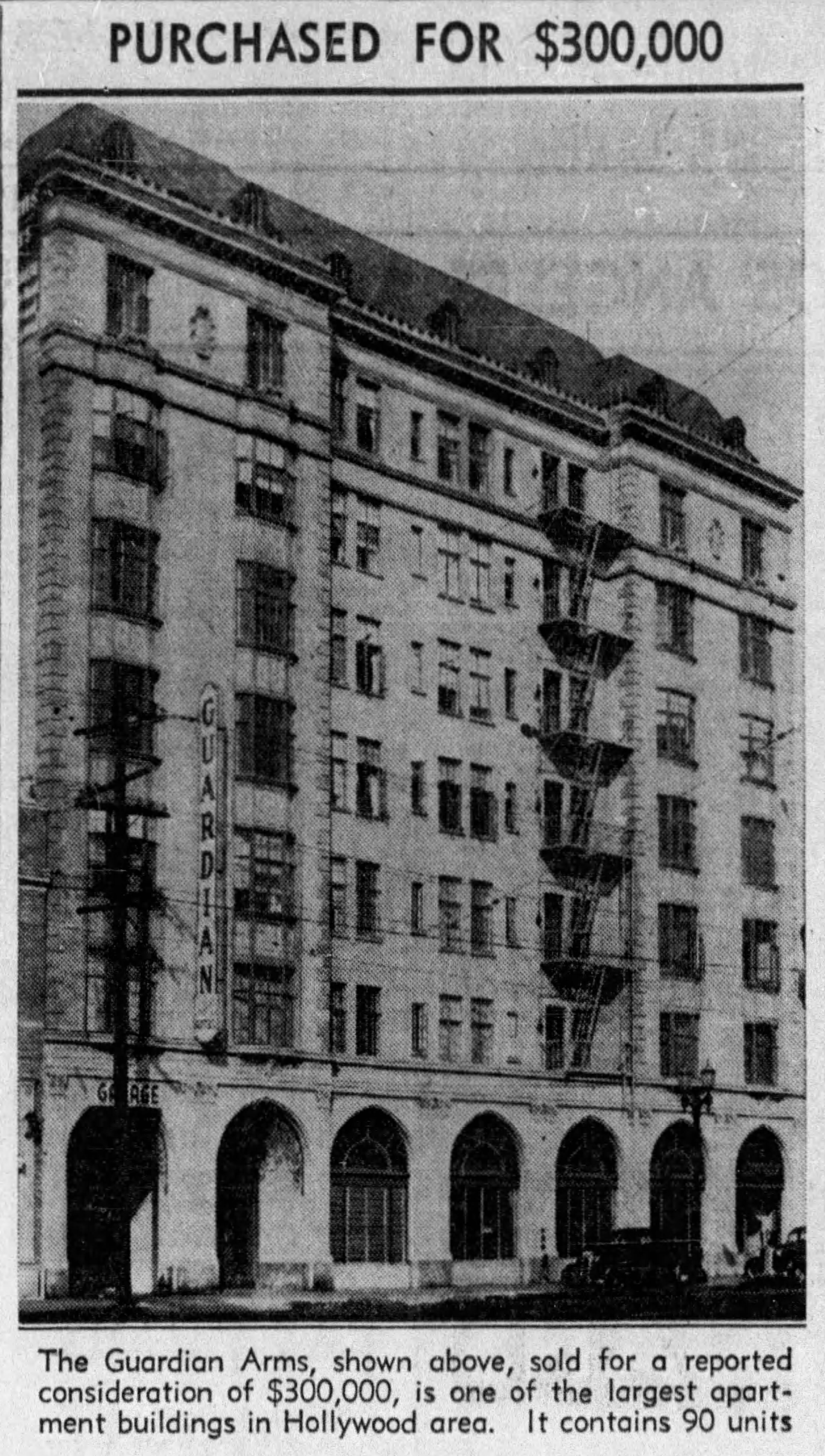
In December 1938 it was revealed that the property had been sold by owner Leslie H. Danis, to an out of town buyer, Leopold Kalish, for $300,000.

LA Times 12/11/1938.

In March 1944, it was made public that Kalish had sold the building to real estate investor G.E. Kinsey for $275,000 – $25,000 less than he had reportedly paid for it a little more than 5 years earlier. Kinsey in turn flipped the property two months later, selling it to Arthur E. Gray and B. Browsky in May 1944 for the same price he had paid for it- $275,000.

Hollywood Citizen News 4/13/1946.

Hollywood Citizen News 4/27/1946.

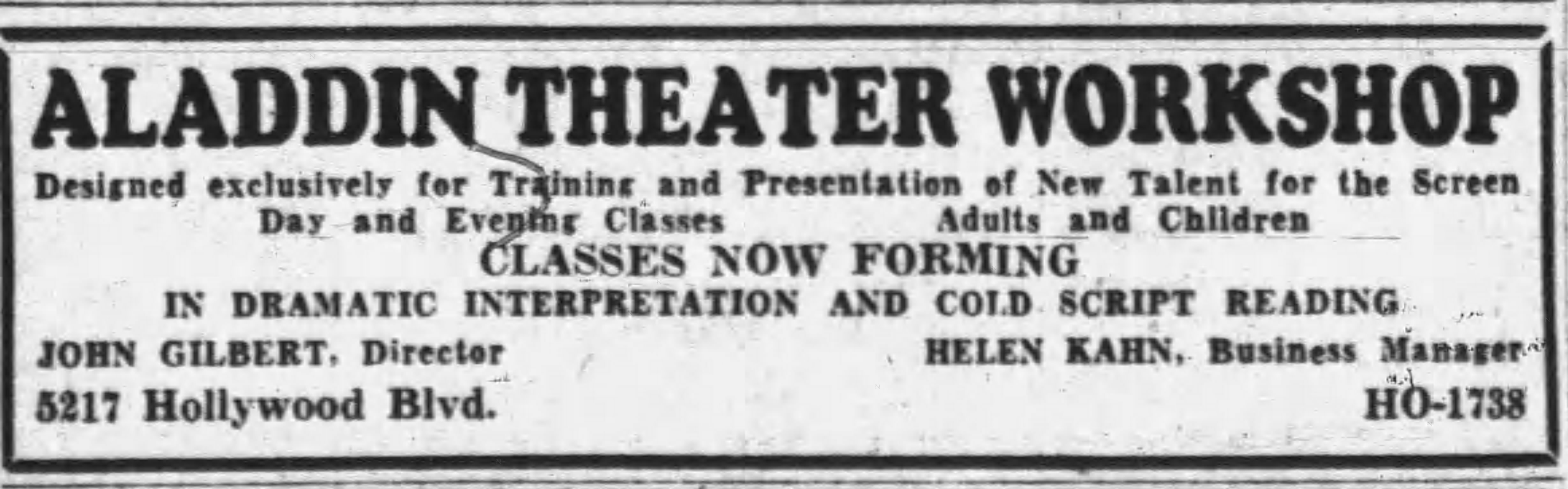
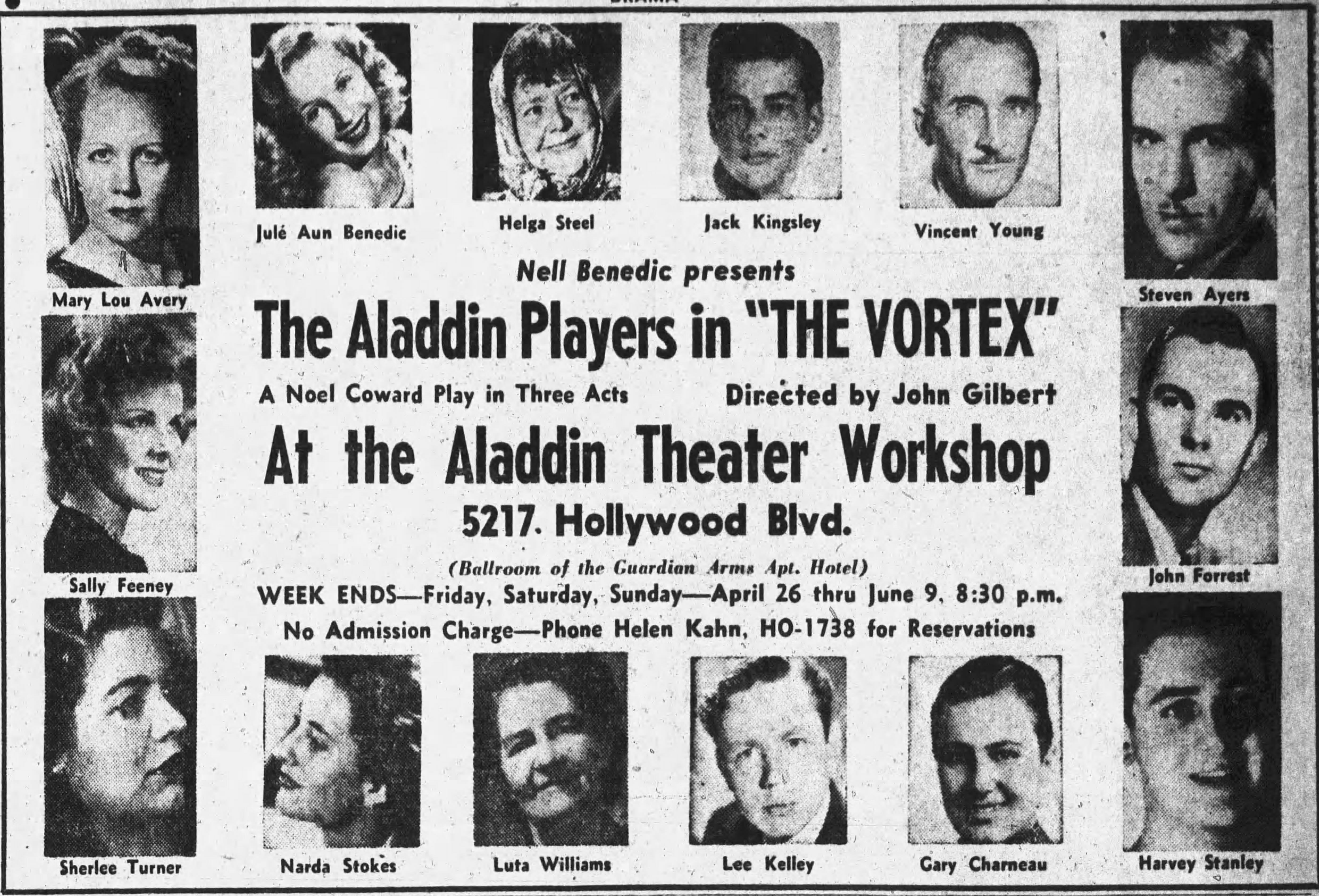
In 1946, the basement auditorium served as an actors’ studio and theater, known as the Aladdin Theater Workshop, for the Aladdin Players. Organized by actor’s agent Nell Benedic as a showcase for her clients, the group debuted with the Noel Coward play, “The Vortex,” in April 1946.

LA Times 6/22/1958.


The Guardian Arms, renamed the Hollywood Hotel Apartments, featured a Hawaiian garden. LA Times 8/26/1958.

In June 1958, the 30 year old building was rebranded as the Hollywood Hotel Apartments. The remodeling cost a reported $300,000 – $50,000 less than it had ostensibly cost to build and the same price it had sold for twenty years earlier.

The Guardian Arms remains extant.

5201 Hollywood Boulevard – El Adobe Market

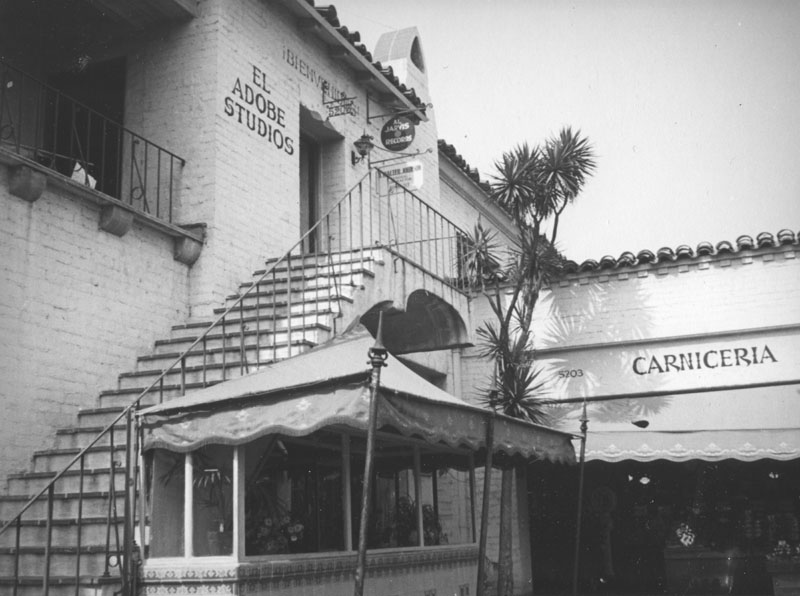
The adorable, Spanish-themed El Adobe Market opened on June 30, 1928 at 5201 Hollywood Boulevard on the northwest corner of Hollywood and Kingsley. Designed by architect Arthur Kelly, it might have been a movie set, down to the old oxcart in the courtyard and the Spanish names painted on the vending stalls (“frutas” for fruits, “verduras” for vegetables” etc).

The site, addressed as 5203 Hollywood Boulevard, had been home to pioneer resident, dentist C. V. Baldwin and his wife Alice, who came to Los Angeles in 1878. Dr. Baldwin passed away in February 1927 at the age of 92.

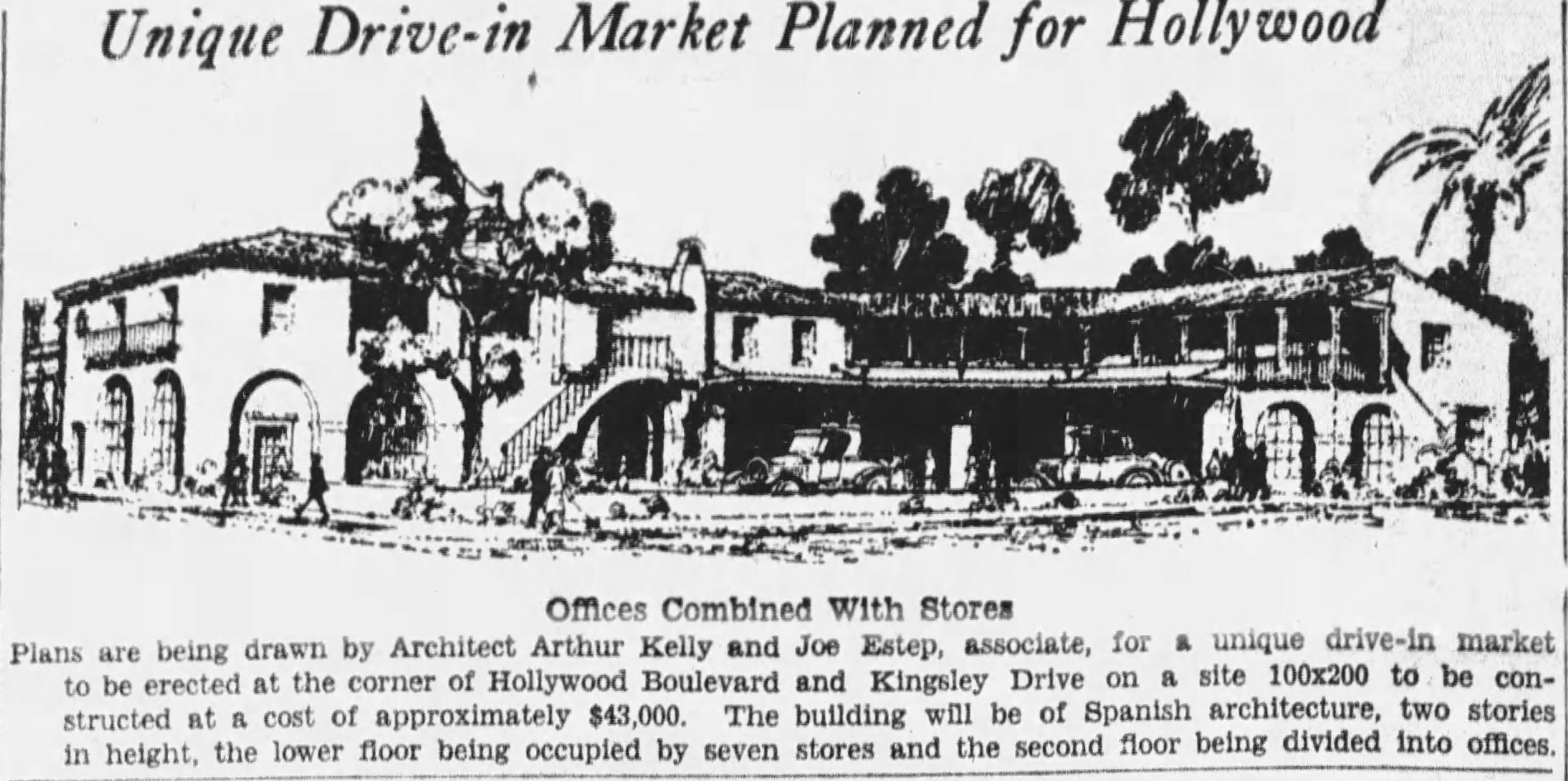
On March 4, 1928, plans were made public for the office and retail building that became the El Adobe Market. Los Angeles was already in love with car culture, reflected in the market’s drive-in design.

Artist’s drawing of the building that would house the El Adobe Market. LA Times 3/4/1928

Opening ad for the El Adobe Market, LA Times 6/29/1928.

The El Adobe Market c. 1937. LAPL photo.

The El Adobe Market’s courtyard and oxcart c. 1937. LAPL photo.

Interior of the El Adobe Market, 1942. LAPL photo.

El Adobe Market c. 1970. The tall building adjacent is the Guardian Arms Apartments, which opened the same day as the El Adobe Market, June 30, 1928. In June 1958, it was renamed the Hollywood Hotel Apartments.

El Adobe Market in recent times. Photo from youarehere.com

El Adobe Market is still in business.

The Hollywood Guild Canteen

The Hollywood Guild Canteen, not to be confused with the Hollywood Canteen or the canteen of the Hollywood USO, was located at 1284 N. Crescent Heights Boulevard at Fountain. Founded in 1942 by Anne Neill Lehr, wife of retired film executive Abraham Lehr, it provided free food, entertainment and overnight accommodations in a home-like atmosphere to service members on leave.

Anne Lehr already had a long resume of civic leadership. During the first World War she had been active with the American Red Cross. She directed the tearoom of the Assistance League’s Good Samaritan Committee, located at 5604 Delongpre Avenue, where the stars served as waitresses, and in 1931 headed the Women’s Auxiliary Committee of the Motion Picture Relief Fund. In 1935, she founded the Hollywood Relief Guild, headquartered at 1305 N. Crescent Heights, to benefit aged and indigent members of the film industry who didn’t qualify for other aid programs or were reluctant to apply for them. Bette Davis was a patron. Anne raised money for the Guild with events such as daily luncheons, weekly bridge luncheons and fashion shows at the Trocadero, garden parties, recitals, premiere benefit parties, and auctions and sales personal items donated by the stars.

With the US entry into World War II, she became chair of the Los Angeles County Women’s Voluntary Service Organization (WVSO), which organized permanent and mobile canteens for soldiers and arranged entertainment for men in camps, among other activities.

Lehr realized there was a need for a space where servicemen could be entertained without being ripped off and founded the Hollywood Guild Canteen on May 15, 1942. She rented a mansion with expansive grounds at 1284 N. Crescent Heights, across the street from her Relief Guild headquarters, and recruited young women from the studio- movie extras, secretaries, clerks- to be hostesses. Stars donated furniture and other supplies- notably a bamboo bar given by Greer Garson according to some reports (others said it came from Norma Shearer). The servicemen could play ping pong, dance to records or the radio, have a home-cooked meal or just relax. There was no charge. Bette Davis was active with the project, and served as chair of the Hollywood Guild Canteen until her own Hollywood Canteen opened in October 1942.

Two decades earlier the mansion had been home to silent Western film star Dustin Farnum and his wife and frequent leading lady Winifred Kingston. The couple married at the house in August 1924. Farnum died in July 1929 and Kingston rented out the property. As of August 1929, it was a private girls’ school. From circa 1932 to 1937 it served as the home base of the Domino Club, a private theater club for film industry women.  Later that decade it briefly served as the Dominican Republic consulate.

LA Times August 25, 1924.

A colorized postcard view of the house as it looked in the 1920s.

Over the 4th of July weekend, 1942, Anne announced that the canteen had entertained 2000 service members.

Later that month, Winifred Kingston sued the Hollywood Canteen Guild for non-payment of rent. She and Lehr had a verbal agreement that the group was to pay $300 a month; in June the amount was reduced to $250 a month. Lehr and Kingston worked it out and the canteen continued to operate. In fact, Lehr, seeing that many of the boys who visited had nowhere to stay, converted the clubhouse into a dorm. It housed between 80-100 service men every weekend and was open to servicemen every day and night.

It cost an estimated $6000 a month to keep the canteen going, all through private donations. Mary Pickford held a garden party at her estate, Pickfair, on August 25, 1942 to benefit both the Hollywood Relief Guild and the Hollywood Guild Canteen. Other star-studded fundraisers would be planned- a dance benefit a Mocambo, a benefit premiere of San Goldwyn’s “Up in Arms” starring Danny Kaye (Abraham Lehr had been VP of the Goldwyn Pictures corporation), Orson Wells magic shows, an ice show at the Trocadero.

Hollywood Citizen News 8/25/1942. Bette Davis was now the chair of the Guild’s canteen.

In January 1943, the Hollywood American Legion Post presented Anne with a U.S. flag in recognition of her work.

Officers elected by the Hollywood Guild Canteen Alumni Association on February 20, 1943. Seated: “Mom” Anne Lehr, president of the Hollywood Guild and Canteen and honorary president of the Alumni Association; and W. Decker Humphrey of Kansas City, Kan., president. Standing, left to right: Verlin McCall, Los Angeles, third vice-president; John Costigan, Davenport, Ia., first vice-president; Caleb Kirk Jolly, Charlotte, N. C., fourth vice-president; Dennis “Lucky” Cooper, Kalamazoo, Mich., second vice-president; William Patton, Joplin, Mo., treasurer; Jerome Parson, Johnstown, Pa., financial secretary; K. A. Parmley, Spokane, Wash., recording secretary. LAPL photo.

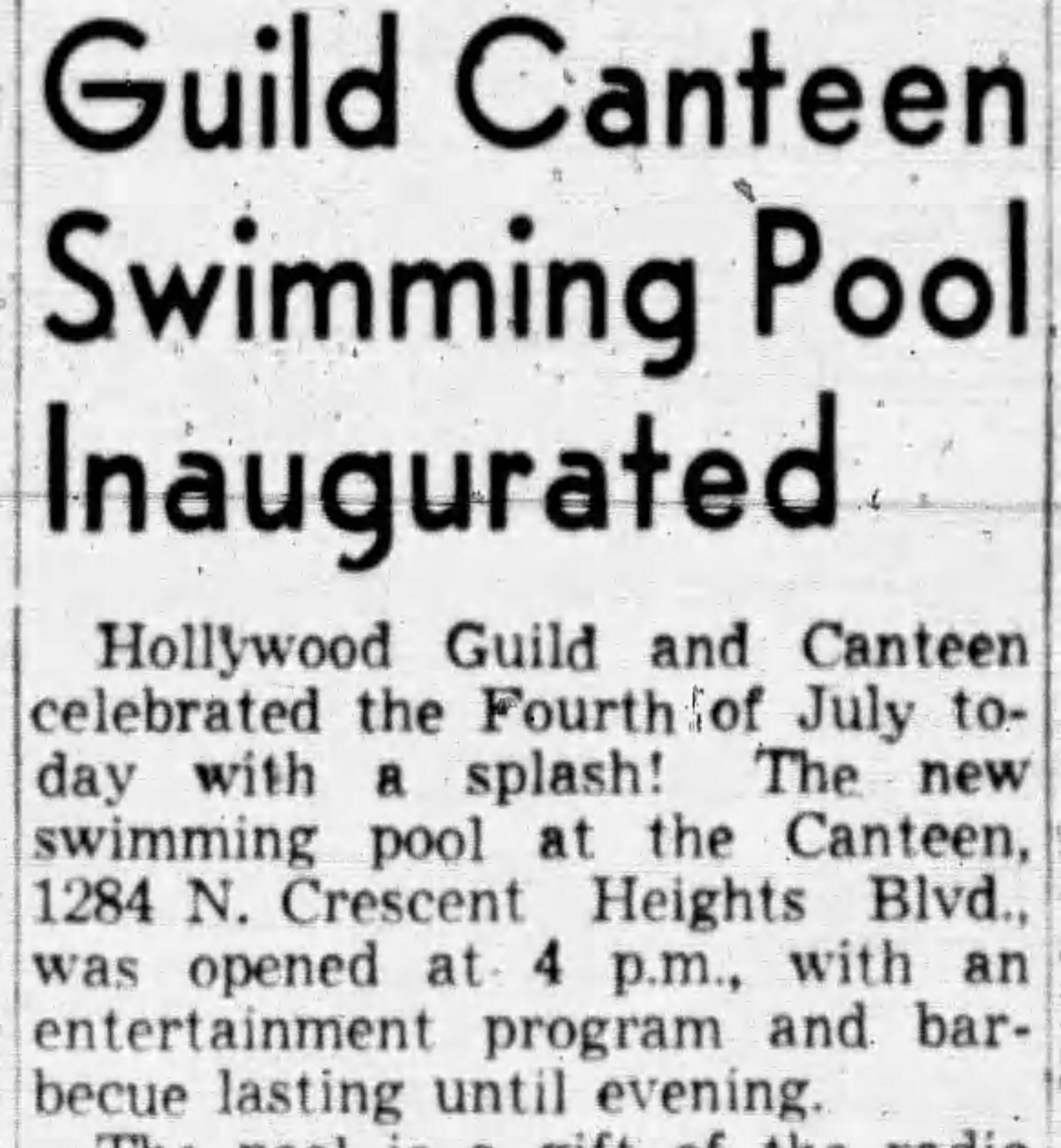
Tom Brenneman, host of a popular morning radio program, “Breakfast at Sardi’s,” used his platform to raise money to install a swimming pool for the Hollywood Guild Canteen. It was inaugurated on the 4th of July, 1944 with a swimming party and barbecue attended by former Olympic swimming champions Buster Crabbe and Johnny Weissmuller.

Hollywood Citizen News 7/4/1944.

On August 10, 1945, Anne announced that the canteen would continue to help after the war. It was already assisting recently detached servicemen to find jobs.

The Trocadero nightclub hosted a benefit for the Hollywood Guild Canteen featuring ice follies star Belita on August 12, 1945.

Japan’s unconditional surrender came two days later, on August 14, 1945.

Though less well known today than her compatriot on ice, Sonja Henie, Belita was a huge skating star in the 1940s. Hollywood Citizen News 8/13/1945.

LA Times 10/25/1945.

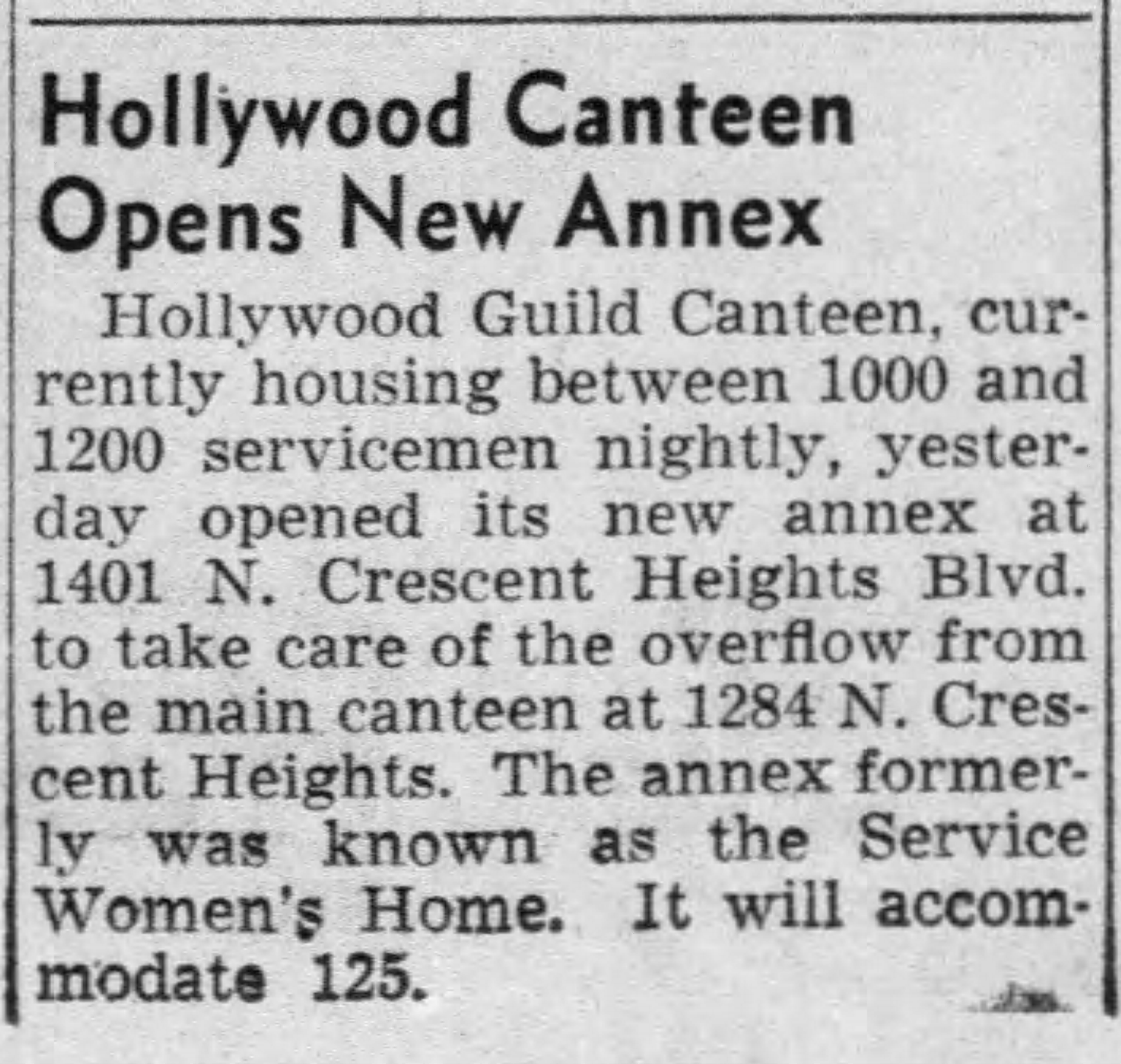
The Hollywood Guild Canteen not only didn’t close- it expanded, opening an annex at 1401 N. Crescent Heights Boulevard on October 24, 1945 in what had been the Service Women’s Home.

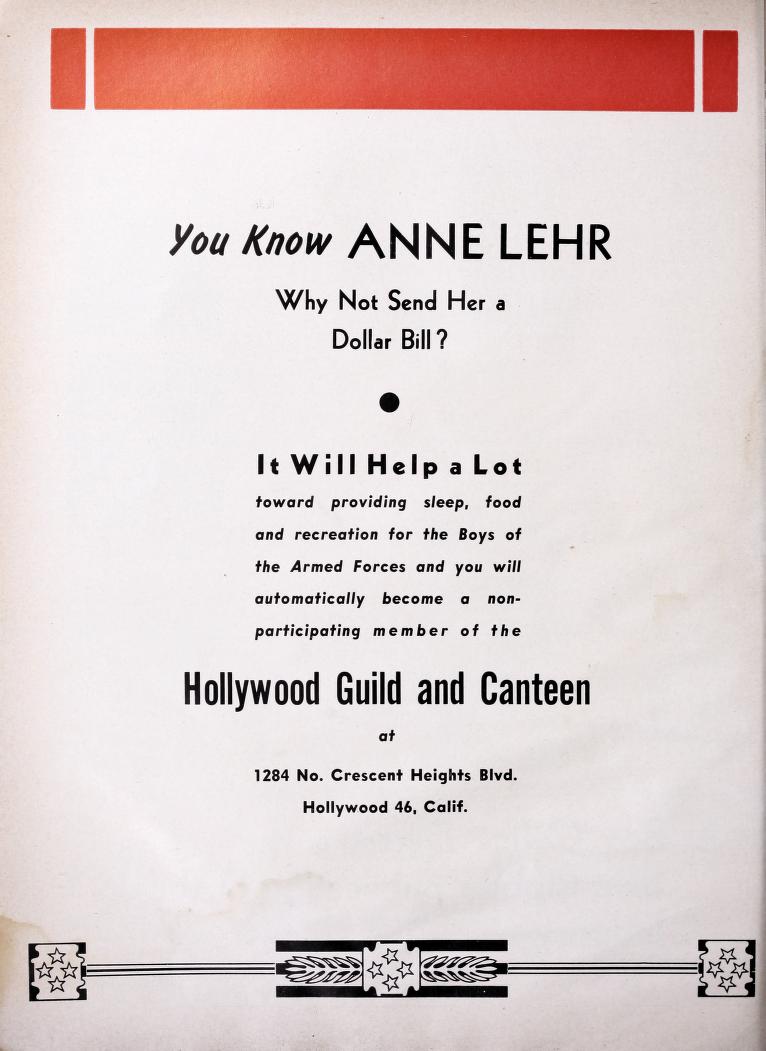
Ad from Box Office Digest 1/20/1945.

The property at 1284 N. Crescent Heights Boulevard was offered to the Guild Canteen for $60,000 in 1945, but it didn’t have the cash. It sold to actor Richard Lane and his business manager Robert Hodge.

On December 10, 1945, the Guild Canteen board voted to operate on a semi-commercial basis, since donations had dwindled. For $7-$10 a week, depending on whether he was going to school (under the GI Bill) or employed, approximately 150 veterans living at the canteen got a bed and breakfast; dinner was fifty cents. All the same, it operated at a loss of $300-$400 a month; the deficit was covered by citizens who, as Anne said, “still cared.” The Guild continued its social services mission from new offices at 802 N. Fairfax, and twice a week, disabled servicemen from nearby hospitals were invited over to 1284 N. Crescent Heights for a swim and a barbecue.

Ad from the Box Office Annual, 1945.

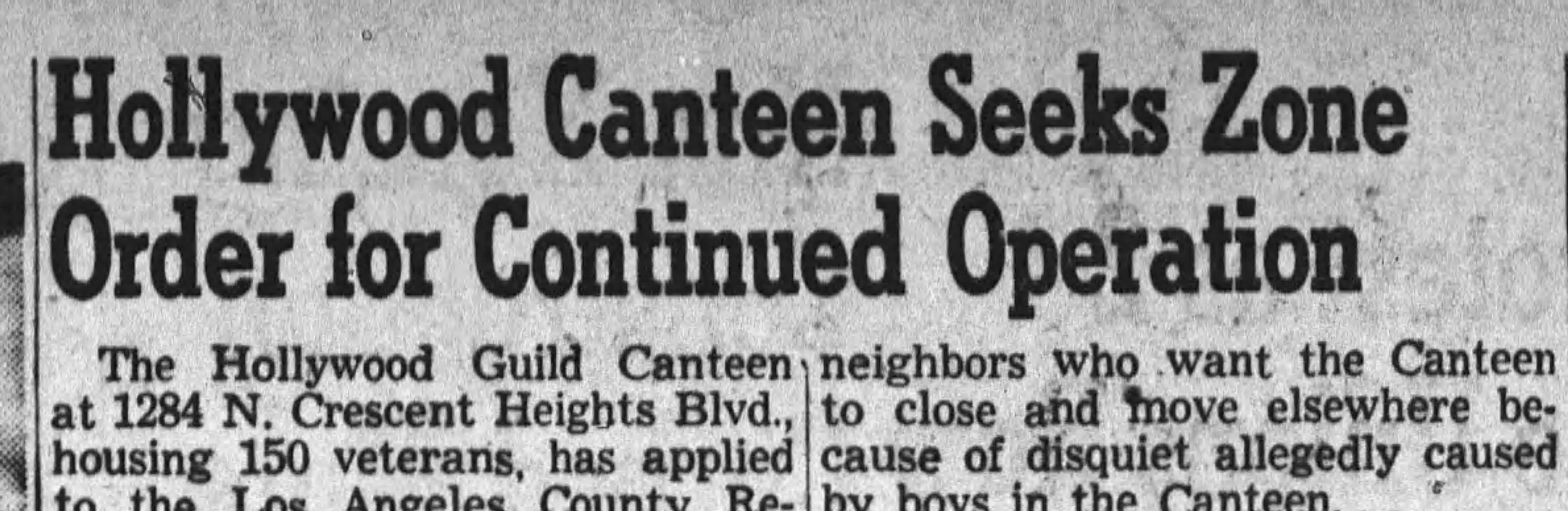
In February 1946, the property’s wartime variance expired; granted “for the duration of physical hostilities plus 6 months,” the variance had allowed the Guild to operate the canteen in a residential neighborhood. The canteen was given notice to cease operations by March 15. The Guild went right on feeding and caring for its discharged veteran residents and guests. Neighbors complained, calling the canteen noisy and a nuisance.  In May 1946, the County Regional Planning Board ordered the canteen to close. The Guild applied to the Board for another zone variance. In addition, the property was again on the market- now for $125,000. The Board set a hearing for September 12 to hear the case. On June 10, the County Health Department inspected the facility and made a list of health and safety code violations.

Hollywood Citizen News 5/17/1946

Hollywood Citizen News 5/30/1946.

A group of residents protested against their potential eviction. Before the September hearing, the County Board of Supervisors agreed the vets living there should not be forced out of their home, but minimum safety requirements would have to be met. At the hearing, the Regional Planning Board agreed to recommend to the Board of Supervisors that another temporary zone variance be granted.  The Supervisors unanimously agreed on October 1, 1946. The canteen now had until October 30, 1948 – one day before its lease expired on October 31.

LA Daily News 8/28/1946.

On October 26, 1948, the Guild held an auction of the canteen’s furnishings. The bamboo bar went for $20. The Hollywood Guild Canteen officially closed on October 27.

The new owner, W.E. Clark, had the house and other structures erected by the Guild during the canteen era, demolished almost immediately. He developed the property with a 64-unit colonial-style apartment complex known as the Greenbriar Apartments. It opened on August 29, 1949.

The Greenbriar Apartments, which replaced the Hollywood Guild Canteen buildings. LA Times 8/28/1949.

With the Korean War underway, in August 1950, Ann Lehr, who had been nicknamed “Mom” during the years of the Hollywood Guild Canteen operation, said the canteen would not be able to reopen due to lack of funds. In January 1951, she did arrange entertainment at the GI Joe Service Center at 305 Olive Street, the lower floor of the Moose Lodge. She also threw a big party for service members at the Hollywood Breakfast Club on February 4, 1951.

The LA Times Mirror 11/9/1951.

Mom Lehr died of a heart attach on November 8, 1951.

Notes

Some reporting about the closing of the Hollywood Guild Canteen stated that Bette Davis; secretary had a difference of opinion with Anne regarding the running of the operation, and therefore talked her boss into opening a “rival” Hollywood Canteen. It’s possible; however the timeline of the Hollywood Canteen suggests that Davis was interested in setting up a facility similar to Broadway’s Stage Door Canteen, even before the Hollywood Guild Canteen was established.

Hollywood had another Ann Lehr/Anna Lehr who was a silent film actress and the mother of Ann Dvorak

The Hollywood Canteen

The Hollywood Canteen opened on October 3, 1942 at 1451 N. Cahuenga Avenue as a free entertainment center for servicemen in uniform. Co-founded primarily by Bette Davis, John Garfield and Mervyn LeRoy, it was modeled after the Stage Door Canteen in New York.

On February 7, 1942, the American Theater Wing had announced it was opening a canteen for servicemen in the unoccupied Little Club beneath the 44th Street Theater at 216 W. 44th Street in New York City. Staffed by Broadway actors, musicians and other theater workers, it opened on March 2, 1942 after a public open house on February 28 and March 1.

On March 26, 1942, AP columnist George Tucker reported that Bette Davis had appeared at the Stage Door Canteen and danced with the soldiers, sailors and marines. The column appeared in papers nationwide into early April 1942.

On June 2, 1942, LA Times arts writer Edwin Schallert returned from a visit to Broadway and reported: “I learned in New York that Bette Davis is much interested in establishing a Stage Door Canteen for the entertainment of servicemen on the Coast and that the idea is about to become a reality. In sprawling Los Angeles and Hollywood, I’d say they’d need several.” Gossip columnist Hedda Hopper also reported that Bette Davis, John Garfield and other top stars wanted to open a local Stage Door Canteen, identifying the prospective location for it as Ciro’s nightclub on Sunset Boulevard. Hopper thought a Hollywood Stage Door Canteen was unlikely to succeed, and questioned whether it was even needed since there was already the Hollywood USO and other similar facilities.

In fact, a Hollywood canteen was about to open- the Hollywood Guild Canteen, organized by Anne Lehr, wife of a former studio executive, Abraham Lehr. Anne had founded the Hollywood Guild in 1935 to air aged and indigent persons from the film industry. On May 15, 1942, she expanded her efforts to include a relaxation and entertainment facility for servicemen. It was up and running by July 1942.

Bette Davis would serve as chair of the Hollywood Guild Canteen but continued to pursue opening a Hollywood version of the Stage Door Canteen. On August 17, Davis and the Hollywood Victory Committee announced that that a Stage Door Canteen-style facility would be coming to Los Angeles. The following day Luella Parsons reported in her syndicated column: “Bette Davis finally will get her Stage Door Canteen only it will be called the Hollywood Canteen.”

Hollywood Citizen News 8/17/1942.

A series of fundraisers were held that month to raise money for the Hollywood Canteen- the first was a premiere for the film “The Talk of the Town” at the Four Star Theater on August 29, followed by dinner and dancing to Benny Goodman’s orchestra at Ciro’s. Ticket sales for the sold-out event raised some $5000 for the Canteen. The next day, Joan Bennett staged a garden party benefit at her Holmby Hills home, located at 515 Mapleton Drive.

Los Angeles Daily News 8/25/1942

The Hollywood Canteen was officially organized as a nonprofit on August 24, 1942. The following day, the Los Angeles Daily News reported that the Hollywood Barn building at Sunset and Cahuenga had been leased for the Hollywood Canteen. The space was donated for the duration by the owners, brothers Frank and Walter Muller and Sarah A. Laughlin. Film industry professionals donated their services to renovate and redecorate the structure.

Entrance to the Hollywood Canteen. LAPL photo.

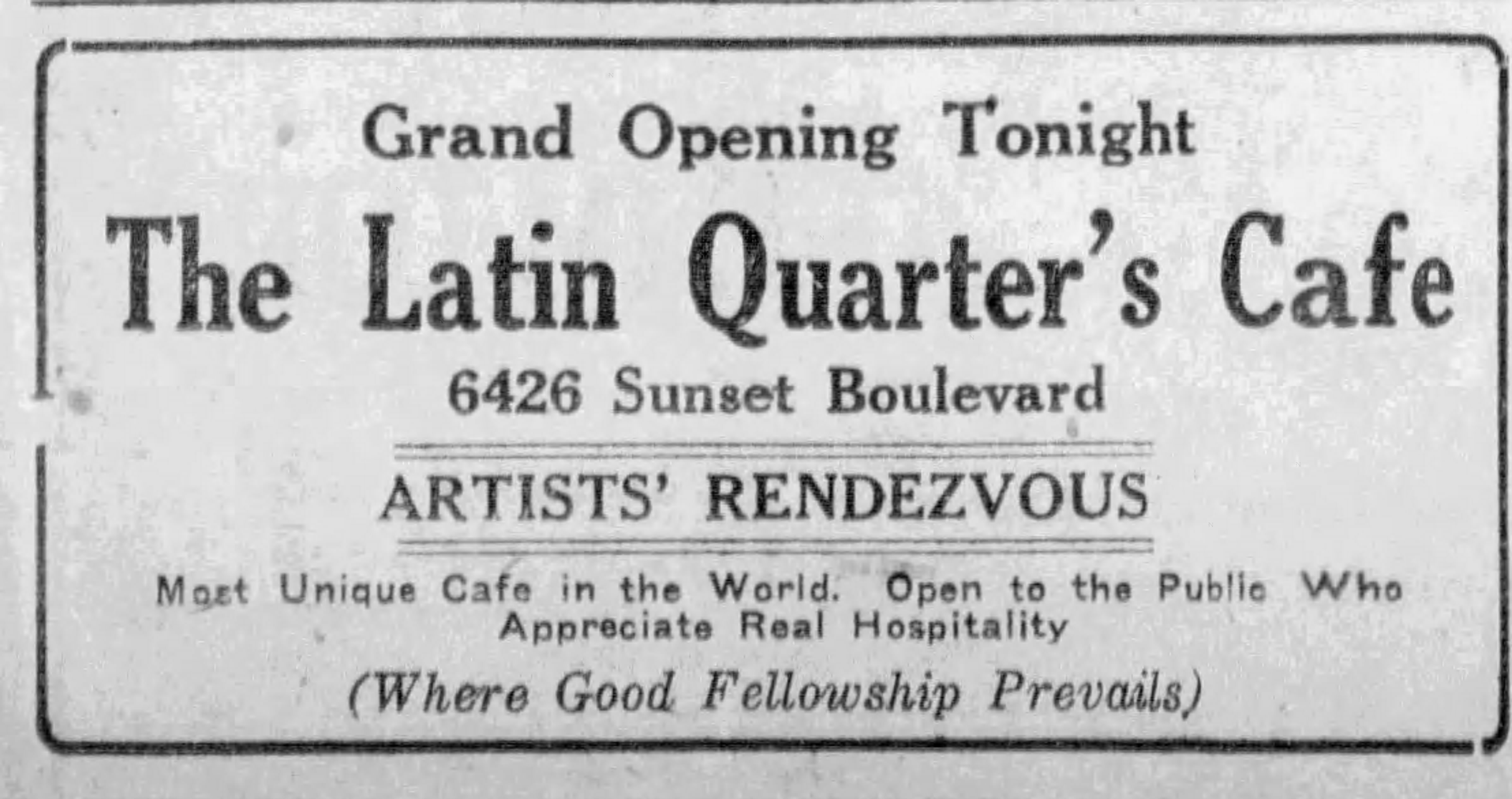
Originally bearing the address  6426 Sunset Boulevard, the place had opened as The Latin Quarter’s Cafe, affiliated with artist Finn H. Frolich of the Norse Studio Club, in May 1924. The club featured themed rooms, including a pirate room, a Cleopatra room, and a “room of all nations.” Not a commercial success, the Latin Quarter was sold to Ward McFadden, original builder/owner of the Ship Cafe in Venice, and his associate Charles Simpson. It reopened on Halloween night, 1924, but didn’t last long. Frolich maintained a workshop at 6426 through 1925 at least.

As The Latin Quarter Cafe. LA Evening Express 5/21/1924

LA Times 10/31/1924.

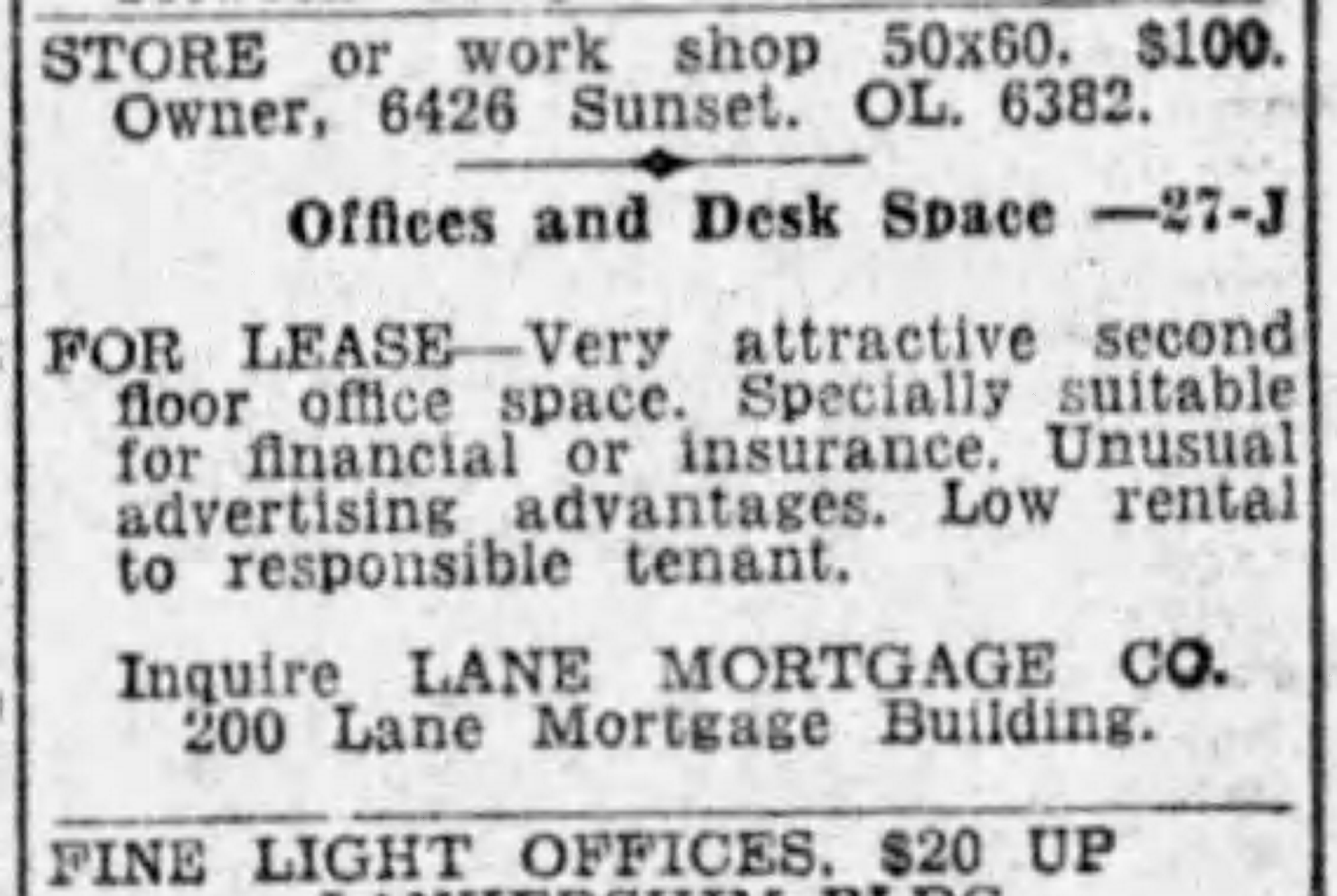
In May 1928, the venue was offered for lease as a store or workshop and briefly housed a woodworking studio, then a catering company.

LA Times 5/20/1928.

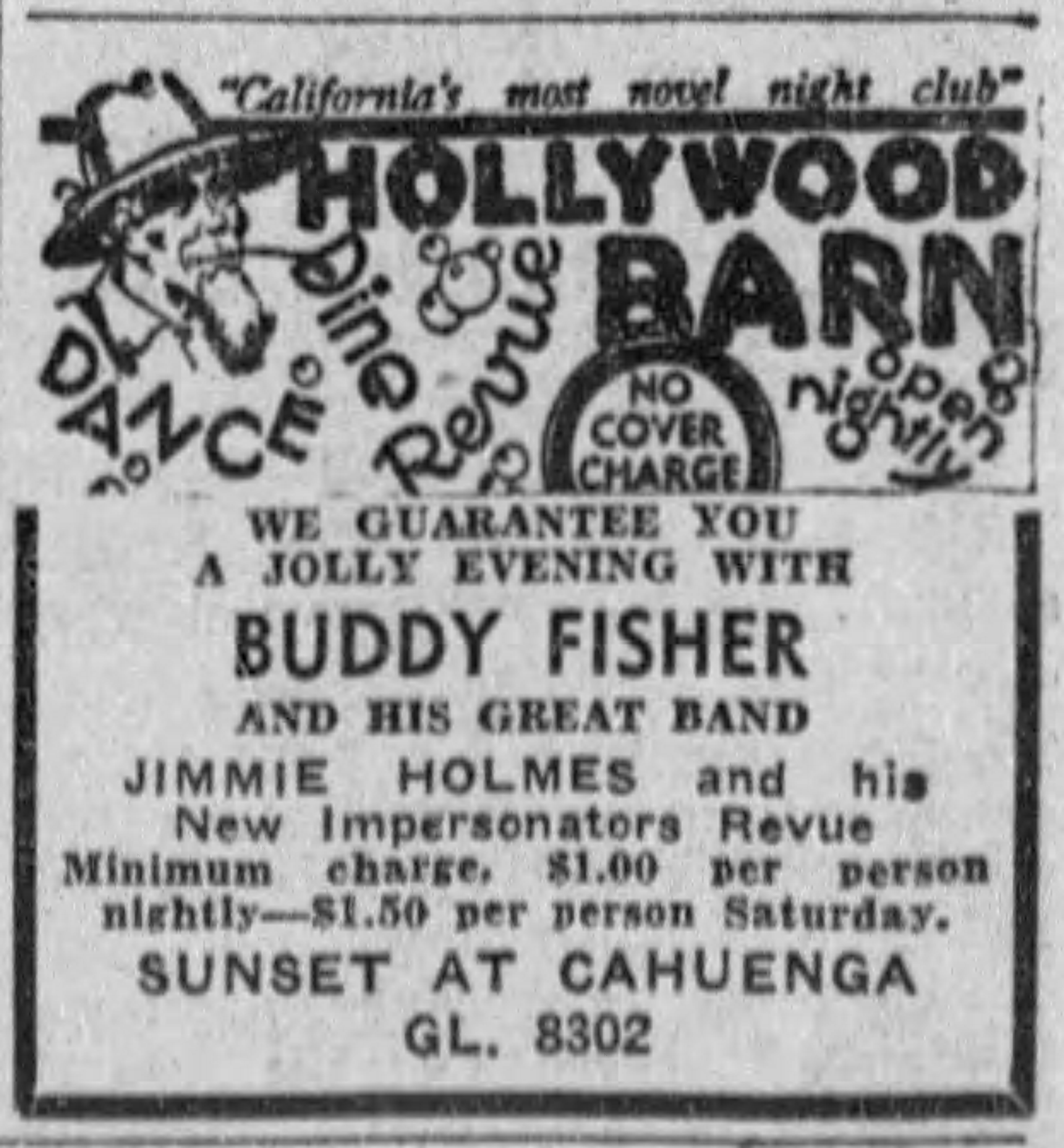
On November 8, 1932, bandleader Buddy Fisher, “the nation’s joy boy,” who had recently completed an extended engagement at Eugene Stark’s Bohemian Club on Santa Monica Boulevard, applied for a dance hall permit at 6426 Sunset Boulevard. It opened on December 22, 1932 as the Hollywood Barn, a new nightclub with a farm theme.

As Buddy Fisher’s Hollywood Barn. Los Angeles Times 3/18/1933

Decorated by Jack Schula of the Hollywood Roosevelt’s Blossom Room, the Montmartre, Al Levy’s Tavern and others, the Barn had “old fashioned rafters, hay mows, grain bins, corn shucks, a cider press and other rural features,” including live animals- chickens and pigs. “Buxom farmers’ daughters” served as waitresses, while “pretty dairy maids” churned fresh butter nightly. Fisher modeled the club after one he reputedly ran in Chicago.

LA Post-Record 11/8/1933.

The last mention found of Fisher’s association with the Barn was May 1933. On May 26, 1933, it was raided by the LAPD vice squad for illegal sales of beer. By September 1933, police told the Hollywood Citizen News it had responded to at least 18 calls to the Barn to “quell disturbances, stop fights and arrest drunks in the vicinity.” Residents complained that it was being “conducted in a noisy manner.” On November 7, 1933, its beer license was revoked. Police asserted that it has become a hangout for bootleggers (hard liquor was still illegal) and gangsters.

By January 1934, it was operating as the Hollywood Stable (sometimes advertised as the Hollywood Stables as well). It was one of 20 nightclubs raided by the State Board of Equalization (which regulated the new State liquor laws) over the weekend of April 21-22, 1934, which was not uncommon in the early days of legalized alcohol sales.

As Hollywood Stables. LA Times 1/24/1934.

As the Hollywood Stable. LA Post-Record 3/24/1934,

As Hollywood Stables. LA Times 10/27/1934

Or was it the Hollywood Stable? The owners couldn’t seem to make up their mind. The address contains a typo- it was 1453 N. Cahuenga, not 1543. LA Times 11/17/1934

As the Hollywood Stables Cafe. LA Times 8/17/1935.

The Hollywood Stable/Stables faced additional suspensions of its license for violating liquor laws. By August 1935, it was known as the Hollywood Stables Cafe and was using the address 1453 N. Cahuenga rather than 6426 Sunset Boulevard. It appears that a service station was built on the prominent Sunset Boulevard corner of the parcel, prompting the address change.  The Hollywood Stable Cafe continued to operate through 1935 at least.

LA Daily News 8/16/1938.

In August 1938, now using the address 1451 Cahuenga, it briefly served as a venue for Wayne Moore’s new Hollywood Drunkard, with a gala opening held August 11-13, 1938.

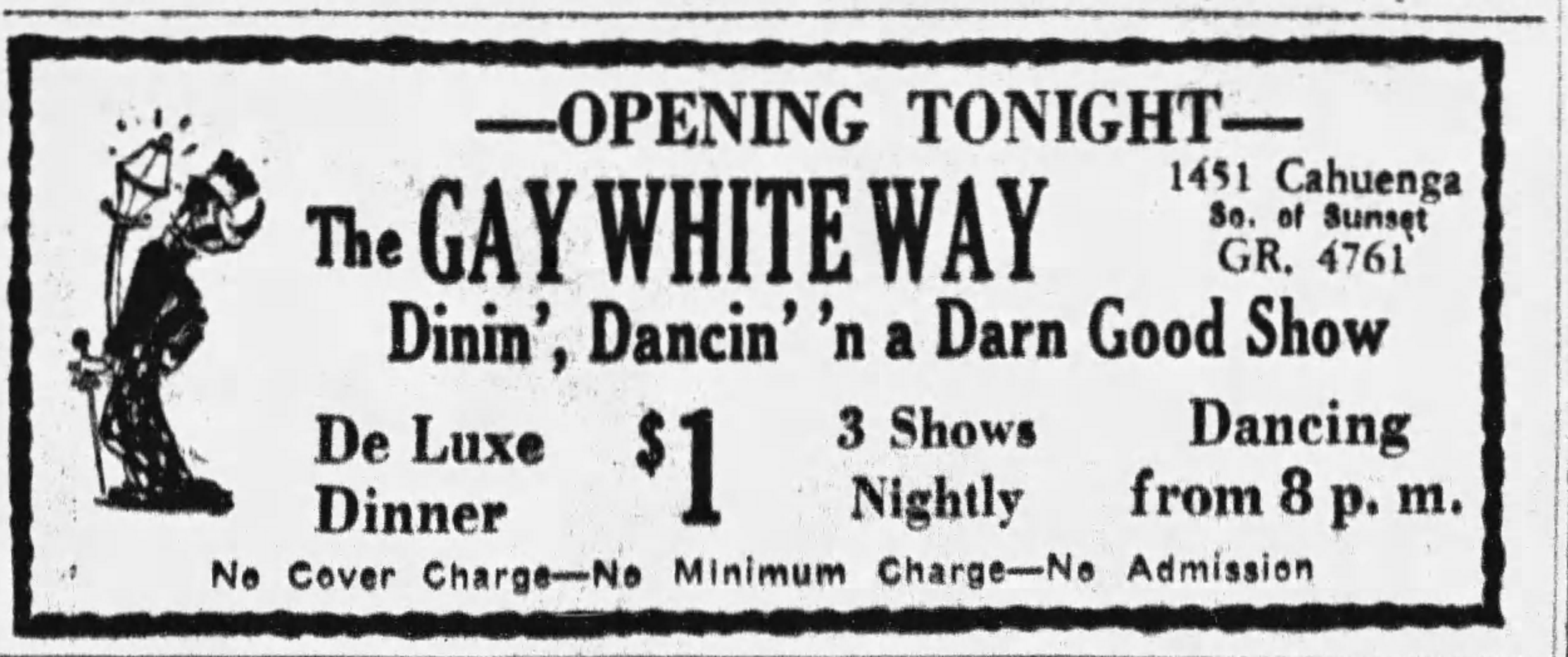
As the Gay White Way. LA Times 10/21/1938.

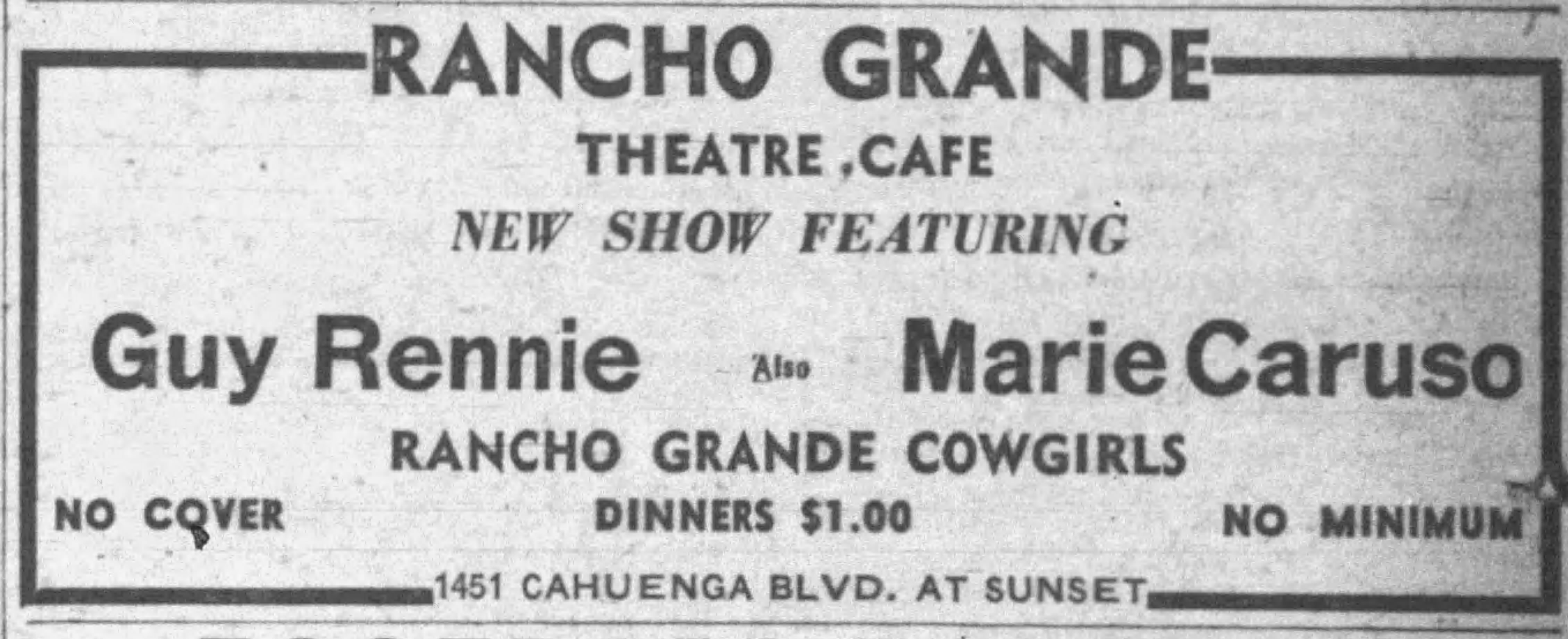
On October 21, 1938, the old barn building opened as another nightclub, the Gay White Way.  By September 1941, it was the Rancho Grande theater cafe. It was likely vacant at the time the Hollywood Canteen leased it.

LA Daily News 9/12/1941.

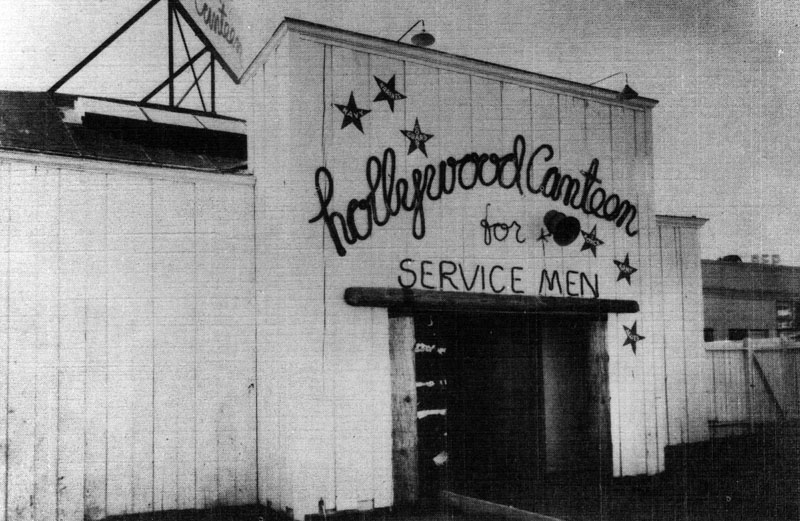
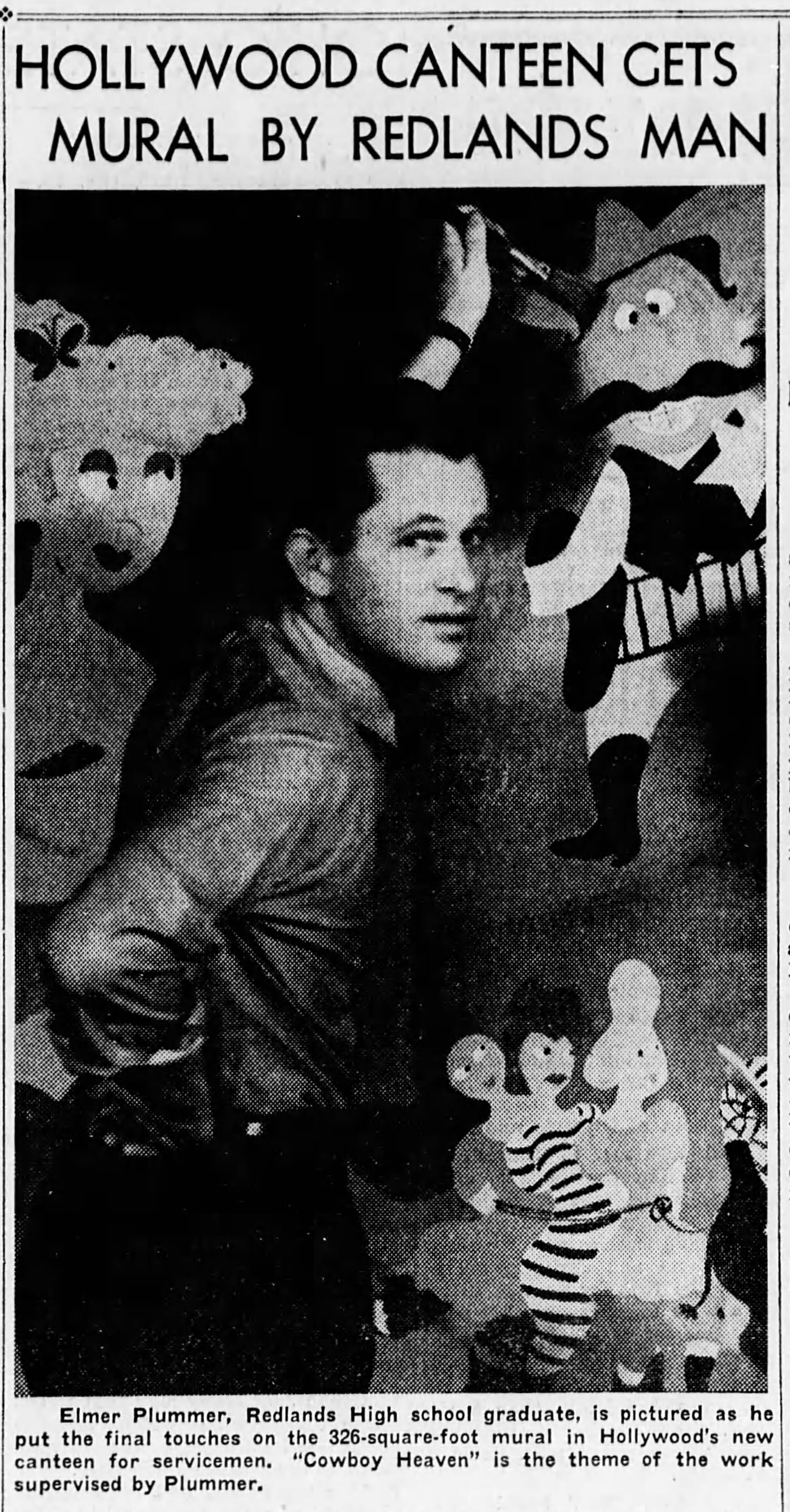
The Hollywood Canteen’s volunteer workers transformed the structure, painting it white and adding a rope sign to the front entrance, in keeping with the Western theme. Inside, artists of the Screen Cartoonist Guild (many of them from Disney, including Mary Blair, Lee Blair, Marc Davis, Retta Scott and Earl Murphy) under the supervision of Elmer Plummer, created a 326-square foot mural on 4 panels, titled “Cowboy Heaven” that depicted “things cowboys dream of.” Actor-director Richard Whorf, who painted as a hobby, painted a mural for the men’s bathroom.

Elmer Plummer and the “Cowboy Heaven” mural. San Bernardino County Sun 10/14/1942.

Another part of the mural. Hollywood Citizen News 10/3/1942.

At the opening on October 3, Hollywood’s elite paid $50 for bleacher seats to watch service members enter the Hollywood Canteen, which could handle 3000 patrons a night. The club only admitted enlisted personnel- no officers were allowed. The only way civilians could enter, aside from the volunteer workers, was to pay $100 for the so-called “Angel’s Table” in the balcony.

Opening for the Hollywood Canteen. LAPL photo.
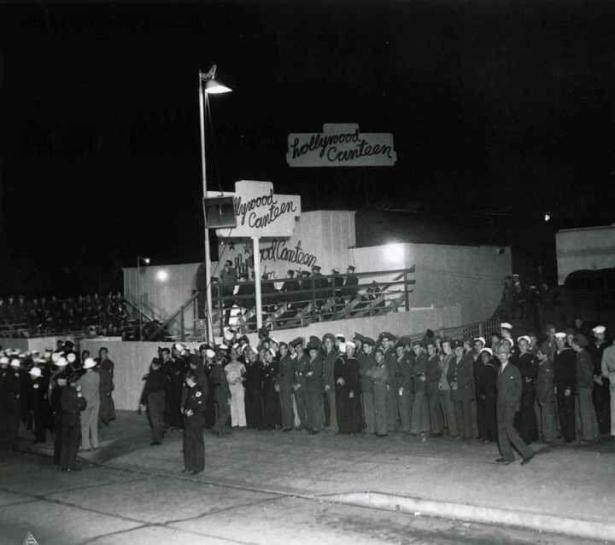
Opening night at the Hollywood Canteen, October 3, 1942. Like a movie premiere but in reverse- the bleacher seating held Hollywood’s elite. The stars of this show were the US service members.

Bette Davis addresses the crowd at the opening. LAPL photo.

Fan magazines covered the Hollywood Canteen’s opening. From Screenland magazine November 1942.

There was no cost to the regular patrons. A uniform was all they needed. Inside was a large snack bar that served food, soft drinks and cigarettes- and an autograph from the screen star hostesses. There were 30-40 hostesses to dance with and a show every hour and a half. Male stars served as busboys, and everybody helped out in the kitchen.
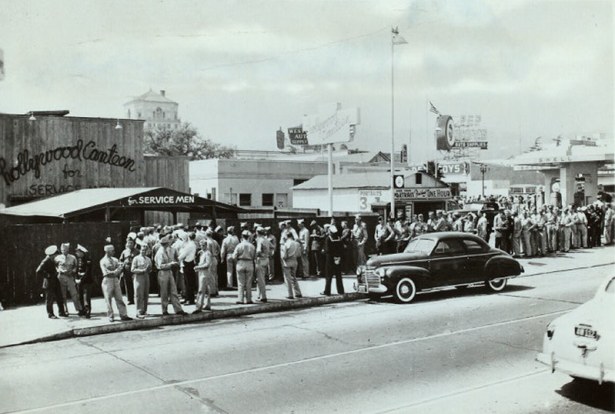
Waiting to get in the Hollywood Canteen.

Bob Hope at the Hollywood Canteen in 1943. UCLA photo.

Service members waiting to get inside the Canteen to celebrate its 1st birthday. LA Times 10/31/1943.
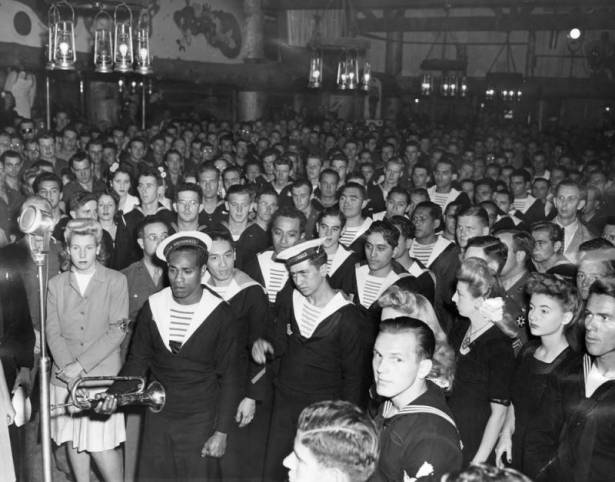
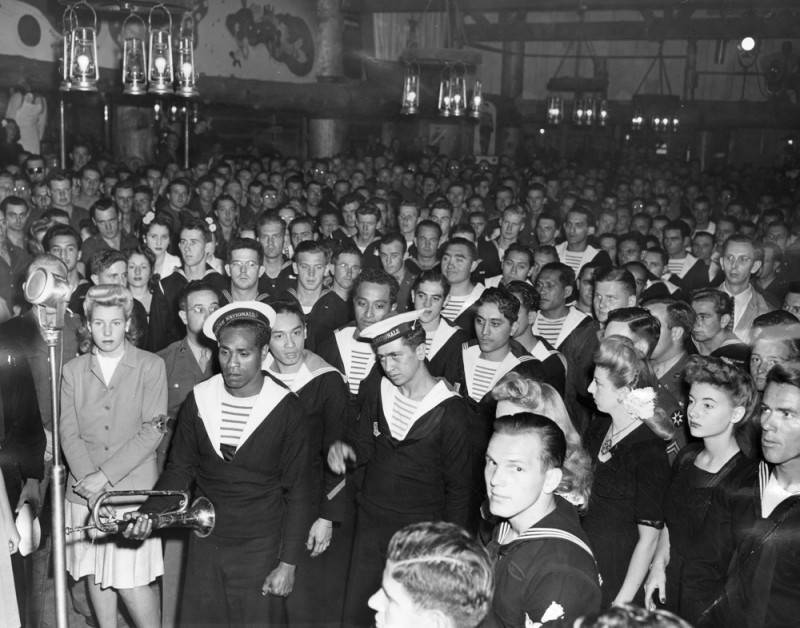
Crowd inside the Hollywood Canteen with visiting French sailors. LAPL photo.

Bette Davis, Marlene Dietrich show off the Hollywood Canteen’s Wall of Honor to Bob Hope. It depicted stars who were serving in the military. LAPL photo.

The 1-millionth patron passed through the doors before the club was even one year old- on September 15, 1943. He was First Sgt. Carl E. W. Bell of Rising Star, Texas.

Opening of the Hollywood Canteen in Hollywood 12/20/1944.

The right to use the famous name was sold to Warner Brothers for more than $500,000 (funds going to the Canteen). The film “Hollywood Canteen” opened in local theaters just before Christmas, 1944.

The hostilities in Europe ended on May 8, 1945 with Germany’s unconditional surrender. On August 14, 1945, President Truman announced that Japan had unconditionally surrendered The war was over, but Los Angeles was still inundated with visiting service members as they returned from the Pacific Theater. The Hollywood Canteen originally planned to close on its third anniversary, October 3, 1945, but due to the continued demand, it remained open through Thanksgiving Day, November 22, 1945.

Postcard view of the famous Hollywood Canteen c. 1945.

It had entertained more than 3 million servicemen. More than 11,000 actors, musicians, dancers and other film industry workers had volunteered their time.

The Canteen’s fixtures were auctioned off in December 1945.

Auction ad. 12/23/1945.

On June 13, 1946, The Hollywood Citizen News reported that the building had been leased by Thomas Lee of the Mark Twain Hotel and that Guy Francis was in charge of remodeling it as a Latin American nightclub. On July 10, Bette Davis filed a restraining order, complaining that the operators were trying to capitalize on the Hollywood Canteen’s famous name by using it in large letters on the club’s signage with “former” in tiny letters, and that with or without the “former,” it was damaging to the prestige of the wartime service organization and the cause to which it was still devoted. Bette won. In March 1947, the building became a new Armed Forces officers’ club, affiliated with the Hollywood Canteen Corporation.

As the Moroccan. The Valley Times 12/31/1955.

On October 15, 1948, 1451 N. Cahuenga reopened as the Hollywood Auditorium. a rental hall operated by Frank E. George. In November 1949 it became a theater, known as the Carousel Theater, which lasted into 1955. In November 1955, John Howard “Johnny” Caldwell announced that the venue had been completely refurbished. It opened on December 31, 1955 as The Moroccan theater restaurant.

As Le Grand Comedy Theater. LA Times 3/1/1959.

By March 1959 it was operating as the Le Grand Comedy Theater and continued into early 1966.

With the US involved in the Korean War, in November 1950, the Hollywood Canteen Foundation purchased the former Florentine Gardens nightclub on Hollywood Boulevard and planned to reopen it as a new Hollywood Canteen but ultimately it did not happen.

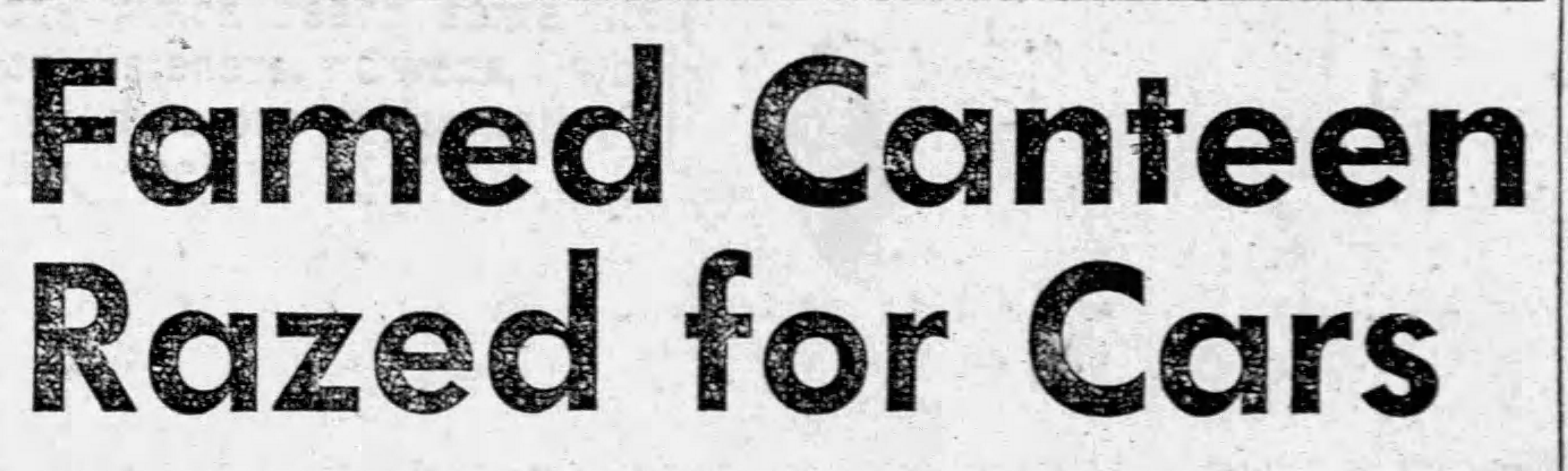
Hollywood Citizen News 12/21/1966.


On December 20, 1966, the Hollywood Citizen News reported that the building, said to have significant dry rot, was torn down for a parking lot. Slabs of sidewalk survived containing the names of servicemen who celebrated the first anniversary of Pearl Harbor at the Hollywood Canteen on December 7, 1942. Janis Paige, who made her movie debut in the Hollywood Canteen film, received the pieces of sidewalk.

Notes:

There was another, unrelated, Latin Quarter nightclub in the 1960s located at 5521 Sunset Boulevard.

There was also a modern era unrelated Hollywood Canteen cafe located at 1006 Seward St.
The Hollywood USO


The United Service Organizations (USO), a non-governmental nonprofit, was founded on February 4, 1941 by Mary Ingraham, acting on President Franklin Roosevelt’s request to boost defense morale. Although the US had not yet entered World War II, war clouds were gathering, and a peacetime draft had been enacted in September 1940.

Pomona Progress-Bulletin 3/3/1941.

Succeeding the United National Welfare Committee, the USO represented the YMCA, YWCA, the National Catholic Community Service, the Jewish Welfare Board and the Salvation Army.

On January 11, 1942, the USO had an open house for its new Los Angeles club at 514 S. Grand Avenue. That day, Dr. A. H. Giannini, Chair of the Los Angeles Area board of the USO, announced that a Hollywood branch of the USO would open soon at Hollywood Boulevard and Cahuenga Avenue, on the second floor of a retail and office building (today known as the Julian Medical Building). The space was donated by the building’s owner, C.B. Bunson. A few days later, Giannini revealed that film producer/songwriter Buddy De Sylva had donated $2500 to the USO, a portion of which would go toward renovating the new Hollywood home.

The Hollywood USO originally opened in this building. USC digital photo.

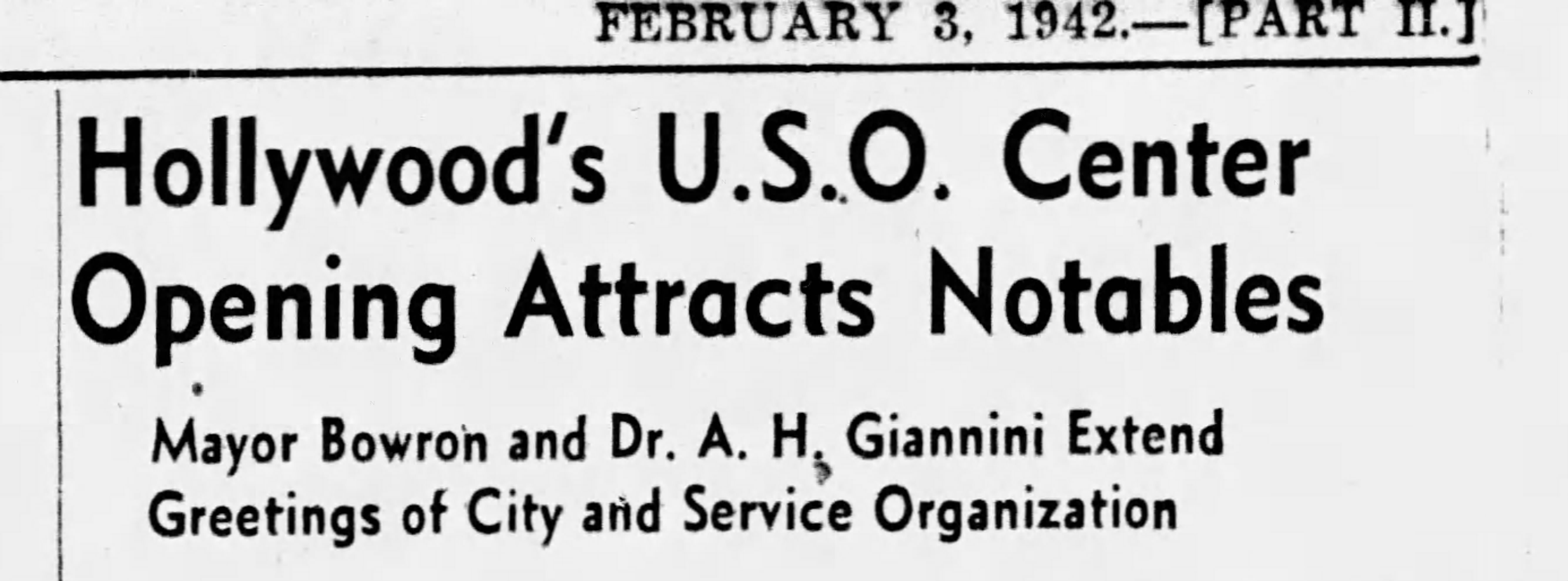
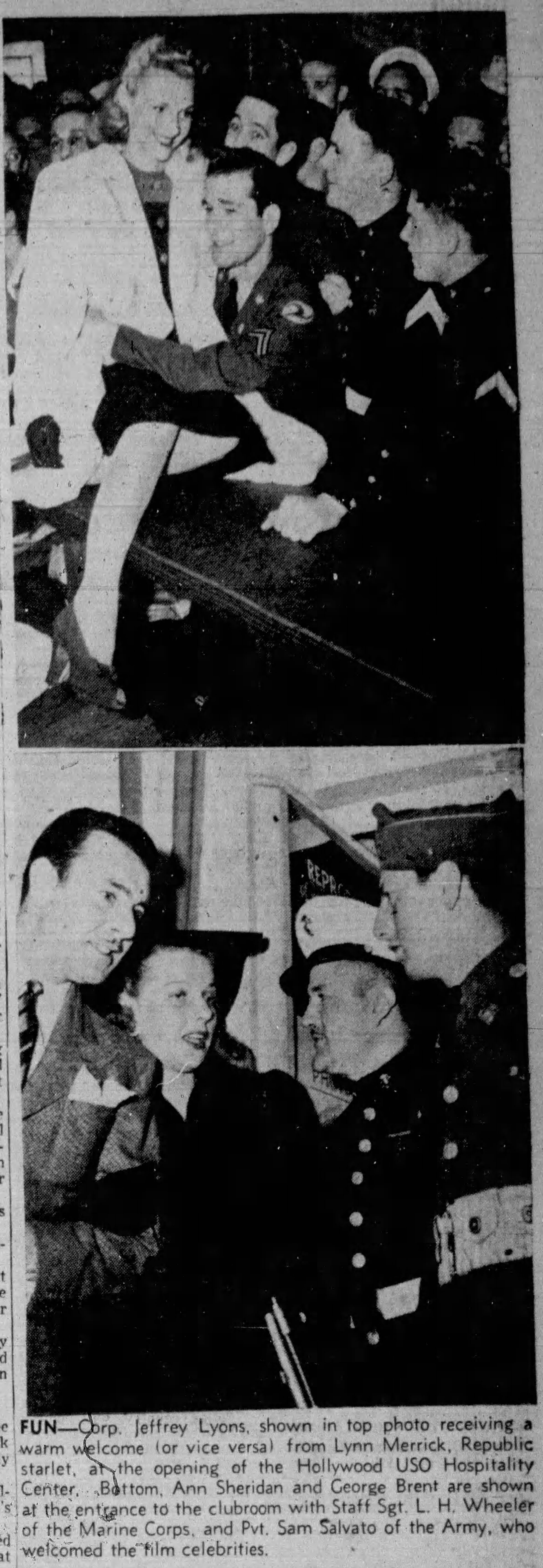
The Hollywood USO held a gala to dedicate the new club on February 2, 1942, with klieg lights sweeping the sky and the street roped off so the Jeeps and Army trucks bringing servicemen to the event would have places to park (always a consideration in Hollywood). Mayor Bowron was in attendance, along with Hollywood actors Edward G. Robinson (the guest of honor), Jinx Falkenberg, Larraine Day, Donna Reed, Virginia O’Brien, Barbara Britton, and Marie McDonald. Newlyweds Ann Sheridan and George Brent also dropped by.

LA Times 2/3/1942.

Dedication party for the Hollywood USO. Hollywood Citizen News 2/3/1942.

The Hollywood USO opened for regular service the following day, February 3, 1942. Accessed from the Cahuenga side of the building, its address was 1654 N. Cahuenga. The club featured a writing room, ping pong tables, a library, and a canteen that served free coffee, sandwiches, donuts, punch, candy and cigarettes. Volunteer hostesses provided companionship and entertainment. On Saturday nights, there was a broadcast, over CBS radio, MC’d by Art Linkletter, during which one lucky serviceman would be chosen to call his mother. Local businesses donated tickets to sporting matches, radio broadcasts, theaters, ice skating, bowling, Hollywood Bowl concerts, etc. Although it had no dormitory, the Hollywood USO could help find overnight accommodations at local hotels or other facilities.
Hero bomber Captain Hewitt T. Wheeler being served donuts and coffee by USO hostess, actress Ann Nagel in May 1942. LAPL photo.

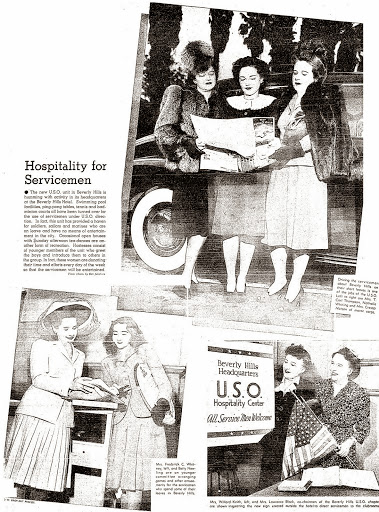
On February 15, 1942, the Beverly Hills USO opened a few miles away. Headquartered at the famous pink hotel on Sunset Boulevard, guests of the USO could use the pool, tennis and badminton courts. Motor transport service was provided to pick up guests of the Hollywood and other area USO clubs and take them to use the recreation facilities.

Beverly Hills USO. LA Times 3/1/1942.

The Beverly Hills Hotel pool c. 1935. Huntington Library photo.

In June 1943, the Hollywood USO moved to new, larger quarters a few doors south of its original home.  Located in a former car dealership at 1531 N. Cahuenga, the new Hollywood USO had three times the space, with a stage, large dance floor, a recording booth (for broadcasts and where service personnel could record messages on records, to be mailed home to loved ones), a library, dressing and shower rooms, offices, and of course a canteen.

Hollywood Citizen News 6/5/1943.

The Hollywood USO at 1531. N. Cahuenga. California State Library photo.


The brick walls of the new quarters were decorated with murals, depicting Hollywood life, painted by Art Institute student Tessie Smith in July 1943.

Although some syndicated Hollywood gossip columnists attributed the USO murals to artist Richard Whorf, they were actually the work of an art student, Tessie Smith.  Hollywood Citizen News 7/15/1943.

Tessie Smith putting the finishing touches on her murals for the Hollywood USO’s new home. Hollywood Citizen News 7/16/1943.

On November 26, 1944, the Hollywood USO debuted what was termed the first ever “Pin Up Exhibition” featuring images of Jane Russel, Toni Seven and (Liltin’) Martha Tilton. The three appeared in person, signing autographed photos for servicemen, on the closing day of the event, December 2, 1944.

LA Times 11/27/1944.

Jane Russell, Toni Seven and Martha Tilton signing autographs during the “pinup exhibition” at the Hollywood USO’s canteen on December 2, 1944. This photo is sometimes mistakenly labeled as taking place at the Hollywood Canteen, which was a separate venue, located nearby at 1451 N. Cahuenga. LAPL photo.

On July 1, 1944, a group of Hollywood artists began a cartoon-mural map of Hollywood for the Hollywood USO. Valued at over $5000, the work was unveiled at a ceremony on January 27, 1945, hosted by Bing Crosby, Frances Langford and Joe E. Brown. The occasion also marked the United Service Organizations’ national fourth anniversary.

Long Beach Independent 1/24/1945.

Unlike the earlier murals by Tessie Smith, this mural was removable; after the war, it was anticipated that it would be moved to a military hospital.

Karen Johnson, one of the artists who worked on the new Hollywood cartoon-map mural for the Hollywood USO. LA Times 1/22/1945.

The cartoon Hollywood map-mural inside the Hollywood USO at 1531 N. Cahuenga seen in Life Magazine, 2/12/1945.

On May 8, 1945, Germany unconditionally surrendered, ending the hostilities in Europe. President Truman announced Japan’s unconditional surrender on August 14, 1945, marking the end of the war. With the many military bases in the area and Los Angeles a port of disembarkation for troops returning from the Pacific Theater, however, demand for the Hollywood USO’s services remained high.

The nearby Hollywood Canteen closed its doors on November 22, 1945 (Thanksgiving Day). The following day, the Hollywood USO held a dedication celebration for its new wing, which included a 400-bed dorm, a new stage and enlarged dance floor, administrative offices, a ladies powder room, a writing room, and a canteen capable of serving 1000 patrons an hour.

The Hollywood USO at 1531 N. Cahuenga finally closed its doors on June 30. 1947.

7/1/1947 LA Times.

With the Korean War underway, a new Hollywood USO opened on February 17, 1951 at 1710 N. Ivar. Mayor Bowron again attended the dedication, which featured appearances by Bob Hope and Marilyn Maxwell.

Hollywood Citizen News 2/16/1951.

This was a small facility; dances had to be held in other venues, including the former Florentine Gardens nightclub, which had been purchased by the Hollywood Canteen Foundation. It closed in June 1952. A new, larger Hollywood USO opened at 6225 Hollywood Boulevard and Argyle (the Pantages Theater building) with a 3-day gala (Mayor Bowron was there) November 7, 8, and 9 1952. It later provided YWCA amenities for service women as well.

In increasingly high demand, the Hollywood USO club remained at this location, until September 1964. On September 11, 1964, it opened in “temporary” quarters at 6160 Hollywood Boulevard, formerly the restaurant space in the former Regent Hotel (at this time known as the Hotel Hastings).

Hollywood Citizen News 9/10/1964

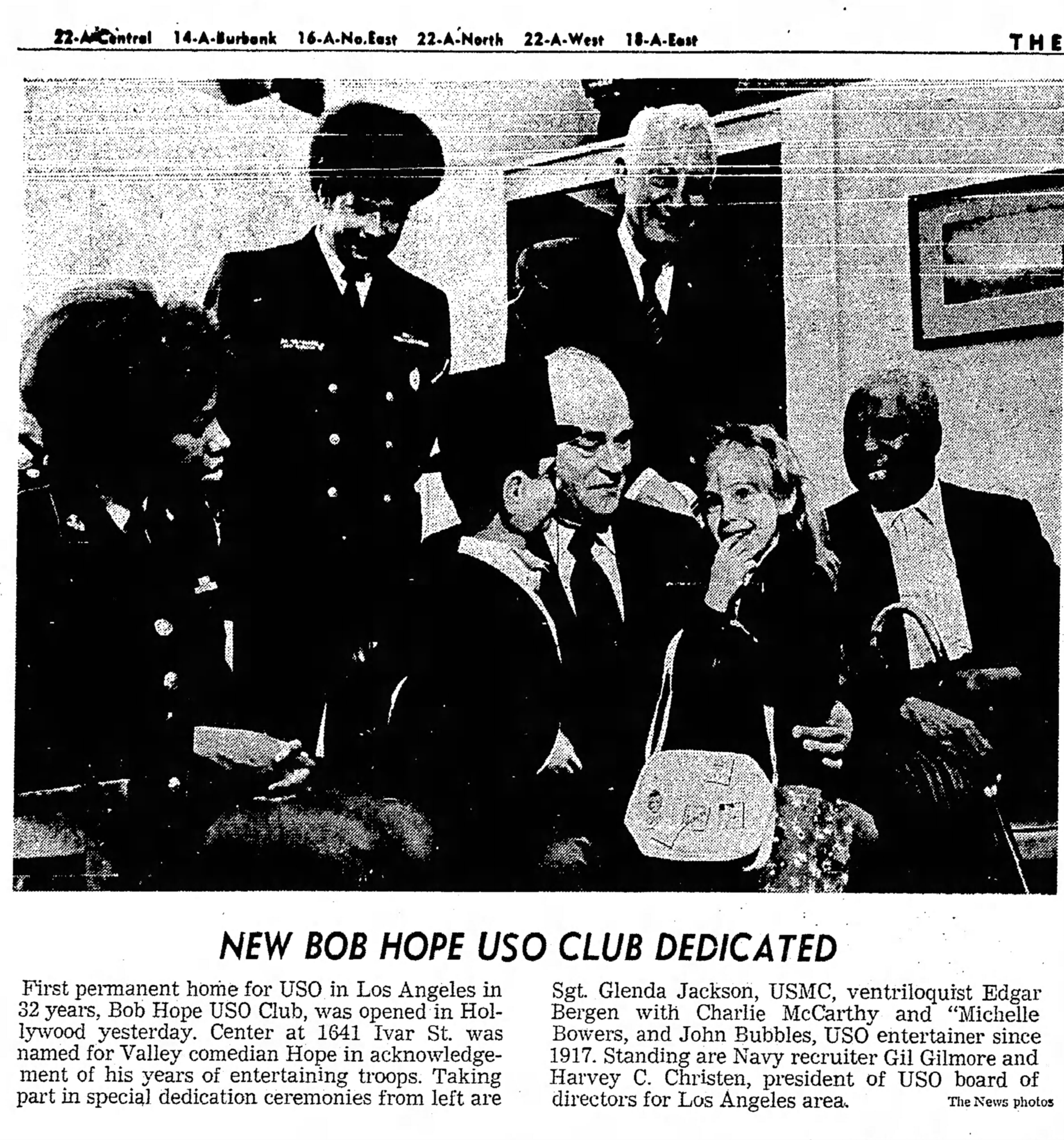
In November 1965, Bob Hope offered to donate his royalties from “Bob Hope on the Road to Viet Nam,” a recording made of his Christmas tour to Southeast Asia, to the Los Angeles and Hollywood USO clubs. The Chamber of Commerce, spurred into action, voted to back the effort to provide adequate space for the club. Though the various civic groups raised funds and discussed plans to build a new home for the Hollywood USO, the club remained in the “temporary” home until May 1973 when it purchased the former California Gas Co. building at 1641 N. Ivar Street. (6160 Hollywood became Greektown restaurant). Dedicated on June 14, 1973, the new facility was called the Bob Hope USO Club aka the Bob Hope Hollywood USO Club.

Bob Hope offered to donate the royalties from this album, released in 1965, to the Los Angeles and Hollywood USO clubs.


Plans for a newly-built modern Hollywood USO never materialized. Hollywood Citizen News 12/16/1965.


The new Hollywood USO was known as the Bob Hope USO Club. Van Nuys News 6/15/1973.

In September 1988, the Bob Hope Hollywood USO announced that it would move to Long Beach in December; it remained on Ivar, however, into 1990. The Long Beach Bob Hope USO Club opened at 230 Pine Street (Masonic Temple Building) on October 22, 1990. The Ivar location continued to be used for a time by the Hollywood USO Mobile Shows program.

In 2018, the Bob Hope USO Club opened new, larger facilities in the historic LAX Theme Building. The amenities include a “Hollywood Canteen” snack bar.