5447 Hollywood Boulevard: Hotel Rector

Located on the northeast corner of Hollywood and Western, the Hotel Rector held its gala grand opening on the night of October 4, 1924, at the same time as the Hollywood Guaranty Building down the street at 6331. An electrical display, “the Aurora Borealis,” supplied by Otto K. Olsen for both buildings lit the Hollywood sky to mark the occasion.

Hollywood Citizen News 10/6/1924

The new Hotel Rector. Hollywood Citizen News 10/3/1924

The 4-story brick structure was designed by architects Walker & Eisen for the leaseholder: the realty development department of the United Cigar Stores corporation. The ground it stood on was owned by a wealth widow, Delia Nadeau of Butte, Montana (who died in 1927). When people got hold of land in Los Angeles, they almost never sold it. Rather, they would issue long term leases on the property. If the leaseholder ever defaulted, any improvements made to the property reverted to the owner of the underlying ground. When the term “sold” was used in relation to real estate transactions, it usually really meant that the building itself, with its attendant lease, changed hands, not the underlying land. Heirs whose relatives didn’t sell off their land to pay for their gambling habits (thanks a lot, Grandpa Bob) lived off the profits of these long-ago leases for decades.

Like most large hotels of the era, it had retail shops on the ground floor. Some of the original tenants were the Rector Pharmacy, the Rector Bootery shoe store at 5461 and the Rector Master Tailor at 5459. The hotel itself was usually addressed as 5447; it was sometimes known as 5455.


Announcing new management of the Hotel Rector five months after it opened. Hollywood Citizen News 3/7/1925.


The 5400 block of Hollywood Boulevard looking west. The LA Public Library dates this photo to c. 1935.

The Hotel Rector saw Hollywood’s rise and its subsequent decline beginning in the late 1960s. Never a luxury accommodation but was a decent mid-level tourist hotel for most of that time, the Rector became a single-room occupancy (SRO) residence. It closed in the late 1980s, supposedly due to damage from the Whittier Earthquake (1987). With vacant or boarded-up structures, the corner of Hollywood and Western was increasingly known for rampant crime- mostly drugs and prostitution.

LA Times 9/6/1990

In September 1990, the Los Angeles Community Redevelopment Agency (CRA) gave developer Ira Smedra $5.1 million in loans and other funding to redevelop the 3-plus acre Hotel Rector property as mixed-use retail and low-income senior housing complex to be known as the Hollywest Promenade and the Hollyview Apartments. Smedra was supposed to secure the remaining funds needed by 1992 or begin paying 10% interest. Most of the money went toward acquiring the property. In September 1992, with the funding to build the project still unsecured, the CRA, which had extended Smedra’s funding deadline (without charging interest), approved Smedra’s request to demolish the Hotel Rector, on the basis that he would have a better chance of getting bank loans if the parcel was vacant. Some CRA board members questioned whether the senior housing was even a good idea- would seniors even want to live in such a crime-ridden area? They seem to have forgotten that the redevelopment was supposed to rid the area of said crime, but whatever.

The Hotel Rector was demolished in July 1993.

LA Times 5/8/2001

In March 1996, the CRA granted Smedra a sixth extension on the terms of his loan (no interest paid). The corner of Hollywood and Western continued to decline, with more boarded-up structures as a result of the Northridge Earthquake. As of February 1998 the parcel remained vacant. Construction on the retail portion of the project finally got underway around late 1999. In May 2001, still only partly completed, Smedra requested another $37 million for the senior housing portion of the complex, which was used as a scapegoat for the lack of progress. The senior housing opened in October 2003. The CRA purchased the project upon its eventual completion and turned the housing wing over to a nonprofit Retirement Housing Foundation.

The Hollywood Boulevard facade of the Hotel Rector property today. Google map image.


5440 Hollywood Boulevard: Leroy Bagley Mortuary

Located at 5440 Hollywood Boulevard, the Bagley Mortuary was one of two funeral homes within the same few blocks (the other being Strothers’ at 6240).

5440 was a 2-story, brick structure with a basement, designed by architect Henry G Grimwood of May & Grimwood for Harry M. Haldeman in June 1916. It had retail space on the ground floor and offices above.

The Eastern half of the Halderman building was leased by Jesse T. Smith, an embalmer with many years experience, and his brother-in-law Warren Leslie for the Smith & Leslie mortuary, which opened on September 11, 1916. It had a private family room, restrooms, an office, morgue and chapel on the main floor. The basement served as a showroom. “Throughout their entire establishment Messrs. Smith and Leslie have gone to a great deal of trouble and expense to make it as home-like as possible,” the Hollywood Citizen-News wrote on September 6, 1916. The “lady attendant” was Mrs. F. K. Paul.

Ad for Smith & Leslie, Hollywood Citizen News 9/15/1916

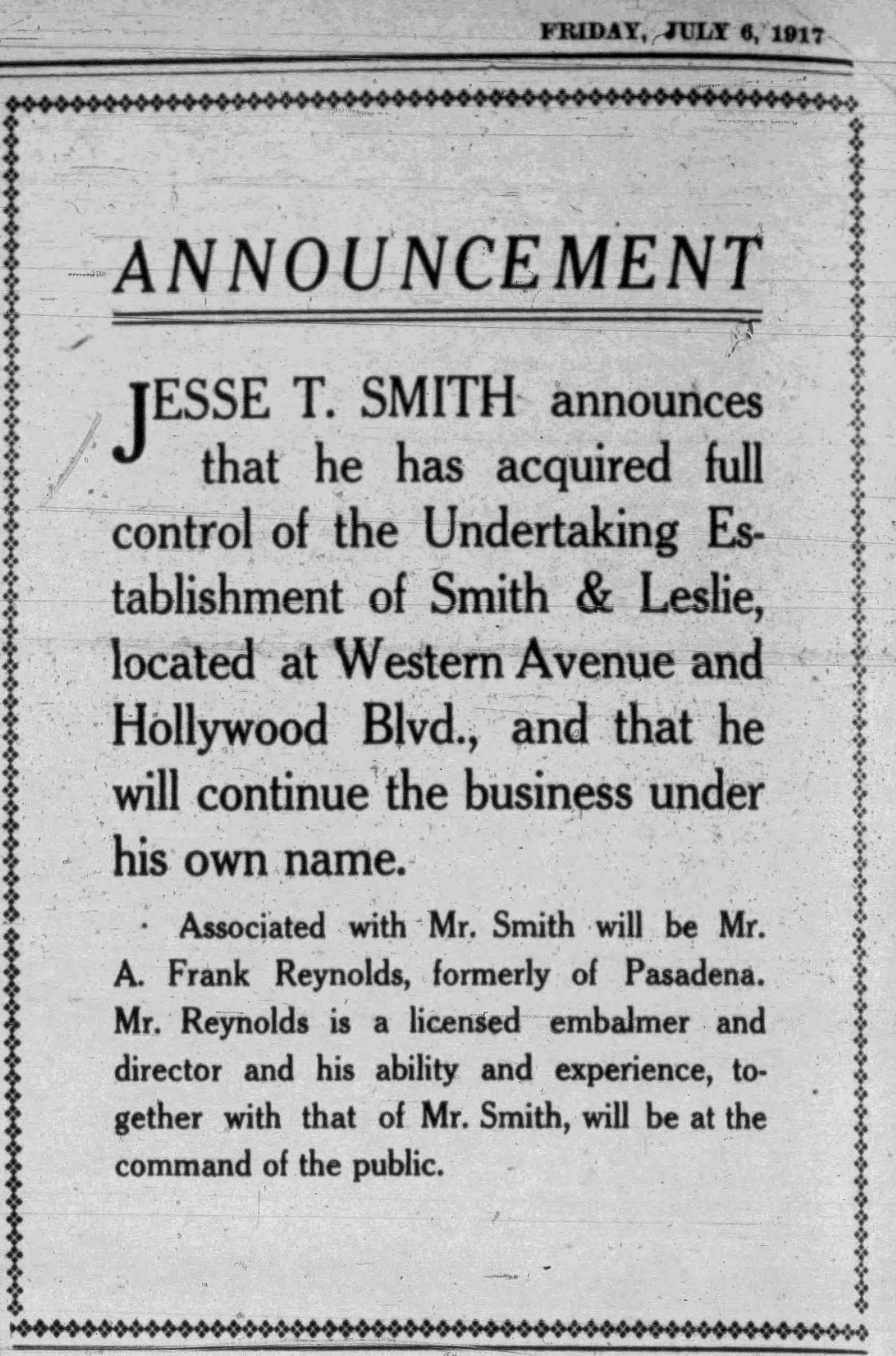
If you were dead in Hollywood, Smith & Leslie was the place to be seen. But the partnership did not last long. In July 1917, Smith took out an ad in the local paper to announce that he was now the sole owner of the establishment and would continue under his own name.

Hollywood Citizen News 7/6/1917

By August 1919, the firm was known as Smith & Dayton. A year later, Leroy Bagley (also spelled Leroy) had become the partner.

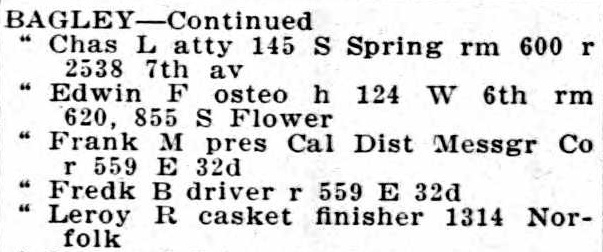
Bagley had come to Los Angeles with his wife from Nebraska. He was here by 1909, when he he listed his occupation as casket finisher.

Bagley in the 1910 Los Angeles City Directory.

The Smith-Bagley partnership lasted through 1921. In 1922, possibly due to financial troubles on Smith’s part, Bagley became the sole owner. Bagley, too, would take on a family member as an employee- his younger brother Clarence.

Hollywood Citizen News 10/24/1925

That might be the Bagley Mortuary on the left center of this view of the 5400 block of Hollywood Boulevard, which the Los Angeles Public Library dates to c. 1935. The Hotel Rector (5447 Hollywood Boulevard), opened 1924, is on the right. The Hollywood Western Building (1928) can be seen on the southwest corner of Hollywood & Western, and the St. Francis Hotel (1927) at 5533 Hollywood Boulevard in the distance.

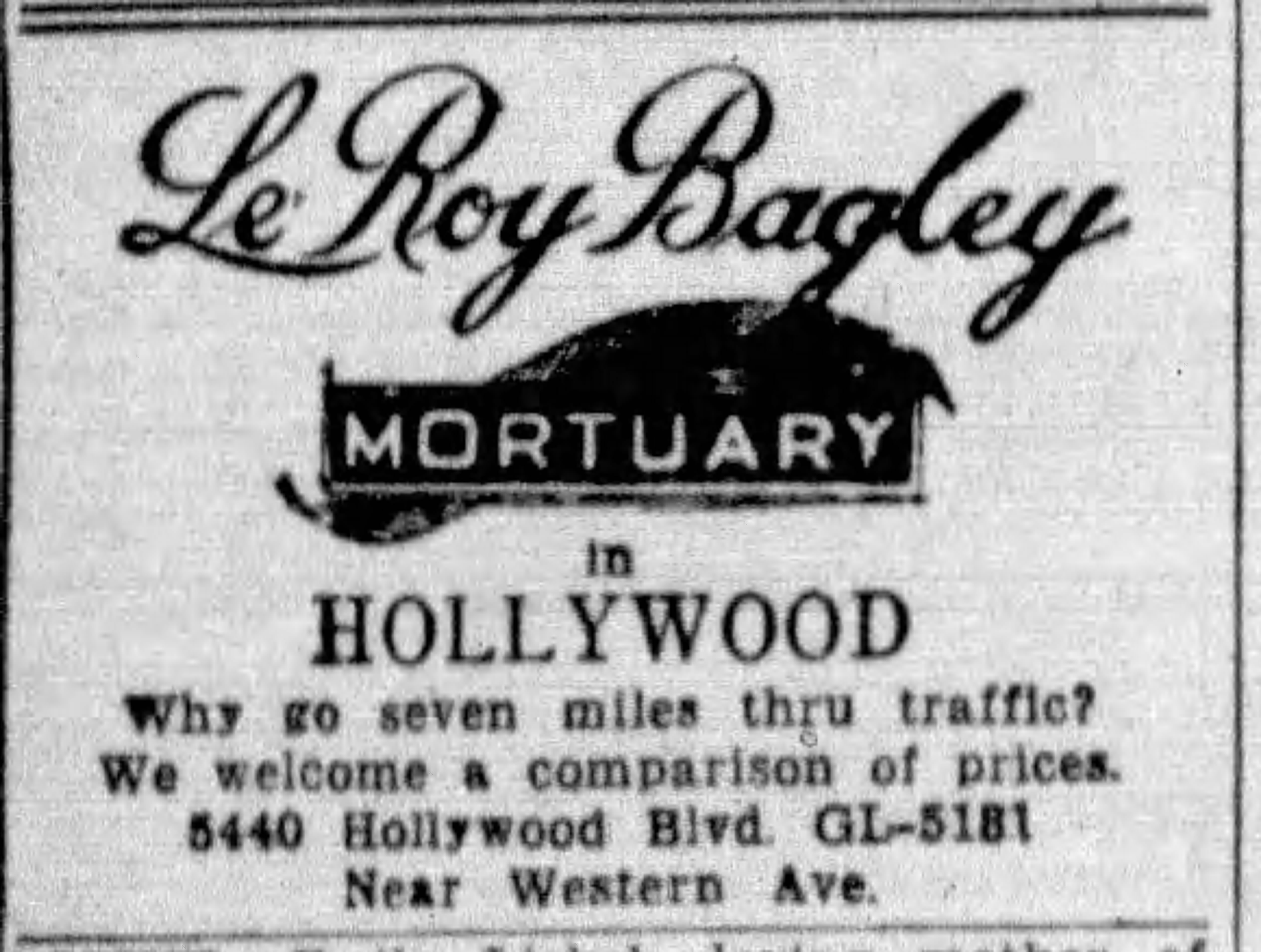
I don’t understand the reference to 7 miles, specifically but ok. Hollywood Citizen News 11/23/1935

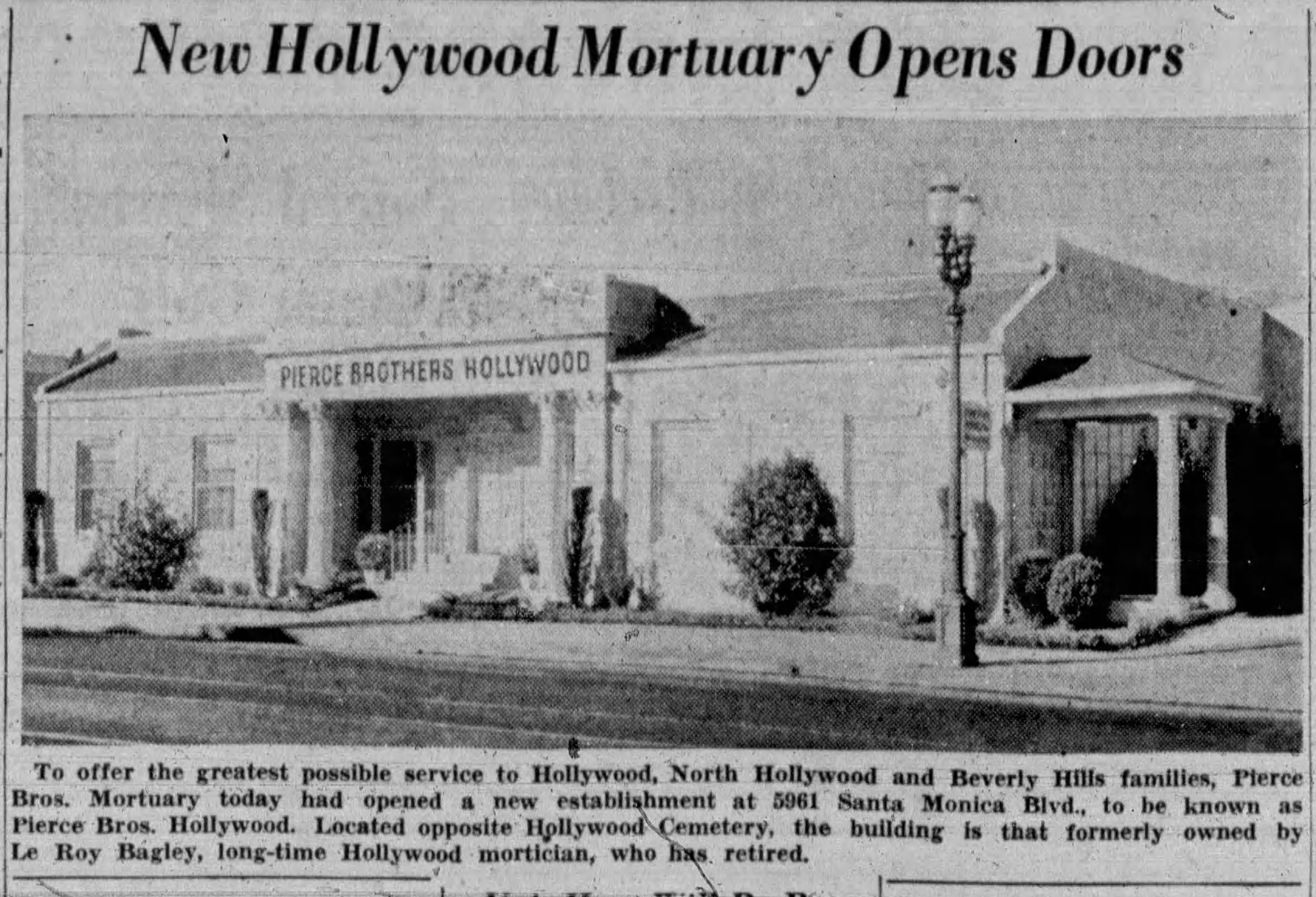
Bagley’s mortuary was at 5440 Hollywood Boulevard into August 1937. In October 1937, he reopened at 5961 Santa Monica Boulevard, conveniently located across the street from the Hollywood Cemetery. He continued at this new location for two more years before retiring.

New location of Leroy Bagley Mortuary. LA Times 10/7/1937

In December 1939, Bagley’s contemporary competition, Pierce Brothers, took over 5961 Santa Monica Boulevard.

Hollywood Citizen News 12/15/1939.

Hollywood Citizen News 12/16/1939

5440 Hollywood Boulevard had a variety of uses after Bagley departed. It has been demolished.

5410 Hollywood Boulevard: The Coronet Motel

The Coronet Motel was constructed at 5410 Hollywood Boulevard between May and December 1958. The 2-story, U-shaped structure held 61 units, 62 parking spaces, a large swimming pool close to the Hollywood Boulevard frontage, and a coffee shop (addressed as 5020 Hollywood Boulevard).

In September 1969, the motels furnishings and decor were sold off and the property underwent a remodeling and updating to become part of the Vagabond Motor Hotel chain.

5410 Hollywood Boulevard as a Vagabond Motor Hotel c. 1970.

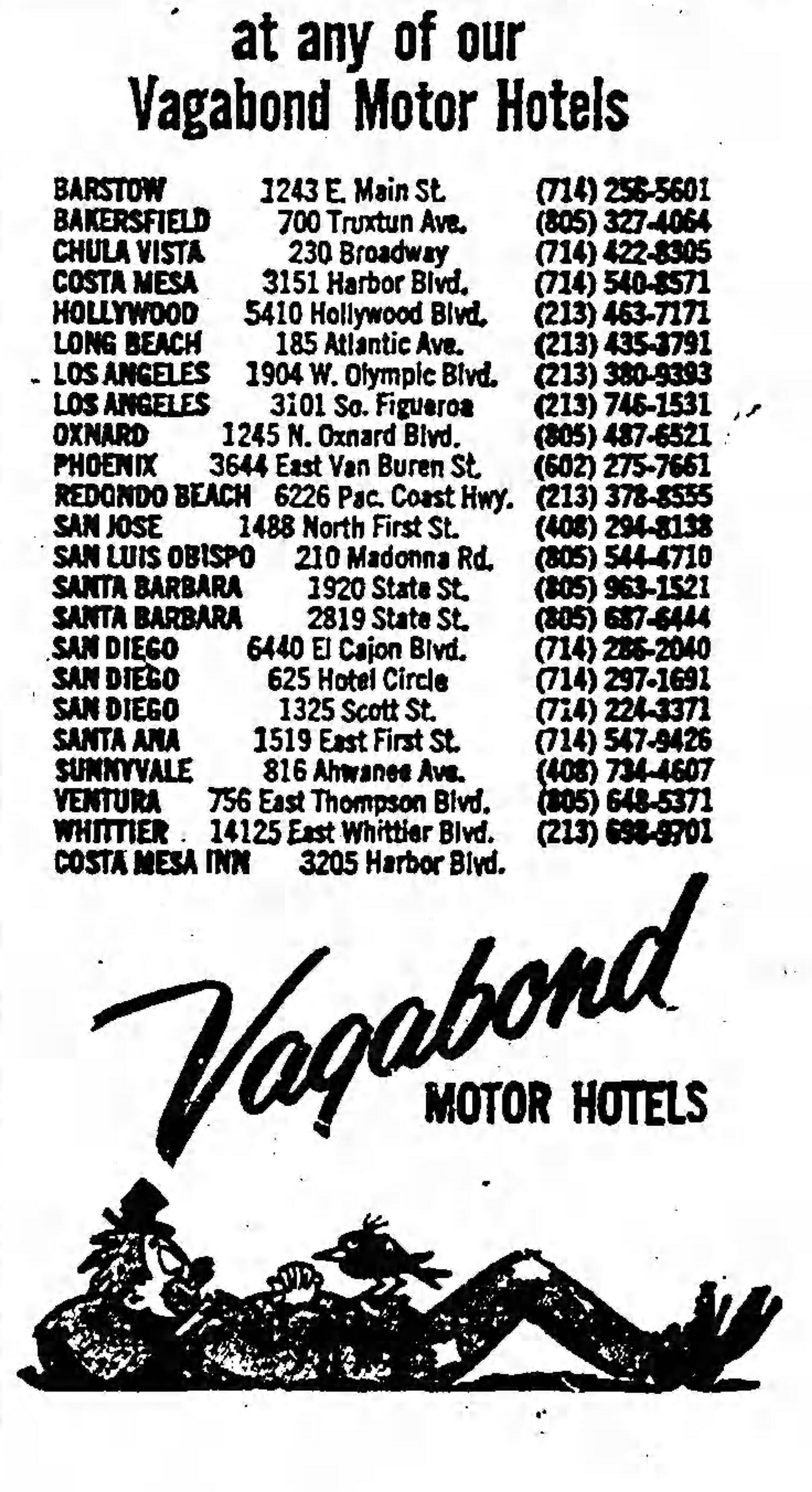
5410 was one of many Vagabond Motor Hotels in the Los Angeles area. LA Times 4/12/1970.


In 1989, the motel became a Quality Inn, then a Days Inn. Today is operates as a boutique hotel, the Dixie Hollywood.


Dixie Hollywood photo.

5261-5263 Hollywood Boulevard: Miniature Golf Course

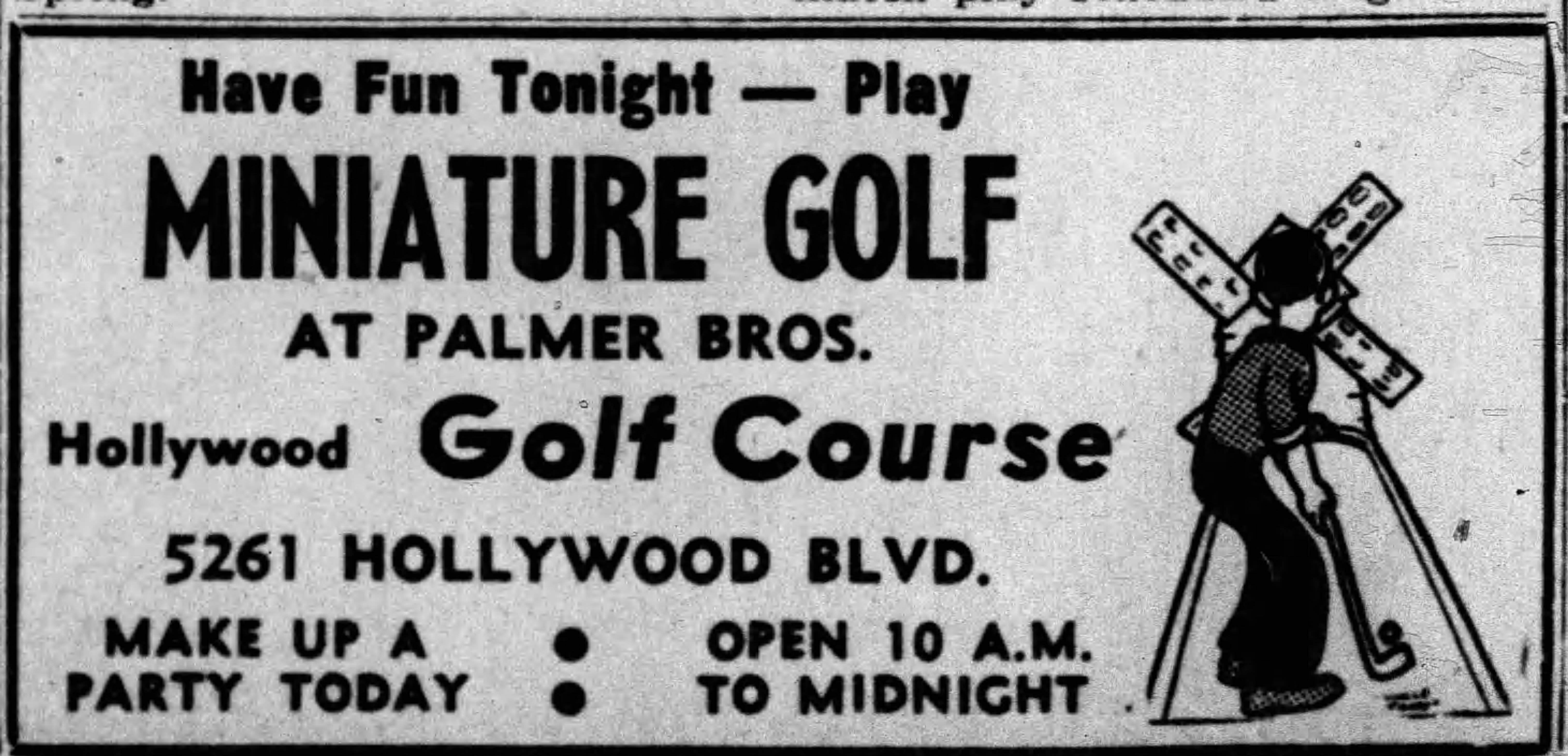
The Hollywood Golf Course, 5261 Hollywood Boulevard. Hollywood Citizen News 3/1/1946

The Hollywood Golf Course miniature golf opened in early 1946 at 5261 Hollywood Boulevard operated by the three brothers- Charles H, Joseph E. and William L Palmer.

This property and adjacent parcels along Hollywood Boulevard near Harvard were part of the Lander Sunnyside Tract. Born in 1849, Anna Elizabeth Watson Lander (also spelled Annah) came to Los Angeles with her children in 1893 after the death of her husband Warren James Lander in November 1892 and was subdividing parcels by the end of the decade. Her sisters, Caroline Watson Lamb and Harriet J. (Hattie) Watson were also successful real estate developers who lived nearby at 1726 N. Harvard Boulevard along with their sister-in-law Mary Clough Watson. The Lander home was at 5253 Hollywood Boulevard. By the teens Lander had converted it to flats. Over time other office/studio structures were erected in the large property.

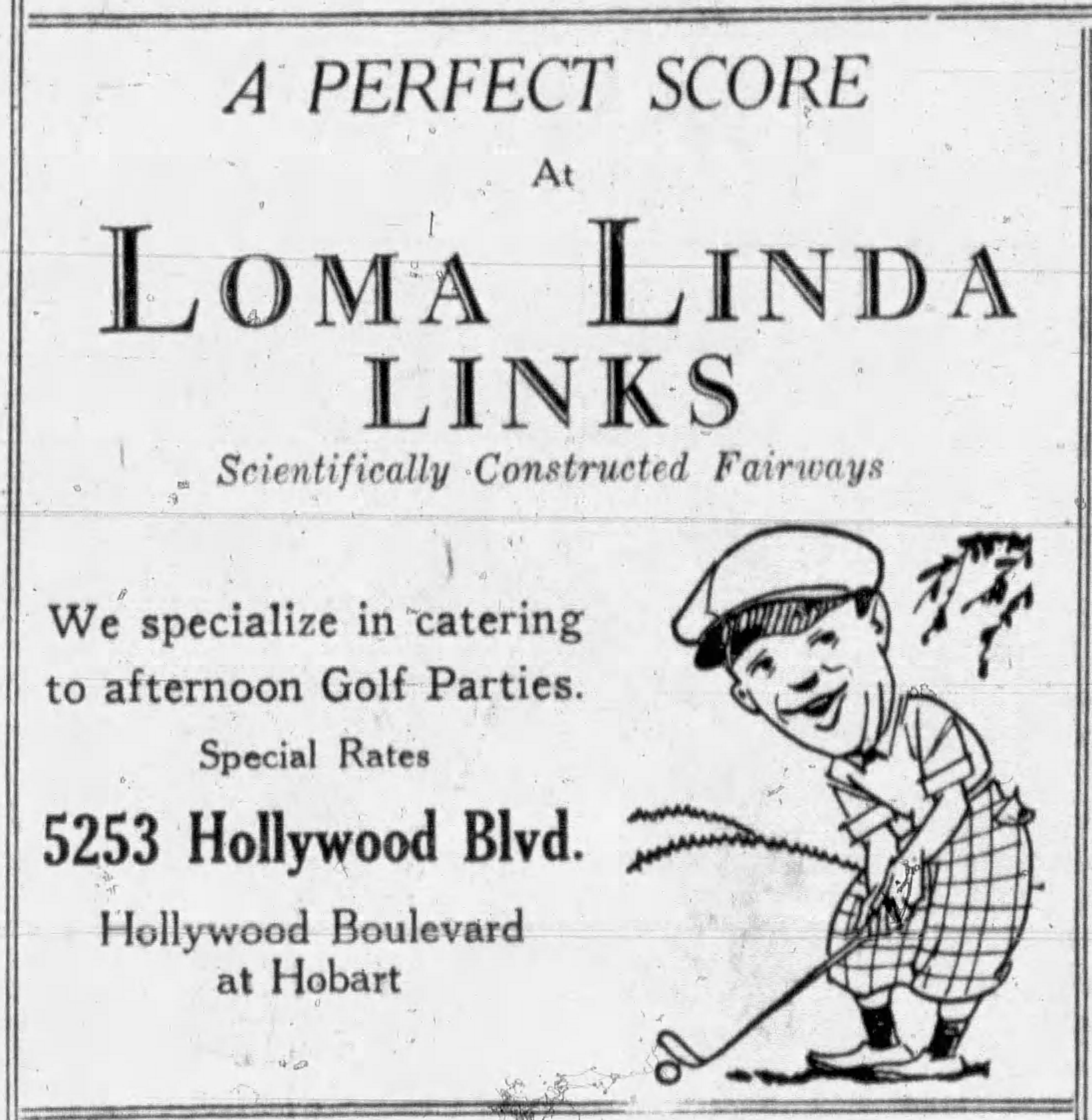
The Loma Linda Links miniature golf course, 5253 Hollywood Boulevard. Hollywood Citizen News 8/1/1930

On July 31, 1930, two of Anna Lander’s sons, Hirschel S. and W.J. Lander (probably Willard, but there was also Warren J. Lander), and their brother-in-law Ernest Hartwell Martin (he was married to Lucille Lander, Hirschel’s twin sister) opened a miniature golf course on the grounds of the old family property at 5253 Hollywood Boulevard and called it the Loma Linda Links.

The Loma Linda Links offered scientifically constructed fairways and afternoon golf parties. Hollywood Citizen News 8/14/1930.

The nation was in the midst of a huge miniature golf fad. Links were springing up all around Los Angeles, including several on Hollywood Boulevard. Even the movie studios were worried about the competition. The craze soon died down but miniature golf remained a popular pastime. The postwar era saw another resurgence.

The Hollywood Golf Course offered night time play. Hollywood Citizen News 8/4/1949

In January 1949, the Palmer Brothers took over the Eagle Rock Miniature Golf Course at 1751 Colorado Boulevard. They continued to operate the Hollywood Golf Course through the summer of 1949 for sure.

By 1951, the course had been acquired by another set of brothers: George and Harry Gittelson, using the address 5263 Hollywood Boulevard.

Hollywood Citizen News 3/27/1951

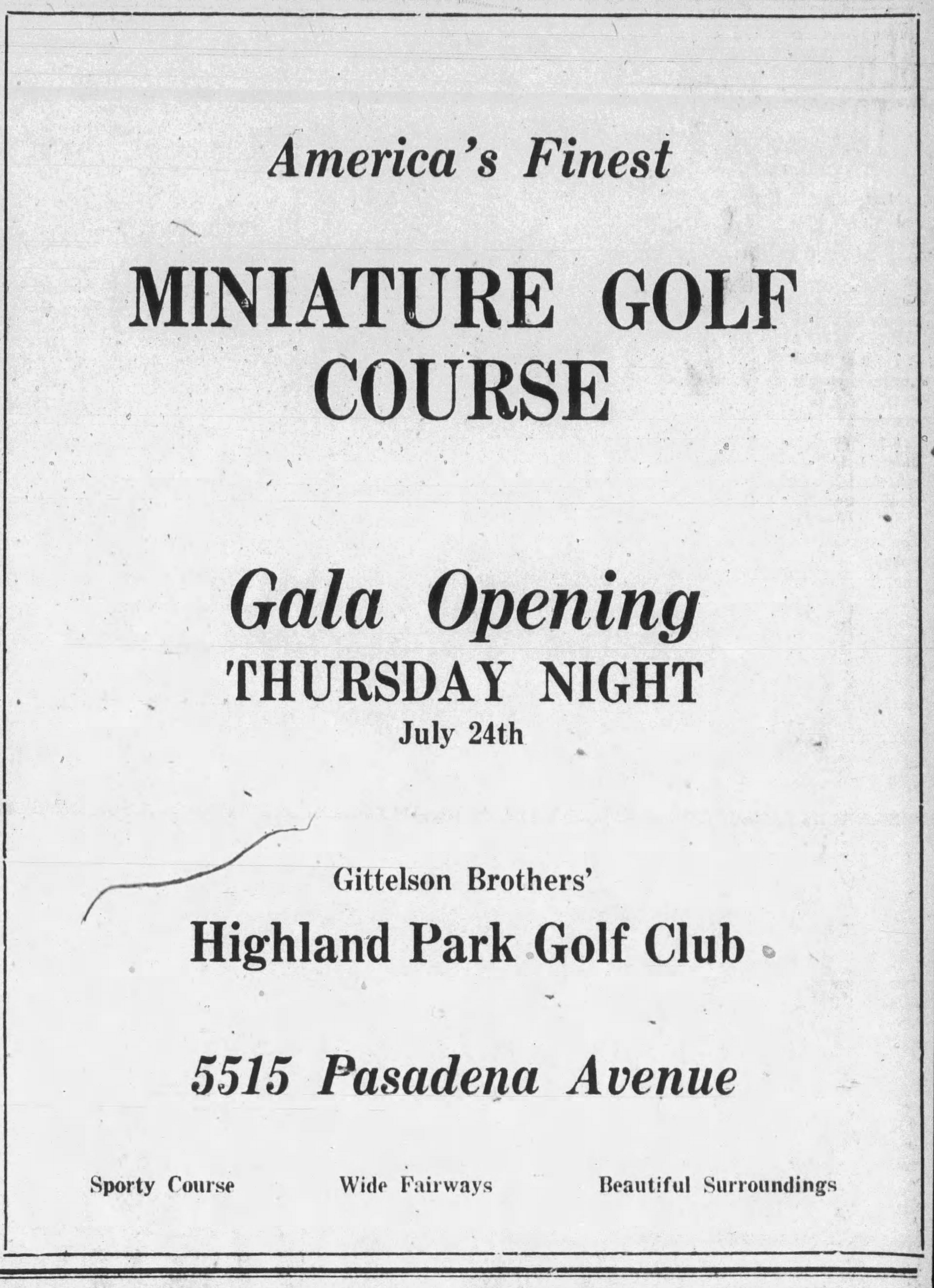
The Gittelson brothers had made a killing founding the first ticket broker agency in Los Angeles. They were also among the first to open a miniature golf course back in 1930, Their Highland Park Miniature Golf Course had opened at 5531 Pasadena Avenue on July 24, 1930, a few days before the Lander’s course opened. They had continued to operate miniature golf courses since that time.

Opening of the Gittelson Brother’s Highland Park Miniature Golf Course. Highland Park News Herald 7/23/1930

The Gittelson Brothers in 1930 at the time of their first miniature golf course opening. LA Evening Express 7/28/1930.

The Hollywood Boulevard links featured windmills, waterfalls and wishing wells. The grounds, extending around the old homestead buildings, were lush and green. The brothers added open-air ping pong table courts.

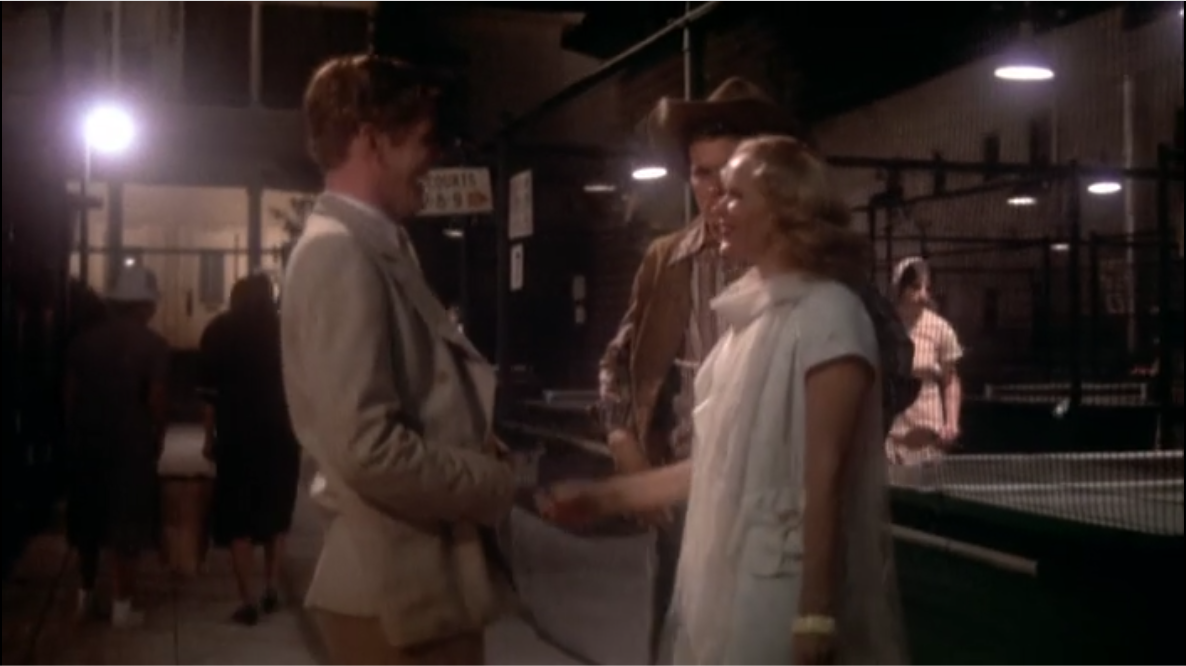
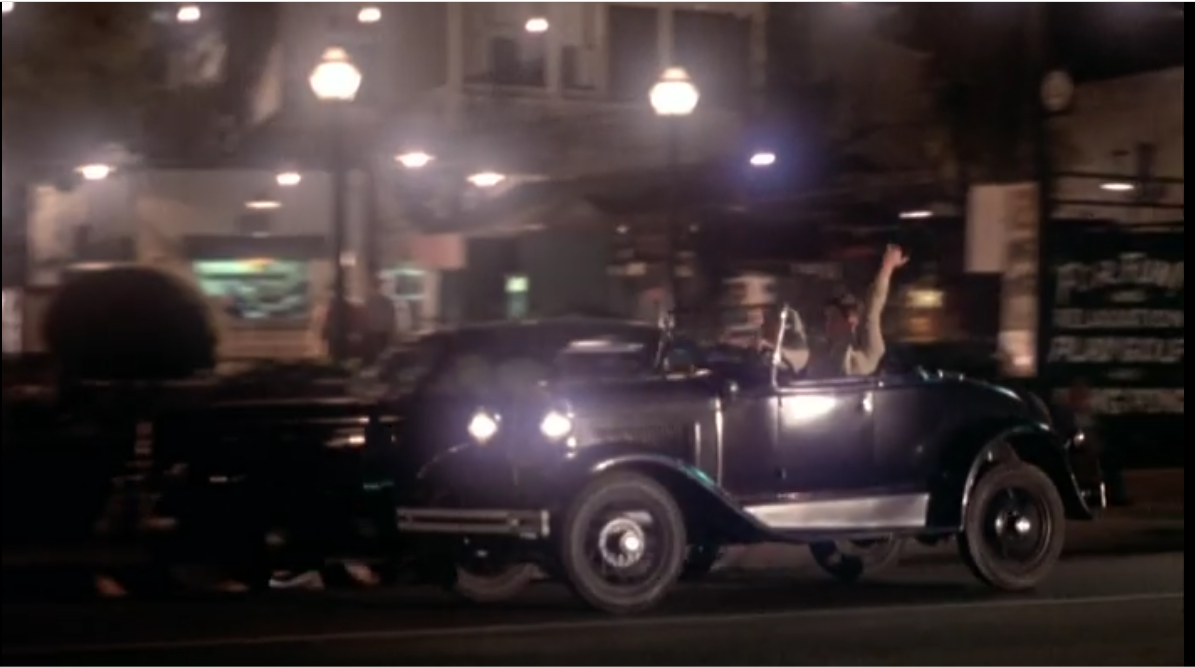
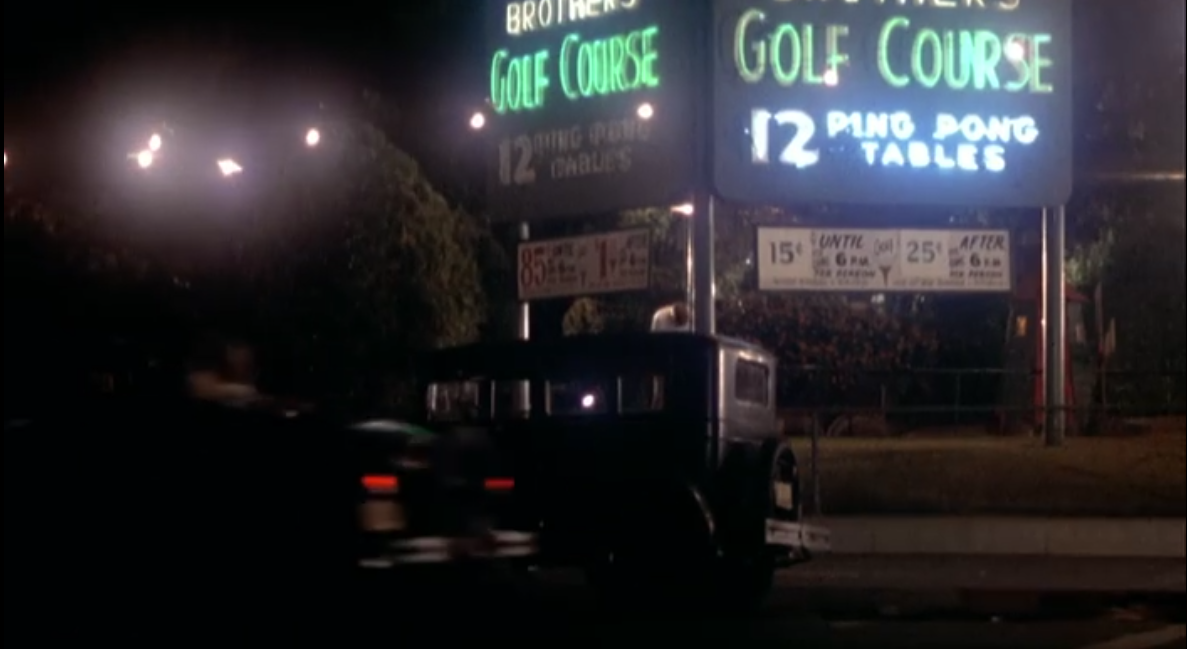
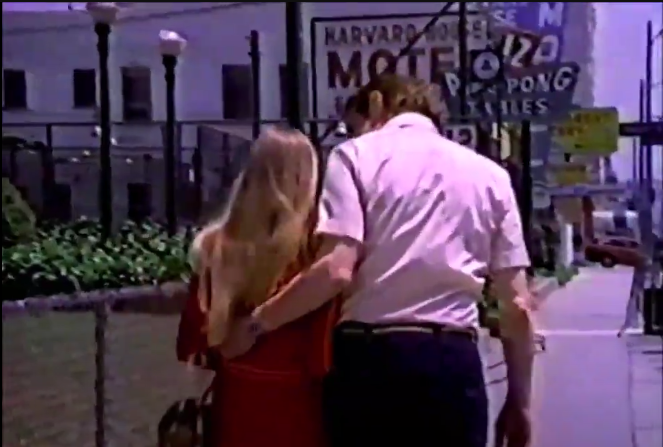
Harry Gittelson died in 1965, George in 1969. The miniature golf course continued into the 1970s. It can be seen at night in the 1975 film “The Day of the Locust” (set in the 1930s), and during the day in the 1976 television film “Dawn: Portrait of a Teenage Runaway.”

Screengrab from :The Day of the Locust” showing the ping pong tables.

Screengrab from :The Day of the Locust.”

Screengrab from :The Day of the Locust.”


Screengrab from :The Day of the Locust.”

Screengrab from “Dawn: Portrait of a Teenage Runaway.” filmed on location at the Gittelson Miniature Golf Course.

Screengrab from “Dawn: Portrait of a Teenage Runaway.” Dawn is heading toward the Harvard House Motel, the mini golf course and ping pong tables is on the left.

The entire property, incorporating addresses 5253 to 5373,

5253-5273 Hollywood Boulevard today. Google map image.

5251 Hollywood Boulevard – Harvard House Motel

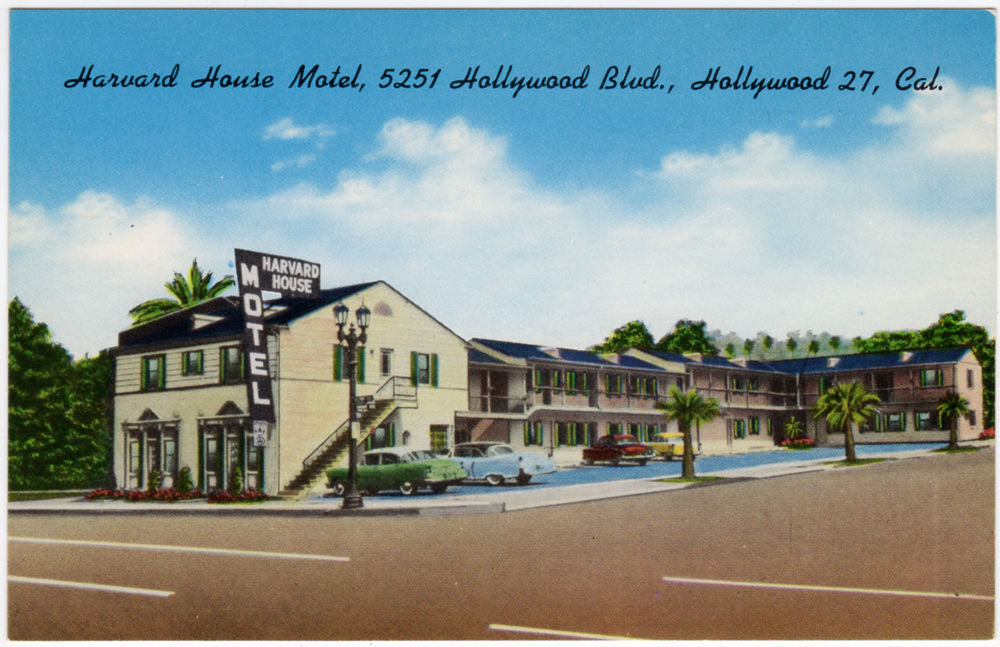
Located at 5251 Hollywood Boulevard at the northwest corner of Hollywood and Harvard Boulevard, the Harvard House motel opened in 1947. The property was part of the Lander Sunnyside Tract (See my post here for more information on that).

The L-shaped, two story, stucco-clad structure initially contained 28 rooms and offices. It was designed by architect Arthur W. Hawes for owner Dushan S. Nicholich (sometimes spelled Nickolich), who operated a real estate business at this location. Nicholich applied for the permit in August, 1947. By 1951, Nicholich had departed Hollywood for Washoe County, Nevada, where he had the “Old Williams Ranch,” renaming it the 102 Ranch.

The Harvard House Motel is still extant.

Postcard view of the Harvard House Motel in the 1950s.

The Harvard House Motel today. Photo via Zillow.

Notes

The Harvard House, looking very much the same as it does today, can be seen in the dismal tv movie “Dawn: Portrait of a Teenage Runaway” (1976).

5217 Hollywood Boulevard- The Guardian Arms Apartments

Located at 5217 Hollywood Boulevard, the Guardian Arms held a public open house on June 29, 1928 and officially opened on June 30, 1928, the same day as its neighbor, the El Adobe Market.

Plans for the 7-story structure were revealed in February 1927. An artists’ drawing of the proposed Spanish-style building, designed by architect W. Douglas Lee, appeared in the Los Angeles Times on March 13, 1927. The owner, the Guardian Holding Corporation, applied for permits to construct the foundation in May 1927, and the building itself in June 1927.

Hollywood Citizen News 2/18/1927.

LA Times 3/13/1927.

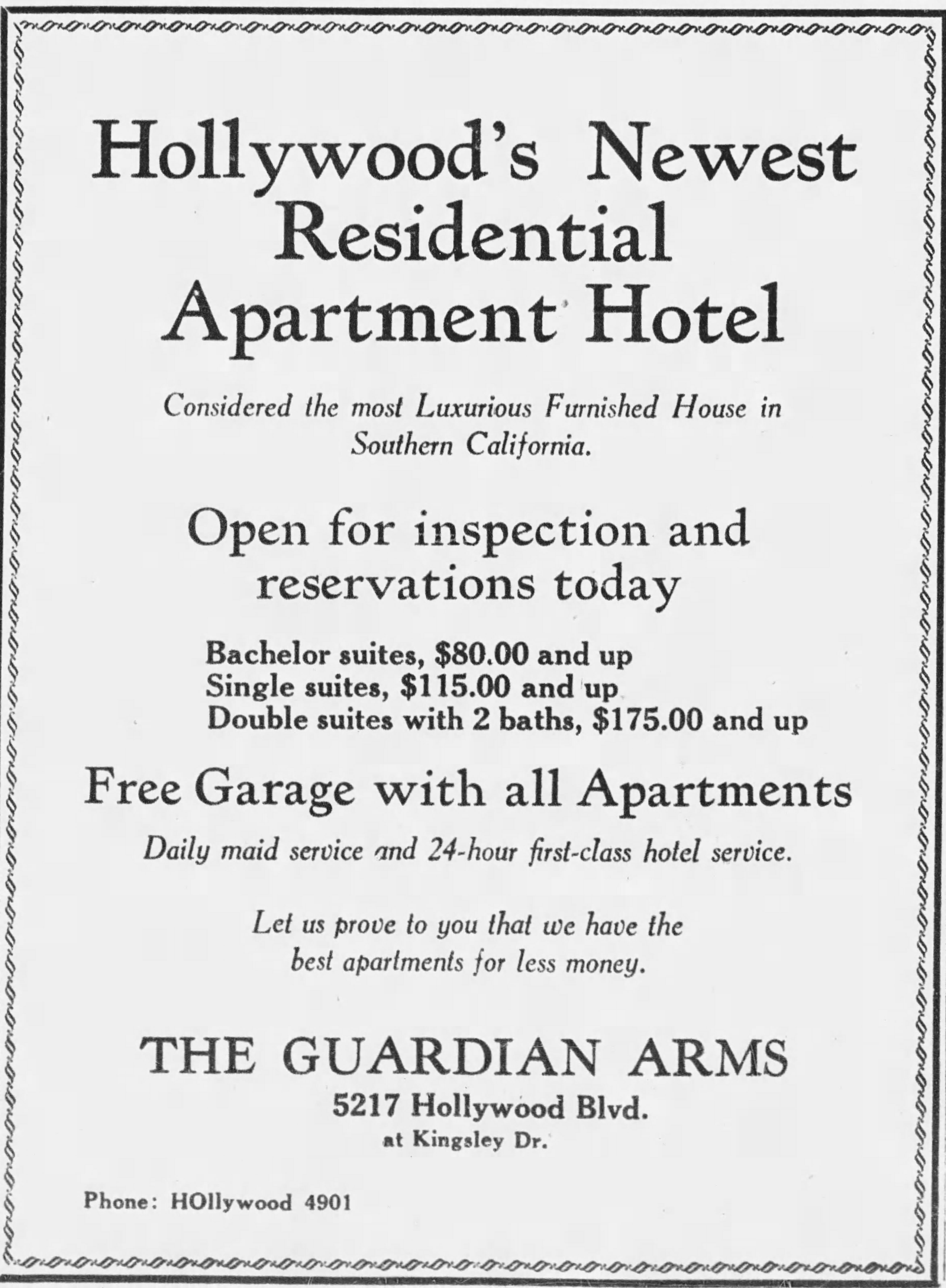
The project took more than a year to complete. The luxury residence contained 90 uniquely furnished units, with a penthouse bungalow and roof garden. Amenities included daily maid and valet service and a 55-car garage in the rear. There was a large lounge area with a dance floor and an auditorium/stage in the basement. Retail shops occupied the ground floor. 

Los Angeles Times May 11, 1928.

Hollywood Citizen-News 6/29/1928.

The Guardian Arms when new. LAPL photo.

Detail of the entrance. California State Library photo.

In 1932, an investor, Anna McKinnie, brought a lawsuit against Guardian Holding Corp, charging fraudulent stock transactions, and in January 1933 was awarded a judgement of almost $250,000. The following month, creditors of Guardian Holding Corp petitioned for bankruptcy in federal court. In April 1933, four officers of Guardian Holding Corp were indicted following a grand jury investigation into the firm’s dealings: E. J. Kampschroer, Charles H. Johnson, E. E. Pratt, and Theodore Kemp. The four were charged with conspiracy and violation of the state Corporate Securities Act. The trial, which began in September 1933, ended with a hung jury. A second trial began March 7, 1934. On April 11, 1934, after over 50 hours of deliberation, the jury found Pratt and Johnson guilty. Kemp was acquitted. The jury was unable to agree on the culpability of Kampschroer, and the DA ultimately moved to dismiss his case. Pratt and Johnson were sentenced to a term at San Quentin later that month. They remained free pending appeal and in October 1934, had their sentences overturned on a habeas corpus ruling.

Los Angeles Post-Record 4/20/1934.

The Guardian Arms sailed right along as a primo, luxury residence.

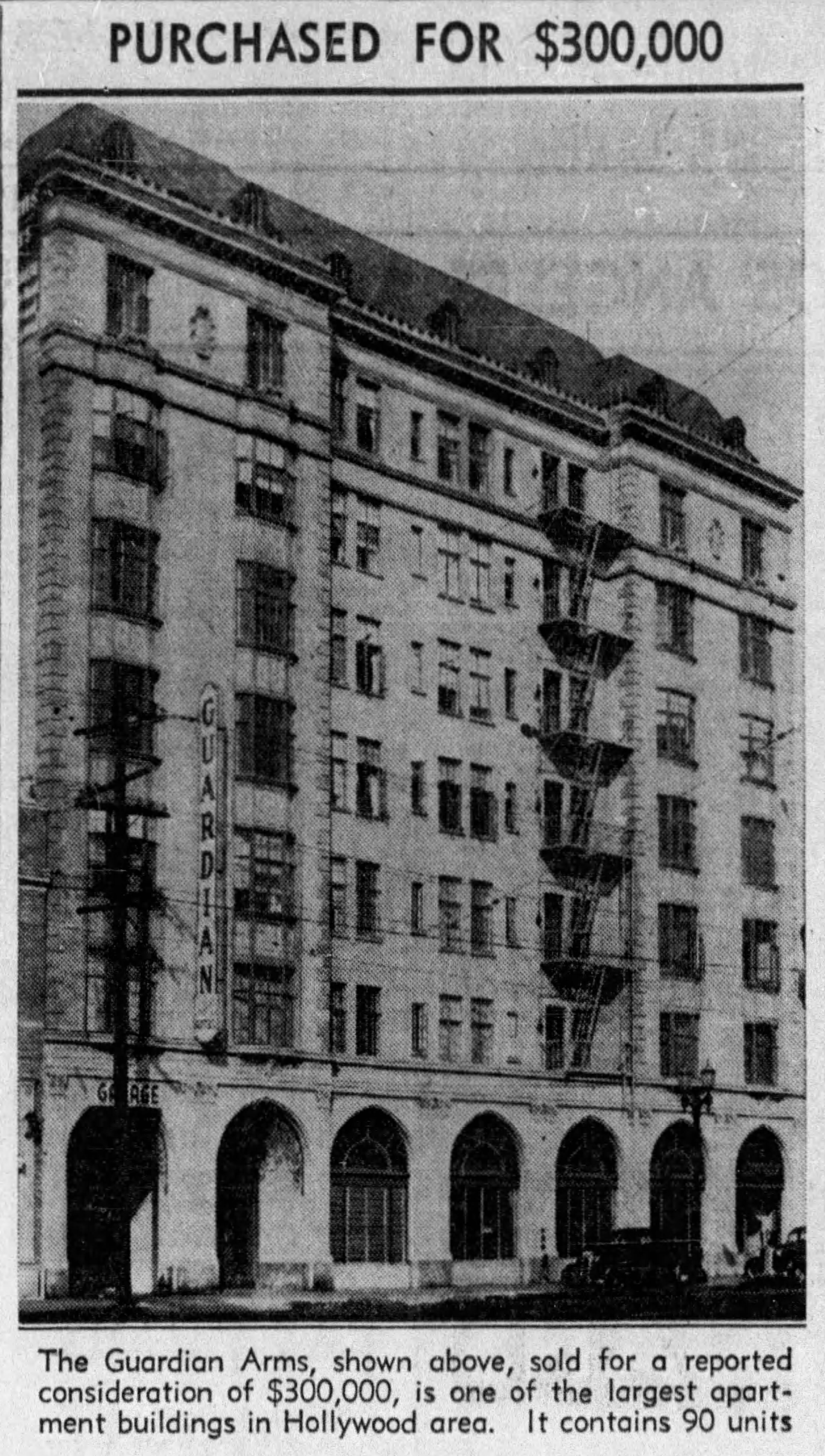
In December 1938 it was revealed that the property had been sold by owner Leslie H. Danis, to an out of town buyer, Leopold Kalish, for $300,000.

LA Times 12/11/1938.

In March 1944, it was made public that Kalish had sold the building to real estate investor G.E. Kinsey for $275,000 – $25,000 less than he had reportedly paid for it a little more than 5 years earlier. Kinsey in turn flipped the property two months later, selling it to Arthur E. Gray and B. Browsky in May 1944 for the same price he had paid for it- $275,000.

Hollywood Citizen News 4/13/1946.

Hollywood Citizen News 4/27/1946.

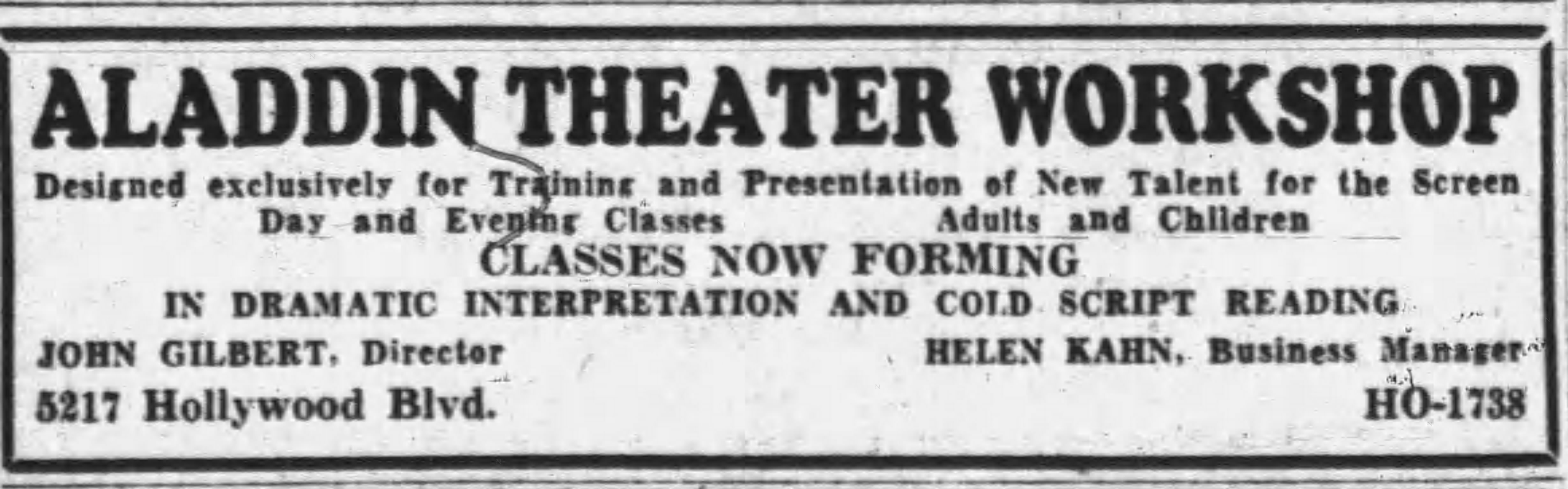
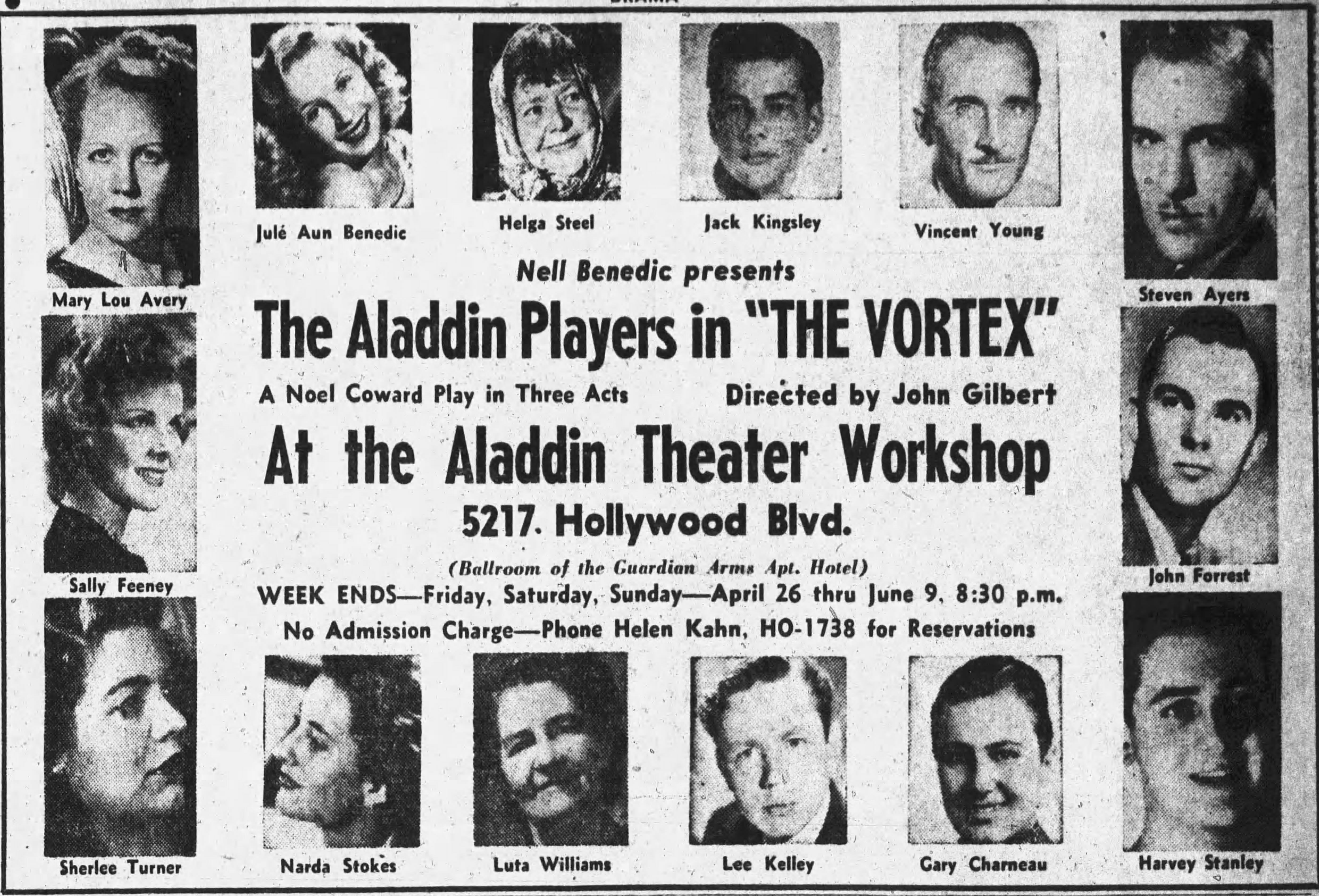
In 1946, the basement auditorium served as an actors’ studio and theater, known as the Aladdin Theater Workshop, for the Aladdin Players. Organized by actor’s agent Nell Benedic as a showcase for her clients, the group debuted with the Noel Coward play, “The Vortex,” in April 1946.

LA Times 6/22/1958.


The Guardian Arms, renamed the Hollywood Hotel Apartments, featured a Hawaiian garden. LA Times 8/26/1958.

In June 1958, the 30 year old building was rebranded as the Hollywood Hotel Apartments. The remodeling cost a reported $300,000 – $50,000 less than it had ostensibly cost to build and the same price it had sold for twenty years earlier.

The Guardian Arms remains extant.

5201 Hollywood Boulevard – El Adobe Market

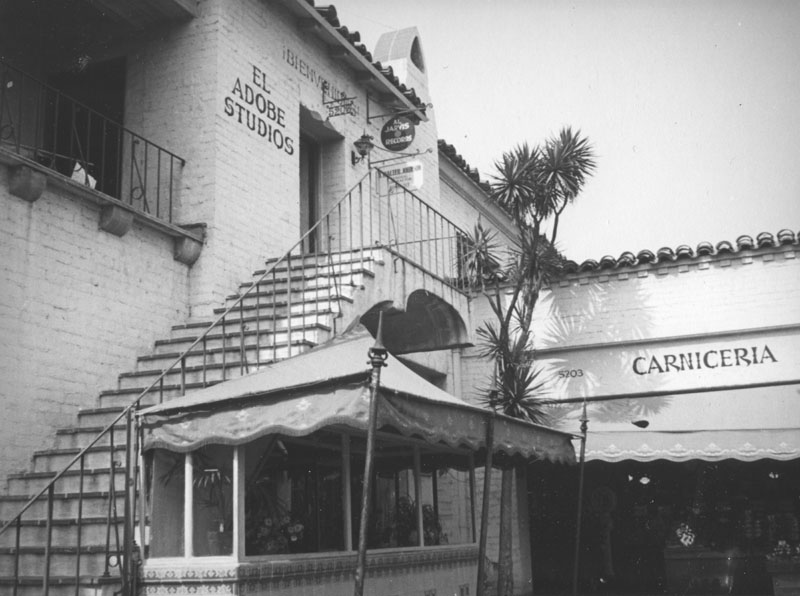
The adorable, Spanish-themed El Adobe Market opened on June 30, 1928 at 5201 Hollywood Boulevard on the northwest corner of Hollywood and Kingsley. Designed by architect Arthur Kelly, it might have been a movie set, down to the old oxcart in the courtyard and the Spanish names painted on the vending stalls (“frutas” for fruits, “verduras” for vegetables” etc).

The site, addressed as 5203 Hollywood Boulevard, had been home to pioneer resident, dentist C. V. Baldwin and his wife Alice, who came to Los Angeles in 1878. Dr. Baldwin passed away in February 1927 at the age of 92.

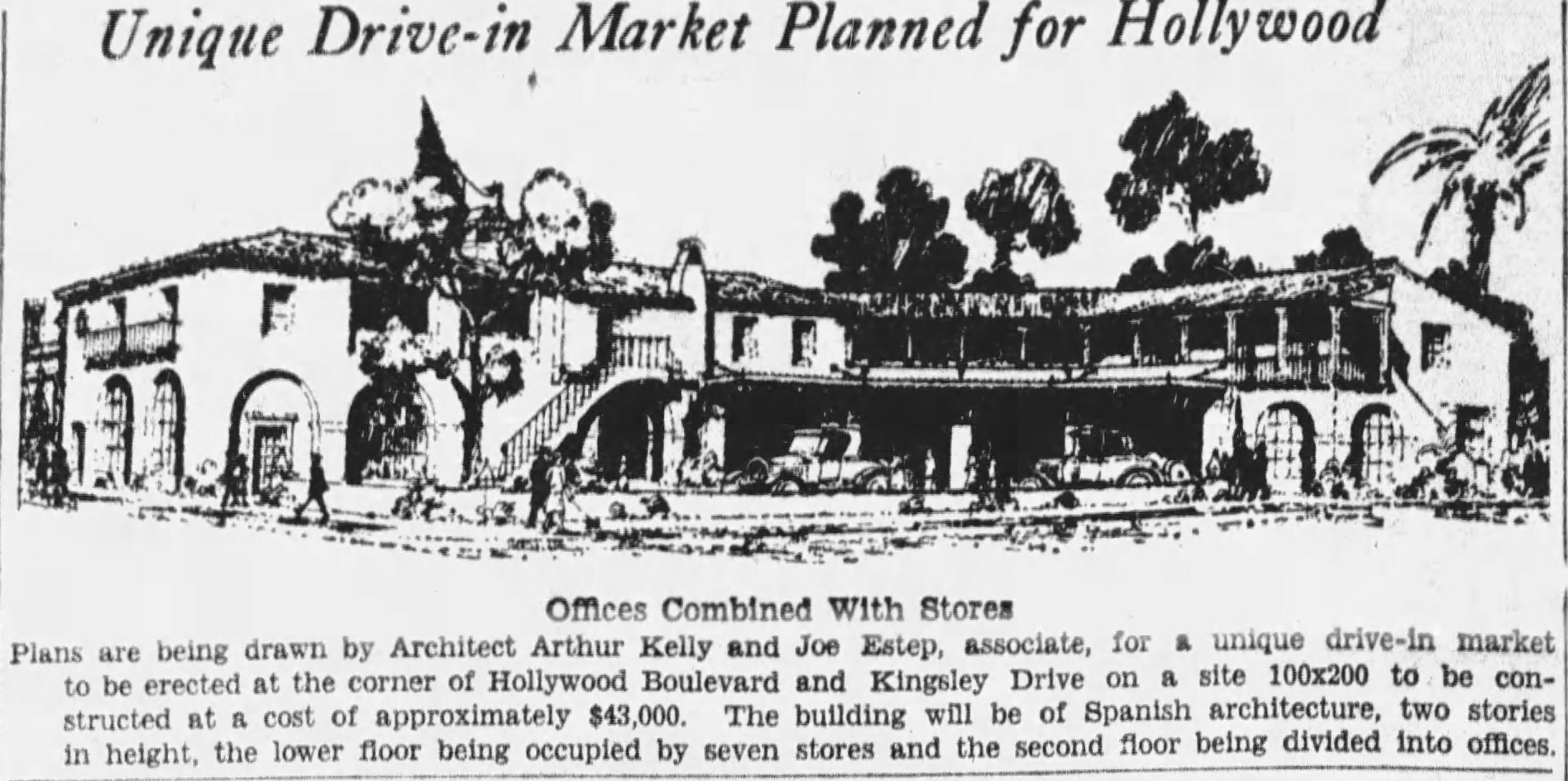
On March 4, 1928, plans were made public for the office and retail building that became the El Adobe Market. Los Angeles was already in love with car culture, reflected in the market’s drive-in design.

Artist’s drawing of the building that would house the El Adobe Market. LA Times 3/4/1928

Opening ad for the El Adobe Market, LA Times 6/29/1928.

The El Adobe Market c. 1937. LAPL photo.

The El Adobe Market’s courtyard and oxcart c. 1937. LAPL photo.

Interior of the El Adobe Market, 1942. LAPL photo.

El Adobe Market c. 1970. The tall building adjacent is the Guardian Arms Apartments, which opened the same day as the El Adobe Market, June 30, 1928. In June 1958, it was renamed the Hollywood Hotel Apartments.

El Adobe Market in recent times. Photo from youarehere.com

El Adobe Market is still in business.

6760 Sunset: Simon’s Drive-In

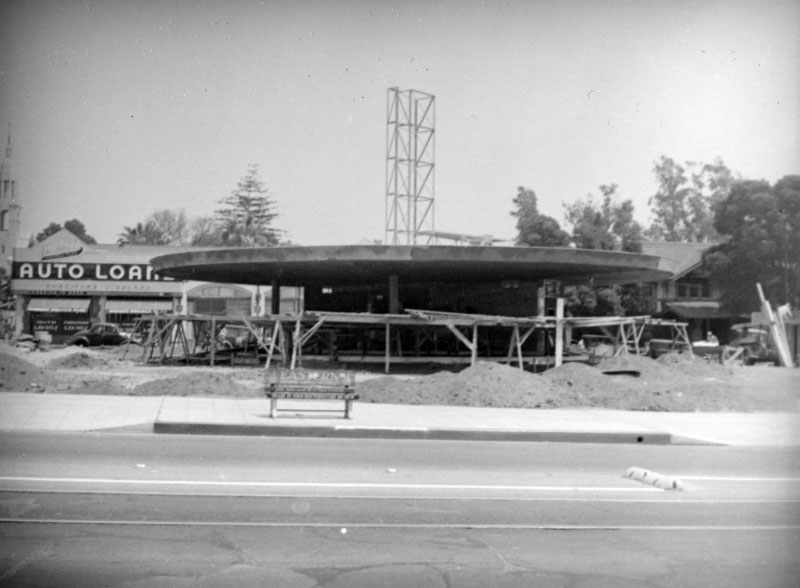
Simon’s hamburger stand at the SE corner of Sunset Boulevard and Highland Avenue opened in early 1939, one in a small chain of locally-owned drive-in cafes started in 1935. It was the second Simon’s on Sunset Boulevard- the first was at 8801 Sunset on the Strip- but this location across the street from Hollywood High School was an instant hit.

A permit for this location was granted by the City in December 1938. The architect/engineer on record is S.B. Barnes.
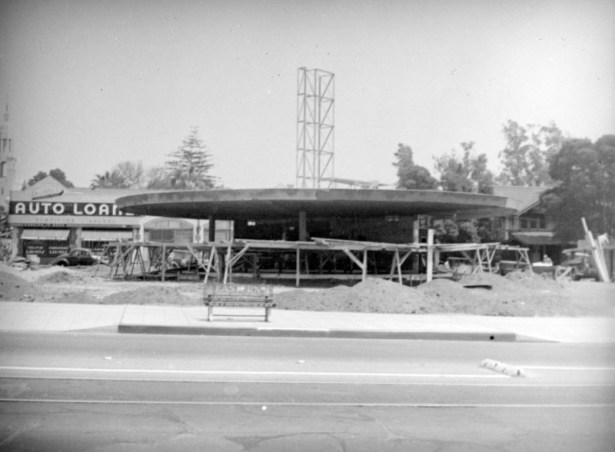
Simon’s Sunset & Highland under construction. LAPL.

The Simons were brothers William Harold Simon and performer-turned-restaurateur Mike Lyman, who were partners in a string of eateries and nightclubs along with their other brothers Albert Simon and bandleader-songwriter Abe Lyman and others.

Michael “Mike” Lyman was born Issac Simon in Chicago in 1887 to Fannie and Jacob Simon, who had come to the USA from Europe in 1885. In 1910, as Michael Simon, he was working as an actor/singer in a cafe in his native Chicago. By 1916 he’d changed his name to Mike Lyman and was living in Los Angeles, a singer at Baron Long’s Sunset Inn in Santa Monica and Long’s Vernon Club.

Mike Lyman performing with “Blondy” Clark at The Sunset Inn. LA Record 11/15/1916

Detail of Mike Lyman’s WWI draft registration card.

Mike Lyman appearing with Lon Stepp at the Ship Cafe, Venice in 1919. LA Evening Record 8/28/1919

No one ever called Baron Long a gangster. He masqueraded as a respectable citizen. He was closely affiliated with Spring Street gangsters like Charles Crawford, Farmer Page, Zeke Caress, Tutor Scherer and his joints, run by fronts, were notorious for liquor violations, gambling and other illicit activities.

In November 1917 the City of Los Angeles passed the Gandier Ordinance, which banned the sale of strong liquor, effectively closing saloons within the city limits. Outlying communities like Vernon, Venice, Santa Monica and other beach towns, attracted the patrons looking to skirt the law. In addition to the Vernon Club, Baron Long operated the Ship Cafe in Venice and the Sunset Inn in Santa Monica. Mike Lyman performed at all three.

In 1918, Long turned the Sunset Inn over to the Red Cross. It was open as a cafe only on certain nights. LA Times 7/7/1918

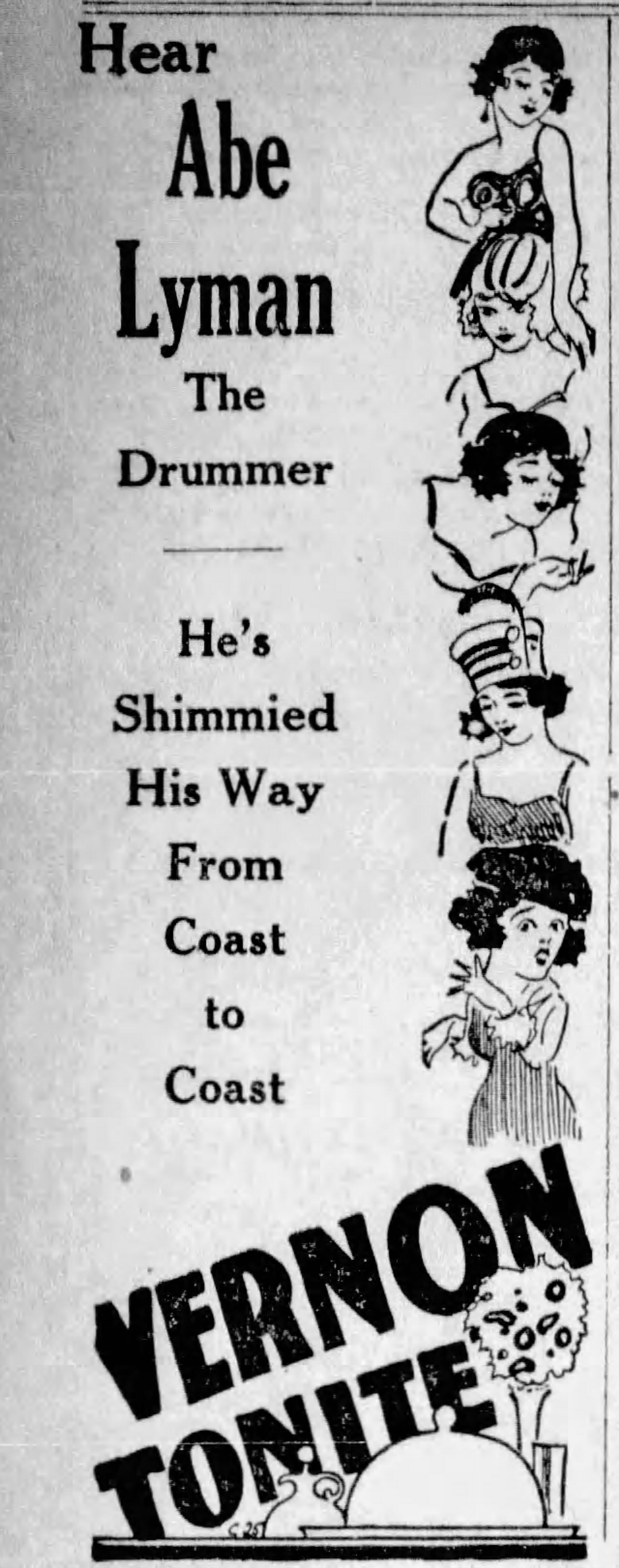
By late 1919, Mike’s younger brother Abraham (“Abe”), who also adopted the stage name Lyman, had come out to Los Angeles and was appearing at Baron Long’s Vernon Club.

Abe Lyman appearing at the Vernon Club, 1919. LA Evening Express 12/16/1919

In 1920, Mike was in charge of entertainment at the reopened Sunset Inn, while Adolph “Eddie” Brandstatter, lately maitre’d of the Victor Hugo restaurant downtown, ran the hospitality side of things. National Prohibition was now the law of the land.

Mike Lyman in charge of “diversions” at the Sunset Inn after its reopening in  1920. Eddie Brandstatter ran the hospitality side of the business. LA Evening Express 6/21/1920

Abe Lyman at the Sunset Inn, 1921. LA Evening Express 8/17/1921

Abe  Lyman, having formed his own orchestra, was soon in demand as the house band at the Ambassador Hotel’s Coconut Grove nightclub, and as a songwriter and recording artist.

Peggy Dear was an early hit for Abe Lyman’s new orchestra. 1923.

Mike Lyman, meanwhile, moved away from performing and was running cafes and nightspots full time with brothers William H. “Big Bill” Simon (born in Chicago in 1896 and known as Harry as a child) and Albert (born in Chicago in 1889 as Alexander Simon) and others. In December 1920 they formed the Winter Garden Corporation, taking over a longtime Los Angeles cafe, McKee’s, at 520 South Spring Street upon the retirement of proprietor Sam McKee. The new Winter Garden cafe, addressed as 518 S. Spring, opened in February 1921.

520 S. Spring Street as McKee;s Cafe, 1905. LA Record 11/14/1905

In December 1921, Mike Lyman was managing the newly opened Palais Royal club at 616 S. Hill Street with his former partner V.B. “Blondy” Clark. The venture was short lived.

Opening of Mike Lyman’s Palais Royal on Hill Street. LA Evening Express 12/26/1921

In May 1922 the Lyman/Simon syndicate purchased land on Washington Boulevard in Culver City for another new nightclub, the southern-themed Plantation Club. It opened in June 1922.

Announcing Mike Lyman’s purchase of land for the Plantation Club, Culver City along with his old partner V.B. “Blondy” Clark. LA Times 5/23/1922

Opening of Mike Lyman’s Culver City’s The Plantation Club. LA Times 6/24/1922.

The Winter Garden Corporation dissolved in August, 1923 and the cafe closed as did the syndicate’s Sunset Inn. The Sunset Inn would reopen that year in Tijuana, where Baron Long operated the turf club. Mike Lyman reopened 518/520 S. Spring as The States restaurant.

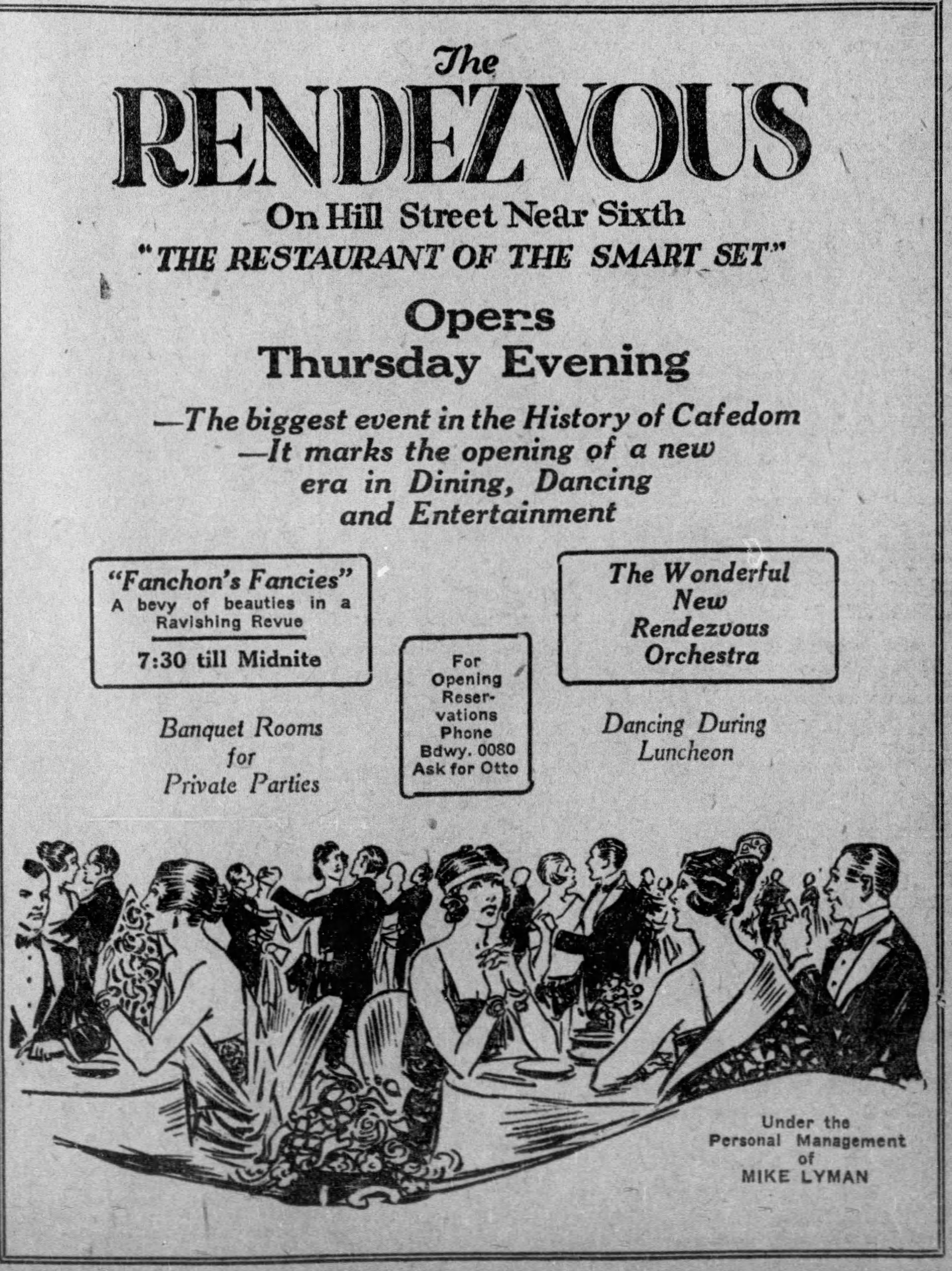
In October 1923, Mike Lyman also opened The Rendezvous at 616 S. Hill Street. It too was short-lived.

Ad for The Rendezvous, October 1923 “under the personal management of Mike Lyman.” Note “Fanchon’s Fancies.” Bill Simon married Fanchon of the brother and sister dance/choreographer duo Fanchon & Marco, who for a time would operate a dance school at 5600 Sunset.

In early 1925, the Lyman/Simon group began work on a dance hall/ballroom to be called the Palais de Dance at the same location in Hill Street of Lyman’s failed Palais Royal and the Rendezvous. A gala grand opening, with appearances by heavyweight champion Jack Dempsey and the Abe Lyman Orchestra, was planned for April 1925 but had to be postponed when the police commission would not issue a dance license due to an ongoing investigation into dance halls and cafes where dancing was allowed, for potential violation of the Prohibition laws. The opening was finally held in August 1925. But the venture was again short-lived.

Ad for the delayed opening of Lyman’s Palais de Dance. LA Times 8/28/1925.

In 1926, Mike Lyman opened the former McKee’s/Winter Garden/States location as the southern-themed Lymans’ Cafe Alabam, addressed as 520 S. Spring.

Lyman’s Club Alabam, 520 S. Spring St. LA Times 3/5/1926.

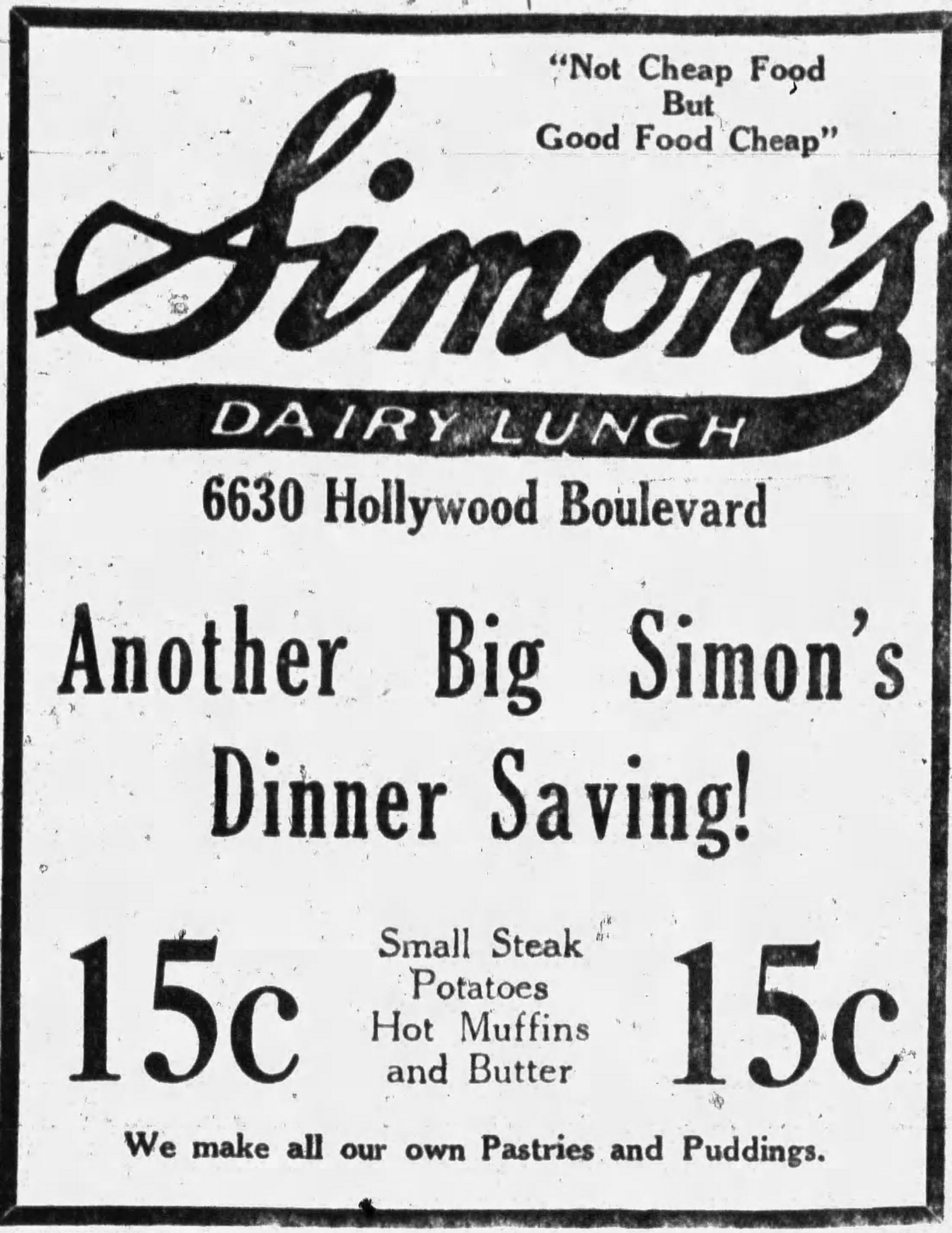
In 1927, Bill Simon, who had up until now been basically operating behind the scenes, opened the first of several Dairy Lunch cafes, which would bear the name Simon. Simon’s Dairy Lunch was located at 6630 Hollywood Boulevard in the new Cherokee Building.
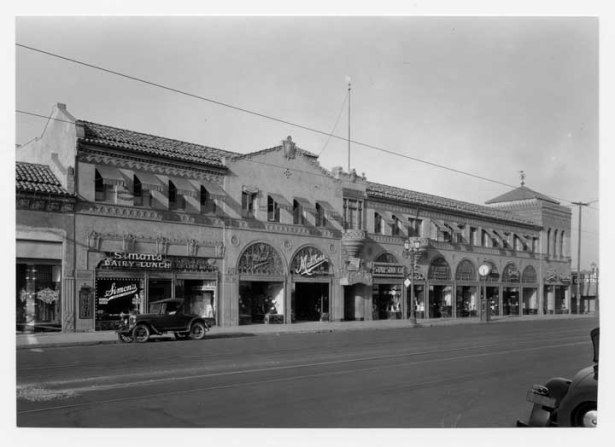
Simon’s Dairy Lunch in the new Cherokee Building at 6630 Hollywood Boulevard, early 1928. This location operated into the 1940s. California State Library photo.

Simon’s Dairy Lunch at 6630 Hollywood Boulevard. Hollywood Daily Citizen, 1/5/1928

Other Simon’s Dairy Lunch spots opened in downtown Los Angeles. In May 1930, Bill Simon leased the former company dining room of the Pacific Mutual Building at Sixth and Olive streets for a large Dairy Lunch location.

Bill Simon’s Dairy Lunch. LA Times 5/18/1930

The Pacific Mutual Building at Sixth & Olive streets.

The early 1930s were a difficult time for any business. Many failed. The Lyman/Simon brothers not only survived but steadily thrived with the dairy lunch counters. The repeal of national Prohibition in 1933 gave a boost to the restaurant industry, as cafes could now legally serve alcohol. Glamorous cocktail lounges were built or added to existing establishments to create an atmosphere of sophisticated tippling.

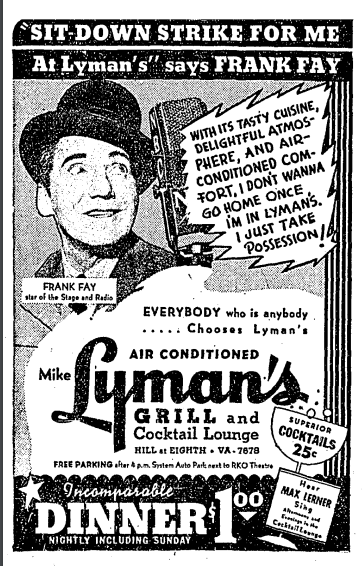
On April 23, 1935, Mike Lyman opened his first namesake cocktail lounge and grill at 751 S. Hill Street, location of the former Herbert’s Cafeteria.

1937 ad for Mike Lyman’s first Grill and Cocktail Lounge, 751 S. Hill St., featuring Frank Fay- who would go on to have his own namesake nightspot in the Valley.

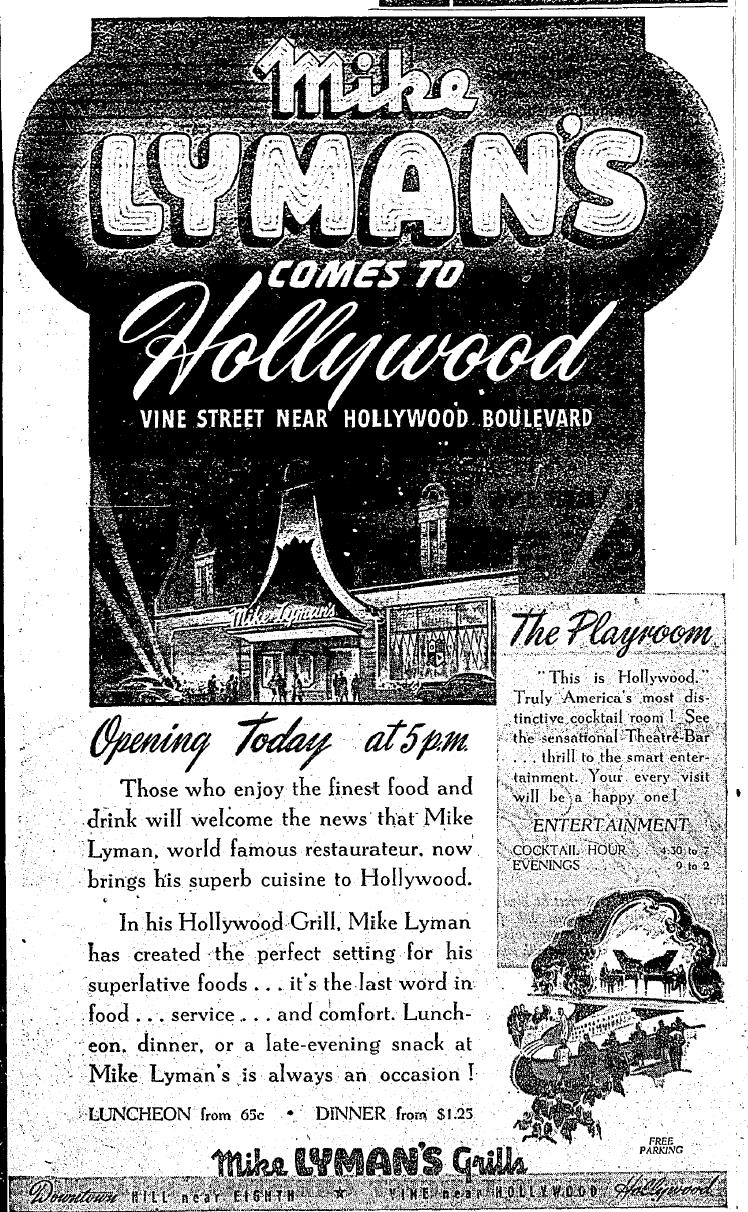
Lyman would open a second Lyman’s Grill in Hollywood, in the former Al Levy’s Tavern at 1623 N. Vine Street in November 1941. Levy, like Sam McKee, was a pioneer restaurant owner. He’d opened the Vine Street location in 1930 and ran it until his death in May 1941. A fire swept through the night spot in July 1941, and in September 1941, the Simon/Lyman brothers leased and renovated the space.

Mike Lyman’s Grill at 1623 N. Vine St. in the former Al Levy’s, c. 1941. LAPL photo.

Ad for Mike Lyman’s Grill in Hollywood, 1623 N. Vine St., in the former Al Levy’s Tavern.

After Bernstein’s Fish Grotto at 424 W. Sixth St. closed in April 1942, this location became the new Mike Lyman’s downtown grill.

Mike Lyman’s Grill at 424 W. 6th St., in the former Berstein’s Fish Grotto.

Interior view of Mike Lyman’s new grill, 424 W. 6th St.

In 1949, Simon’s Sunset and Highland Drive-In was used as a filming location for the gambling expose, 711 Ocean Drive. In the still below, Hollywood High School can be seen across the street.

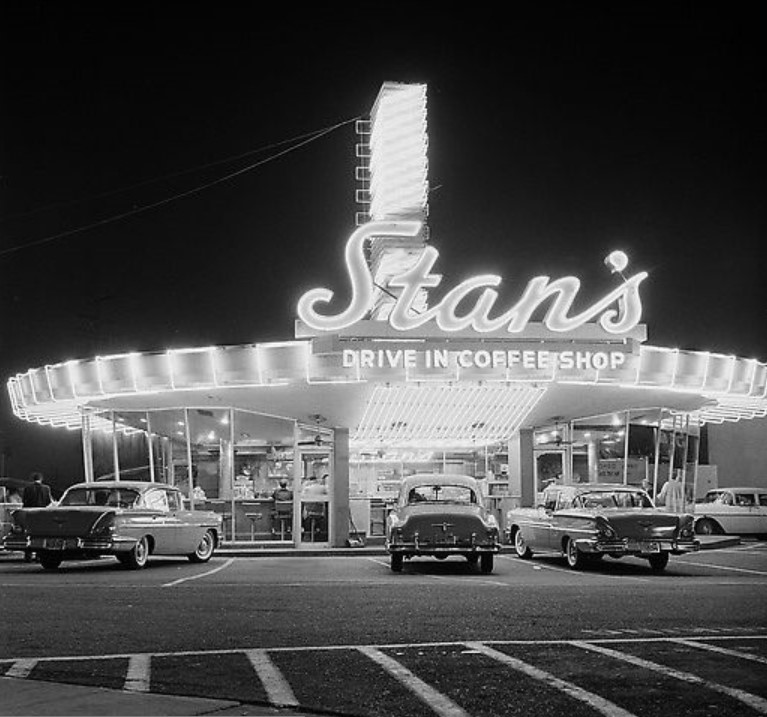
In December 1951, the brothers sold 12 of their Simon’s drive-in restaurants and 5 of their cocktail lounges to Stanley Burke, Sacramento drive-in owner. This Simon’s is one of the 12 that became a “Stan’s.”

The Simon/Lyman brothers sale of 12 drive-ins and 5 cocktail lounges. Hollywood Citizen News 12/10/1951
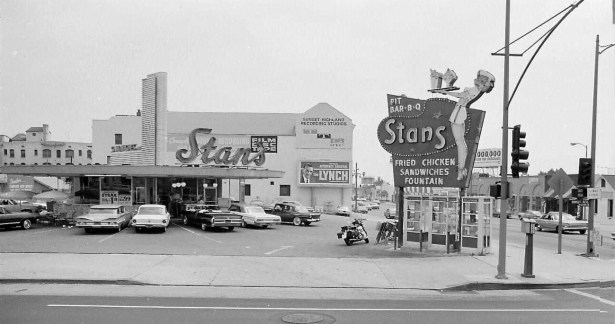
As Stan’s. This photo is from USC, per this website (USC link is now broken)

The former Simon’s at Sunset & Highland as Stan’s Drive-In. LAPL photo.
Mike Lyman died in November 1952. Albert Simon died in December 1956. Abe Lyman died in October 1957.

Mike Lyman’s Hollywood grill continued to operate until April 1959 when Bill Simon decided the time had come to close it. The building was demolished in 1966. Lyman’s namesake bar and grill on West Sixth St. continued to operate until December 1965, when the fixtures were sold at auction and the building subsequently demolished. The former Simon’s/Stan’s drive-in at Sunset and Highland was demolished in 1971.

Bill Simon died in April 1976.

***

Notes

The Simon brothers also had two sisters: Sarah and Dorothy. Dorothy used the name Lyman for a time.