5956 Hollywood Boulevard: Mountain View Inn


The Mountain View inn was a three-story wood-framed Shingle style hotel located on Hollywood Boulevard for 25 years. It was built on land acquired from John B. and Ida Brokaw, whose ranch home was across the street, on what was called the Brokaw Tract No. 2.

Investor Leon P. Bishop of Utica New York owned the land and had the 25-room hotel built in 1906.
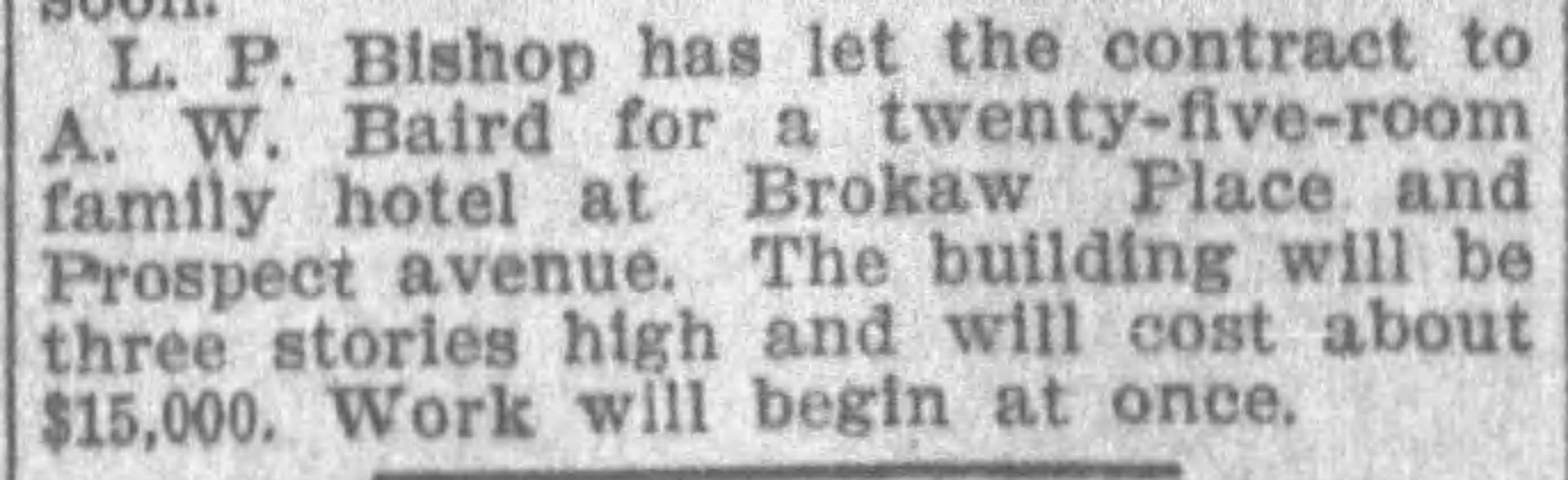
Hollywood Boulevard was then known as Prospect Avenue. Brokaw Place was an alley just west of the Mountain View Inn that connected Hollywood Boulevard and Carlton Way. LA Times 9/5/1906

Originally addressed as 620 E. Prospect Avenue,  the hotel was leased to Benjamin Fowler and his wife Louise, formerly of Redlands. It opened in 1907.

LA Times 5/31/1907.


The Mountain View Inn. California State Library image.


Rates started at $10 a week in 1908. It had steam heat, a telephone and croquet grounds. LA Times 2/2/1908

Benjamin Fowler died in October 1911 at age 69. His wife, Louise Ely Fowler continued to run the hotel with the assistance of the couple’s married daughter, Mabel Foster, through April 1925.

A fire in March 1912 destroyed the second and third floors; no one was injured. The Mountain View Inn was quickly rebuilt and reopened for business in May 1912.

Fire. LA Express 3/14/1912.


“Recently opened” here meant re-opened after the fire. Hollywood Citizen 5/24/1912


The Mountain View Inn parcel in 1913. Detail from a Sanborn Fire Insurance map. Library of Congress.


LA Times 2/21/1915

Some of the earliest residents were actors from David Horsley’s Nestor Studios, established in 1911 at Sunset and Gower; it would also be convenient to the old Warner studio at Sunset and Bronson.
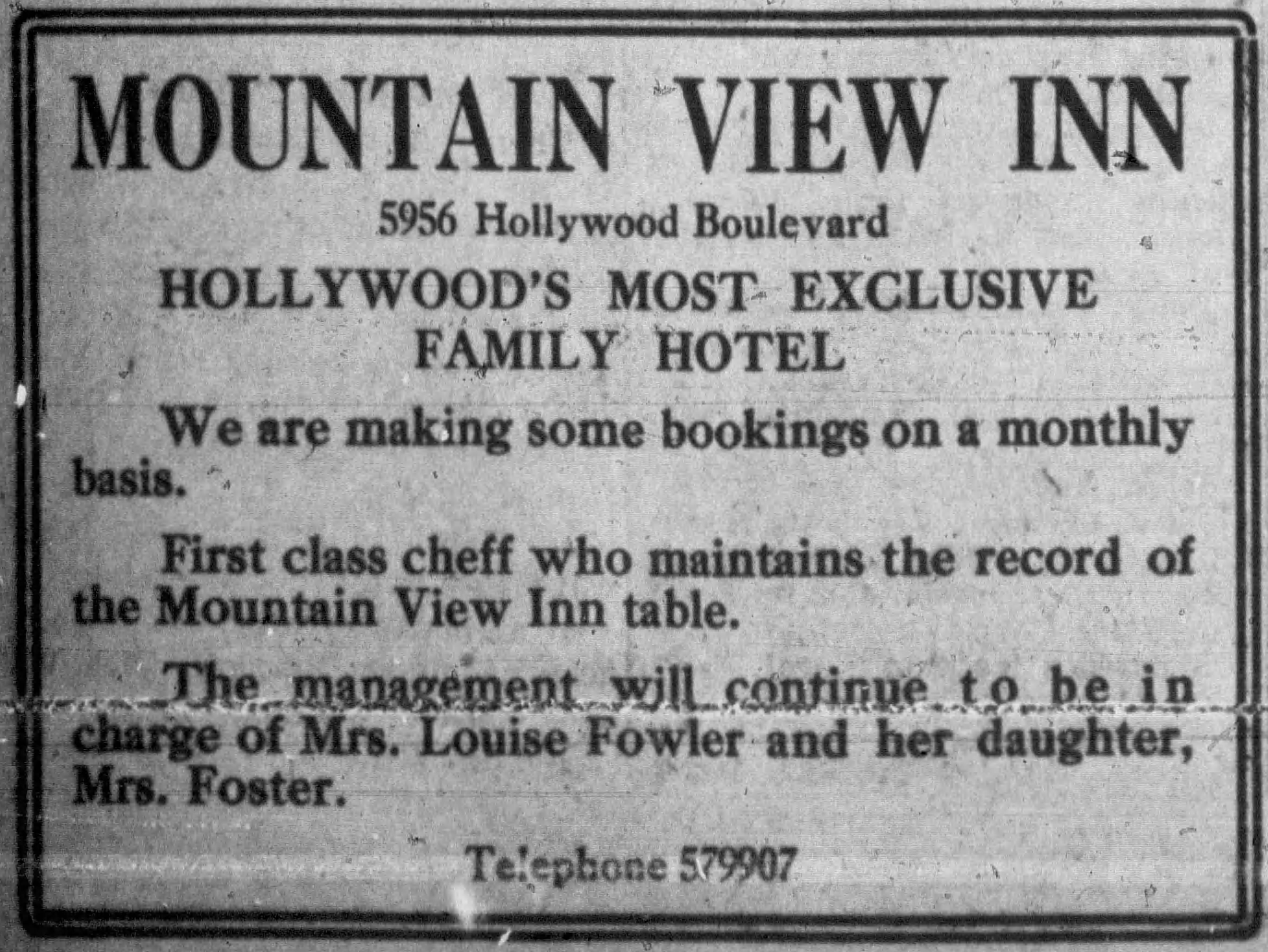
Hollywood Citizen 6/11/1920


Hollywood Citizen 4/29/1921
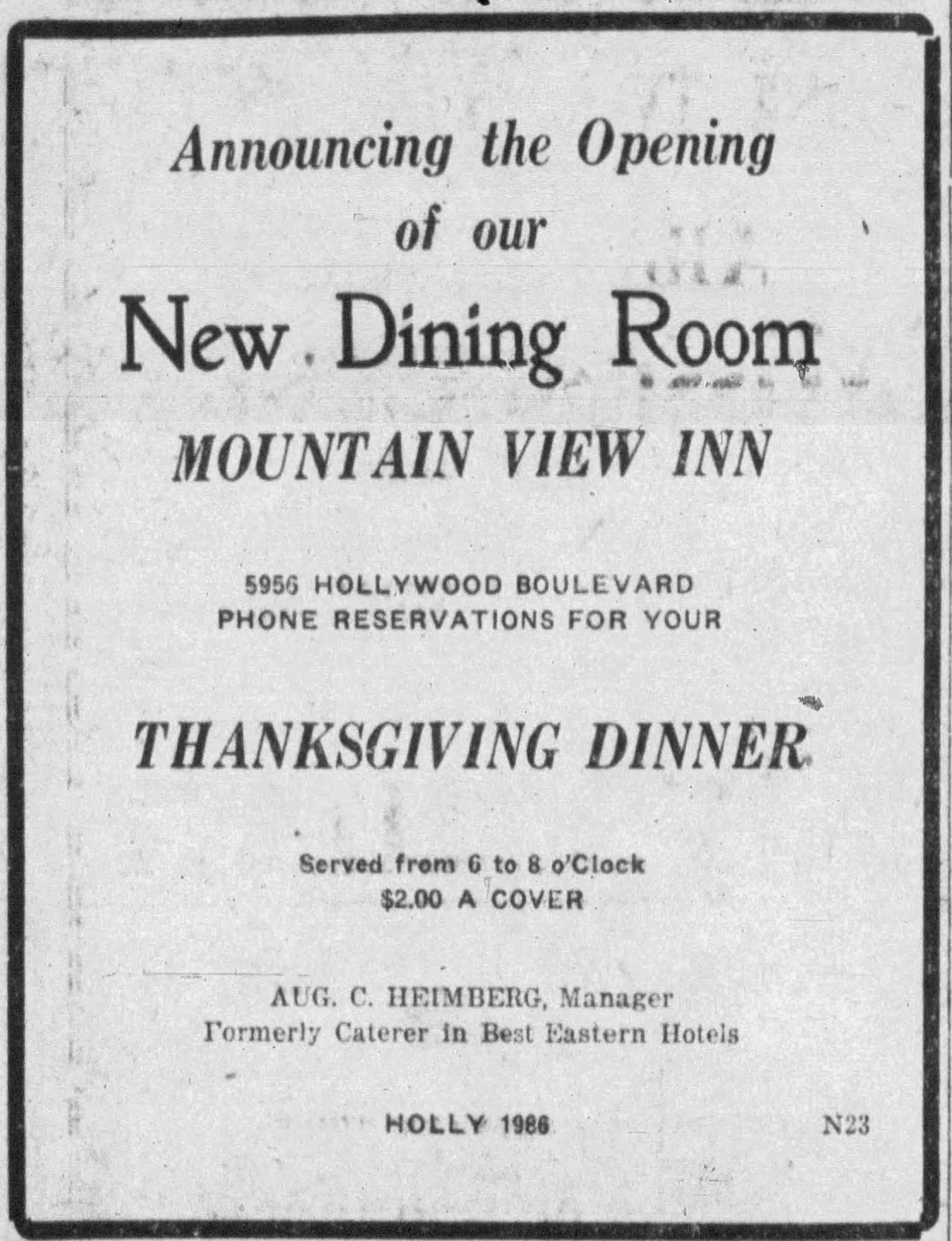
 

Hollywood Daily Citizen 11/22/1921


The Mountain View Inn can be seen c. 1937 across the street from the Palms Grill at 5831 Hollywood Boulevard. LAPL photo.

The Mountain View Inn remained a residence up until the end. Veteran actress Augustine B. Mudge was still living here at the time of her death, in April 1952, at age 79.

The building was demolished on July 10, 1952. The adjacent Gordon Warren Chevrolet dealership at 5950 used the space to expand their car lot.

Hollywood Citizen News 7/10/1952

Hollywood Citizen News 7/10/1952

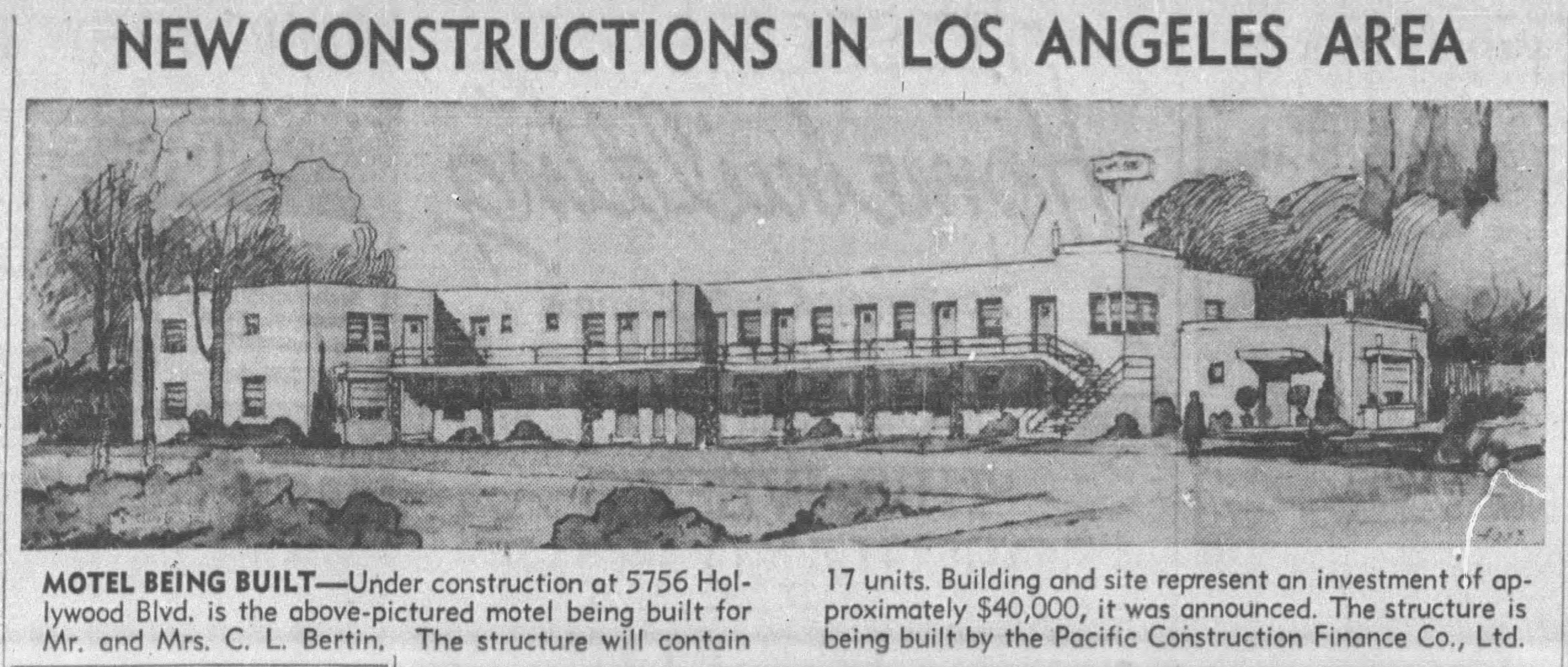
 

5756 Hollywood Boulevard: Hollywood Town Motel

This 2-story brick motel on the south side of Hollywood Boulevard was designed in February 1940 by architect L.B. Clapp for owners Mr. and Mrs. C. L. Berton. Plans for the project were made public in April 1940.


LA Times 4/28/1940.


The Town Motel rooms had kitchens and offered weekly rates, catering to long-term tenants rather than short term tourist traffic. Harry Rubin was owner c. 1945 through 1960.

Colorized postcard view of the Town Motel.


The Hollywood Town Motel c. 1960.

The building was demolished in 1973.

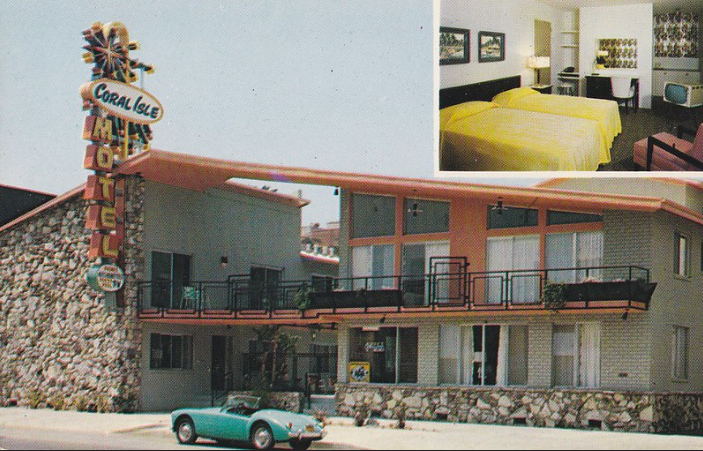
5601 Hollywood Boulevard: Coral Isle Motel

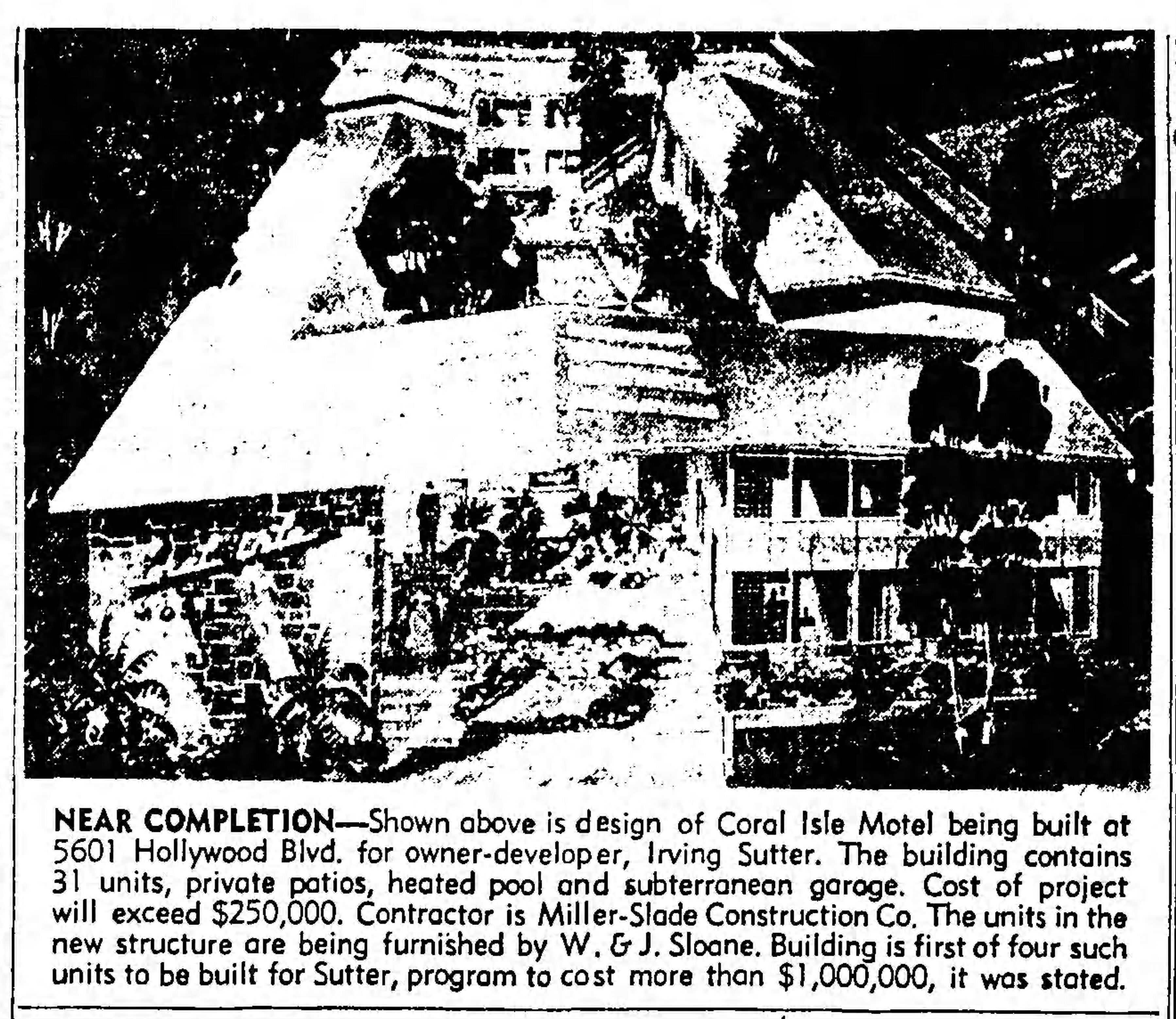
The Coral Isle Motel was built at 5601 Hollywood Boulevard, in the Morgan’s Hollywood Tract, in 1957 for owner-developer Irving Sutter. In June 1956, Richard E. Garland demolished an existing residential structure; the parcel also contained a recent building, used as a real estate office, built in 1945.

Construction on the Coral Isle was underway by April 1957. It catered more to long-term residents rather than transient guests.

LA Times 4/7/1957

LA Times 9/29/1957

Hollywood Citizen News 5/27/1959

Today the Coral Isle  is a boutique hotel, the Downtowner Inn.

5533 Hollywood Boulevard: The St. Francis Apartment Hotel

The St. Francis Apartment Hotel opened at 5533 Hollywood Boulevard at the northeast corner of Hollywood Boulevard, a little ways west of Western Avenue, on August 15, 1928.

LA Times 8/22/1926.

LA Times 8/8/1926.

The owner, Hollywood Income Properties, represented by George Marcell, applied for a permit to construct the hotel in July 1926. In August 1926, the Times reported that the foundation had been completed, and that work on the structural steel frame was to begin. It was to be known as the Weston Apartments for owner of the parcels it stood on, Harold Weston, and would be completed about February 1, 1927. February came and went, however. In April 1927, the Weston was said to be nearing completion and set to open around May 1, 1927. That date, too, passed. In July 1927, the Times reported that the property was now the property of the Hollywood-Roosevelt Properties Corp (George Marcell, Secretary-Treasurer). Now known as the “Hollywood Apartment Hotel,” it would reportedly be ready about August 15.

It did open on August 15- but it was August 15, 1928 not August 15, 1927. In the meantime, in July 1928 the Times reported that the recently completed apartment hotel, now renamed the St. Francis, as well as the underlying land it stood on, had recently been sold to the Hollywood Securities Corp., James Long Wright, president, for $850,000.

LA Times 7/29/1928.

Finally, the 5-story, brick-veneer apartment-hotel, designed by architect William Allen, did hold its grand opening, with an open house and the now-usual light display by Otto K. Olesen.

Hollywood Daily Citizen 8/14/1928

Hollywood Citizen News 8/14/1928.

Hollywood Citizen News 8/14/1928

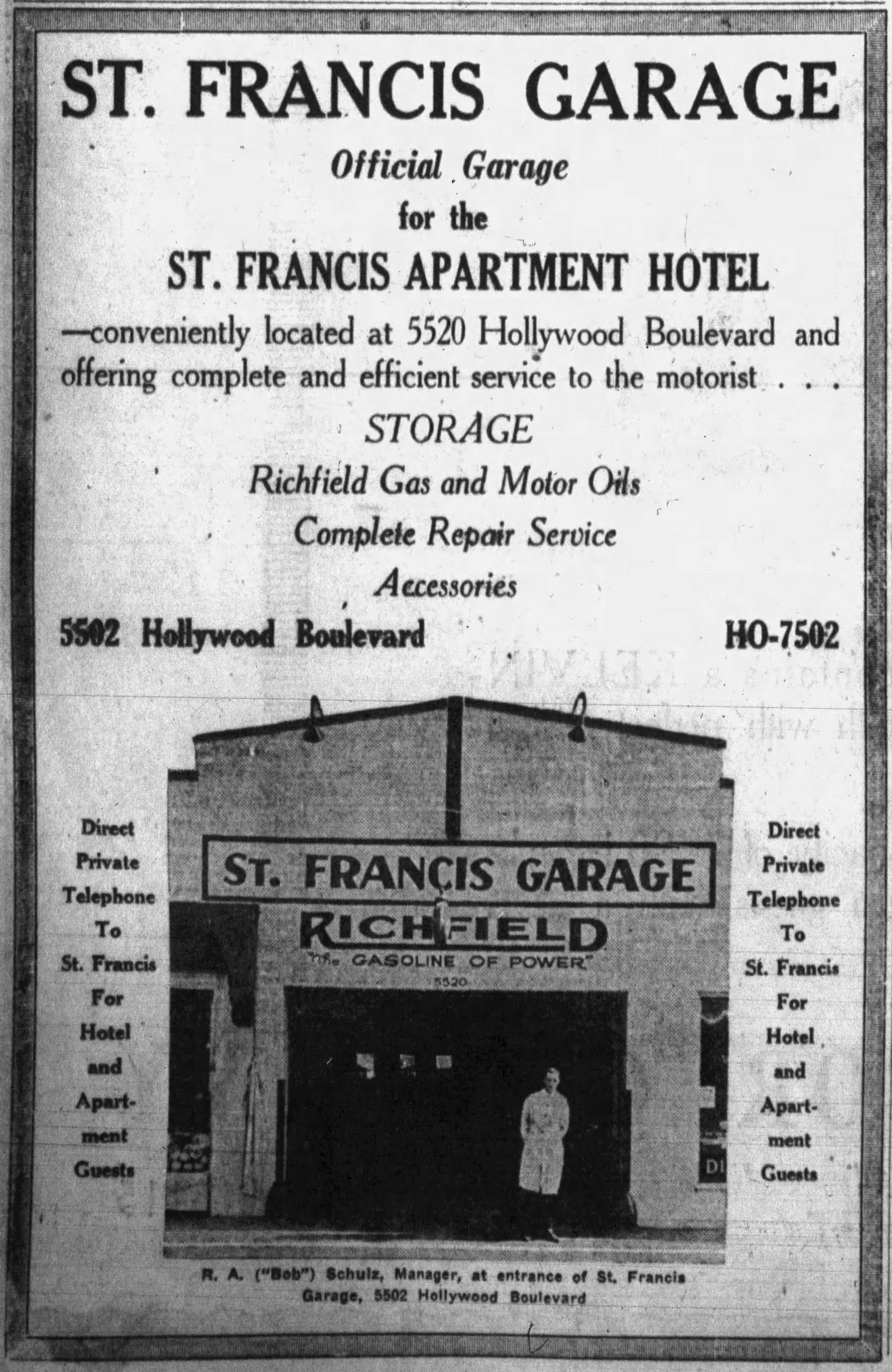
The hotel’s official garage was located across the street at 5502 Hollywood Boulevard. Hollywood Daily News 8/14/1928

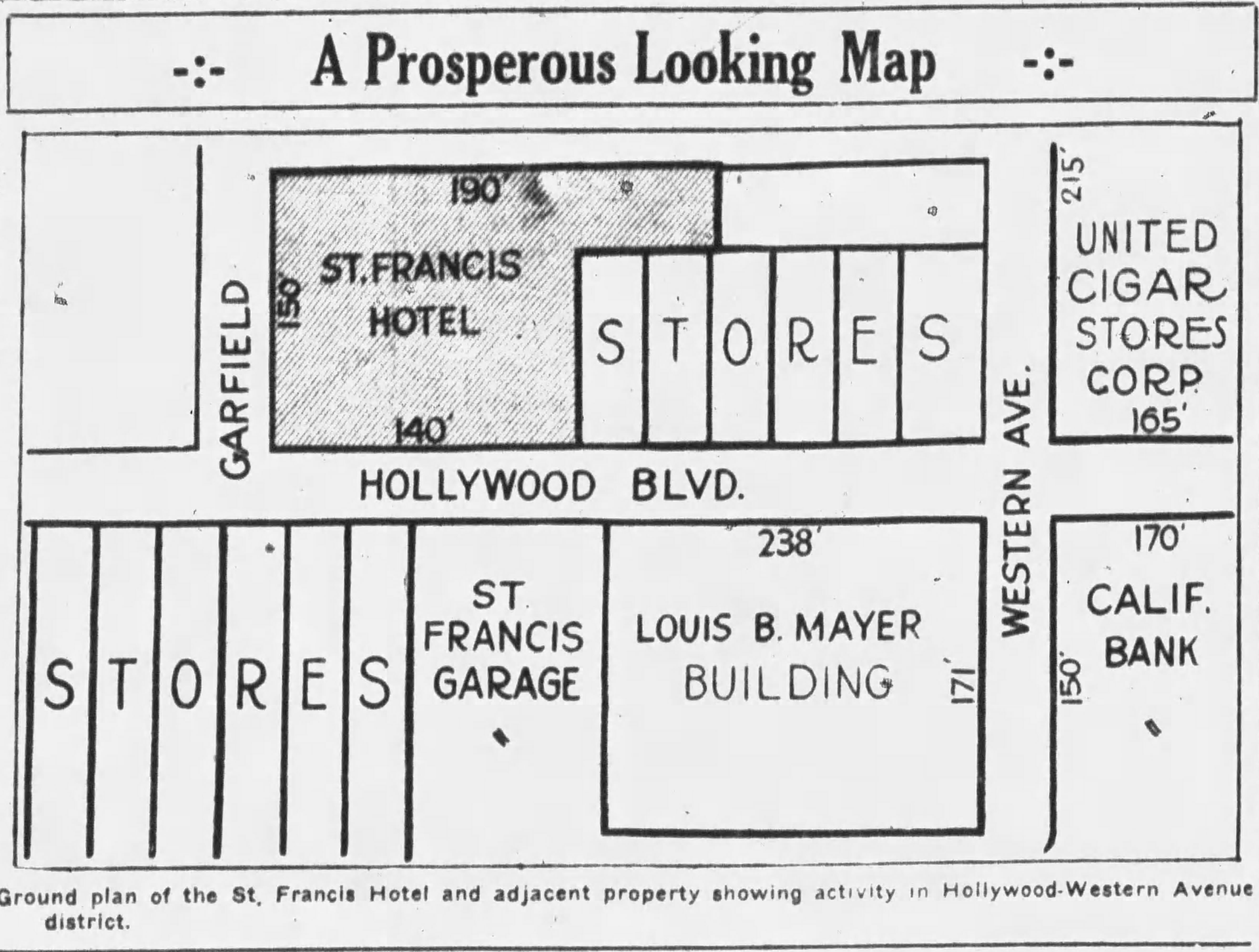
Map of recent development in the Hollywood & Western area, including the Rector Hotel (1924, owned by United Cigar Stores Corp) and the Hollywood-Western Building (1928). Hollywood Daily News 8/14/1928.

Hollywood Daily Citizen 12/7/1928

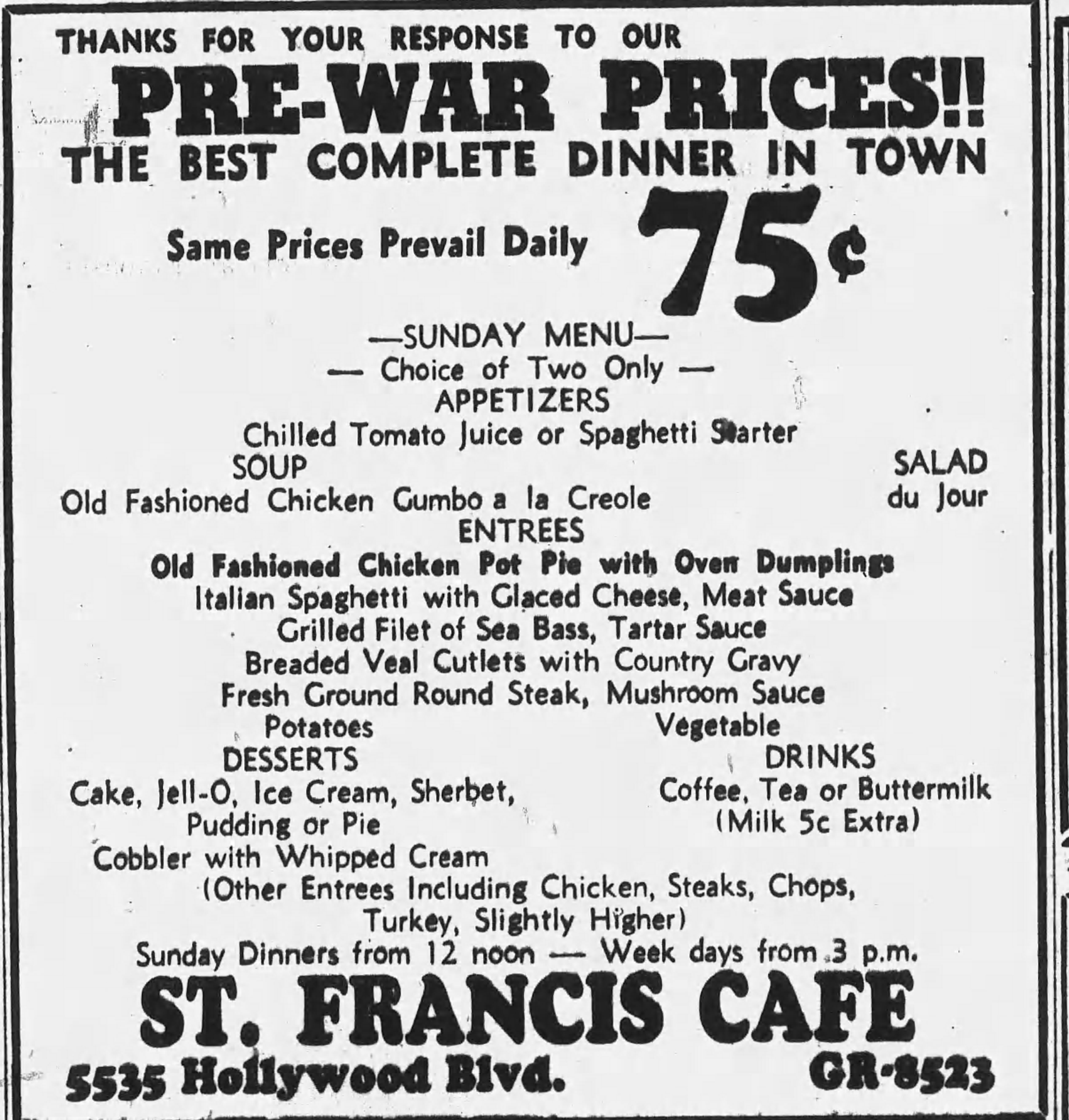
The hotel restaurant, the St. Francis Cafe, was addressed as 5535 Hollywood Boulevard. It has its own entrance from the street, as well as one from the lobby.

LA Daily News 4/19/1938

Hollywood Citizen News 5/13/1939

Hollywood Citizen New 4/17/1948

On May 15, 1951, it became the short-lived Hagen’s Restaurant. The cafe space was converted to other uses not long after this.

Hollywood Citizen News 5/14/1951


The St. Francis in the 1960s. LAPL photo.

The apartment-hotel is still extant. It is now known as the Gershwin.

5447 Hollywood Boulevard: Hotel Rector

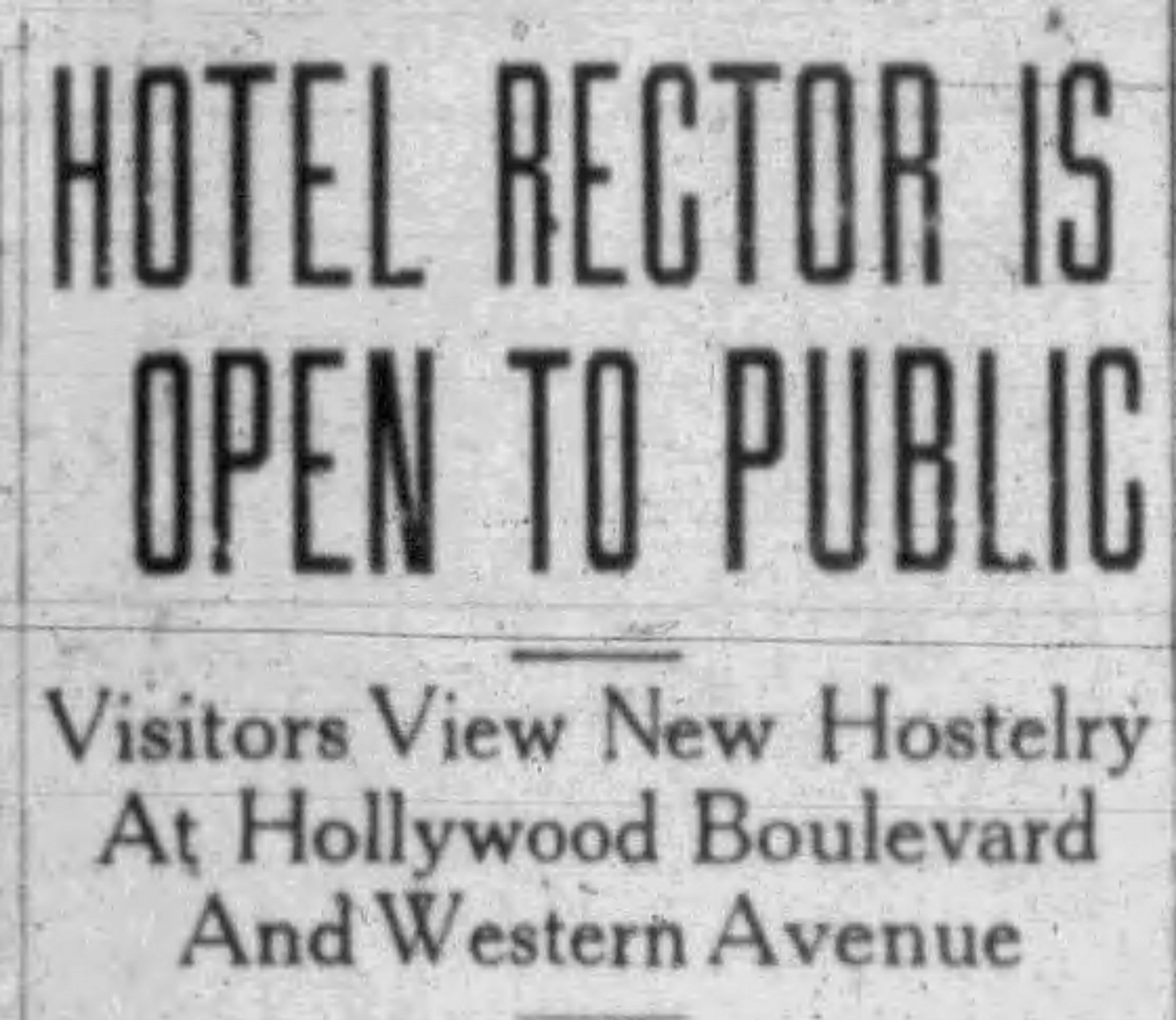
Located on the northeast corner of Hollywood and Western, the Hotel Rector held its gala grand opening on the night of October 4, 1924, at the same time as the Hollywood Guaranty Building down the street at 6331. An electrical display, “the Aurora Borealis,” supplied by Otto K. Olsen for both buildings lit the Hollywood sky to mark the occasion.

Hollywood Citizen News 10/6/1924

The new Hotel Rector. Hollywood Citizen News 10/3/1924

The 4-story brick structure was designed by architects Walker & Eisen for the leaseholder: the realty development department of the United Cigar Stores corporation. The ground it stood on was owned by a wealth widow, Delia Nadeau of Butte, Montana (who died in 1927). When people got hold of land in Los Angeles, they almost never sold it. Rather, they would issue long term leases on the property. If the leaseholder ever defaulted, any improvements made to the property reverted to the owner of the underlying ground. When the term “sold” was used in relation to real estate transactions, it usually really meant that the building itself, with its attendant lease, changed hands, not the underlying land. Heirs whose relatives didn’t sell off their land to pay for their gambling habits (thanks a lot, Grandpa Bob) lived off the profits of these long-ago leases for decades.

Like most large hotels of the era, it had retail shops on the ground floor. Some of the original tenants were the Rector Pharmacy, the Rector Bootery shoe store at 5461 and the Rector Master Tailor at 5459. The hotel itself was usually addressed as 5447; it was sometimes known as 5455.


Announcing new management of the Hotel Rector five months after it opened. Hollywood Citizen News 3/7/1925.


The 5400 block of Hollywood Boulevard looking west. The LA Public Library dates this photo to c. 1935.

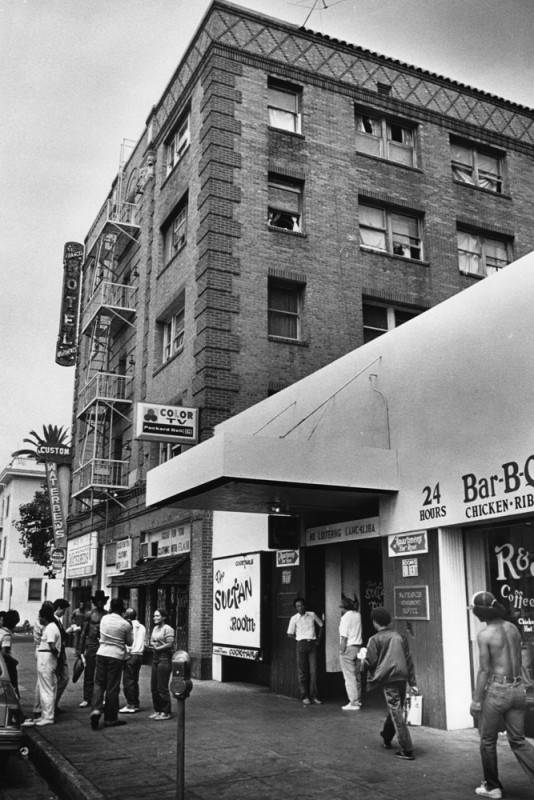
The Hotel Rector saw Hollywood’s rise and its subsequent decline beginning in the late 1960s. Never a luxury accommodation but was a decent mid-level tourist hotel for most of that time, the Rector became a single-room occupancy (SRO) residence. It closed in the late 1980s, supposedly due to damage from the Whittier Earthquake (1987). With vacant or boarded-up structures, the corner of Hollywood and Western was increasingly known for rampant crime- mostly drugs and prostitution.

LA Times 9/6/1990

In September 1990, the Los Angeles Community Redevelopment Agency (CRA) gave developer Ira Smedra $5.1 million in loans and other funding to redevelop the 3-plus acre Hotel Rector property as mixed-use retail and low-income senior housing complex to be known as the Hollywest Promenade and the Hollyview Apartments. Smedra was supposed to secure the remaining funds needed by 1992 or begin paying 10% interest. Most of the money went toward acquiring the property. In September 1992, with the funding to build the project still unsecured, the CRA, which had extended Smedra’s funding deadline (without charging interest), approved Smedra’s request to demolish the Hotel Rector, on the basis that he would have a better chance of getting bank loans if the parcel was vacant. Some CRA board members questioned whether the senior housing was even a good idea- would seniors even want to live in such a crime-ridden area? They seem to have forgotten that the redevelopment was supposed to rid the area of said crime, but whatever.

The Hotel Rector was demolished in July 1993.

LA Times 5/8/2001

In March 1996, the CRA granted Smedra a sixth extension on the terms of his loan (no interest paid). The corner of Hollywood and Western continued to decline, with more boarded-up structures as a result of the Northridge Earthquake. As of February 1998 the parcel remained vacant. Construction on the retail portion of the project finally got underway around late 1999. In May 2001, still only partly completed, Smedra requested another $37 million for the senior housing portion of the complex, which was used as a scapegoat for the lack of progress. The senior housing opened in October 2003. The CRA purchased the project upon its eventual completion and turned the housing wing over to a nonprofit Retirement Housing Foundation.

The Hollywood Boulevard facade of the Hotel Rector property today. Google map image.


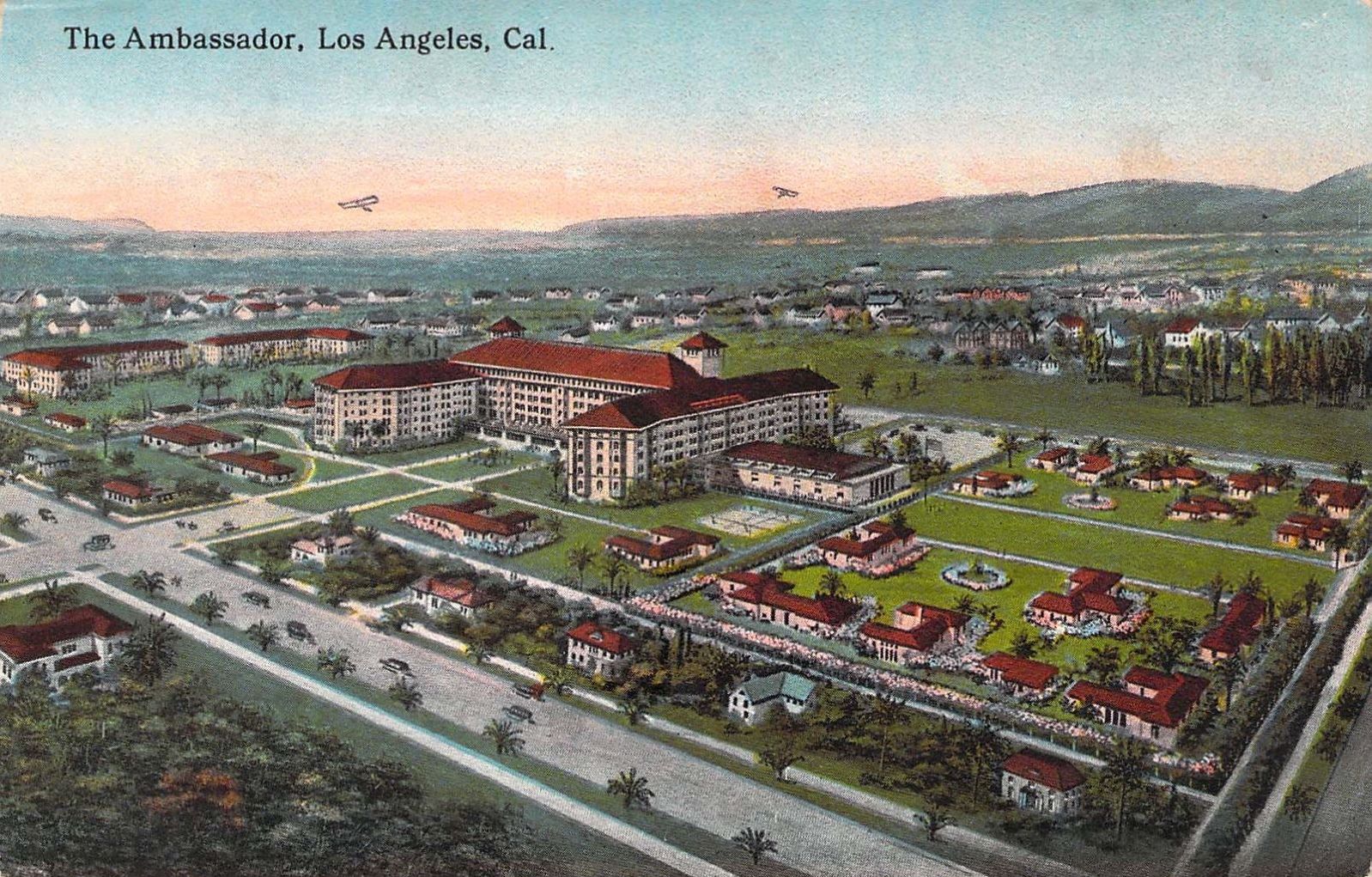
The Ambassador Hotel & the Cocoanut Grove

ambassador_hotel_los_angelesFrom the time the Ambassador Hotel opened on New Years’ Day, 1921 it was more than a hotel, it was a destination. Set amidst 21 acres of landscaped grounds, with its own tennis courts, golf course, restaurants, movie theater, post office, beauty salon, barber, shops and shoeshine stands, it was like a small city on its own. Its nightclub, The Cocoanut Grove, opened a few months after the hotel and Los Angeles and Hollywood society had been enjoying palmy nights there ever since. Continue reading