6032 Hollywood Boulevard: Automobile dealerships / Hollywood Toyota

Detail of a 1913 Sanborn Fire Insurance Co. map for Hollywood. The parcel that became 6030-6038 was still vacant. The Rich family also owned both parcels directly to the east (6024-6028) and west (6048). Library of Congress map.

Like its neighbor 6028 to the east, 6032 Hollywood Boulevard has home to a smorgasbord of automobile dealerships, including the first Toyota dealership in the USA.

The parcel was vacant until 1920 when siblings Frank Rich and Bessie Rich Garlock had a 1-story retail building constructed here. With space for 5 retail stores, it was addressed as 6030-6032-6034-6036-6038 Hollywood Boulevard. Rich & Garlock were the adult children of Edwin Rich, who owned the adjacent parcel (see 6028 Hollywood Boulevard). Their uncle was Sanford Rich, of 6048 Hollywood Boulevard, who had been mayor of Hollywood from 1904 to 1905 before it was annexed by the City of Los Angeles in 1910.

The building housed various small, mostly short-lived businesses- an automotive supply, a plumber, an architect, a hat shop, a luggage maker.

On June 2, 1928, local papers announced that the property had been leased to Leo G. Coryell, Hollywood Oakland-Pontiac dealer.

Though the papers stated that the existing 1-story building would be demolished and a new auto showroom built in its place at a cost of $20,000, that was either a mistake or a deliberate fib- the same day of the announcement, the siblings obtained a permit to modify the existing building at a cost of $20,000. From now on it would be 6032 Hollywood Boulevard.

Coryell had been a salesman for the Albertson Motor Company Dodge distributors. For several years in the early 1920s, the firm supplied a fleet of Dodges for the LAPD.

By 1927, Coryell was a dealer for Oakland and Pontiac automobiles. The Oakland Motor Car Company was founded in 1907 and purchased by General Motors (GM) in 1909. Pontiac was a also a GM brand, created in 1926.

Coryell had his formal opening for 6032, with motion pictures, lights, prizes and a general good time, on August 25, 1928.

Hollywood Daily Citizen 1/15/1930.

Hollywood Daily Citizen 8/15/1928


Hollywood Daily Citizen 8/15/1928

Hollywood Daily Citizen 8/15/1928.
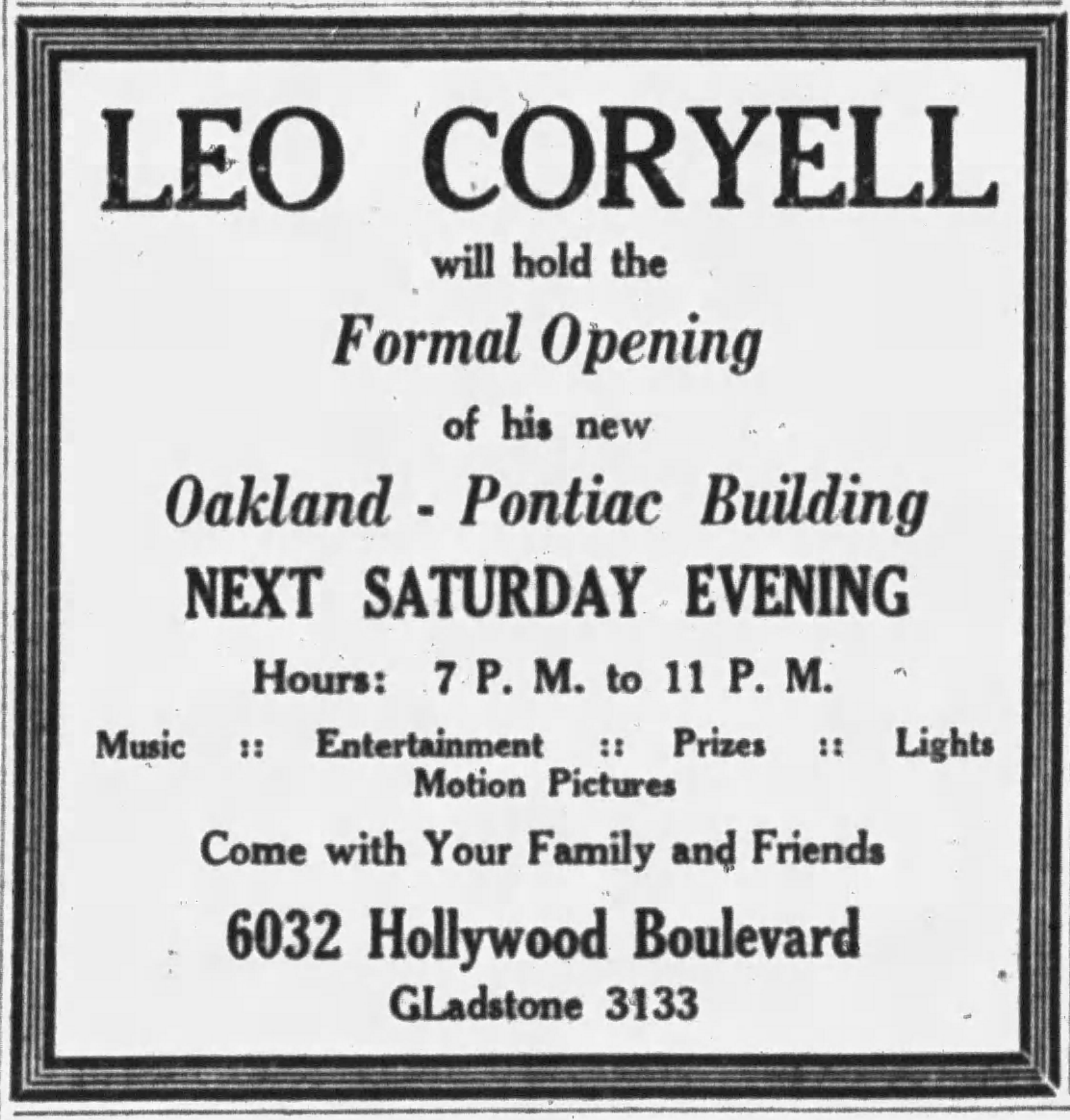
Hollywood Daily Citizen 8/23/1928.
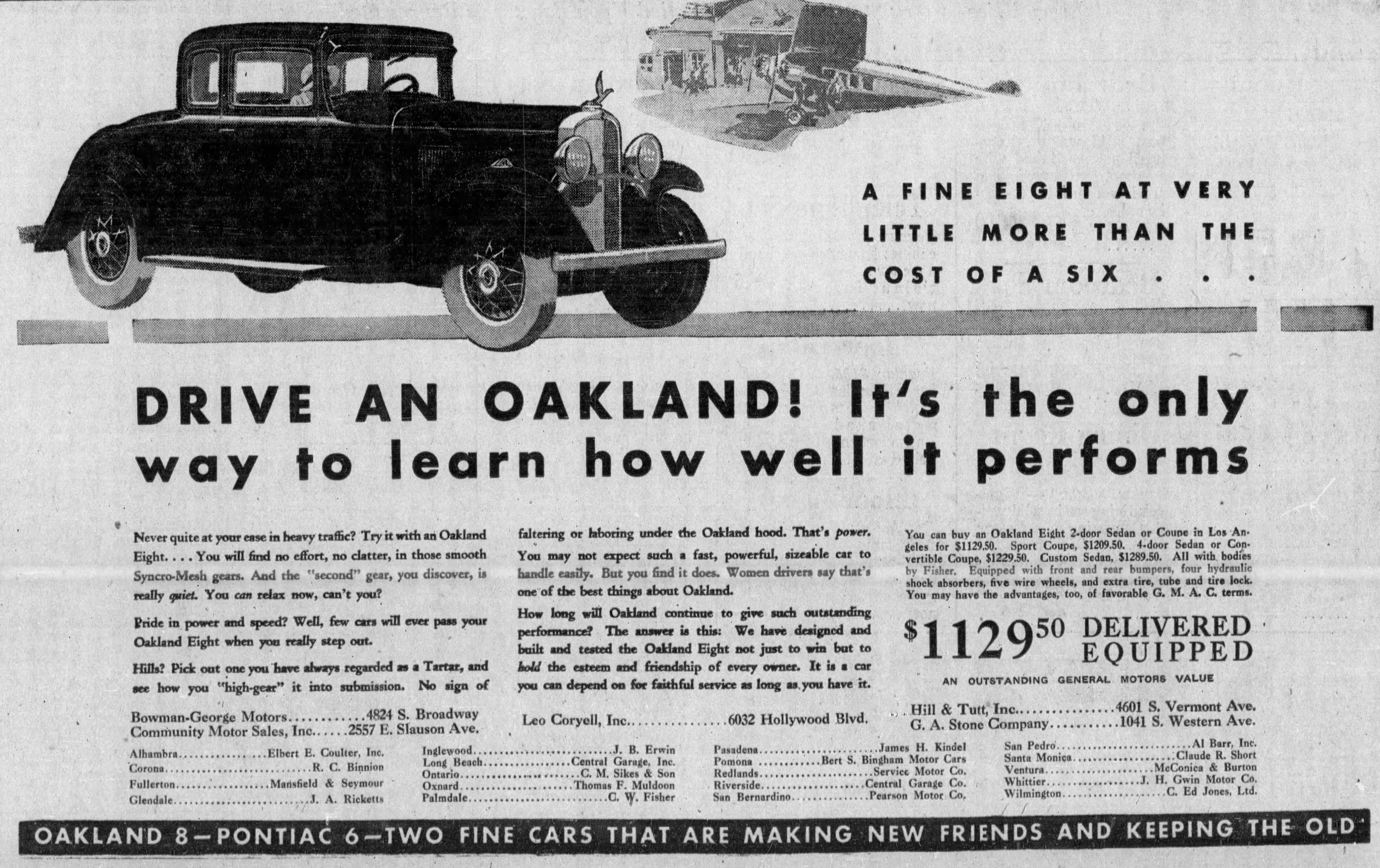
LA Times 9/10/1931

H. H. Goodrich, president of Leo Coryell, Inc., took over the dealership in April 1932, now selling the Pontiac only as GM phased out the Oakland in 1931. He was only in business briefly and closed out the shop in November 1932.
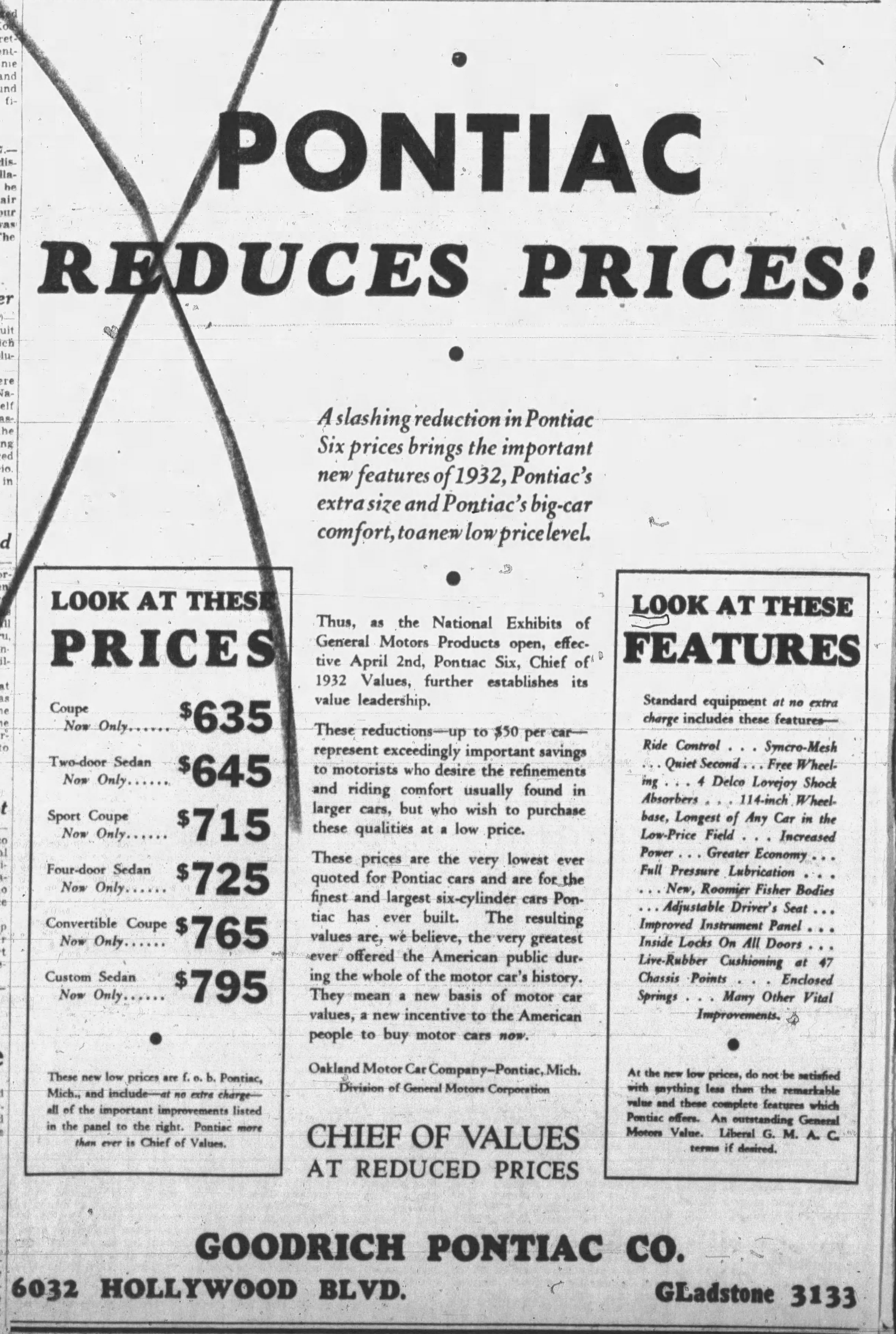
As Goodrich Pontiac. Hollywood Citizen News 5/7/1932.
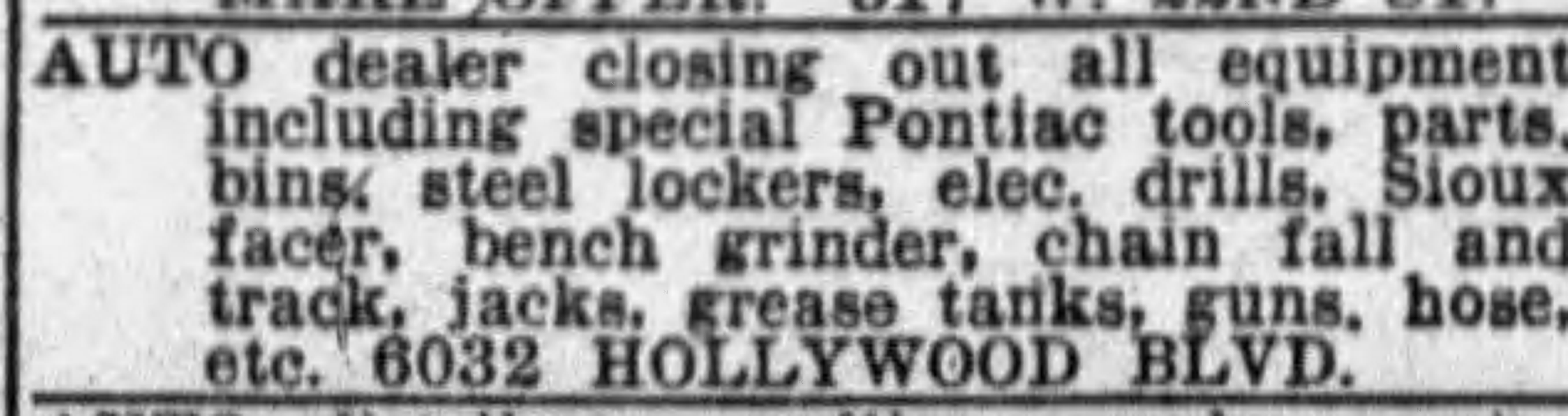
 

LA Times 11/26/1932.


On March 1, 1933, it was announced that Hudson Essex dealer Glenn B. Austin had opened a branch at 6032 for his used car department, The cars sold here were largely demonstrator models with only a few miles on them.

Named for department store owner Joseph L. Hudson, the Hudson Motor Car Company was founded in Detroit in 1909. The company introduced the Essex in 1919. It began phasing out the brand in 1932, replacing it with the Terraplane.

“Why put up with mere transportation?” By all means, shame the Depression-era car buyer into taking on more debt, Glenn! Hollywood Citizen News 3/1/1933.

Austin was only here briefly, through May 1933. Hudson would return to this vicinity in 1941- when Sunset Motors moved next door at 6028. By then the Terraplane was no longer made- Hudson discontinued it in 1938.

From August 1933 to September 1935, 6032 Hollywood Boulevard served as an auction house.

In October 1935, 6032 again became a Pontiac dealership when Pontiac dealer A. E. (Ab) England announced that he was moving into what he called “one of the finest and best equipped automotive establishments in the movie capital.”  England and his brother C.P. England came to Hollywood from Phoenix, where they’d been in the auto business with their uncle O.T. England.
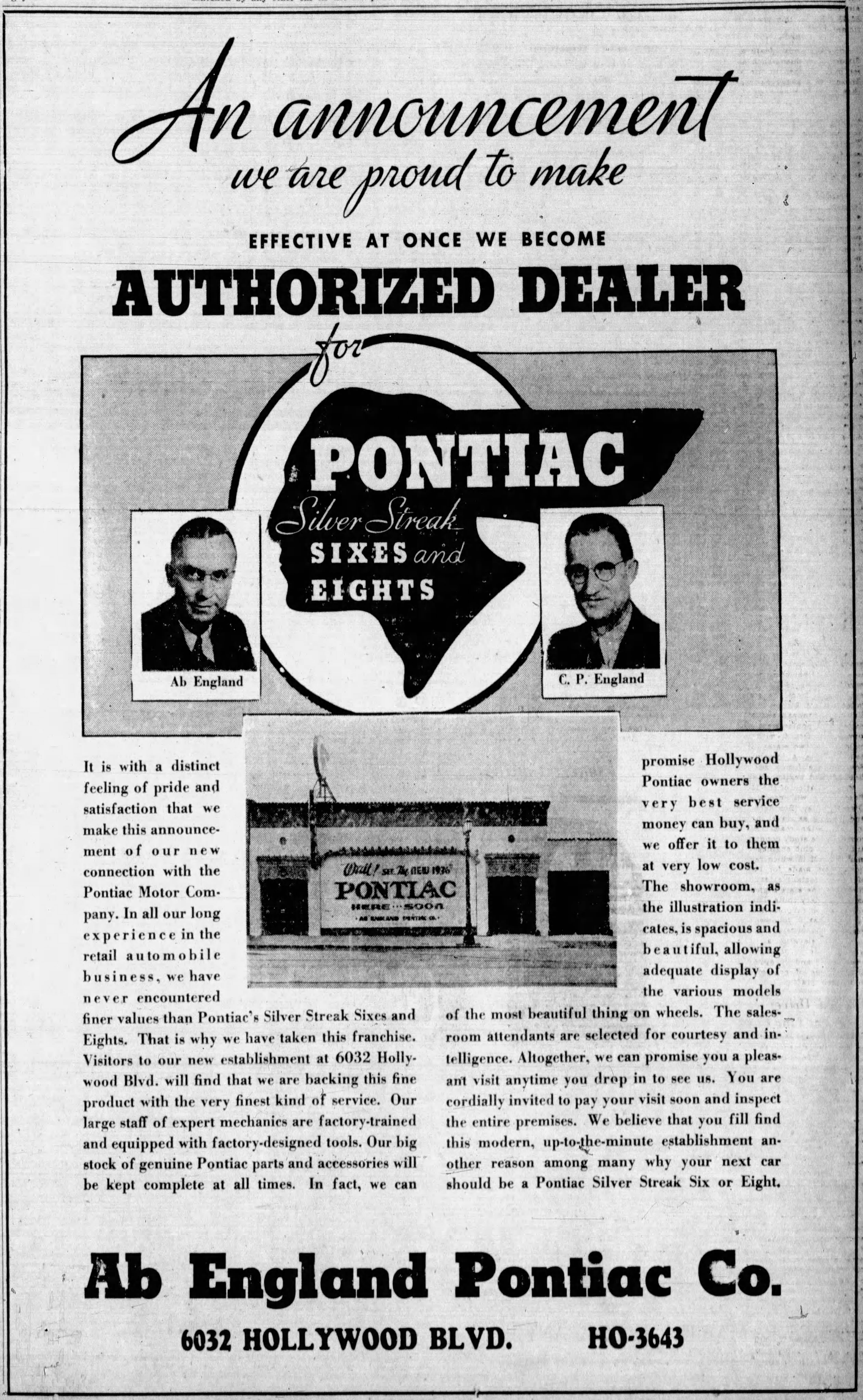
As Ab. England Pontiac. Hollywood Citizen News 10/16/1935.

This section of the Boulevard was still fairly undeveloped at this point. The south side of the block was largely devoted to auto dealerships interspersed by the shaded lawns of the Mountain View Inn. Across the street, there was the Marcal Theater and some small retail buildings but the rural Brokaw property was still undeveloped, but for a defunct miniature golf course. That would change between the years 1936 and 1940 when the Palms Grill, Hawaii Theater, Florentine Gardens and Hollywood Food Mart were built.
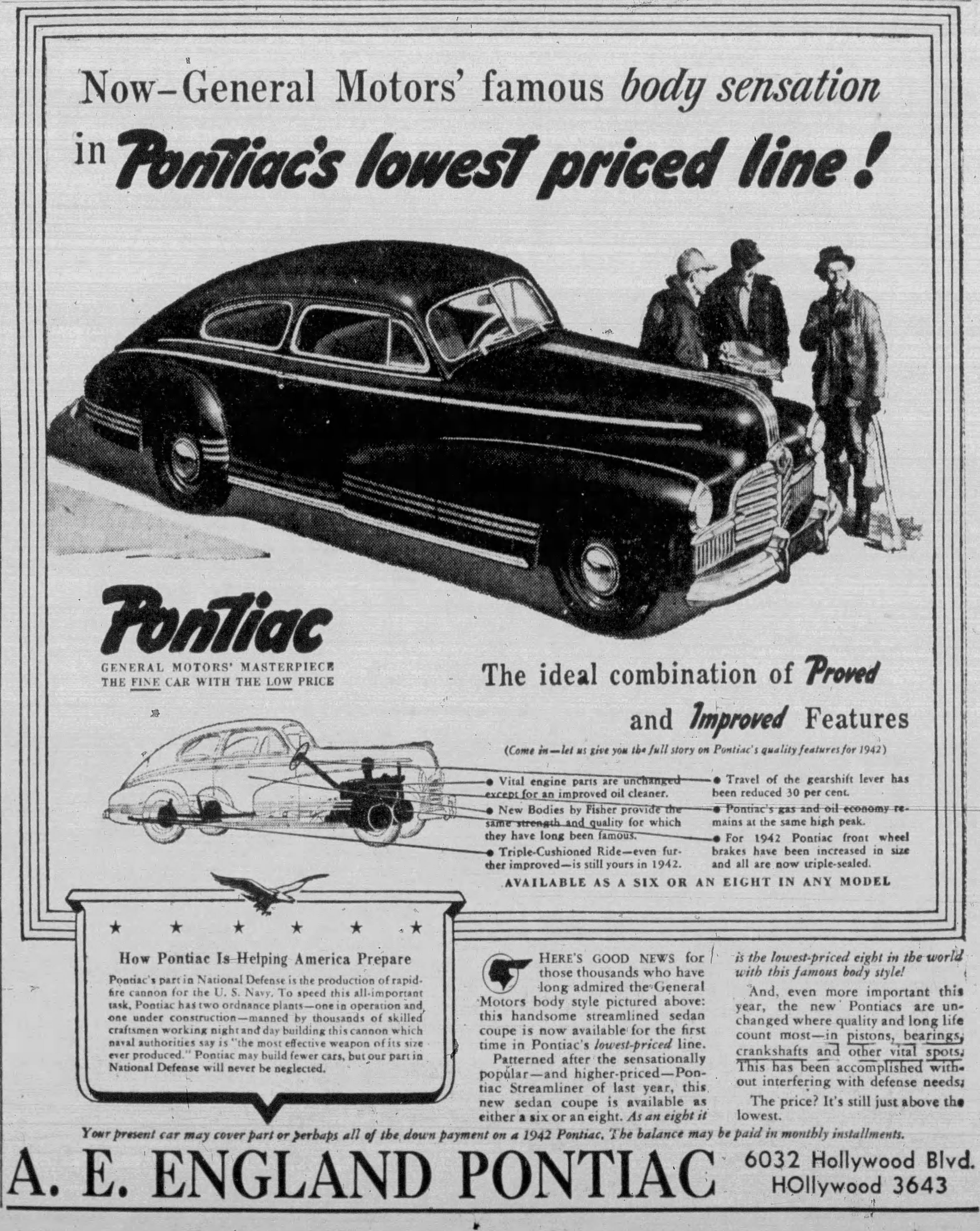
Hollywood Citizen News 11/19/1941

Many auto manufacturers like Pontiac were already working on military contracts prior to the US entry into World War II. Domestic auto production shut down in February 1942 as the auto industry turned 100% to the war effort. Dealers like A.E. England focused on maintaining and repairing existing cars in the service departments and buying and selling used models.

A. E. England Pontiac moved out of 6032 after September 1944, relocating up the block at 6161 Hollywood Boulevard.

6032 again languished as an automotive building. It became the new home of the Hollywood Gun Shop from March 1945 through December 1949. The shop also sold items such as bicycles, fishing rods and reels and other sporting goods equipment. It moved to the former Paul G. Hoffman Studebaker building at 6116 Hollywood Boulevard.

LA Times 3/18/1945.

LA Times 7/16/949

In March 1950, the building returned to automotive use as the showroom of “Roi’s of Hollywood” used cars. Roi’s remained here through early June 1950.
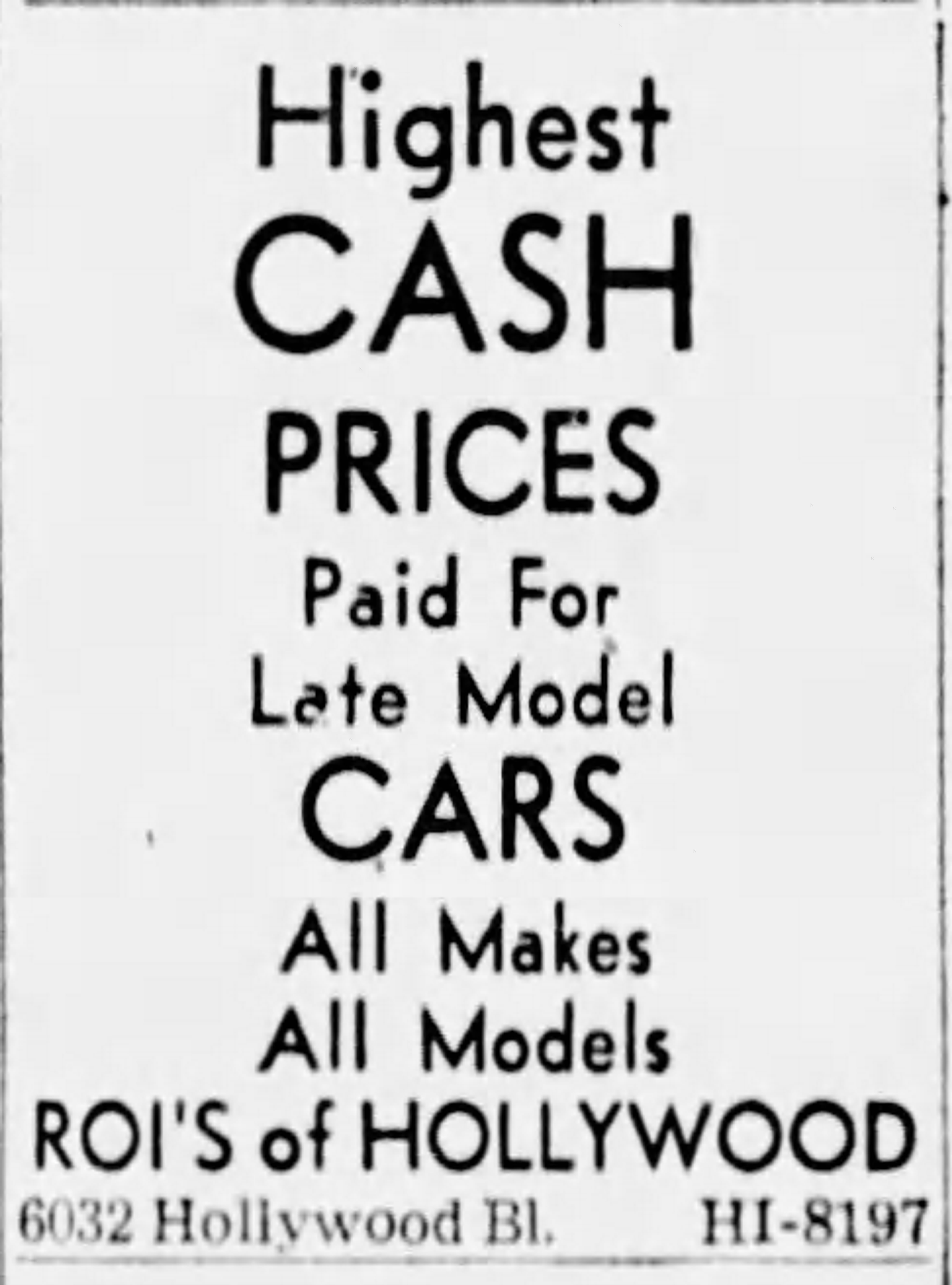
Valley Times 3/20/1950.

On June 22, 1950 it became Hollywood Nash. Nash had previously operated next door at 6028 in 1936 to 1937 when 6032 was a Pontiac dealership. Nash Motors Co. had become Nash-Kelvinator Corporation in January 1937, and operated as the automotive division of Kelvinator, manufacturer of refrigerators and other appliances.

Nash Motors Company, based in Kenosha, Wisconsin, was founded by former GM president Charles W. Nash in 1916 when he acquired the Thomas B. Jeffrey Co., which had manufactured a horseless carriage called the Rambler from 1902 to 1914. Nash introduced its Rambler for the 1950 model year along with the Nash Statesman and the Nash Ambassador. The Rambler was considered a compact car for the time. Nash began using the distinctive “Airflyte” aerodynamic body styling in 1949.

In November 1950, manager Ted Faull announced that a modernization and reorganization of the space was nearing completion. Customers would now be able to enter the service department from Hollywood Boulevard but would exit onto Carlton Way, thereby avoiding traffic on the Boulevard. This indicates the dealership must have been routing customers along the south (rear) part of the property, and to the east past 6028 and 6000 Hollywood Boulevard to the alley called Brokaw Place that connected Hollywood Boulevard to Carlton Way between 6000 and the Mountain View Inn at 5956 Hollywood Boulevard.
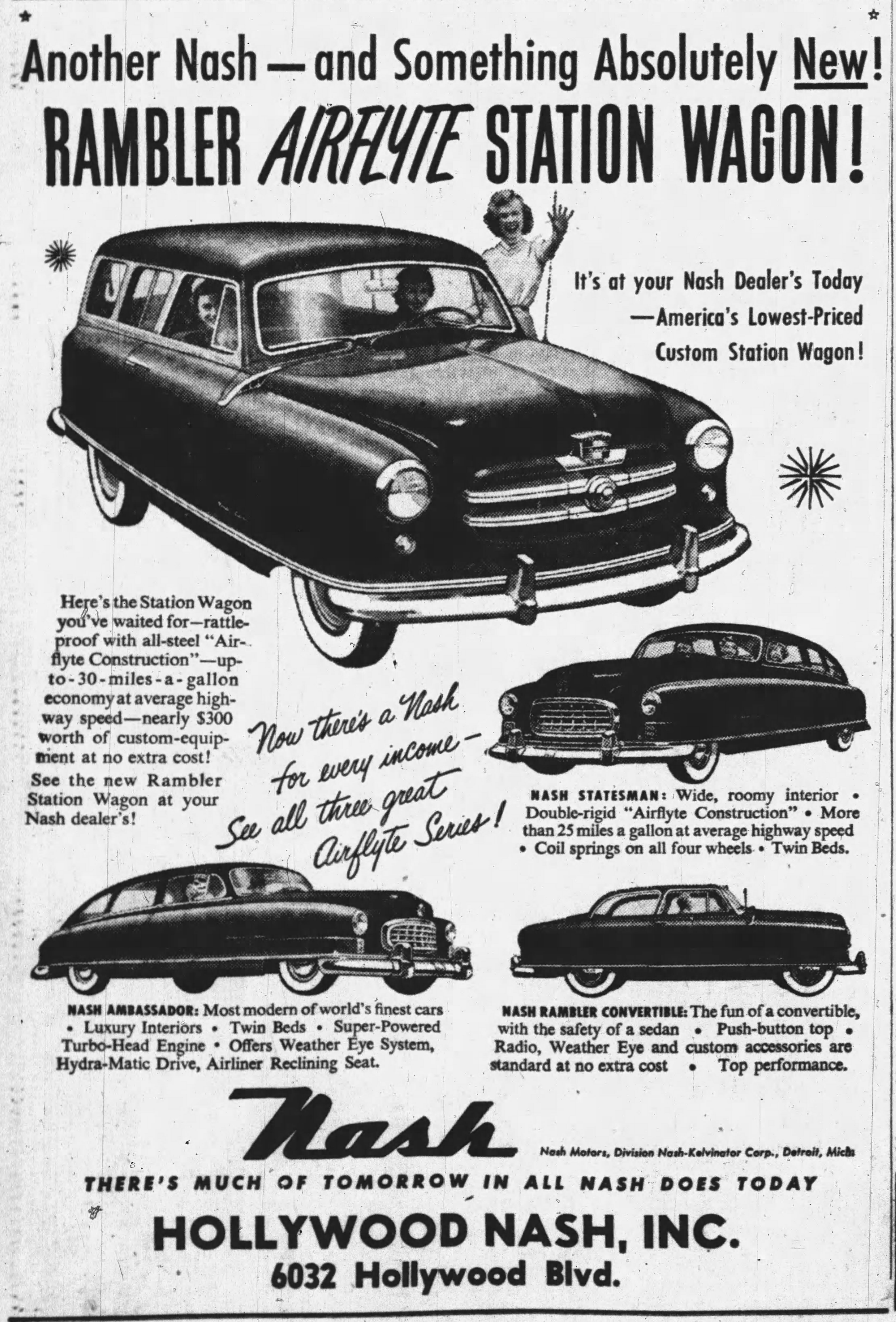
Twin beds? Yes, the Nash Ambassador and Nash Statesman features fold-down front seats that made into a bed. The “Weather Eye” was the heating and air-conditioning system. Hollywood Citizen News 6/23/1950.
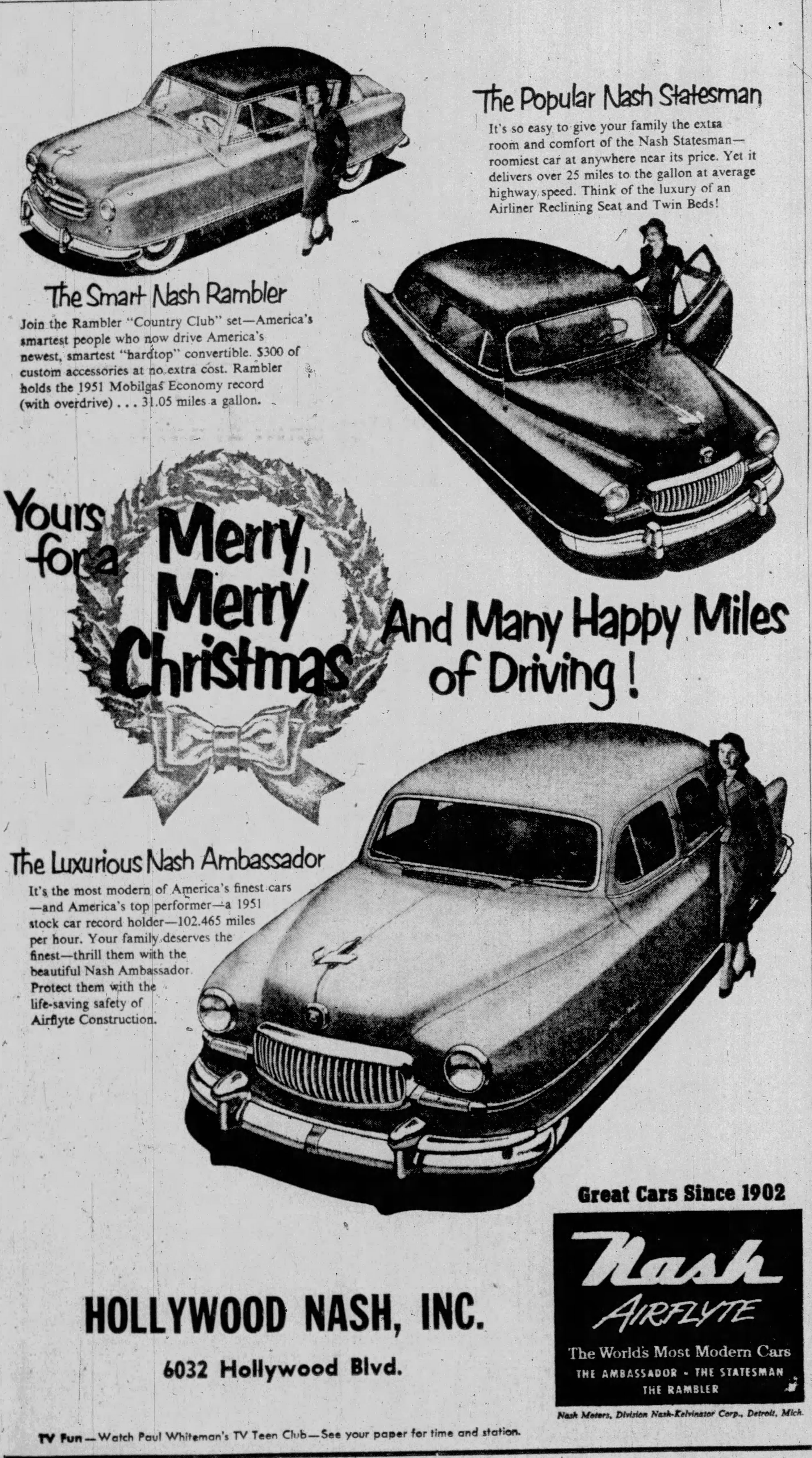
Hollywood Citizen News 12/13/1951
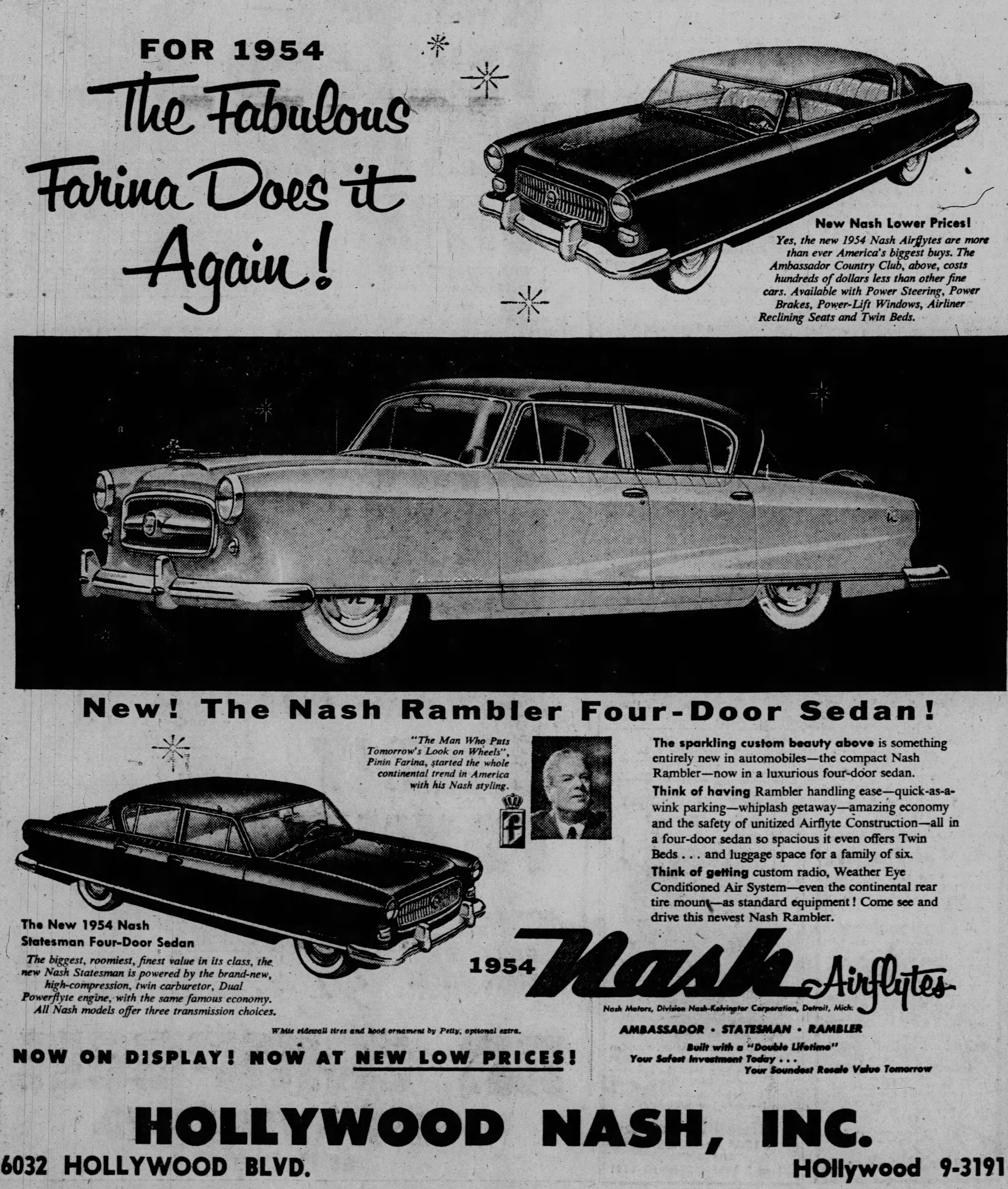
“The Fabulous Farina” is a reference to Italian auto designer Battista “Pinin” Farina who worked as a consultant for Nash on the 1952-1954 models. Citizen News 12/1/1953.

Hollywood Nash remained here through December 1953. It moved to 5239 Sunset Boulevard. In 1954, Nash-Kelvinator merged with Hudson to form the American Motors Corporation (AMC).

From January 1954 to May 1957, 6032 was used by J. F. O’Connor and Son  Lincoln-Mercury, who had moved to 6028 in 1949, and then by O’Connor’s successor, Pearson Lincoln-Mercury. By this time both parcels were owned by Mark M. Hansen of the Marcal Theater and his wife Ida. Hansen had acquired 6032 by 1940 and 6028 as of 1952 for sure. Pearson left in May 1957 when Hollywood Ford took over 6028 Hollywood Boulevard. Likely Ford was using this property as well.

Hollywood Citizen News 1/15/1954.
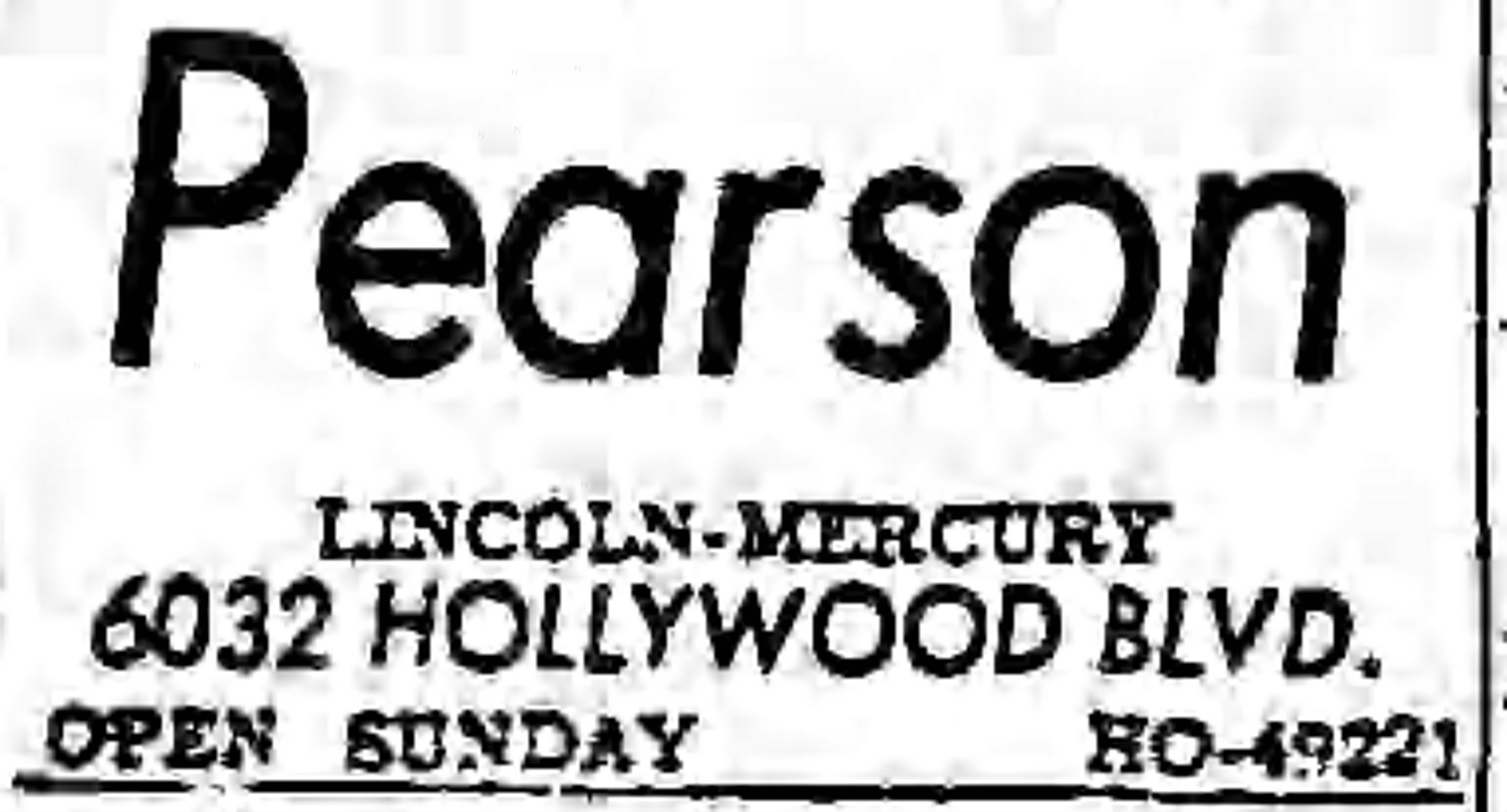
LA Times 5/13/1957.


In July 1957, Reuters and other news correspondents reported that the Toyota Motor Company of Nagoya, Japan was to begin exporting its Toyopet passenger cars in the USA, an attempt to capture the growing market her for smaller, more fuel efficient cars. Toyota officials scouted locations and decided that Hollywood was the ideal place to open its first dealership.

Reuters reports on Toyota’s plan to enter the US market. LA Times 7/14/1957.


Los Angeles Toyota fans with a paid admission to the Imported Motor Cars Show, held at the Shrine Auditorium January 9-19, 1958, got to see the new Toyopet Crown- the first showing in the USA.

LA Mirror News 1/11/1958.

While the show was still underway, on January 18, 1958, the Hollywood Citizen-News reported that Toyota had been granted a license to sell their vehicles in California. Toyota sales director Masuyuki Kato announced that their first dealership would open at 6032 Hollywood Boulevard in February 1958. On March 1, the paper reported that Toyopet parts had arrived at Los Angeles Harbor, bound for the brand’s showroom at 6032 Hollywood Boulevard. The cars themselves were expected in late March. The article indicates there was a Toyota Land Cruiser, 2 station wagons and 4 passenger cars on hand here. These were likely demonstrator models and not for sale.
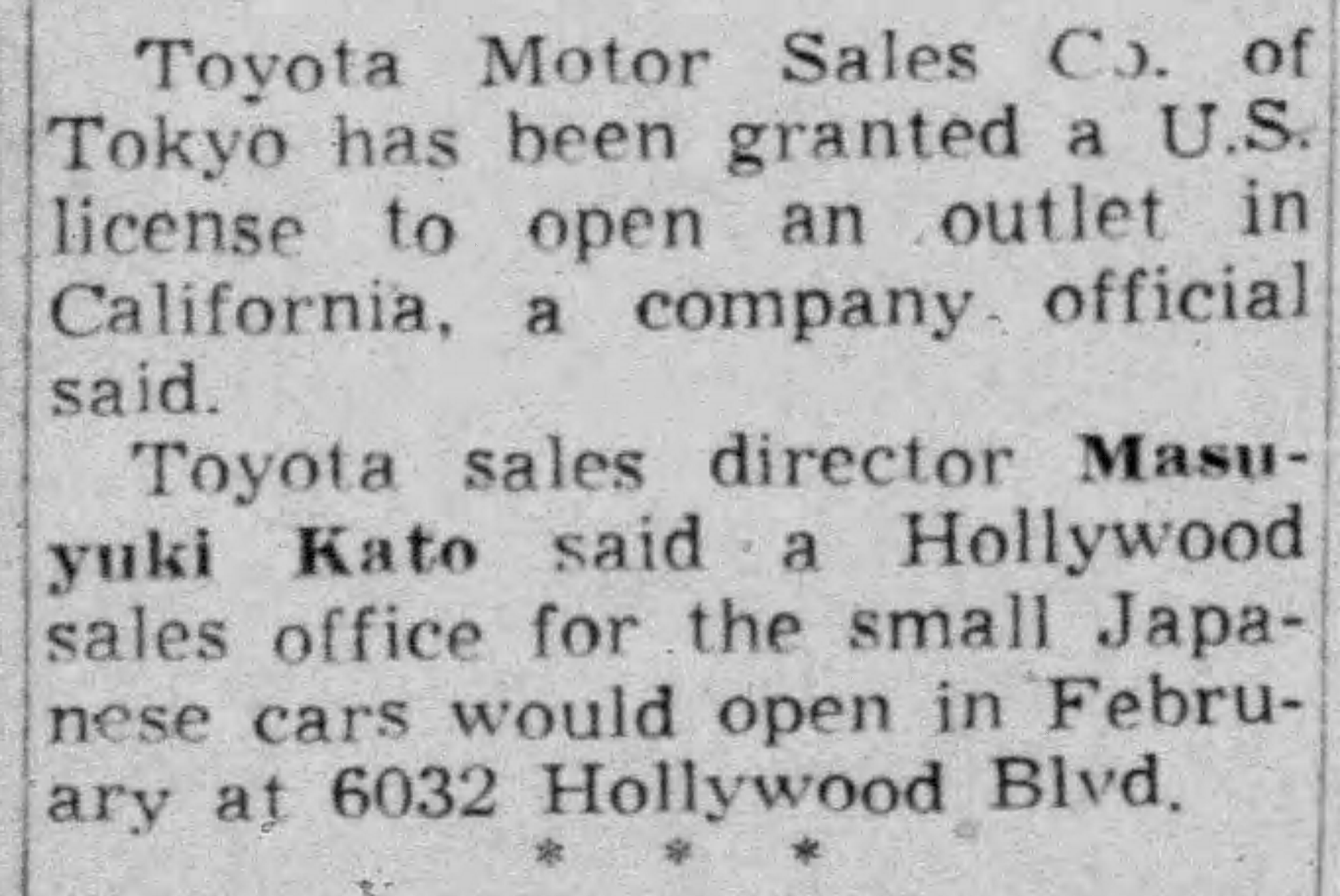
Hollywood Citizen News 1/18/1958.


Hollywood Citizen News 3/1/1958.


Late March came and went. The first shipment of Toyopets for retail sale arrived at LA Harbor on June 20, 1958 and would be available for public viewing on July 18. That date got pushed back to July 31, 1958. And when the Toyopets were finally put on the market, it does not appear that they were sold at 6032 Hollywood Boulevard, after all.  Holt Motor Company Dodge-Plymouth dealer in the Valley at 5230 Van Nuys Boulevard claimed the first public showing. A local Toyopet ad published July 31, 1958 lists all the So Cal Toyopet dealerships. 6032 Hollywood Boulevard is not mentioned. If Toyopet vehicles were being sold or displayed here at this time, it wasn’t hyped.

Pasadena Independent 6/26/1958.


Valley News 7/29/1958.

LA Mirror News 7/30/1958.

Closer look at the local Toyopet dealers listed in the ad above. LA Mirror News 7/30/1958.

In September 1959, Stan Brucks Oldsmobile had an import division called Brucks Imports at 6032 Hollywood Boulevard, and was an authorized dealer of the Toyopet along with other import makes- including Triumph and Singer motor cars from Britain and the Volvo.

LA Times 9/18/1959.

LA Times 9/18/1959.


LA Times 11/20/1959.

Brucks continued to advertise here through November 1959.

July 21, 1961 was the first advertisement for Hollywood Toyota Motor, Inc. at 6032 Hollywood Boulevard.

LA Times 7/27/1961.

If that wasn’t an incentive to buy a new Toyota from Hollywood Toyota! Free passes to see the new James Bond film then playing exclusively down at the Chinese Theater, “You Only Live Twice,” co-starring the Toyota 2000 G. T. Hollywood Citizen News 7/12/1967.

Hollywood Toyota moved to a new building at 1000 N. Vermont Avenue May 24-26, 1968, and later moved again to 6161 Hollywood Boulevard- the onetime home of A. E. England Pontiac.
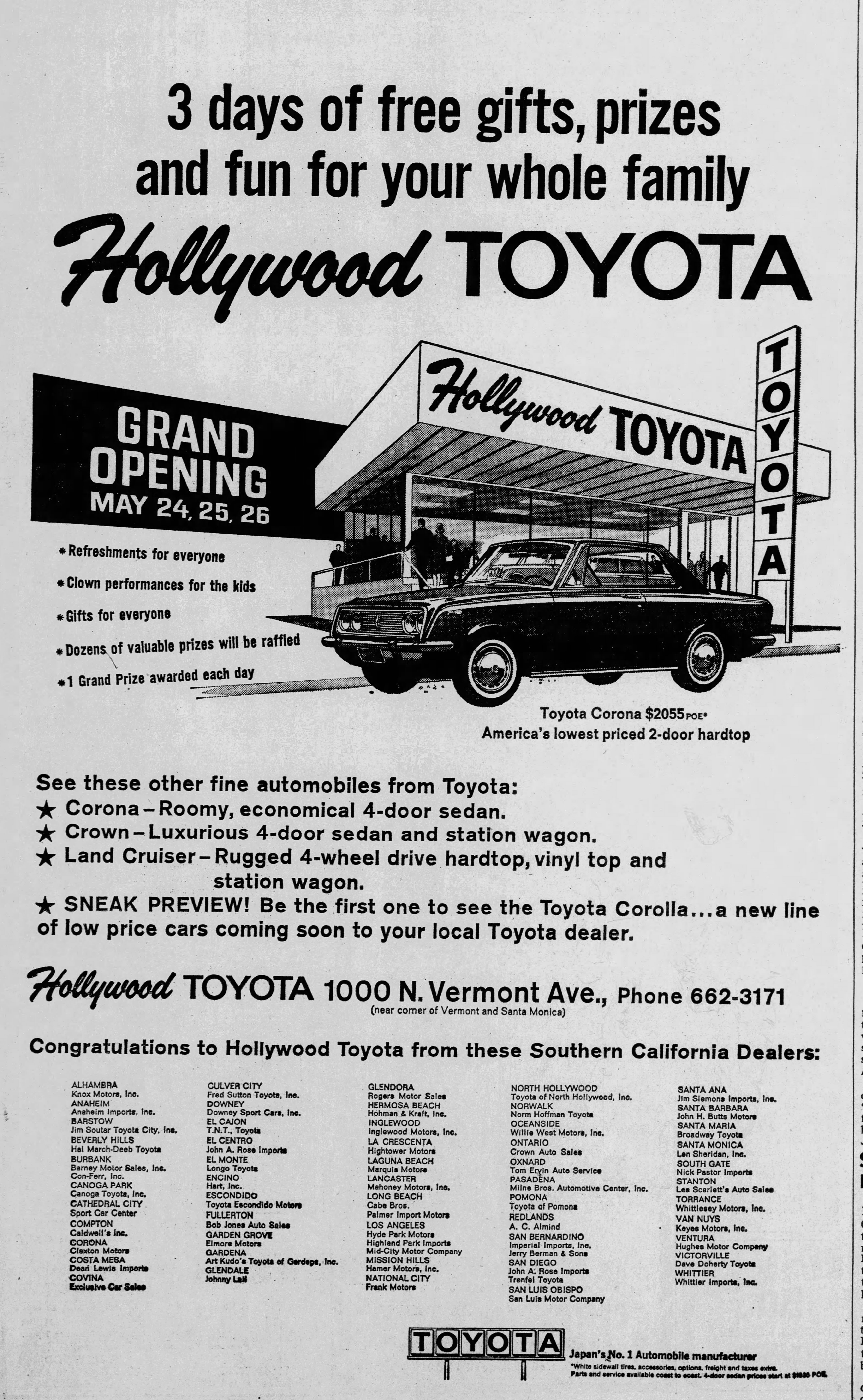
Hollywood Citizen News 5/24/1968.

The address 6032 Hollywood Boulevard does not appear to have been used after Toyota moved out. In June 1970, Hollywood Ford at 6000 Hollywood Boulevard had all extant structures on 6032 and 6028 demolished and the entire property from 6000 to the corner of Gower was addressed as 6000 Hollywood Boulevard.  Hollywood Toyota moved back to this location (as 6000 Hollywood Boulevard) in 1983. Today it remains Hollywood Toyota.
6028 Hollywood Boulevard: Automobile dealerships


Detail of a 1913 Sanborn Fire Insurance map for Hollywood. Library of Congress.

6028 Hollywood Boulevard, on the south side of the street between Bronson and Gower was home to a variety of automobile showrooms.

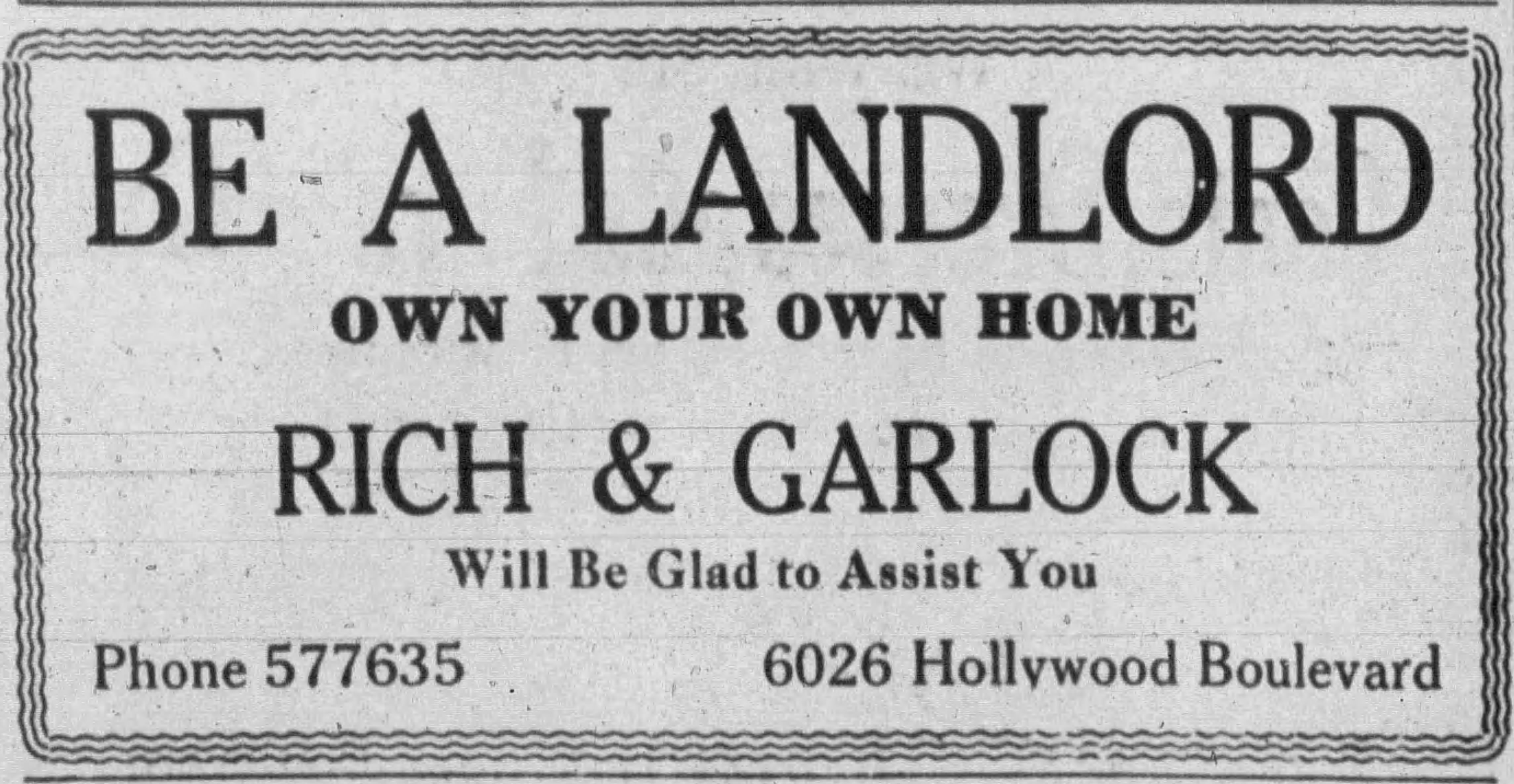
Like most of the block, the parcel was rural/residential before World War I. The property owner was Edwin Rich, brother of Sanford Rich. The brothers had come to Hollywood in the early 1900s and developed numerous tracts in the heart of Hollywood. Sanford was a pioneer realtor and the first mayor of Hollywood when it was incorporated in 1903 (Hollywood was annexed by the City of Los Angeles in 1910), whose home was at 6048 Hollywood Boulevard until his death in June 1930 at age 89. Two of Edwin’s grown children, son Frank and daughter Bessie, were also in real estate, as Rich & Garlock, based briefly at 6026 Hollywood Boulevard, and developed the adjacent parcel at 6032. Edwin Rich passed away at age 90 in September 1932.

Hollywood Citizen 1/2/1920

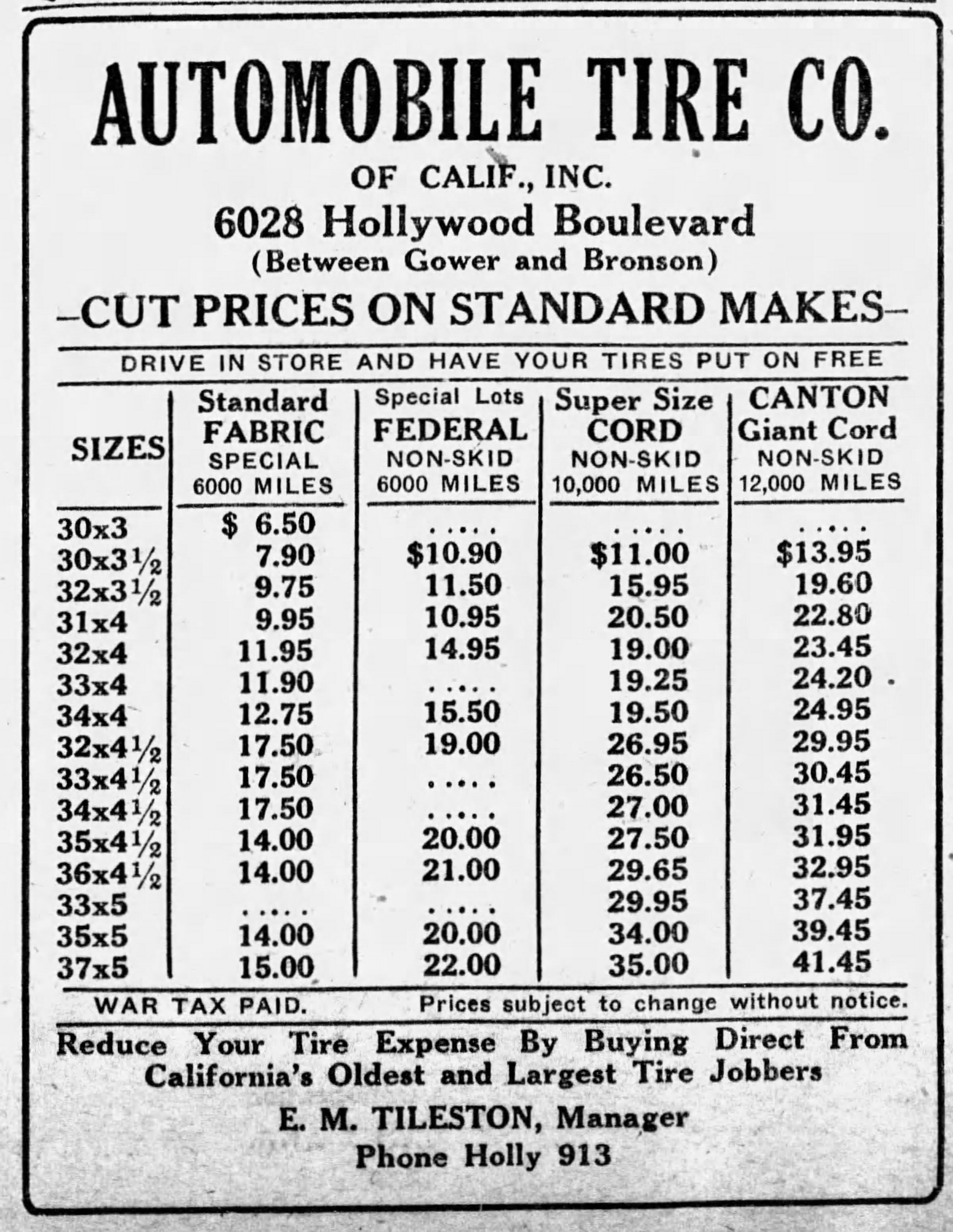
F.R. “Jack” Germond was the first known auto dealer to operate at 6028 as The Germond Motor Company. A salesman for Earl V. Armstrong, LA’s distributor for the Chandler Motor Car Co., in October 1919 Germod was appointed Hollywood’s dealer for Cleveland Automobile Company, a new subsidiary of Chandler.  Apparently operating out of an existing building on this property, by November 1920 he had moved to temporary quarters at 6151 Hollywood Boulevard and 6028 became an auto repair shop. In 1922 a tire shop opened here as well. Edwin Rich modified the building with a partition to accommodate the two businesses.

Hollywood Citizen 7/23/1920

LA Evening Express 9/9/1922

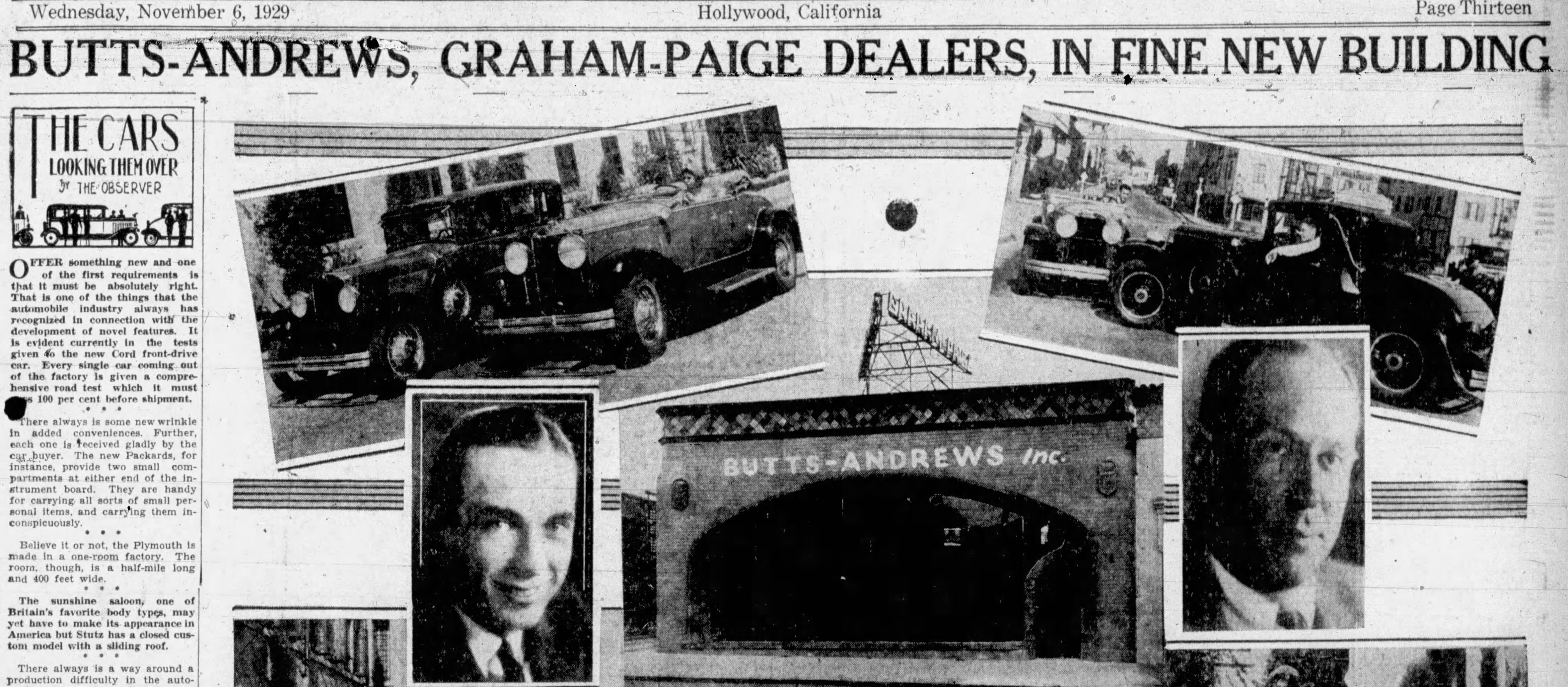
In November 1929, 6028 became the home of Butts-Andrews Graham-Paige, situated in a new building built for them by engineer William J. Moran. The unusual structure had a slightly Art Nouveau appearance, with a 50-foot-wide arched central window, intended to look like the proscenium arch of a theater. The interior was designed to “represent the tap room of an early Spanish inn,” with un-plastered, polychrome walls that had a “crude stone block” effect and ceilings of rough lumber that featured a “pyro” (burned) finish.

Hollywood Daily Citizen 11/6/1929

F.W. Butts and J. J Andrews had been Pierce-Arrow dealers at 5760 Sunset Boulevard in 1927. In October 1929, at the same location, they became dealers for Graham-Paige. Headquartered in Evansville, Indiana, Graham-Paige was established in 1927 when the Graham brothers purchased the Detroit Motor Car Company, makers of Paige and Jewett automobiles.

As Butts-Andrews Graham-Paige. Hollywood Daily Citizen 11/6/1929

Butts-Andrews were only in their new building a brief time, through June 1930.

The next tenant to move in was Herbert Woodward, Inc. Reo dealership, on October 15, 1930. Based in Lansing, Michigan, Reo was founded by Ransom E. Olds (of Oldsmobile) in 1905.

As Herbert Woodward Reo. Hollywood Daily Citizen 10/15/1930.

Herbert Woodward Reo was only here a brief time, also- through June 1931.

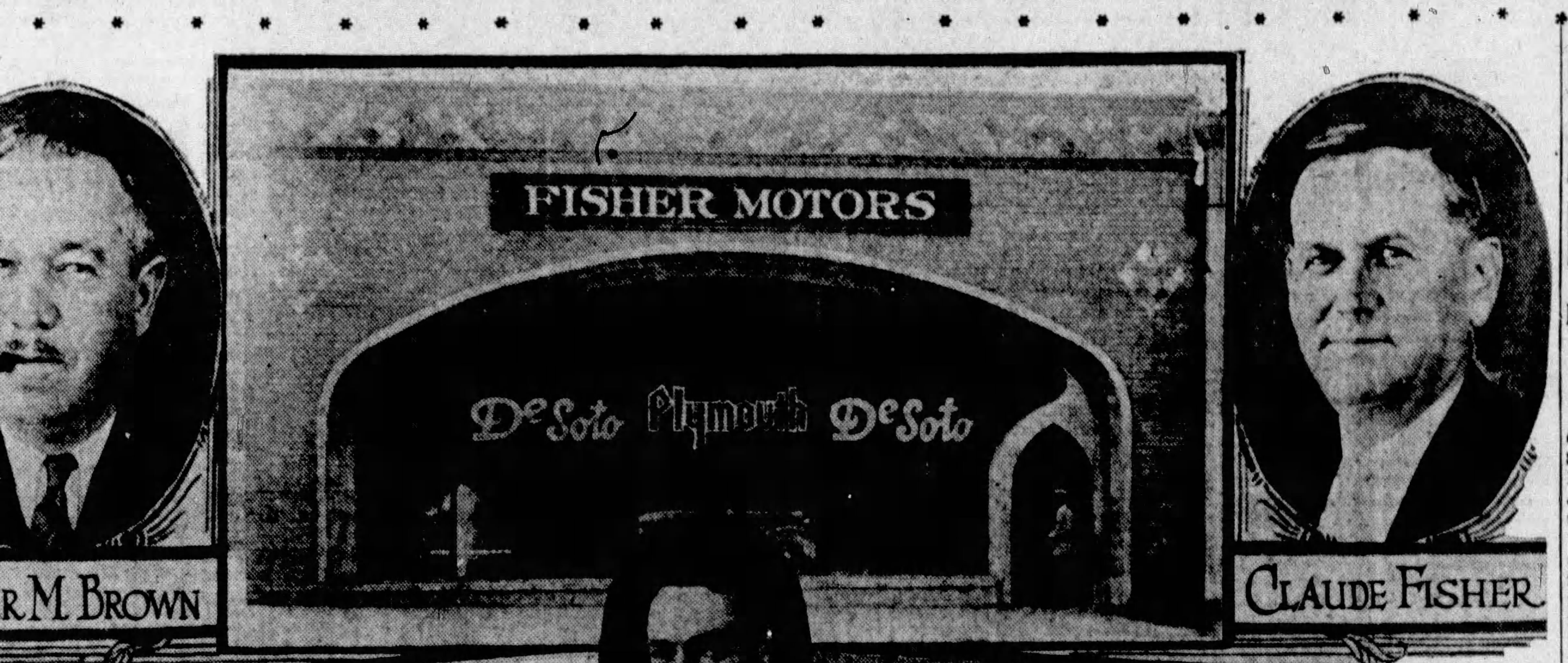
On September 30, 1931, 6028 Hollywood Boulevard became Fisher Motors De Soto-Plymouth, operated by Claude Fisher and Walton M. Brown. The formal opening was held October 3, 1931 with searchlights, music, and a talking picture of Plymouth’s record run through Death Valley. Plymouth and De Soto were divisions of the Chrysler Corporation introduced in July and August, respectively, 1928.

As Fisher Motors De Soto-Plymouth. Hollywood Daily Citizen 9/30/1931


Hollywood Daily Citizen 9/30/1931

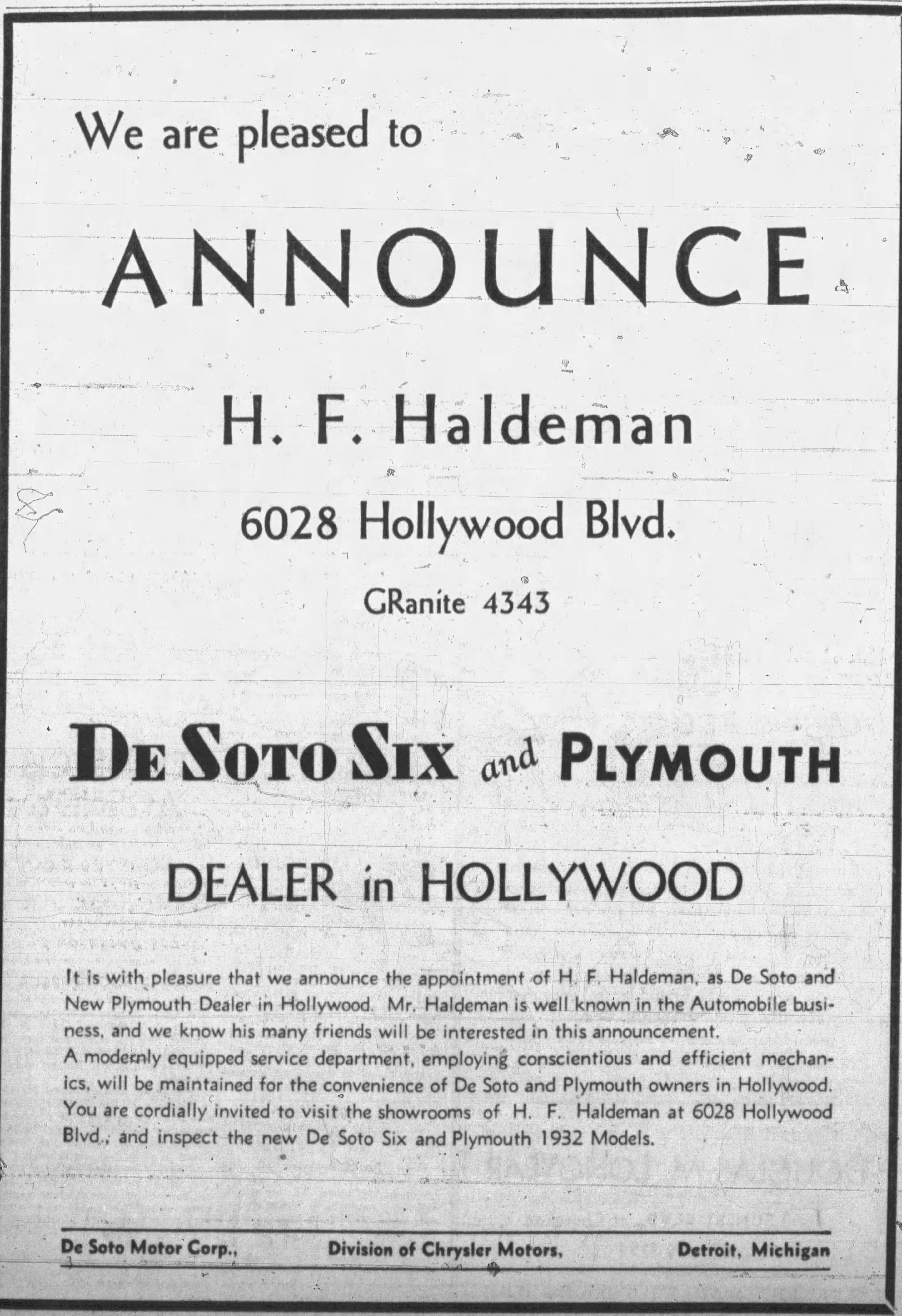
Fisher Motors exited in March 1932 but the building remained a De Soto and Plymouth Dealership under H. F. Haldeman, who opened here April 6, 1932.

As H. F. Haldeman DeSoto Plymouth. Hollywood Citizen News 4/6/1932

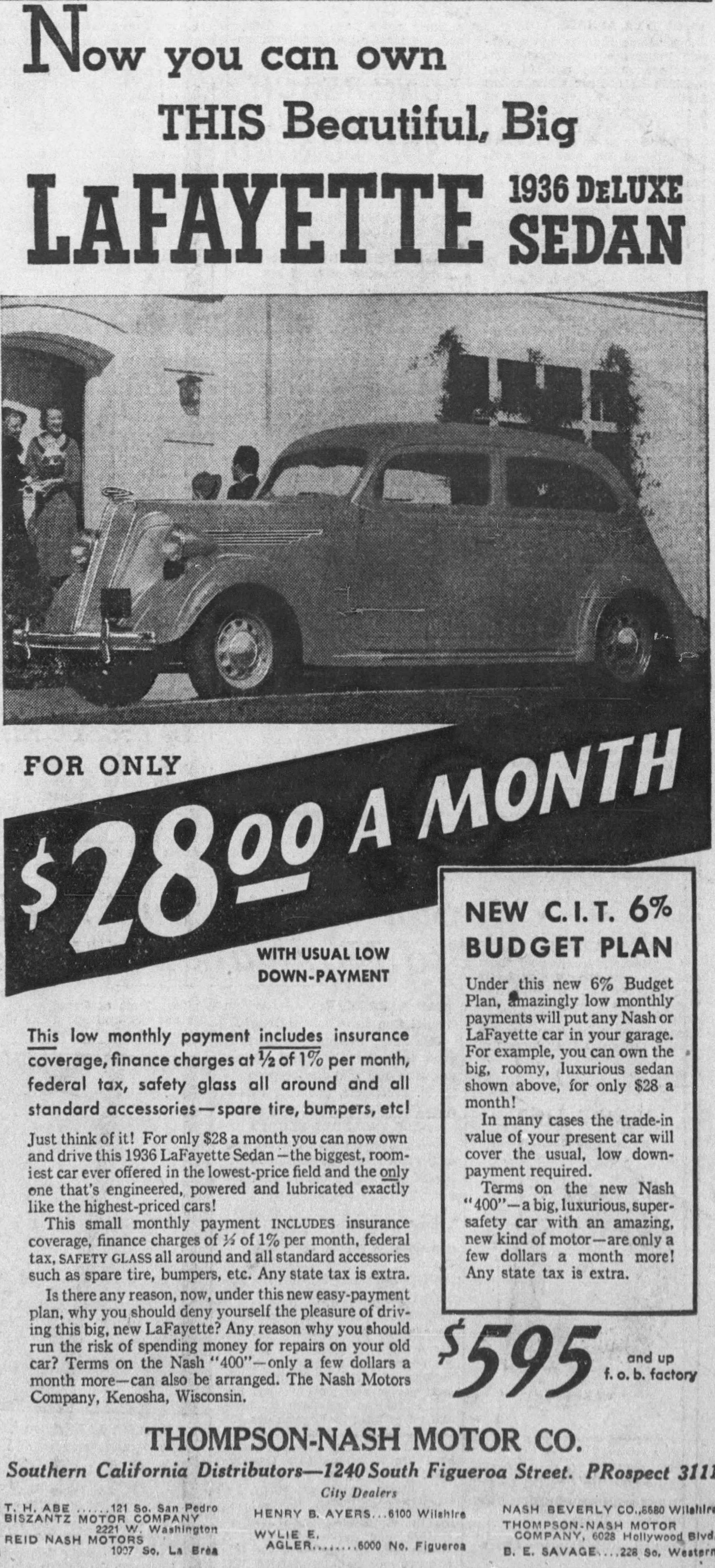
Haldeman remained here until November 1935. The Thompson-Nash Motor Company moved in in February 1936. Nash Motors Company, based in Kenosha, Wisconsin, was founded by former GM president Charles W. Nash in 1916 when he acquired the Thomas B. Jeffrey Co. Nash took over the LaFayette Motors Co. in 1921. The LaFayette name was retired for a time but revived by Nash in 1934.

LA Times 2/4/1936

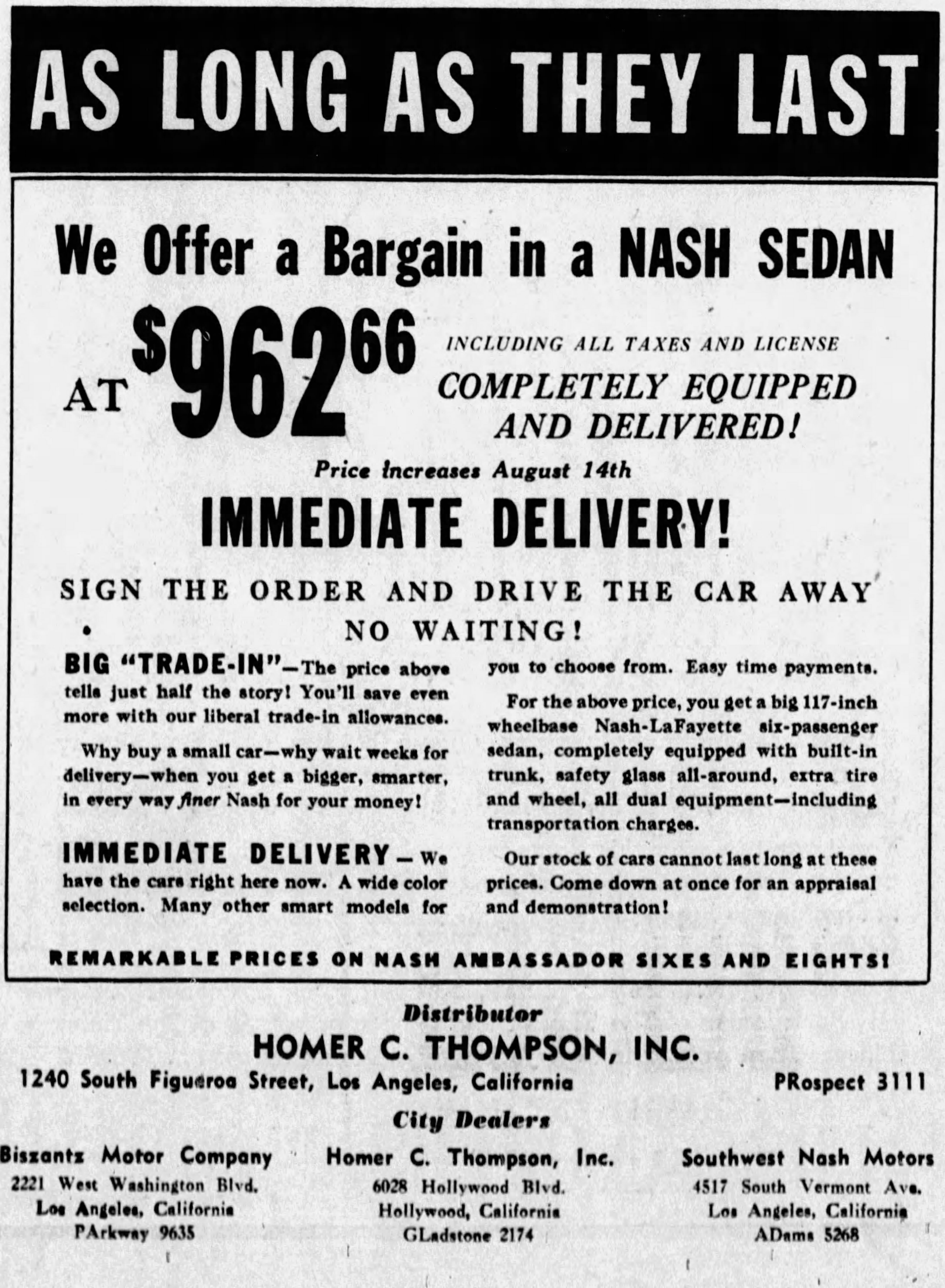
In August 1937, Thompson-Nash Motor Co. became Homer C. Thompson Inc. Homer C. Thompson was the general manager of Thompson Nash and continued selling Nash cars at 6028 after the change in name and ownership. Nash Motors Co. had become Nash-Kelvinator Corporation in January 1937, the automotive division of Kelvinator, manufacturer of refrigerators and other appliances.

LA Times 8/12/1937

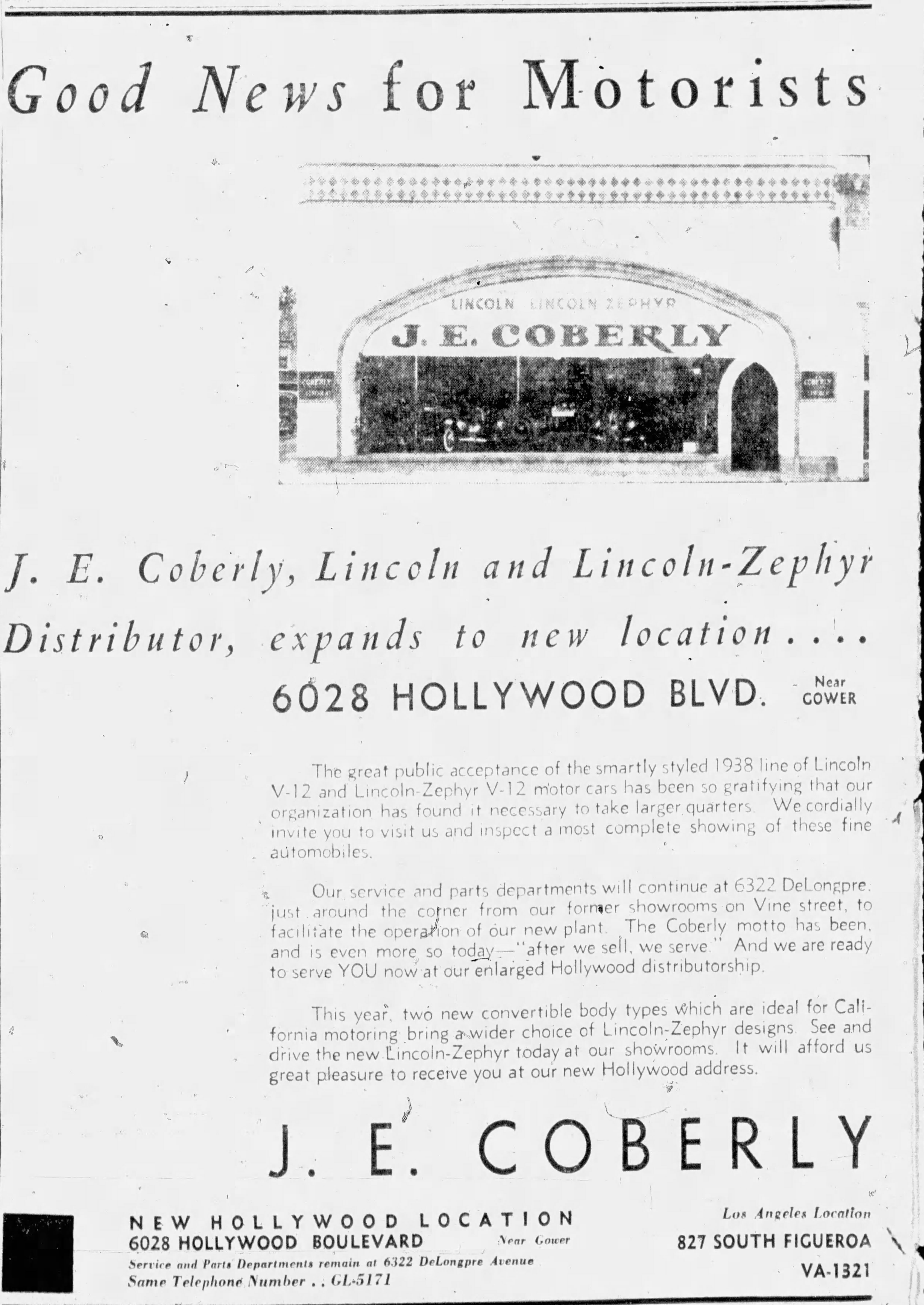
Homer C. was here only briefly (Nash, however, would later return to the vicinity, next door at 6032). In February 1938, this dealership became J. E. Coberly Lincoln, selling Lincolns and the Lincoln-Zephyr. Lincoln was the luxury division of the Ford Motor Company. Founded in 1917, it was acquired by Ford in 1922. Zephyrs were made from 1936 to 1942.

As Coberly Lincoln. Hollywood Citizen News 2/9/1938

J. E. Coberly was here through January 1939.

The property appears to have languished for a time. In November 1939 it was used as the temporary home of the Hollywood branch public library while the library’s old building at Hollywood and Ivar was being dismantled and salvaged for use at its new location north of the Boulevard on Ivar. In May 1940, 6028 was the temporary quarters of an auction house.

In January 1941, it became the new showroom of Sunset Motors, the Hudson dealership of Frank B. Hughes. Hudson Motor Co. of Detroit was founded in 1909. In 1954 it merged with Nash-Kelvinator to form the American Motors Corporation (AMC).

Hollywood Citizen News 2/19/1941.

Hollywood Citizen News 11/12/1941

Sunset Motors remained here until November 1941, when Hughes retired to serve with the Red Cross disaster emergency transportation organization. The following year, in November 1942, he became head of the auto division of the War Production Board.

With the US at war, the federal Office of Production put a freeze on all sales of passenger cars and the following month, February 1942, production of non-military vehicles came to a halt. 6028 turned into a defense plant for rivets and bolts then was again an auto repair shop- a service in high demand. With no new autos being made, maintenance of your existing car became critical.

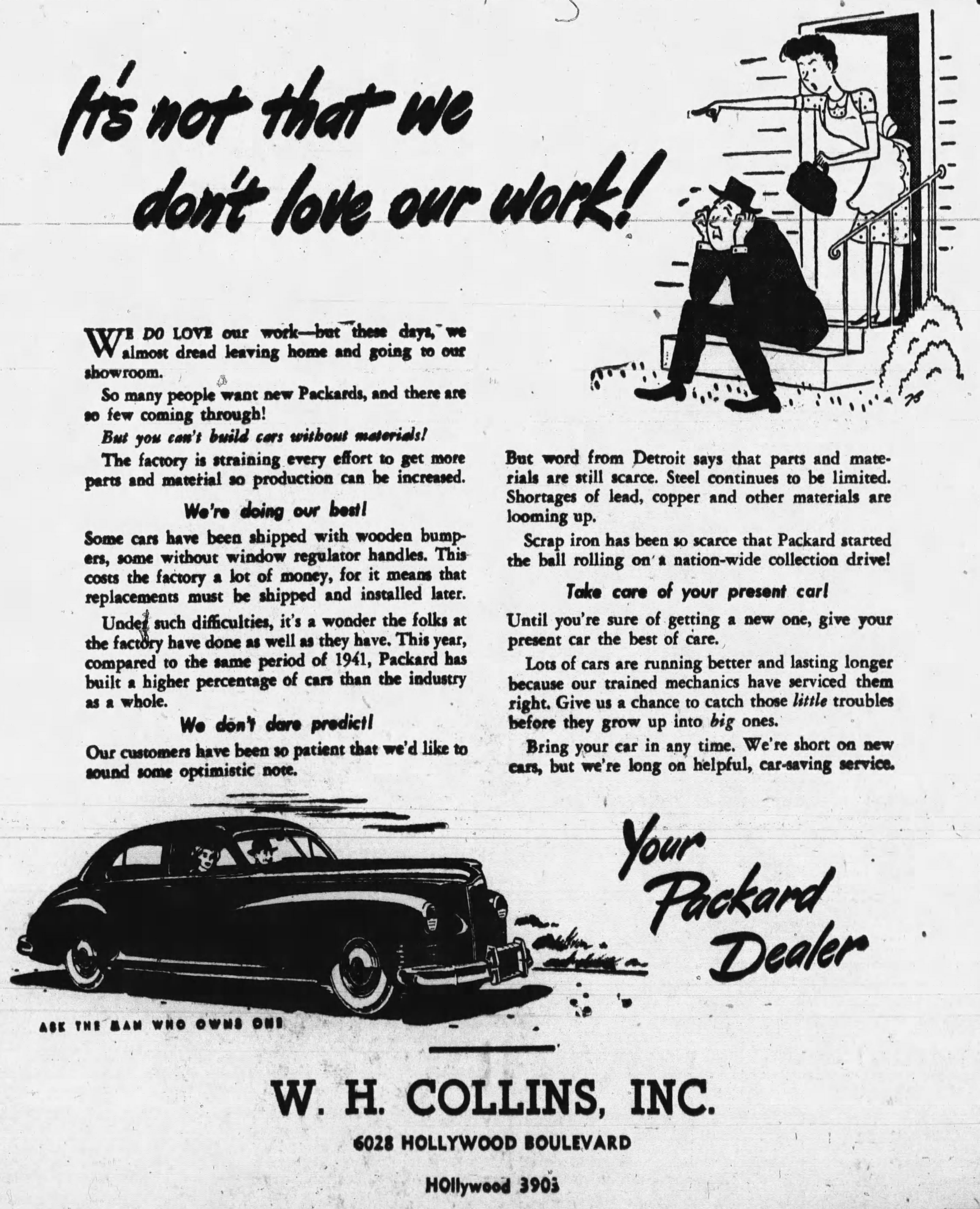
In March 1945, Packard dealer W. H. Collins Inc. moved in to 6028. Packard was a luxury automobile, founded in 1899, whose famous slogan was “Ask the man who owns one.”

With the war over, auto makers were given the green light to return to full commercial production on August 25, 1945. Still, it was impossible to meet the demand for new cars and for most customers it was a long wait until their orders could be filled. See my previous post on 1946 cars, here.

Hollywood Citizen News 10/29/1946

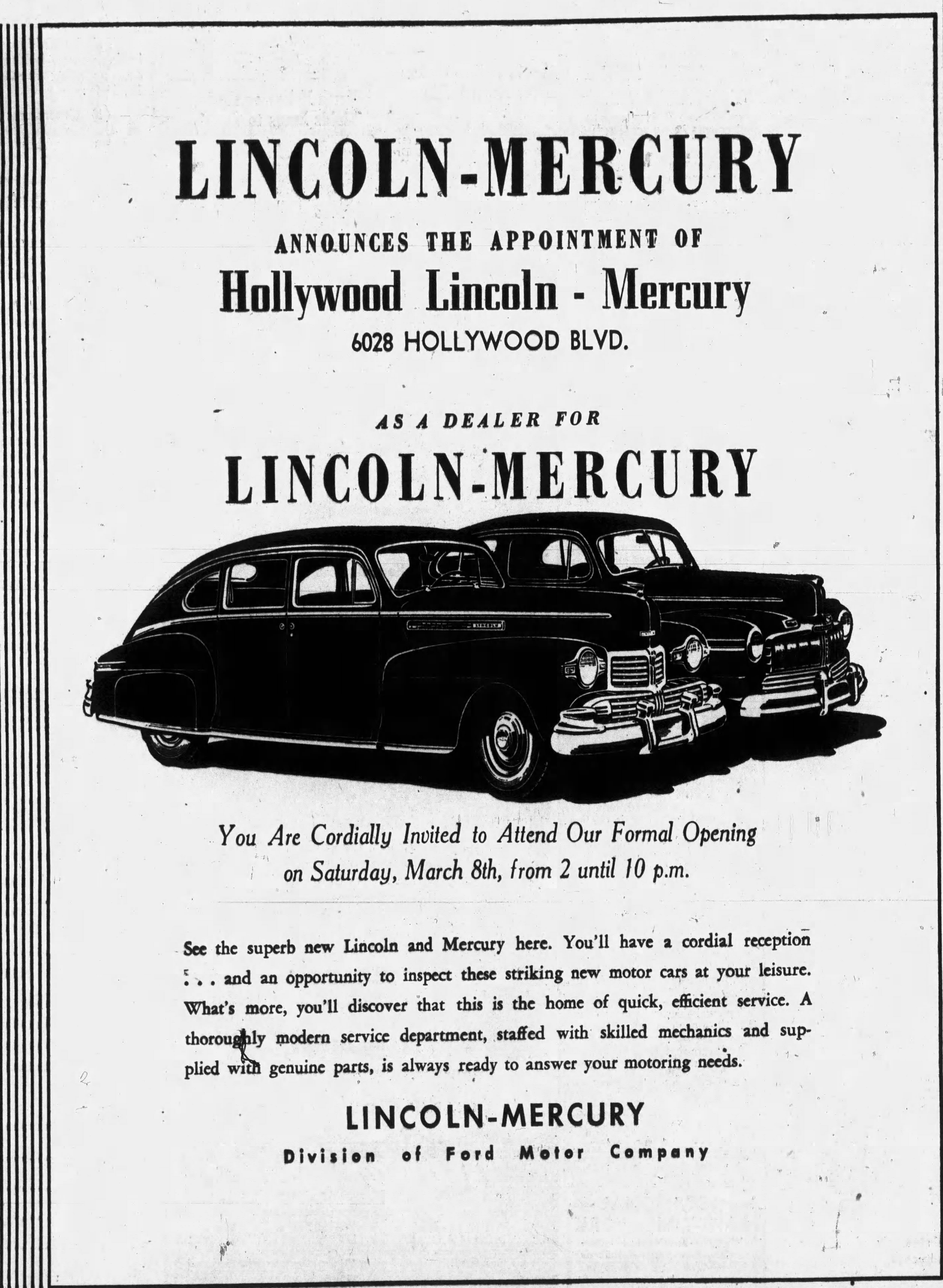
W. H. Collins Packard was here until February 13, 1947, when the dealership became L. W. “Eph” Andrews Lincoln-Mercury. Ford had introduced the Mercury in 1938. The Lincoln-Mercury division was formed in October 1945- part of Henry Ford II’s reorganization of the company. Eph Andrews had previously been the president and general manager of W. H. Collins Packard. The official opening was March 8, 1947 under the new name Hollywood Lincoln-Mercury.

As Hollywood Lincoln-Mercury. Hollywood Citizen News 3/7/1947

In August 1949, the dealership was taken over by J. F. O’Connor & Son, whose former location at 5800 Hollywood Boulevard was taken over for the Hollywood Freeway. Previously Nash dealers, O’Connor and Son was now a Lincoln-Mercury dealership.

O’Connor & Sons were previously at 5800 Hollywood Boulevard. Hollywood Citizen News 8/12/1949

LA Times 9/30/1949

O’Connor and Son would use both 6028 and 6032 Hollywood Boulevard at times; both parcels were acquired by Mark M. Hansen of the Marcal Theater and his wife Ida. Hansen also owned O’Connor’s previous location and had a building constructed for him on the lot in 1945. O’Connor also sometimes used 6000 Hollywood Boulevard.

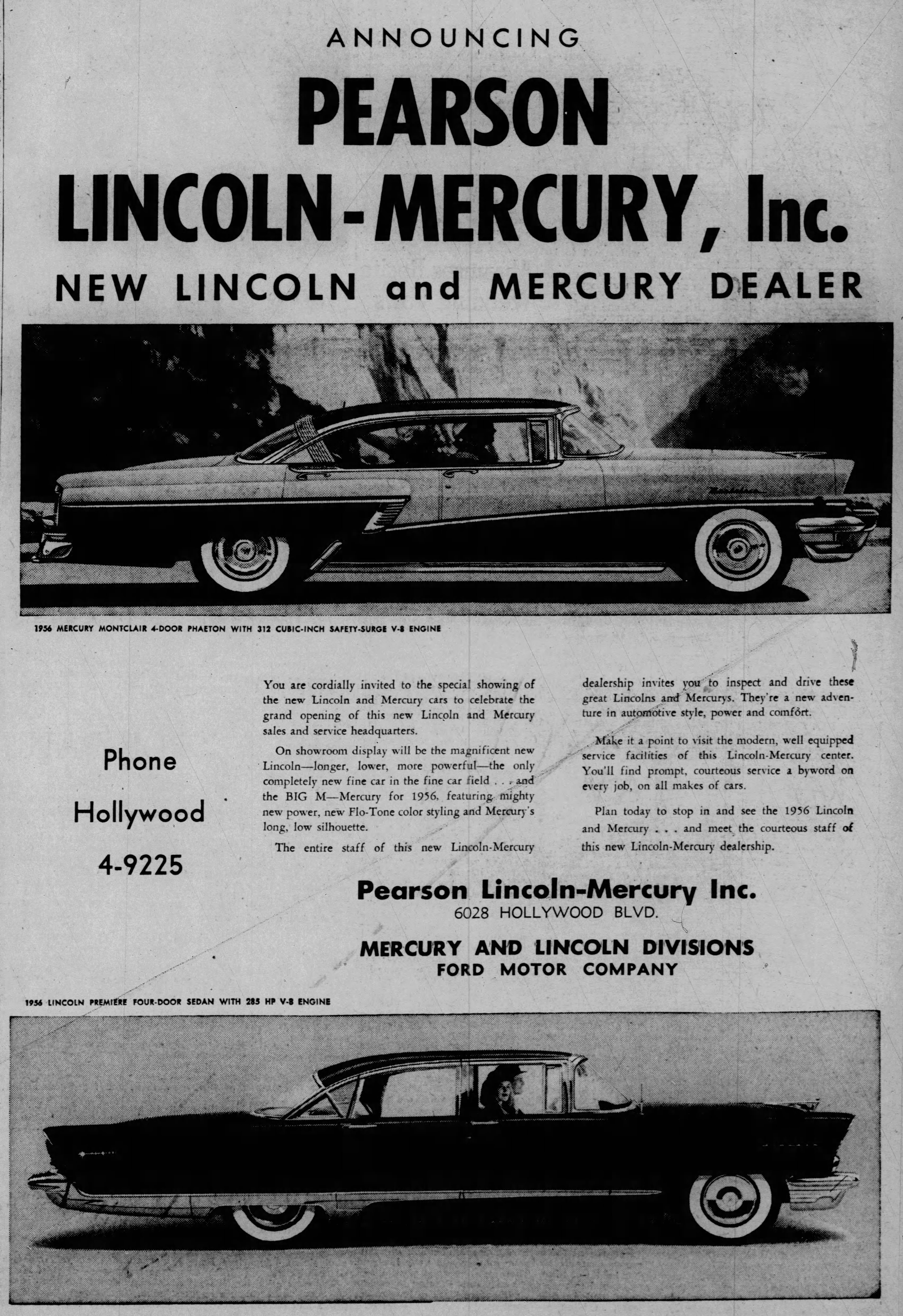
Glenn Pearson Lincoln-Mercury dealership took over from the O’Connors in July 1956. He held his grand opening in a much-remolded 6028 Hollywood Boulevard on November 10, 1956.

Glenn Pearson getting ready to take over 6028. Hollywood Citizen News 7/26/1956.


Hollywood Citizen News 8/3/1956.


As Pearson Lincoln-Mercury. Bye-bye proscenium arch window! LA Times 10/10/1956.

On May 13, 1957, Hollywood Ford moved to 6000 Hollywood Boulevard. Pearson remained at 6028 through May 1957 but thereafter, the address, if it was used at all, was Hollywood Ford. Ford demolished all structures on 6028 and 6032 in 1970. Today this parcel is part of the Hollywood Toyota dealership, addressed as 6000 Hollywood Boulevard.

California Eagle 8/16/1962


6021-6025 Hollywood Boulevard: The Marcal Theater

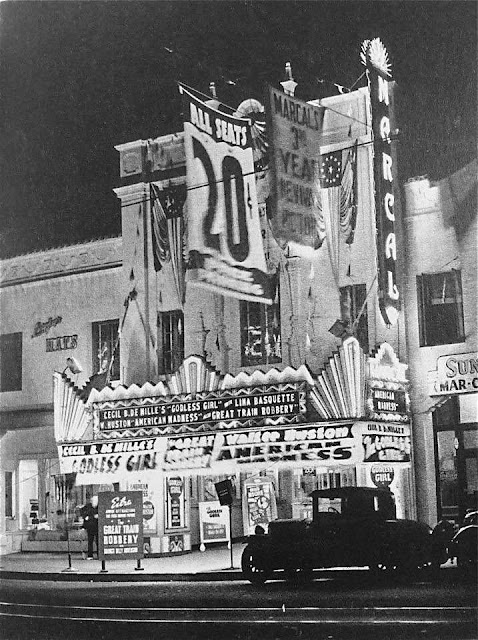
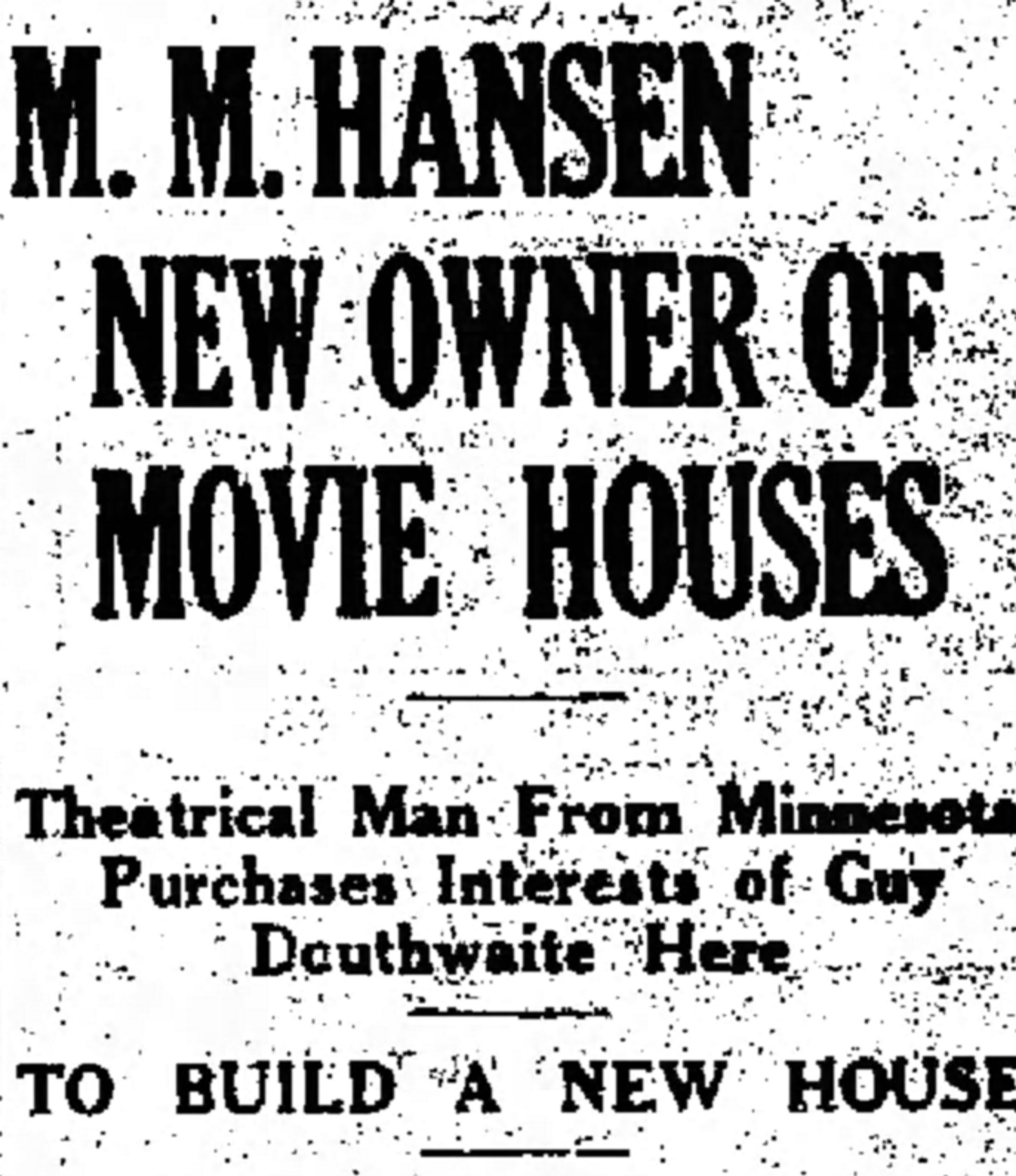
The Marcal Theater (also written as Mar-Cal), on the north side of Hollywood Boulevard at 6025 just West of the Brokaw property, opened on May 15, 1926. The name was a combination of two of its owners’ names: Screen actress Alice Calhoun and theater operator Mark M. Hansen.

Marinus Mark Hansen was born in Aalborg, Denmark in 1892. He came to the USA by way of Liverpool in March 1910 aboard the doomed ocean liner Lusitania, and settled briefly in Lostwood, North Dakota where he had an older brother, Carl, who had immigrated a few years earlier, and worked as a laborer taking odd jobs.

As of 1914 he was working as a saloon keeper in Madoc, Montana. By 1915 he also had a half-interest in the Lyceum Theatre in Scobey, Montana with partner Charles Peterson; Hansen sold his half-interest in November 1915.

Scobey Montana in 1917.

He married Ida R. Nelson in Plentywood, Montana on September 9, 1915. The couple’s first daughter was born at Madoc in 1916.

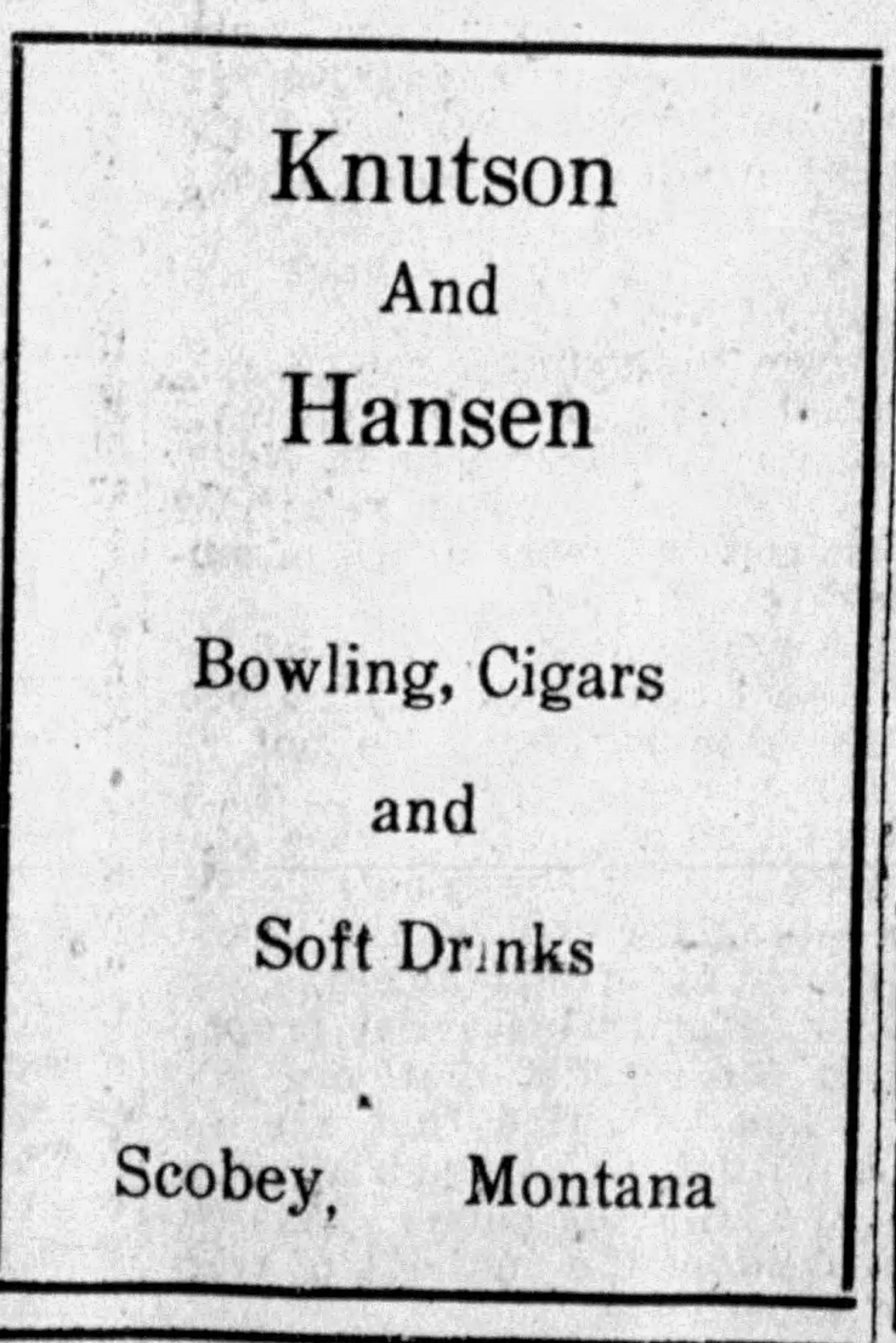
In May 1919 Hansen bought a former saloon in Scobey, which he converted into a bowling alley and cigar store.

The Scobey Citizen 12/25/1919

In August 1919, Hansen bought the Lyric Theater in Williston, North Dakota. He soon joined with local businessmen to build a second theater there, the Orpheum.

Williston, ND as it looked in Hansen’s time.

Within two years, the couple had moved to Minnesota, where Mark also had theater interests, and their second daughter was born in August 1921. Hansen sold his theaters in Blue Earth, Minnesota in September 1921.

Blue Earth, Minnesota in 1920.

In June 1922, the Hansens relocated to the Coast when Mark bought 3 theaters in Oxnard, California.

Oxnard in the 1920s.

Oxnard Press Courier 6/2/1922

A year and a half later, on March 19, 1924 it was announced that Hansen was moving to Los Angeles. It was here that he would finally settle permanently.

Hansen already owned three theaters in Los Angeles, including the Larchmont. At 149 N. Larchmont, it had opened in 1922 and was operated by Alice Calhoun. Hansen had become an owner by January 1924.

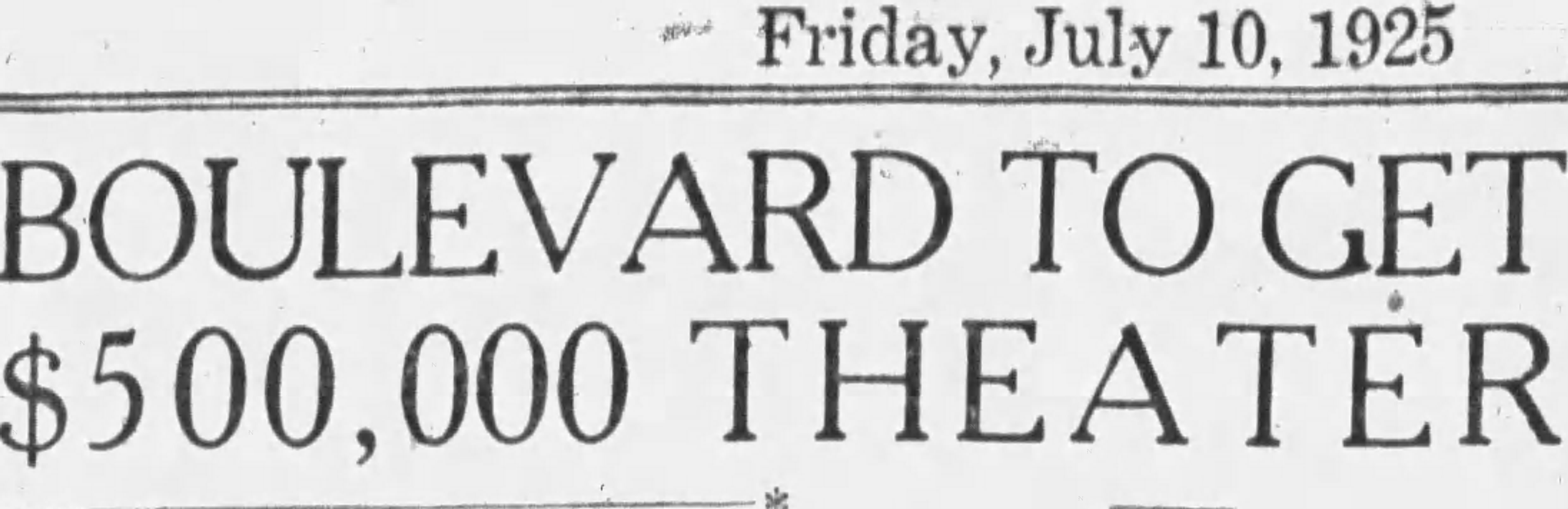
On July 10, 1925, the Hollywood Daily Citizen reported that Hansen and Calhoun had taken a 99 year lease on the Jewett property at 6025 Hollywood Boulevard where they would build an as-yet unnamed theater, to be designed by architect William Allen.


Hollywood Daily Citizen 7/10/1925

J.C. and Margaret O. Jewett had been living at this address, originally 541 Prospect Avenue, since circa 1906. Margaret Jewett was still living here through 1924 before relocating.

Detail of a 1913 Sanborn Fire Insurance map showing the Jewett property at 6025 Hollywood Boulevard. Library of Congress.

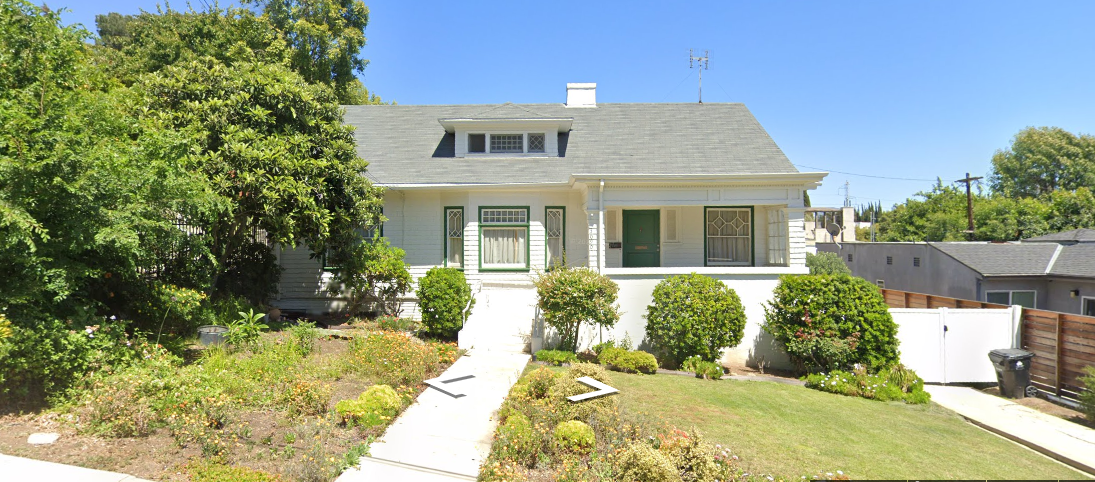
In August 1925, the Jewett ranch house and garage were moved from 6025 Hollywood Boulevard to 3090 St. George Street in the Los Feliz neighborhood. It appears to have survived at this location.

The former 6025 Hollywood Boulevard today. Google map image.

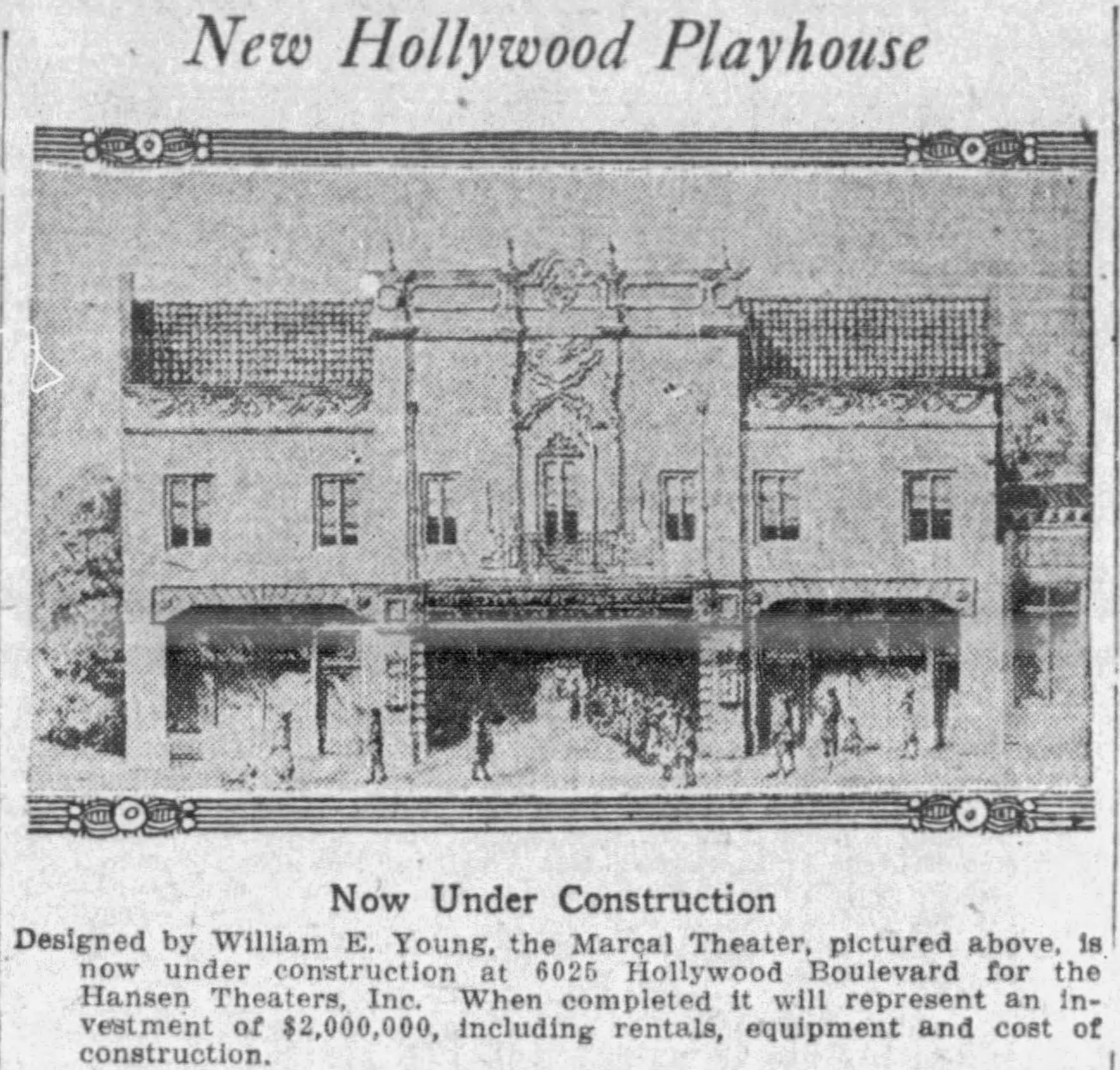
Although the July 10 report had stated construction was to begin within 60 days, ground breaking for the new theater did not happen until December 1, 1925- with Alice Calhoun operating the steam shovel herself.

Alice Calhoun (center) and Mark Hansen (lower right) around the time the Marcal Theater was proposed. Hollywood Daily Citizen 2/25/1926

Earlier reports stated that it was a 99-year lease. LA Times 12/2/1925

Sketch of the Marcal. William Allen was architect. LA Times 1/24/1926.

The completed theater had a gala grand opening on May 14, 1926 with a showing of “Skinner’s Dress Suit.” The stars of the picture, Laura La Plante and Reginald Denny (who would later be on the Boulevard with his hobby shop) made a personal appearance.

Hollywood Daily Citizen 5/15/1926

Hollywood Daily Citizen 5/14/1926


Looking east on Hollywood Boulevard from Gower when the Marcal was new. The theater can be seen near the large trees. LAPL photo.

The new theater was an independent theater, unaffiliated with any movie studio. Independents typically didn’t get to show first-run films made by the major studios until after they had finished their initial run at a studio-owned or affiliated theater.

The exterior lobby and ticket booth of Marcal Theater. USC photo.

The Marcal had barely been open six months when it closed for renovations. On January 1927, Hansen announced that effective January 27, 1927, it would change programs weekly and present only first-run films. It held another gala grand opening on that date to celebrate the post-renovation reopening with a premiere of “Remember” and the Lindsay Simons jazz orchestra


Hollywood Daily Citizen 1/26/1927

Hollywood Daily Citizen 1/26/1927

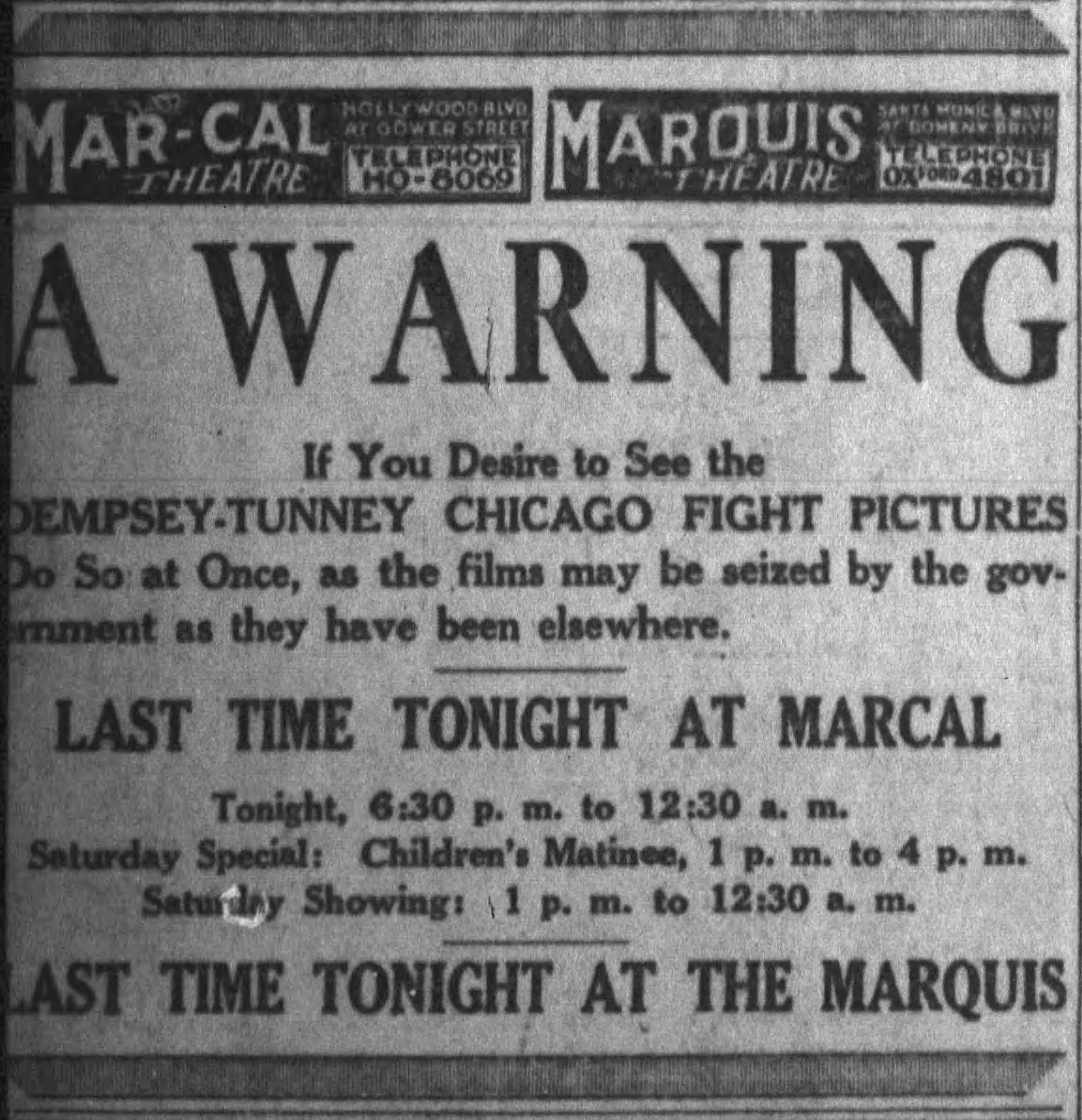
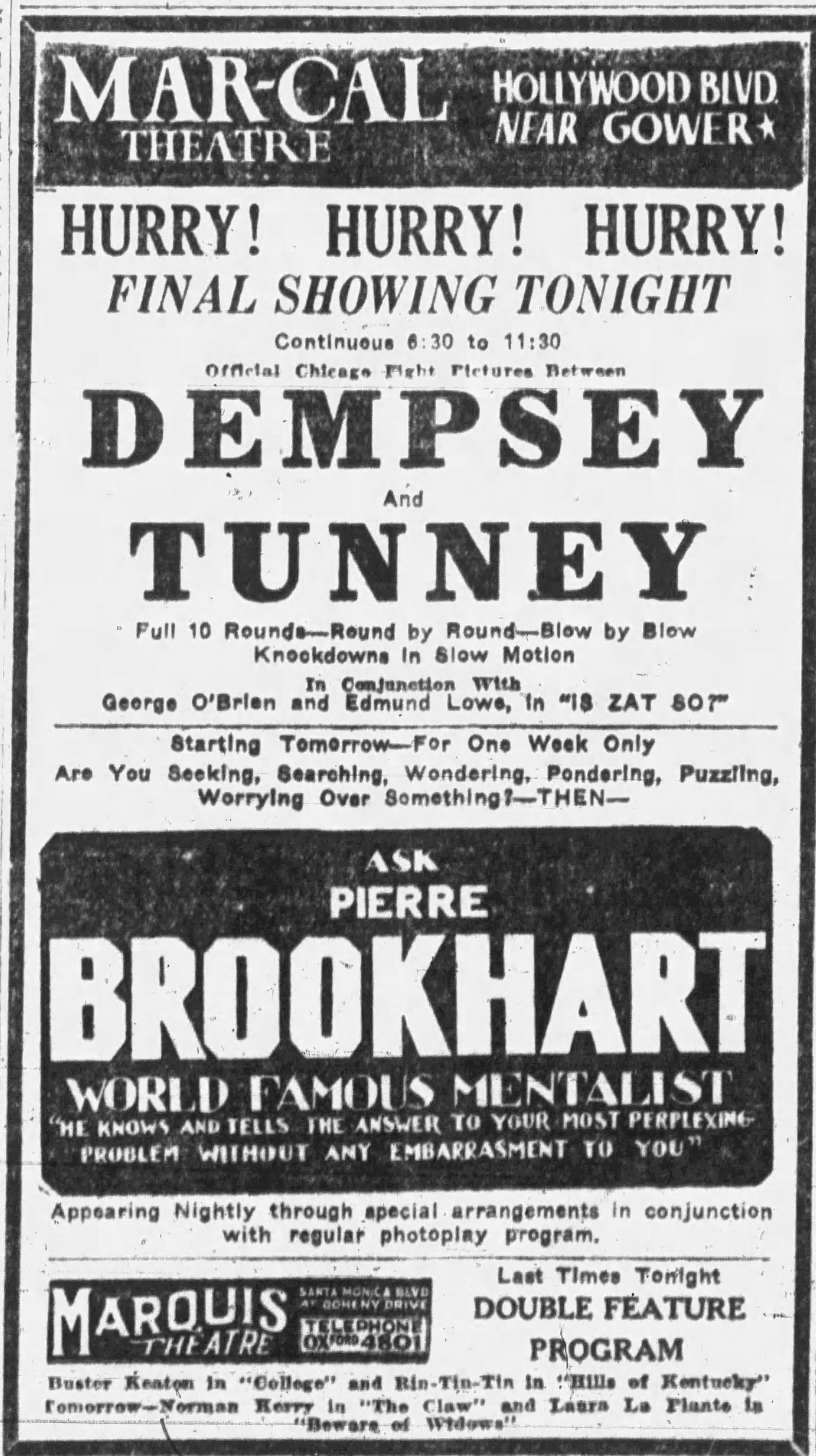
On September 30, 1927, Mark Hansen and employees of the Marcal were called to testify before the federal grand jury in its investigation of booking agent  T.R. Gardner, who was indicted on suspicion of having brought the Jack Dempsey/Gene Tunney fight film to Los Angeles from Chicago. The film had been showing at the Marcal.

It was illegal at the time to transport fight films across state lines. But everyone wanted to see the film of this fight- especially the 7th round and the infamous “long count.” The fight had taken place at Chicago’s Soldier Field on September 22, 1927, a rematch between the two fighters; Tunney had taken the heavyweight title away from Dempsey the year before (my post on that is here). Dempsey knocked Tunney down in the 7th round. It was a new rule that a fighter had until the count of 10 to get up after being knocked down and that the opponent was to retreat to a neutral corner. Dempsey stood over Tunney for several seconds; the referee did not begin the 10 second count until Dempsey went to a neutral corner, therefore giving Tunney that extra time to recover. At the end of the match, Tunney was declared the winner.

It was not illegal to show fight films in theaters, and despite the ad’s warning, there was no attempt to seize the film, which continued at the Marcal through October 3. For more information about fight films, see my post here.

Hansen also operated the Marquis Theater at 9038 Melrose Avenue at Doheny, It opened in November 1925. Hollywood Daily Citizen 9/30/1927.

Mentalist Pierre Brookhart was booked into the Marcal as an added feature following the run of the Dempsey-Tunney fight film. Hollywood Daily Citizen 10/3/1927.

In March 1928, Hansen announced that he was getting into the real estate business, with offices on the second floor of the Marcal (his theater company’s offices were also on the second floor). Hansen and his wife did for sure buy a number of Hollywood Boulevard properties, including 6028 and 6032 across the street and others in the 5800 block.

In December 1931, the Marcal celebrated its 5th birthday, with a cake from the Pig n’ Whistle cafe and in-person appearances by special guest stars. Hansen stated that the theater had hosted over 3 million patrons and had screened over 1200 feature films.

Hollywood Citizen News 12/16/1931

In December 1934, Hansen announced that he was leasing the operation of the Marcal Theater to Jay M. Sutton and Albert A. Galston of Galston & Sutton Theaters and retiring from the theater business, at least temporarily, to focus on running his new nightclubs.

Hollywood Citizen News 12/18/1934.


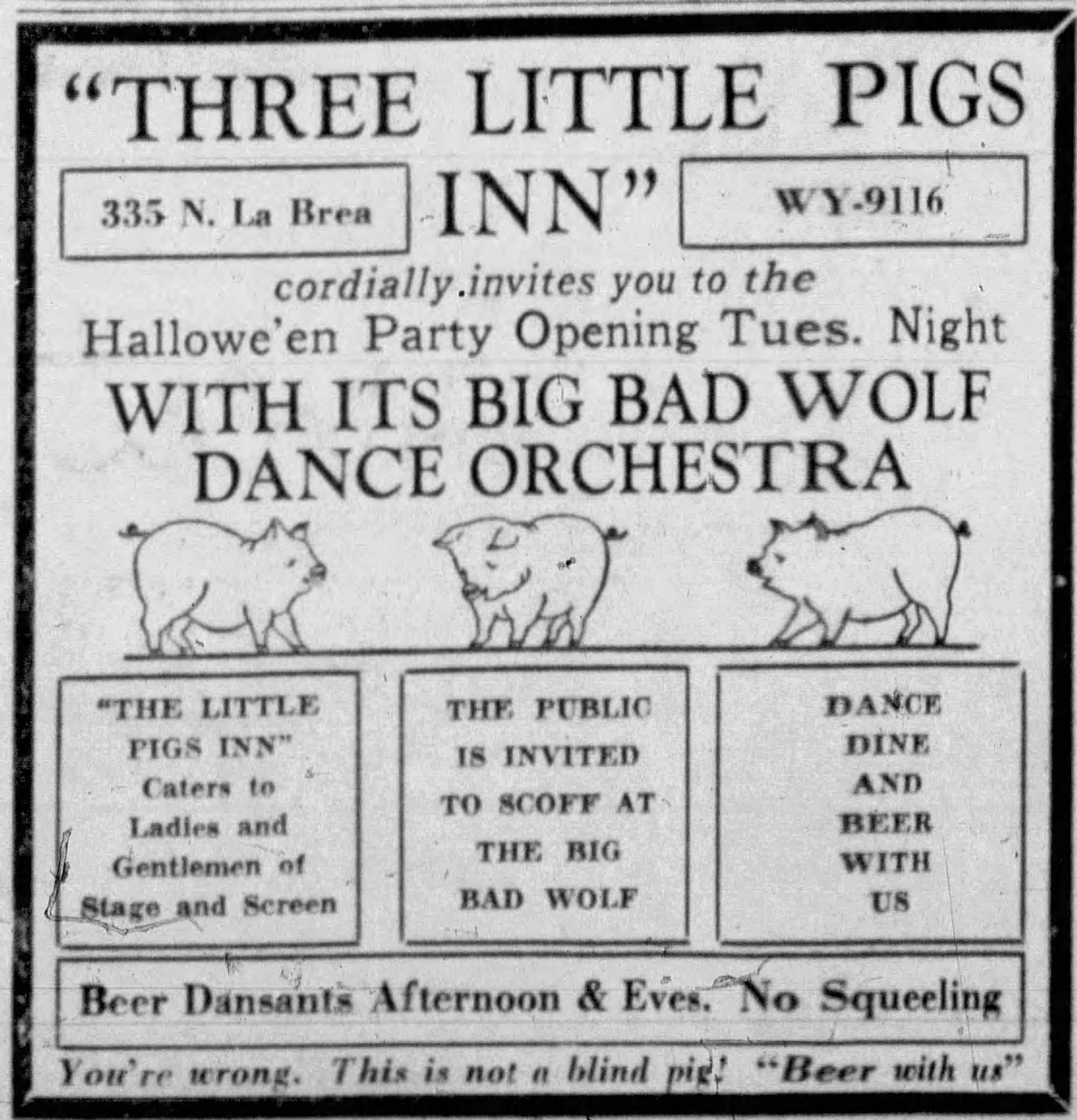
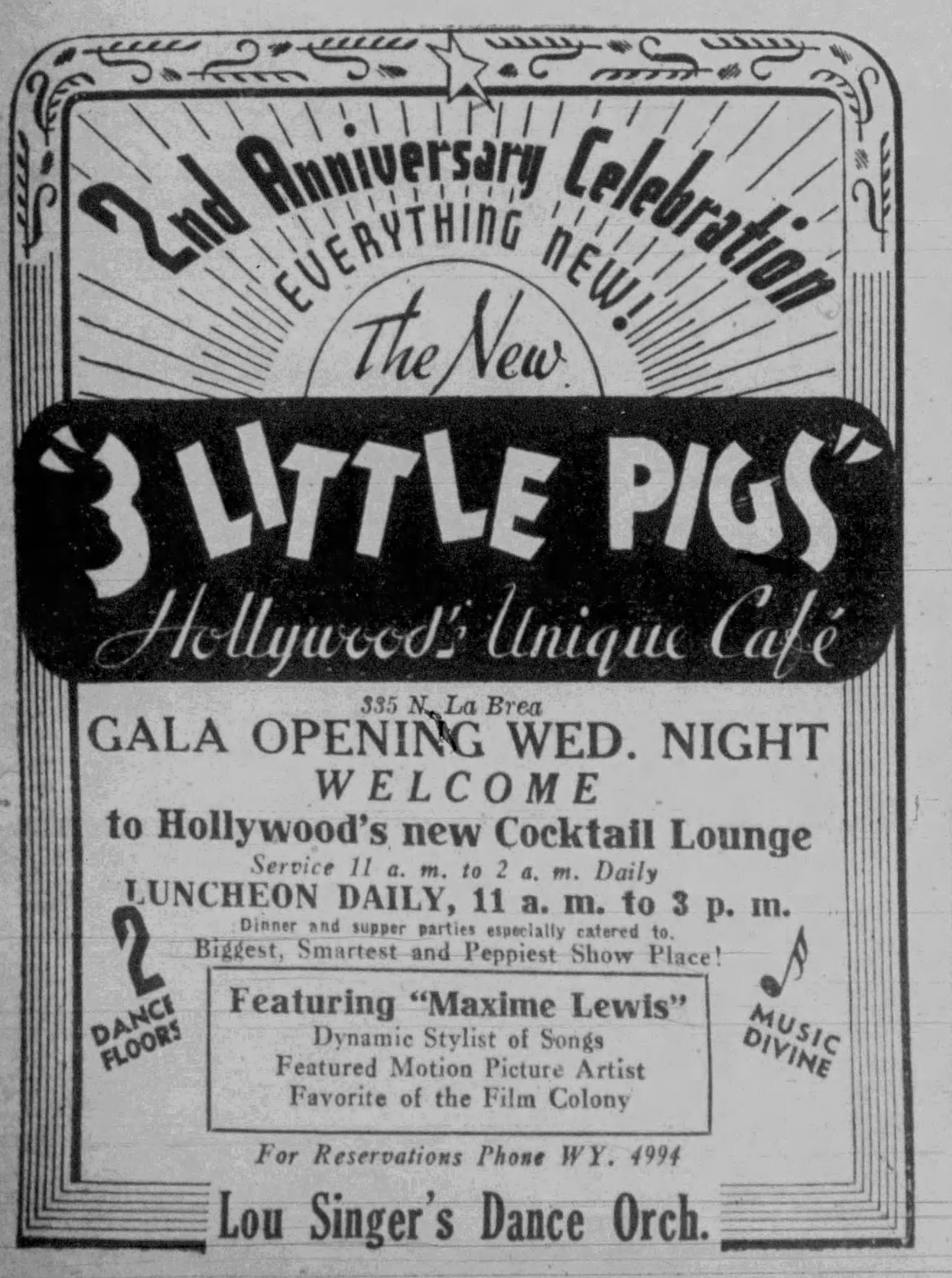
In the Summer of 1933, with national Prohibition on the way out (beer and wine sales were legalized in March 1933; spirits and hard liquor remained forbidden until full Repeal in December), Hansen opened the Cabin Club at 2914-2916 S. Western Avenue. On Halloween night 1933, he opened a second club, the 3 Little Pigs, at 335 N. La Brea. The theme was inspired by the smash hit Disney cartoon released that year.

Hollywood Citizen News 10/27/1933


LA Illustrated Daily News 10/15/1935.

On November 9, 1933, Hansen was arrested for failure to take out a license to sell alcohol (beer) at his clubs as well as failure to pay sales tax on alcohol sales. In July 1934 he was back in court facing charges by the State Board of Equalization (SBE), which regulated implementation of new State liquor laws after repeal of Prohibition, that he had failed to report to the SBE that he was selling beverages with greater than 3.2% alcohol within 1-1/2 miles of the Sawtelle Soldier’s Home, as the law required. With the laws in flux, such charges were fairly typical at the time. Hansen said her was endeavoring to operate his places in a legal manner and was allowed to continue in business.

Nightclubs typically have a high turnover, however, and Hansen’s career as a nightclub man did not last long. Both clubs appear to have changed hands by the end of 1936. 335 N. La Brea later became the infamous Pirate’s Den club. See my post on this address here.

LA Times 11/10/1933


While Hansen was busy with his nightclubs, Galston & Sutton steered the Marcal through difficult times as the economy slowly began to recover from the Great Depression. Many Hollywood theaters were dark several nights a week, or were leasing them out for radio broadcasts as the Movie Town became a Radio City (I discussed the Westward progress of radio in previous posts here and here.).

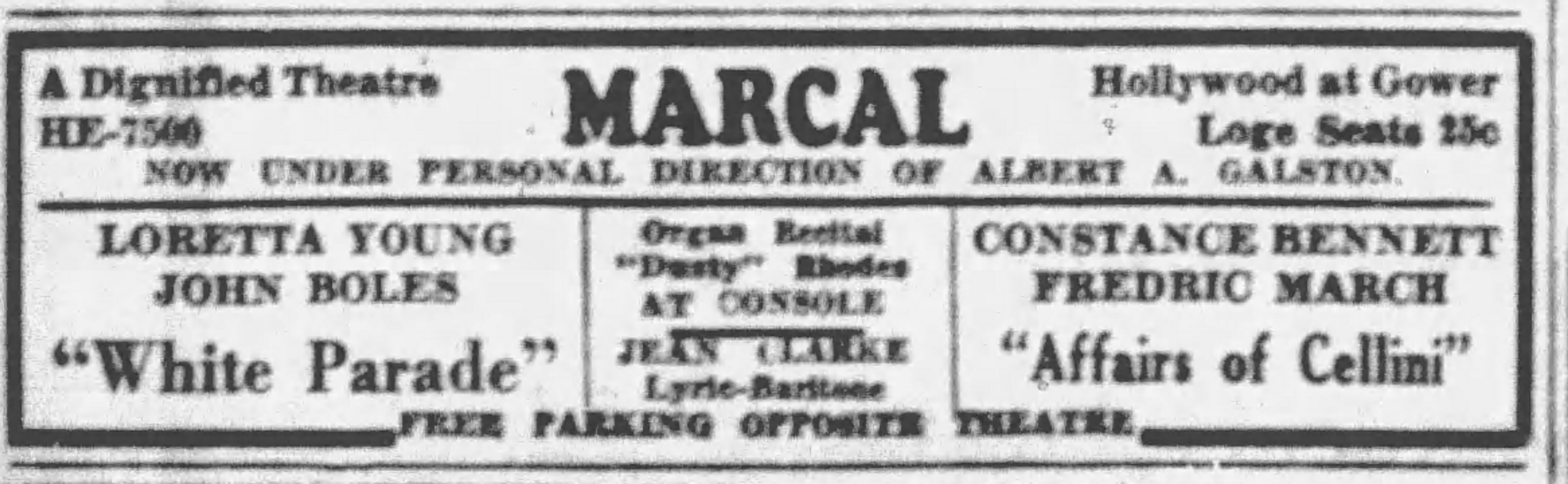
The Marcal “now under personal direction of Albert A. Galston.” There was free parking across the street because Mark Hansen owned several parcels there. Hollywood Daily Citizen 1/18/1935

In February 1935, the new management undertook another remodeling. It reopened February 24, 1935 with a 7 day celebratory “inaugural week” to usher in their new policy of lowered loge seat admission price for adults from 25 cents to 20 cents. Galston & Sutton would also institute a revival policy, showing films not seen in Hollywood theaters for several years- and always a double feature.

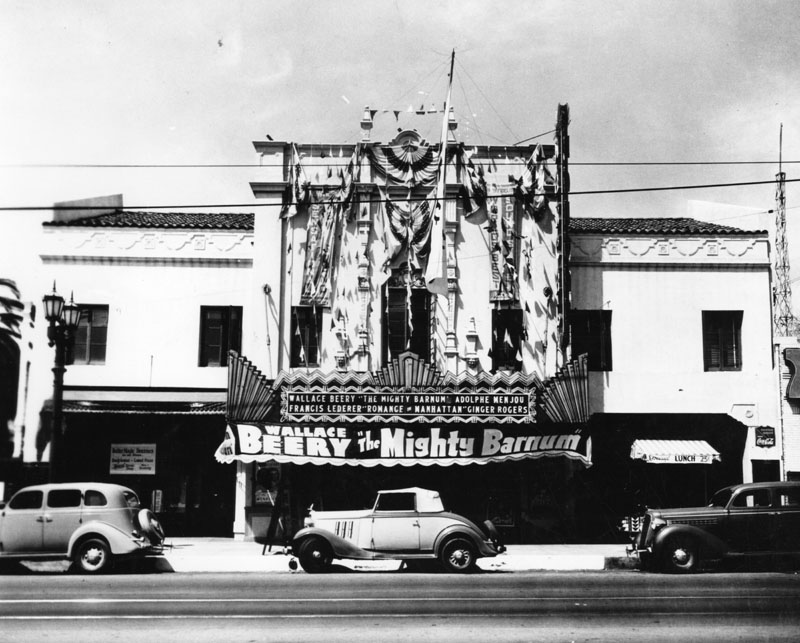
The Marcal Theater in April 1935 during the run of The Mighty Barnum.” LAPL photo.


Hollywood Citizen News 4/18/1935

In the Spring of 1939, Mark Hansen Theaters, Inc. was thrown into involuntary bankruptcy by creditors. Being a corporation, however, this simply meant that he reorganized and carried on.

In April 1940, Hansen sued Galston & Sutton, seeking to forfeit renewal of their lease. Galston and Sutton argued that the theater’s gross profit had increased by 50% under their management. The duo prevailed and the lease was renewed for 10 years. In May, their second theater, the Hawaii, would open a few doors down at 5939-5941.

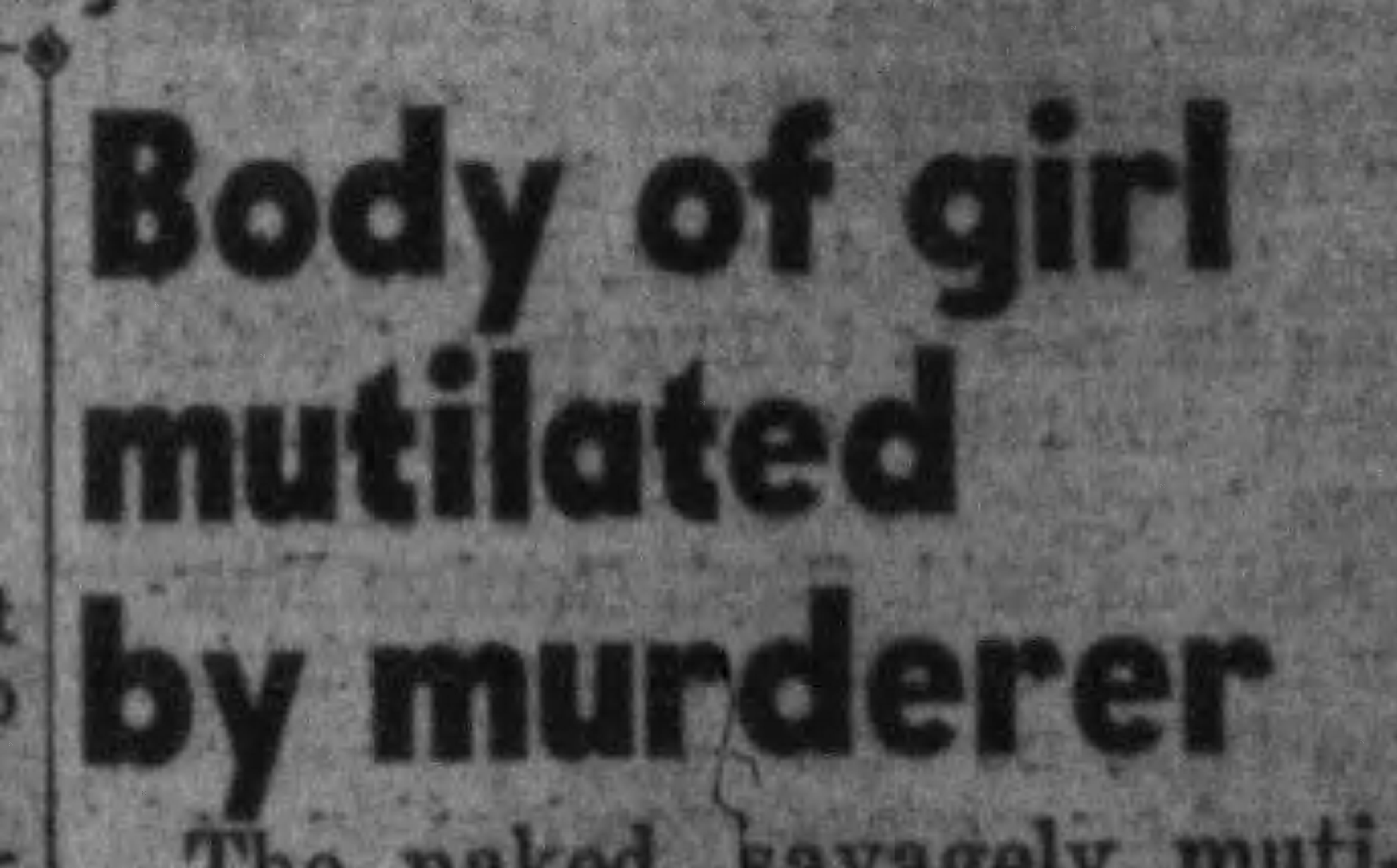
In January 1947, Hansen would enter the annals of true crime infamy. The horribly mutilated corpse of a young woman was discovered in a vacant lot on January 15, 1947. She was soon identified through fingerprints as 22-year-old Elizabeth Short, who had been living in Hollywood on and off for several months. Police (and reporters) ran down hundreds of leads but no arrests were made. Just as the case seemed to go cold, someone mailed a package of Short’s belongings – the contents of her purse- to the Los Angeles Examiner.

LA Times 1/25/1947

One of the items was a small date book, known as a diary, that Short had been using as an address book. It was stamped on the cover with the name Mark M. Hansen and the year 1937. Questioned by police on January 25, Hansen said he knew Short “casually” through Ann Toth, a “friend.” Short and Toth assertedly rented rooms at Hansen’s home, 6024 Carlos Avenue, located on the block north of the Marcal. Toth, a bit player in the movies, had been questioned by police on January 17 and told them that Short had lived with her at 6024 Carlos Avenue for about 2 months starting in August 1946. Hansen told the authorities that the book had been black the last time he saw it and that Short must have taken it from his desk. He had last seen Short in November 1946, he said. He was eliminated as a suspect at the time. Amateur sleuths, with scant “evidence” have continued to speculate about his guilt in the case, which was never solved.

Hansen had occupied the Carlos Avenue residence since 1936 at least, along with his wife Ida and daughters though 1940 for sure, per the 1940 US Census. It was convenient to his offices in the Marcal Theater.

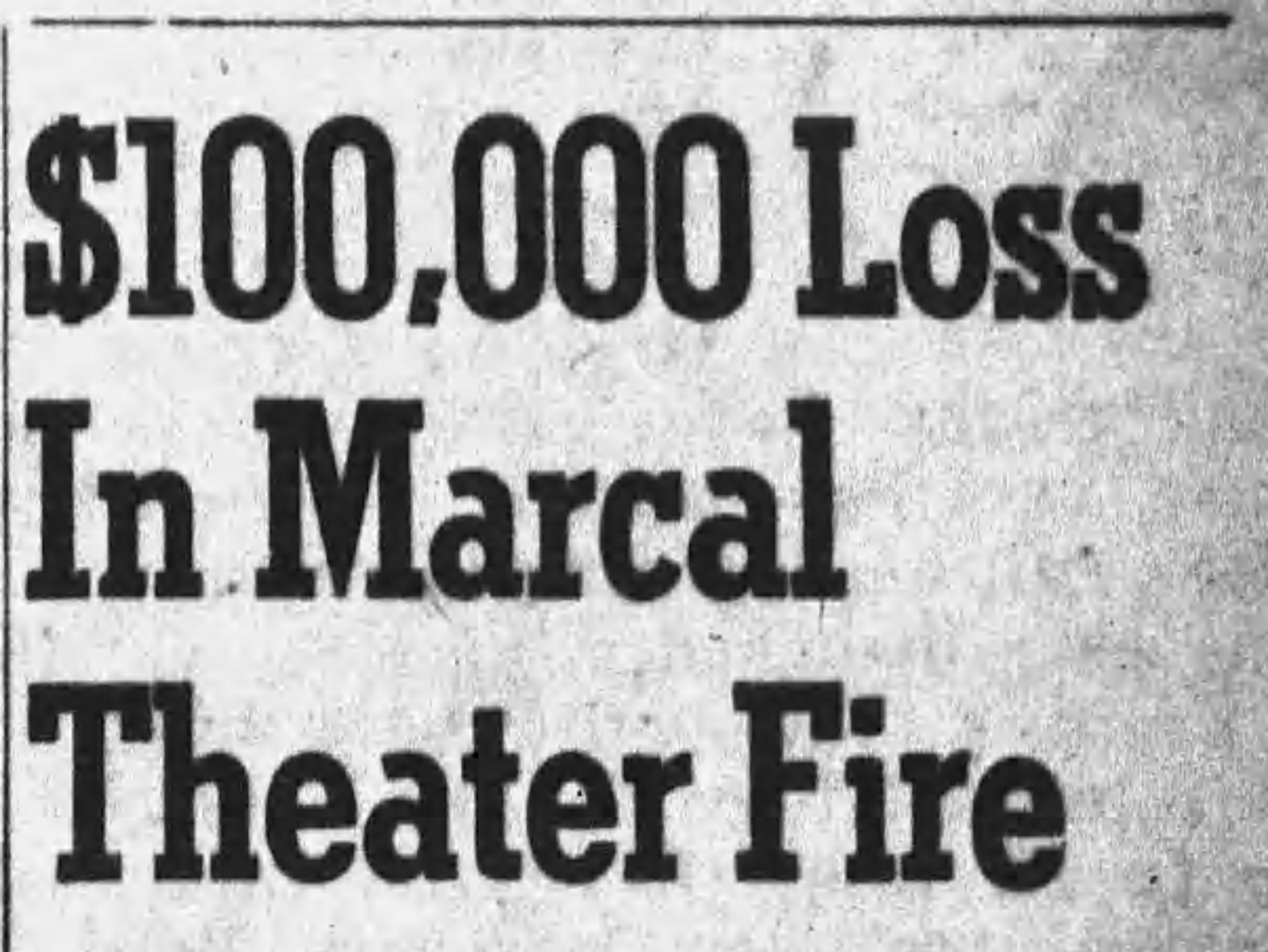
In the wee hours of June 25, 1948, the Marcal Theater caught fire. Hansen saw the flames from his Carlos Avenue home and called the fire department. The auditorium was extensively damage- $100,000 worth according to some papers, $75,000 in others.  Insurance covered the loss and the theater reopened- with a refurbishment and modernized projection and sound equipment- on March 31, 1949 with a revival of “San Francisco” starring Clark Gable and Jeanette McDonald, and the Marx Brothers comedy classic, “A Night at the Opera.” The gala event was broadcast on local television via Don Lee’s KTSL.

Hollywood Citizen News 6/26/1948

Television by now posed a threat to the movies as audiences stayed home. The reopening of the Marcal was broadcast over Don Lee’s KTSL. LA Times 3/30/1949

Later in 1949, Hansen became a part owner of the Florentine Gardens, just east of the Marcal, which reopened under his management on July 1. Two weeks later, on July 15, 1949, a young woman named Lola Titus shot Hansen at the Carlos Avenue home. He survived, telling police that Titus was mad because he wouldn’t hire her for a show at the Florentine Gardens. Titus’ explanation of a romantic entanglement seems more plausible. Florentine Gardens would be sold to the Hollywood Canteen Foundation by the end of 1950.

Newspaper reports of the incident stated that Hansen and Ida had been estranged for 20 years. If so, they had been living together at the Carlos Avenue home in 1940, at least. They would live together again, at 2274 Canyon Drive (Ida’s address in 1949) per the 1950 US Census. She may have been used to his dalliances with other women (see notes below).

Television In May to June 1950, the television show “Hollywood Amateur Hour” was broadcast from the Marcal on Saturday mornings over KIEV.

Hollywood Citizen News 5/12/1950


San Pedro News Pilot 9/25/1951

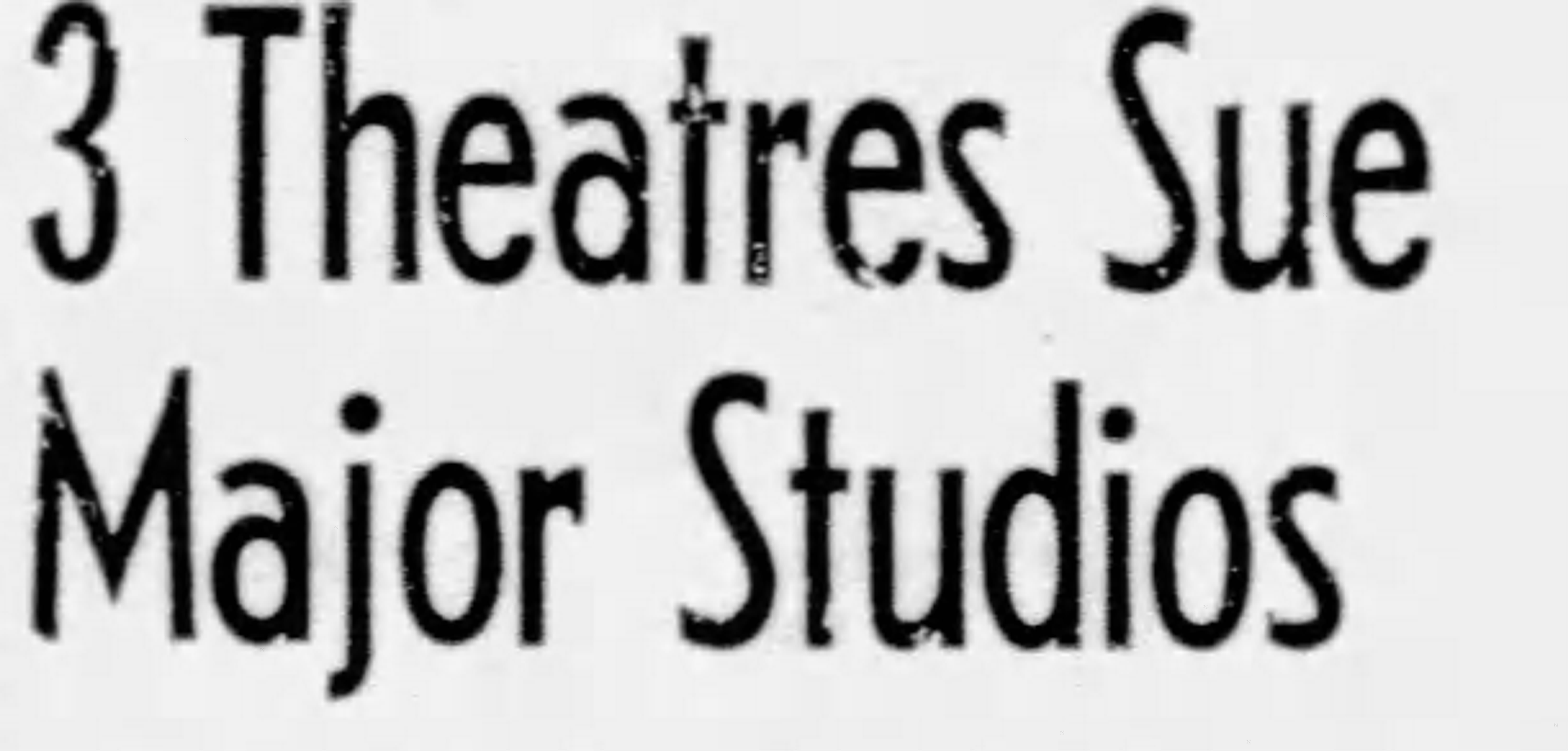
In September 1951, the Marcal Theater joined the Hawaii and Beverly Hills Music Hall theaters in filing an anti-trust lawsuit against 20th Century Fox Corp., National Theaters Corp., Loew’s Inc., Warner Brothers Pictures, Inc., Warner Brothers Pictures Distributing Company, Universal Film Exchanges, Inc., Paramount Pictures Corp., Columbia Pictures Corp., United Artists Corp., Fox West Coast Theater Corp., and the Fox West Coast Agency Corp., charging them with unfair distribution and exhibition practices. The suit mirrored an earlier federal lawsuit, which had ultimately prevailed after going all the way to the US Supreme Court, but was still in the process of finalizing its terms.

The Marcal struggled as a film venue, however and for a time ceased showing movies.

In April 1952 FilmCraft Productions used the Marcal Theater for television filming. A pilot for a new Mark Goodson-Bill Todman produced game show, “Two for the Money” was filmed there on June 5, 1952. Allen turned down the job of emcee but the show was picked up using a different host.  Excerpts of the pilot, with glimpses of the live audience in the Marcal auditorium, can be viewed here:

In December 1952, Hansen had a full stage constructed in the auditorium so that the theater could host legitimate theater. It’s first production, “The Merry Widow,” debuted on December 4, 1952 but was not well received. The French Postcard Review, an old Earl Carroll “girl review” style show opened on October 2, 1953. It was followed on November 24 by “Brooklyn USA,” a play about the mob’s Murder, Inc. It was poorly reviewed as well.

Films returned in early 1954. In February it screened the Billy Wilder hit Stalag 17. This was followed by the controversial film “Salt of the Earth.”

The LA Mirror 2/23/1954

LA Daily News 5/20/1954.

In November 1957, the theater was rented out to the People’s Church of Hollywood led by Nate Perry. In January 1958 through June 1958 it continued as a religious venue with evangelist Paul Cain conducting services here.

LA Times 11/16/1957

LA Mirror 1/18/1958.

In July 1958, the theater returned to hosting occasional live stage shows and the odd special-interest film. In 1959 it began showing films regularly again. In April 1960 it was reported that Hansen was mulling turning it into a legitimate playhouse but that didn’t happen.

The play The Innocents based on the Henry James novel “The Turn of the Screw” debuted at the Marcal on September 12, 1958 with poor reviews. Hollywood Citizen News 9/13/1958

The last shows screened at the Marcal were “Splendor in the Grass” on a double bill with Elvis in “Girls! Girls! Girls!” The fare opened June 5, 1963. The final show was June 9, 1963.

Hansen sold the Marcal to Pacific Theaters, who had it renovated inside and out by architect Carl Mohler. The facade of the theater was encapsulated by a modern screened effect and new signage was added. It reopened as The World Theater on July 3, 1963 with a screening of “Captain Sinbad” and “The Slave.” The Hawaii Theater was closing around this same time and became the new Hollywood headquarters of the Salvation Army.

Hollywood Citizen News 7/3/1963

Mark Hansen (far right) with reps from Pacific Theaters and Mayor Yorty’s office. Hollywood Citizen News 7/18/1963

An example of typical World Theater fare. Hollywood Citizen News 6/18/1964

Mark Hansen died in June 1964.

The World Theater operated into the 1980s. The facade was damaged in the 1994 Northridge Earthquake and while the building is extant, it has been significantly altered.

Notes:

Different sources (including his own crypt) cite different years for Hansen’s birth date. July 25, 1892, is what he used on his naturalization papers. He applied for citizenship in 1916.

“Used to his dalliances with other women”: In July 1936, an actress named Faith Norton sued Hansen for breach of promise; the case was decided in her favor in January 1937 but the court only awarded her $100 of the $125,000 she sought.

Carlos Avenue was a short street, north of Hollywood Boulevard between Argyle and Bronson. Originally it was even shorter and did not extend east of Gower except for a short stump for the First Presbyterian Church of Hollywood at Gower and Carlos until later. In 1947, newspapers sometimes referred to 6024 Carlos as an apartment, other times a bungalow. It was a small, 1-story, 7-room single-family residence designed by architect C.S. Albright in February 1915. It was demolished in 1973.

On November 14, 1947, gossip columnist May Mann reported that Nils T. Granlund (NTG), formerly of the Florentine Gardens,  and Mark Hansen were going to open a 12-story hotel on Hollywood Boulevard near Gower, with a cabaret on the roof. Construction was to begin “shortly.” This project never happened.

5800 Block of Hollywood Boulevard: Hollywood Freeway

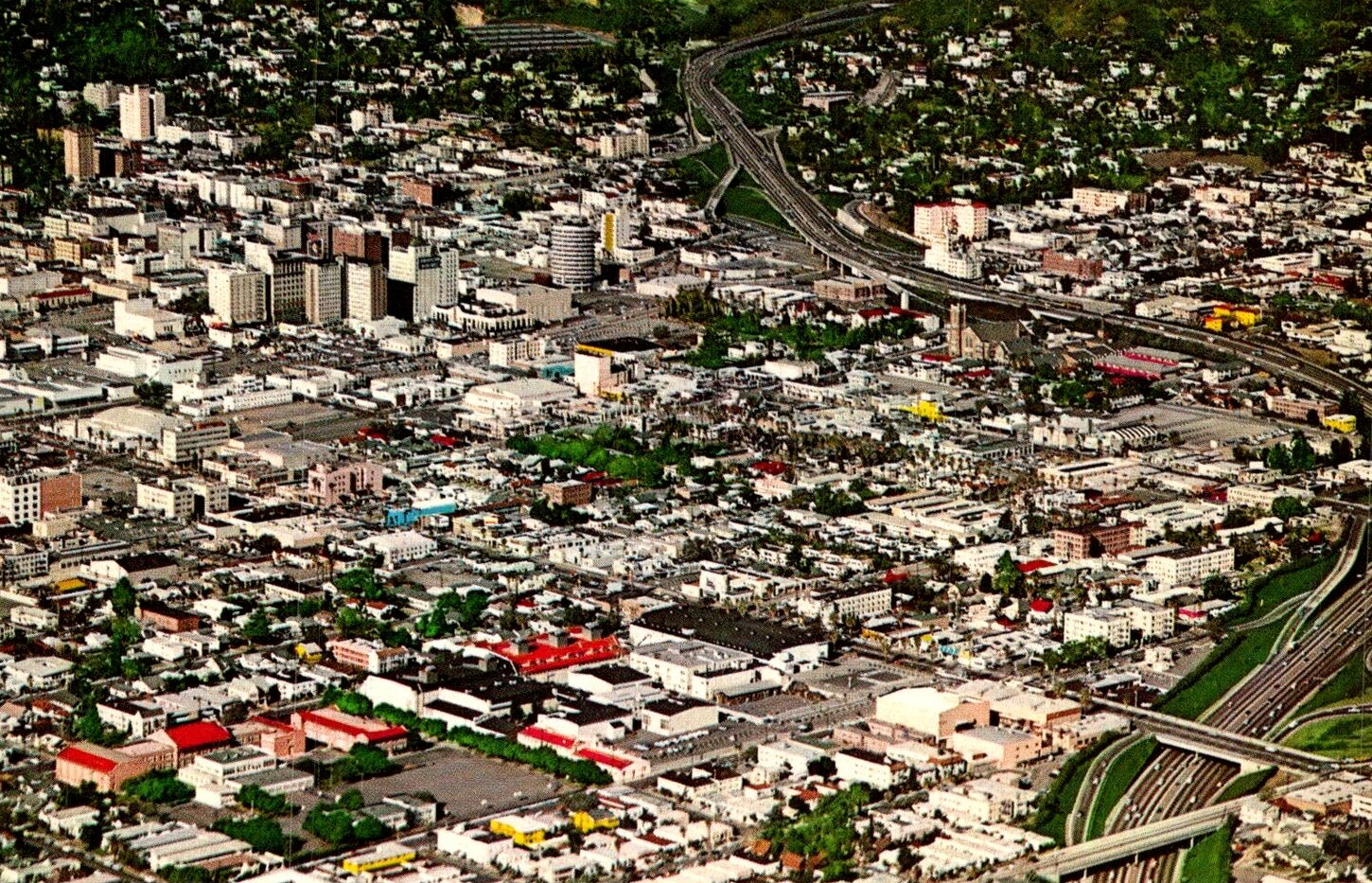
The Hollywood Freeway (US Route 101) was constructed to connect downtown Los Angeles with the San Fernando Valley.

Originally to be known as the Hollywood Parkway when a plan was presented to Mayor Bowron in 1939, the first unit, constructed by the City of Los Angeles with city and state funds, opened in July 1940 through the Cahuenga Pass from Highland Avenue to Barnham Boulevard.

Funding and World War II put a halt to further progress on the freeway for the duration, After the war, restarting of the project was again pushed back as civic leaders and residents protested that removal of existing dwellings would make the already severe housing shortage situation worse (see my posts on the postwar housing crisis here and here), but in 1946 excavation got underway in the Civic Center section and Fort Moore Hill became a lot less hill. The project was full steam ahead when the Collier-Burns Act of 1947 assured state highway funding for freeway construction.

Hollywood business and religious leaders expressed concerns about the route through Hollywood, arguing that it would impact the acoustics of the Hollywood Bowl and cause the destruction of  KTTV’s new studio (later Metromedia Square), which opened at 5746 Sunset Boulevard on January 1, 1947 and the 1923 First Presbyterian Church of Hollywood at 1760 N. Gower. The State Highway Commission did indeed modify the route to avoid the studio and the church, and added what would today be called mitigation measures around the Hollywood Bowl in the form of landscaping to diminish effects to the acoustics (which as it turned out were fine).

By 1949 right of way acquisition for the Western Avenue to Hollywood Boulevard link began. Because the Hollywood Freeway is a depressed freeway, construction on the Boulevard meant excavating underneath it and constructing a bridge over the freeway as well as on and off ramps. The 5800 block of Hollywood Boulevard was affected, between Van Ness Avenue to the east and Bronson Avenue to the west. Canyon Drive, which had gone through to the north side of Hollywood Boulevard, would be rerouted onto Van Ness north of the Boulevard.


Overall, Hollywood Boulevard itself was minimally impacted by the project. There wasn’t a lot of development here; there were 1 and 2-story retail buildings, remnants of large, formerly rural residential estates, used car lots (this was the tail end of Hollywood Boulevard’s Auto Row), and gas stations.

5821 Hollywood Boulevard between Van Ness and Canyon Drive had been the home of Mary Taft, matriarch of the Taft family, from 1904 until her passing in 1938 at age 96; her daughter Dr. Gertrude Taft continued to live here until her death in September 1941. Detail of a 1913 Sanborn Fire Insurance map, LOC.


5873 Hollywood Boulevard, between Bronson and Canyon Drive, was a residence in 1913; the site had been a Union Oil gas station since 1921. It survived the Hollywood Freeway construction and was demolished in 1969. The current Original Tommy’s fast food restaurant was built in 1995. Detail of a 1913 Sanborn Fire Insurance map, LOC.


Nash dealers J. F. O’Conner & Son relocated from 5800 Hollywood Boulevard, where they had been since 1945, to 6028 Hollywood Boulevard due to freeway construction. Mark M. Hansen, owner of the Marcal Theater and part owner of the Florentine Gardens, owned both this property and the new location. Hollywood Citizen News 8/12/1949.

With right of way acquisition completed, excavation work at Hollywood Boulevard got underway in March 1951. The first task was to build a detour for the Pacific Electric tracks between Bronson and Van Ness.

Hollywood Citizen News 2/24/1951


Work on the PE detour. Hollywood Citizen News 3/8/1951

The final link, from Hollywood Boulevard to Mullholland Bridge was opened with a ribbon cutting ceremony on April 15, 1954.

The Hollywood Freeway bridge carrying eastbound Hollywood Boulevard traffic, May 1952. LAPL photo.


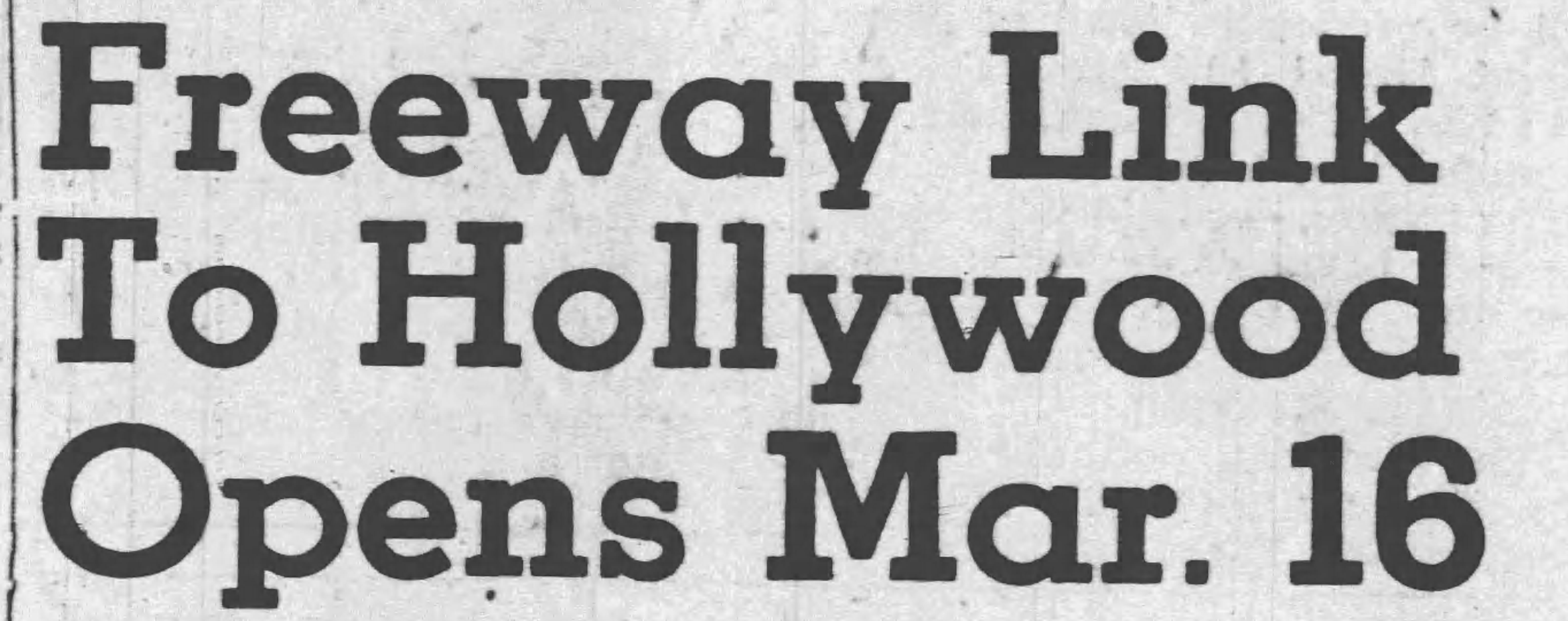
The opening if the Western Avenue to Hollywood Boulevard link. Hollywood Citizen News 3/3/1953

The Western Avenue to Hollywood Boulevard link of the freeway was to have opened in January 1953 but heavy rains delayed construction. It opened on March 16, 1953. Dorothy Lamour appeared at the ribbon-cutting ceremony- a nod to her “Road to…” series of films with Bing Crosby and Bob Hope. The first accident on this stretch of highway occurred about 5 minutes later.

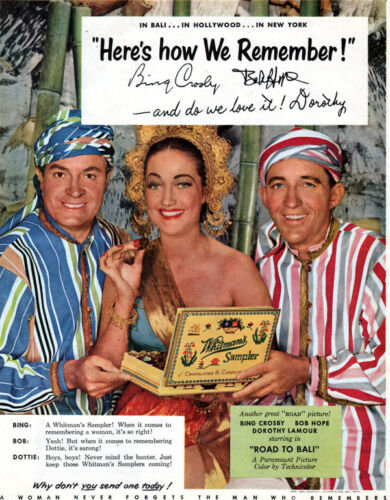
Dorothy Lamour, Bob Hope and Bing Crosby were known for their “Road” films. In 1953 it was “The Road to Bali.”

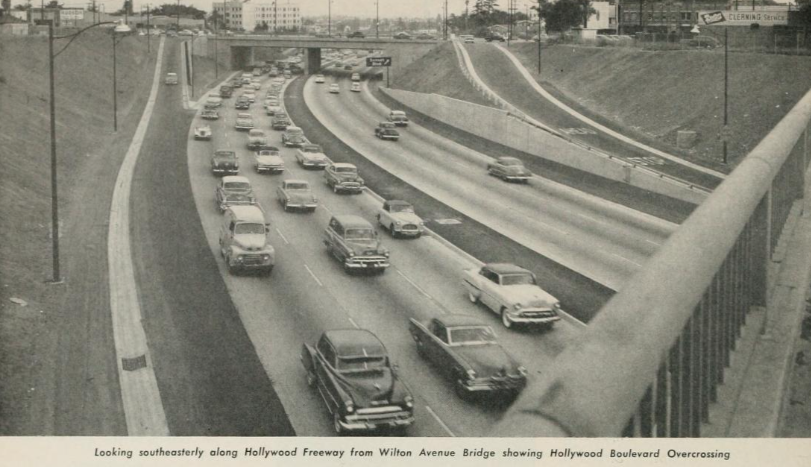
Looking toward the Hollywood Boulevard overcrossing from the Wilton Avenue Bridge. From California Highways and Public Works magazine September/October 1954.

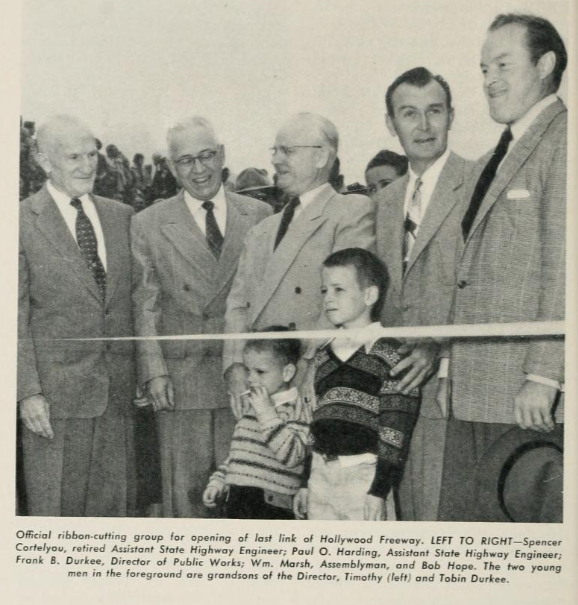
Hollywood Boulevard would be the end of the freeway until the final link opened in April 1954. This time, Bob Hope officiated at the ribbon cutting.

Bob Hope opening the final link of the Hollywood Freeway, April 1954. From California Highways and Public Works magazine May/June 1954.


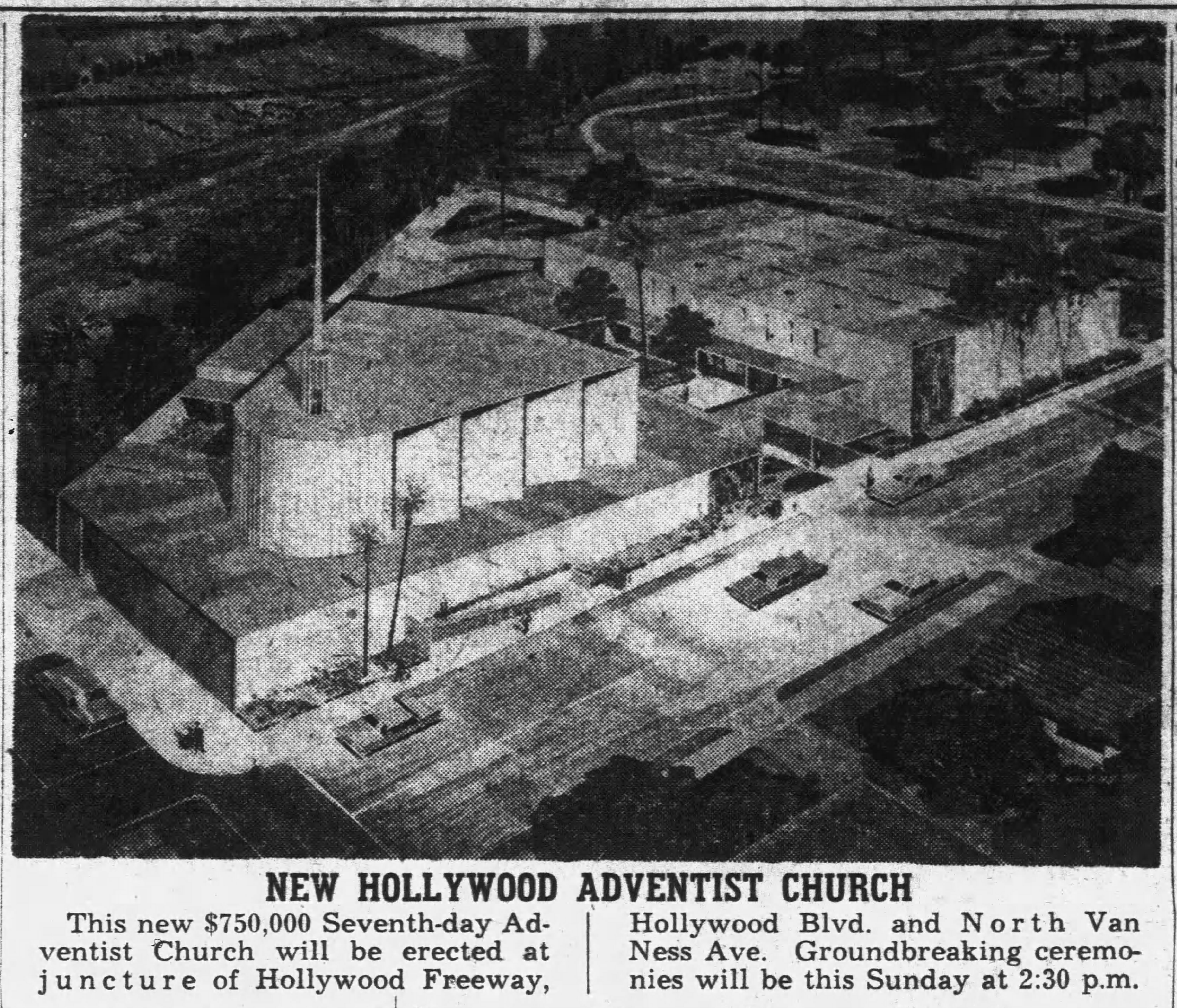
Although it looks like it was marooned by the Hollywood Freeway construction, the Seventh-Day Adventist Church between the ramps was built in 1961, almost 10 years after the freeway was completed. Its address is actually on Van Ness Avenue. Hollywood Citizen News 5/27/1961.