5939 Sunset Boulevard, located at the northeast corner of Sunset and Gordon Avenue, was designed by architect McNeal Swasey in 1924 for Stanley W. Smith as his Hollywood showroom of Peerless motor cars. The star-studded grand opening took place in the evening of June 25, 1924.
Author: jhgraham
6000 Sunset: Cashis King Market / Hollywood Casino/ Recording Studio
6000 Sunset Boulevard, on the corner of Gordon Street, was designed in the art moderne style in April 1933 by architect Harry L. Pierce. It opened that summer as the Sunset Cashis King Market.
5539 Sunset: Sunset House Restaurant
5539 Sunset Boulevard, between Western Avenue and St. Andrews Place, was designed by Shelby R. Coon in 1925 as an auto showroom, part of a cluster of automotive-related businesses built from 5533 to 5565 Sunset for E.F. Bogardus. Auburn dealer Wilshire Motors opened here in May 1926 amid a cluster of other auto-related businesses.
5600 Sunset: Fanchon & Marco Studios / 2nd Hollywood Rollerbowl / Stardust Ballroom
The parcel that includes 5600 Sunset Boulevard is located between Wilton Place and St. Andrews Place.
In 1925, a 1-story brick automobile showroom and garage was built at the southwest corner of St. Andrews Place (addressed variously as 5600-5606 and 5600-5620 depending on the number of interior partitions). It’s function remained automobile-related through early 1931.
5852 Sunset: Warner Brothers Studio/ Roller Bowl/ Sunset Bowl
In February 1919, Niles. California-based F.S. Reed announced that his new company, the Bonnie-Reed Film Manufacturing Company, was relocating to Hollywood and was to begin construction at once on a $3 million studio on a parcel front Sunset Boulevard between Bronson Avenue and Wilton Place, in the Beesemyer Tract. Citizens living in the vicinity lobbied the Public Welfare Committee to protest the inclusion of the property in the “Motion Picture Zone.”
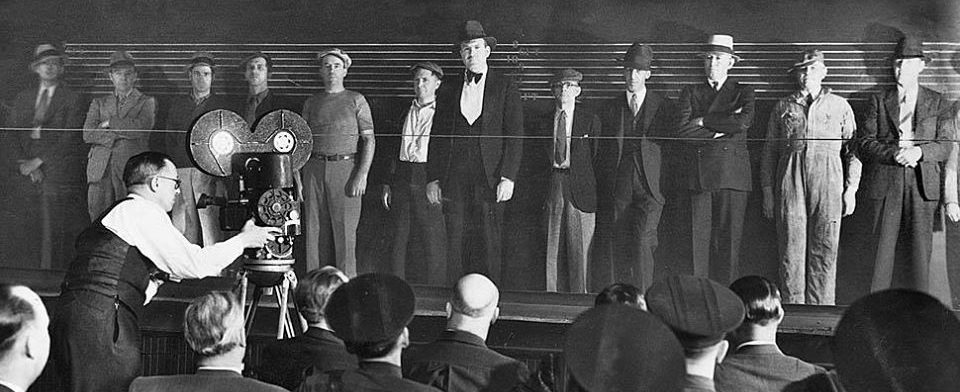
Old Central Police Station
For nearly 60 years, the Los Angeles Central Police Station and City Jail was located between Broadway and Hill streets at 318 West First Street.
The Bate Case
Police Brutality Pt. I
On Wednesday evening, September 19, 1923 about 11 pm, James H. (Harry) Bate was tired. It had been a long day. After working a full shift as Assistant Head Janitor for the Los Angeles County Courthouse and Hall of Records buildings, he’d attended a meeting of his lodge at the Odd Fellows Hall on Wall Street between Seventh and Eighth Streets, where he was secretary, then stopped in at his church, the Second Baptist Church at 740 Maple Avenue, where he served as treasurer. Now, lugging records from both institutions in a pair of suitcases, the 64-year-old walked north the half-block to the corner of Seventh and Maple where he would catch a streetcar home (1).
The Collins Case
On March 14, 1928, Christine Collins went to police headquarters on West First Street to report that her 9-year-old son Walter had been missing for four days. Collins told Captain Joseph J. Jones, head of the juvenile division, that she believed Walter had been kidnapped by enemies of her husband- also named Walter- who was then doing time in prison.
Lee Francis
“You’re a cog in the organized traffic when you’re running a house, a spoke in the wheel of the underworld.”
-Call House Madam
Lee Francis was the madam of multiple brothels in Los Angeles under Charles Crawford and his successors. Almost all that is known about her, or believed that is known about her, is information that came from Francis herself and is not reliable. The following is based on my own original research.