6157-6161 Hollywood Boulevard: Automobile dealership

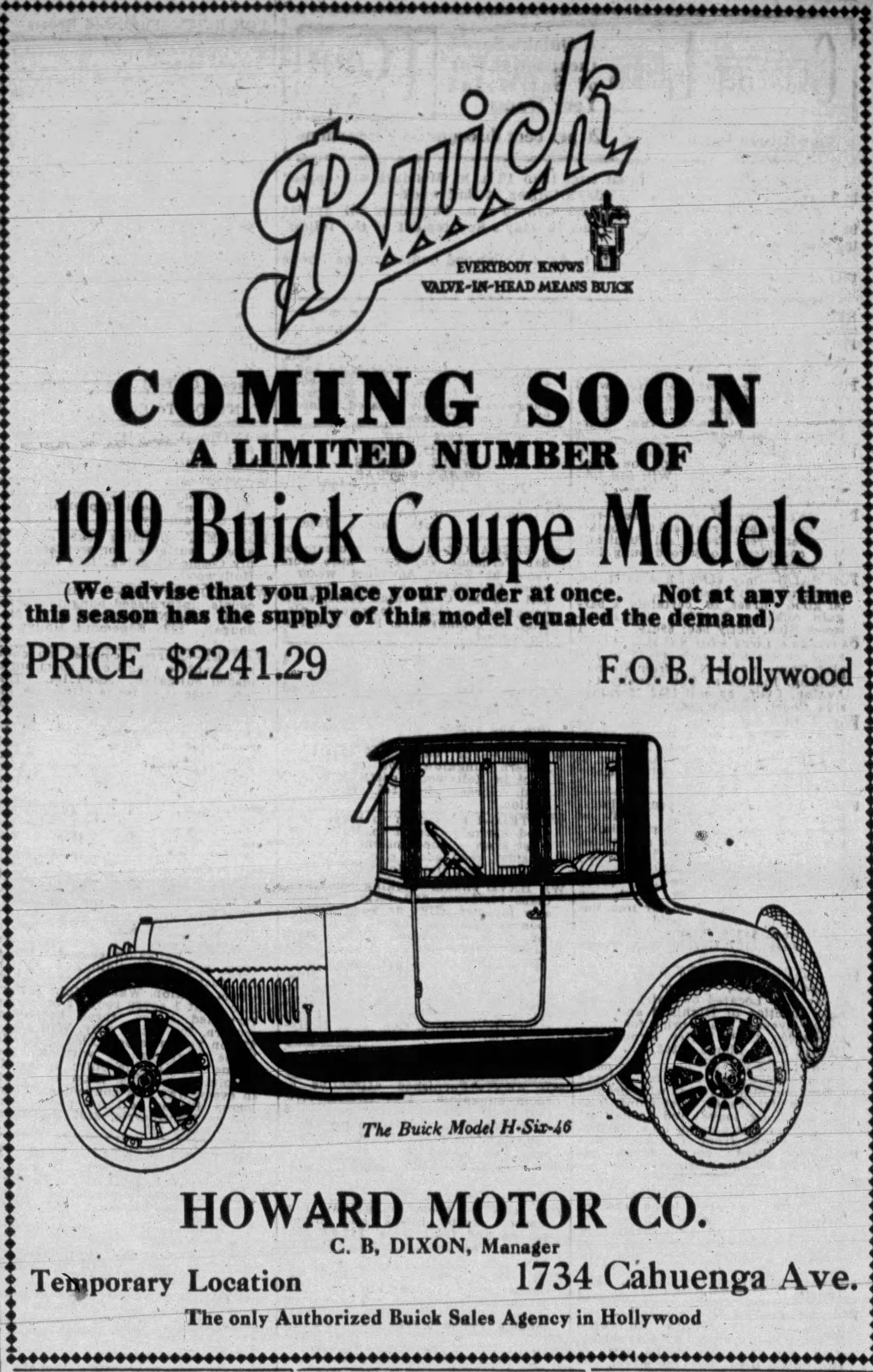
This 1-story building, at the now-gone northeast corner of Vista del Mar and Hollywood Boulevard, was built in 1919 for the Howard Automobile Company’s new Hollywood Buick showroom. It was originally addressed as 6157 Hollywood Boulevard.

The property owner was investor Harry H. Ziegler, who bought it from the E. W. Twist realty Company as part of the Del Mar tract.

Twist Realty had previously occupied this corner itself; this section of Vista del Mar between Hollywood Boulevard and Carlos Avenue, was known Cyril Drive until 1915.

Elias W. Twist was the husband of Josephine Gassagne. Josephine and her surviving siblings – Charles Gassagne, Marie (Mrs. Louis Drouet), Constance (Mrs. James Larquier later Mrs. Pierre J. Picherie), Adele (aka Jenny, Mrs. Henry Kracke) and Eugenie (Mrs. Alexander T. Hoover later Mrs. Frederick Gambold)- were the grandchildren of the French-born Los Angeles pioneer Jose Mascarel, who had settled in Los Angeles in the 1840s and served 1-term as mayor from 1965 to 1966. Among his many real estate holdings was a large parcel of land on the north side of Hollywood Boulevard (originally Prospect Avenue) between Gower and Vine. Mascarel, in his 80s, began subdividing the property in 1897. He died in 1899 and a battle over his estate ensued, initiated by his three surviving adult children. The adult children were not, as was sometimes reported, cut out of his will- they were to receive 1/3 of the sizable estate, but that was not sufficient. They didn’t want any of it going to the grandchildren- whom they accused of poisoning the old man’s mind against his children and, moreover, alleged that they were not Mascarel’s biological grandchildren.

Census records for 1850 and 1860 show Mascarel living with his wife, Cerilda Lugo and the couple’s children- Marie Conception Mascarel included. However by 1870, Jose was living with another woman, Jesus, at least two decades his junior. Cerilda died in 1887 at age 59. Jose and Jesus remained together until his death; they formalized the relationship by marrying in 1896.

Jose and Cerilda Mascarel’s daughter Marie Conception married a livery stable owner named Charles (“French Charlie/Charley”) Gassagne. They were the parents of the 6 grandchildren who became Jose Mascarel’s chief heirs. Marie C. Mascarel Gassange died sometime between 1871 and 1875.

The heirs settled out of court over the will in 1900, agreeing to split the estate 50-50. The grandchildren resumed subdividing the Del Mar tract. They sold a 5-acre parcel on the west side of Vista del Mar Drive to pioneer music company head A. G. Bartlett in November 1900.

Josephine Gassagne married Elias W. Twist in 1880. They built a large residence in Hollywood at 6129 Carlos Avenue, facing south, that in 1914 was leased to a military academy and in 1916 became the first home of the Hollywood Studio Club.

In 1912, Twist operated his real estate office at 6157 Hollywood Boulevard before selling the property to Ziegler.

Detail of a January 1913 Sanborn Fire Insurance Company map for Hollywood. Vista del Mar Dr. here was called Cyril Drive until 1915. Library of Congress.

Hollywood Citizen 1/17/1913.

Zeigler built the Buick showroom on the site in April 1919 as well as another 1-story garage, addressed as 6151, adjacent to the east for use as an automotive paint shop. The Buick showroom has a facade of artificial stone; the interior featured a blue and white color scheme.

Charles S. Howard was the Buick distributor for California. The Hollywood branch operated out of temporary quarters at 1734 Cahuenga before moving to the new building in July 1919.

Hollywood Citizen 3/28/1919.

Hollywood Citizen 7/4/1919.

Hollywood Citizen 7/11/1919.

Howard Motor Co.’s Buick showroom at 6157 Hollywood Blvd. c. 1925. The Doll ‘Em Up Shop auto painters was at 6151. This photo is from the Homestead Museum collection.

Doll ‘Em Up Shop auto painters were next door to Buick at 6151 Hollywood Boulevard. LA Times 3/15/1926

Howard Motor Co.’s Hollywood Buick showroom moved to larger quarters at 6660 Sunset Boulevard on May 1, 1936. The building was a former Packard showroom. 6157 Hollywood Boulevard in turn became the new Packard showroom of W. H. Collins.

Hollywood Citizen News 5/26/1937.

Wartime Packard ad. LA Times 9/6/1943.

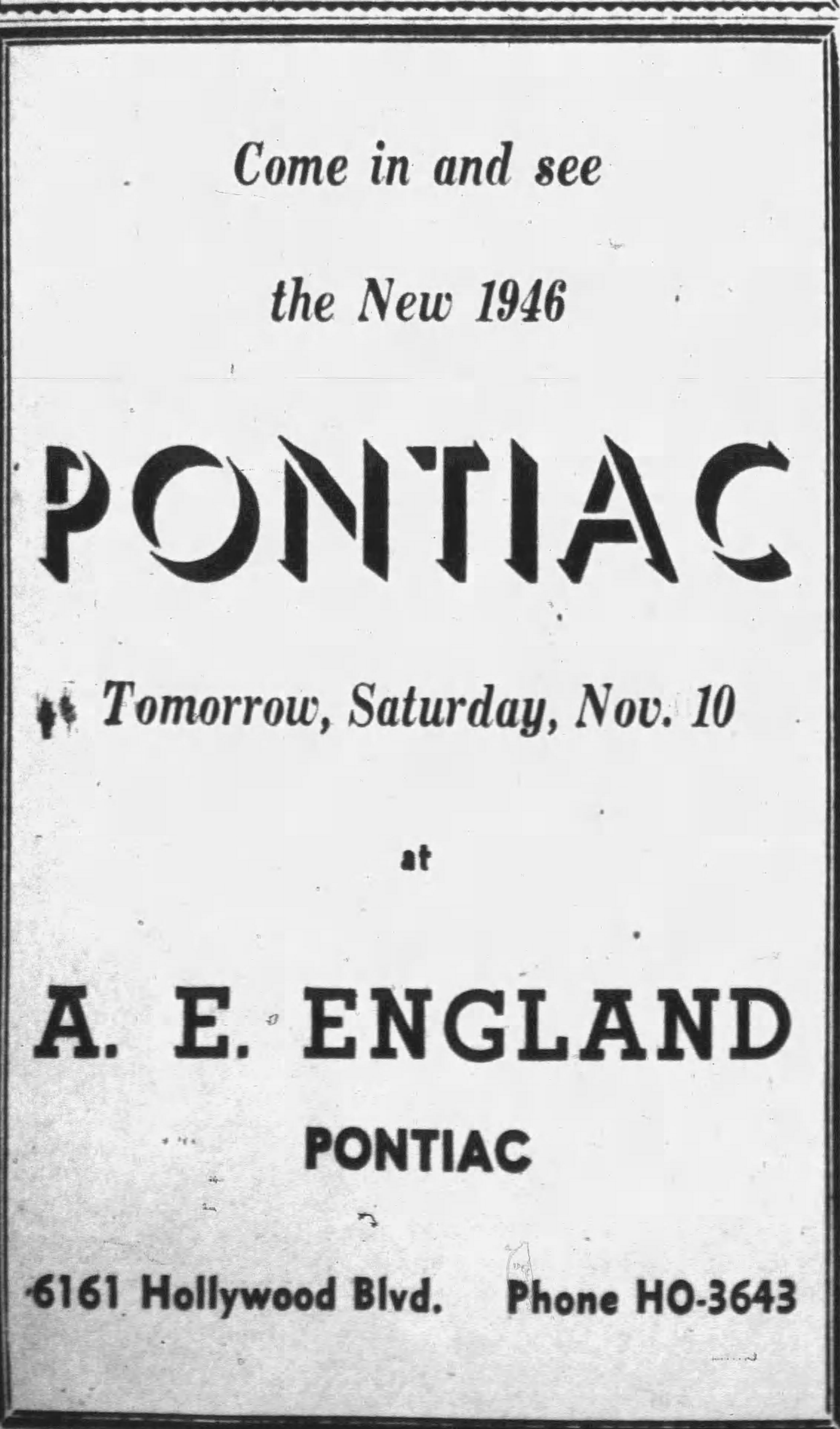
W. H. Collins remained at 6157 into 1945, when he moved to 6028 Hollywood Boulevard. Abner Elliott England’s A. E. England Pontiac dealership moved into the vacated space from 6032 Hollywood Boulevard. England re-addressed the building as 6161 Hollywood Boulevard.

Hollywood Citizen News 11/9/1945.

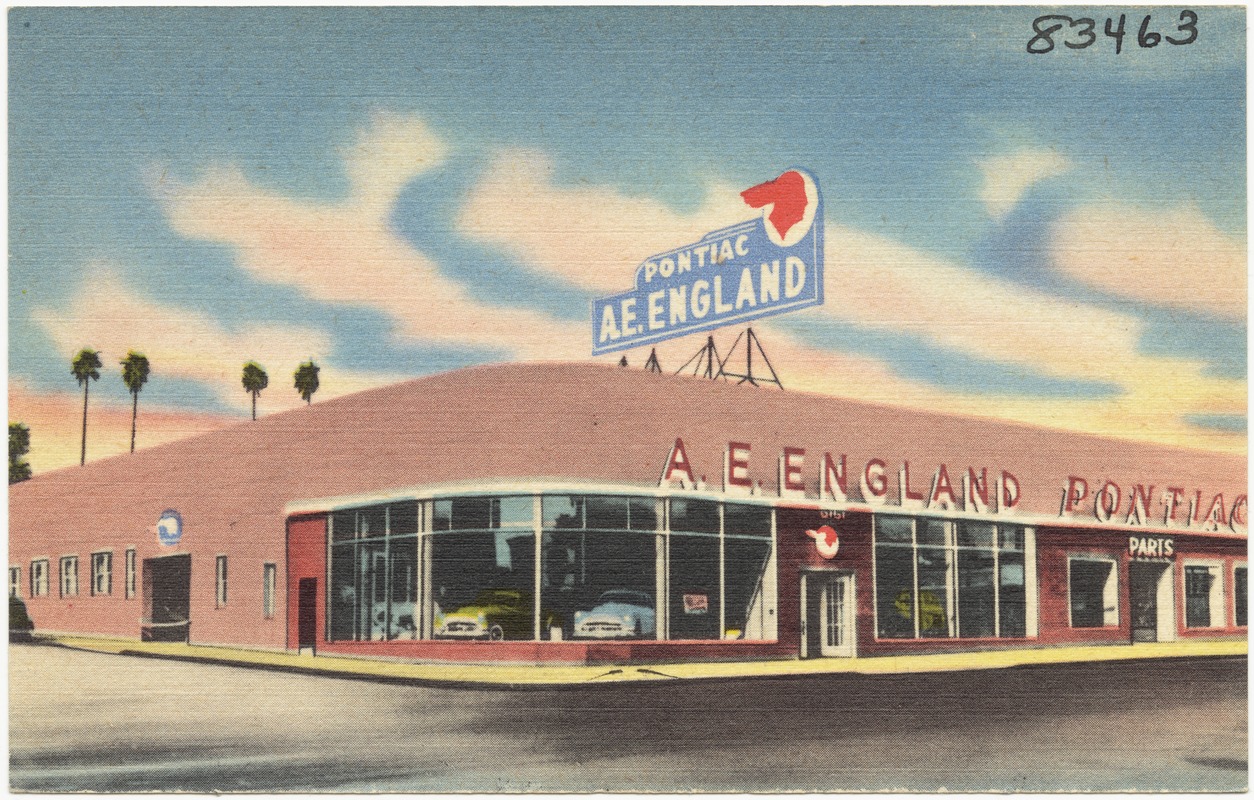
Though the building had a new address, it retained its 1919 appearance until late 1948, when A. E. England began modernizing it. Architect Victor Gruen oversaw the remodel, which gave the building a late-moderne rounded curve on the southwest elevation and large, backlit A. E. England Pontiac signage across the front entrance. The work was completed in February 1949.

Hollywood Citizen News 12/8/1948.

Postcard view of the 1948-1949 remodeled A. E. England Pontiac building. From the Boston Public Library collection.

A. E. England Pontiac remained here into 1971. Ab England died in May 1971. In January 1972 it became Jack Poet Toyota. Toyota moved down the block in 1983.

LA Times 1/22/1972.

6161 became an auto radio shop and other auto-related businesses. Today this site is part of the Eastown Apartment complex, addressed as 6201 Hollywood Boulevard.

Notes:

Jesus only received $5 in Jose Mascarel’s will; this was reportedly satisfactory to her, having received gifts of property from him during his lifetime. She died in 1902.

Josephine and E. W. Twist lived at 6127 Yucca Avenue after leasing the mansion. She died in 1925. He died in 1930.

6150 Hollywood Boulevard: Automobile showroom

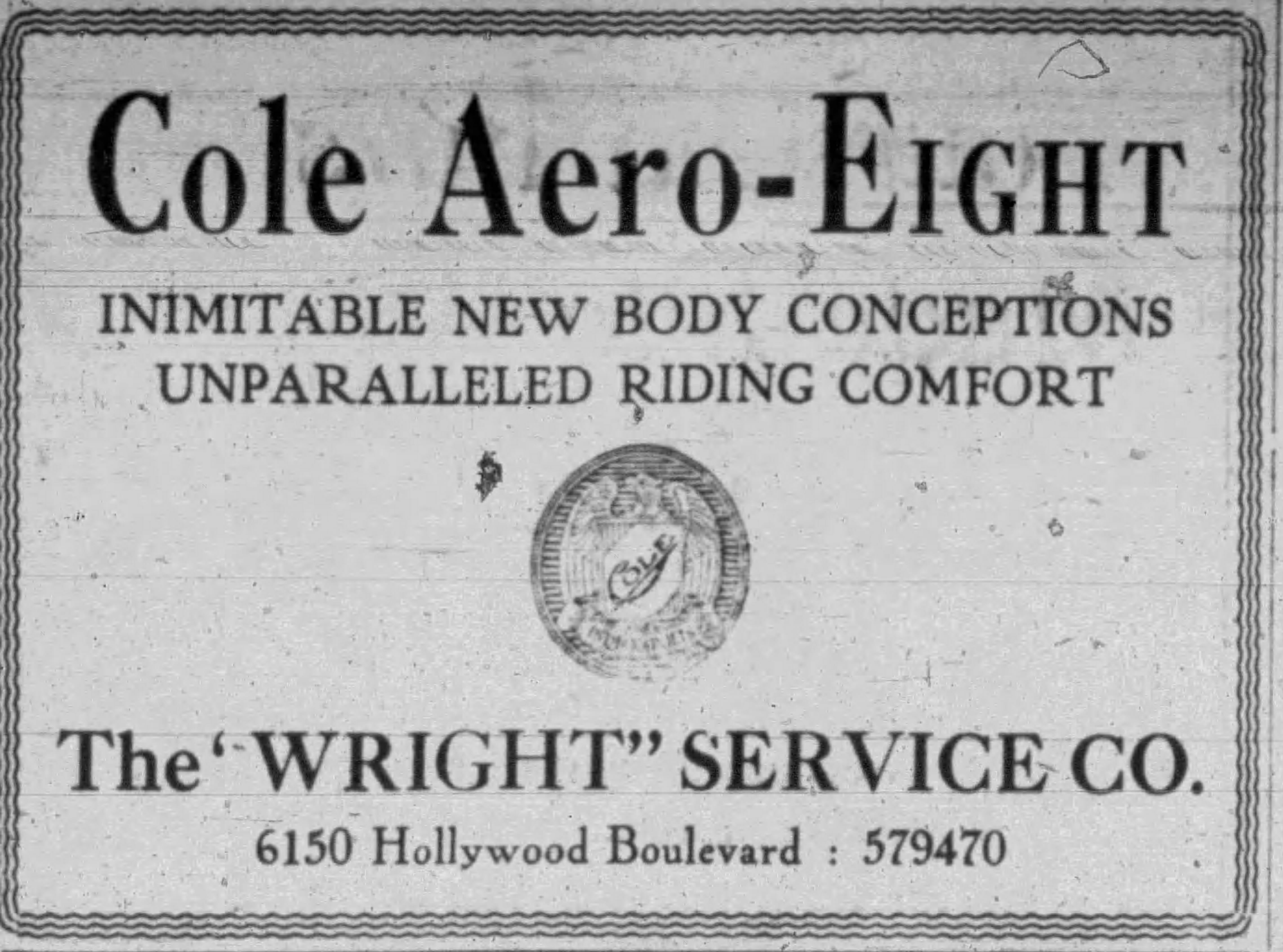
This building was a 1-story auto showroom on the southwest corner of Hollywood Boulevard and El Centro built in 1919 for Frank E. Wright of the Wright Service Company, who leased the property from owner William E. Graham and his wife Mamie Kendall Graham.

F. E. Wright had the Hollywood Studebaker franchise at the time, having taken over management of the former Studebaker dealer, the Nixon Motor Car Company in September 1917. He was officially named the Studebaker agent for Hollywood in November 1917, his display room located at 6658 Hollywood Boulevard.

Construction on his new home at 6150 was announced in April 1925. The building featured tapestry brick (i.e., with a pattern effect) and enameled brick trim. Wright moved in in July.

LA Times 7/2/1919.

Hollywood Citizen News 10/3/1919.

Paul G. Hoffman, Studebaker distributor for So Cal would expand into Hollywood, and in 1922 built a new showroom a little ways to the East of 6150, at 6116 Hollywood Boulevard.

Wright, meanwhile, became the Hollywood Cole-8 dealer in October 1919.

Based in Indianapolis, the Cole Motor Car Company was founded by Joseph J. Cole in 1909. Its 8-cylinder engine, the Cole Eight was introduced in 1915. Cole distributors for So Cal and Arizona, House and Meyer, opened their own Hollywood branch across the street at 6145 Hollywood Boulevard in May 1920. That month, Wright became Hollywood’s Peerless dealer.

The Peerless Motor Car Company, based in Cleveland, made luxury automobiles beginning in 1900.

Hollywood Citizen News 6/25/1920.

Things moved quickly in the post-World War I automobile World. The rush of expansion in the late Teens was followed by a slump in 1920-1921.

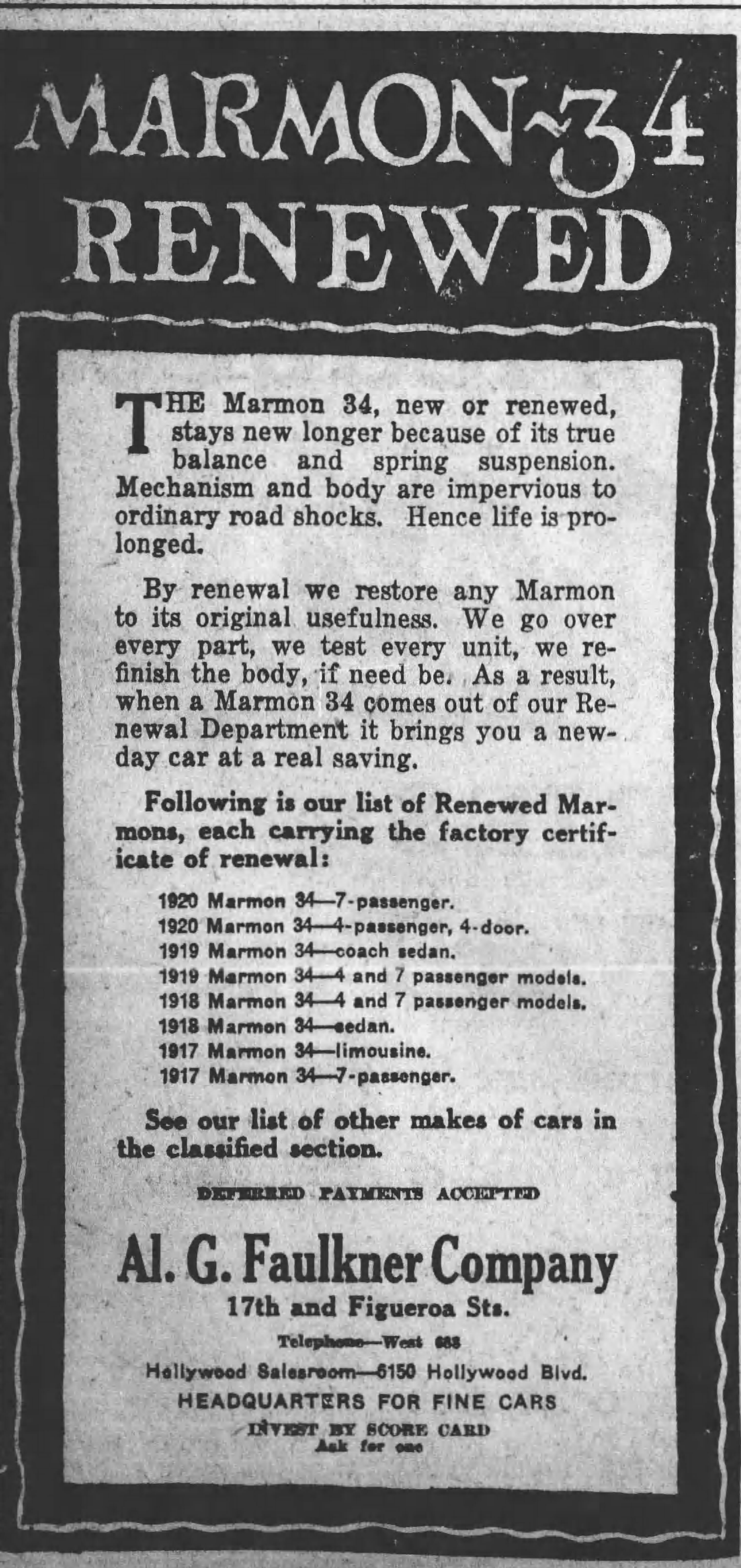
In January 1921, 6150 briefly became home to the Marmon. Founded by Henry Carpenter Marmon, the company had been making luxury automobiles since 1902. Al G. Faulkner as their area distributor.

LA Evening Express 1/1/1921.

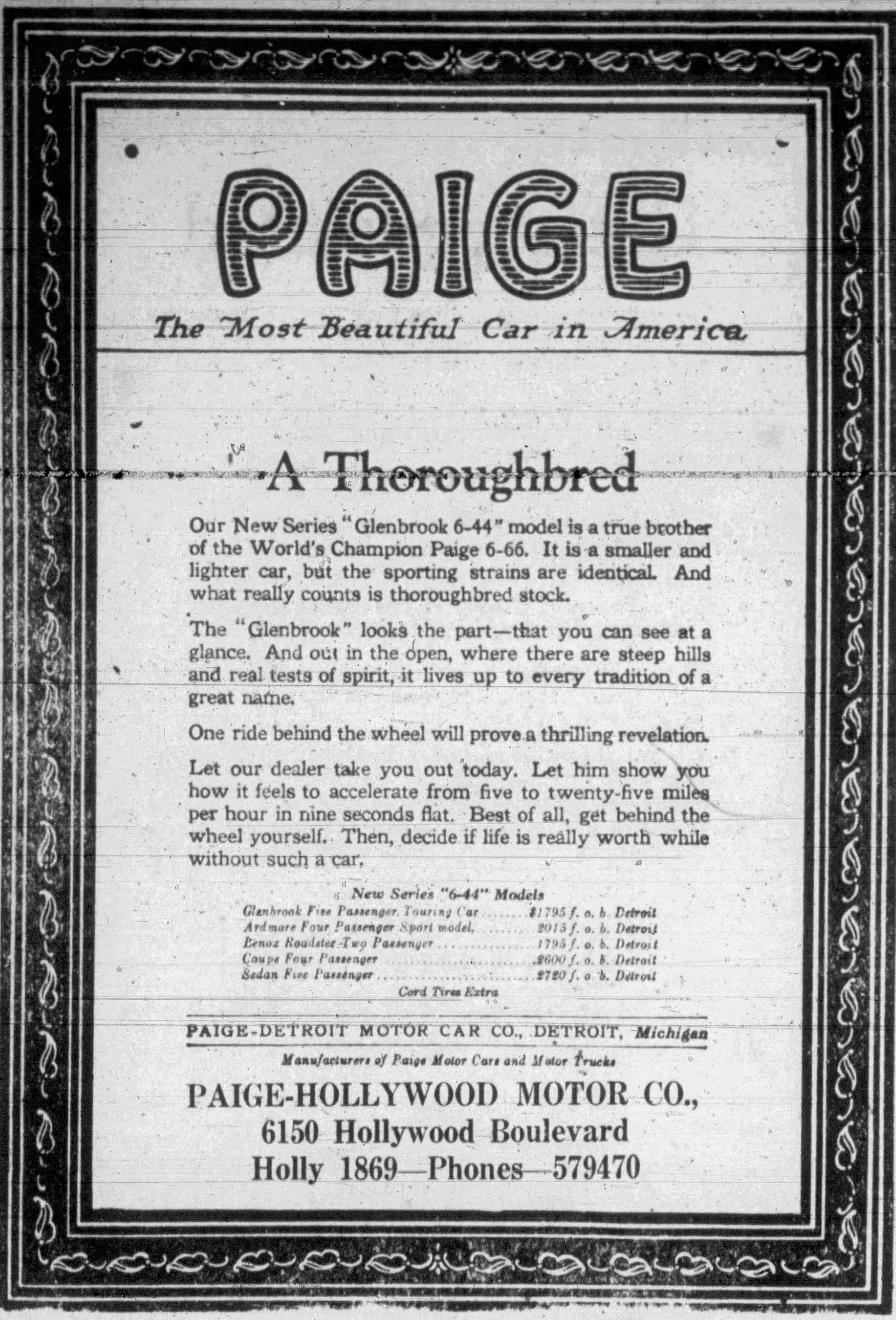
In April 1921, 6150 Hollywood Boulevard became the Paige-Hollywood Motor Company, dealers for the Paige-Detroit Motor Car Company.

Founded by Frederick O. Paige, the company began making luxury automobiles in 1908.

Hollywood Citizen 4/15/1921.

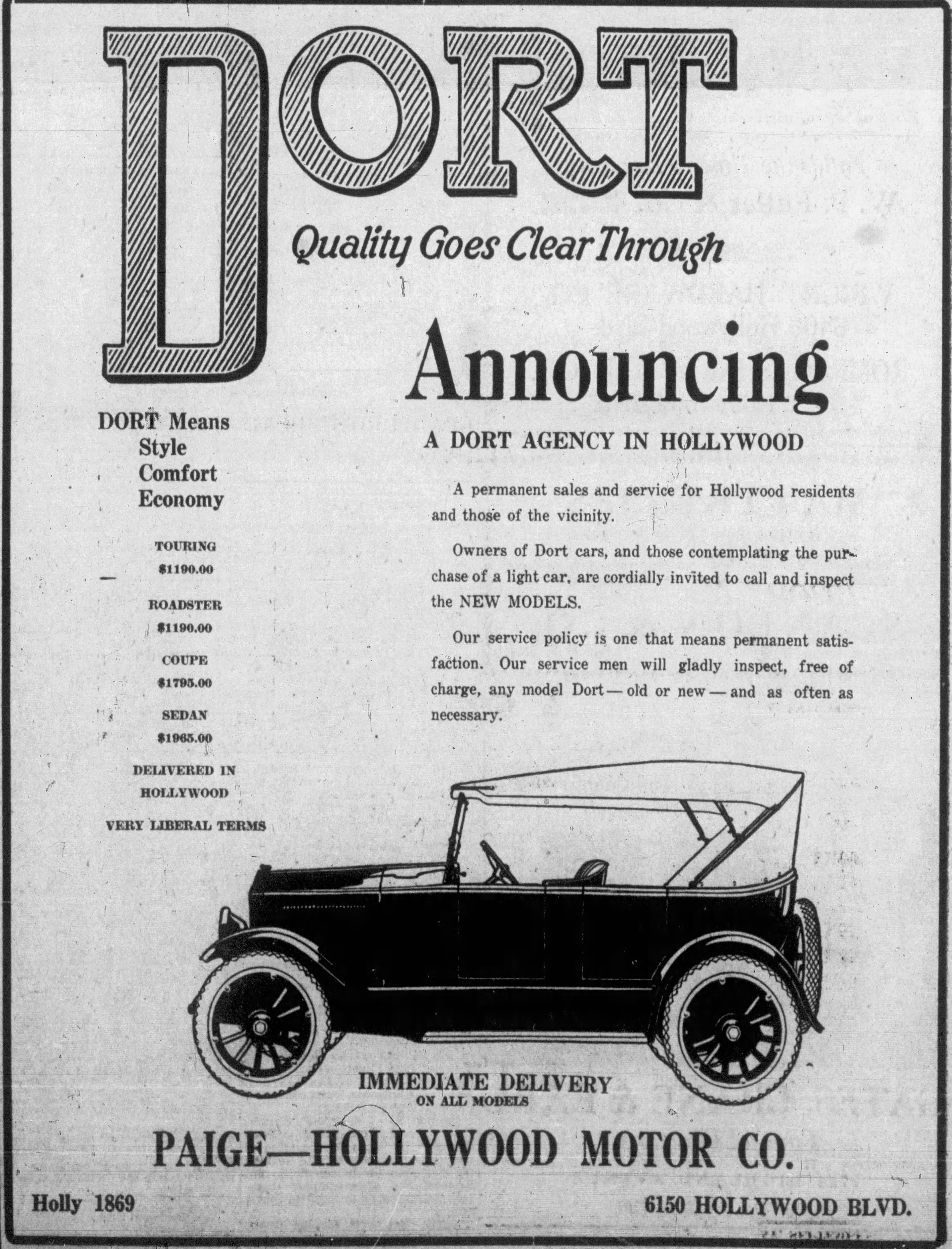
In September, the Paige-Hollywood Motor Company began handling the Dort motor car in addition to Paige.

The Dort Motor Car Company was based in Flint, Michigan. Founder Josiah Dallas Dort had been a carriage maker with partner William Durant; Dort began making autos in 1915. Paige-Hollywood Co.’s manager, L.n. McDowell had sold the first Dort in Hollywood back in 1916.

Hollywood Citizen 9/23/1921.

In January 1922, the Hollywood-Paige Motor Co. announced that it was changing its name to the Sunset Motor Company (no relation to another dealership company called Sunset Motors).

Hollywood Daily Citizen 1/14/1922.

In June 1922, Sunset Motor Co. added the Jewett to its lineup, a lower-priced offering from Paige. Made from March 1922 through 1926, it was named for company president Harry M. Jewett.

Hollywood Daily Citizen 6/30/1922.

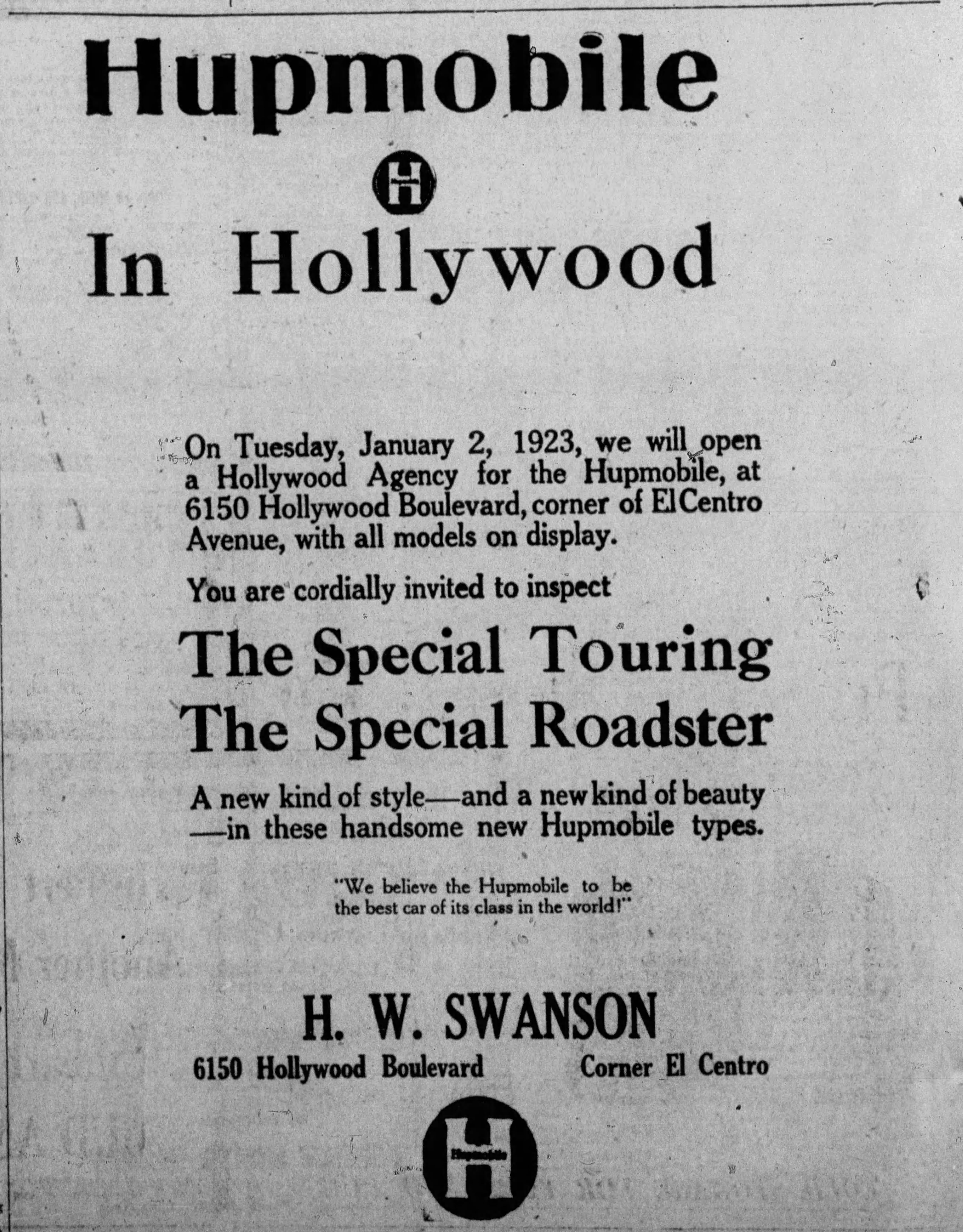
On January 2, 1923, 6150 became H. W. Swanson’s new Hupmobile showroom.

The Hupp Motor Car Company was founded in Detroit in 1909 by Bobby Hupp and investor Charles Hastings.


Hollywood Daily Citizen 12/26/1922.

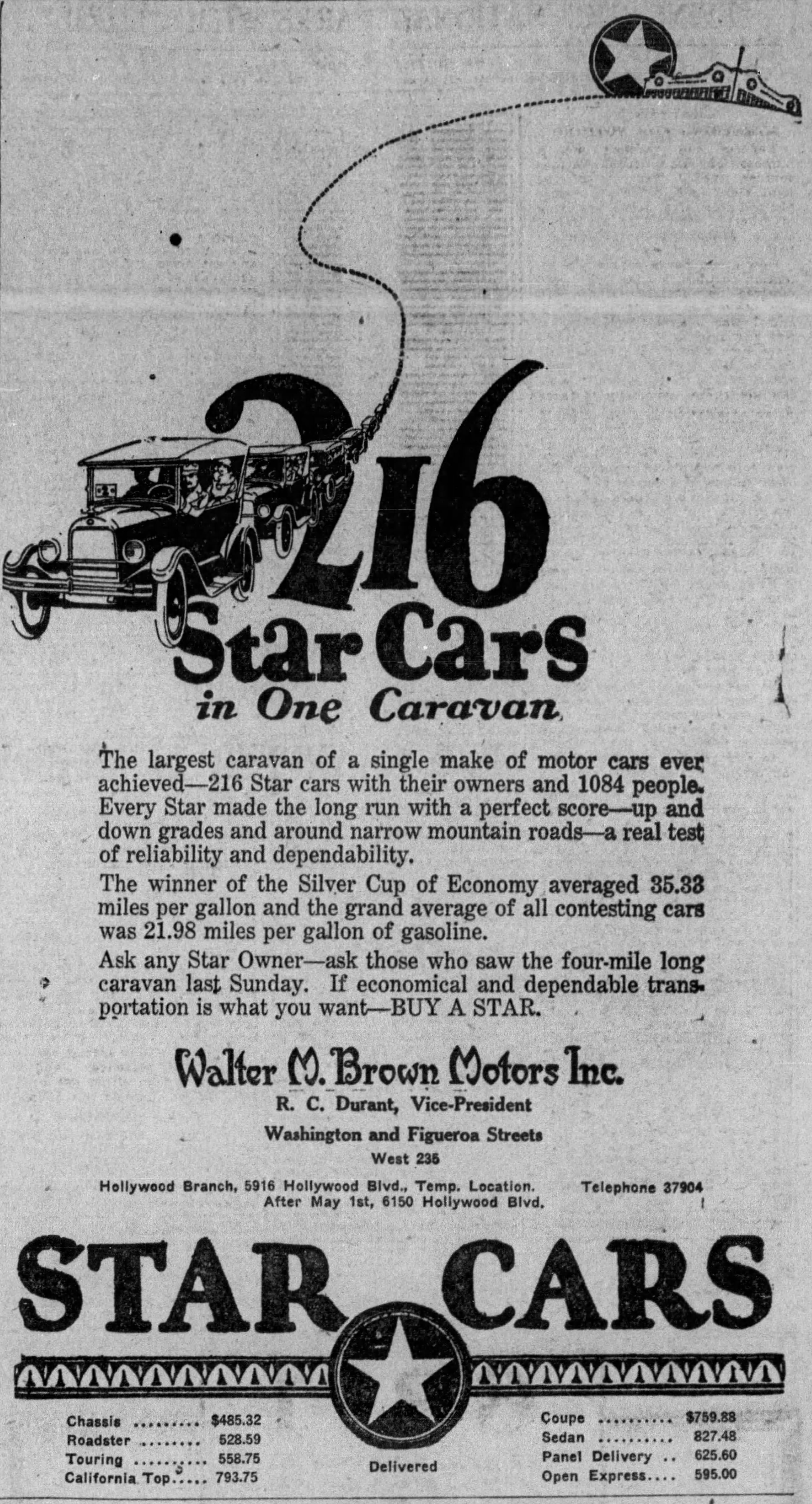
Later in January 1923, Walter M. Brown Motors, Inc. announced that 6150 was to become the new home of the Star Car as of May 1. Hupmobile actually remained here through June 1923; the Star Car moved in in July from its temporary home at 5916 Hollywood Boulevard.

The Star, aka “the Star Car” was a passenger vehicle assembled by the Durant Motors Company, from parts manufactured by others. Durant Motors was  the Baby Vamp of Auto Row, founded in 1921 by William (“Billy”) Durant. Son R. C. (“Cliff”) Durant was in charge of the company’s interests on the West Coast.

LA Times 1/28/1923.


Hollywood Daily Citizen 7/11/1923.

In November 1925, the Star Car (and its roof sign) moved to its own custom-built quarters at 5610 Hollywood Boulevard.

A glimpse of 6150 c. 1925 when its occupant was the Star. Note signage advertising their upcoming move to 5610 Hollywood Blvd. This photo is from the Homestead Museum collection.

In early December, 1925, the vacated 6150 became home of Sherman P. Bakewell’s Bakewell Motors, dealers of the Jordan.

The Jordan Motor Car Inc., was founded in Cleveland in 1916 by Edward S. (“Ned”) Jordan as the Jordan Motor Car Company. Like the Star Car, the Jordan was at this time an assembled car, built with parts made by others. Bakewell soon took on a partner, George B. Eshleman and became Bakewell and Eshleman.

Hollywood Daily Citizen 12/16/1925.

In February 1927, the building again became a Paige showroom, operated by Paige distributor Harry H. Anderson.

Hollywood Daily Citizen 3/2/1927.

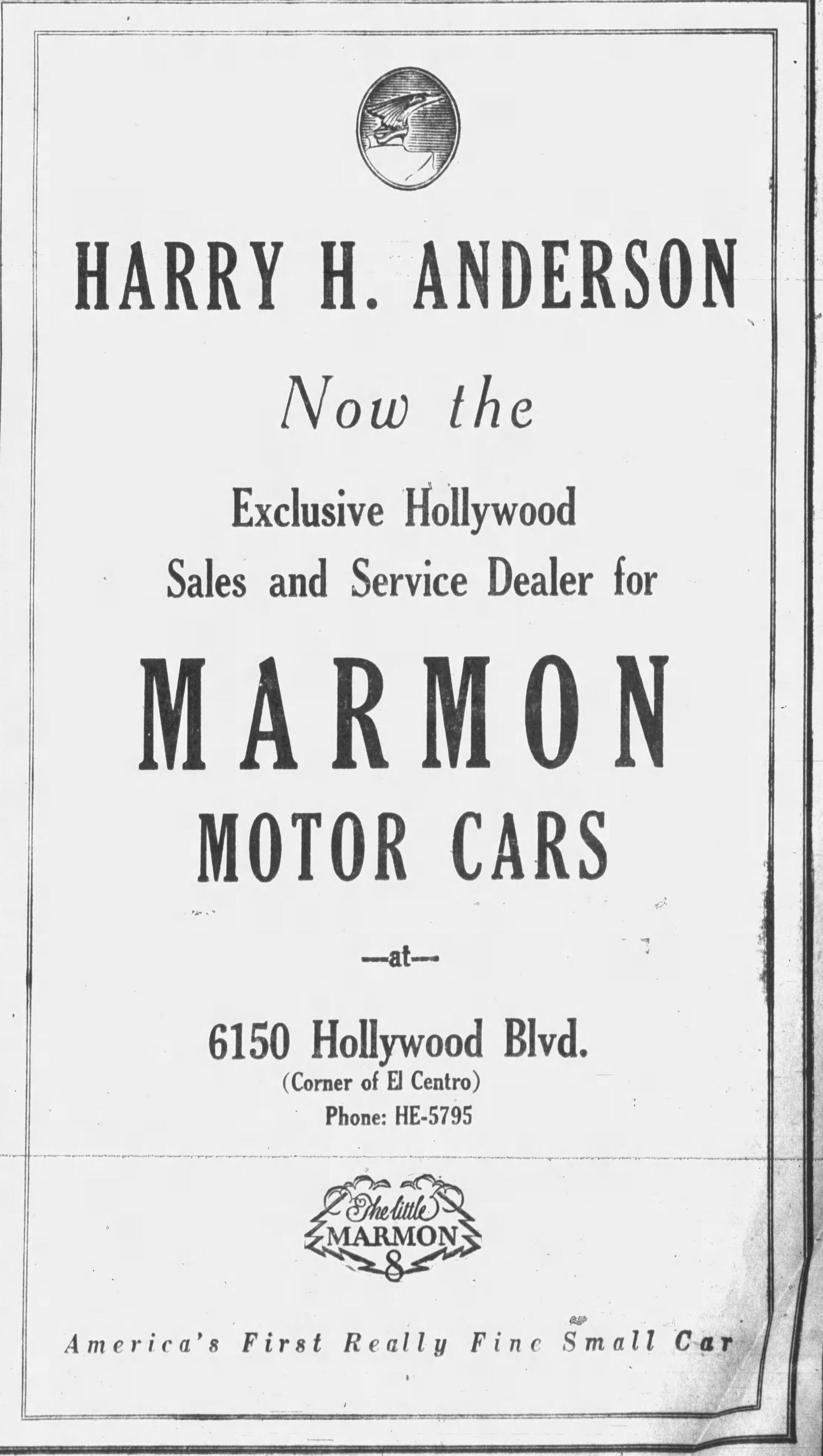
In May 1927, the Marmon also returned to 6150 when Anderson became the area’s exclusive Marmon dealer. The Marmon was made until 1933 but they were not sold at 6150 for long.

Hollywood Daily Citizen 5/11/1927.

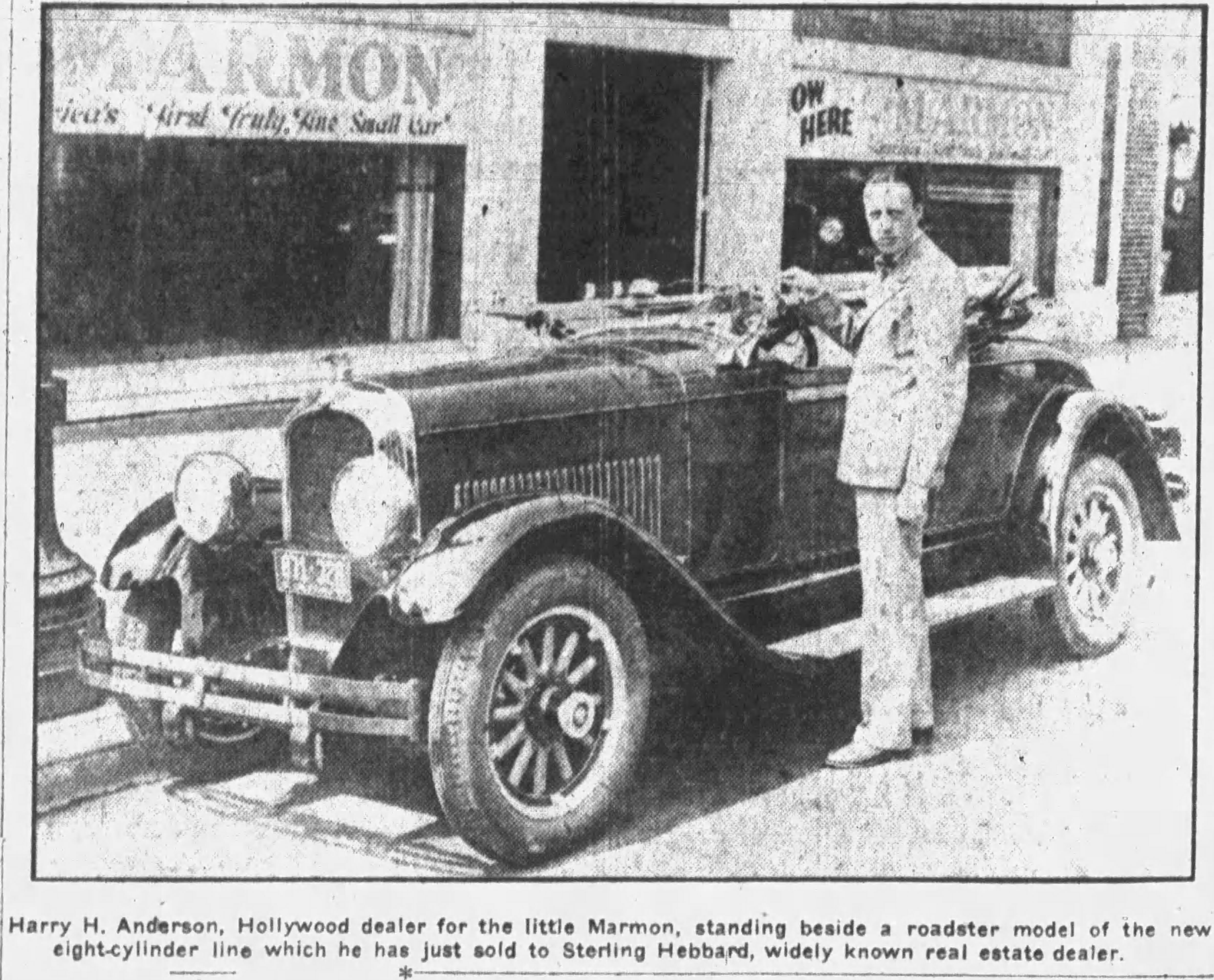
Harry H. Anderson in front of 6150 when it was a Marmon showroom. Hollywood Daily Citizen 6/15/1927.

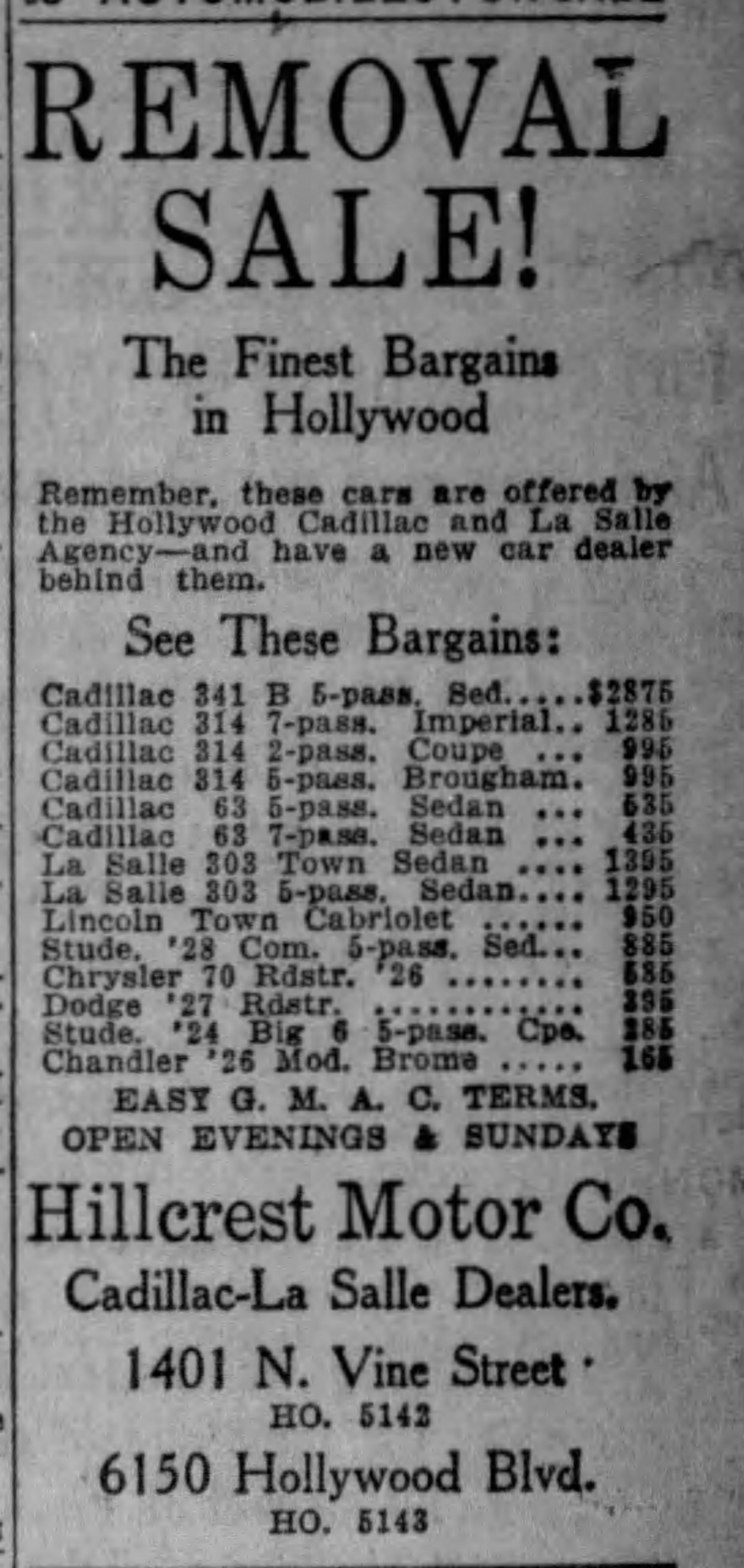
In May 1928, the building became an outlet of the Hollywood Cadillac Agency, used car specialists. The agency was later taken over by Hollywood’s Caddy and La Salle dealer, Hillcrest Motor Co. and moved out of 6150 at the end of 1929.

LA Evening Express 11/23/1929.


In January 1930 6150 became a second Hollywood home of the H. F. Haldeman Willys dealership.

Willys was a product of Willys Overland Motor, founded by John North Willys. Willys began bought Overland Automotive in 1912 and renamed his automobile company accordingly.

Hollywood Daily Citizen 1/8/1930.

6150 existed as a used car outlet for most of 1930 through 1931 and the first half of 1932.

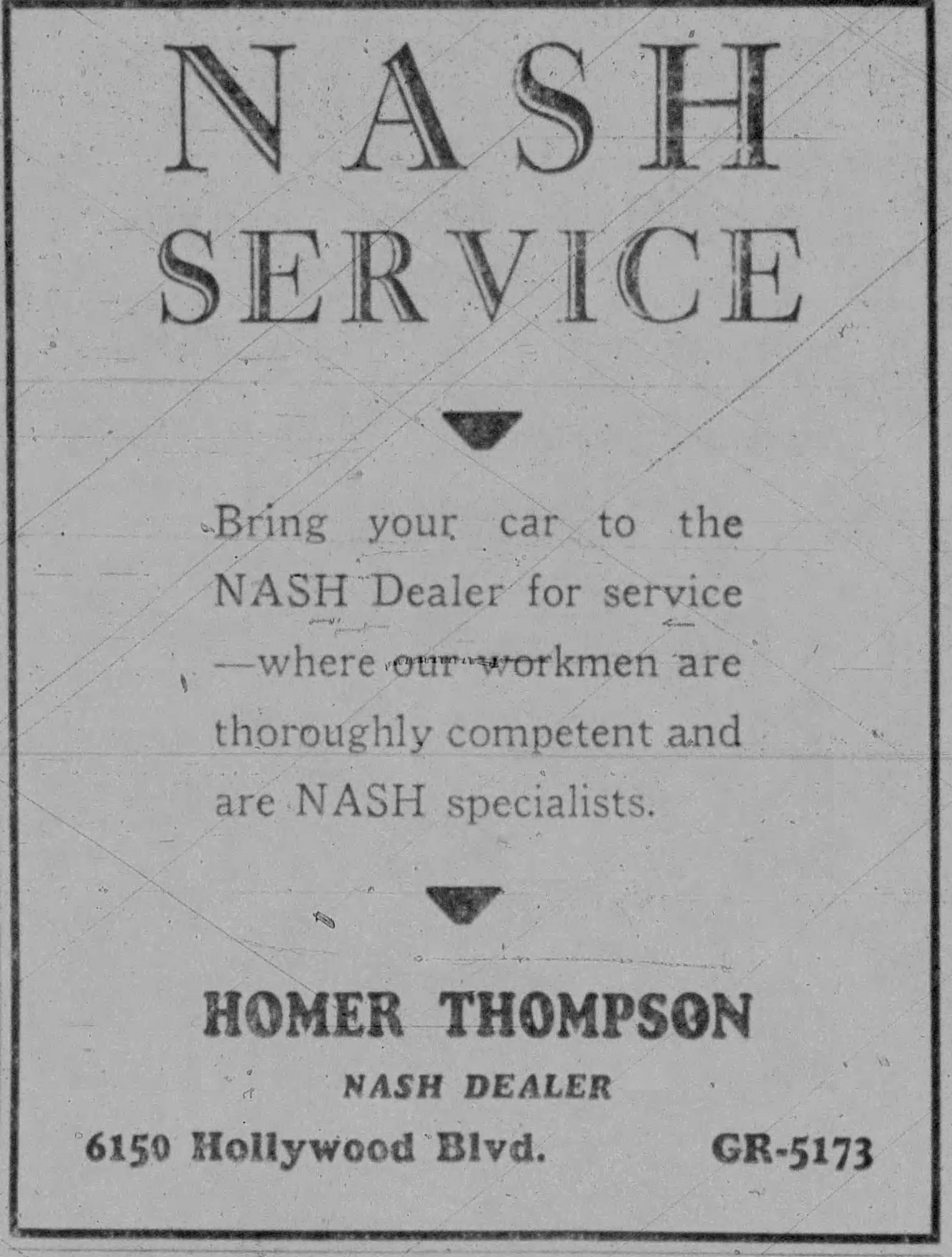
In late June it became the new home of Homer Thompson’s “Nash in Hollywood” dealership. Thompson and Al Stuebing (later of Ford) as the Thompson Stuebing Co. were the Nash distributors for So Cal.

Hollywood Citizen News 7/6/1932.

In May 1934, Frank C. Bestor took over as Hollywood’s exclusive Nash dealer, renamed Nash Bestor Company. Bestor also offered the LaFayette. Nash had purchased the LaFayette in 1924 and in 1934 introduced the Nash-built Lafayette, a lower-priced model. Thompson resumed operation of the Nash dealership here for 1935- early 1936.

Nash Bestor also had a used car lot at 6170 Hollywood Boulevard. Hollywood Citizen News 5/2/1934.

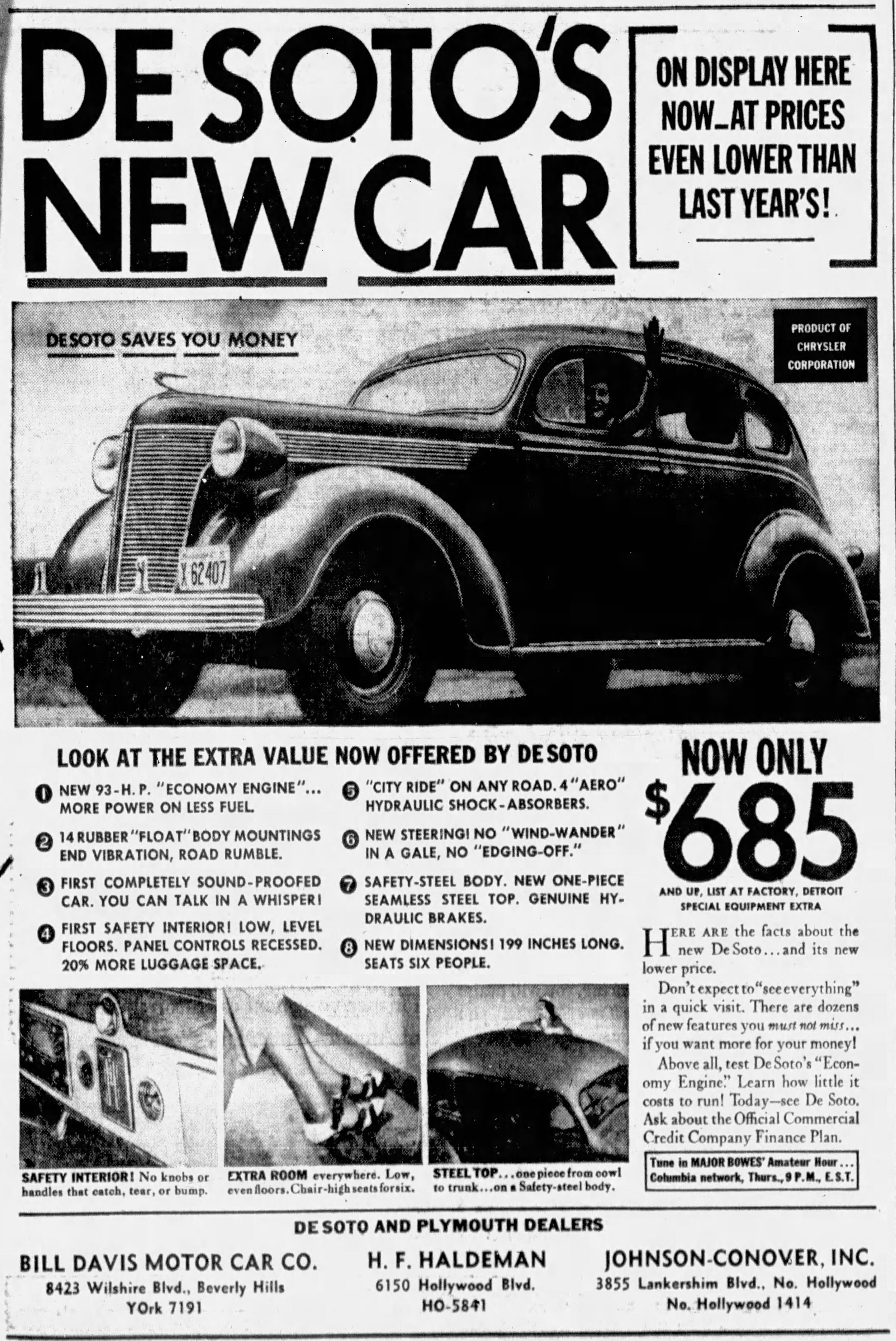
Starting in May 1936, H. F. Haldeman returned to 6150, now as a De Soto and Plymouth dealer. Both cars were made by the Chrysler Corporation.

Hollywood Citizen News 11/23/1936.

Ferd H. Cate, Haldeman’s longtime manager, took over the De Soto Plymouth dealership in August 1938.

Hollywood Citizen News 8/3/1938.

Hollywood Citizen News 11/20/1940.

With domestic auto production halted in February 1942, the government had also put a freeze on new 1942 cars that had already rolled off the line and were sitting on dealers’ lots. Most of them went to military use. Others could be sold, under limited circumstances. For the duration, dealers like Ferd Cate would focus on used car sales and their service departments.

Hollywood Citizen News 5/20/1942.

Ferd Cate would not see the end of WWII or the postwar era of car sales. He died in July 1945, age 51.

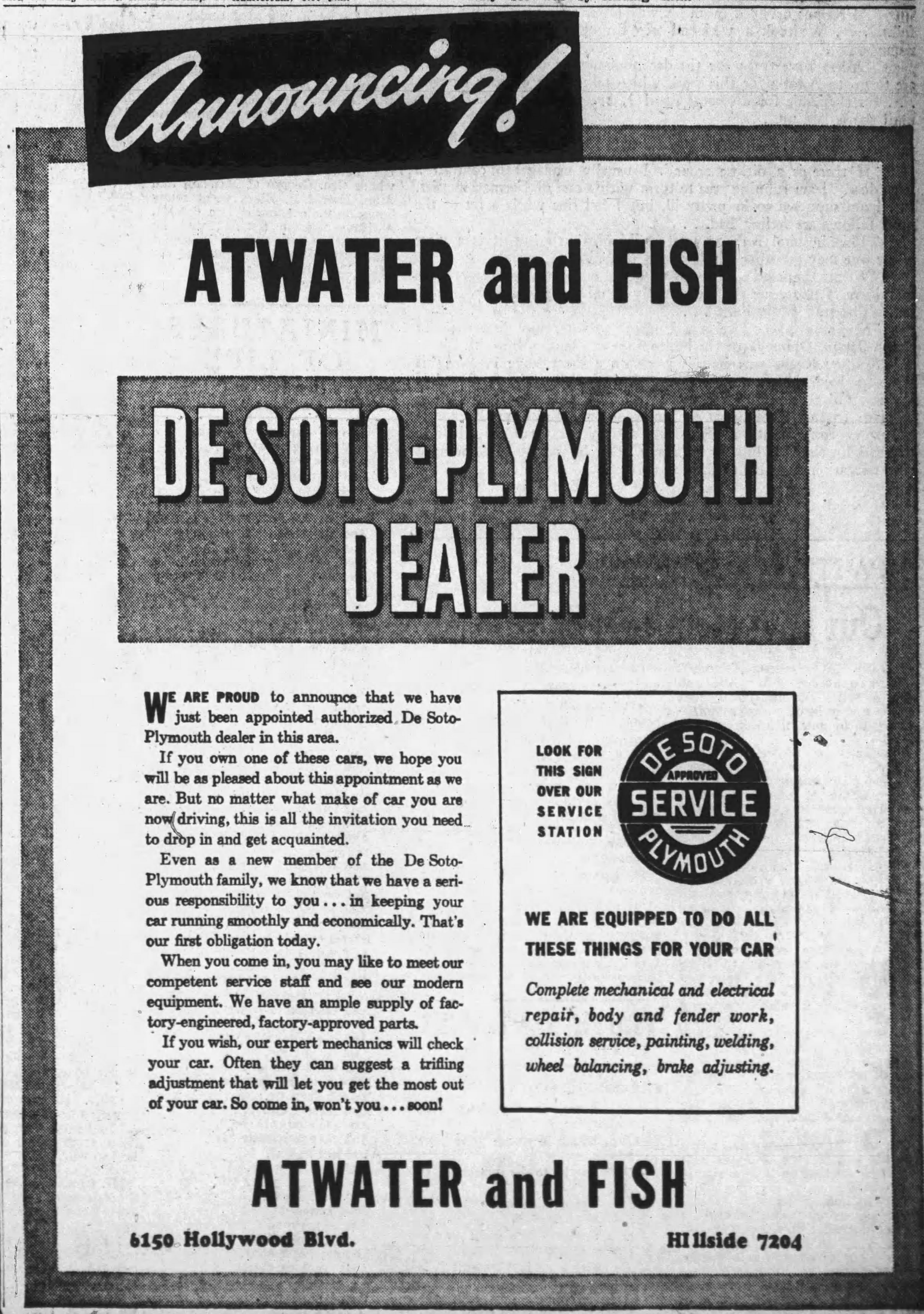
Cate’s longtime manager Clem F. Atwater, partnered with Vance Fish, took over the Hollywood De Soto Plymouth dealership here, expanding and remodeling the building in January 1946 in anticipation of new cars arriving for the first time since 1942. Their appointment as official De Soto Plymouth dealers was announced in March 1946.

Hollywood Citizen News 3/2/1946.

One of the first 1958 Plymouth Fury cars in Hollywood at Atwater and Fish. 11/20/1957.

Although the firm still sold De Sotos, by June 1959, Atwater and Fish were known as Hollywood Plymouth Center.

The 1960 Valiant at Atwater and Fish Plymouth Center. Mel Alsbury was the Chrysler dealer, located across the street at 6119. Hollywood Citizen News 12/29/1959.

Atwater and Fish remained here into June 1961, the building’s longest occupants by far. It’s days as an automobile concern were over.

In September 1961, 6150 became a Blue Chip Stamp Redemption Center. Founded in California, the Blue Chip Stamp Company was a loyalty program, similar to S&H Green Stamps, where customers of certain stores were issued stamps that could be redeemed for crappy merchandise. They were introduced in So Cal in January 1960. 6150 remained one of many LA area redemption centers, through May 1963.

LA Times 5/12/1963.

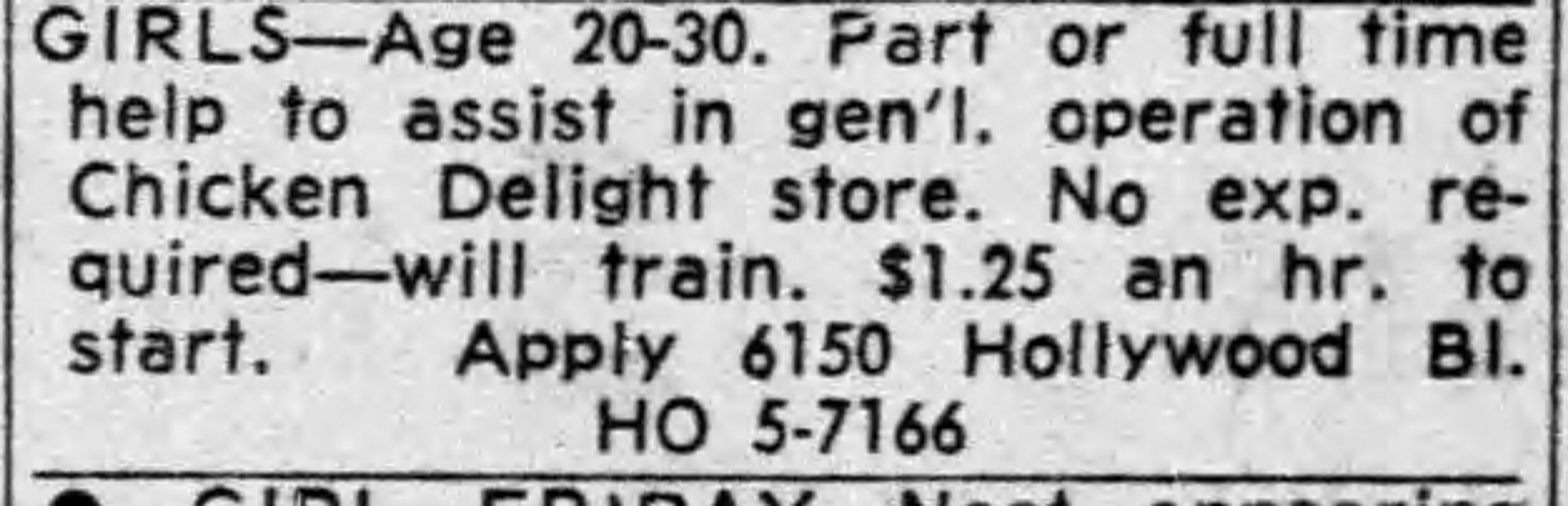
In November 1963, 6150 became an outlet of the Chicken Delight fast food chain, which oddly specialized in a fish pizza.

12/11/1963.

6/17/1970.

The building was demolished in 1994 for Metro’s Red Line subway project.

Notes

W. E. Graham died in 1924. Mamie K. Graham continued to own the building. She died in 1969.

5955 Hollywood Boulevard: Florentine Gardens

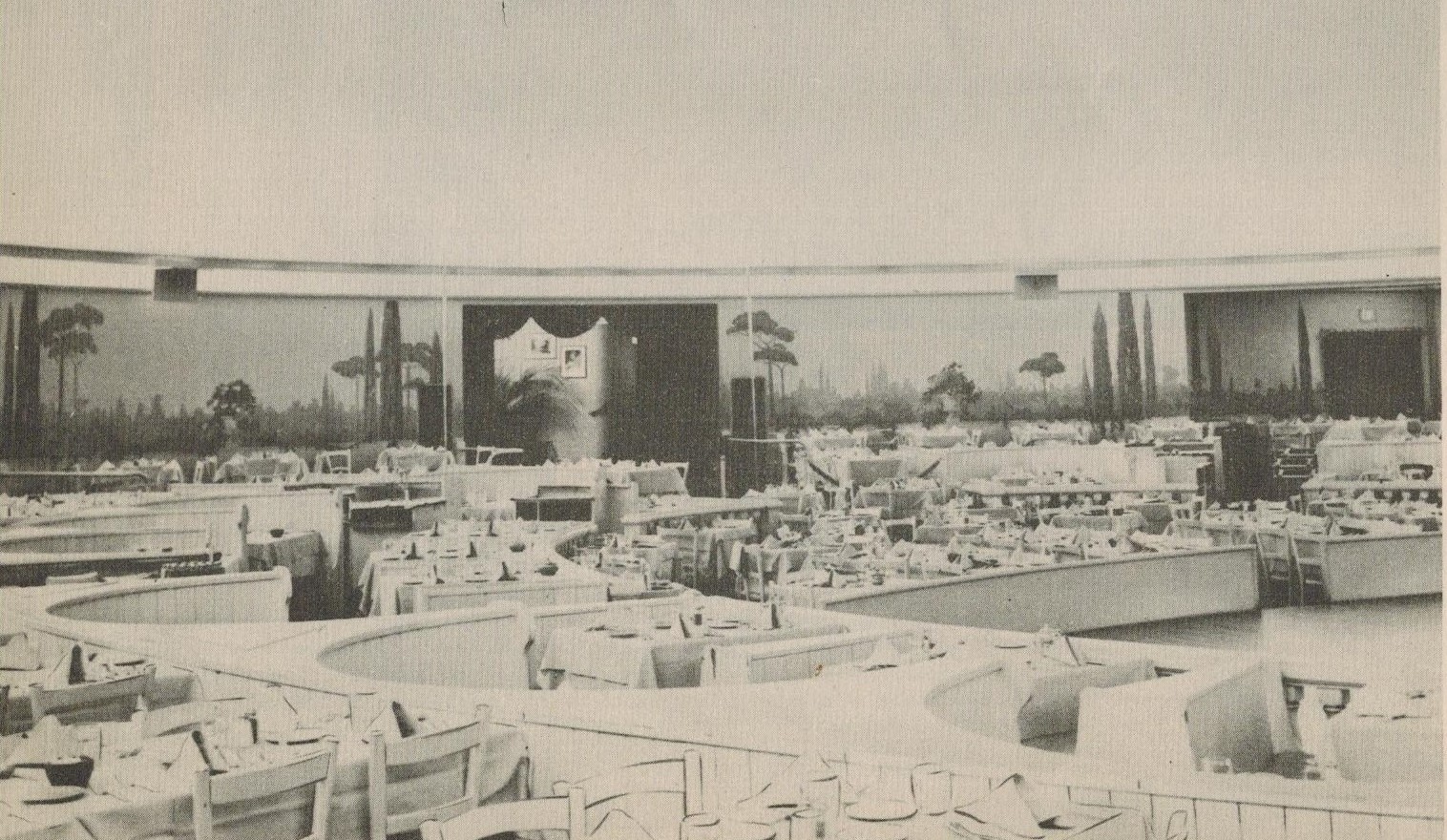
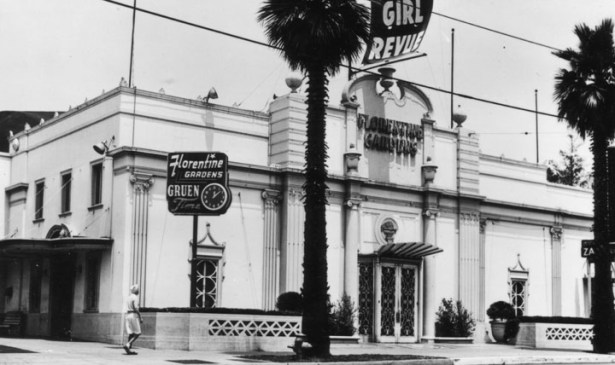
Florentine Gardens. LAPL photo.

Florentine Gardens cabaret restaurant, at 5955 Hollywood Boulevard was the third of 4 buildings constructed on the former Brokaw ranch property.

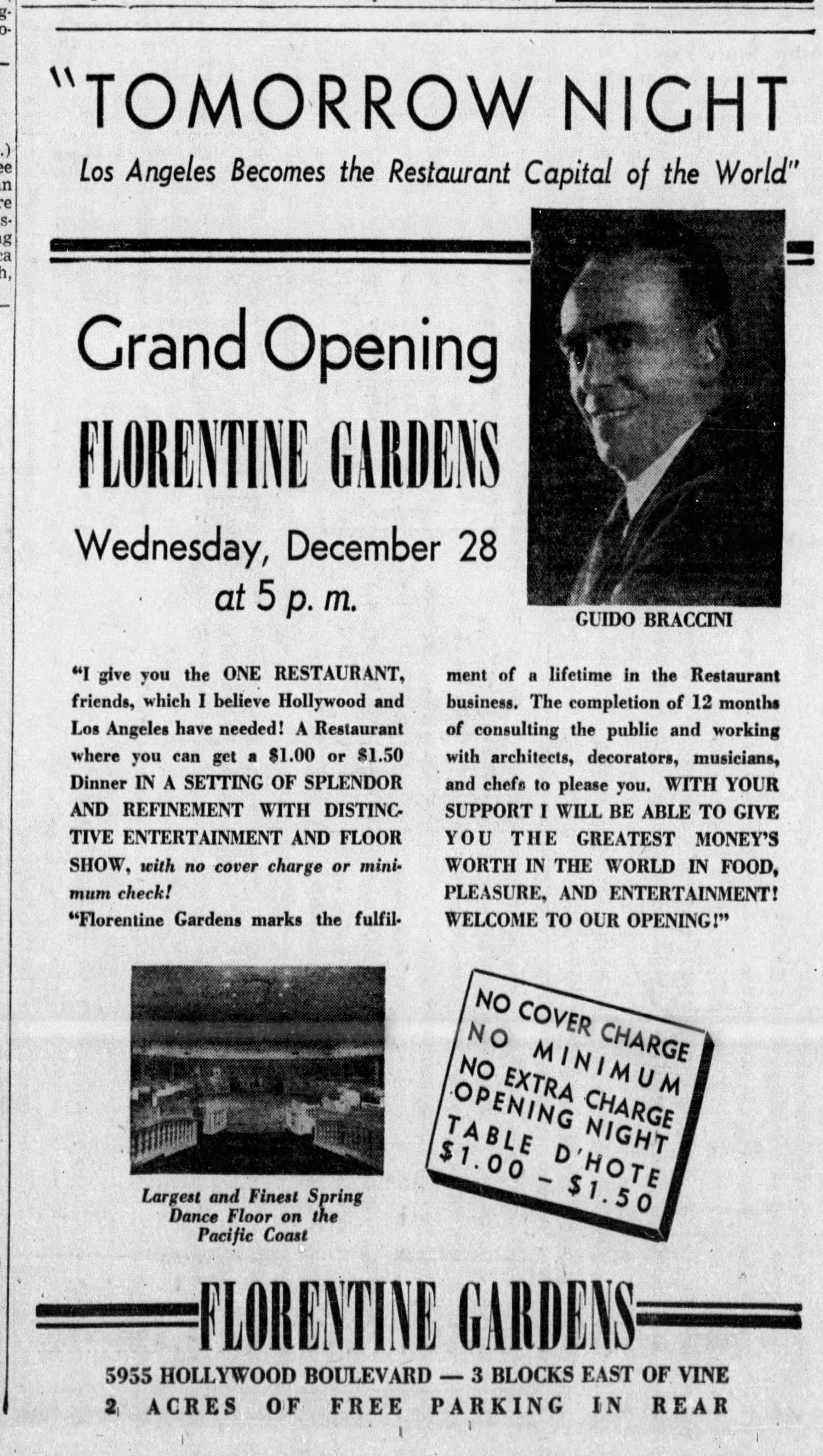
The project was announced in the LA Times on November 28, 1937. The Times’ parent company, Times Mirror Company, owned the land on which it would be built, having acquired the Brokaw ranch parcel about 1932-1933. It granted a lease to Guido Braccini, Inc., who (with his unnamed investors) would build and operate the restaurant.

Braccini was born in Italy in 1879. He came to the USA in 1903 and settled in San Francisco. He’d sold Italian statuary in the ‘teens and later founded Lucca’s Italian restaurant. A second Lucca’s opened in Los Angeles in 1933. Braccini sold his interest in Lucca’s before embarking on the Florentine Gardens project. The new restaurant would seat 1000 persons, with private banquet rooms and a dance floor that could hold 200 couples. Plus it had 2 acres of free parking.

LA Times 11/28/1937

Architect Gordon B. Kaufmann designed the structure. It originally was to have open-air gardens. The finished design did have a faux-garden effect in the dining room, but the huge dance floor was covered with a neon-lit dome.

Gordon B. Kaufmann’s original design for Florentine Gardens. LA Times 11/28/1937.

The lease deal was still being finalized in late May 1938, but construction finally got underway and was substantially completed by late Fall 1938.

The Florentine Gardens under construction. Hollywood Citizen News 10/15/1938


Florentine Gardens nearing completion. LA Times 11/6/1938
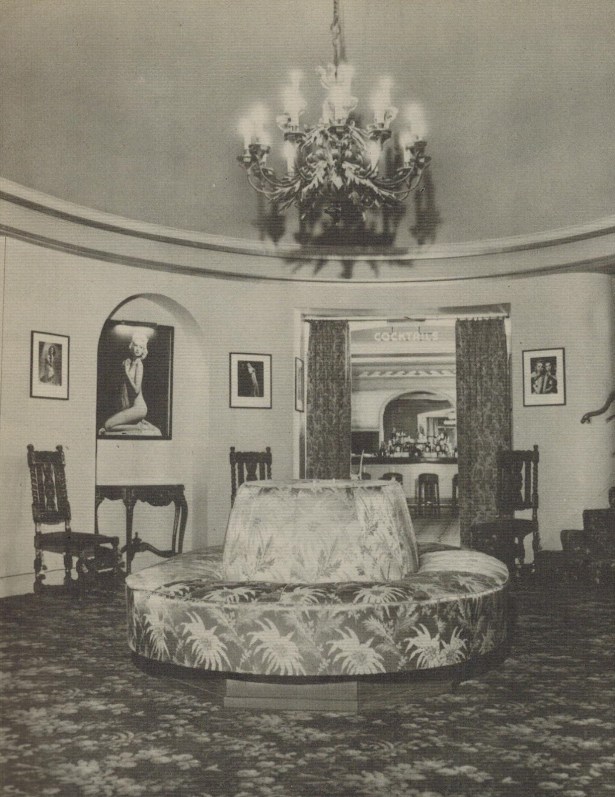
 

The lobby.
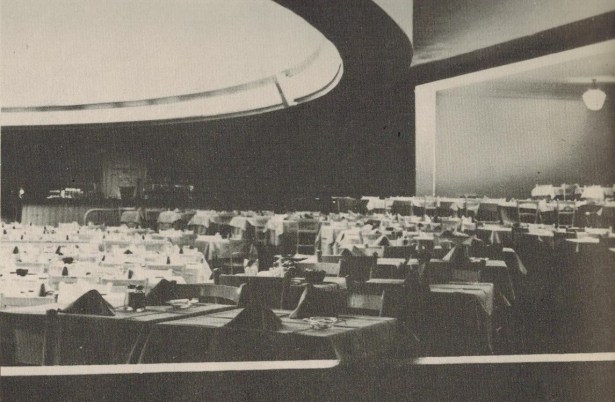
The domed, neon-lit dance floor.

The dining room.

Florentine Gardens held its grand opening on December 28, 1938. It would be competing with- and often compared unfavorably to- Earl Carroll’s new cabaret restaurant at 6230 Sunset Boulevard, which had opened 2 days earlier on December 26.

LA Times 12/27/1938

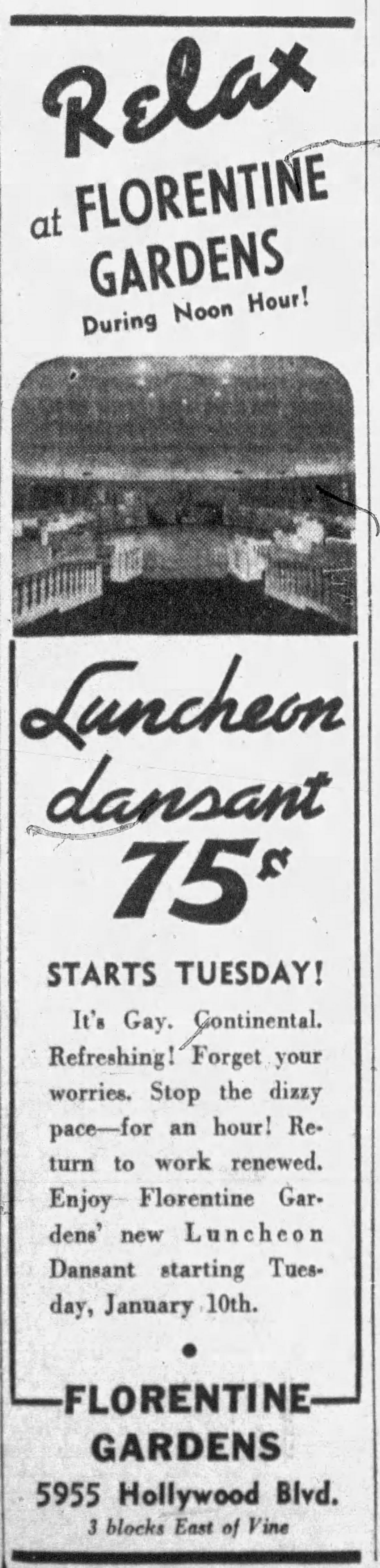
The new venue was popular for dining and dancing; its house band’s music aired over the radio nightly. But it was hard to fill those 1000 seats. On January 10, 1939, the restaurant began opening in the afternoons with “luncheon dansant” specials to try to draw the lunch-hour crowds.

Hollywood Citizen News 1/9/1939

LA Times 2/4/1939

On February 15, 1939, dance instructor Maurice Kosloff staged a classical ballet floor show at the Florentine Gardens. In general, though, the venue tended to operate more as a restaurant with entertainment as a sideline. That would change in the new year.

LA Times 2/15/1939.

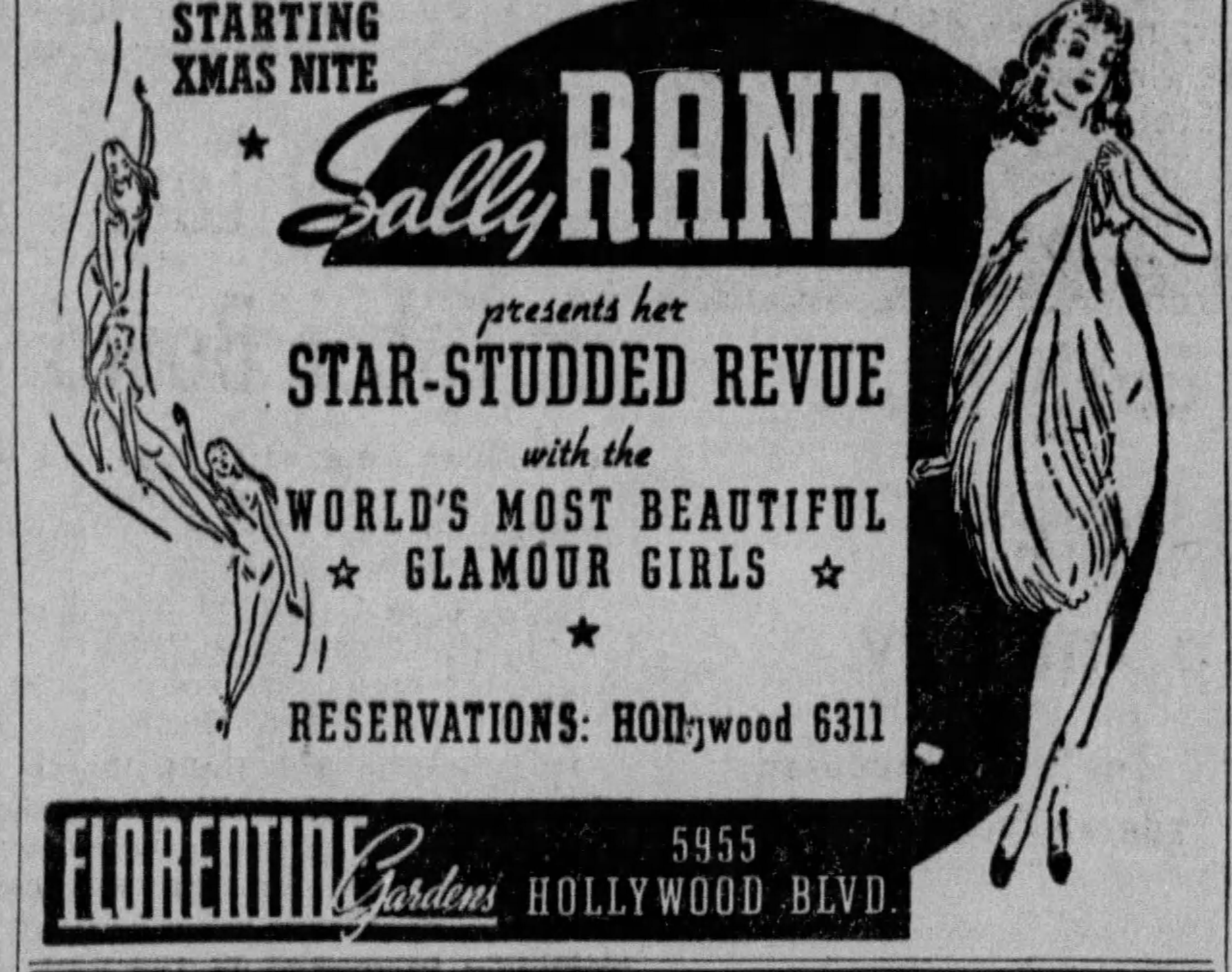
Famous fan dancer Sally Rand appeared at the Florentine Gardens between Christmas 1939 and New Years’ Day 1940. (She needed cash). LA Times 12/23/1939.

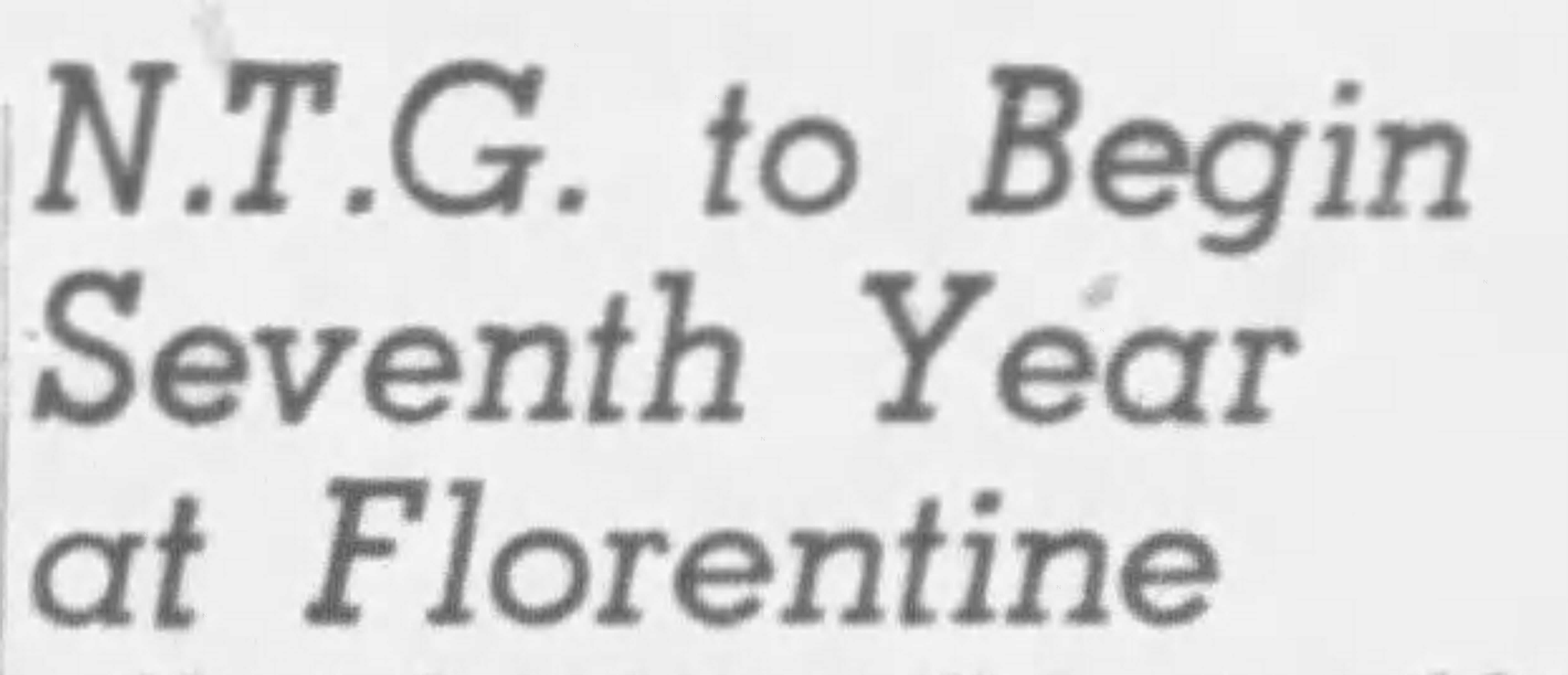
In his 1957 memoir, “Blondes, Brunettes and Bullets,” Nils T. Granlund, aka NTG or “Granny” to his friends, says that Florentine Gardens was drowning in red when he agreed to take over its entertainment wing in early 1940.

NTG came from Prohibition-era Broadway where among other things he helped pick out showgirls for Flo Ziegfeld and Earl Carroll. He would take credit for discovering Ruby Keeler, Joan Crawford and Barbara Stanwyck from those days. He’d worked with Texas Guinan as emcee at speakeasies like Frank Fay’s El Fay Club. The relationship between gangsters and nightclubs was described by NTG in his memoir:

“In those days, if you wanted to do business with the nightclubs you did your bargaining with gangsters; it was impossible to avoid contact with them. Anyone who had anything to do with show business in those places had to know gangsters, had to deal with the mob… Blondes, brunettes, redheads, male and female, stars and chorus girls and workers in the vineyards were all mixed up with the gangsters, whether they liked it or not. If you were in show business and you worked in a night club, the club was owned by a member of the fraternity, for only mobsters had the money to afford places big enough to have entertainment.”

There’s no reason to think this changed with the end of Prohibition. Gangsters having got a foothold were not likely to give up such a lucrative income source.
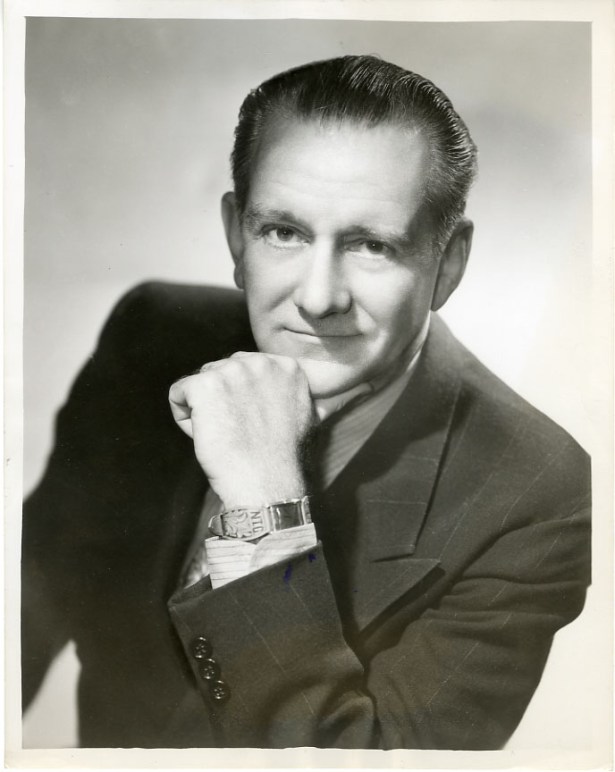
Nils T. Granlund (NTG) c. 1946.

Guido Braccini sold the Florentine Gardens circa early 1940. His name was closely associated with the advertising up to December 1939 but not after that. When NGT began staging its shows, his boss was Frank R. Bruni. Bruni served president and general director of the Gardens. Max Sisenwein was treasurer and general counsel. Harry Barg was secretary and assistant manager. Dave Gould, who had created dances for Fred Astaire and Ginger Rogers in the movies, was choreographer.

Announcing the arrival of Nils T. Granlund. LA Times 2/27/1940.

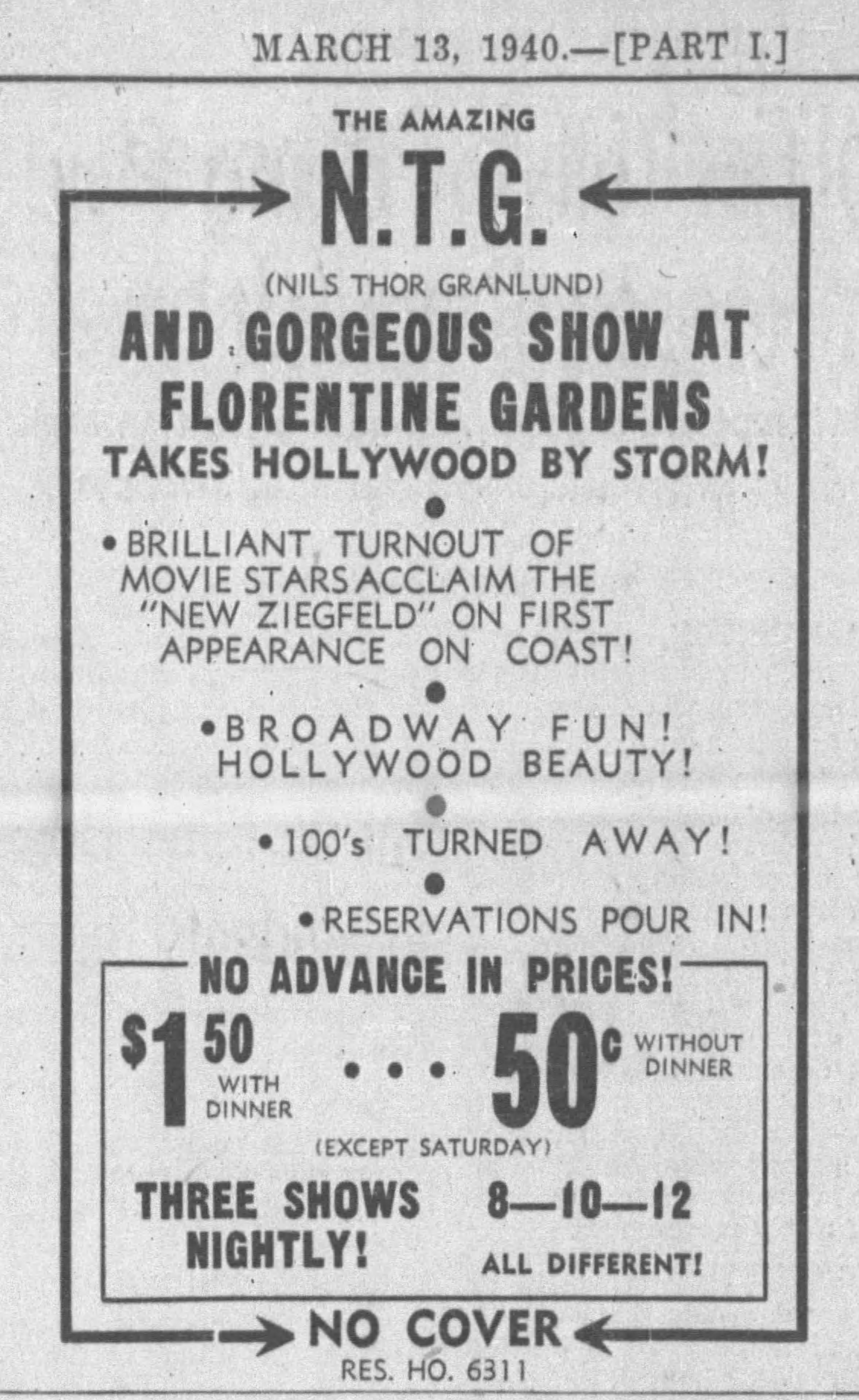
NTG’s first show for Florentine Gardens, on March 10, 1940, was called, fittingly, “Hello Hollywood.” He wasn’t shy about self promotion .

LA Times 3/13/1940

LA Times 3/24/1940


LA Times 3/31/1940


LA Times 4/21/1940

NTG and the new management put Florentine Gardens back in the black- so much so that just a few months after his arrival- in August 1940- the venue was able to embark on a $25,000 expansion- increasing its seating capacity from 1000 to 1500 and almost doubling the size of the dance floor. Sweeping staircases were added to either side of the orchestra stage and a balcony was added. The project also included removing columns from the dining room, and the booths were terraced, ensuring a good view of the floor from all angles.

LA Times 2/27/1940


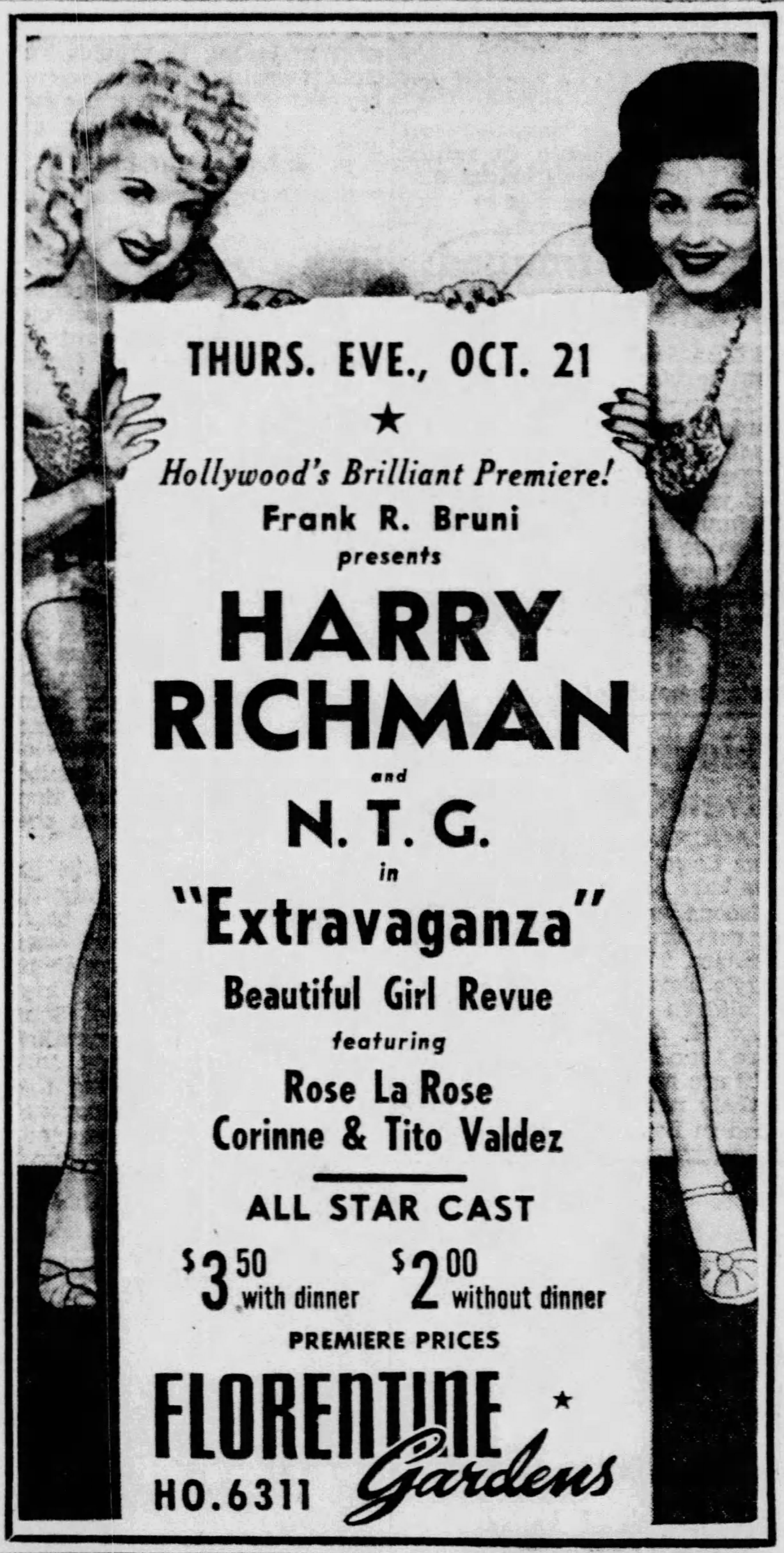
NTG often booked artists he had known in the old Broadway days- like Sophie Tucker, Ted Lewis, and Harry Richman, and brought in newer discoveries like Ozzie Nelson.

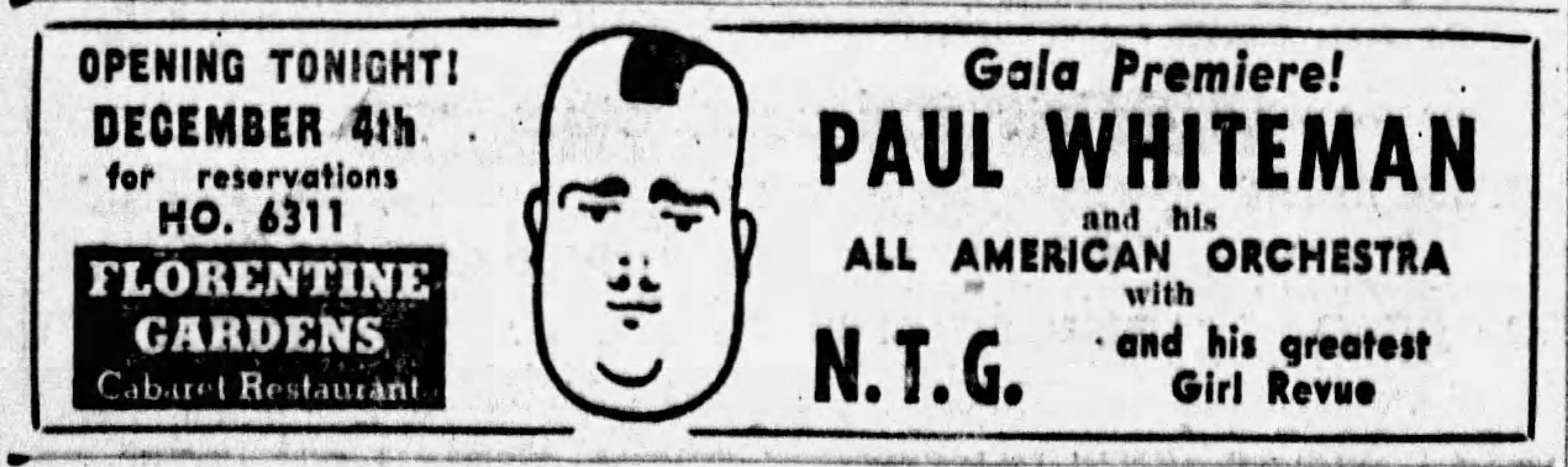
Celebs packed the audience for the opening of King of Jazz Paul Whiteman at Florentine Gardens December 4, 1941. Three days later, the US was at war. The war years were boom times for Gardens and other nightclubs.

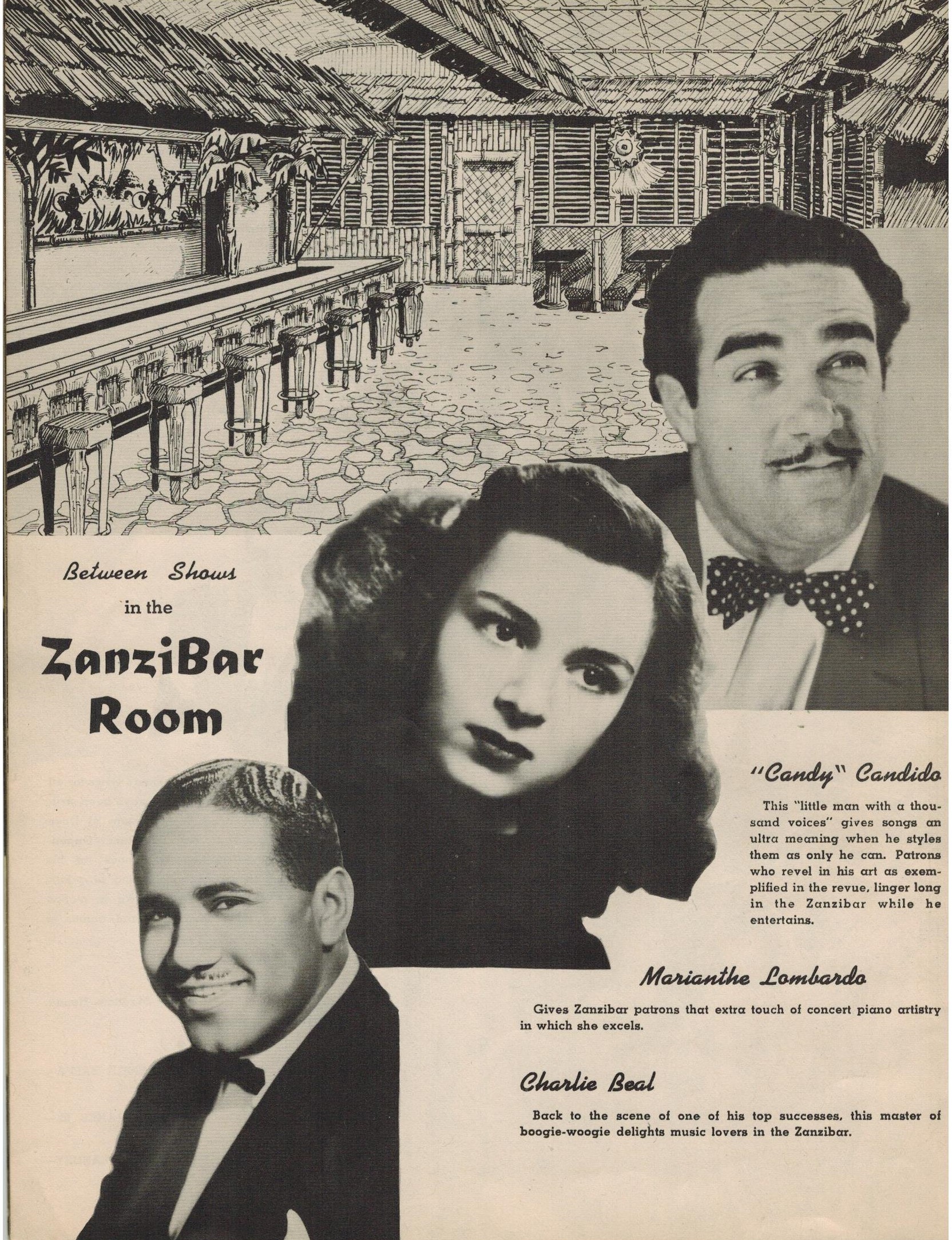
The Zanzibar Room, Florentine Gardens’ re-vamped jungle-themed cocktail lounge, opened in January 1942. The Mills Brothers opened in the Zanzibar Room on July 29, 1942 while NGT’s “Spirit of Victory” review played in the main showroom.

The Zanzibar Room cocktail lounge.


LA Times 7/26/1942

LA Daily News 7/29/1942

Chorus girls in NTG’s reviews at this time included Yvonne DeCarlo, who would soon go on to fame in the movies, and burlesque star Lili St. Cyr, who appeared under her real name: Marie Van Schaack.

Lili St. Cyr- as Marie Van Schaack appeared in a sketch called “Hollywood Canteen” in NTG’s “Petticoat Army review in October 1942. The famous Hollywood Canteen had just opened. LA Times 10/7/1942


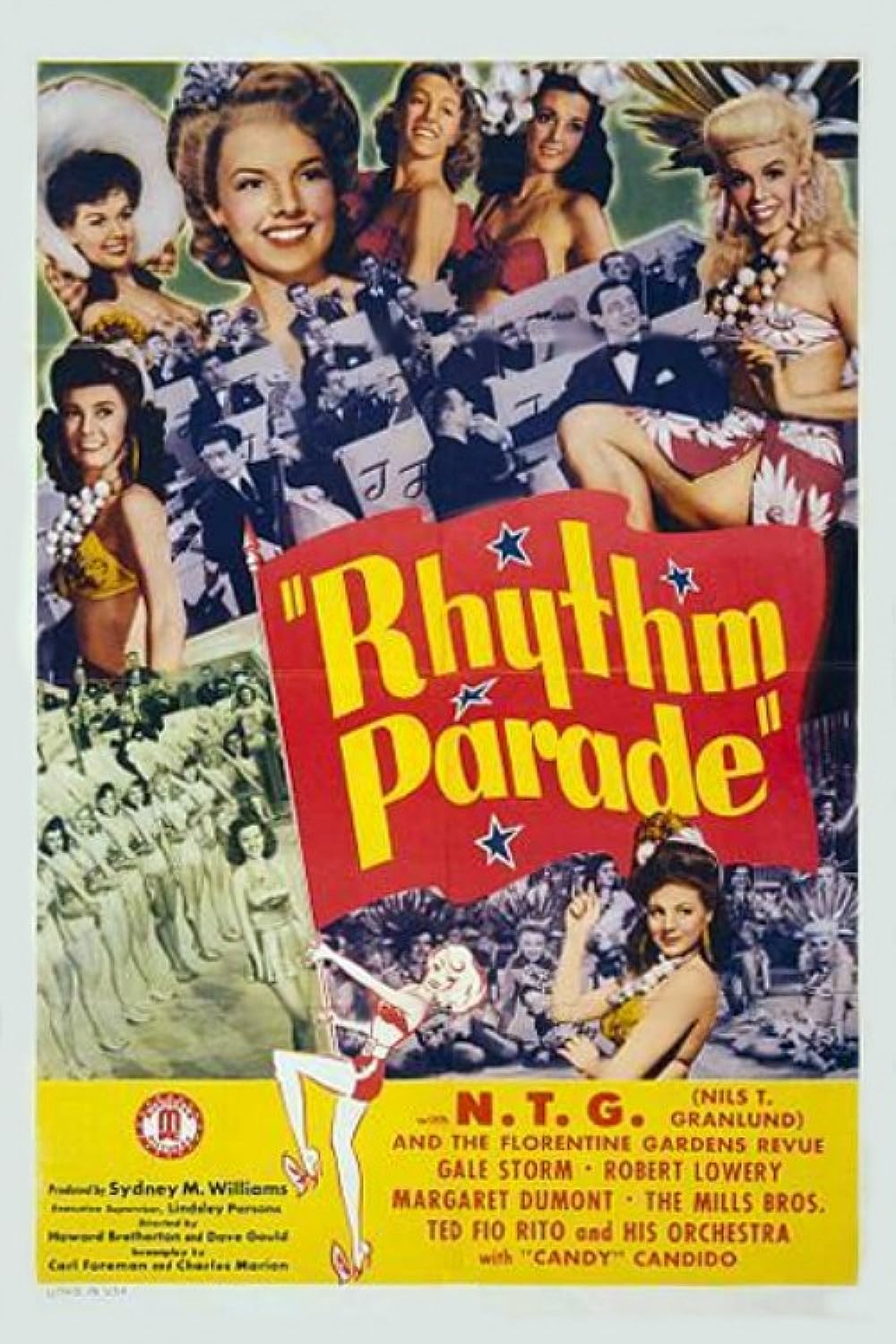
In 1942, NTG also produced a film for Monogram Pictures, called “Rhythm Parade,” shot at Florentine Gardens and featuring its house orchestra Ted Fio Rito, its comedian “Candy” Candido, its chorus girls, the Mills Brothers, and NTG himself. The film opened at the Colony Theater down the street from Florentine Gardens on New Years’ Eve. In 1944, NGT (with the Florentine Garden girls) would also make an appearance in RKO’s “Goin’ to Town,” a film featuring radio characters Lum and Abner as well as Paramount’s “Take It Big.”


LA Daily News 12/31/1942

Florentine Gardens in March 1943 during the run of NGT’s “Thrills of 43” review with Ann Corio, Milton Britton, Pinky Tomlin, Paul Regan, Cy Landry and others.


NTG often booked talented artists he had known in the old Broadway days like Sophie Tucker, Ted Lewis and Harry Richman. LA Times 10/20/1943

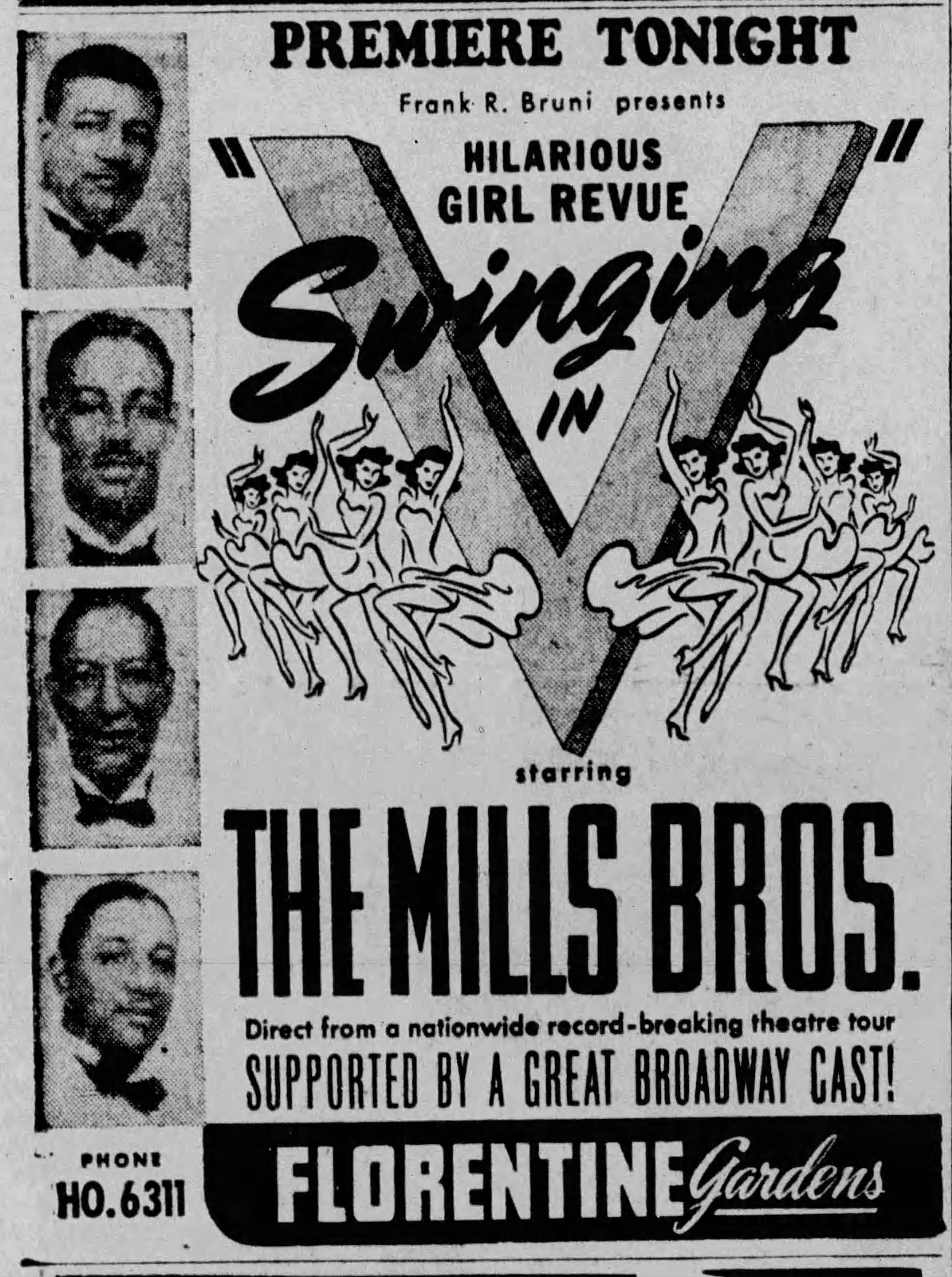
Though he’d saved the Florentine Gardens, the relationship between NTG and Bruni became strained. NTG still emcee’d for Florentine Gardens, but Bruni took over producing the reviews. Beginning with the “Swinging in Victory” review featuring the Mills Brothers, Bruni used comedian Eppy Pearson as MC while NTG toured with a group of Florentine Gardens beauties.  When the group was due to appear in New York City in December 1945, it was widely rumored that NTG was opening a new club on Broadway- possibly started by NTG himself as a trial balloon.

Having packed the Zanzibar room nightly in the Summer of ’42, the Mills Brothers made a triumphant return to the Florentine Gardens as headliners in 1945, having since recorded their smash hit, “Paper Doll.” Hollywood Citizen News 5/2/1945.

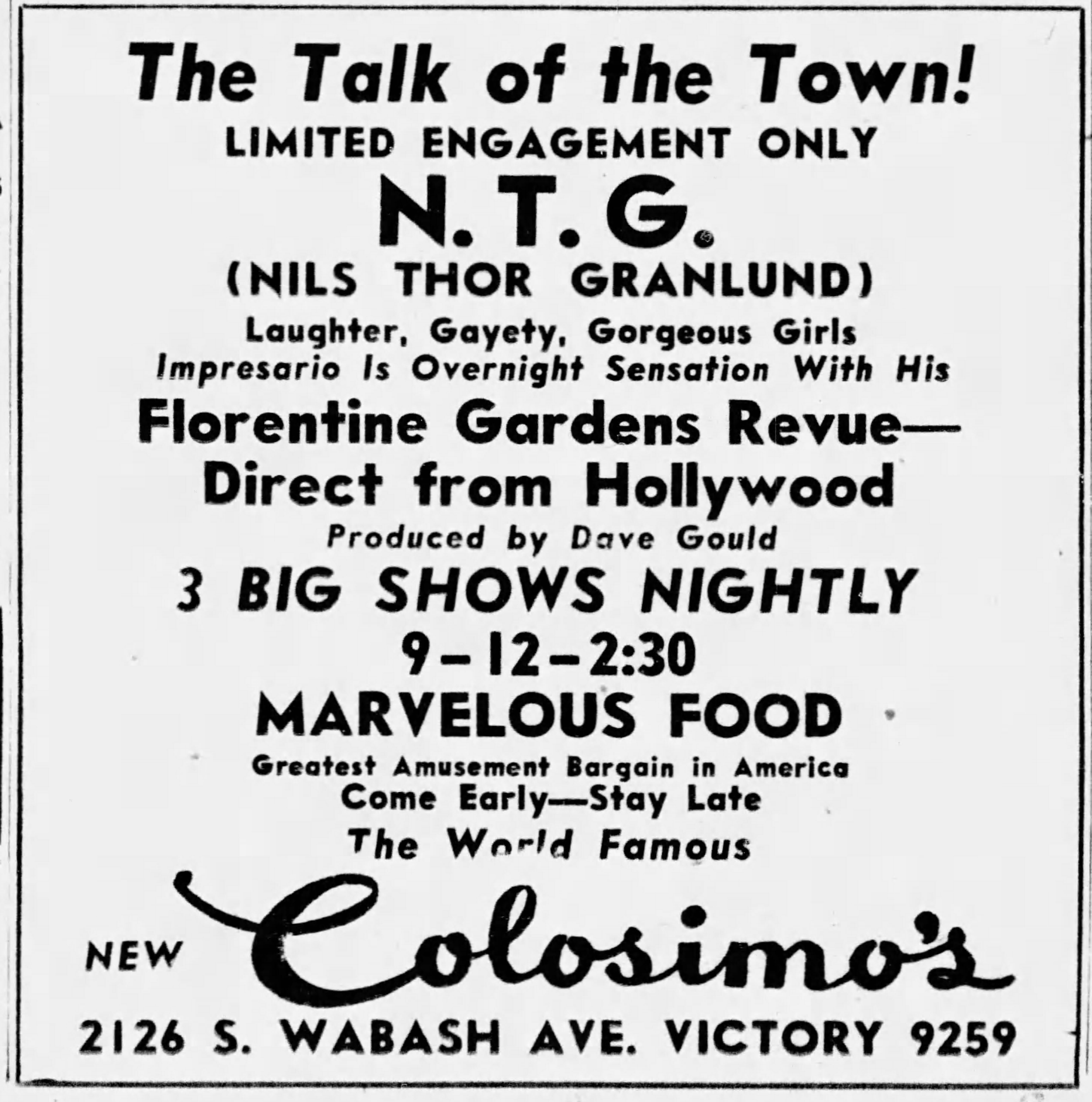
The NTG Florentine Gardens tour reached Chicago in January 1946. They appeared at Colosimo’s, where NTG had last performed 7 years earlier before coming to Hollywood. Unfortunately the Tribune’s critic Will Davidson rated the show Not Too Good.

Granlund responded by telling syndicated gossip columnist Lou Sobol that he had been offered a half interest in Colsimo’s plus a “huge salary” to run the show their but that he had “decided” to return to Hollywood.

NTG on tour with the Florentine Gardens beauties 1945-1946. They appeared at the (new) Colosimo’s in Chicago in January 1946. Chicago Tribune 1/10/1946

In February 1946, it was announced that NTG would host a Monday-Friday daytime radio show, “You’re in the Act,” to be broadcast from the Florentine Gardens on CBS starting March 4, 1946. Panned by critics, it did not last long. NTG also resumed emcee duties for Bruni’s Florentine Gardens’ reviews.

LA Times 3/7/1946


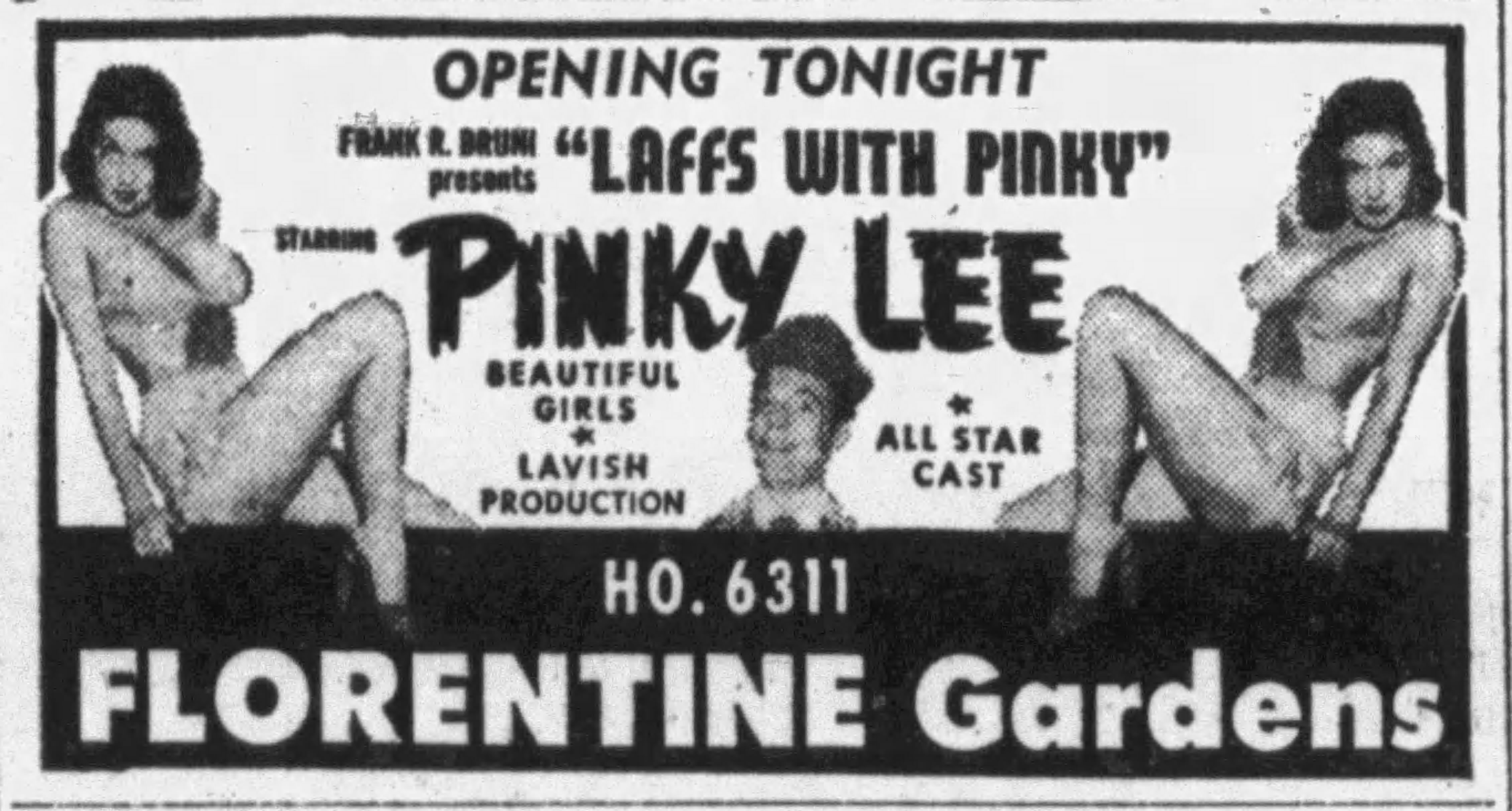
Actress-model Jean Spangler appeared in the Pinky Lee comedy review “Laffs with Pinky,”  which opened October 14, 1946 but does not appear to have been a regular Florentine Gardens dancer.  She went missing in October 1949, the presumed victim of foul play. Valley Times 11/29/1946

LA Daily News 10/14/1946

In November 1946, NTG did return to Broadway, staging shows at the Greenwich Inn. In March 1947 he moved to the new Rio Cabana Club at Broadway and 52nd. John Chaplin of the New York Daily News noted that his jokes did not appear to have changed in 20 years. He returned to emceeing at Bruni’s Florentine Gardens. His old pal and fan favorite Sophie Tucker opened on September 8, 1947 and ran through November 1947. When she left, NTG was again sidelined.

LA Daily News 8/25/1947

On November 14, 1947, gossip columnist May Mann reported that NTG and Mark Hansen were going to open a 12-story hotel on Hollywood Boulevard near Gower, with a cabaret on the roof. Construction was to begin “shortly.” This project never happened.

Mark Hansen was a theater owner whose holding included the Marcal Theater just up the street at 6025 Hollywood Boulevard near Glower. There’s no reason to think he had any connection to the Florentine Gardens at this date.

Hollywood Citizen News 11/14/1947


Florentine Gardens in late December 1947-early January 1948 during Beatrice Kay’s run, which opened December 29, 1947. “Christmas Eve” at the Hawaii Theater next door opened December 31, 1947. California State Library photo.


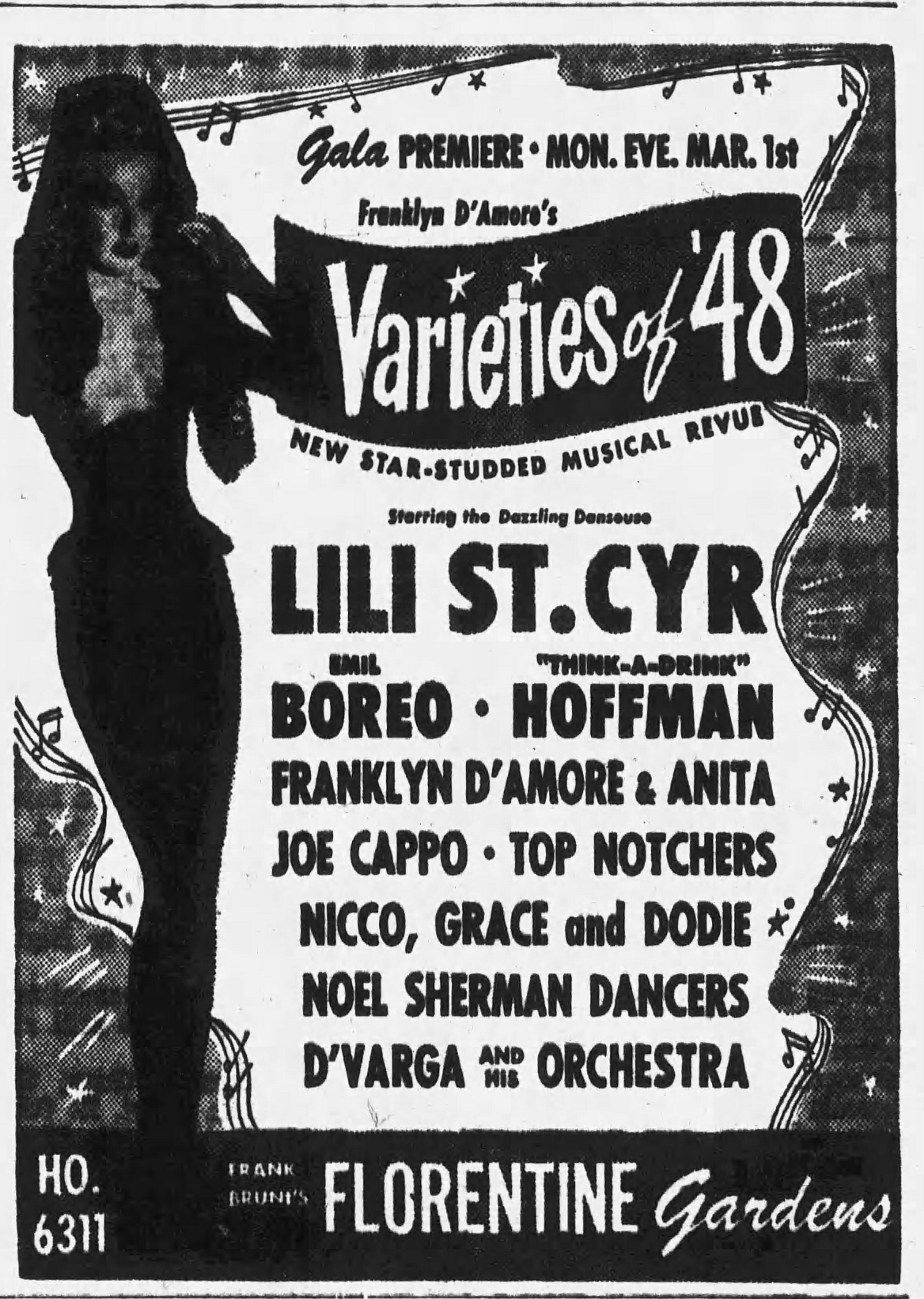
Lili St. Cyr made her return to the Florentine Gardens as a headliner on March 1, 1948. The show included “Think a Drink Hoffman” and Paul Valentine- St. Cyr’s husband at this time.  Hollywood Citizen News 2/28/1948

By 1948, nightclubs, like movie theaters, were experiencing a significant drop in patronage since the boom of the war years.

NTG returned to the Florentine Gardens in March 1948 as emcee for headliners The Ink Spots. Critics, however, now found his audience participation antics, in which businessmen would be called upon to take off their ties, roll up their pant legs and join the beauties on stage,  rather stale.

On May 13, 1948, Frank Bruni announced that Florentine Gardens would close after Ethel Waters’ engagement ended on May 17, 1948 and undergo a remodeling to become a legitimate theater, including turning the bandstand into a full stage. Further, he said, it would be known as the Florentine Theater Restaurant beginning with the opening of George White’s Scandals on June 3, 1948.

George White Scandals opened at the newly renamed “Florentine Theater Restaurant” on  June 3, 1948. LA Times 6/3/1948.

The Florentine Gardens, or Florentine Theater Restaurant, was shuttered only two days after the opening. Trade publication Variety reported in August 1948 that Bruni’s debts were said to be in the $100,000 range. The corporate owners- Florgar, Inc. headed by architect S. Charles Lee, were supposedly considering operating it themselves. Lou Walters, of New York’s Latin Quarter nightclub, was also reportedly interested in taking it over. In September, 1948, the equipment and fixtures were offered up in a bankruptcy sale.

LA Times 9/19/1948

In October 1948, gossip writer Edith Gwynn reported that NTG (who had lately been staging reviews for Zucca’s Opera House) wanted to reopen the Florentine Gardens. On November 29, 1948 local papers reported that the new owner was Harold Stanley, and it would reopen with a new look on Christmas Eve. The opening date was later pushed back to mid-January. It finally reopened, with a new name as well, on February 7, 1949 as the Cotton Club with Count Basie headlining.

Hollywood Citizen News 2/1/1949

Even the great Count Basie couldn’t keep the doors open, however, and 5955 Hollywood Boulevard was soon shuttered again. It was offered for sale or lease in April 1949.

LA Times 4/10/1949

On June 28, 1949, it was reported that the “new Florentine Gardens” would reopen July 1 under the management of Mark M. Hansen and Eddie Allen. Hansen was said to be a part owner as well; if so, the actual owner was still Flogar, Inc.  The first show under Hansen would be a Gay 90s review, Grandfather’s Follies. Jimmy Grier, an old favorite from the Cocoanut Grove in the early ’30s, would provide dance music. Critics generally praised the show, but didn’t rave.

The New LA Mirror 7/9/1949

Two weeks after the Florentine Gardens reopened, Mark Hansen was shot in his home at 6024 Carlos Avenue, Hollywood, by a young woman named Lola Titus, who had recently worked as a taxi dancer at LA’s Roseland Roof and Dreamland Ballroom. Hansen survived. He told police that Titus was upset that he wouldn’t put her in his show at the Florentine Gardens. Titus’ explanation of a lovers’ tiff was more plausible.

Hansen had occupied this address, which was near his offices in the Marcal Theater building, since at least 1936- originally with his wife and two daughters- before the Florentine Gardens was even built, let alone any association between him and the nightclub.

Titus was convicted of assault with a deadly weapon in September 1949. She was deemed insane after the trial (as it worked then, defendants were tried first then assessed for competency) and sent to Patton State Hospital.

Lola Titus in court, 1949.

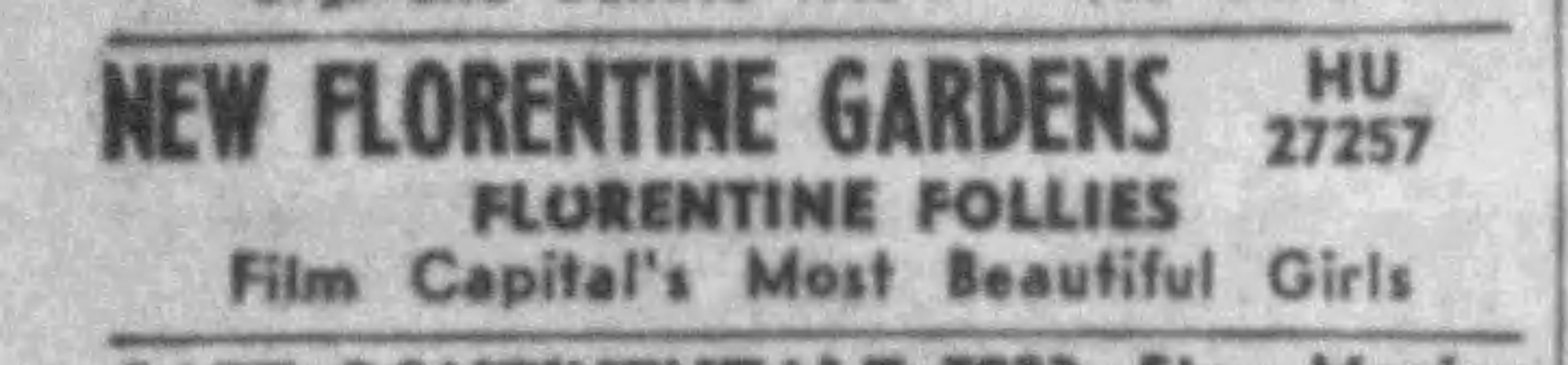
A new review, Follies Bizarre” opened August 8, 1949. On September 30, 1949, the venue ushered in a “vaudeville police” with the “Florentine Follies.”

LA Mirror 8/25/1949

LA Daily News 11/19/1949

Florentine Gardens wound down after the new year and does not appear to have been open regularly, though special banquet events would still be held there.

On February 20, 1950, Zucca’s Opera House burned down just before its new review, “Virgin Island,” was to open. The show must go on, however; Hansen and Zucca struck a deal and on February 24, it opened for a show to benefit the actors at the Florentine Gardens, renamed Florentine Gardens Opera House. The show then moved to the Paddock Club, a former ballroom on Riverside Drive.

LA Mirror 2/24/1950

In April 1950, Paul V. Coates of the LA Times reported that NTG was dickering to buy the Florentine Gardens, but that did not happen. Instead, on August 30, 1950, the Hollywood Citizen News reported that the Hollywood Canteen Foundation was buying the Florentine Gardens building and equipment to reactivate the Hollywood Canteen in early 1951 under the direction once again of Bette Davis and John Garfield.

The famous Hollywood Canteen for servicemen’s entertainment had operated on Cahuenga Boulevard from October 1943 to November 1945. (My post on the Canteen can be found here). The Canteen had earned $500,000 by selling the rights to use its name to Warner Brothers for the “Hollywood Canteen” film; the Foundation had been formed to manage this money and with the US now in the Korean War a new Canteen seemed like the thing to do with it. S. Charles Lee, as president of the building’s owner (Still Flogar, Inc), officially revealed the plans for the building’s purchase on November 2, 1950. There were not yet enough service persons in Los Angeles at the time to warrant an immediate opening, however. The Canteen would use the Gardens as a nightclub and rented out for special events until it reopened the new Hollywood Canteen- if it ever did. On December 15, 1950, the Police Commission granted the Hollywood Canteen a public dance hall/cafe permit.

LA Times 11/2/1950

Bette Davis herself announced in March 6, 1951 that the Hollywood Canteen would reopen at 5955 Hollywood Boulevard on July 4, 1951. The opening was pushed back to Labor Day “or thereafter.” It still had not opened by the end of 1951 but was used for other events.

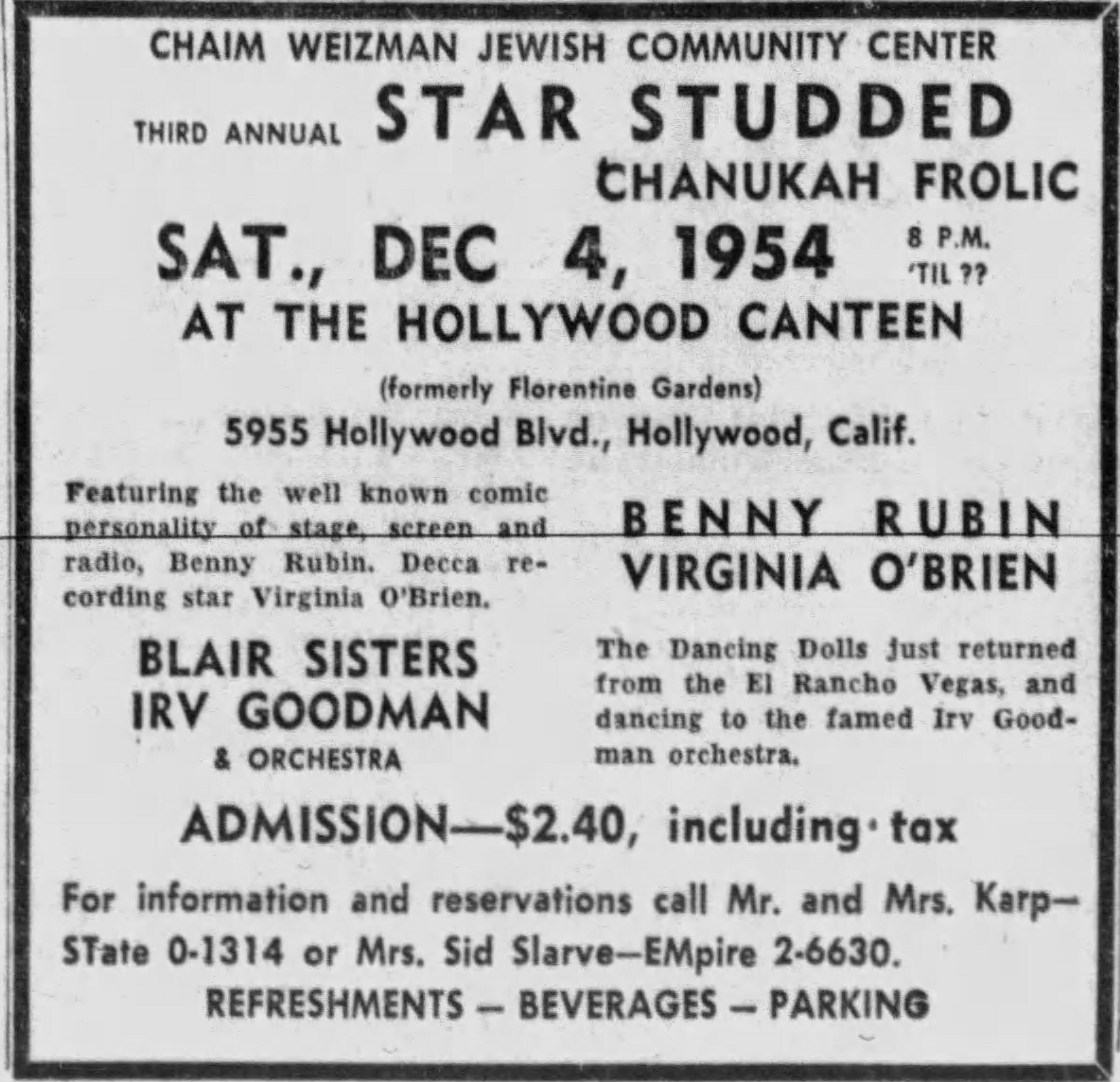
The Hollywood Canteen Foundation, owners of the Florentine Gardens, rented the building for special events while planning to reopen it as the new Hollywood Canteen. Hollywood Citizen News 4/3/1952.

The building never did reopen as the Hollywood Canteen.

The Valley Times 12/4/1954

On July 8, 1955, completely revamped for office use, the building became the headquarters of the Retail Clerks Union.

Hollywood Citizen News 7/8/1955

The building would go on to have other uses, including a dance club. In 2005, the City proposed building a new fire station on the site. Owner Kenneth MacKenzie refused to sell, wishing to preserve the building. The city suggested that the facade could be incorporated into the design. The building was ultimately preserved and is extant today as a performance venue, still known as Florentine Gardens.

Notes:

Guido Braccini was threatened with deportation in April 1940, accused of violating the terms of his naturalized citizenship. Ultimately it was dropped. In June 1942 he opened the Louisiana restaurant at 5665 Wilshire Boulevard (formerly the Wilshire Bowl), which became Slapsie Maxie’s in November 1943. In 1950 he opened a new Lucca’s restaurant in Richmond. He died in 1960.

NTG continued to produce shows and hosted talent contest shows on television in the early 1950s. He wrote his memoir, published in February 1957 and was planning to stage shows for the Flamingo Hotel, Las Vegas. He was killed in Las Vegas on April 21, 1957 when a taxi he was riding in was hit by another vehicle.

Lola Titus would tell police her real name was Beverly Alice Bennett but Lola Titus was the name she was born with. Newspapers cited her age as anywhere from 23 to 25; she was actually only 21; her correct birthdate was March 15, 1928. She died at Patton State Hospital in November 1958, age 30, and her body was shipped back to Pennsylvania where her mother and sister still lived; her father died in July 1949 less than two weeks after the Hansen shooting.
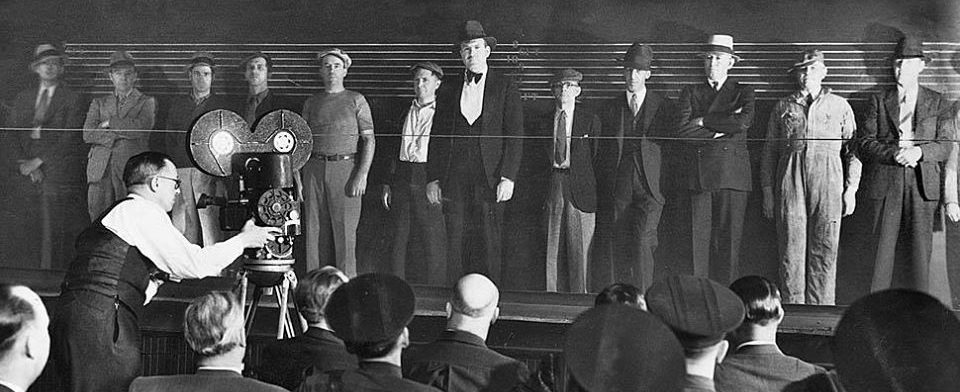
5939-5941 Hollywood Boulevard: The Hawaii Theater

The Hawaii Theater in May 1940. Umbrellas on the patio dining area of the Palms Grill can be seen in the center right. California State Library photo.

The Hawaii Theater opened on May 6, 1940. The last of 4 buildings constructed on the former Brokaw ranch property (the others were the Palms Grill at 5931-5937, the Hollywood Food Mart at 5959 and the Florentine Gardens cabaret restaurant at 5955), the theater, addressed initially as 5939 Hollywood Boulevard, was said to occupy the site of the ranch house itself.

Sketch of the proposed Hawaii Theater in the Los Angeles Times on November 19, 1939. The Times’ parent company owned the property that it would be built on.

On November 19, 1939, the property owner, the Times-Mirror Company, announced the project. Carl G. Moeller designed the streamline moderne-style 2-story building, which also housed two retail stores and office space, with supervising architect Clarence J. Smalle. The unfinished building was leased to Albert A. Galston and Jay M. Sutton of Galston & Sutton Theaters, who operated the Marcal Theater just up the block at 6025 Hollywood Boulevard. To be called the Hawaii Theater (it was peak Hawaiian craze, after all), it reflects a new era of theater building- not a movie palace but a neighborhood picture house. With seating for 1100 people, it featured a mezzanine in the “modern colonial” style with a children’s nursery (the Merry Melody room), complete with staffed attendant; a women’s reception room and powder room; a men’s lounge with a private smoking lounge next to the Projection Room; and the offices of Galston & Sutton, all of which would open onto a furnished 50-foot oval lobby.

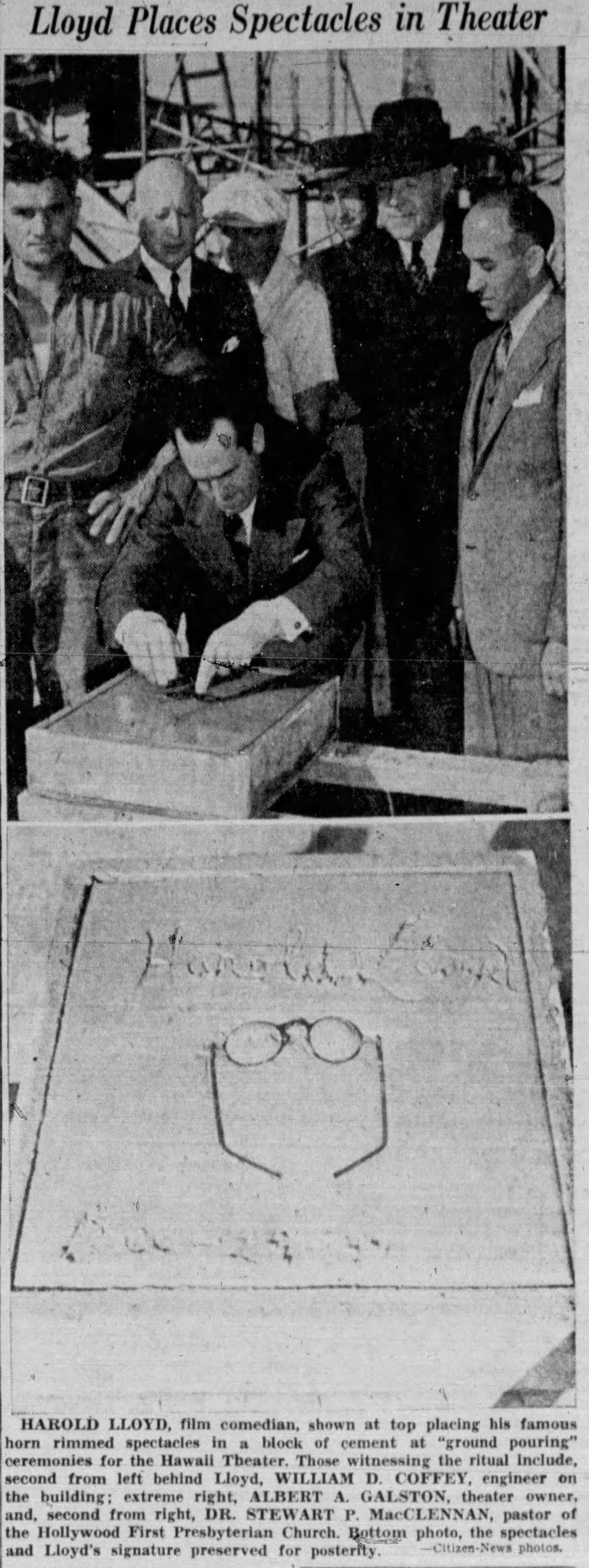
At the “ground pouring” ceremony in December 1939, Harold Lloyd placed his signatire trademark round glasses in a block of wet cement, like at Graumann’s Chinese Theater up the block.

Hollywood Citizen News 12/30/1939


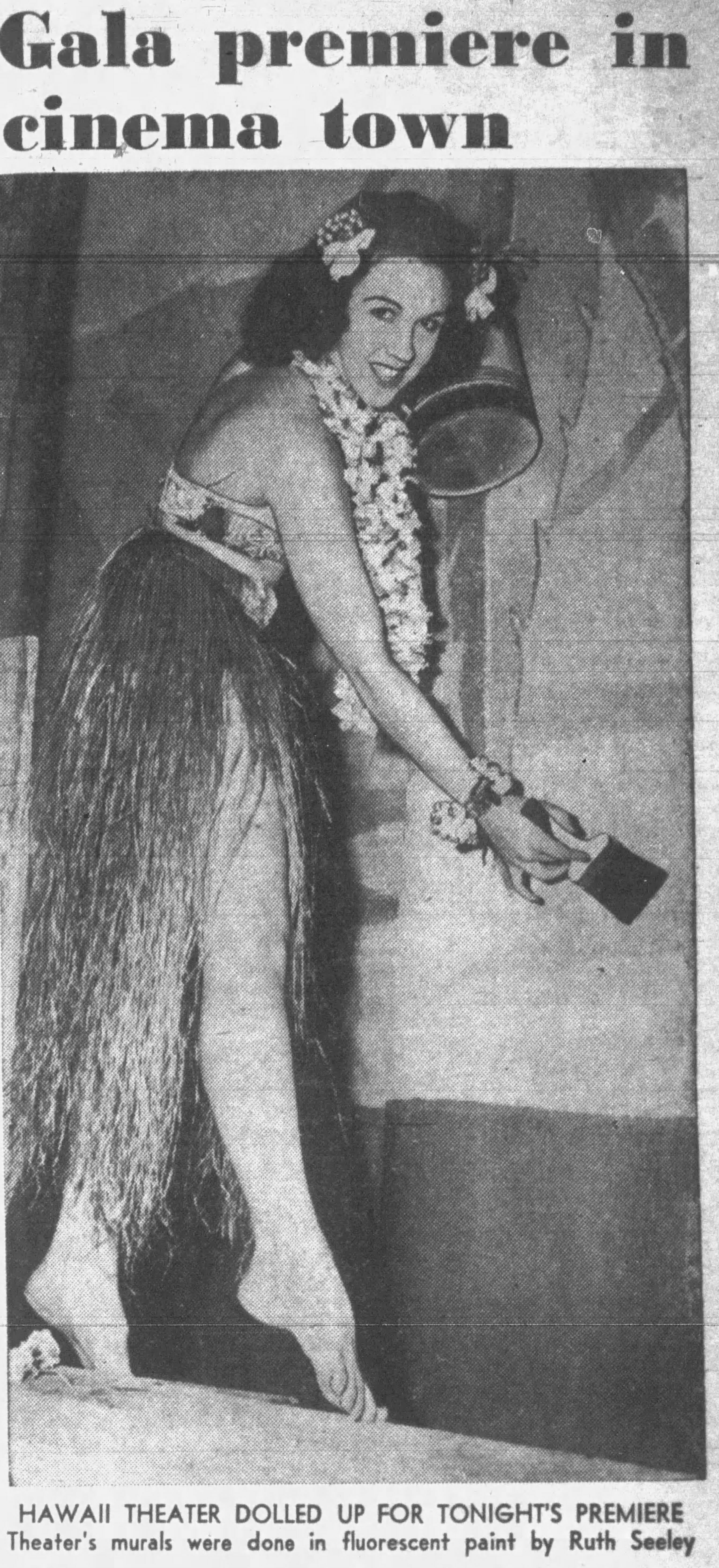
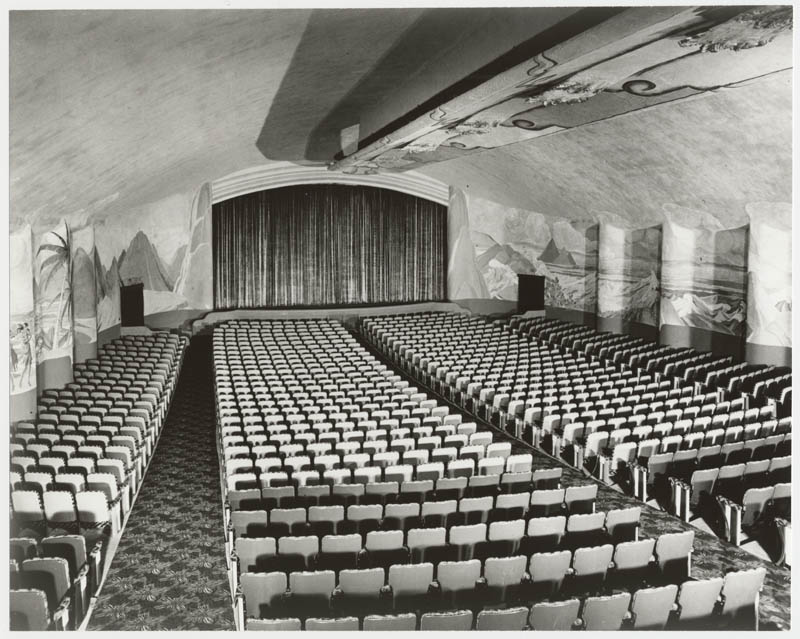
The Hawaii theater’s decor was, not surprisingly, Hawaiian. The auditorium was notable at the time for the use of blacklight illumination with fluorescent murals by Ruth Seeley.

LA News 5/6/1940

Auditorium of the Hawaii Theater in 1940. California State Library photo.

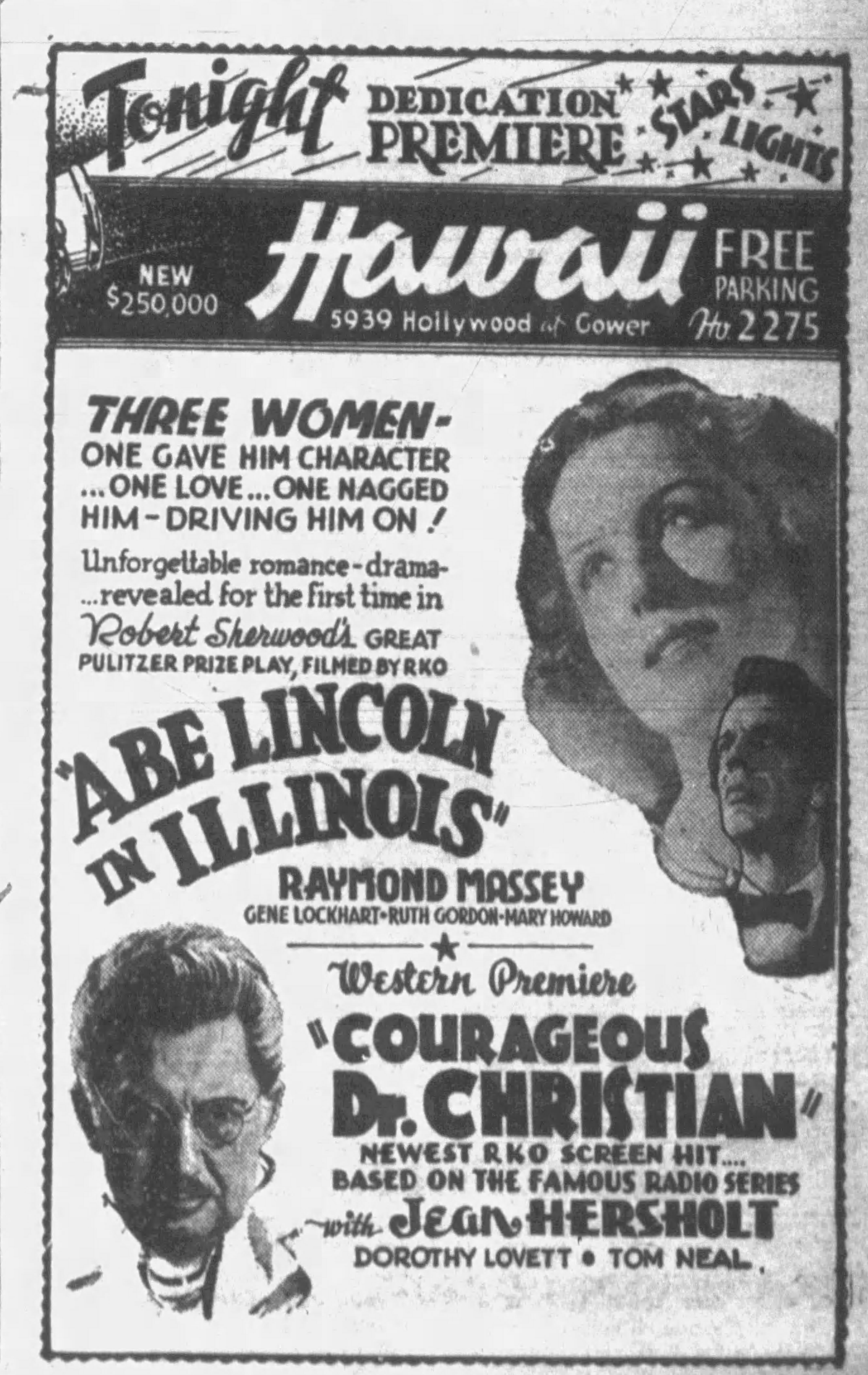
Citizens lined the Boulevard for the gala opening on May 6, 1940, which featured Hawaiian music, lights, stars, and, more importantly- free parking! Usherettes wore leis and “Hawiian-looking” outfits.

Most of the big-name stars were up the block at the Warner Theater for a preview of “Torrid Zone” with Ann Sheridan, James Cagney and Pat O’Brien. The Hawaii’s debut film was a reissue of “Abe Lincoln In Illinois,” which had premiered in Los Angeles in January 1940. The second feature was a first run film, The Courageous Dr. Christian,” with Jean Hersholt as the doctor, reprising his role in the popular Dr. Christian radio series (1937-1954).

Los Angeles News 5/6/1940


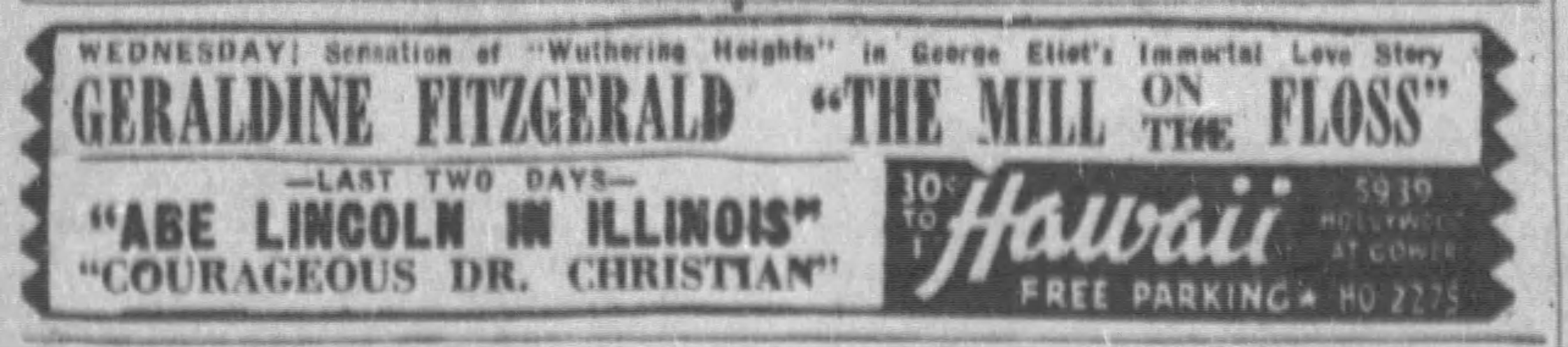
The Mill on the Floss and Isle of Destiny followed Abe Lincoln and Dr. Christian at the Hawaiian. LA Times 5/20/1940.

An independent theater at a time when many theaters were affiliated with, if not owned by, the major movie studios, the Hawaii was the first Los Angeles theater to land Gone With the Wind after the picture finally left the Carthay Circle Theater.

Gone With the Wind had been produced by an independent studio, Selznick International. MGM studio had netted distribution rights to the film as part of the king’s ransom David O. Selznick had to pay MGM (headed by his father-in-law, Louis B. Meyer), for the use of Clark Gable, who was under contract to MGM. The film had its world premiere in Atlanta December 14-16, 1939. It had its Los Angeles premiere at the Carthay Circle on December 28, 1939 and began its public run the following day at Carthay Circle and the United Artis Theater downtown. It remained at UA for 16 weeks and at the Carthay Circle for 24 weeks before closing its initial run on June 12, 1940. The film opened at the Carthay and US for a return engagement August 5-11, 1940 coinciding with the Hawaii Theater opening. The Hawaii Theater had to install benches on the street corners to accommodate all the Gone With the Wind fans arriving or leaving by streetcar or bus.

LA News 8/1/1940

The Hawaii Theater was primarily a second-run house, mostly showing films like Gone With the Wind, that had previously enjoyed an initial run at a major theater, or revivals of pictures that had not been on the screen in several years. Showmen Galston and Sutton often got creative with stunts and performance art “prologues” to fill the Hawaii’s 1100 seats. During the run of “Phantom Speaks,” which opened on Friday, April 13, 1945, for example, actor Loren Palmer would be “electrocuted” on the stage 5 times a day, then would subsequently run through the auditorium as the “electric ghost.”

Hollywood Citizen News 4/11/1945

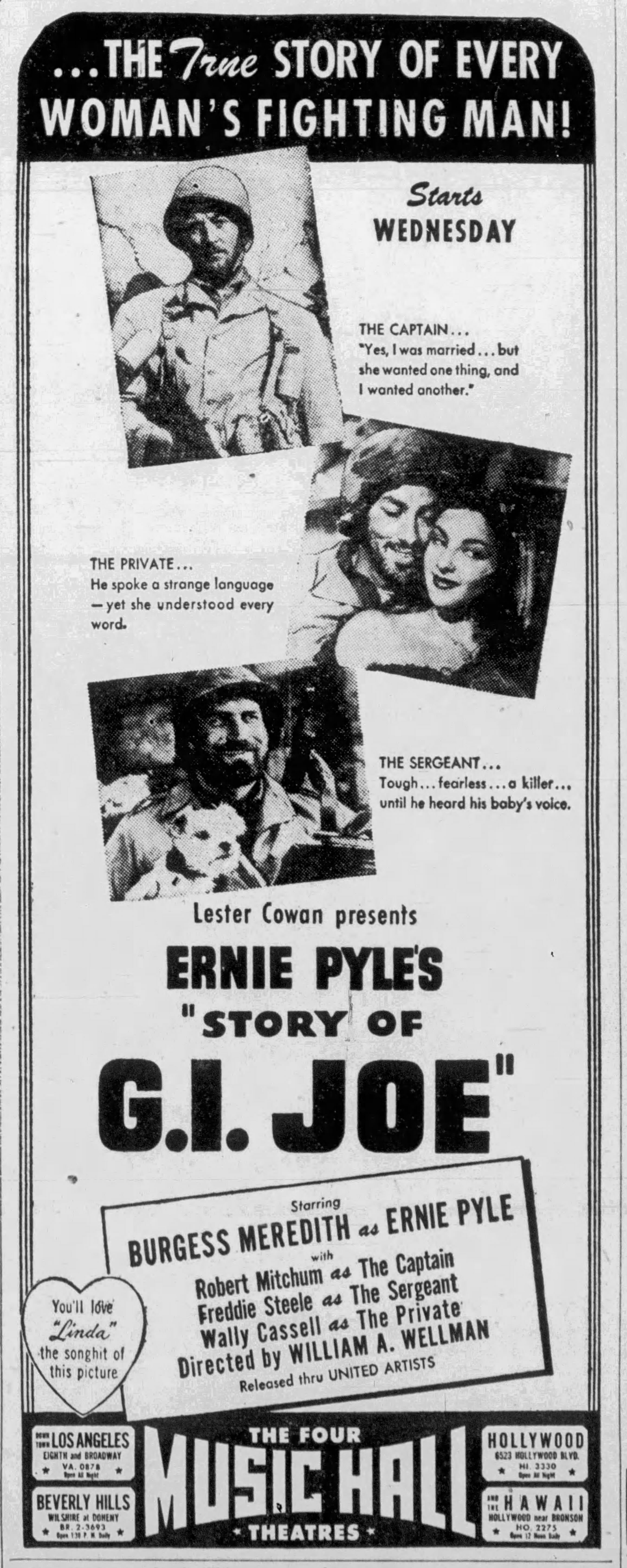
In June 1945, it was reported that the San Francisco Music Hall theater chain had acquired 4 Los Angeles theater: The Hollywood at 6523 Hollywood Boulevard, the Los Angeles at 8th & Broadway, the Beverly Hills on Wilshire, and the Hawaii Theater. United Artist were partners in the organization, as were Sutton and Galston. Music Hall theaters would show mostly first-run films, starting with Ernie Pyle’s “The Story of G.I. Joe” on August 8, 1945

LA Daily News 8/6/1945

Howard Hughes’ long-delayed film “The Outlaw” finally went into general release in April 1946 and the Hawaii, as one of the Music Hall theaters, was one of the 4 places to see it in Los Angles. Was it a real stinkeroo? Yes. Did audiences flock to see it anyway? Also yes.

Hollywood Citizen News 3/30/1946

Hollywood Citizen News 4/4/1946


The Hawaii Theater in early February 1947 during the run of “The Chase” starring Robert Cummings. LAPL photo.


The Chase in its 2nd week at the Hawaii. LA Times 2/1/1947


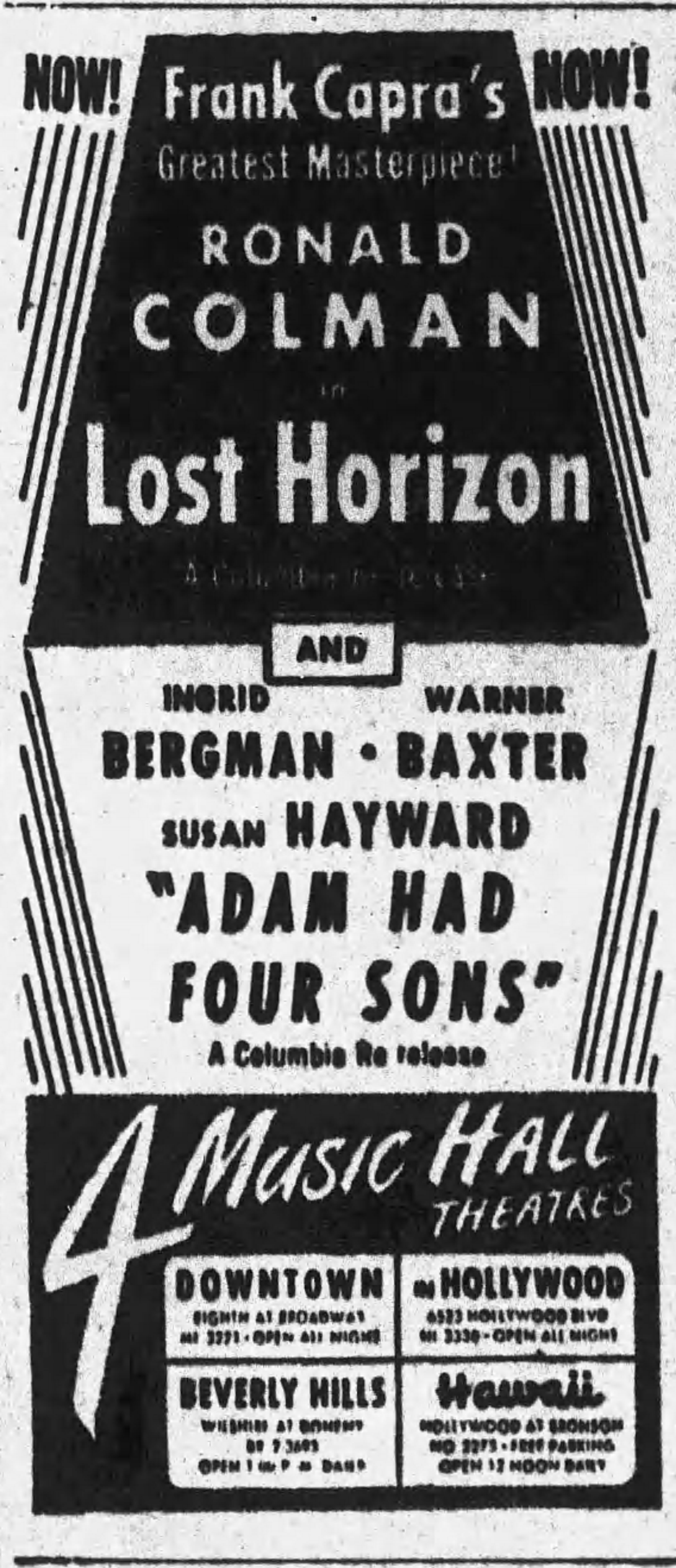
With a general shortage of new films being produced in 1948, the Music Hall theaters, including the Hawaii, revived “Lost Horizon,” which had first been seen in 1937. The revival proved to be a huge hit.

Hollywood Citizen News 4/13/1948

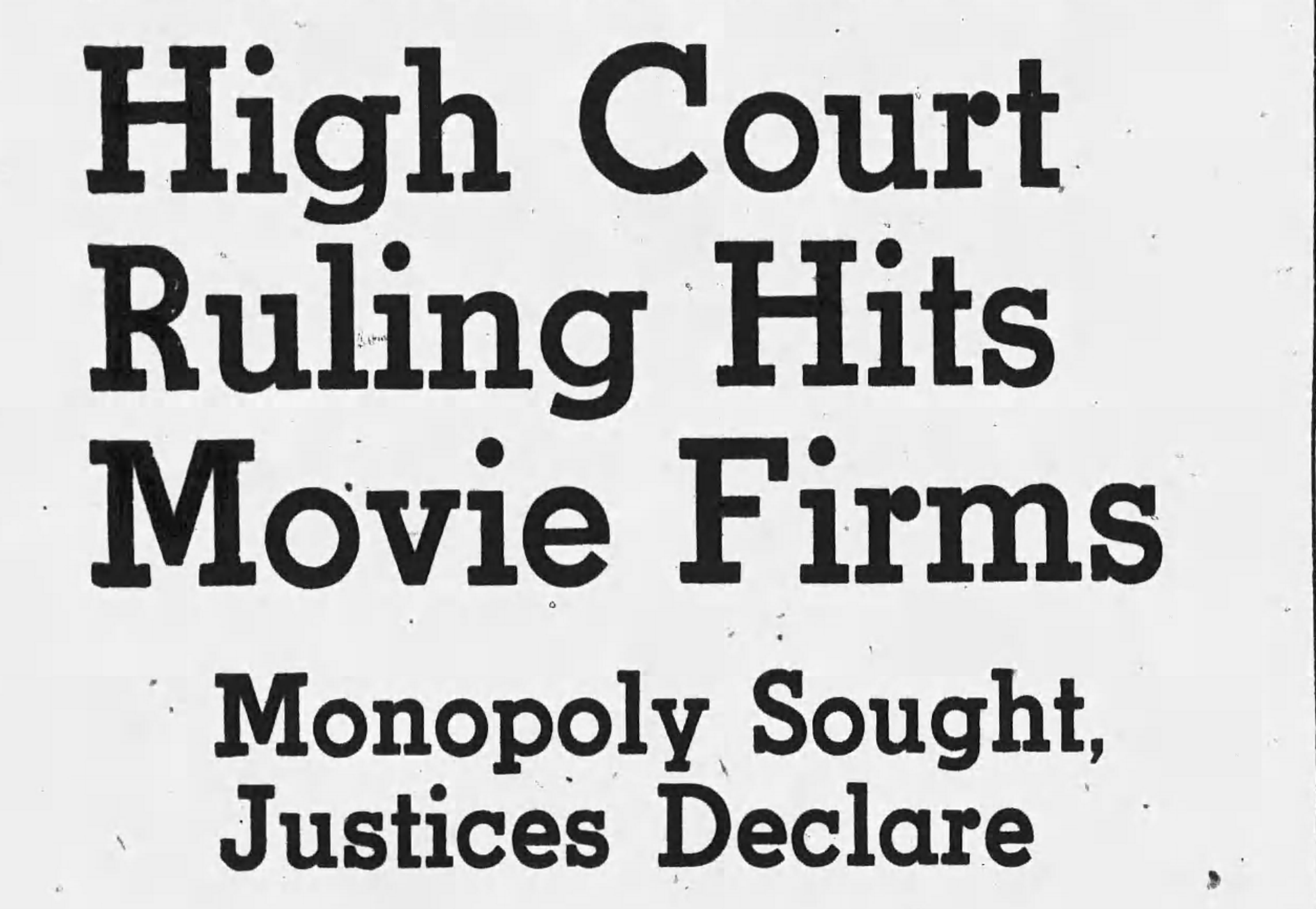
In May 1948, the US Supreme Court ruled in favor of the federal government in an anti-trust lawsuit against the major film corporations, filed by the Department of Justice almost 10 full years earlier.

In July 1938, the DOJ sued Paramount Pictures, Inc., Loew’s Inc., the Irving Trust Co. (trustee for RKO Corp., then in bankruptcy), Warner Brothers Pictures, Inc., 20th Century Fox Film Corp., Columbia Pictures Corp., Universal Corp., and United Artists Corp., accusing the industry of violating the 1890 Sherman Anti-Trust Act. The suit was an outgrowth of complaints by small, independent theater operators, who felt that studio policies for motion picture distribution and exhibition were designed to drive them out of business or compel them to sell to studio-owned theaters. A similar suit had been filed in 1928 and the studios lost; however, as with attempts to regulate film content, the studios basically functioned as usual and in 1933 got the federal government to nullify the judgment under FDR’s new National industrial Recovery Act (itself declared unconstitutional in 1935). No doubt there were many late-night meetings about it over at the Meyer Building down the street.

LA Daily News 7/21/1938

A settlement in the 1938 suit was reached in June 1940, shortly after the indy Hawaii Theater opened. The studios were meant to comply with new distribution and exhibition rules by November 1943. The compliance did not happen and the DOJ went back to court. The case went to trial in October 1945 and the District court ruled in favor of the studios. The DOJ appealed to the US Supreme Court, which decided in favor of the government in May 1948. Each of the defendants entered into a consent decree with the DOJ- known as the “Paramount Decrees” – between 1949 and 1952. Among other things, the ruling meant studios could no longer both distribute films and own theaters without prior approval of the Court and outlawed the long -hated (by theater operators) practice of “block-booking” whereby a theater had to take all of a studio’s film offerings, stinkeroos included, not just the pipperoos it wanted.

Hollywood Citizen News 5/3/1948

The ruling is often cited as the cause of the breakup of the studio system. However, movie theaters, like nightclubs, were already struggling as audiences drifted to other past times. Tax figures, for example, showed movie theater and nightclub admissions were down 20% in 1948 compared to 1947. The huge dinner theater nightclub next door to the Hawaii, The Florentine Gardens, went bankrupt in 1948.

Hollywood Citizen News 3/30/1948

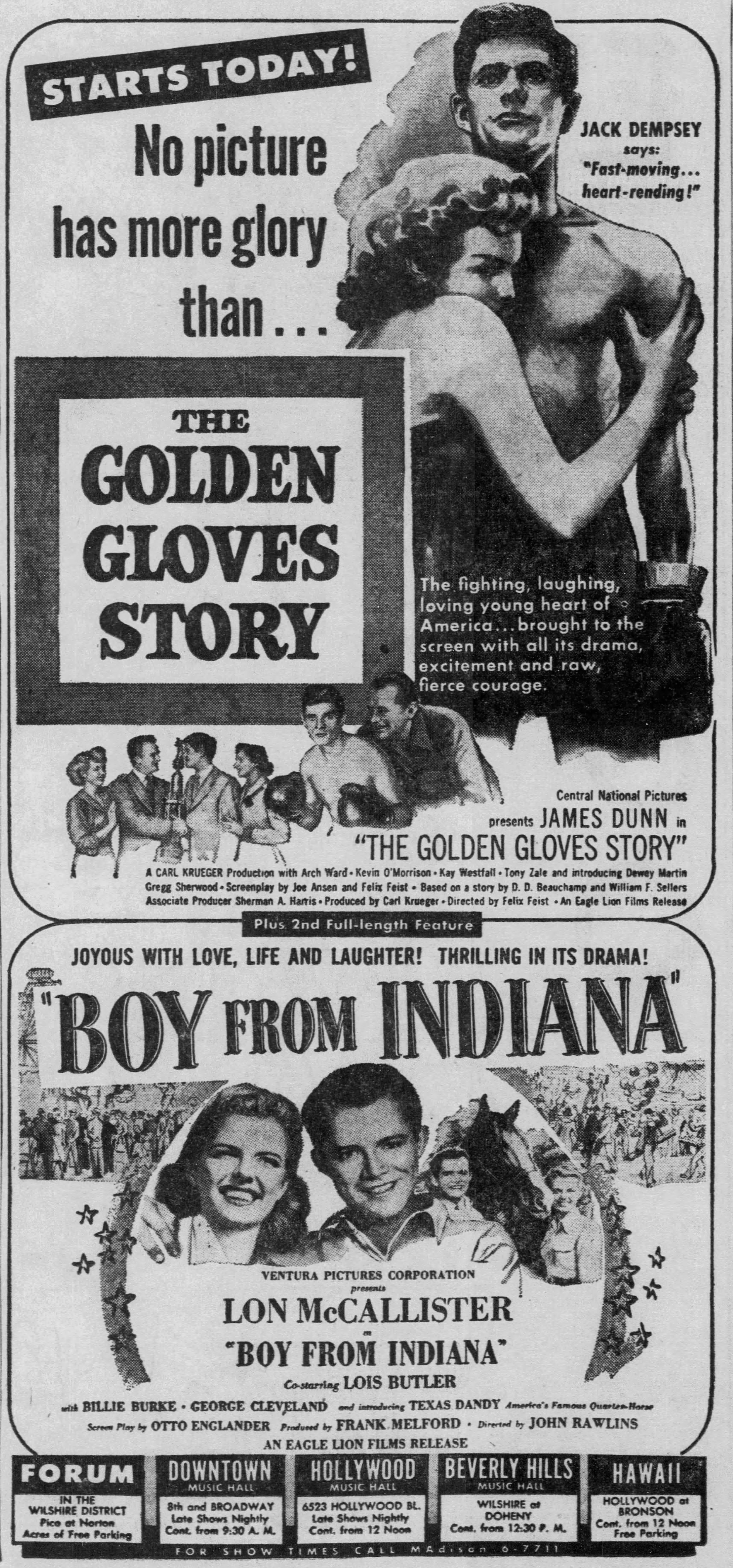
“The Golden Gloves Story,” released in May 1950, was one of the last first-run films to show at the Hawaii as part of the Music Hall theater chain.

A fifth Music Hall theater had been added to the chain- the Forum. LA Times 5/17/1950

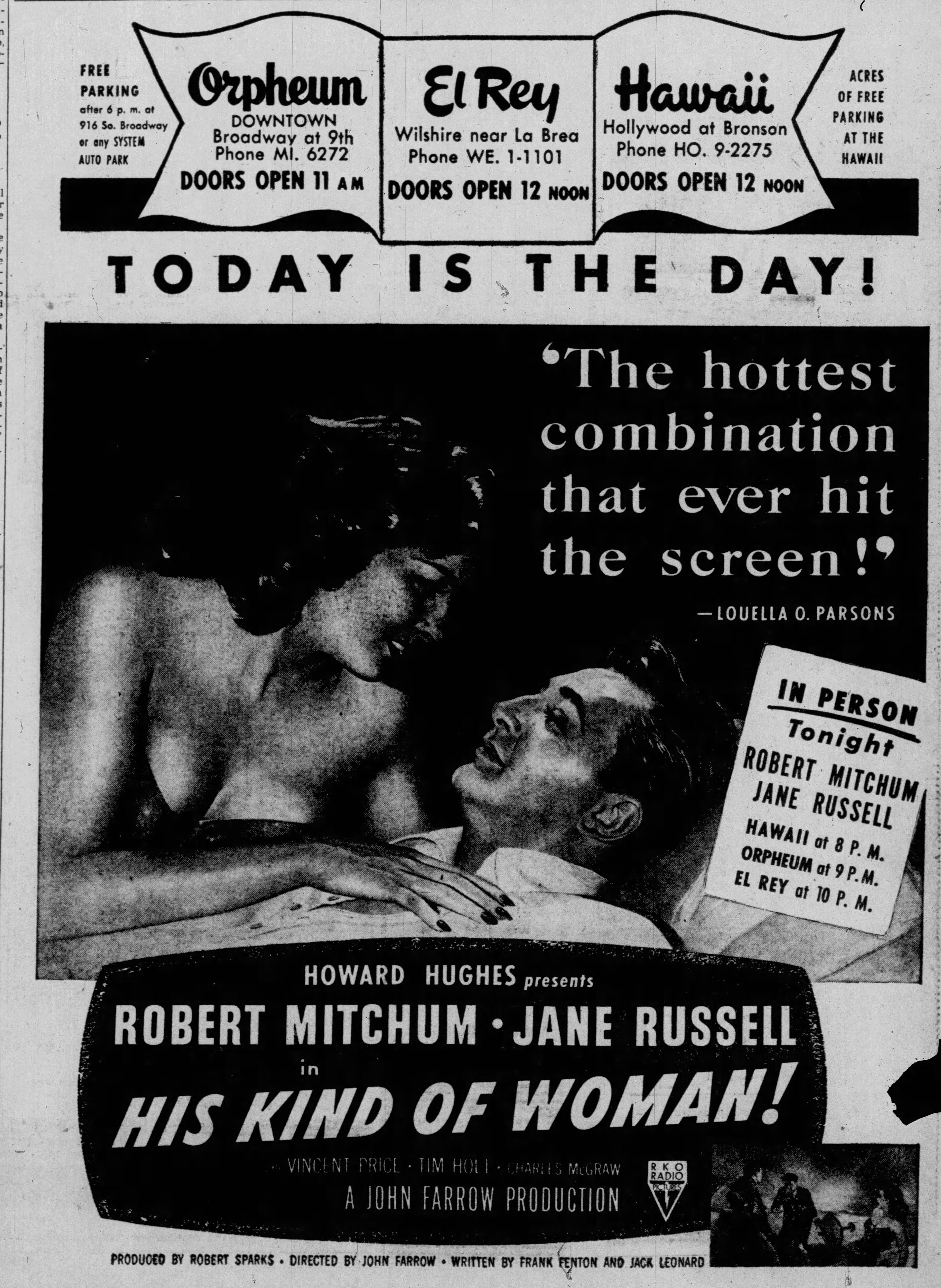
The stars of “His Kind of Woman,” Robert Mitchum and Jane Russell, signed autographs in the lobby of the Hawaii Theater on August 31, 1951, the day the film opened at the Hawaii, the Orpheum and the El Rey. The Hawaii was no longer part of the Music Hall chain.

Hollywood Citizen News 8/31/1951

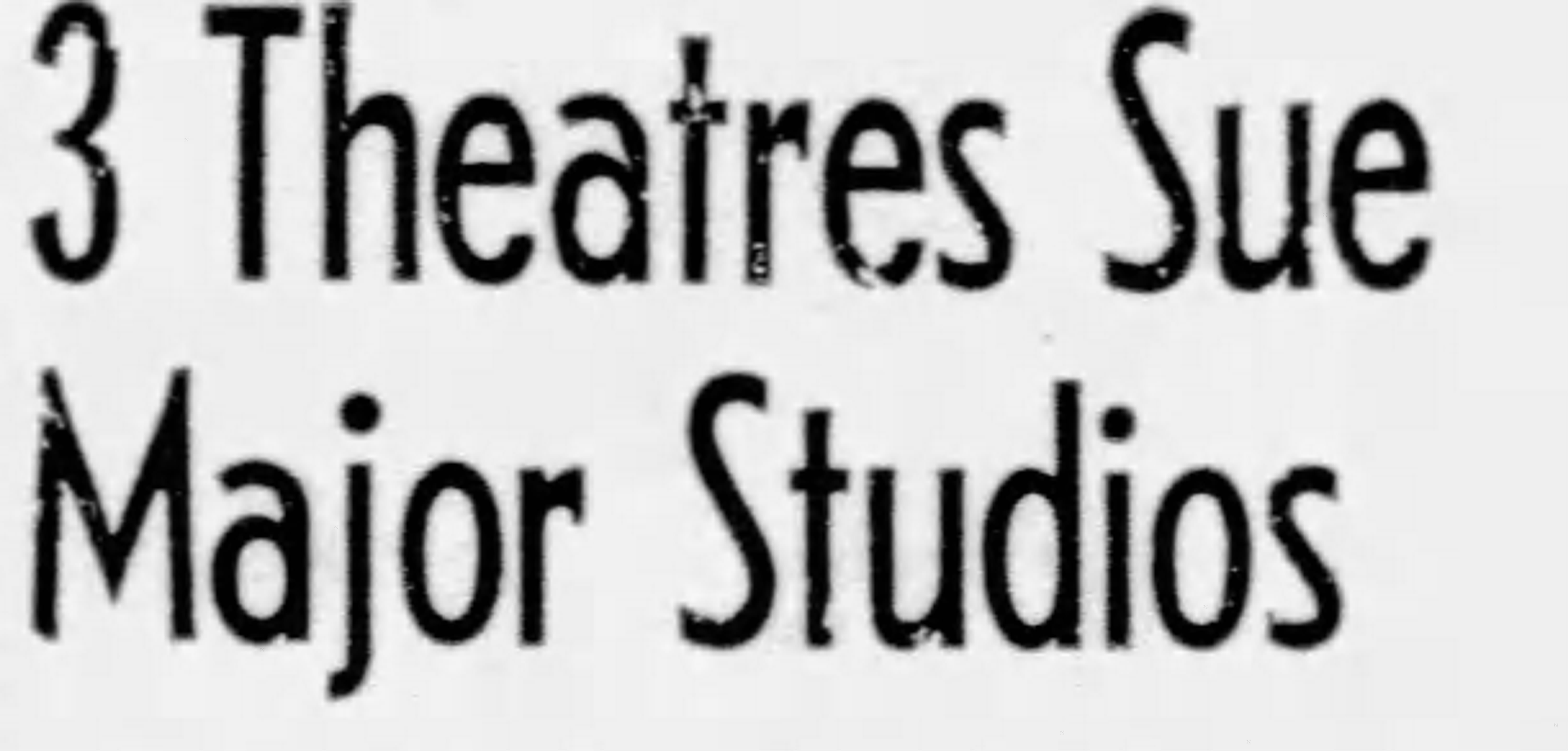
In September 1951, operators of the Hawaii Theater, the Marcal and the Beverly Hills Music Hall, filed an anti-trust lawsuit against 20th Century Fox Corp., National Theaters Corp., Loew’s Inc., Warner Brothers Pictures, Inc., Warner Brothers Pictures Distributing Company, Universal Film Exchanges, Inc., Paramount Pictures Corp., Columbia Pictures Corp., United Artists Corp., Fox West Coast Theater Corp., and the Fox West Coast Agency Corp., charging them with unfair distribution and exhibition practices. With the federal lawsuit also finalizing its terms, the lawsuit was successful. Films often began to open at the Hawaii concurrently with their runs at the major downtown theaters.

San Pedro News Pilot 9/25/1951

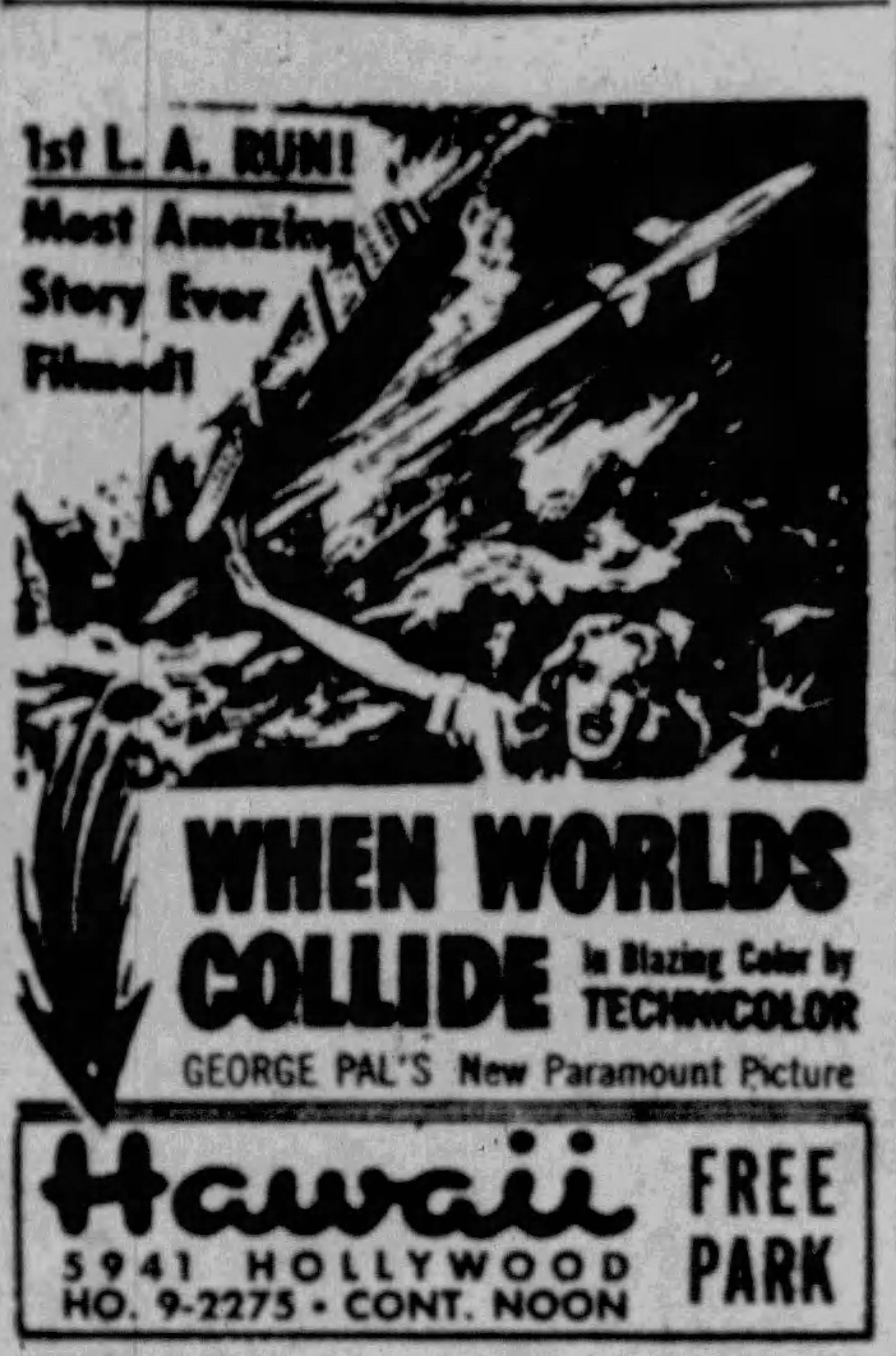
Paramount’s first-run When Worlds Collide debuted at the Hawaii Theater at the same time as it was showing downtown. Hollywood Citizen News 11/22/1951.

Theaters in general and independent theaters in particular, struggling in the early 50s to compete with television turned to new technology like CinemaScope, Filmorama, cycloramaic screens and 3D pictures to draw customers.

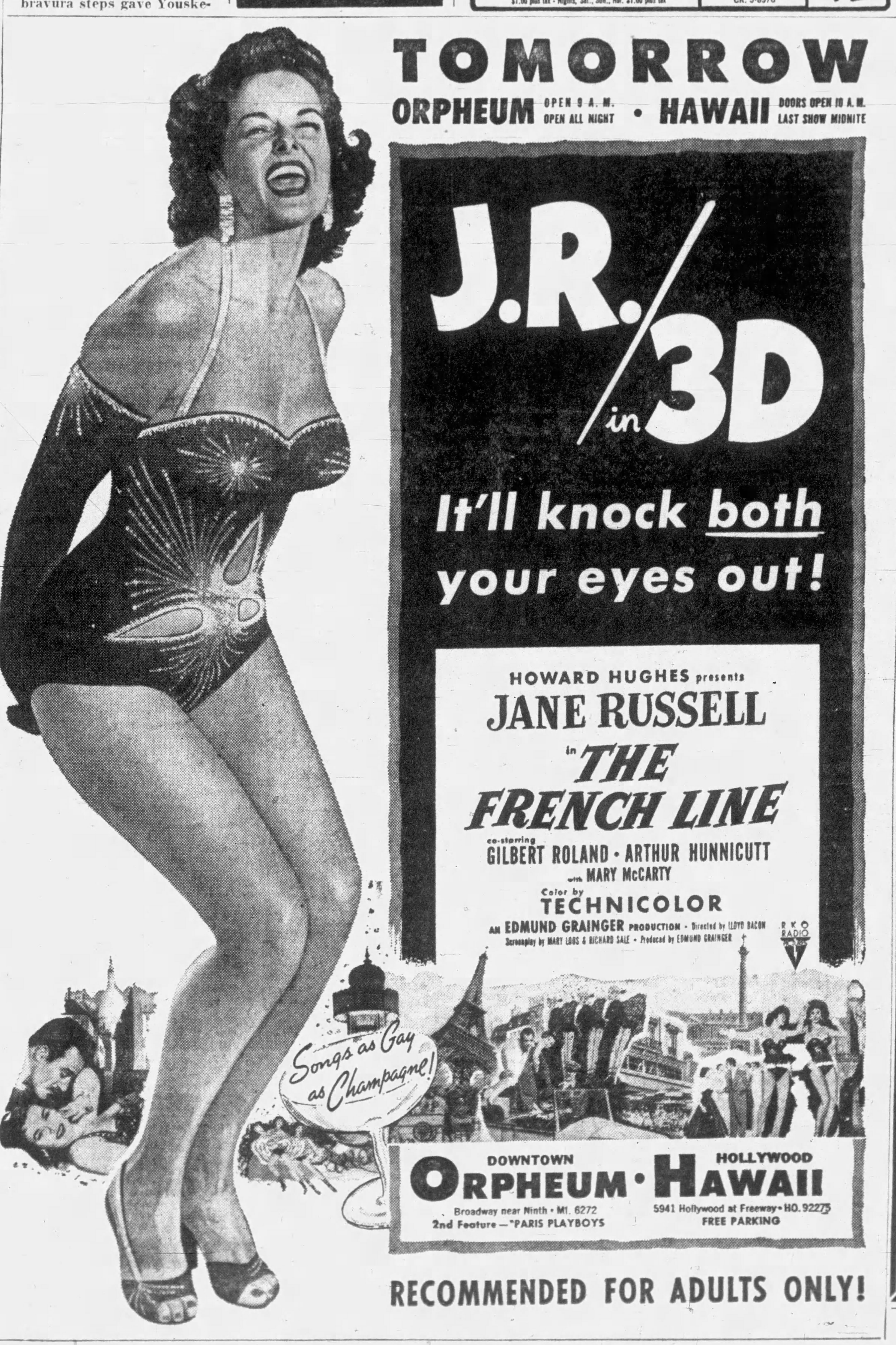
Jane Russel’s 3-D technicolor film The French Line came to the Hawaii on February 24, 1954. LA Mirror 2/23/1954.

Nothing could stop the changes happening to Hollywood Boulevard, however. Over the next decade, The Palms Grill next door closed. The Florentine Gardens and the Hollywood Food Mart became office buildings. The Mountain View Inn across the street was torn down.

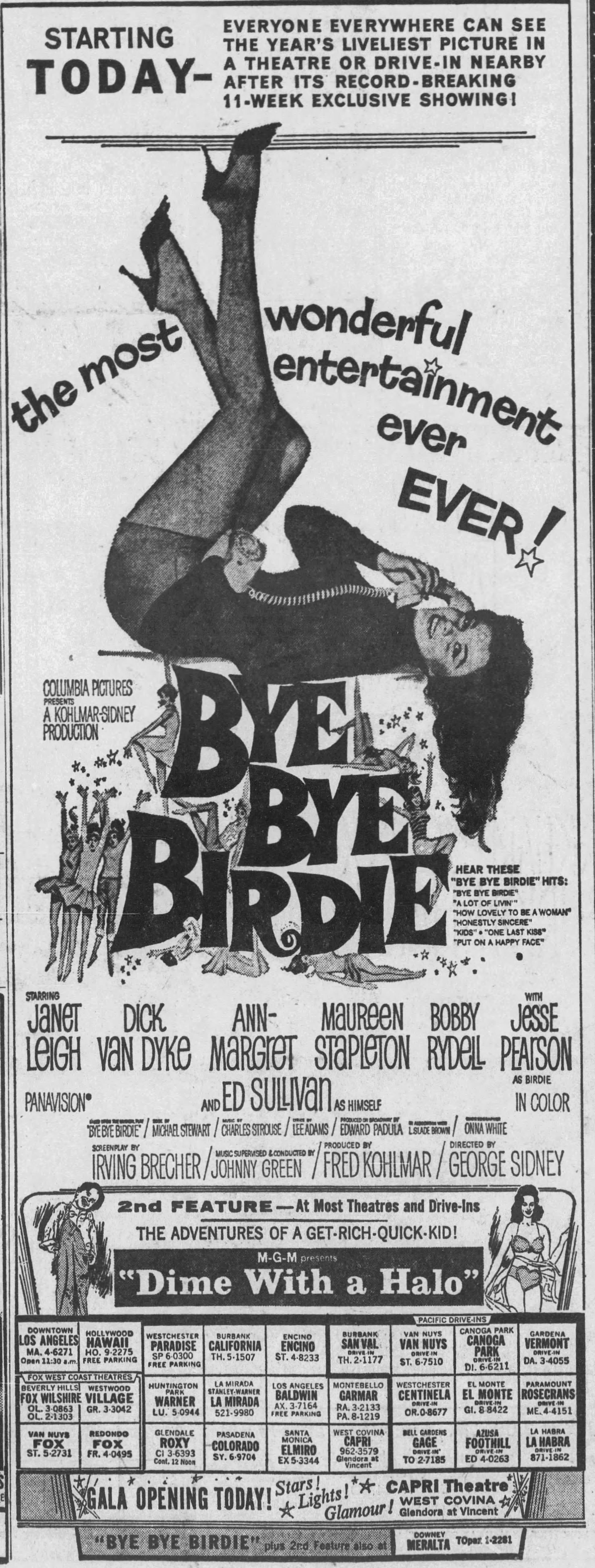
The last film to screen at the Hawaii Theater was “Bye Bye Birdie.” The film opened at the Hawaii (and other theaters) on June 19, 1963 in wide release after finishing its held-over 11-week initial run at the Hollywood Paramount Theater.

LA Times 6/19/1963. “Bye Bye Birdie” played in wide release with “Dime With a Halo,” a comedy produced at the Hal Roach Studio.

The final showing of “Bye Bye Birdie” at the Hawaii Theater was June 23, 1963. Its doors closed after that.

LA Times 7/29/1963

“The invasion of Hollywood….” Hollywood Citizen News 10/14/1964

In July 1963 the Salvation Army took over the Hawaii Theater building as its new Hollywood headquarters. (The organization would also take over the vacant Palms Grill next door). The building’s interior was gutted and the exterior was substantially altered. The new headquarters held a grand opening October 16-18, 1964. The building is still extant, but unrecognizable.

Notes:

Sutton & Galston began operating the Marcal, taking a lease from owner Mark M. Hansen, in late December 1934. They continued to run it through 1941. In April 1940 Hansen sued to have their 10-year lease forfeited. The Marcal will have its own post.

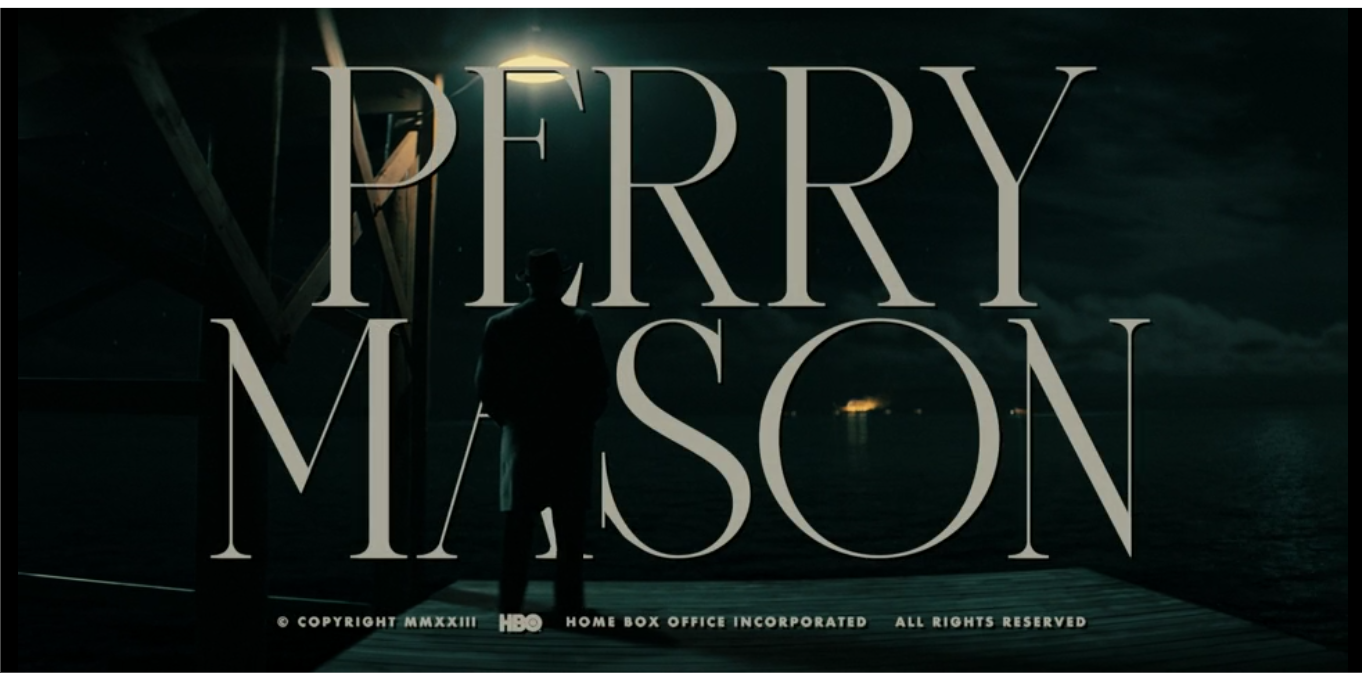
HBO’s Perry Mason Season 2

HBO has aired Season 2 of its dark Perry Mason series, set in early 1930s Los Angeles. If you haven’t seen Season 2 yet, this post may contain spoilers.

Click here to read my previous post on Season 1.

Season 2 picks up six months after the events of Season 1 concluded, so it begins in June/July 1932 and seems to continue into 1933.

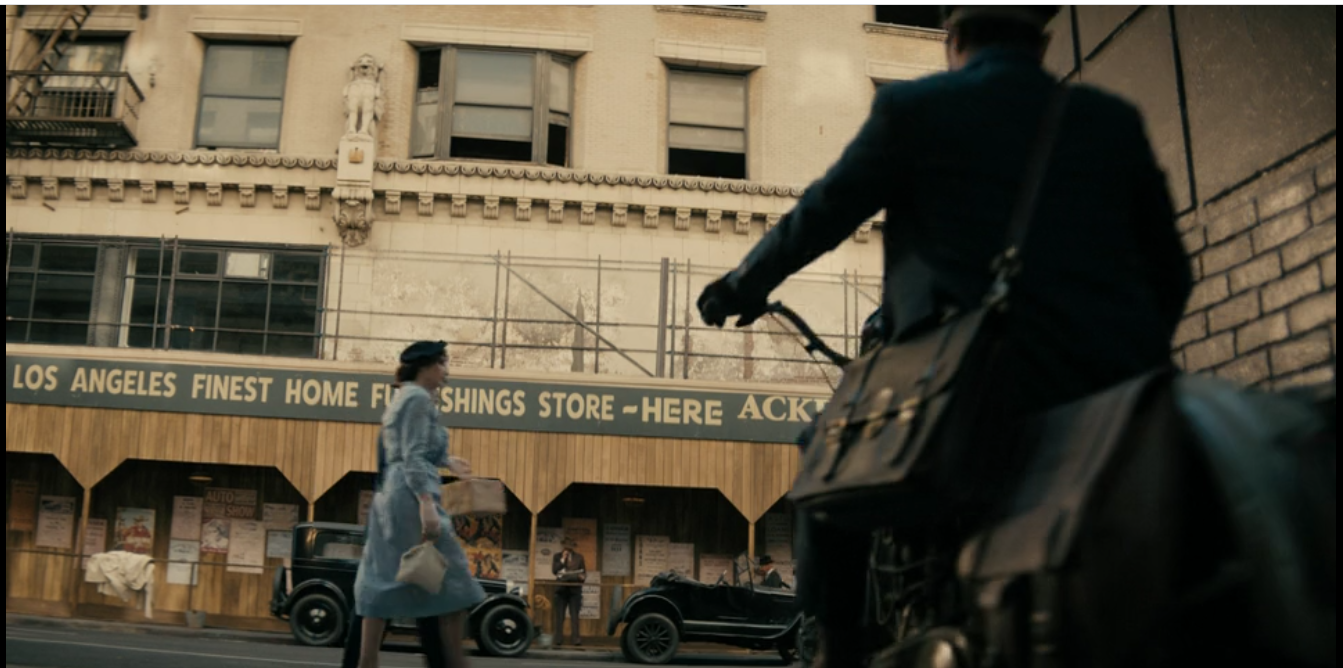
In 1932, Los Angeles hosted the Summer Olympic Games and even gangsters like Spike O’Donnell and Bugsy Siegel played tourist. Once again the show’s producers do a good job  depicting  Depression-era Los Angeles.

New characters, father and son Lydell and Brooks McCutcheon appear to be loosely based on multi-millionaire Edward L. Doheny of the Pam American Petroleum & Transport Company and his son Ned.

A US Senate investigation in 1924 led to the indictment, in 1925, of the senior Doheny as well as former Harding Administration Interior Secretary Albert Fall, an old pal of Doheny’s. E. L. Doheny was accused of giving Fall a $100,000 bribe in exchange for Fall’s issuing leases of the Teapot Dome Naval oil reserves to Doheny. Ned Doheny was said to have delivered the bribe in person. The case dragged through the courts for the remainder of the decade.

E. L. Doheny. LAPL photo.

Ned Doheny. LAPL photo.

On February 16, 1929, Ned Doheny and his friend and secretary Theodore High Plunkett were found dead of gunshot wounds inside Ned’s newly constructed estate, Greystone, in Beverly Hills. When investigators were finally summoned, the family doctor, E. C. Fishbaugh, physician to the rich and famous, had already spent considerable time at the scene. The family and the doctor fingered Plunkett as the shooter, asserting that he had become mentally imbalanced lately and had shot Ned then himself.

LA Examiner’s photo-diagram on the actual crime scene photo illustrating “police officers’ theory of the dual tragedy in which Theodore Plunkett killed his employer, Edward L. Doheny, Jr. and then committed suicide. According to the police theory, Plunkett held the gun at his waist and shot Doheny seated in a chair.” LAPL photo.

Despite a number of anomalies, this explanation was accepted and the case was closed without further investigation or even a coroner’s inquest. After one day of sensational press coverage depicting Plunkett as the villain and young Doheny as a hero who’d tried to help his ill friend, the case also vanished from the newspapers. Ned Doheny was buried on February 19; Plunkett was laid to rest the following day.

There are multiple theories today about what really happened that night, and speculation as to the motive, including that Ned Doheny was soon to testify to the Grand Jury in the bribery trial. In any case, on October 25, 1929, Albert Fall was convicted of accepting a bribe and sent to prison. E.L. Doheney, however, was acquitted in 1930 of having done the bribing. Raymond Chandler references the case, calling it the “Cassidy case,” in The High Window.

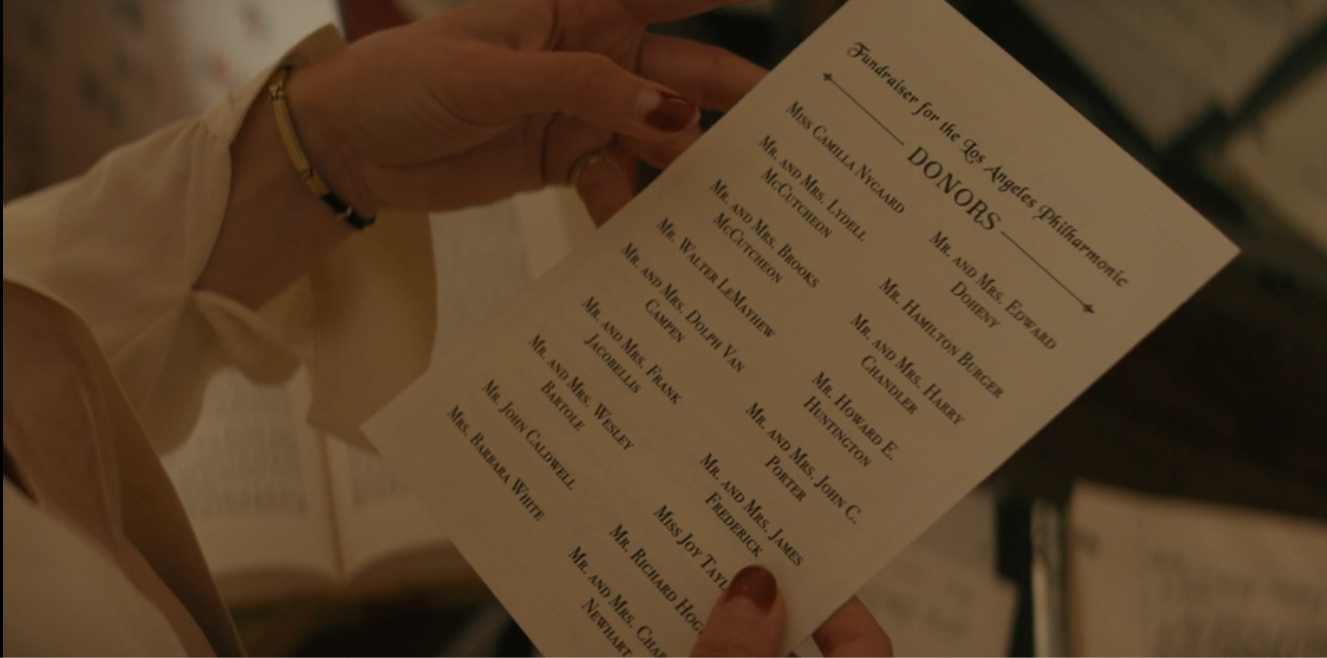
“Mr. and Mrs. Edward Doheny” are among the donors listed in the program of Camilla Nygaard’s musical soiree. HBO.

The Gambling Ships

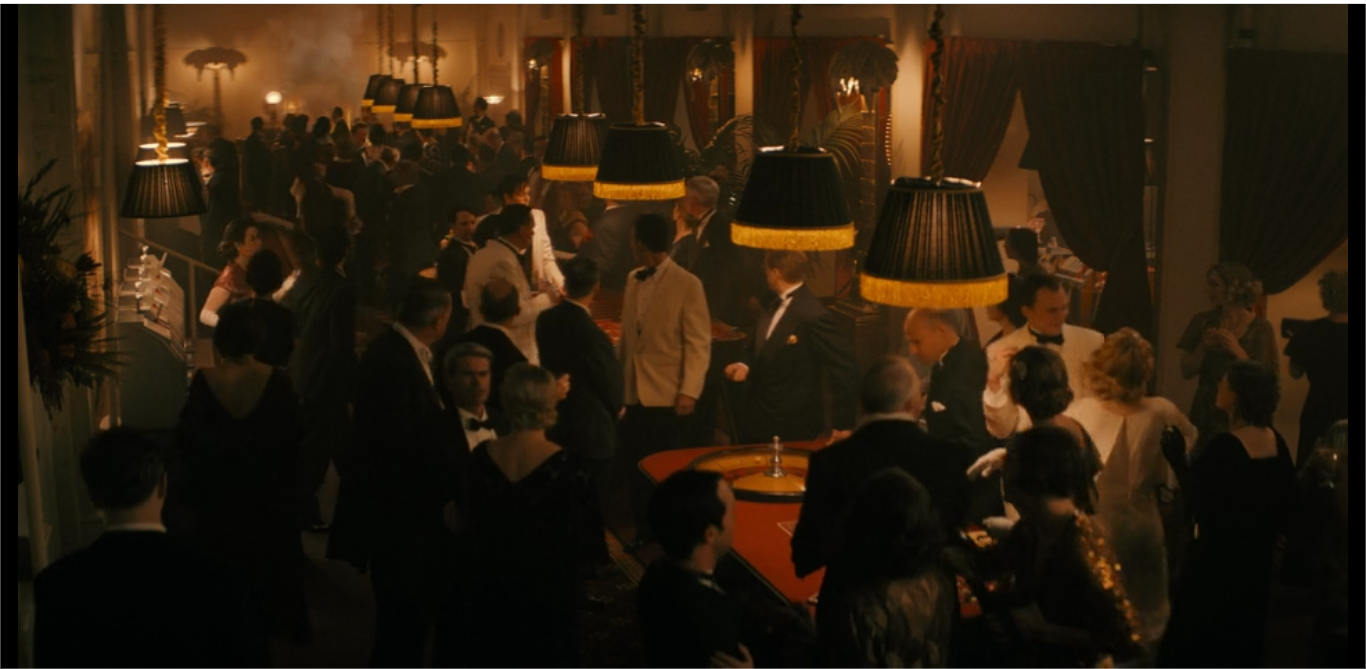
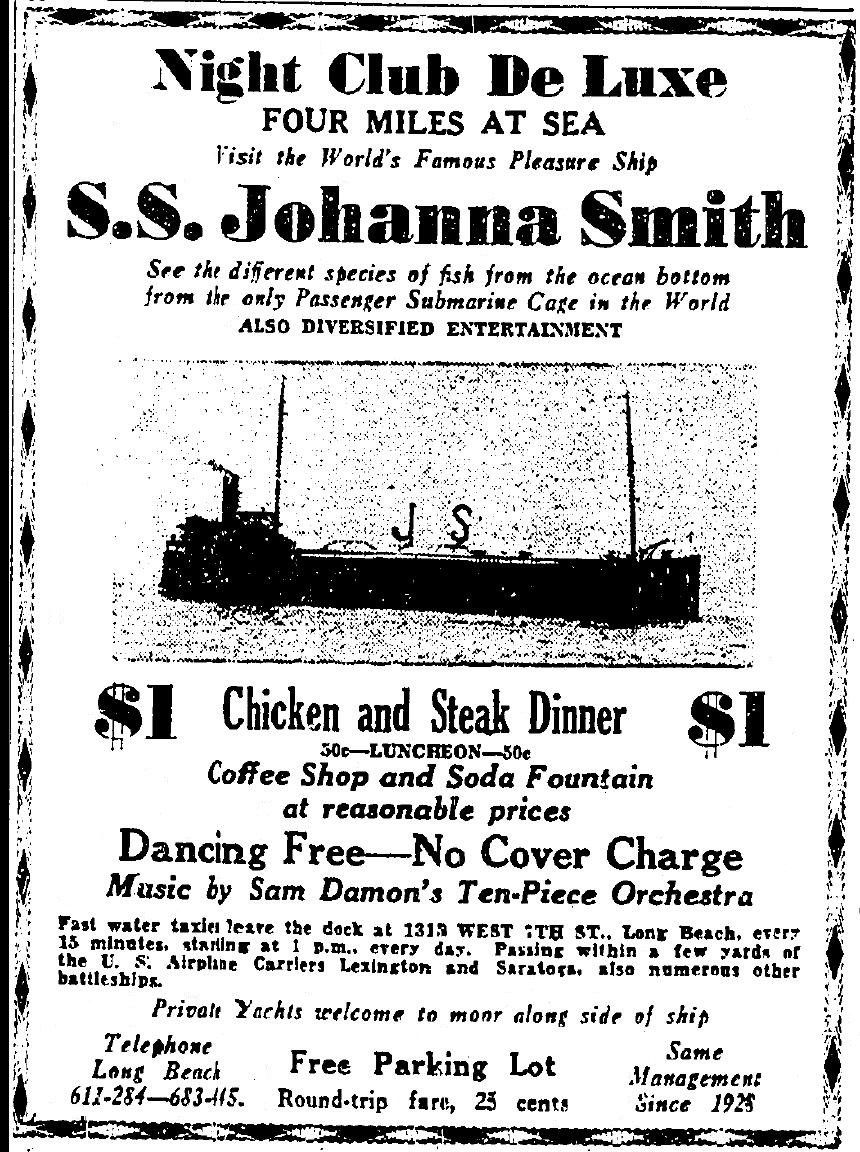
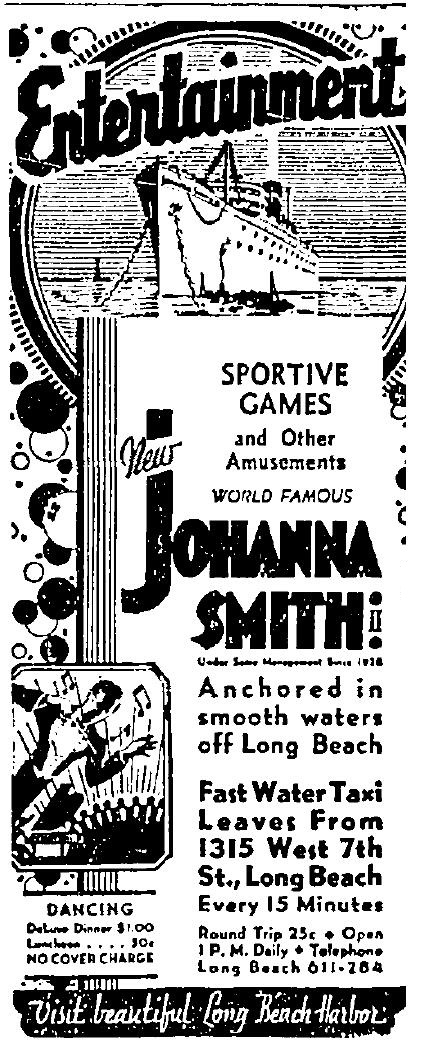
Brooks McCutcheon has an interest in a gambling ship, The Morocco. Los Angeles did have a number of gambling ships operating off of its coastline over the years. The LA mob’s Tutor Scherer experimented with an unnamed gambling barge in 1928; Farmer Page backed the Rose Isle in 1930. Jack Dragna was behind the Monfalcone (1928-1930). In 1932, the ships operating were the Johanna Smith and the Monte Carlo. Both had the involvement of former bootlegger Doc Schouweiler. Page likewise had an interest in the Johanna Smith. In addition, the La Playa began operation in 1932. Unlike the other two, which were stationary, the La Playa actually sailed, taking passengers on a “cruise to nowhere” while they gambled on the high seas.

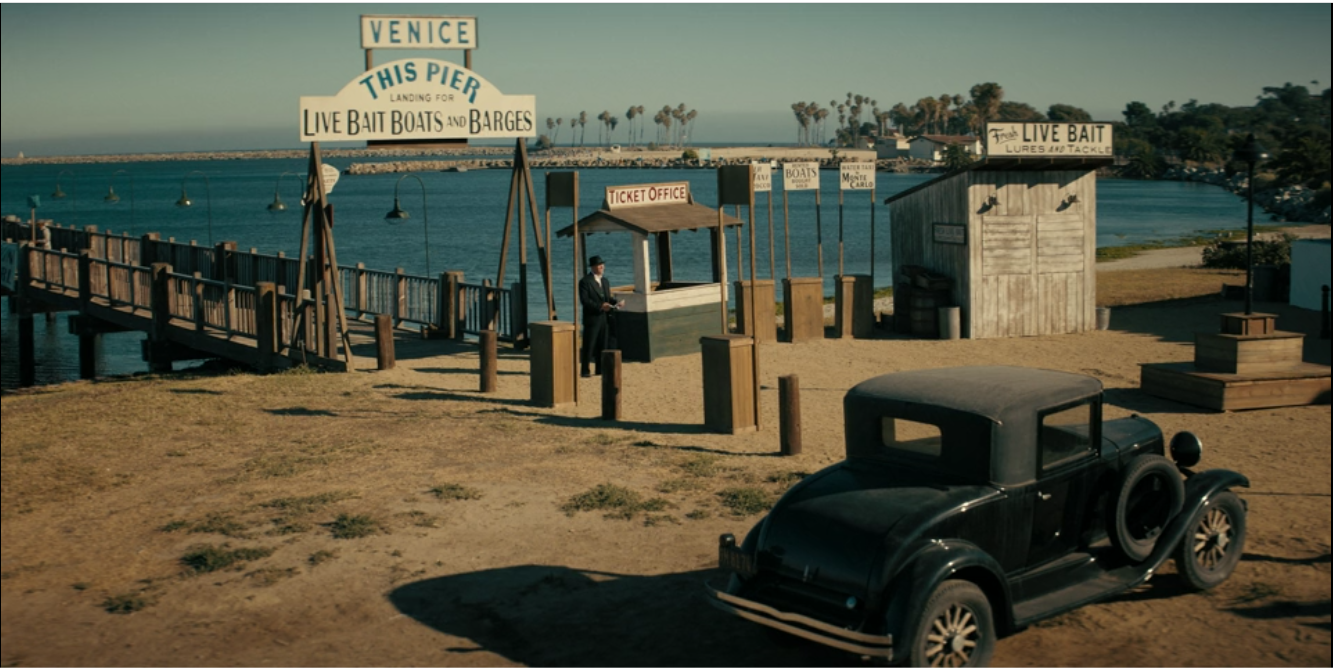
The ships theoretically operated in international waters, outside the jurisdiction of local and state authorities. The water taxis that brought customers to the ships, however, were subject to local laws and efforts to shut down the ships generally focused on this weak link.

In July 1932, there was a fire aboard the Johanna Smith, with many passengers aboard. The ship was replaced later that year by the Johanna Smith II.

The Morocco on the high seas in Perry Mason. HBO.

The Johanna Smith gambling ship in 1930. LAPL photo.

Fire aboard the Johanna Smith 7/22/1932.

The exterior and interiors of the ships were not nearly as glamorous as depicted in their advertising.

Aboard The Morocco. HBO
Aboard the Morocco. HBO.

Game room on a gambling ship. LAPL photo.

Ad for The S.S. Johanna Smith 7/8/1932.

Ad for the LA Playa “cruise to nowhere” gambling ship. Unlike the others, which were not seaworthy, the La Player actually sailed. 8/23/1932.

Ad for the Johanna Smith II. 11/18/1932.


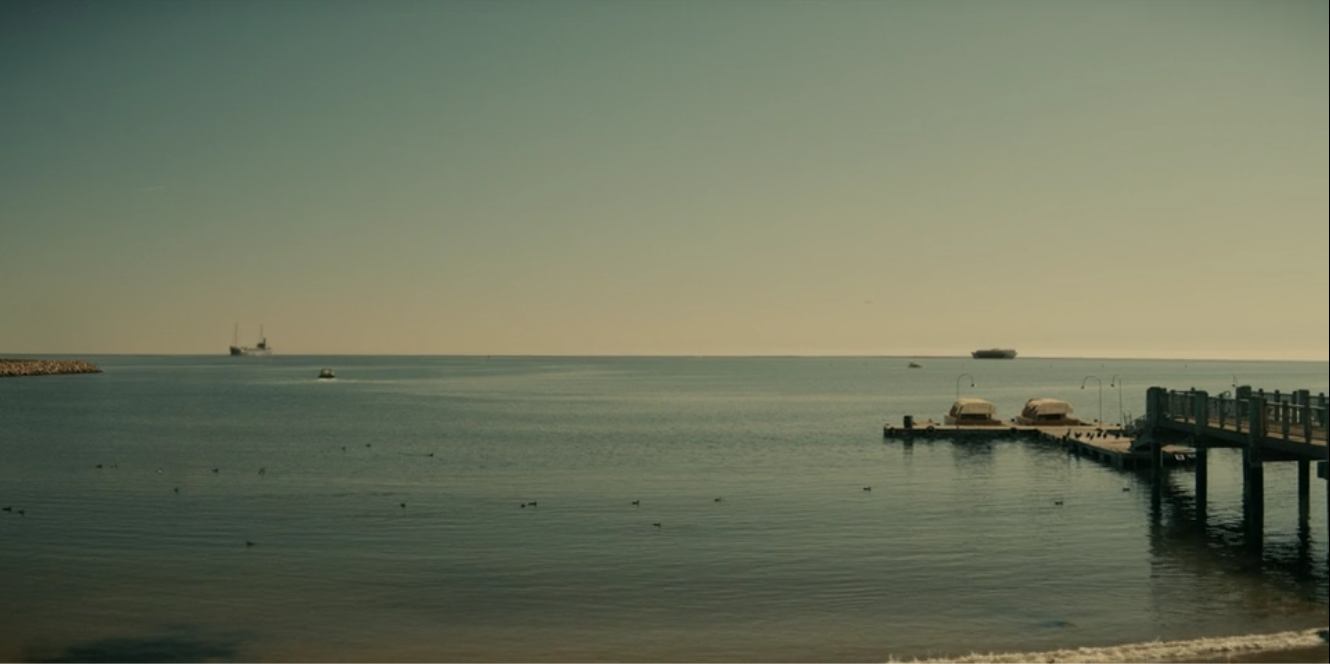
The water taxi pier at Venice Pier in Perry Mason. The gambling ships mostly operated out of Long Beach at this time.

Note signs for the water taxis, which conveyed customers to the gambling ships.

Perry’s Apartment

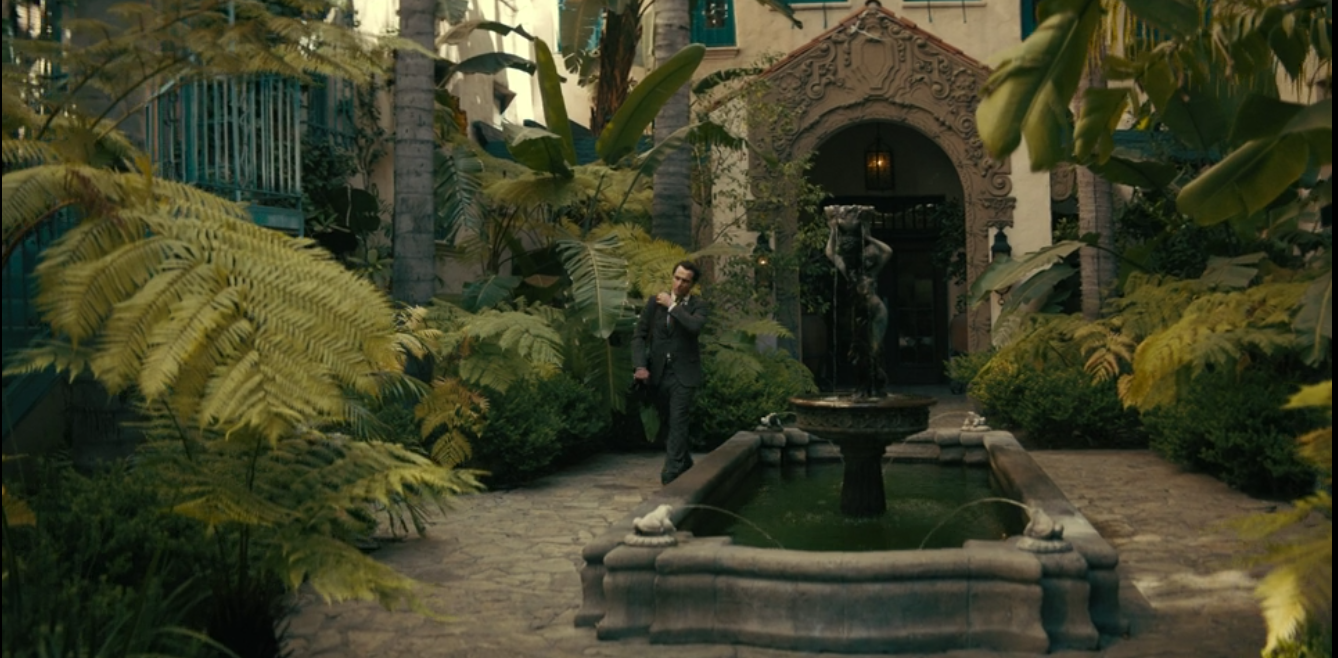
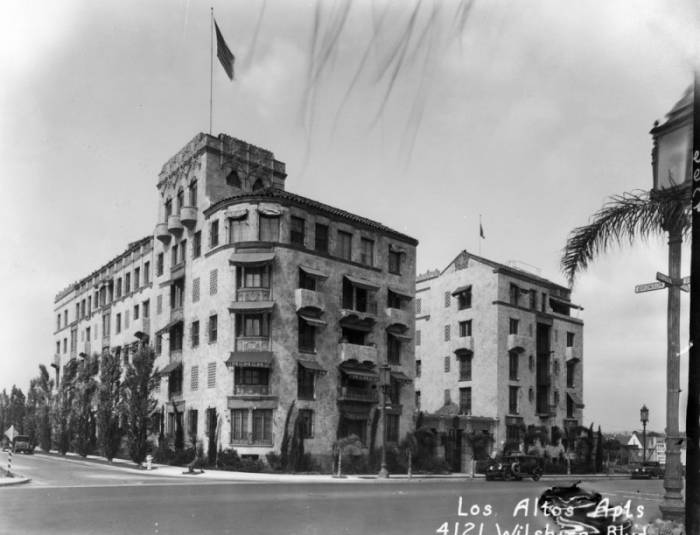
Having sold the family farm in Season 1, in Season 2 Perry has recently moved in to a swanky new apartment. The location of the building shown in the series is the Los Altos Apartments at 4121 Wilshire Boulevard. Built in 1925, the Mission-Revival style building offered both  rentals and own-your-own units. By 1932 it had fallen on hard times and in was offering bargain rates. Perhaps Perry took advantage.

Courtyard of the Los Altos Apartments. HBO.


Outside view of the Los Altos. HBO.

The Los Altos Apartments c. 1934. LAPL.

Ad for the Los Altos Apartments 7/3/1932.

Perry’s Office

Perry’s office is in the Chester Williams Building at 215 West Fifth Street. Opened in 1926, it did indeed house a number of lawyers’ offices. See my previous post on the Chester Williams Building, here.

chester_williams_building_1926

Perry heads to work down the Frank Ct. alley next to the Chester Williams Building. The building straight ahead of him is the Alexandria Hotel, which had fallen on hard times in 1932. HBO. 
Entrance to Perry’s offices in the Chester Williams Building on Fifth St. HBO.

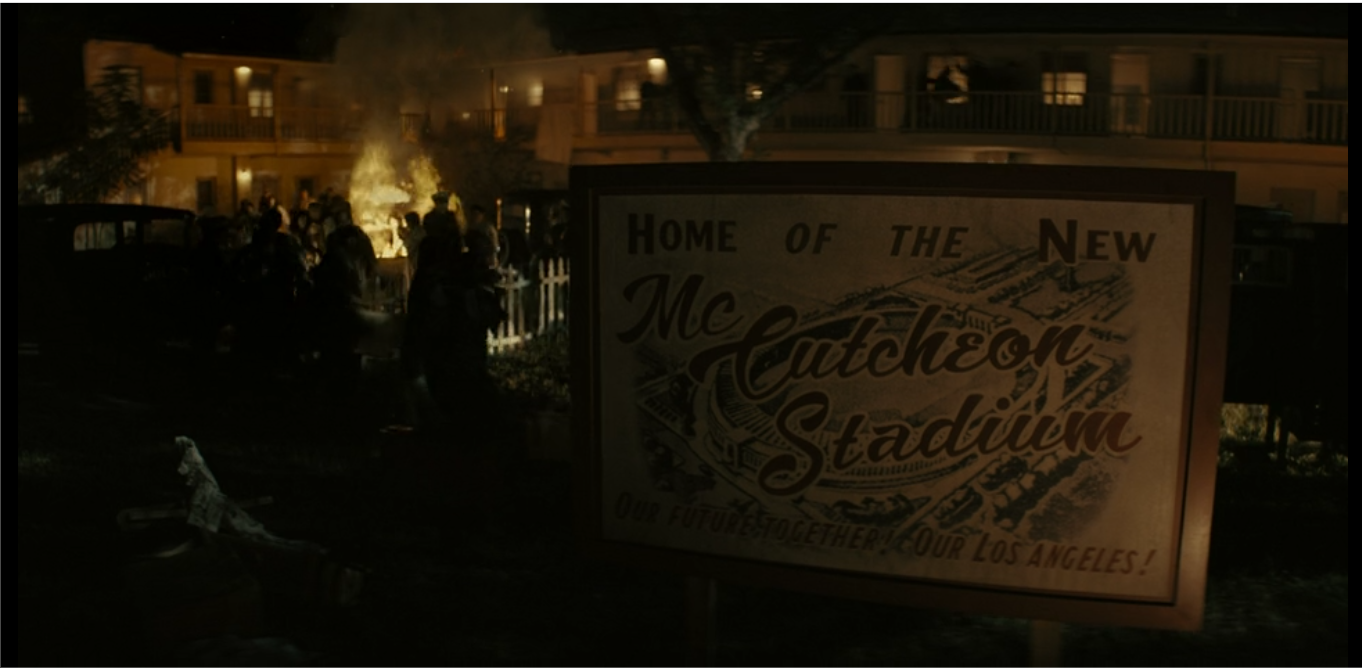
Mateo and Rafael Gallardo’s horrific eviction storyline and Brooks’ desire to build a baseball stadium on the site to draw a major league team to Los Angeles seem clearly inspired by the Chavez Ravine evictions and the building of Dodger Stadium.  The evictions by the city began in the early 1950s, resulting in most of the community leaving their homes. The planned development for the area never materialized, however. And it would be more than a quarter century before the Dodgers came to Los Angeles, in 1958. Voters approved a measure to give the Chavez Ravine land to the team’s owner to construct a stadium. Construction began in 1959 and the remaining residents who refused to leave were violently forced out.

McCutcheon Stadium signage as residents are burned out of their homes. HBO.

Evictions at Chavez Ravine, 1959. LAPL photo.

The building shown in the series as McCutcheon Stadium is the Los Angeles Memorial Coliseum at 3911 S Figueroa Street in the Exposition Park neighborhood. It opened in 1923. Many of the 1932 Summer Olympic Games events were held here. I wrote about it previously in this post. The Dodgers used it for their games from 1959 until Dodger Stadium opened in 1962.

Mateo Gallardo proposes in the shadow of the unfinished McCutcheon Stadium. HBO.

"los angeles memorial coliseum" 1920s

Los Angeles Memorial Coliseum in the 1920s before the Olympic Torch was added above the entrance in 1930. 

Griffith Observatory

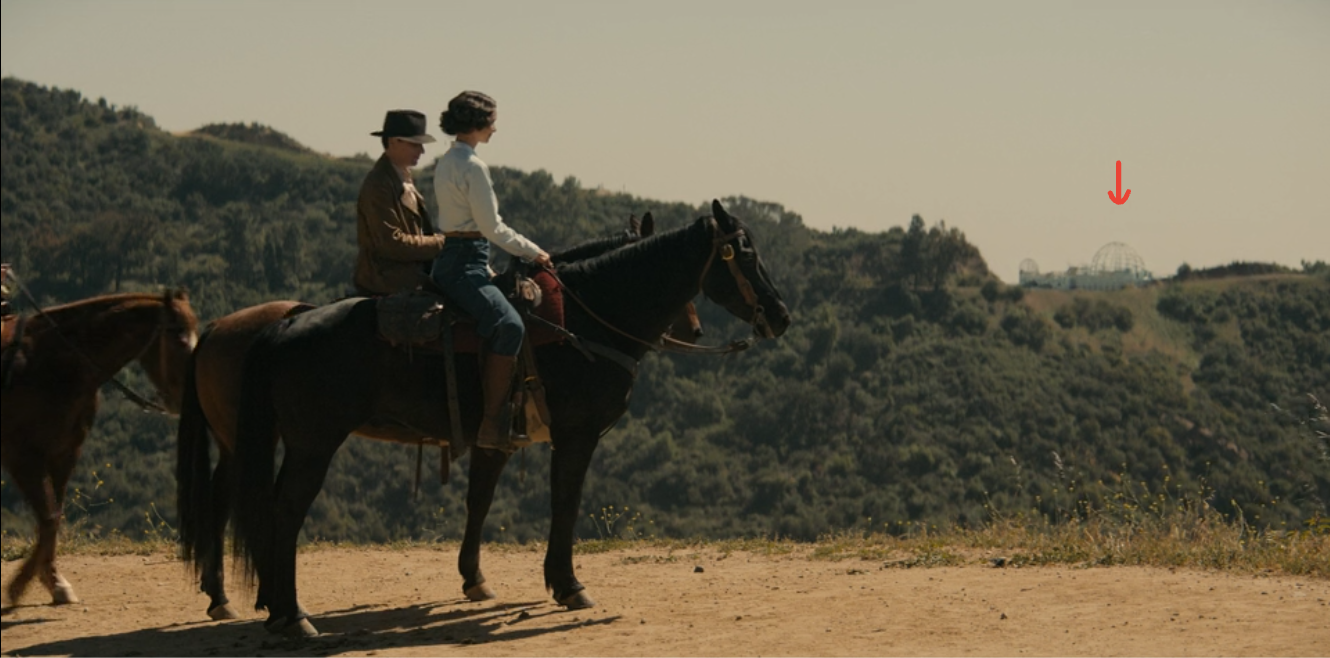
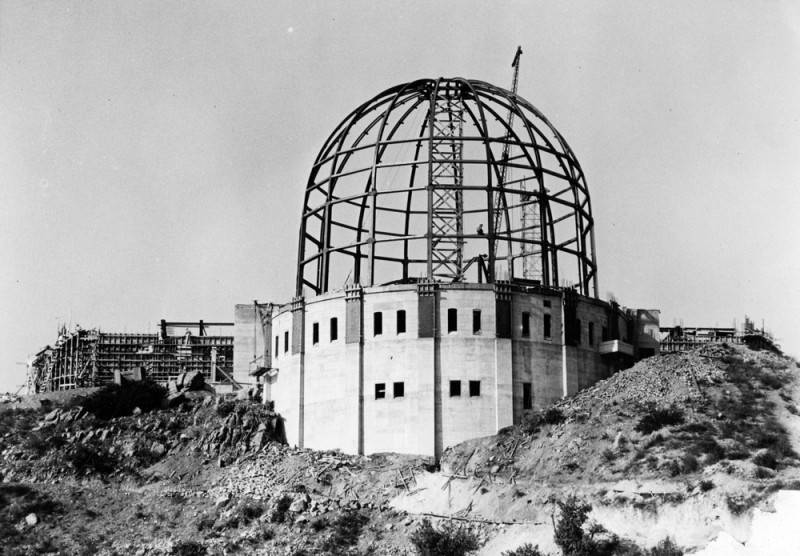
When Perry and his son go horseback riding in the Hollywood hills with Ginny Aimes, Griffith Observatory can be seen under construction in the distance.

The late Col. Griffith J. Griffith had bequeathed funds to build the observatory. The site was selected in November 1931. Construction on the buildings, designed by architect John C. Austin, got underway until June 1933. The observatory opened in 1935.

Griffith Observatory under construction in the distance. HBO.

Griffith Observatory under construction c. 1933. LAPL photo.

Announcing start of construction on Griffith Observatory. LA Times 6/19/1933

Santa Anita

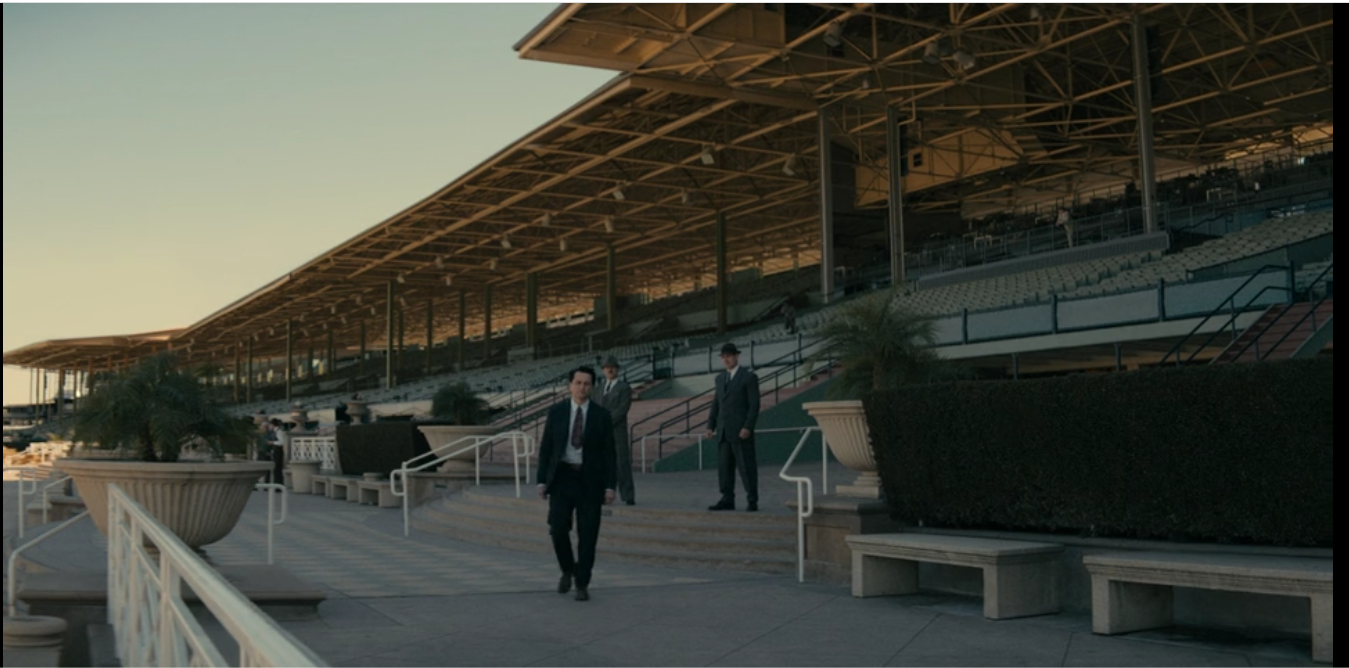
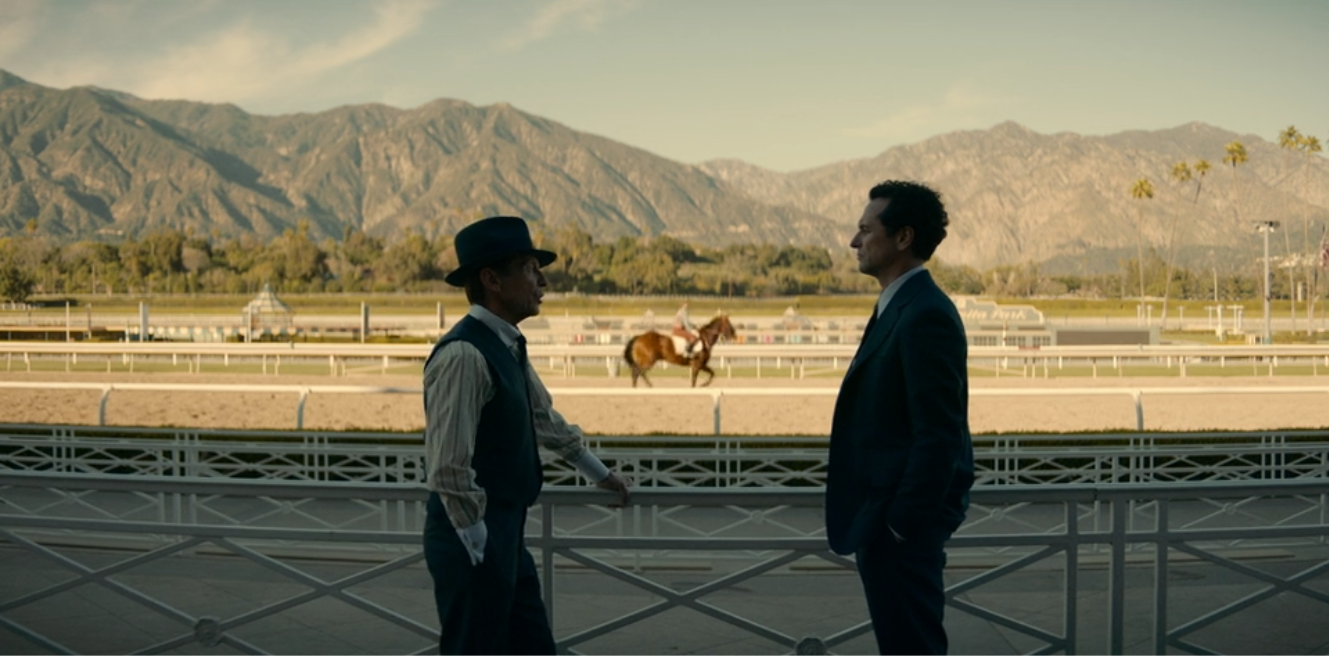
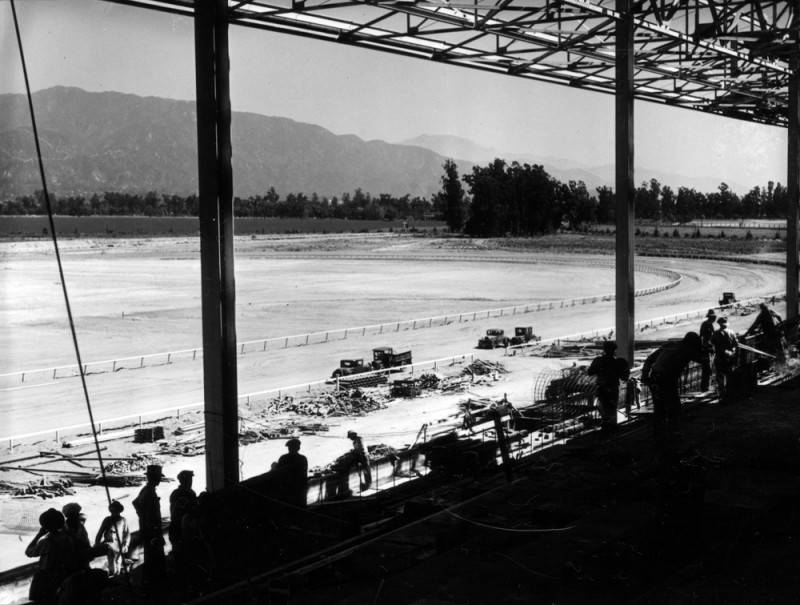
Perry has a terse meeting with Lydell McCutcheon at Santa Anita racetrack. The track is shown completed, with horses working out on the track. Groundbreaking for the new Santa Anita, home of the Los Angeles Jockey Club, began in August 1932. In June 1933, California voted to legalize parimutuel betting again. Santa Anita park opened on December 25, 1934.


Santa Anita under construction 1933. LAPL photo.

Devil’s Gate Reservoir.

As in Season 1, Perry and Pete meet at the 1920 Devil’s Gate Reservoir. See more pictures of this location in my post on Season 1.


The Hall of Records

As in Season 1, courtroom scenes take place at City Hall, not the Hall of Justice or the old County Courthouse on Poundcake Hill. In a nice touch, though, the series recreates a glimpse of the long-gone 1908 Hall of Records building, then located at 220 N. Broadway. Perry does report to the Hall of Records to begin seving his sentence.

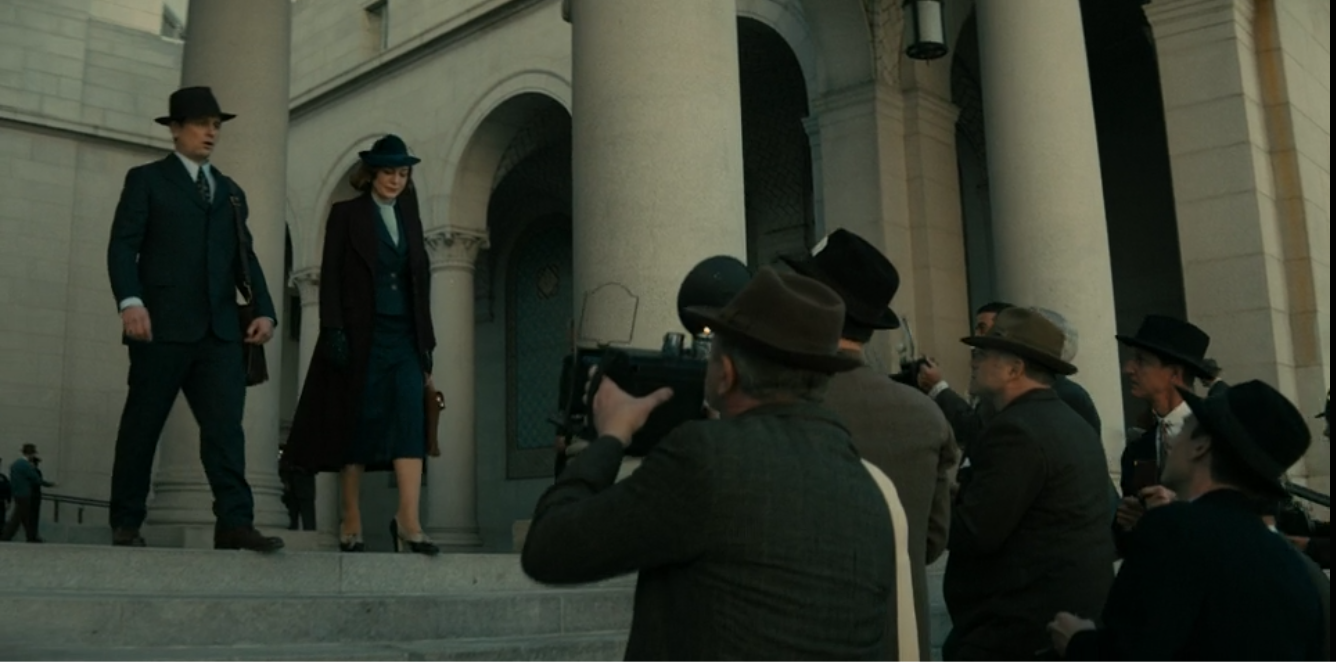
Della and Perry leaving City Hall. HBO.

Perry watches Della addressing reporters on the steps of City Hall while the old Hall of Records looms large. HBO.


The Hall of Records seen from City Hall c. 1939. LAPL photo.

Hall of Records (left) and the LA County Courthouse, connected by a bridge. LAPL photo.

Hope Perry, Della and Paul will be back for a Season 3.

***

Notes

Dr. Fishbaugh was also doctor to the Pantages family and that same year, 1929, testified for the defense in the murder trial of Lois Pantages, and also lobbied to keep her husband out of jail for reasons of poor health while he faced accusations of sexual assault. See my post on the Love Mart case. In 1937 he was Jean Harlow’s doctor.

Another wealthy oil man involved in the Teapot Dome scandal, Harry F. Sinclair, was convicted of jury tampering and served a six month prison term.

The Johanna Smith II operated until 1935, The Monte Carlo until 1936. Other ships operating out of LA in the 1930s were the City of Panama (1933), another “cruise to nowhere” ship; the Tango (1935-1939), the Star of Hollywood (1937), the Caliente (1937-1838), the Rex (1938-1939), operated by Tony Cornero, the Showboat (1939), and the Texas/Mt. Baker (1939). State Attorney General Earl Warren successful shut down gambling the ships in 1939. In 1946, Tony Cornero opened a new gambling ship, the Lux, which operated briefly.

Los Angeles had a Pacific League team at the time, the Los Angeles Angels, based at Wrigley Field.

6641-6657 Sunset: Blessed Sacrament Church and School

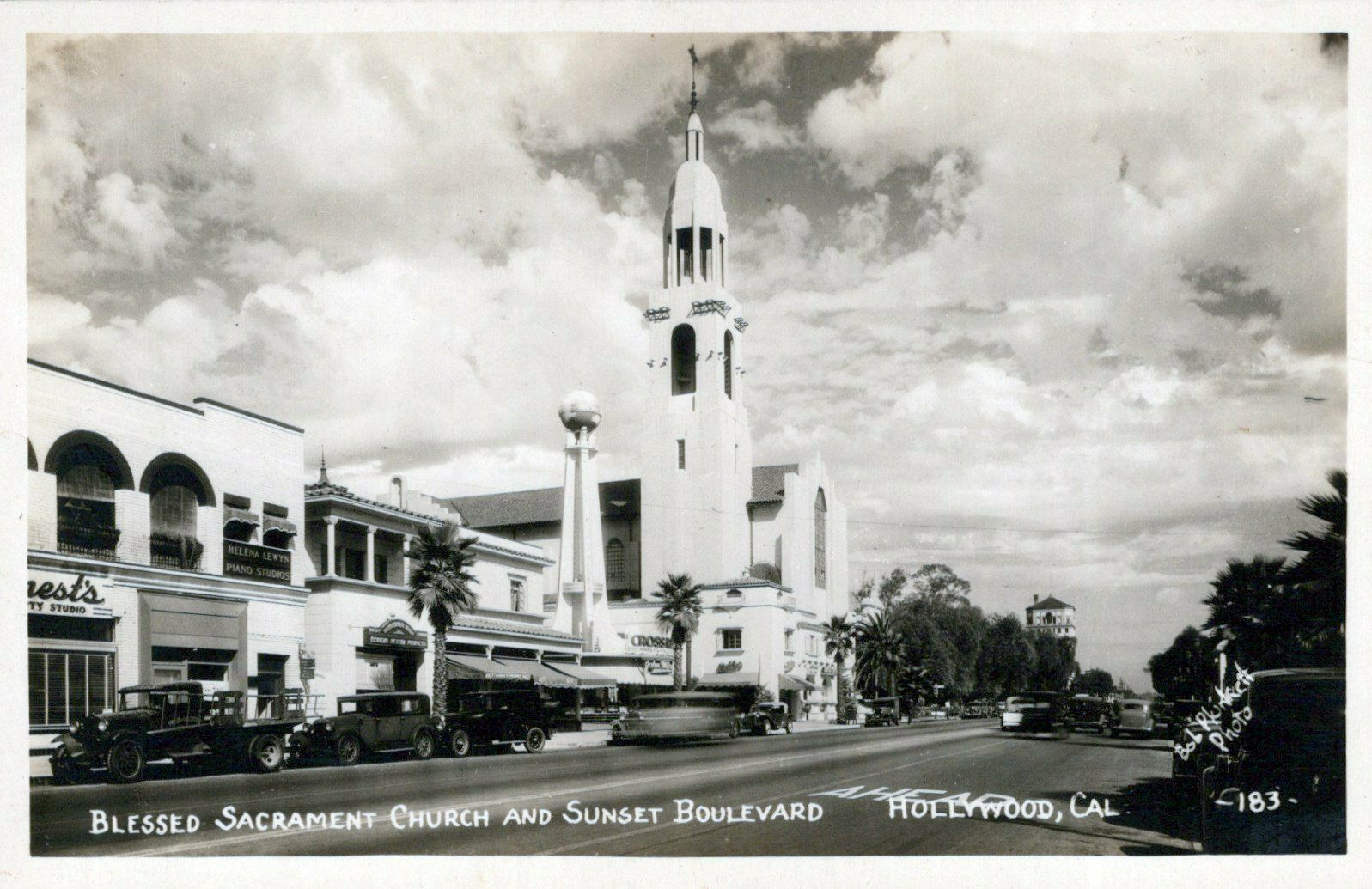
The Blessed Sacrament Catholic Church on the north of Sunset Boulevard near Las Palmas opened in 1928, 5 years after the parish’s parochial school located just to the west, which opened in 1923. Today the school is addressed as 6641 Sunset, the church as 6657. Previously the site had been the home of former police commissioner H.W. Lewis.

Continue reading